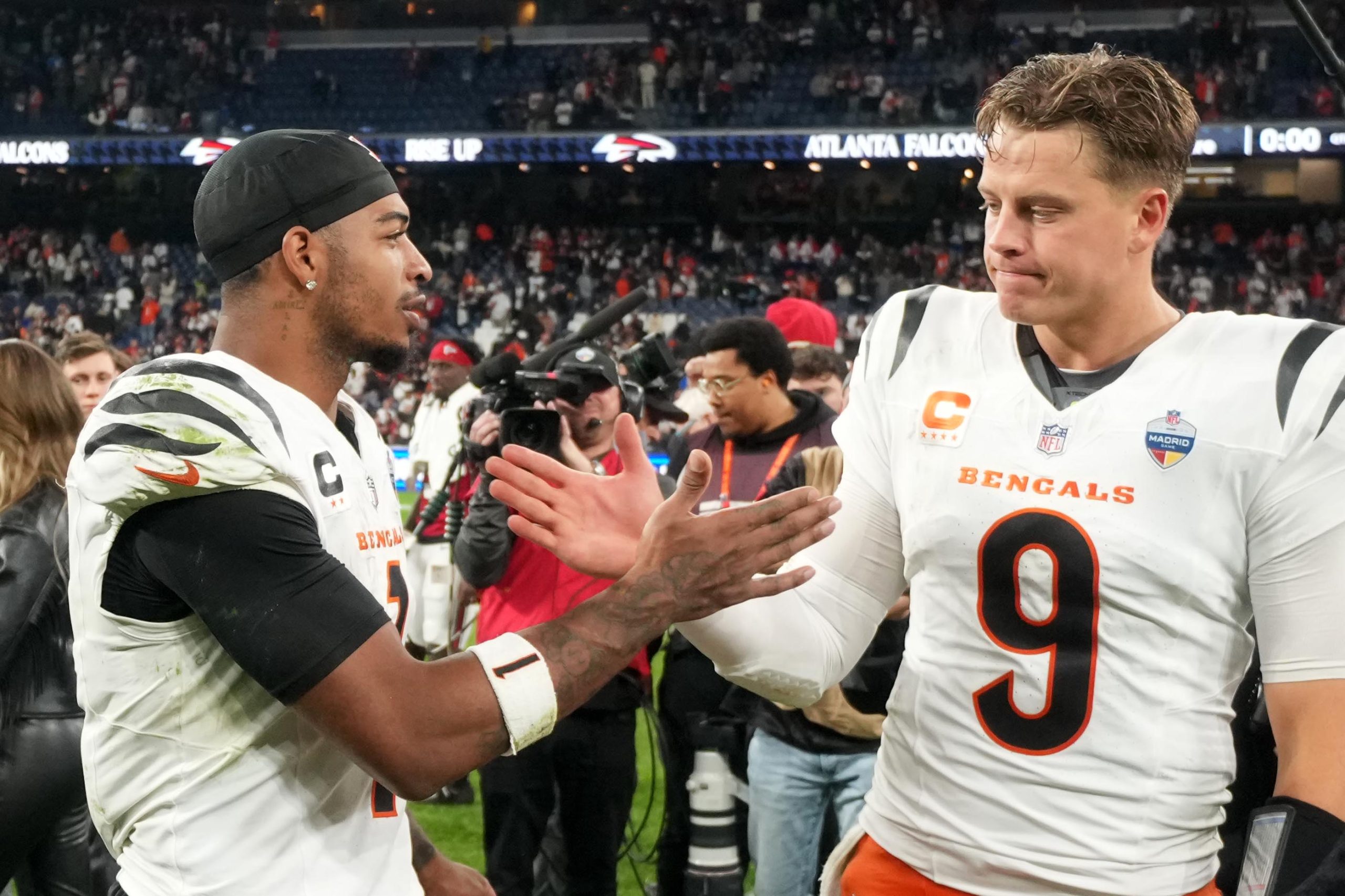
Nov 8, 2026; Madrid, ESP; Cincinnati Bengals wide receiver Ja'marr Chase (1) and quarterback Joe Burrow (9) react after the 2026 NFL Madrid Game against the Atlanta Falcons at Bernabeu Stadium. Mandatory Credit: Kirby Lee-Imagn Images
Joe Burrow and Ja’Marr Chase gave Madrid the highlight it came to see. The Bengals’ defense gave Cincinnati something it can take home.
Atlanta scored on its first two possessions Sunday and led 10–7 at the end of the first quarter. The Falcons scored only once the rest of the game. Cincinnati won 34–17 at the Santiago Bernabéu to improve to 6–2, and the most encouraging stretch was the second quarter, when the Bengals turned a three-point deficit into a 14-point halftime lead.
The defense gave Burrow time to build a lead
Burrow completed 24 of 29 passes for 271 yards and three touchdowns and ran for another score. Chase caught 10 passes for 155 yards, including a 47-yard touchdown, and Tee Higgins caught the other two touchdown passes. Cincinnati scored on all four first-half possessions.
Those numbers explain how Cincinnati took the lead. Atlanta’s scoreless second quarter explains how the Bengals turned it into breathing room. Every stop put the ball back in the hands of an offense that was already dictating the game. The Falcons got within 24–17 in the third quarter on a Bijan Robinson touchdown, but Burrow found Higgins on the ensuing Cincinnati possession, and Atlanta went scoreless in the fourth. One touchdown drive from the Bengals was enough to restore control because the defense kept the Falcons from answering again.
The second quarter was the most useful part of the film
Cincinnati’s 17 unanswered points before halftime mattered because Atlanta still had its entire offense available. The Falcons could lean on Robinson, use play-action or throw on an early down without worrying about the clock. Once
Cincinnati had a two-touchdown lead, every Atlanta possession that ended without points made it harder for the Falcons to stick with the run. The value of the second-quarter stops was that they helped create the situation in which the defense could play with that advantage.
There was another encouraging moment after halftime. Robinson’s touchdown made it a one-score game, and the Falcons had a chance to force Cincinnati back into a back-and-forth finish. After the Bengals answered, Atlanta never scored again. That’s the stretch I’d bring up if someone asked what the defense contributed in Madrid. Burrow helped push the margin back to 14, and the defense kept that lead from becoming another one-possession game. The two units worked together at the point when the outcome was still in doubt.
Pittsburgh will test the part Atlanta exposed
Atlanta ran for 157 yards on 24 carries. At 6.5 yards per attempt, the Falcons showed how an opponent can stay ahead of the chains against Cincinnati. That matters next Sunday when Pittsburgh comes to Paycor Stadium. If the Steelers get steady gains on early downs, they can extend drives and limit Burrow’s possessions. Cincinnati’s front has to make those early downs harder so the defense can get off the field before Pittsburgh dictates the pace.
Watch what happens on second down against Pittsburgh. If Cincinnati can turn a first-down run into second-and-eight, its linebackers have more freedom to play the pass, and the front can attack the pocket on third down. Give up five or six on first down and the Steelers can keep the full playbook open. The difference will show up in how often Burrow gets the ball and how much time he has to work with, especially if the teams trade scores early.
The other test is the first series after Cincinnati scores. A stop there gives the offense a chance to stretch a lead, just as it did in Madrid. If the Steelers answer with a long drive, Cincinnati can still win behind Burrow, but it’ll be asking him to win a different kind of game. That distinction matters at 6–2, when the question is how this team will handle opponents that can make it play from behind.
Cincinnati has scored at least 30 in four straight games. That gives the Bengals a credible path through the AFC, especially if the defense can give Burrow extra possessions when a game is still close. Madrid offered a good example. Against Pittsburgh, the Bengals get to show whether they can do it again when the opposing offense has a reason to keep running the ball.
New Users - Get $200 in Bonus Bets when you wager $5 for 4 days
T&Cs apply
4.6/5
Gambling Problem? Call 1-800-GAMBLER or 1-800-MY-RESET. Visit www.mdgamblinghelp.org (MD). 1-888-789-7777 or ccpg.org/chat (CT). Hope is here. GamblingHelpLineMA.org or (800) 327-5050 for 24/7 support (MA). 1-877-8-HOPENY or text HOPENY (467369) (NY). 21+ (18+ D.C., WY) and present in select states (for KS, in affiliation with Kansas Star Casino). First online real money wager only. Min $5 wager required for 4 consecutive days. $5 first deposit required. Bonus issued as nonwithdrawable bonus bets which expire 5 days after receipt. Restrictions apply. See terms at sportsbook.fanduel.com. Call 1-877-770-7867 (LA).
Get Up to $1,000 Back in Bonus Bets Over Your First 10 Days
T&Cs apply
4.5/5
Gambling problem? Call 1-800-GAMBLER or 1-800-MY-RESET (Available in the US) 877-8-HOPENY or text HOPENY (467369) (NY) 1-800-327-5050 (MA), 1-800-BETS-OFF (IA), 21+ only. Please Gamble Responsibly. Visit mdgamblinghelp.org (MD). See BetMGM.com for Terms. New Player Offer for new players only. Subject to eligibility requirements. Bonus bets are non-withdrawable. In partnership with Kansas Crossing Casino and Hotel. This promotional offer is not available in NJ, MA, MI, NV, NY, ON, PA, PR, and WV.
New DraftKings Customers: Bet $5, Get $200 + 3 Months of NBA League Pass
T&Cs apply
4.5/5
GAMBLING PROBLEM? CALL 1-800-GAMBLER or 1-800-MY-RESET, (800) 327-5050 or visit gamblinghelplinema.org (MA). Please Gamble Responsibly. 888-789-7777/visit ccpg.org (CT), or visit www.mdgamblinghelp.org (MD), 1-800-981-0023 (PR). 21+ and present in most states. (18+ DC/NH/PR/WY). Void in CAN. Eligibility restrictions apply. On behalf of Boot Hill Casino (KS). Pass-thru of per wager tax may apply in IL. 1 per new Sportsbook customer. $5+ first-time bet req. Max. $200 issued as non-withdrawable Bonus Bets. Stake removed from payout. Reward issued as $50 in Bonus Bets every 7 days via click-to-claim for 21 days. Bonus Bets and click-to-claims expire 7 days (168hrs) after issuance. Terms: dkng.co/offer. Get 1 promo code to redeem a 3-month NBA League Pass subscription, complimentary of DraftKings. Subscription auto-renews monthly at then-current price (currently $16.99/mo); cancel anytime. Terms, restrictions, and eligibility requirements apply. Redeem League Pass by 12/19/26 at 11:59 PM ET. Addt’l terms: support.watch.nba.com/hc/en-us/articles/9165532876183-League-Pass-Terms-of-Use_. Ends 11/29/26 at 11:59 PM ET. Sponsored by DK.
Must be 21+. GAMBLING PROBLEM? CALL 1-800-GAMBLER OR CALL 1-800-MY-RESET, www.mdgamblinghelp.org (MD), (800)-327-5050 or gamblinghelplinema.org (MA), Call (877)8-HOPENY or text HOPENY (467369) (NY), (888) 789-7777 or ccpg.org (CT), morethanagame.nc.gov (NC), 1800gambler.net (WV)
Bet $1 and get double the winnings up to $25 for your next 10 bets
T&Cs apply
4.4/5
21+ New users only. Must register using eligible promo code. First bet after registration must qualify. Max. Bonus Bet: $1,000. Bonus Bet expires 14 days after receipt. Void where prohibited. See Caesars.com/promos for full terms. Gambling Problem? 1-800-GAMBLER (1-800-426-2537)
21+ and present in OH. Gambling Problem? Call 1-800-GAMBLER.
This site is using
Cloudflare
and adheres to the
Google Safe Browsing Program. We adapted
Google's Privacy Guidelines
to keep your data safe at all times.
Close
Ready to Win Big? Join the Elite with Our Sports Betting Deals!
FanDuel Promo
New Users - Get $200 in Bonus Bets when you wager $5 for 4 days
Our Favorite
T&Cs and 21+ apply
Gambling Problem? Call 1-800-GAMBLER or 1-800-MY-RESET. Visit www.mdgamblinghelp.org (MD). 1-888-789-7777 or ccpg.org/chat (CT). Hope is here. GamblingHelpLineMA.org or (800) 327-5050 for 24/7 support (MA). 1-877-8-HOPENY or text HOPENY (467369) (NY). 21+ (18+ D.C., WY) and present in select states (for KS, in affiliation with Kansas Star Casino). First online real money wager only. Min $5 wager required for 4 consecutive days. $5 first deposit required. Bonus issued as nonwithdrawable bonus bets which expire 5 days after receipt. Restrictions apply. See terms at sportsbook.fanduel.com. Call 1-877-770-7867 (LA).
Code:
Open FanDuel
Get Bonus
BetMGM Promo
Get Up to $1,000 Back in Bonus Bets Over Your First 10 Days
Best Slots
T&Cs and 21+ apply
Gambling problem? Call 1-800-GAMBLER or 1-800-MY-RESET (Available in the US) 877-8-HOPENY or text HOPENY (467369) (NY) 1-800-327-5050 (MA), 1-800-BETS-OFF (IA), 21+ only. Please Gamble Responsibly. Visit mdgamblinghelp.org (MD). See BetMGM.com for Terms. New Player Offer for new players only. Subject to eligibility requirements. Bonus bets are non-withdrawable. In partnership with Kansas Crossing Casino and Hotel. This promotional offer is not available in NJ, MA, MI, NV, NY, ON, PA, PR, and WV.
Code:
Open BetMGM
Get Bonus
DraftKings Promo
New DraftKings Customers: Bet $5, Get $200 + 3 Months of NBA League Pass
Newcomer
T&Cs and 21+ apply
GAMBLING PROBLEM? CALL 1-800-GAMBLER or 1-800-MY-RESET, (800) 327-5050 or visit gamblinghelplinema.org (MA). Please Gamble Responsibly. 888-789-7777/visit ccpg.org (CT), or visit www.mdgamblinghelp.org (MD), 1-800-981-0023 (PR). 21+ and present in most states. (18+ DC/NH/PR/WY). Void in CAN. Eligibility restrictions apply. On behalf of Boot Hill Casino (KS). Pass-thru of per wager tax may apply in IL. 1 per new Sportsbook customer. $5+ first-time bet req. Max. $200 issued as non-withdrawable Bonus Bets. Stake removed from payout. Reward issued as $50 in Bonus Bets every 7 days via click-to-claim for 21 days. Bonus Bets and click-to-claims expire 7 days (168hrs) after issuance. Terms: dkng.co/offer. Get 1 promo code to redeem a 3-month NBA League Pass subscription, complimentary of DraftKings. Subscription auto-renews monthly at then-current price (currently $16.99/mo); cancel anytime. Terms, restrictions, and eligibility requirements apply. Redeem League Pass by 12/19/26 at 11:59 PM ET. Addt’l terms: support.watch.nba.com/hc/en-us/articles/9165532876183-League-Pass-Terms-of-Use_. Ends 11/29/26 at 11:59 PM ET. Sponsored by DK.
Code:
Open DraftKings
Get Bonus
Find out what the legends have to say about sports this week....
New Users - Get $200 in Bonus Bets when you wager $5 for 4 days
Gambling Problem? Call 1-800-GAMBLER or 1-800-MY-RESET. Visit www.mdgamblinghelp.org (MD). 1-888-789-7777 or ccpg.org/chat (CT). Hope is here. GamblingHelpLineMA.org or (800) 327-5050 for 24/7 support (MA). 1-877-8-HOPENY or text HOPENY (467369) (NY). 21+ (18+ D.C., WY) and present in select states (for KS, in affiliation with Kansas Star Casino). First online real money wager only. Min $5 wager required for 4 consecutive days. $5 first deposit required. Bonus issued as nonwithdrawable bonus bets which expire 5 days after receipt. Restrictions apply. See terms at sportsbook.fanduel.com. Call 1-877-770-7867 (LA).