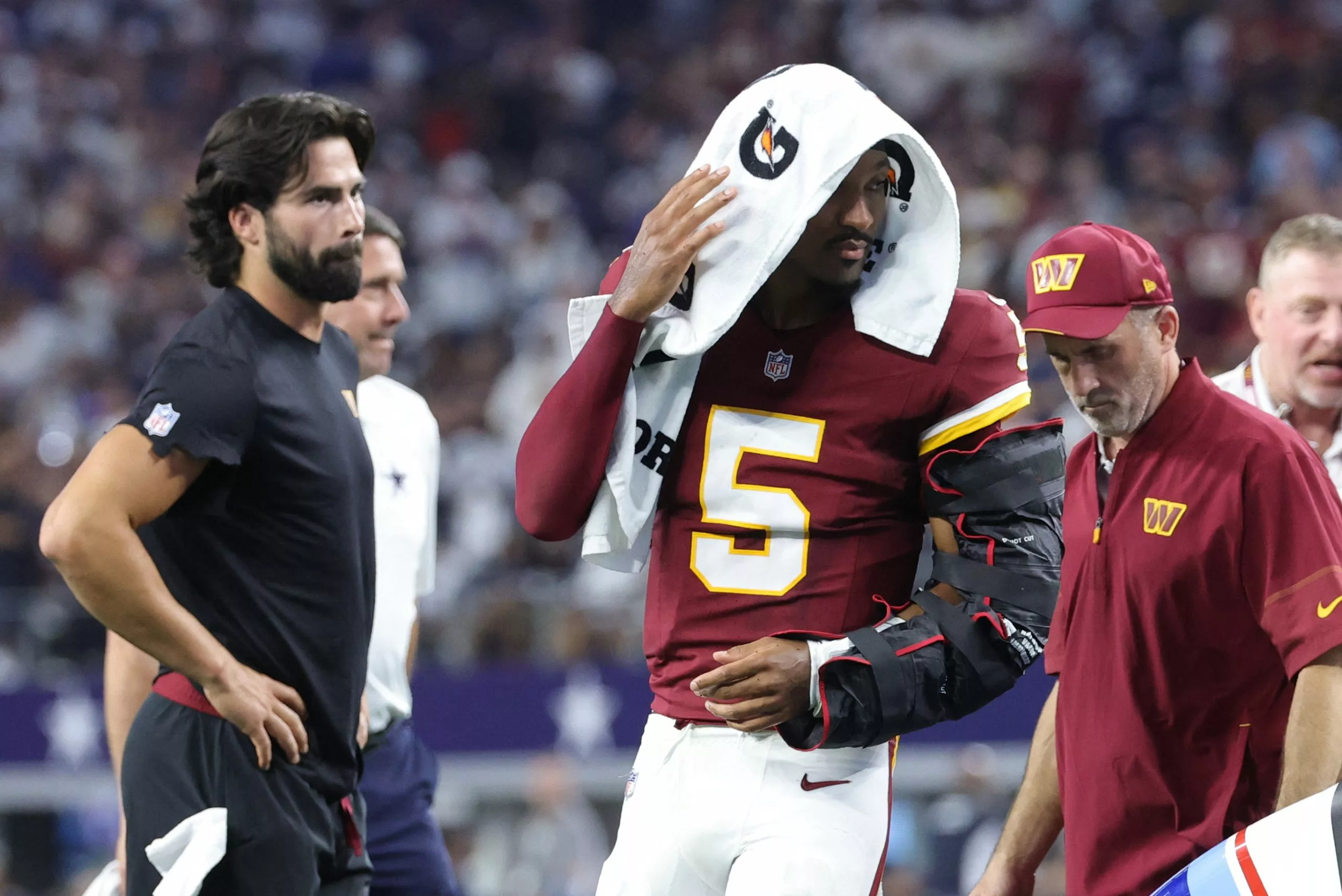
Sep 20, 2026; Arlington, Texas, USA; Washington Commanders quarterback Jayden Daniels (5) leaves the game with an apparent injury to his left arm during the second half against the Dallas Cowboys at AT&T Stadium. Mandatory Credit: Kevin Jairaj-Imagn Images
The Washington Commanders can survive a few games without Jayden Daniels. What they cannot survive is the possibility that injuries will continue defining the career of their franchise quarterback.
Daniels dislocated his left elbow during Washington’s 37–20 loss to the Dallas Cowboys, an injury that immediately overshadowed the Commanders’ second consecutive defeat. Initial X-rays revealed no fracture, but Daniels remains out indefinitely while doctors evaluate the extent of the damage.
Marcus Mariota is expected to start against the defending Super Bowl champion
Seattle Seahawks. That may solve Washington’s immediate quarterback problem, but it does nothing to answer the much larger question surrounding the organization:
Can the Commanders build their future around a quarterback who keeps getting hurt?
A Freak Play With Serious Consequences
Daniels’ latest injury did not occur because he recklessly challenged a linebacker or refused to slide at the end of a scramble.
On the final play of the first half, Daniels was accidentally stepped on by left guard Chris Paul. He lost his balance and attempted to brace himself with his left arm. His elbow bent awkwardly underneath him, producing an immediate and disturbing reaction.
The scene was difficult to watch. Daniels remained on the turf as Washington’s medical staff attended to him, and the quarterback was eventually taken off the field.
The initial diagnosis offered a small measure of relief. Daniels did not suffer a fracture, but further testing was required to determine whether the dislocation caused ligament damage or would require surgery.
It would be unfair to blame Daniels’ playing style for this specific injury. It was an unfortunate accident that could have happened to almost any quarterback.
The context, however, makes it impossible to dismiss.
The Same Elbow, the Same Concern
This is reportedly the second time Daniels has dislocated his left elbow since last season. His previous elbow injury came against Seattle and forced him to miss the final portion of the 2025 campaign.
That injury was only one part of a troubling season. Daniels also dealt with knee and hamstring problems, appeared in just seven games and was removed from four of those contests because of an injury.
One injury can be dismissed as bad luck. Two injuries can still be coincidental. When the same quarterback repeatedly leaves games with different physical problems—and then dislocates the same elbow again—the organization must confront the pattern.
That does not mean Daniels should already be permanently labeled “injury-prone.” Football is a violent sport, and quarterbacks are routinely placed in vulnerable positions. Daniels also plays with an athletic, aggressive style that helped make him one of the NFL’s most exciting young players.
But Washington can no longer pretend durability is a minor concern.
It is now one of the most important issues facing the franchise.
Daniels’ Greatest Weapon Also Creates a Difficult Balance
Daniels’ mobility is essential to his success.
Before suffering the injury in Dallas, he completed 11 of 17 passes for 96 yards and a touchdown. He also rushed for 69 yards, repeatedly using his speed to extend plays and punish the Cowboys when their coverage created open space.
Washington cannot simply order Daniels to stop running. Taking away that part of his game would eliminate one of the traits that makes him special.
The Commanders must instead become more selective about when and how they expose him.
Designed quarterback runs should be used with greater caution. Empty formations that leave Daniels responsible for identifying every potential pass rusher must be carefully evaluated. Washington also needs to make sure its young quarterback is not being asked to rescue broken plays on every important third down.
Some of that responsibility belongs to Daniels. He must become more willing to throw the ball away, step out of bounds and accept the end of a play. The difference between gaining three additional yards and taking an unnecessary hit is rarely worth the risk.
Most of the responsibility, however, belongs to the organization.
The Commanders drafted Daniels to transform their franchise. Protecting that investment must shape every decision they make—from offensive-line construction to play-calling and roster depth.
Washington Cannot Treat This as Only a Quarterback Problem
Daniels’ injury will dominate the discussion, but Washington’s 0–2 start has exposed problems that extend beyond the quarterback position.
Dallas scored 37 points and controlled significant stretches of the game. Dak Prescott completed 26 of 31 passes for 279 yards and four touchdowns as the Commanders struggled to generate stops.
A healthy Daniels would not have fixed Washington’s defensive problems.
That is what makes this situation especially concerning.
The Commanders
are not simply waiting for their quarterback to return so everything can become normal again. They have protection issues, defensive shortcomings and a difficult early-season schedule.
Daniels covered many of those problems when healthy. His ability to escape pressure, create explosive plays and turn potential losses into first downs gave Washington an advantage that could not be replicated by an ordinary quarterback.
Now that advantage is gone for an undetermined amount of time.
Marcus Mariota Is Capable—but He Is Not Jayden Daniels
Mariota performed reasonably well after replacing Daniels in Dallas. He completed 11 of 16 passes for 111 yards and a touchdown, giving Washington functional quarterback play during the second half.
He is also an experienced veteran who understands the offense and can contribute as a runner. The Commanders could do much worse at backup quarterback.
But there is an enormous difference between keeping an offense functional and making it dangerous.
Defenses do not fear Mariota the way they fear Daniels. Washington’s explosive-play potential decreases, opposing pass rushers can play more aggressively, and the margin for error becomes considerably smaller.
That is particularly problematic against Seattle.
The Seahawks enter the matchup as defending champions and one of the league’s most complete teams. Washington was already facing a difficult assignment with Daniels. Attempting to defeat Seattle with Mariota while the defense is struggling makes the challenge even greater.
Head coach Dan Quinn has not offered a definitive timetable for Daniels’ return, confirming only that Mariota is expected to handle the next opportunity.
The Commanders therefore must prepare as if this will be more than a one-game absence.
The Commanders Are Approaching a Dangerous Point
Washington is 0–2 after consecutive divisional losses. A defeat against Seattle would leave the Commanders at 0–3 and place them in an immediate fight to prevent the season from unraveling.
That does not mean Daniels should be rushed back.
In fact, the record must be removed from the medical decision entirely. If Daniels needs several weeks—or significantly longer—to recover properly, Washington must accept the consequences.
Bringing him back before the elbow is stable would be an irresponsible attempt to save one season at the potential expense of the franchise’s future.
The Commanders have already seen how dangerous it can be when desperation influences decisions involving a young quarterback’s health. The organization does not need another reminder that a player’s long-term future matters more than short-term pressure.
Washington must be patient even if that patience effectively ends its postseason hopes.
The Uncomfortable Questions Are Now Fair
Daniels has the talent to become one of the NFL’s defining quarterbacks. His accuracy, speed, composure and playmaking ability give Washington something it searched decades to find.
Talent, however, only matters when it is available.
The Commanders must now determine whether Daniels’ injuries are an unfortunate cluster or evidence of a longer-term durability problem. They must evaluate whether their offensive approach is sustainable and whether the roster surrounding him offers enough protection.
They must also consider how Daniels’ health affects the franchise’s timeline.
Can Washington confidently construct its offense around his running ability? Should the Commanders invest even more heavily in the offensive line? Does the coaching staff need to reduce his designed rushing workload? Can Daniels adjust his instincts without sacrificing the improvisational ability that makes him exceptional?
There are no easy answers.
There is also no longer any excuse for avoiding the questions.
Washington’s Priority Must Be Protecting Its Future
The Commanders’ immediate focus will be preparing Mariota to face Seattle and finding a way to avoid an 0–3 start.
The organization’s real priority must be bigger than Week 3.
Washington needs to protect
Jayden Daniels—not only from opposing defenses, but from the temptation to bring him back too soon and from an offensive structure that may place too much responsibility on his athleticism.
The Dallas injury was a freak accident. The growing durability concern is not.
Daniels has now suffered another significant injury to the same elbow after a season repeatedly interrupted by physical problems. That does not prove he cannot become Washington’s long-term answer at quarterback.
It does mean the Commanders have a serious problem that can no longer be explained away as simple bad luck.
Washington finally found a quarterback capable of changing the franchise.
Now it must figure out how to keep him on the field.
New Users – Get $350 in Bonus Bets when you wager $5 for 7 days
T&Cs apply
4.6/5
Gambling Problem? Call 1-800-GAMBLER or 1-800-MY-RESET. Call 1-888-789-7777 or visit ccpgg.org/chat (CT). Hope is here. GamblingHelpLineMA.org or call (800) 327-5050 for 24/7 support (MA). Visit www.mdgamblinghelp.org (MD). Call 1-877-8HOPE-NY or text HOPENY (NY). 21+ (18+ DC, WY) and present in select states (for KS, in affiliation with Kansas Star Casino). Find online real money wagering only. Min $5 wager required for 7 consecutive days. $5 free play credit. Bonus issued as non-withdrawable bonus with cash withdrawable bonus with cash withdrawable. Bonus bets which expire 7 days after receipt. Restrictions apply. See terms at sportsbook.fanduel.com. Call 1-877-770-7867 (LA).
Up To $1500 in Bonus Bets Paid Back if your First Bet Does Not Win
T&Cs apply
4.5/5
Gambling problem? Call 1-800-GAMBLER or 1-800-MY-RESET (Available in the US) 877-8-HOPENY or text HOPENY (467369) (NY) 1-800-327-5050 (MA), 1-800-BETS-OFF (IA), 1-800-981-0023 (PR). 21+ only. Please Gamble Responsibly. See BetMGM.com for Terms. First Bet Offer for new customers only (if applicable). Subject to eligibility requirements. Bonus bets are non-withdrawable. In partnership with Kansas Crossing Casino and Hotel. Promotional offers not available in Mississippi, Massachusetts, New York, Ontario, or Puerto Rico.
New DraftKings Customers: Bet $5, Get $200 + 3 Months of NBA League Pass!
T&Cs apply
4.5/5
GAMBLING PROBLEM? CALL 1-800-GAMBLER or 1-800-MY-RESET, (800) 327-5050 or visit gamblinghelplinema.org (MA). Please Gamble Responsibly. 888-789-7777/visit ccpg.org (CT), or visit www.mdgamblinghelp.org (MD), 1-800-981-0023 (PR). 21+ and present in most states. (18+ DC/NH/PR/WY). Void in CAN. Eligibility restrictions apply. On behalf of Boot Hill Casino (KS). Pass-thru of per wager tax may apply in IL. 1 per new Sportsbook customer. $5+ first-time bet req. Max. $200 issued as non-withdrawable Bonus Bets. Stake removed from payout. Reward issued as $50 in Bonus Bets every 7 days via click-to-claim for 21 days. Bonus Bets and click-to-claims expire 7 days (168hrs) after issuance. Terms: dkng.co/offer. Get 1 promo code to redeem a 3-month NBA League Pass subscription, complimentary of DraftKings. Subscription auto-renews monthly at then-current price (currently $16.99/mo); cancel anytime. Terms, restrictions, and eligibility requirements apply. Redeem League Pass by 12/19/26 at 11:59 PM ET. Addt’l terms: support.watch.nba.com/hc/en-us/articles/9165532876183-League-Pass-Terms-of-Use_. Ends 11/29/26 at 11:59 PM ET. Sponsored by DK.
Must be 21+. GAMBLING PROBLEM? CALL 1-800-GAMBLER OR CALL 1-800-MY-RESET, www.mdgamblinghelp.org (MD), (800)-327-5050 or gamblinghelplinema.org (MA), Call (877)8-HOPENY or text HOPENY (467369) (NY), (888) 789-7777 or ccpg.org (CT), morethanagame.nc.gov (NC), 1800gambler.net (WV)
Bet $1 and get double the winnings up to $25 for your next 10 bets
T&Cs apply
4.4/5
21+ New users only. Must register using eligible promo code. First bet after registration must qualify. Max. Bonus Bet: $1,000. Bonus Bet expires 14 days after receipt. Void where prohibited. See Caesars.com/promos for full terms. Gambling Problem? 1-800-GAMBLER (1-800-426-2537)
21+ and present in OH. Gambling Problem? Call 1-800-GAMBLER.
This site is using
Cloudflare
and adheres to the
Google Safe Browsing Program. We adapted
Google's Privacy Guidelines
to keep your data safe at all times.
Close
Ready to Win Big? Join the Elite with Our Sports Betting Deals!
FanDuel Promo
New Users – Get $350 in Bonus Bets when you wager $5 for 7 days
Our Favorite
T&Cs and 21+ apply
Gambling Problem? Call 1-800-GAMBLER or 1-800-MY-RESET. Call 1-888-789-7777 or visit ccpgg.org/chat (CT). Hope is here. GamblingHelpLineMA.org or call (800) 327-5050 for 24/7 support (MA). Visit www.mdgamblinghelp.org (MD). Call 1-877-8HOPE-NY or text HOPENY (NY). 21+ (18+ DC, WY) and present in select states (for KS, in affiliation with Kansas Star Casino). Find online real money wagering only. Min $5 wager required for 7 consecutive days. $5 free play credit. Bonus issued as non-withdrawable bonus with cash withdrawable bonus with cash withdrawable. Bonus bets which expire 7 days after receipt. Restrictions apply. See terms at sportsbook.fanduel.com. Call 1-877-770-7867 (LA).
Code:
Open FanDuel
Get Bonus
BetMGM Promo
Up To $1500 in Bonus Bets Paid Back if your First Bet Does Not Win
Best Slots
T&Cs and 21+ apply
Gambling problem? Call 1-800-GAMBLER or 1-800-MY-RESET (Available in the US) 877-8-HOPENY or text HOPENY (467369) (NY) 1-800-327-5050 (MA), 1-800-BETS-OFF (IA), 1-800-981-0023 (PR). 21+ only. Please Gamble Responsibly. See BetMGM.com for Terms. First Bet Offer for new customers only (if applicable). Subject to eligibility requirements. Bonus bets are non-withdrawable. In partnership with Kansas Crossing Casino and Hotel. Promotional offers not available in Mississippi, Massachusetts, New York, Ontario, or Puerto Rico.
Code:
Open BetMGM
Get Bonus
DraftKings Promo
New DraftKings Customers: Bet $5, Get $200 + 3 Months of NBA League Pass!
Newcomer
T&Cs and 21+ apply
GAMBLING PROBLEM? CALL 1-800-GAMBLER or 1-800-MY-RESET, (800) 327-5050 or visit gamblinghelplinema.org (MA). Please Gamble Responsibly. 888-789-7777/visit ccpg.org (CT), or visit www.mdgamblinghelp.org (MD), 1-800-981-0023 (PR). 21+ and present in most states. (18+ DC/NH/PR/WY). Void in CAN. Eligibility restrictions apply. On behalf of Boot Hill Casino (KS). Pass-thru of per wager tax may apply in IL. 1 per new Sportsbook customer. $5+ first-time bet req. Max. $200 issued as non-withdrawable Bonus Bets. Stake removed from payout. Reward issued as $50 in Bonus Bets every 7 days via click-to-claim for 21 days. Bonus Bets and click-to-claims expire 7 days (168hrs) after issuance. Terms: dkng.co/offer. Get 1 promo code to redeem a 3-month NBA League Pass subscription, complimentary of DraftKings. Subscription auto-renews monthly at then-current price (currently $16.99/mo); cancel anytime. Terms, restrictions, and eligibility requirements apply. Redeem League Pass by 12/19/26 at 11:59 PM ET. Addt’l terms: support.watch.nba.com/hc/en-us/articles/9165532876183-League-Pass-Terms-of-Use_. Ends 11/29/26 at 11:59 PM ET. Sponsored by DK.
Code:
Open DraftKings
Get Bonus
Find out what the legends have to say about sports this week....
New Users – Get $350 in Bonus Bets when you wager $5 for 7 days
Gambling Problem? Call 1-800-GAMBLER or 1-800-MY-RESET. Call 1-888-789-7777 or visit ccpgg.org/chat (CT). Hope is here. GamblingHelpLineMA.org or call (800) 327-5050 for 24/7 support (MA). Visit www.mdgamblinghelp.org (MD). Call 1-877-8HOPE-NY or text HOPENY (NY). 21+ (18+ DC, WY) and present in select states (for KS, in affiliation with Kansas Star Casino). Find online real money wagering only. Min $5 wager required for 7 consecutive days. $5 free play credit. Bonus issued as non-withdrawable bonus with cash withdrawable bonus with cash withdrawable. Bonus bets which expire 7 days after receipt. Restrictions apply. See terms at sportsbook.fanduel.com. Call 1-877-770-7867 (LA).