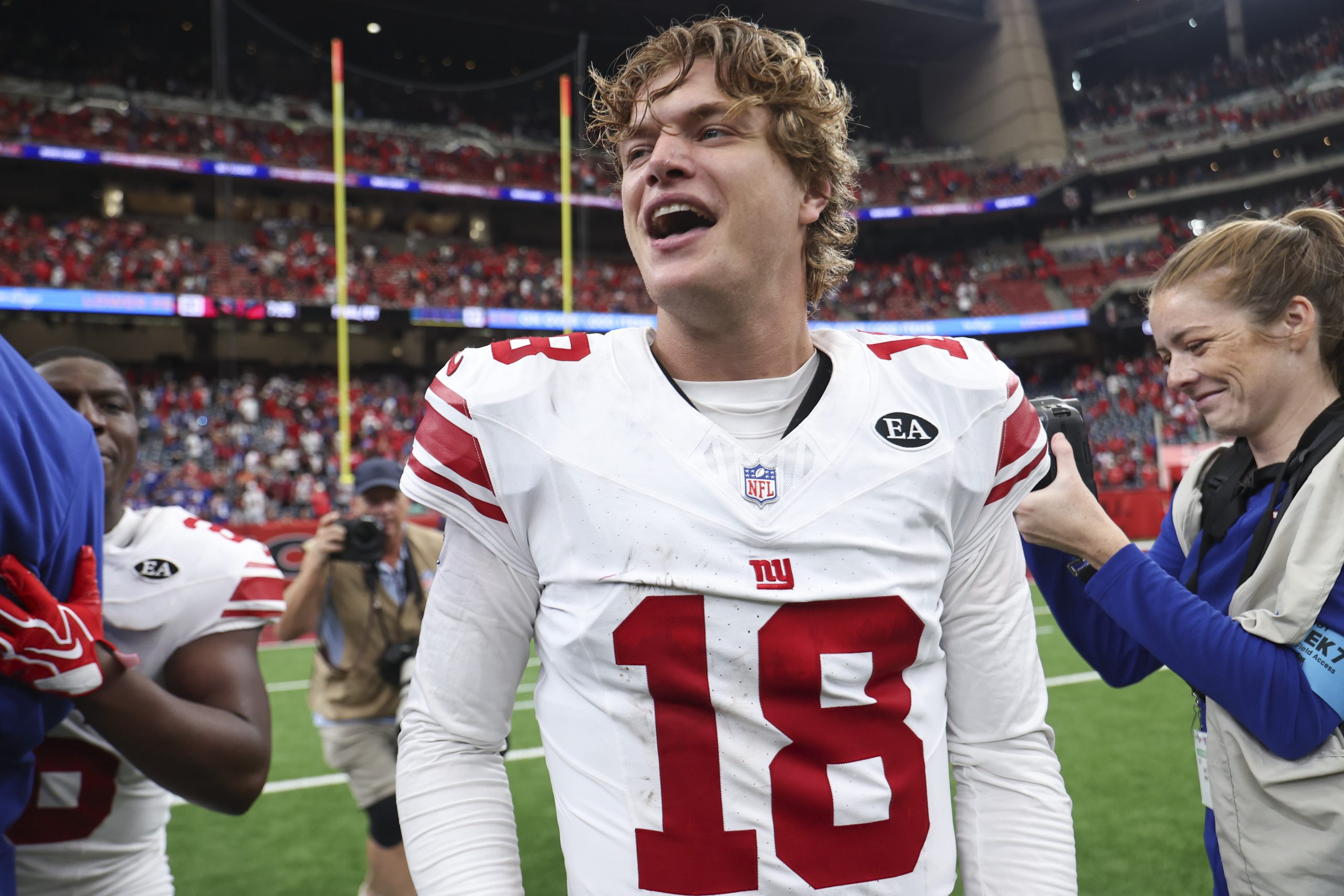
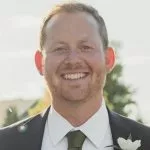
Oct 25, 2026; Houston, Texas, USA; New York Giants quarterback J.J. McCarthy (18) smiles after the game against the Houston Texans at Reliant Stadium. Mandatory Credit: Troy Taormina-Imagn Images
The Giants did not need J.J. McCarthy to settle their quarterback future Sunday. They needed him to help keep their season moving forward.
He delivered.
Making his first start for New York, McCarthy completed
20 of 28 passes for 252 yards, helping the Giants defeat Houston
27–21 in overtime. New York enters its bye
4–2–1, having already started three different quarterbacks.
That is a meaningful position for a team that has repeatedly adjusted at the sport’s most important position. The victory gives the Giants something more useful than a promising individual performance: another win while they evaluate what their offense can become.
McCarthy supplied reasons for optimism. The running game gave those reasons a foundation. Together, they produced a performance worth building on without answering every question about what comes next.
McCarthy Offered Efficiency With Downfield Potential
The strongest part of
McCarthy’s afternoon
was the combination of accuracy and meaningful yardage.
His
71.4% completion rate
came with an average of
9.0 yards per attempt. He finished without a touchdown pass, but he also avoided an interception and posted a
99.1 passer rating.
Those numbers describe a productive balance. McCarthy moved the ball without requiring an enormous volume of attempts, and the absence of passing touchdowns should not obscure his contribution to getting the offense into scoring position.
He established that possibility early. McCarthy completed six of his first seven passes for 106 yards, including a
42-yard completion to Malik Nabers
that helped set up a Tyrone Tracy Jr. rushing touchdown.
That is the kind of play that can change how an opponent approaches the rest of the game.
A defense wants to challenge an inexperienced starter. It wants to compress the field, contest shorter routes and force difficult decisions. Completing passes downfield makes that approach more costly.
The Giants do not need McCarthy to chase explosive plays on every possession. They do need enough of a downfield threat to prevent defenders from crowding everything closer to the line of scrimmage.
Sunday provided evidence that he can supply it.
The Running Game Gave Him a Workable Assignment
McCarthy’s performance becomes more encouraging when viewed alongside what New York accomplished on the ground.
The Giants rushed for
188 yards on 34 attempts, averaging approximately
5.5 yards per carry.
That support matters for any quarterback. It matters especially for one making his first start with a new team.
A productive rushing attack creates more manageable decisions. It can keep the offense from repeatedly facing obvious passing situations, make play-action more credible and force defenders to respect more than one way of advancing the ball.
It also gives the quarterback room to play within the game rather than feeling responsible for producing something extraordinary on every snap.
That does not mean the Giants can simply assume their running game will repeat this performance. Blocking, execution and opponent adjustments will vary. But Houston offered a useful model: create opportunities through the air while maintaining enough rushing production to keep the offense balanced.
The two elements can reinforce each other. Downfield completions discourage a defense from compressing the field. Successful runs make it harder to devote every resource to disrupting the quarterback.
Skattebo and Singletary Finished the Job
The most decisive demonstration came in overtime.
After the defense forced Houston to punt,
Cam Skattebo broke a 42-yard run.
Devin Singletary followed with a 30-yard touchdown run, ending the game. Skattebo finished with a career-high
124 rushing yards, one week after receiving no touches.
That sequence is essential to understanding the victory.
McCarthy helped put New York in position to win, but the Giants did not ask him to manufacture the final answer through the air. They won with a defensive stop and two explosive rushing plays.
For a team evaluating a young quarterback, that is a healthy development. The offense should give him opportunities to influence the outcome while remaining capable of finishing possessions through other players.
Skattebo’s contribution also supplied a reminder that offensive improvement does not always require finding a new player. Sometimes it comes from getting more out of the options already available.
The Giants found that production at the moment they needed it most.
There Were Still Problems to Correct
Winning should not erase the less comfortable parts of the afternoon.
Houston tied the game
21–21 with 52 seconds remaining in regulation, after the Giants had been forced to punt following McCarthy’s third sack. New York then had to recover in overtime to secure a game it had been positioned to finish earlier.
That creates a clear area for improvement: closing games with greater control.
Some of that responsibility belongs to the offense, which needs to sustain possessions and handle pressure. Some belongs to the defense, which must protect late advantages. The lesson should be shared rather than placed entirely on the new quarterback.
McCarthy’s evaluation must also extend beyond completion percentage.
How consistently does he recognize pressure? Can he make the correct adjustment when an opponent takes away the initial read? Will he preserve his decision-making when the running game is less productive?
One successful start supplies evidence. Repeated performances against changing defensive plans will supply a more reliable answer.
The Bye Arrives with Something to Build Around
At
4–2–1, the Giants have kept themselves in a competitive position despite considerable quarterback disruption. McCarthy’s start followed turns by Jaxson Dart and Jameis Winston, making him New York’s third starter of the season.
The bye now gives the coaching staff an opportunity to review a full game built around McCarthy.
That is more valuable than evaluating isolated relief appearances. Coaches can examine which concepts produced clear decisions, where protection needs improvement and how the passing game can work alongside the rushing attack.
The objective should be a more repeatable offense, not a larger collection of responsibilities handed to McCarthy simply because his first start ended well.
A Stronger Position, With the Quarterback Evaluation Still Open
McCarthy earned credit for helping the Giants win in Houston. He delivered efficient passing, contributed a downfield threat and avoided an interception.
The running game earned equal attention for making the offense more balanced and deciding overtime.
That combination makes the Giants more interesting because it offers a plausible way forward: a quarterback capable of creating opportunities, supported by teammates who can capitalize without requiring him to do everything.
The next task is repetition.
New York does not need to
declare its quarterback
search finished to recognize a productive afternoon. It can acknowledge the progress, use the bye to strengthen the offense and ask McCarthy to build on what he showed.
Sunday gave the Giants another win and a better starting point for that work.
New Users – Get $350 in Bonus Bets when you wager $5 for 7 days
T&Cs apply
4.6/5
Gambling Problem? Call 1-800-GAMBLER or 1-800-MY-RESET. Call 1-888-789-7777 or visit ccpgg.org/chat (CT). Hope is here. GamblingHelpLineMA.org or call (800) 327-5050 for 24/7 support (MA). Visit www.mdgamblinghelp.org (MD). Call 1-877-8HOPE-NY or text HOPENY (NY). 21+ (18+ DC, WY) and present in select states (for KS, in affiliation with Kansas Star Casino). Find online real money wagering only. Min $5 wager required for 7 consecutive days. $5 free play credit. Bonus issued as non-withdrawable bonus with cash withdrawable bonus with cash withdrawable. Bonus bets which expire 7 days after receipt. Restrictions apply. See terms at sportsbook.fanduel.com. Call 1-877-770-7867 (LA).
Get Up to $1,000 Back in Bonus Bets Over Your First 10 Days
T&Cs apply
4.5/5
Gambling problem? Call 1-800-GAMBLER or 1-800-MY-RESET (Available in the US) 877-8-HOPENY or text HOPENY (467369) (NY) 1-800-327-5050 (MA), 1-800-BETS-OFF (IA), 21+ only. Please Gamble Responsibly. Visit mdgamblinghelp.org (MD). See BetMGM.com for Terms. New Player Offer for new players only. Subject to eligibility requirements. Bonus bets are non-withdrawable. In partnership with Kansas Crossing Casino and Hotel. This promotional offer is not available in NJ, MA, MI, NV, NY, ON, PA, PR, and WV.
New DraftKings Customers: Bet $5, Get $200 + 3 Months of NBA League Pass!
T&Cs apply
4.5/5
GAMBLING PROBLEM? CALL 1-800-GAMBLER or 1-800-MY-RESET, (800) 327-5050 or visit gamblinghelplinema.org (MA). Please Gamble Responsibly. 888-789-7777/visit ccpg.org (CT), or visit www.mdgamblinghelp.org (MD), 1-800-981-0023 (PR). 21+ and present in most states. (18+ DC/NH/PR/WY). Void in CAN. Eligibility restrictions apply. On behalf of Boot Hill Casino (KS). Pass-thru of per wager tax may apply in IL. 1 per new Sportsbook customer. $5+ first-time bet req. Max. $200 issued as non-withdrawable Bonus Bets. Stake removed from payout. Reward issued as $50 in Bonus Bets every 7 days via click-to-claim for 21 days. Bonus Bets and click-to-claims expire 7 days (168hrs) after issuance. Terms: dkng.co/offer. Get 1 promo code to redeem a 3-month NBA League Pass subscription, complimentary of DraftKings. Subscription auto-renews monthly at then-current price (currently $16.99/mo); cancel anytime. Terms, restrictions, and eligibility requirements apply. Redeem League Pass by 12/19/26 at 11:59 PM ET. Addt’l terms: support.watch.nba.com/hc/en-us/articles/9165532876183-League-Pass-Terms-of-Use_. Ends 11/29/26 at 11:59 PM ET. Sponsored by DK.
Must be 21+. GAMBLING PROBLEM? CALL 1-800-GAMBLER OR CALL 1-800-MY-RESET, www.mdgamblinghelp.org (MD), (800)-327-5050 or gamblinghelplinema.org (MA), Call (877)8-HOPENY or text HOPENY (467369) (NY), (888) 789-7777 or ccpg.org (CT), morethanagame.nc.gov (NC), 1800gambler.net (WV)
Bet $1 and get double the winnings up to $25 for your next 10 bets
T&Cs apply
4.4/5
21+ New users only. Must register using eligible promo code. First bet after registration must qualify. Max. Bonus Bet: $1,000. Bonus Bet expires 14 days after receipt. Void where prohibited. See Caesars.com/promos for full terms. Gambling Problem? 1-800-GAMBLER (1-800-426-2537)
21+ and present in OH. Gambling Problem? Call 1-800-GAMBLER.
This site is using
Cloudflare
and adheres to the
Google Safe Browsing Program. We adapted
Google's Privacy Guidelines
to keep your data safe at all times.
Close
Ready to Win Big? Join the Elite with Our Sports Betting Deals!
FanDuel Promo
New Users – Get $350 in Bonus Bets when you wager $5 for 7 days
Our Favorite
T&Cs and 21+ apply
Gambling Problem? Call 1-800-GAMBLER or 1-800-MY-RESET. Call 1-888-789-7777 or visit ccpgg.org/chat (CT). Hope is here. GamblingHelpLineMA.org or call (800) 327-5050 for 24/7 support (MA). Visit www.mdgamblinghelp.org (MD). Call 1-877-8HOPE-NY or text HOPENY (NY). 21+ (18+ DC, WY) and present in select states (for KS, in affiliation with Kansas Star Casino). Find online real money wagering only. Min $5 wager required for 7 consecutive days. $5 free play credit. Bonus issued as non-withdrawable bonus with cash withdrawable bonus with cash withdrawable. Bonus bets which expire 7 days after receipt. Restrictions apply. See terms at sportsbook.fanduel.com. Call 1-877-770-7867 (LA).
Code:
Open FanDuel
Get Bonus
BetMGM Promo
Get Up to $1,000 Back in Bonus Bets Over Your First 10 Days
Best Slots
T&Cs and 21+ apply
Gambling problem? Call 1-800-GAMBLER or 1-800-MY-RESET (Available in the US) 877-8-HOPENY or text HOPENY (467369) (NY) 1-800-327-5050 (MA), 1-800-BETS-OFF (IA), 21+ only. Please Gamble Responsibly. Visit mdgamblinghelp.org (MD). See BetMGM.com for Terms. New Player Offer for new players only. Subject to eligibility requirements. Bonus bets are non-withdrawable. In partnership with Kansas Crossing Casino and Hotel. This promotional offer is not available in NJ, MA, MI, NV, NY, ON, PA, PR, and WV.
Code:
Open BetMGM
Get Bonus
DraftKings Promo
New DraftKings Customers: Bet $5, Get $200 + 3 Months of NBA League Pass!
Newcomer
T&Cs and 21+ apply
GAMBLING PROBLEM? CALL 1-800-GAMBLER or 1-800-MY-RESET, (800) 327-5050 or visit gamblinghelplinema.org (MA). Please Gamble Responsibly. 888-789-7777/visit ccpg.org (CT), or visit www.mdgamblinghelp.org (MD), 1-800-981-0023 (PR). 21+ and present in most states. (18+ DC/NH/PR/WY). Void in CAN. Eligibility restrictions apply. On behalf of Boot Hill Casino (KS). Pass-thru of per wager tax may apply in IL. 1 per new Sportsbook customer. $5+ first-time bet req. Max. $200 issued as non-withdrawable Bonus Bets. Stake removed from payout. Reward issued as $50 in Bonus Bets every 7 days via click-to-claim for 21 days. Bonus Bets and click-to-claims expire 7 days (168hrs) after issuance. Terms: dkng.co/offer. Get 1 promo code to redeem a 3-month NBA League Pass subscription, complimentary of DraftKings. Subscription auto-renews monthly at then-current price (currently $16.99/mo); cancel anytime. Terms, restrictions, and eligibility requirements apply. Redeem League Pass by 12/19/26 at 11:59 PM ET. Addt’l terms: support.watch.nba.com/hc/en-us/articles/9165532876183-League-Pass-Terms-of-Use_. Ends 11/29/26 at 11:59 PM ET. Sponsored by DK.
Code:
Open DraftKings
Get Bonus
Find out what the legends have to say about sports this week....
New Users – Get $350 in Bonus Bets when you wager $5 for 7 days
Gambling Problem? Call 1-800-GAMBLER or 1-800-MY-RESET. Call 1-888-789-7777 or visit ccpgg.org/chat (CT). Hope is here. GamblingHelpLineMA.org or call (800) 327-5050 for 24/7 support (MA). Visit www.mdgamblinghelp.org (MD). Call 1-877-8HOPE-NY or text HOPENY (NY). 21+ (18+ DC, WY) and present in select states (for KS, in affiliation with Kansas Star Casino). Find online real money wagering only. Min $5 wager required for 7 consecutive days. $5 free play credit. Bonus issued as non-withdrawable bonus with cash withdrawable bonus with cash withdrawable. Bonus bets which expire 7 days after receipt. Restrictions apply. See terms at sportsbook.fanduel.com. Call 1-877-770-7867 (LA).