The Seattle Seahawks entered Sunday’s game against the Arizona Cardinals without starting quarterback Sam Darnold.
The Seattle Seahawks entered Sunday’s game against the Arizona Cardinals without starting quarterback Sam Darnold. They left Arizona looking like one of the deepest, most complete and most dangerous teams in the NFL.
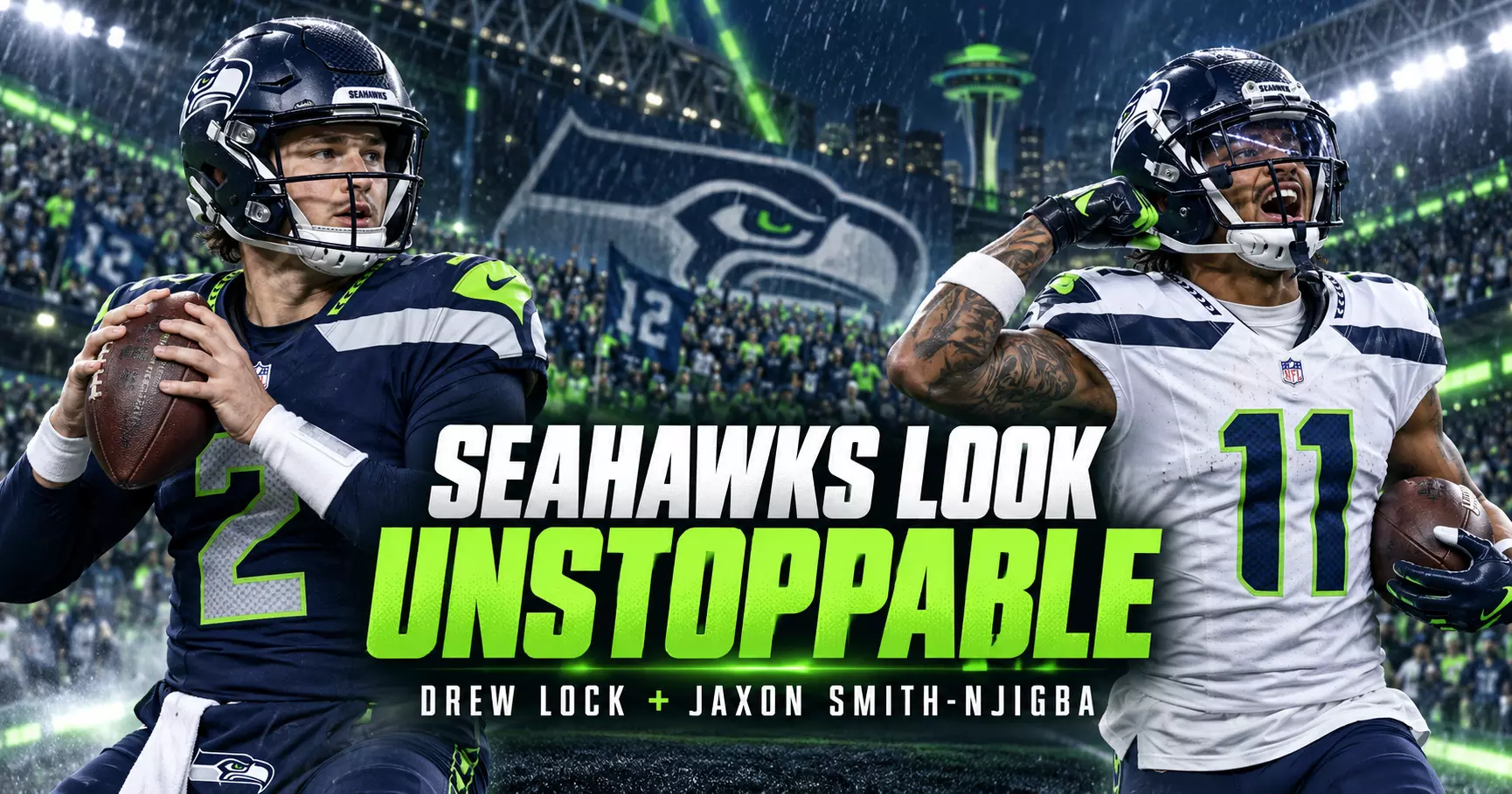
Drew Lock stepped into the starting lineup and delivered one of the finest performances of his career, completing 19 of 26 passes for 235 yards, three touchdowns and no turnovers. All three touchdown passes went to Jaxon Smith-Njigba, who finished with nine receptions for 155 yards in Seattle’s emphatic 31–7 victory.
Seattle improved to 2–0 and extended its winning streak to a franchise-record 12 games. The Seahawks have also defeated the Cardinals 10 consecutive times.
This was more than another divisional victory. Seattle demonstrated that it could lose its starting quarterback, struggle through an uneven first half and still completely overwhelm an opponent. That is what championship contenders do.
Drew Lock Looked Completely Comfortable
Lock did not play like a backup quarterback trying to survive until Darnold returns. He played like someone who believed the offense belonged to him.
Seattle did not ask Lock to manage the game by throwing checkdowns and avoiding difficult situations.
The Seahawks
allowed him to attack Arizona’s defense, and he rewarded that confidence with an efficient, turnover-free performance.
The defining play came when Lock connected with Smith-Njigba for an 82-yard touchdown—the longest reception of Smith-Njigba’s career. It demonstrated everything that has made Lock intriguing throughout his NFL career: a strong arm, confidence and a willingness to challenge a defense vertically.
Lock has always possessed the physical talent necessary to play quarterback in the NFL. Consistency and decision-making have prevented him from becoming an established starter. Against Arizona, however, he combined his natural aggressiveness with the patience and maturity of a veteran.
He did not force unnecessary throws. He completed more than 73 percent of his attempts, avoided turnovers and repeatedly placed the football where Smith-Njigba could make plays.
Lock later called it “a complete game” and credited Seattle’s offensive line, defense and coaching staff for putting him in position to succeed. He also thanked Darnold for helping him prepare during the week.
Seattle does not have a quarterback controversy after one game. Darnold remains the starter when healthy. What the Seahawks do have, however, is something every championship contender needs: a backup quarterback capable of winning meaningful games.
Jaxon Smith-Njigba Has Become Nearly Impossible to Defend
Smith-Njigba is no longer simply one of the NFL’s promising young receivers. The reigning NFL Offensive Player of the Year has become one of the most dangerous offensive weapons in football.
Arizona could not contain him at any level of the field.
Smith-Njigba beat the Cardinals deep for the 82-yard touchdown, found openings in shorter areas and continued producing even after Arizona adjusted its coverage. His three touchdowns represented a career high, while his 155 receiving yards accounted for most of Lock’s passing production.
The chemistry between the two players was especially impressive because Lock entered the lineup as an injury replacement. Their timing looked natural, and Lock showed complete confidence in Smith-Njigba when coverage tightened.
Seattle also deserves credit for how it creates opportunities for its top receiver. Smith-Njigba’s production does not come entirely from forcing passes into double coverage. Cooper Kupp, Rashid Shaheed and the rest of the offense make it difficult for opponents to devote all their resources to stopping one player.
Smith-Njigba acknowledged that collective effort after the game, crediting Seattle’s offensive line and his fellow receivers for helping create the openings he exploited.
When an elite receiver is surrounded by enough complementary talent to prevent defenses from concentrating exclusively on him, he becomes almost impossible to remove from a game.
Arizona learned that lesson painfully.
Seattle Took Control After Halftime
The final score makes the game appear effortless, but the Seahawks were tied 7–7 at halftime. Arizona had contained Seattle outside Smith-Njigba’s long touchdown and still had an opportunity to make the game uncomfortable.
Instead, Seattle responded with 24 unanswered points.
Lock found Smith-Njigba for two more touchdowns, Jason Myers converted a 33-yard field goal and tight end AJ Barner completed the scoring with a one-yard touchdown run. What had been a competitive divisional game became a rout.
That second-half response might be the most encouraging aspect of the victory.
Seattle did not panic when it failed to dominate immediately. The coaching staff made adjustments, the defense tightened its control and the offense began sustaining drives. Smith-Njigba described the Seahawks as a “four-quarter team,” and their performance supported that assessment.
The Seahawks have enough explosiveness to score quickly, but they are not entirely dependent upon big plays. They can make adjustments, control possession and gradually squeeze the life out of an opponent.
The Defense Was Even More Dominant
Lock and Smith-Njigba will receive most of the attention, but Seattle’s defense may have been the biggest reason the game became so one-sided.
The Seahawks held Arizona to approximately 150 total yards. Cardinals quarterback Jacoby Brissett passed for only 95 yards, while Arizona scored its only touchdown before being shut out throughout the second half.
Seattle’s defense forced punts, created poor down-and-distance situations and never allowed Arizona to establish any sustained offensive rhythm. Julian Love contributed an interception, and Jarran Reed recorded a fourth-quarter sack as the Seahawks continued applying pressure even after taking control.
Arizona simply could not generate enough offense to threaten Seattle.
That defensive dominance also made Lock’s assignment considerably easier. He did not have to chase points or make dangerous throws because Seattle’s defense prevented the Cardinals from building momentum.
A team with a dominant defense, an elite receiver and multiple capable quarterbacks has very few obvious weaknesses.
Seattle’s Depth Is Becoming Its Greatest Strength
The Seahawks
were already operating without Darnold, but quarterback was not their only area of concern.
Seattle has been dealing with running back injuries, including Zach Charbonnet’s recovery from a torn ACL. Rookie Jadarian Price then exited Sunday’s game with a chest injury, although subsequent X-rays were negative.
Emanuel Wilson responded by rushing 21 times for 92 yards. That gave Seattle the balance it needed to avoid placing the entire offense on Lock’s shoulders.
This is what makes the Seahawks so intimidating. When one important player becomes unavailable, another contributor steps forward.
Lock replaced Darnold. Wilson helped compensate for the injuries at running back. Smith-Njigba continued producing even when Arizona knew the football was coming in his direction. The defense controlled the game after halftime.
Seattle did not merely survive its personnel problems. It dominated despite them.
Are the Seahawks the Team to Beat?
It is still September, and declaring any team unstoppable after two games would be premature. Arizona also may not represent the level of competition Seattle will encounter against the best teams in the NFC.
Nevertheless, a 12-game winning streak cannot be dismissed as an early-season illusion.
Seattle has now assembled the longest winning streak in franchise history, surpassing even the great Seahawks teams that reached consecutive Super Bowls. The current run stretches across two seasons and reflects the program Mike Macdonald and general manager John Schneider have constructed.
The Seahawks can win with defense. They can produce explosive plays. They can run the football, protect a lead and overcome injuries at the game’s most important position.
Most importantly, they appear comfortable playing together. Lock described Sunday’s performance as a complete game, and that may be the most accurate explanation for why Seattle suddenly looks so formidable.
The Seahawks did not defeat Arizona because of one player. They won because Lock was efficient, Smith-Njigba was spectacular, the running game remained productive and the defense was suffocating.
That combination made Seattle look unstoppable—and it should have the rest of the NFC paying attention.
Up To $1500 in Bonus Bets Paid Back if your First Bet Does Not Win
T&Cs apply
4.5/5
Gambling problem? Call 1-800-GAMBLER or 1-800-MY-RESET (Available in the US) 877-8-HOPENY or text HOPENY (467369) (NY) 1-800-327-5050 (MA), 1-800-BETS-OFF (IA), 1-800-981-0023 (PR). 21+ only. Please Gamble Responsibly. See BetMGM.com for Terms. First Bet Offer for new customers only (if applicable). Subject to eligibility requirements. Bonus bets are non-withdrawable. In partnership with Kansas Crossing Casino and Hotel. Promotional offers not available in Mississippi, Massachusetts, New York, Ontario, or Puerto Rico.
New DraftKings Customers: Spend $5+ Get $150 in Bonuses
T&Cs apply
4.5/5
GAMBLING PROBLEM? CALL 1-800-GAMBLER or 1-800-MY-RESET, (800) 327-5050 or visit gamblinghelplinema.org (MA). Please Gamble Responsibly. 888-789-7777/visit ccpg.org (CT), or visit www.mdgamblinghelp.org (MD), 1-800-981-0023 (PR). 21+ and present in most states. (18+ DC/NH/PR/WY). Void in CAN. Eligibility restrictions apply. On behalf of Boot Hill Casino (KS). Pass-thru of per wager tax may apply in IL. 1 per new DraftKings customer. $5+ first-time bet req. Max. $150 issued as non-withdrawable Bonus Bets. Stake removed from payout. Reward issued as $50 in Bonus Bets every 7 days via click-to-claim for 14 days. Bonus Bets and click-to-claims expire 7 days (168hrs) after issuance. Terms: sportsbook.draftkings.com/promos. Ends 10/11/26 at 11:59 PM ET. Sponsored by DK.
Must be 21+. GAMBLING PROBLEM? CALL 1-800-GAMBLER OR CALL 1-800-MY-RESET, www.mdgamblinghelp.org (MD), (800)-327-5050 or gamblinghelplinema.org (MA), Call (877)8-HOPENY or text HOPENY (467369) (NY), (888) 789-7777 or ccpg.org (CT), morethanagame.nc.gov (NC), 1800gambler.net (WV)
Bet $1 and get double the winnings up to $25 for your next 10 bets
T&Cs apply
4.4/5
21+ New users only. Must register using eligible promo code. First bet after registration must qualify. Max. Bonus Bet: $1,000. Bonus Bet expires 14 days after receipt. Void where prohibited. See Caesars.com/promos for full terms. Gambling Problem? 1-800-GAMBLER (1-800-426-2537)
21+ and present in OH. Gambling Problem? Call 1-800-GAMBLER.
This site is using
Cloudflare
and adheres to the
Google Safe Browsing Program. We adapted
Google's Privacy Guidelines
to keep your data safe at all times.
Close
Ready to Win Big? Join the Elite with Our Sports Betting Deals!
FanDuel Promo
New Users – Get $250 in Bonus Bets when you wager $5 for 5 days
Up To $1500 in Bonus Bets Paid Back if your First Bet Does Not Win
Best Slots
T&Cs and 21+ apply
Gambling problem? Call 1-800-GAMBLER or 1-800-MY-RESET (Available in the US) 877-8-HOPENY or text HOPENY (467369) (NY) 1-800-327-5050 (MA), 1-800-BETS-OFF (IA), 1-800-981-0023 (PR). 21+ only. Please Gamble Responsibly. See BetMGM.com for Terms. First Bet Offer for new customers only (if applicable). Subject to eligibility requirements. Bonus bets are non-withdrawable. In partnership with Kansas Crossing Casino and Hotel. Promotional offers not available in Mississippi, Massachusetts, New York, Ontario, or Puerto Rico.
Code:
Open BetMGM
Get Bonus
DraftKings Promo
New DraftKings Customers: Spend $5+ Get $150 in Bonuses
Newcomer
T&Cs and 21+ apply
GAMBLING PROBLEM? CALL 1-800-GAMBLER or 1-800-MY-RESET, (800) 327-5050 or visit gamblinghelplinema.org (MA). Please Gamble Responsibly. 888-789-7777/visit ccpg.org (CT), or visit www.mdgamblinghelp.org (MD), 1-800-981-0023 (PR). 21+ and present in most states. (18+ DC/NH/PR/WY). Void in CAN. Eligibility restrictions apply. On behalf of Boot Hill Casino (KS). Pass-thru of per wager tax may apply in IL. 1 per new DraftKings customer. $5+ first-time bet req. Max. $150 issued as non-withdrawable Bonus Bets. Stake removed from payout. Reward issued as $50 in Bonus Bets every 7 days via click-to-claim for 14 days. Bonus Bets and click-to-claims expire 7 days (168hrs) after issuance. Terms: sportsbook.draftkings.com/promos. Ends 10/11/26 at 11:59 PM ET. Sponsored by DK.
Code:
Open DraftKings
Get Bonus
Find out what the legends have to say about sports this week....