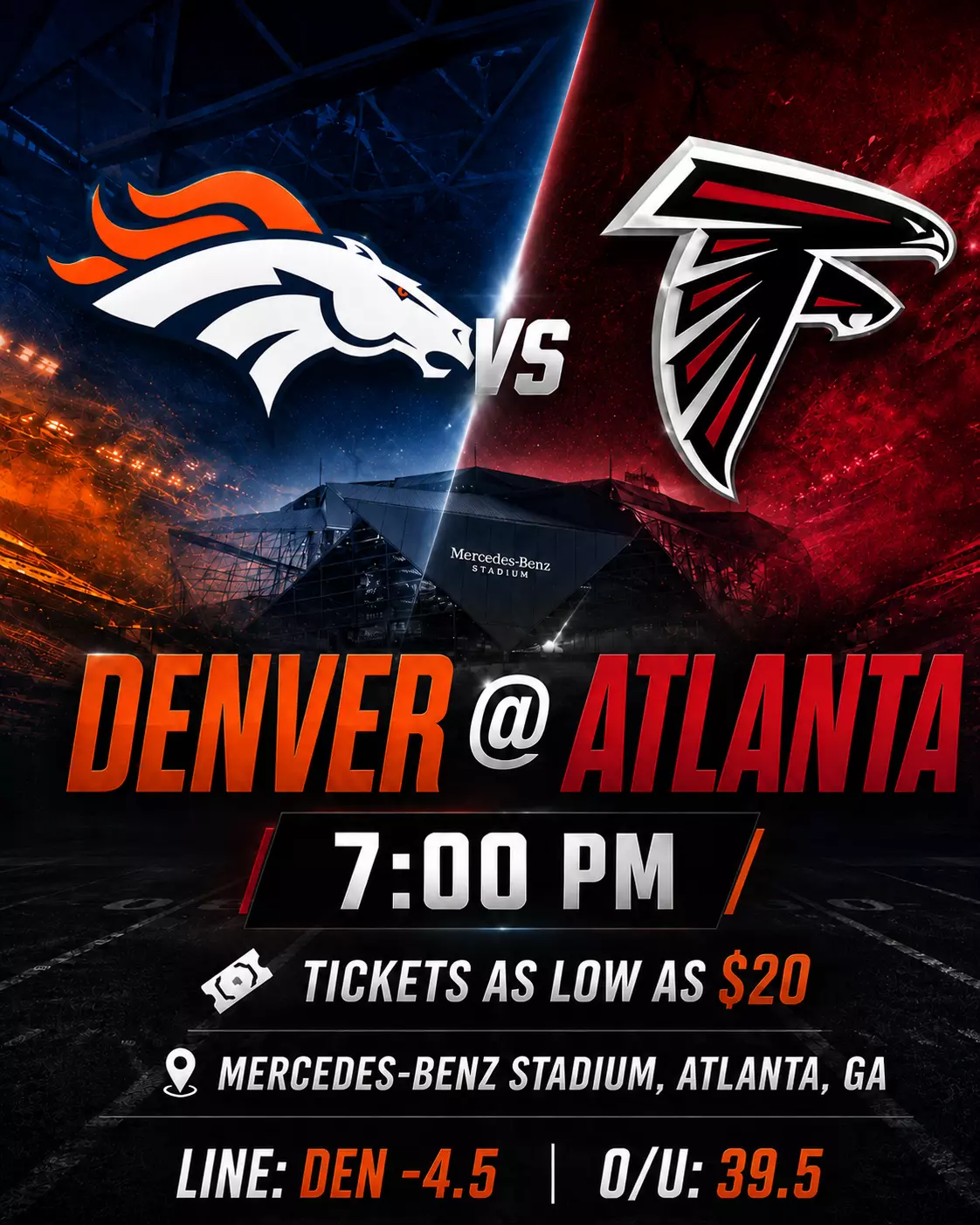
Denver @ Atlanta 7:00 PM Tickets as low as $20 Mercedes-Benz Stadium, Atlanta, GA Line: DEN -4.5 O/U: 39.5
Denver Broncos at Atlanta Falcons 2026 Preseason Preview: Prediction, Betting Odds & 4 Prop Bets
Friday, August 14, 2026
Time:
7:00 PM ET
Location:
Mercedes-Benz Stadium, Atlanta, Georgia
TV:
FOX 5 Atlanta / 9NEWS Denver; out-of-market streaming on NFL+
Tickets:
As low as $20
Betting Line:
Denver Broncos -4.5
Over/Under:
39.5 Points
The Denver Broncos open their 2026 preseason Friday night against the Atlanta Falcons at Mercedes-Benz Stadium in a matchup featuring two teams willing to give at least some of their established players meaningful exhibition snaps.
Denver head coach Sean Payton plans to play most of his available starters for approximately 15 snaps, but quarterback Bo Nix will be the major exception. Nix will sit out the preseason opener before making his exhibition debut against Green Bay on August 21. Jarrett Stidham and Sam Ehlinger will instead divide the quarterback duties, with each scheduled to play one half.
Atlanta head coach Kevin Stefanski is also planning to use his starters. The Falcons’ first unit is expected to play approximately one series or 10 offensive snaps, whichever comes first. Tua Tagovailoa will start at quarterback before veteran Cooper Rush and undrafted rookie Jack Strand take over. Michael Penix Jr. remains unavailable for full-team work as he continues his recovery from last season’s ACL injury.
Those quarterback rotations create one of the most interesting dynamics of the matchup.
Denver enters as a 4.5-point favorite with a 39.5-point total. The spread is relatively significant for a preseason road team, but Payton’s recent exhibition success and Denver’s experienced backup quarterback combination help explain the confidence in the Broncos. Denver has won seven consecutive preseason games and is 7-2 in exhibition games during Payton’s tenure.
Top Four Prop Bets
Preseason player props are not offered consistently at every sportsbook. Unless your sportsbook lists the exact number, the player totals below should be considered projected betting targets based on announced playing time and expected rotations.
Prop Bet #1: Jarrett Stidham Over 109.5 Passing Yards
DraftKings
4.5/5
Tip: Stidham Over 109.5 Passing Yards
Full First Half
Veteran Experience
Defined Quarterback Rotation
New DraftKings Customers: Bet $5, Get $200 + 3 Months of NBA League Pass!
Get bonus now
GAMBLING PROBLEM? CALL 1-800-GAMBLER or 1-800-MY-RESET, (800) 327-5050 or visit gamblinghelplinema.org (MA). Please Gamble Responsibly. 888-789-7777/visit ccpg.org (CT), or visit www.mdgamblinghelp.org (MD), 1-800-981-0023 (PR). 21+ and present in most states. (18+ DC/NH/PR/WY). Void in CAN. Eligibility restrictions apply. On behalf of Boot Hill Casino (KS). Pass-thru of per wager tax may apply in IL. 1 per new Sportsbook customer. $5+ first-time bet req. Max. $200 issued as non-withdrawable Bonus Bets. Stake removed from payout. Reward issued as $50 in Bonus Bets every 7 days via click-to-claim for 21 days. Bonus Bets and click-to-claims expire 7 days (168hrs) after issuance. Terms: dkng.co/offer. Get 1 promo code to redeem a 3-month NBA League Pass subscription, complimentary of DraftKings. Subscription auto-renews monthly at then-current price (currently $16.99/mo); cancel anytime. Terms, restrictions, and eligibility requirements apply. Redeem League Pass by 12/19/26 at 11:59 PM ET. Addt’l terms: support.watch.nba.com/hc/en-us/articles/9165532876183-League-Pass-Terms-of-Use_. Ends 11/29/26 at 11:59 PM ET. Sponsored by DK.
Jarrett Stidham enters Friday night’s matchup with something every preseason bettor should value: a clearly defined workload.
Payton has announced that Stidham and Ehlinger will each play one half while Nix sits. That should give Stidham approximately 25-to-35 offensive snaps, depending on Denver’s ability to sustain drives.
That volume makes a projected passing total around 110 yards attractive.
Stidham doesn’t need to dominate Atlanta’s defense. He simply needs to operate Denver’s offense efficiently and accumulate yardage through short and intermediate completions.
The Broncos will also have some starters available during his portion of the game.
Denver’s initial depth chart lists Courtland Sutton, Jaylen Waddle and Marvin Mims Jr. among its starting receivers, with Troy Franklin and Pat Bryant among the players behind them. Even if the established receivers leave after approximately 15 snaps, Stidham should continue working with legitimate receiving talent.
Atlanta’s starters are expected to play only about 10 snaps, meaning Stidham could spend most of the first half attacking the Falcons’ second-team defense.
The argument against the over involves Denver’s running game.
Payton will want to evaluate several running backs, and a successful rushing attack could reduce Stidham’s attempts. Denver also has no reason to expose its complete regular-season passing package in the preseason opener.
Still, playing an entire half provides Stidham with enough volume to challenge this number.
Projected Bet: Jarrett Stidham Over 109.5 Passing Yards
Prop Bet #2: Sam Ehlinger Over 24.5 Rushing Yards
FanDuel
4.6/5
Tip: Ehlinger Over 24.5 Rushing Yards
Entire Second Half
Mobile Quarterback
Broken-Play Ability
New Users – Get $350 in Bonus Bets when you wager $5 for 7 days
Get bonus now
Gambling Problem? Call 1-800-GAMBLER or 1-800-MY-RESET. Call 1-888-789-7777 or visit ccpgg.org/chat (CT). Hope is here. GamblingHelpLineMA.org or call (800) 327-5050 for 24/7 support (MA). Visit www.mdgamblinghelp.org (MD). Call 1-877-8HOPE-NY or text HOPENY (NY). 21+ (18+ DC, WY) and present in select states (for KS, in affiliation with Kansas Star Casino). Find online real money wagering only. Min $5 wager required for 7 consecutive days. $5 free play credit. Bonus issued as non-withdrawable bonus with cash withdrawable bonus with cash withdrawable. Bonus bets which expire 7 days after receipt. Restrictions apply. See terms at sportsbook.fanduel.com. Call 1-877-770-7867 (LA).
Sam Ehlinger’s mobility could become one of Denver’s biggest advantages after halftime.
Ehlinger will receive the entire second half, giving him significantly more opportunity than many quarterbacks participating in the opening preseason weekend.
Throughout his NFL career, Ehlinger has demonstrated that he is comfortable leaving the pocket when protection breaks down. He accumulated 96 rushing yards on 20 attempts during his early NFL appearances with Indianapolis, an average of 4.8 yards per carry.
That skill becomes especially valuable during preseason games.
Reserve offensive lines frequently struggle with communication.
Young receivers don’t always adjust properly against coverage.
Protection assignments get missed.
Quarterbacks are forced to improvise.
Those circumstances naturally create scrambling opportunities.
Ehlinger doesn’t need Denver to call eight designed quarterback runs to surpass 24.5 yards. Three or four scrambles could potentially get him there.
Atlanta’s defensive backups will also need to maintain discipline while rushing the passer. Aggressive edge defenders trying to produce sacks can create open running lanes, and Ehlinger has enough experience to recognize those opportunities.
The case against the over is injury prevention.
Denver has no reason to encourage its quarterback to absorb unnecessary contact during an exhibition game. Ehlinger could also throw the football away instead of scrambling once he gets outside the pocket.
But an entire second half gives him enough opportunity to make his legs a factor.
Projected Bet: Sam Ehlinger Over 24.5 Rushing Yards
Prop Bet #3: Zachariah Branch Over 24.5 Receiving Yards
Caesars
4.4/5
Tip: Branch Over 24.5 Receiving Yards
Explosive Rookie
Extended Playing Time
Open Receiver Competition
Bet $1 and get double the winnings up to $25 for your next 10 bets
–
21+ New users only. Must register using eligible promo code. First bet after registration must qualify. Max. Bonus Bet: $1,000. Bonus Bet expires 14 days after receipt. Void where prohibited. See Caesars.com/promos for full terms. Gambling Problem? 1-800-GAMBLER (1-800-426-2537)
Atlanta rookie Zachariah Branch could become one of the most entertaining players on the field once the Falcons’ established offensive starters leave.
The Falcons’ opening depth chart lists Olamide Zaccheaus as a starting receiver with Branch directly behind him. Drake London headlines the other receiver position, but Atlanta’s starters are expected to play only around one series or 10 snaps.
That should create considerably more playing time for Branch.
His speed and open-field ability make a projected total of 24.5 receiving yards appealing because he doesn’t need high target volume.
One explosive catch could nearly cash the bet.
Branch has been heavily involved throughout Atlanta’s training camp and is competing for an offensive role as well as opportunities on special teams. The rookie’s preseason snaps will give Stefanski an opportunity to determine how quickly his athletic ability can translate against NFL defenders.
Quarterback rotation should also help.
Tagovailoa will play briefly before Rush enters, and Strand is expected to finish the game.
Branch could therefore remain on the field much longer than London and Atlanta’s established offensive stars.
The biggest concern is quarterback efficiency.
Rush is experienced, but Strand will be making his first NFL preseason appearance. If Atlanta’s reserve offensive line struggles, downfield opportunities could become limited.
Target competition is another concern.
Atlanta has several receivers fighting for roster positions, including Chris Blair, Vinny Anthony II and others. Stefanski needs to evaluate all of them.
Still, Branch possesses the explosiveness to reach 25 yards without requiring a huge workload.
Projected Bet: Zachariah Branch Over 24.5 Receiving Yards
Prop Bet #4: Game Total Under 39.5 Points
BetMGM
4.5/5
Tip: Under 39.5 Points
Bo Nix Sitting
Short Starter Workloads
Backup Quarterback Rotations
Up To $1500 in Bonus Bets Paid Back if your First Bet Does Not Win
Get bonus now
Gambling problem? Call 1-800-GAMBLER or 1-800-MY-RESET (Available in the US) 877-8-HOPENY or text HOPENY (467369) (NY) 1-800-327-5050 (MA), 1-800-BETS-OFF (IA), 1-800-981-0023 (PR). 21+ only. Please Gamble Responsibly. See BetMGM.com for Terms. First Bet Offer for new customers only (if applicable). Subject to eligibility requirements. Bonus bets are non-withdrawable. In partnership with Kansas Crossing Casino and Hotel. Promotional offers not available in Mississippi, Massachusetts, New York, Ontario, or Puerto Rico.
A 39.5-point total is relatively high for a preseason game built largely around backup quarterbacks.
Nix won’t play.
Penix won’t play.
Tagovailoa should receive only one series or approximately 10 snaps.
Denver’s established starters are expected to play around 15 snaps.
That means most of Friday night’s offensive possessions should belong to Stidham, Ehlinger, Rush and Strand.
There are reasons to respect each quarterback.
Stidham has considerable NFL experience.
Ehlinger brings mobility.
Rush has started regular-season games.
Strand was highly productive in college.
But preseason football presents challenges beyond quarterback talent.
Second- and third-team offensive linemen frequently struggle with protection calls.
Receivers and quarterbacks have limited chemistry.
Penalties erase productive plays.
Drives stall after substitutions.
Coaches become more interested in evaluating personnel than aggressively chasing points.
The argument against the under is Denver’s preseason history under Payton.
The Broncos have won seven consecutive preseason games, suggesting Payton’s approach translates well to exhibition football.
Atlanta’s brief use of Tagovailoa, Bijan Robinson, Drake London and Kyle Pitts could also produce an early touchdown.
Still, 39.5 requires something resembling a 24-17 game to reach the over.
Once the starters leave, sustained touchdown drives should become increasingly difficult.
Bet: Under 39.5 Points
The Matchup Context: Denver’s Preseason Formula
Sean Payton has never treated preseason games as completely meaningless.
Denver has won seven consecutive exhibition contests and owns a 7-2 preseason record since Payton became head coach.
The result itself isn’t the primary objective, but developing winning habits matters.
Payton wants clean substitutions.
Proper alignment.
No unnecessary penalties.
Good situational football.
Sound tackling.
Efficient quarterback play.
Those seemingly small details frequently determine preseason games once the established starters leave.
Denver’s approach Friday provides another interesting wrinkle.
Most starters should receive approximately 15 snaps, but Nix will watch from the sideline.
That gives Stidham an unusual opportunity.
Rather than starting exclusively with backups, he could operate with much of Denver’s first-team offense during the opening portion of the game.
For someone trying to prove himself as a reliable No. 2 quarterback, those repetitions matter.
Atlanta Begins the Kevin Stefanski Era
Friday night represents the first game for Kevin Stefanski as Atlanta’s head coach.
His decision to play the starters immediately creates one of the biggest storylines.
The Falcons haven’t always taken an aggressive approach to preseason playing time in recent years, but Stefanski believes football players need live football repetitions to prepare for the regular season.
His plan calls for the starters to play roughly one series or 10 snaps, although workloads can vary by individual player.
That means Atlanta fans should get at least a brief look at Tagovailoa operating the offense.
The quarterback situation makes that especially significant.
Tagovailoa joined Atlanta during the offseason and is still learning a new offensive system. Falcons quarterbacks coach Alex Van Pelt said this week that Tagovailoa has become increasingly comfortable with the terminology, protection adjustments and overall structure of the offense.
Friday provides the first game-speed evaluation.
Tagovailoa doesn’t need to produce a 75-yard touchdown drive.
Atlanta wants clean execution.
Get the play communicated.
Break the huddle efficiently.
Make the correct protection adjustment.
Complete the easy throw.
Then get him safely back to the sideline.
Atlanta’s Quarterback Rotation
After Tagovailoa leaves, the game becomes about Cooper Rush and Jack Strand.
Rush brings NFL experience and should provide stability.
Strand represents the developmental project.
The undrafted rookie was highly productive at Minnesota State-Moorhead, finishing his college career with 13,161 passing yards and 126 touchdown passes in 42 games. He stands 6-foot-5 and 240 pounds and has already received significant practice work during training camp.
That makes Friday night’s fourth quarter particularly interesting.
Strand has thrown thousands of collegiate passes.
None came against an NFL defense.
Denver’s third-team defenders will be fighting for roster spots and attacking every opportunity as if their careers depend on it—because for some of them, they do.
Strand’s ability to handle pressure and avoid negative plays could determine whether Atlanta remains competitive late.
Denver’s Running Back Competition
Denver possesses one of the deeper running back rooms entering the preseason.
The Broncos’ initial depth chart lists J.K. Dobbins first, followed by RJ Harvey, Tyler Badie, Jaleel McLaughlin, Cody Schrader and rookie Jonah Coleman.
Don’t allow Coleman’s initial depth-chart placement to disguise his importance.
Payton has described the rookie as one of Denver’s pleasant surprises during training camp and praised the maturity with which he has handled NFL practices.
That makes Coleman one of the most interesting players to monitor.
Preseason running backs can rapidly improve their roster position by demonstrating three things:
Ball security.
Pass protection.
Special-teams usefulness.
Rushing yards matter, but coaches already know whether a player can physically run the football.
The bigger challenge is proving he can be trusted when the quarterback changes the protection or a linebacker blitzes through an unexpected gap.
Coleman should receive opportunities to demonstrate that Friday night.
Atlanta’s Offensive Skill Players
The first Atlanta possession could feature significantly more recognizable names than the rest of the game.
The Falcons’ initial depth chart lists Tagovailoa at quarterback, Bijan Robinson at running back, London and Zaccheaus at receiver and Kyle Pitts at tight end.
That gives Atlanta the ability to challenge Denver immediately.
Robinson creates matchup problems as both a runner and receiver.
London provides size outside.
Pitts creates difficult coverage assignments from tight end.
Tagovailoa’s accuracy is particularly effective on quick throws and timing routes.
The question is whether they remain on the field long enough to produce points.
If Atlanta’s first possession lasts eight or nine plays, Stefanski may decide the starters have accomplished everything necessary regardless of whether the drive ends with a touchdown.
That limits the value of traditional star-player props in this game.
The more interesting betting targets involve players such as Branch who should remain on the field after the first unit leaves.
Players to Watch
Jarrett Stidham, QB, Broncos:
With Nix sitting, Stidham receives the entire first half. He should also get some snaps with Denver’s starting offensive personnel, giving him an excellent opportunity to demonstrate why the Broncos trust him behind Nix.
Sam Ehlinger, QB, Broncos:
Ehlinger takes over after halftime. His mobility could become particularly dangerous against Atlanta’s third-team defenders.
Jonah Coleman, RB, Broncos:
The fourth-round rookie has impressed Payton during camp and gets his first NFL game opportunity. His rushing performance will attract attention, but his pass protection may be equally important.
Pat Bryant, WR, Broncos:
Bryant sits behind Courtland Sutton on Denver’s initial depth chart and should receive extended preseason opportunities once the established receivers leave.
Jahdae Barron, CB, Broncos:
Barron is listed behind Riley Moss and also appears as the backup nickel corner. Preseason snaps provide an important opportunity for him to expand his defensive role.
Tua Tagovailoa, QB, Falcons:
Atlanta’s veteran quarterback makes his Falcons game debut. His appearance should be short, but efficient operation of Stefanski’s offense will matter more than statistics.
Cooper Rush, QB, Falcons:
Rush should handle the middle portion of the game and gives Atlanta valuable veteran stability once Tagovailoa exits.
Jack Strand, QB, Falcons:
The undrafted rookie should finish the game and has an opportunity to turn his impressive college production into an encouraging first NFL performance.
Zachariah Branch, WR, Falcons:
Branch’s explosiveness makes him a potential difference-maker on offense and special teams. He should receive more opportunities than Atlanta’s established receivers.
Harold Perkins Jr., LB, Falcons:
The rookie linebacker has received additional opportunities during training camp and is one of Atlanta’s most intriguing young defenders.
Keys to the Game
Denver Broncos
Denver’s first priority is maximizing Stidham’s opportunity with the first-team offense.
Because Nix is sitting, Stidham gets something backup quarterbacks rarely receive in preseason games: meaningful repetitions alongside established starters.
He needs to take advantage.
Protect the football.
Avoid sacks.
Get Denver into the correct protection.
Move the offense.
The Broncos also need to evaluate the running backs behind Dobbins and Harvey.
Coleman is particularly interesting, but Denver has enough depth that every carry matters for the players competing near the bottom of the roster.
Defensively, Denver needs to tackle well against Robinson during Atlanta’s opening possession.
Once the Falcons’ starters leave, Denver can become more aggressive.
Rush is an experienced quarterback who won’t be easily confused, but Strand is making his NFL debut. Denver’s reserve pass rushers should attempt to accelerate his internal clock and force mistakes.
The Broncos must also continue the discipline that has helped them succeed during Payton’s preseason tenure.
Denver consistently plays organized football deep into preseason games.
Atlanta Falcons
Atlanta’s first goal should be giving Tagovailoa a successful opening possession.
That doesn’t necessarily mean scoring a touchdown.
Three or four completions, one first down and clean communication would represent progress.
The Falcons also need their backup offensive line to protect Rush and Strand.
Denver possesses substantial defensive depth, and the game could become difficult if Atlanta consistently faces second-and-long or third-and-long.
Branch needs touches.
Whether Atlanta uses him on screens, underneath routes or special teams, getting the ball into his hands provides the coaching staff with information about how his explosiveness translates to the NFL.
The Falcons must also evaluate their crowded running back competition.
Behind Robinson and Brian Robinson Jr., Atlanta’s depth chart includes Tyler Goodson, Nathan Carter, Cash Jones and Trey Sermon.
Those players aren’t simply competing for carries.
They’re fighting for jobs.
Finally, Atlanta must make Ehlinger throw from the pocket.
Allowing Denver’s second-half quarterback to consistently escape pressure could turn third downs into first downs and extend drives that otherwise should end.
Betting Prediction
Denver’s status as a 4.5-point road favorite is notable.
Preseason favorites laying more than a field goal always create some risk because the final quarter can involve players who won’t be on either team’s roster several weeks later.
But Denver has several factors working in its favor.
First is quarterback structure.
Stidham gets one half.
Ehlinger gets one half.
Both are experienced NFL quarterbacks who have spent the offseason in Denver’s system.
Atlanta has a more complicated rotation.
Tagovailoa will play only briefly.
Rush should handle the middle portion of the game.
Strand finishes.
That means Denver could possess a major quarterback-experience advantage during the fourth quarter.
Second is Payton’s preseason record.
The Broncos have gone 7-2 during his preseason tenure and enter Friday riding seven consecutive exhibition victories.
Those games don’t count in the standings, but they demonstrate that Denver’s reserve units have generally executed well under Payton.
Atlanta’s home field and opening possession with its starters keep the Falcons dangerous.
Tagovailoa could potentially guide Atlanta to an early touchdown before leaving.
But Denver should become increasingly comfortable as the game moves into the second and third quarters.
The Verdict
Prediction: Broncos 23, Falcons 16
Pick: Denver Broncos -4.5
Total Pick: Under 39.5
Denver’s quarterback rotation provides the strongest reason to back the Broncos.
Nix won’t play, but replacing him with Stidham for an entire half isn’t the same as handing the offense to an inexperienced rookie.
Stidham has enough NFL experience to keep Denver organized.
Ehlinger then provides a completely different challenge after halftime because of his mobility.
Atlanta should start well.
Tagovailoa will have Robinson, London, Pitts and other established offensive players available during the opening series, giving the Falcons an opportunity to produce points before the substitutions begin.
The game should become increasingly favorable to Denver after that.
Atlanta’s transition from Tagovailoa to Rush shouldn’t dramatically change the offense, but the eventual move to Strand creates more uncertainty.
The rookie has intriguing size, arm talent and college production, but facing NFL defenders in the fourth quarter is entirely different from training-camp practice.
Denver’s defensive depth should create enough pressure to produce a turnover or several stalled possessions.
The under is also attractive.
Both teams should remove their established offensive players relatively early, and the final three quarters will emphasize evaluation rather than aggressive play-calling.
Expect Atlanta to produce an encouraging opening series, Stidham to move Denver efficiently during the first half and Ehlinger to use his mobility to help the Broncos control the final two quarters.
Denver’s experience at quarterback and Payton’s proven ability to prepare his roster for preseason games should ultimately make the difference.
Final Score Prediction: Denver Broncos 23, Atlanta Falcons 16
Best Bet: Under 39.5
Against the Spread: Denver Broncos -4.5
Top Player Prop: Jarrett Stidham Over 109.5 Passing Yards
New Users – Get $350 in Bonus Bets when you wager $5 for 7 days
T&Cs apply
4.6/5
Gambling Problem? Call 1-800-GAMBLER or 1-800-MY-RESET. Call 1-888-789-7777 or visit ccpgg.org/chat (CT). Hope is here. GamblingHelpLineMA.org or call (800) 327-5050 for 24/7 support (MA). Visit www.mdgamblinghelp.org (MD). Call 1-877-8HOPE-NY or text HOPENY (NY). 21+ (18+ DC, WY) and present in select states (for KS, in affiliation with Kansas Star Casino). Find online real money wagering only. Min $5 wager required for 7 consecutive days. $5 free play credit. Bonus issued as non-withdrawable bonus with cash withdrawable bonus with cash withdrawable. Bonus bets which expire 7 days after receipt. Restrictions apply. See terms at sportsbook.fanduel.com. Call 1-877-770-7867 (LA).
Up To $1500 in Bonus Bets Paid Back if your First Bet Does Not Win
T&Cs apply
4.5/5
Gambling problem? Call 1-800-GAMBLER or 1-800-MY-RESET (Available in the US) 877-8-HOPENY or text HOPENY (467369) (NY) 1-800-327-5050 (MA), 1-800-BETS-OFF (IA), 1-800-981-0023 (PR). 21+ only. Please Gamble Responsibly. See BetMGM.com for Terms. First Bet Offer for new customers only (if applicable). Subject to eligibility requirements. Bonus bets are non-withdrawable. In partnership with Kansas Crossing Casino and Hotel. Promotional offers not available in Mississippi, Massachusetts, New York, Ontario, or Puerto Rico.
New DraftKings Customers: Bet $5, Get $200 + 3 Months of NBA League Pass!
T&Cs apply
4.5/5
GAMBLING PROBLEM? CALL 1-800-GAMBLER or 1-800-MY-RESET, (800) 327-5050 or visit gamblinghelplinema.org (MA). Please Gamble Responsibly. 888-789-7777/visit ccpg.org (CT), or visit www.mdgamblinghelp.org (MD), 1-800-981-0023 (PR). 21+ and present in most states. (18+ DC/NH/PR/WY). Void in CAN. Eligibility restrictions apply. On behalf of Boot Hill Casino (KS). Pass-thru of per wager tax may apply in IL. 1 per new Sportsbook customer. $5+ first-time bet req. Max. $200 issued as non-withdrawable Bonus Bets. Stake removed from payout. Reward issued as $50 in Bonus Bets every 7 days via click-to-claim for 21 days. Bonus Bets and click-to-claims expire 7 days (168hrs) after issuance. Terms: dkng.co/offer. Get 1 promo code to redeem a 3-month NBA League Pass subscription, complimentary of DraftKings. Subscription auto-renews monthly at then-current price (currently $16.99/mo); cancel anytime. Terms, restrictions, and eligibility requirements apply. Redeem League Pass by 12/19/26 at 11:59 PM ET. Addt’l terms: support.watch.nba.com/hc/en-us/articles/9165532876183-League-Pass-Terms-of-Use_. Ends 11/29/26 at 11:59 PM ET. Sponsored by DK.
Must be 21+. GAMBLING PROBLEM? CALL 1-800-GAMBLER OR CALL 1-800-MY-RESET, www.mdgamblinghelp.org (MD), (800)-327-5050 or gamblinghelplinema.org (MA), Call (877)8-HOPENY or text HOPENY (467369) (NY), (888) 789-7777 or ccpg.org (CT), morethanagame.nc.gov (NC), 1800gambler.net (WV)
Bet $1 and get double the winnings up to $25 for your next 10 bets
T&Cs apply
4.4/5
21+ New users only. Must register using eligible promo code. First bet after registration must qualify. Max. Bonus Bet: $1,000. Bonus Bet expires 14 days after receipt. Void where prohibited. See Caesars.com/promos for full terms. Gambling Problem? 1-800-GAMBLER (1-800-426-2537)
21+ and present in OH. Gambling Problem? Call 1-800-GAMBLER.
This site is using
Cloudflare
and adheres to the
Google Safe Browsing Program. We adapted
Google's Privacy Guidelines
to keep your data safe at all times.
Close
Ready to Win Big? Join the Elite with Our Sports Betting Deals!
FanDuel Promo
New Users – Get $350 in Bonus Bets when you wager $5 for 7 days
Our Favorite
T&Cs and 21+ apply
Gambling Problem? Call 1-800-GAMBLER or 1-800-MY-RESET. Call 1-888-789-7777 or visit ccpgg.org/chat (CT). Hope is here. GamblingHelpLineMA.org or call (800) 327-5050 for 24/7 support (MA). Visit www.mdgamblinghelp.org (MD). Call 1-877-8HOPE-NY or text HOPENY (NY). 21+ (18+ DC, WY) and present in select states (for KS, in affiliation with Kansas Star Casino). Find online real money wagering only. Min $5 wager required for 7 consecutive days. $5 free play credit. Bonus issued as non-withdrawable bonus with cash withdrawable bonus with cash withdrawable. Bonus bets which expire 7 days after receipt. Restrictions apply. See terms at sportsbook.fanduel.com. Call 1-877-770-7867 (LA).
Code:
Open FanDuel
Get Bonus
BetMGM Promo
Up To $1500 in Bonus Bets Paid Back if your First Bet Does Not Win
Best Slots
T&Cs and 21+ apply
Gambling problem? Call 1-800-GAMBLER or 1-800-MY-RESET (Available in the US) 877-8-HOPENY or text HOPENY (467369) (NY) 1-800-327-5050 (MA), 1-800-BETS-OFF (IA), 1-800-981-0023 (PR). 21+ only. Please Gamble Responsibly. See BetMGM.com for Terms. First Bet Offer for new customers only (if applicable). Subject to eligibility requirements. Bonus bets are non-withdrawable. In partnership with Kansas Crossing Casino and Hotel. Promotional offers not available in Mississippi, Massachusetts, New York, Ontario, or Puerto Rico.
Code:
Open BetMGM
Get Bonus
DraftKings Promo
New DraftKings Customers: Bet $5, Get $200 + 3 Months of NBA League Pass!
Newcomer
T&Cs and 21+ apply
GAMBLING PROBLEM? CALL 1-800-GAMBLER or 1-800-MY-RESET, (800) 327-5050 or visit gamblinghelplinema.org (MA). Please Gamble Responsibly. 888-789-7777/visit ccpg.org (CT), or visit www.mdgamblinghelp.org (MD), 1-800-981-0023 (PR). 21+ and present in most states. (18+ DC/NH/PR/WY). Void in CAN. Eligibility restrictions apply. On behalf of Boot Hill Casino (KS). Pass-thru of per wager tax may apply in IL. 1 per new Sportsbook customer. $5+ first-time bet req. Max. $200 issued as non-withdrawable Bonus Bets. Stake removed from payout. Reward issued as $50 in Bonus Bets every 7 days via click-to-claim for 21 days. Bonus Bets and click-to-claims expire 7 days (168hrs) after issuance. Terms: dkng.co/offer. Get 1 promo code to redeem a 3-month NBA League Pass subscription, complimentary of DraftKings. Subscription auto-renews monthly at then-current price (currently $16.99/mo); cancel anytime. Terms, restrictions, and eligibility requirements apply. Redeem League Pass by 12/19/26 at 11:59 PM ET. Addt’l terms: support.watch.nba.com/hc/en-us/articles/9165532876183-League-Pass-Terms-of-Use_. Ends 11/29/26 at 11:59 PM ET. Sponsored by DK.
Code:
Open DraftKings
Get Bonus
Find out what the legends have to say about sports this week....
New Users – Get $350 in Bonus Bets when you wager $5 for 7 days
Gambling Problem? Call 1-800-GAMBLER or 1-800-MY-RESET. Call 1-888-789-7777 or visit ccpgg.org/chat (CT). Hope is here. GamblingHelpLineMA.org or call (800) 327-5050 for 24/7 support (MA). Visit www.mdgamblinghelp.org (MD). Call 1-877-8HOPE-NY or text HOPENY (NY). 21+ (18+ DC, WY) and present in select states (for KS, in affiliation with Kansas Star Casino). Find online real money wagering only. Min $5 wager required for 7 consecutive days. $5 free play credit. Bonus issued as non-withdrawable bonus with cash withdrawable bonus with cash withdrawable. Bonus bets which expire 7 days after receipt. Restrictions apply. See terms at sportsbook.fanduel.com. Call 1-877-770-7867 (LA).