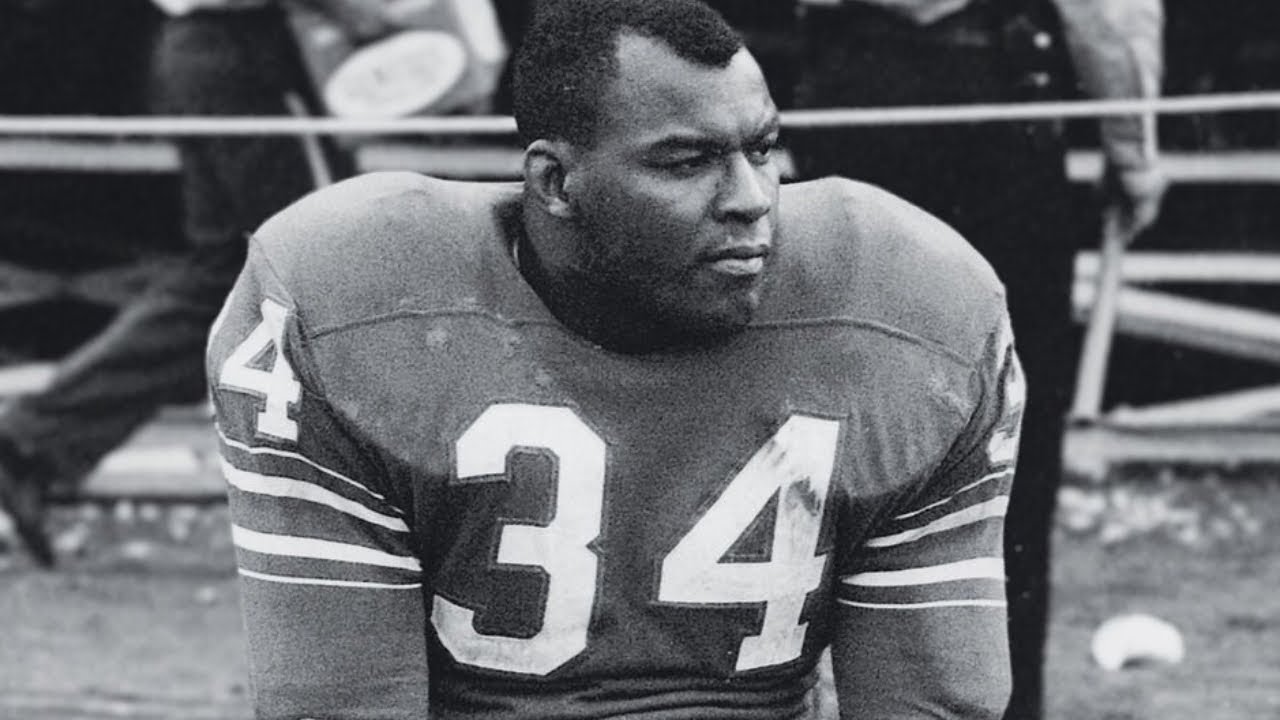
Few athletes have ever embodied power, defiance, and independence like Cookie Gilchrist. A larger-than-life figure whose impact transcended the gridiron, Gilchrist was not just a great football player — he was a symbol of self-respect, racial pride, and the courage to stand up to the establishment. His career spanned multiple leagues, continents, and controversies, but through it all, Cookie Gilchrist remained one of the most compelling and misunderstood figures in football history.
The NFL signed him in HIGH SCHOOL… How did his career turn out?
Early Life and Canadian Beginnings
Carlton Chester “Cookie” Gilchrist was born on May 25, 1935, in Brackenridge, Pennsylvania, and grew up in a working-class family near Pittsburgh. His prodigious football talent emerged early — so early, in fact, that the Cleveland Browns tried to sign him as a teenager. At just 18, Gilchrist agreed to join Paul Brown’s Browns, but the contract was deemed illegal due to his age, leaving him blacklisted from the NFL for years.
That setback led him north — to the
Canadian Football League
— where he quickly became a sensation. Gilchrist played for the Sarnia Imperials and then the Toronto Argonauts, laying waste to defenders with his 6’3”, 250-pound frame. He could run, catch, block, and even kick field goals. His versatility and ferocity made him a legend in Canada long before most Americans knew his name.
Dominance in the CFL
During the 1950s, Cookie Gilchrist became the face of Canadian football. Playing for teams like Hamilton and Toronto, he earned multiple All-Star selections and won the Grey Cup with the Hamilton Tiger-Cats in 1957. His combination of brute strength and finesse was unlike anything the CFL had seen. Gilchrist could bulldoze linebackers or sidestep them — and then line up as a kicker and drill extra points.
Yet, his time in Canada was about more than athletic dominance. He also became outspoken about racism and player treatment. Gilchrist often clashed with management, refusing to back down when he felt disrespected or underpaid. His reputation as a “difficult” player stemmed largely from his unwillingness to accept second-class treatment in a sport — and society — that often-marginalized Black athletes.
Cookie Gilchrist Was One Tough Cookie
The AFL Years: A Force of Nature
When the upstart American Football League was founded in 1960, Gilchrist finally got the chance to bring his talents back to the U.S. The Buffalo Bills signed him in 1962, and he immediately became the AFL’s most feared player. That year, he rushed for 1,096 yards and 13 touchdowns, earning the league’s MVP award. He followed that with a record-breaking 243-yard game against the New York Jets — a mark that stood for decades.
Gilchrist led the Bills to the 1964 AFL Championship, forming a bruising backfield duo with quarterback Jack Kemp. His punishing style defined Buffalo’s offense, and his leadership inspired teammates — even as his outspokenness sometimes frustrated management. When the Bills refused to pay him what he felt he deserved, he demanded a trade — and got one, to the Denver Broncos in 1965.
Trailblazer and Activist
Off the field, Gilchrist became one of football’s earliest player activists. In 1965, he organized a boycott by Black players of the AFL All-Star Game in New Orleans after they were denied service in restaurants and hotels. The protest succeeded — the game was moved to Houston, marking one of the first major civil rights actions in professional sports.
That same year, he became the first professional football player to openly challenge the league’s pay structure and advocate for collective bargaining rights. Decades before modern unions secured free agency, Gilchrist was demanding respect, equality, and economic fairness.
Life After Football
After short stints with Denver and Miami, Gilchrist retired in 1967. He tried his hand at business — running a construction company, opening restaurants, and even starting a semi-pro football league — but financial troubles and his uncompromising nature often led to conflict.
In later years, he lived quietly in western New York and then in Pennsylvania, where he became a local folk hero. Despite health struggles, including cancer and heart disease, he remained outspoken about the NFL’s neglect of its older players. Gilchrist passed away on January 10, 2011, at the age of 75.
The Life and Legend of Cookie Gilchrist
Legacy: A Rebel, A Pioneer, A Champion
Cookie Gilchrist’s story is one of brilliance and defiance. He never played by the rules — and often paid a price for it — but he also never compromised his dignity. He was a four-time CFL All-Star, a two-time
AFL rushing champion, a league MVP, and a Grey Cup winner. Yet his true legacy lies beyond stats or trophies.
He was one of the first professional athletes to stand up publicly against racism, demand fair treatment, and inspire others to use their platform for change. Gilchrist was, in many ways, the bridge between Jim Brown’s power and Muhammad Ali’s principle — a man ahead of his time in both strength and spirit.
In the end, Cookie Gilchrist wasn’t just a football player.
He was a movement — one that helped shape the modern athlete’s right to dignity, equality, and voice.
Up To $1500 in Bonus Bets Paid Back if your First Bet Does Not Win
T&Cs apply
4.5/5
Gambling problem? Call 1-800-GAMBLER or 1-800-MY-RESET (Available in the US) 877-8-HOPENY or text HOPENY (467369) (NY) 1-800-327-5050 (MA), 1-800-BETS-OFF (IA), 1-800-981-0023 (PR). 21+ only. Please Gamble Responsibly. See BetMGM.com for Terms. First Bet Offer for new customers only (if applicable). Subject to eligibility requirements. Bonus bets are non-withdrawable. In partnership with Kansas Crossing Casino and Hotel. Promotional offers not available in Mississippi, Massachusetts, New York, Ontario, or Puerto Rico.
New DraftKings Customers: Spend $5+ Get $150 in Bonuses
T&Cs apply
4.5/5
GAMBLING PROBLEM? CALL 1-800-GAMBLER or 1-800-MY-RESET, (800) 327-5050 or visit gamblinghelplinema.org (MA). Please Gamble Responsibly. 888-789-7777/visit ccpg.org (CT), or visit www.mdgamblinghelp.org (MD), 1-800-981-0023 (PR). 21+ and present in most states. (18+ DC/NH/PR/WY). Void in CAN. Eligibility restrictions apply. On behalf of Boot Hill Casino (KS). Pass-thru of per wager tax may apply in IL. 1 per new DraftKings customer. $5+ first-time bet req. Max. $150 issued as non-withdrawable Bonus Bets. Stake removed from payout. Reward issued as $50 in Bonus Bets every 7 days via click-to-claim for 14 days. Bonus Bets and click-to-claims expire 7 days (168hrs) after issuance. Terms: sportsbook.draftkings.com/promos. Ends 10/11/26 at 11:59 PM ET. Sponsored by DK.
Must be 21+. GAMBLING PROBLEM? CALL 1-800-GAMBLER OR CALL 1-800-MY-RESET, www.mdgamblinghelp.org (MD), (800)-327-5050 or gamblinghelplinema.org (MA), Call (877)8-HOPENY or text HOPENY (467369) (NY), (888) 789-7777 or ccpg.org (CT), morethanagame.nc.gov (NC), 1800gambler.net (WV)
Bet $1 and get double the winnings up to $25 for your next 10 bets
T&Cs apply
4.4/5
21+ New users only. Must register using eligible promo code. First bet after registration must qualify. Max. Bonus Bet: $1,000. Bonus Bet expires 14 days after receipt. Void where prohibited. See Caesars.com/promos for full terms. Gambling Problem? 1-800-GAMBLER (1-800-426-2537)
21+ and present in OH. Gambling Problem? Call 1-800-GAMBLER.
This site is using
Cloudflare
and adheres to the
Google Safe Browsing Program. We adapted
Google's Privacy Guidelines
to keep your data safe at all times.
Close
Ready to Win Big? Join the Elite with Our Sports Betting Deals!
FanDuel Promo
New Users – Get $250 in Bonus Bets when you wager $5 for 5 days
Up To $1500 in Bonus Bets Paid Back if your First Bet Does Not Win
Best Slots
T&Cs and 21+ apply
Gambling problem? Call 1-800-GAMBLER or 1-800-MY-RESET (Available in the US) 877-8-HOPENY or text HOPENY (467369) (NY) 1-800-327-5050 (MA), 1-800-BETS-OFF (IA), 1-800-981-0023 (PR). 21+ only. Please Gamble Responsibly. See BetMGM.com for Terms. First Bet Offer for new customers only (if applicable). Subject to eligibility requirements. Bonus bets are non-withdrawable. In partnership with Kansas Crossing Casino and Hotel. Promotional offers not available in Mississippi, Massachusetts, New York, Ontario, or Puerto Rico.
Code:
Open BetMGM
Get Bonus
DraftKings Promo
New DraftKings Customers: Spend $5+ Get $150 in Bonuses
Newcomer
T&Cs and 21+ apply
GAMBLING PROBLEM? CALL 1-800-GAMBLER or 1-800-MY-RESET, (800) 327-5050 or visit gamblinghelplinema.org (MA). Please Gamble Responsibly. 888-789-7777/visit ccpg.org (CT), or visit www.mdgamblinghelp.org (MD), 1-800-981-0023 (PR). 21+ and present in most states. (18+ DC/NH/PR/WY). Void in CAN. Eligibility restrictions apply. On behalf of Boot Hill Casino (KS). Pass-thru of per wager tax may apply in IL. 1 per new DraftKings customer. $5+ first-time bet req. Max. $150 issued as non-withdrawable Bonus Bets. Stake removed from payout. Reward issued as $50 in Bonus Bets every 7 days via click-to-claim for 14 days. Bonus Bets and click-to-claims expire 7 days (168hrs) after issuance. Terms: sportsbook.draftkings.com/promos. Ends 10/11/26 at 11:59 PM ET. Sponsored by DK.
Code:
Open DraftKings
Get Bonus
Find out what the legends have to say about sports this week....