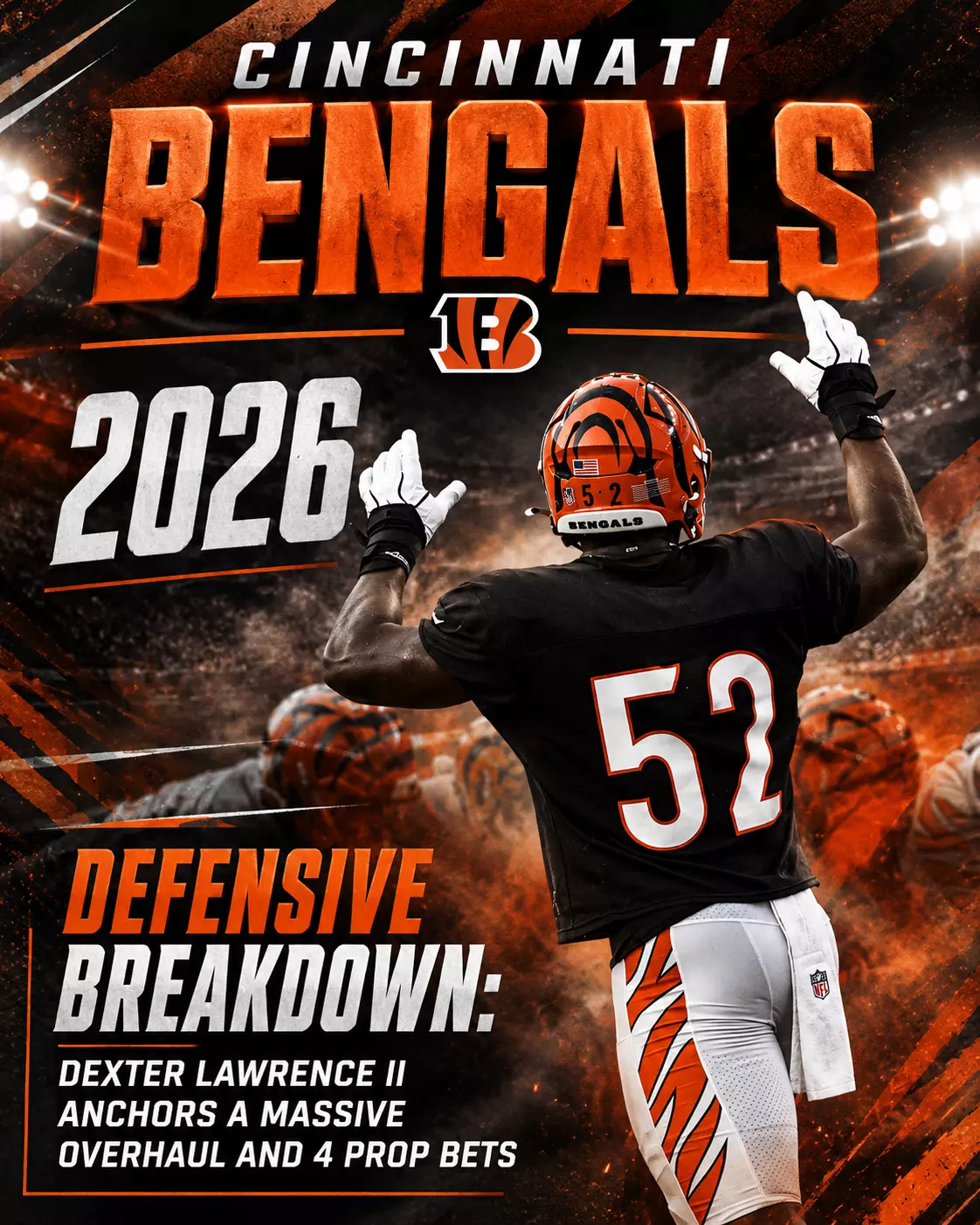
Cincinnati Bengals 2026 Defensive Breakdown: Dexter Lawrence II Anchors a Massive Overhaul and 4 Prop Bets
Cincinnati Bengals 2026 Defensive Breakdown: Dexter Lawrence II Anchors a Massive Overhaul and 4 Prop Bets
The
Cincinnati Bengals enter the 2026 NFL season with perhaps the most dramatically rebuilt defense of the Zac Taylor era.
The reason for the overhaul isn’t difficult to understand.
Cincinnati finished only
6-11 in 2025, missing the playoffs for a third consecutive season. The Bengals allowed
492 points, or 28.9 per game, ranking 30th in the NFL in scoring defense. Opponents accumulated
6,475 total yards, including 2,500 rushing yards and 4,175 passing yards. That works out to approximately
380.9 total yards, 147.1 rushing yards and 245.6 passing yards allowed per game.
The defense produced
35 sacks and 13 interceptions, but those numbers weren’t enough to compensate for one of the league’s worst run defenses and too many explosive passing plays. Opponents averaged
5.2 yards per rushing attempt and 7.8 yards per passing attempt.
The Bengals traded the
No. 10 overall pick to the New York Giants for three-time Pro Bowl defensive tackle Dexter Lawrence II.
They signed two-time Pro Bowl defensive tackle
Jonathan Allen.
They signed former Seattle edge rusher
Boye Mafe.
They signed safety
Bryan Cook.
They later added veteran safety
Kyle Dugger.
Then Cincinnati used the
41st overall pick of the 2026 NFL Draft on Texas A&M edge rusher Cashius Howell, the reigning SEC Defensive Player of the Year after an 11.5-sack season.
That is not patching holes.
That is reconstruction.
And perhaps the most encouraging part of the rebuild is that Cincinnati doesn’t need every young defender to start over.
Demetrius Knight Jr.
recorded 106 tackles, three sacks and two interceptions as a rookie.
Barrett Carter
added 102 tackles and an interception.
Jordan Battle
led Cincinnati with 112 tackles and four interceptions.
DJ Turner II
broke out with 18 passes defensed.
Myles Murphy
finally began converting his physical talent into production, leading the Bengals with 5.5 sacks.
The defense that failed in 2025 has not simply been brought back and asked to improve.
Al Golden has been given substantially better personnel.
Now comes the question that may determine Cincinnati’s entire season:
Can the Bengals turn one of the NFL’s weakest defenses into an average-to-above-average unit quickly enough to maximize Joe Burrow’s championship window?
Cincinnati Bengals 2026 Defensive Projections
Projected Record:
10-7
Projected Points Allowed Per Game:
22-24
Projected Total Defense:
330-350 yards per game
Projected Rushing Defense:
105-120 yards per game
Projected Passing Defense:
220-230 yards per game
Projected Team Sacks:
43-48
Projected Interceptions:
14-17
Projected Total Takeaways:
23-27
Projected Tackles for Loss:
80-90
Biggest Defensive Strength:
Interior Defensive Line
Biggest Defensive Question:
Can Cincinnati replace Trey Hendrickson’s edge pressure while simultaneously integrating a completely rebuilt defensive front?
Al Golden’s Cincinnati Bengals Defense
The 2026 season will be
Al Golden’s second year as Cincinnati’s defensive coordinator.
That is important.
Golden’s first season did not produce the immediate turnaround Cincinnati wanted.
The Bengals still finished near the bottom of the league defensively.
But 2025 also forced Golden to depend heavily on young players.
Knight and Carter were rookies.
The defensive line lacked enough difference-makers.
The secondary experienced inconsistency.
And Cincinnati eventually moved on from veteran linebacker Logan Wilson during the season.
The situation is completely different now.
Golden isn’t being asked to manufacture an elite defense without elite defensive personnel.
And Knight and Carter enter Year 2 after combining for
208 tackles as rookies.
Golden also has additional coaching support.
Cincinnati’s 2026 defensive staff includes
Sean Desai as senior defensive assistant, Jerry Montgomery as defensive line/run-game coordinator, Mike Hodges coaching linebackers, Charles Burks coaching the cornerbacks and Jordan Kovacs coaching the safeties.
That staff has a significantly different roster to work with.
The biggest change should be up front.
Cincinnati allowed
2,500 rushing yards last season, an average of 147.1 per game.
That number affected everything.
When offenses consistently run successfully on first and second down, defensive coordinators lose flexibility.
Third-and-2 is an offensive down.
Third-and-9 is a defensive down.
Cincinnati didn’t create enough third-and-long opportunities in 2025.
Lawrence can change that.
Allen can change that.
Additional defensive-line depth can change that.
And if the Bengals consistently create second-and-long and third-and-long situations, Golden should have considerably more freedom to bring pressure from different locations.
The ideal 2026 defense isn’t necessarily one that blitzes constantly.
It is one that doesn’t have to.
Cincinnati Bengals Defensive Tackle Breakdown
This is now the most accomplished position group on Cincinnati’s defense.
And the transformation starts with
Dexter Lawrence II.
The Bengals surrendered the No. 10 overall pick to acquire Lawrence from the New York Giants and then extended his contract through the 2028 season.
That demonstrates exactly how important Cincinnati believes he can be.
Lawrence enters Cincinnati as a
three-time Pro Bowler and two-time All-Pro.
He has accumulated
30.5 career sacks, including 9.5 during the 2024 season, despite consistently facing one of the highest double-team rates among NFL defensive linemen. Cincinnati’s own roster analysis notes that Lawrence has faced more than 1,100 pass-rush double teams over the last five seasons.
That is the hidden value.
Lawrence doesn’t have to make the tackle himself to change a play.
If the center and guard both have to account for him, somebody else gets a one-on-one matchup.
That somebody could be Jonathan Allen.
Boye Mafe.
Myles Murphy.
Cashius Howell.
Or a blitzing Knight.
Cincinnati simply hasn’t had that kind of interior gravitational force in recent seasons.
Then there is
Jonathan Allen.
Allen arrives with
45.5 career sacks and two Pro Bowl selections. He has recorded 30 sacks during the 2020s, placing him among the NFL’s most productive interior pass rushers during that span.
The combination becomes fascinating.
Lawrence provides massive power.
Allen provides proven interior disruption.
And
B.J. Hill
remains available.
Hill started all 17 games in 2025 and recorded
66 tackles. Cincinnati’s position review credited him with 41 tackles against the run and only one missed tackle on run-defense snaps.
Think about that rotation.
Lawrence.
Allen.
Hill.
T.J. Slaton Jr., who started all 17 games last season and produced a career-high three sacks and 52 tackles.
Kris Jenkins Jr.
McKinnley Jackson.
Jordan Jefferson.
And rookie
Landon Robinson, who won AAC Defensive Player of the Year at Navy after recording 8.5 tackles for loss and 6.5 sacks in 2025.
Cincinnati should never have to play an exhausted defensive tackle simply because there is nobody trustworthy behind him.
That alone is a major improvement.
The Bengals can rotate.
Keep Lawrence fresh.
Keep Allen fresh.
Use Hill aggressively.
And potentially shorten the game by making opponents far less efficient on the ground.
Projected Bengals Rushing Defense: 105-120 yards per game
Dexter Lawrence II: Cincinnati’s Defensive Centerpiece
Dexter Lawrence II may be the single most important addition the Bengals have made on defense in years.
Not because he needs 12 sacks.
Not because he needs 100 tackles.
Because he changes the math.
Interior defensive linemen capable of demanding double teams affect every level of a defense.
Linebackers stay cleaner.
Edge rushers receive more one-on-one opportunities.
Quarterbacks lose the ability to comfortably step forward in the pocket.
Running backs are forced to change direction.
Protection schemes become less predictable.
Lawrence has already demonstrated that impact throughout his career.
His résumé includes
three Pro Bowls, two All-Pro selections and 30.5 sacks, and Cincinnati specifically paid premium draft capital to make him the centerpiece of its front.
There may also be a benefit that never appears in Lawrence’s statistics.
Knight recorded 106 tackles last season.
Carter recorded 102.
They often had to deal with offensive linemen reaching the second level.
If Lawrence occupies two blockers consistently, the Bengals’ sophomore linebackers could become dramatically more effective even if their raw tackle totals decline.
That is good defense.
Fewer tackles five yards downfield.
More tackles at or behind the line.
Dexter Lawrence II Projection: 50-60 tackles, 8-12 tackles for loss and 6-8 sacks.
Cincinnati Bengals Edge-Rusher Breakdown
This position group contains both Cincinnati’s biggest question and some of its most intriguing upside.
The Bengals moved on from two established edge rushers during the offseason.
Trey Hendrickson and Joseph Ossai departed in free agency.
That creates obvious risk.
Hendrickson had been Cincinnati’s premier pass rusher.
You don’t simply remove that player from the roster and assume everything will improve.
But Cincinnati attacked the position aggressively.
Start with
Boye Mafe.
The Bengals signed Mafe to a three-year contract after four seasons in Seattle.
His best season came in 2023, when he recorded
nine sacks and produced a sack in seven consecutive games, a Seahawks franchise record. Mafe appeared in all 17 regular-season games for Seattle in 2025 and was part of the Seahawks’ Super Bowl LX championship team.
Mafe doesn’t need to become Hendrickson.
He needs to become a reliable seven-to-nine-sack edge defender who consistently generates pressure.
Then there is
Myles Murphy.
The 2025 season finally provided some of the breakout Cincinnati had been waiting for.
Murphy recorded a career-high
5.5 sacks and 52 tackles
while generating 41 pressures. He recorded four sacks over the final nine games and produced his first career multi-sack performance late in the season.
That progression matters.
Murphy is no longer being projected entirely based on draft pedigree.
There is actual NFL production.
The question becomes whether 5.5 sacks can become seven or eight.
Then comes
Cashius Howell.
The Bengals selected Howell with the
41st overall pick in the 2026 NFL Draft
after he exploded for
11.5 sacks at Texas A&M, earning SEC Defensive Player of the Year and First-Team All-America honors.
That is exactly the skill Cincinnati needed to add.
Howell isn’t simply another athletic developmental defensive end.
He produced.
Eleven-and-a-half sacks in the SEC is legitimate evidence of pass-rushing ability.
The NFL transition will still be difficult.
NFL tackles are bigger.
Stronger.
Faster.
More technically refined.
But Howell doesn’t have to immediately become an every-down 10-sack defender.
Golden can use him situationally.
Put Lawrence and Allen inside.
Mafe on one side.
Howell on the other.
Force offensive lines to decide where the help goes.
That could produce favorable third-down situations.
The Bengals also still have
Shemar Stewart, their 2025 first-round pick.
Stewart’s rookie season was disrupted by a knee injury, limiting him to eight games and five starts, but he returned late in the year and recorded his first NFL sack.
There is still significant developmental upside.
Cedric Johnson.
Isaiah Foskey.
Additional rotational options.
The Bengals don’t need one player to replace every Hendrickson sack.
They need Mafe, Murphy, Howell, Stewart and the interior defensive line to collectively create a more difficult pass rush.
Myles Murphy enters 2026 with an opportunity to finally become the impact player Cincinnati envisioned when it selected him in the first round of the 2023 NFL Draft.
The signs appeared last season.
Murphy led Cincinnati with
5.5 sacks.
He had 52 tackles.
He doubled his pressure total from 20 in 2024 to 41 in 2025.
And his production improved as the season continued.
That is important.
Development isn’t always linear for defensive linemen.
Murphy entered the NFL with tremendous physical tools but needed time to develop technique and consistency.
Now he enters his fourth professional season surrounded by the best defensive-line talent Cincinnati has assembled during his career.
That should help.
When Dexter Lawrence commands attention inside, Murphy may get cleaner edge opportunities.
When Jonathan Allen wins inside, quarterbacks cannot simply step forward.
When Mafe attacks from the opposite side, protection cannot completely tilt toward Murphy.
And when Howell enters obvious passing situations, Golden can create four-man fronts with legitimate rush ability at every spot.
The biggest concern is whether Murphy’s 5.5-sack season represented a real breakthrough or simply modest improvement.
The 2026 season should answer that.
Myles Murphy Projection: 45-55 tackles, 8-11 tackles for loss and 7-8 sacks.
Cincinnati Bengals Linebacker Breakdown
This may be Cincinnati’s most underrated defensive position group.
Because the Bengals essentially started over here one year early.
Demetrius Knight Jr. and Barrett Carter entered 2025 as rookies.
By the end of the season, both had become full-time defensive contributors.
Knight played all 17 games with 14 starts and recorded
106 tackles, seven passes defensed, three sacks, one forced fumble and two interceptions.
Carter played all 17 games and started the final 12, producing
102 tackles, four passes defensed and one interception.
Combined:
208 tackles.
Three sacks.
Three interceptions.
Eleven passes defensed.
From two rookies.
That is an excellent foundation.
And Cincinnati’s defensive-line overhaul may benefit no position more.
Director of player personnel Duke Tobin specifically pointed to the upgraded defensive line as something that should elevate the young linebackers.
The logic is simple.
Linebackers want clear sight lines.
They want defensive tackles occupying blockers.
They want running backs forced into defined lanes.
They do not want 320-pound guards climbing untouched into the second level.
Lawrence should reduce that.
Allen should reduce that.
Hill and Slaton provide size behind them.
Knight and Carter now get to play behind a defensive front capable of winning more often.
That could allow both linebackers to become more aggressive.
Knight may be especially interesting as a pressure player.
Three rookie sacks demonstrate that Golden can send him.
And his two interceptions show he isn’t simply a run defender.
Carter provides speed and range.
He should be much more comfortable processing NFL offenses after an entire rookie season.
The Bengals also retain veteran
Oren Burks, who made nine starts and recorded 48 tackles last season, along with Joe Giles-Harris, Shaka Heyward and developmental depth.
But the future of the position is obvious.
Knight and Carter.
Demetrius Knight Jr. Projection: 105-120 tackles, 5-8 tackles for loss, 3-5 sacks and 1-3 interceptions
Barrett Carter Projection: 90-105 tackles, 5-7 tackles for loss and multiple splash plays in coverage
Demetrius Knight Jr.: Cincinnati’s Defensive Leader of the Future
There is a strong argument that
Demetrius Knight Jr. could become the Bengals’ most important young defensive player in 2026.
He was thrown directly into the NFL.
And produced immediately.
His
106 tackles ranked second on Cincinnati and second among all NFL rookies.
He also contributed in virtually every phase.
Three sacks.
Two interceptions.
Seven passes defensed.
One forced fumble.
That is the profile of an every-down linebacker.
Now remove the rookie adjustment.
Knight has already seen NFL motion.
NFL play-action.
NFL offensive-line combinations.
NFL quarterbacks manipulating coverage.
He understands Golden’s terminology.
And he now plays behind Lawrence and Allen.
There is reason to believe Knight’s raw tackle total could actually decline while his overall impact increases.
That wouldn’t be negative.
If Cincinnati’s defensive line makes more stops near the line of scrimmage, the linebackers won’t have to collect 15 tackles because opponents ran 75 plays.
The statistic to watch may be tackles for loss and sacks.
If Knight turns more of his downhill opportunities into negative plays, he could emerge as one of the AFC North’s better young linebackers.
Cincinnati Bengals Secondary Breakdown
Cincinnati’s secondary enters 2026 with much more stability than the front seven.
It also has substantially more competition.
Start with
DJ Turner II.
Turner had the best season of his NFL career in 2025.
He allowed only
31 completions on 66 targets, according to the Bengals’ PFF-based review, while posting a 47% completion rate allowed.
Turner recorded
18 passes defensed, tied for third in the NFL and the most by a Bengals defender since 2009.
He also recorded his first two career interceptions and started 16 games.
That is breakout production.
Then there is
Dax Hill.
Hill tied his career high with
11 passes defensed
and improved significantly following Cincinnati’s bye week, allowing no touchdowns on 35 late-season targets cited by the Bengals’ position review.
That gives Cincinnati two experienced corners entering contract years.
The Bengals also used a third-round pick on
Tacario Davis, adding another high-upside outside corner. Davis currently sits behind Hill on Cincinnati’s official depth chart.
Then consider the safeties.
Jordan Battle
had a massive 2025 season.
Battle led Cincinnati with
112 tackles and four interceptions, while adding six passes defensed and two forced fumbles.
He became one of the rare bright spots on an otherwise struggling defense.
Now Cincinnati has surrounded him with considerably more experience.
Bryan Cook
signed a three-year deal after four seasons in Kansas City.
Cook won two Super Bowls with the Chiefs and posted an
83.2 PFF coverage grade in 2025, fourth among safeties, according to Cincinnati’s position review. His 5.3% missed-tackle rate ranked third among qualifying safeties.
That is exactly the profile Cincinnati needed.
Reliable coverage.
Reliable tackling.
Championship experience.
And familiarity with high-pressure games.
Then there is
Kyle Dugger.
Dugger has appeared in
90 regular-season games with 78 starts
and has scored four career defensive touchdowns.
That gives Golden another versatile safety who can play around the box and create turnovers.
The secondary has options.
Turner.
Hill.
Battle.
Cook.
Dugger.
Davis.
Jalen Davis.
Josh Newton.
Daijahn Anthony.
Additional depth behind them.
The key is pressure.
Cincinnati allowed
4,175 passing yards and 33 passing touchdowns last season.
Some of that falls on the secondary.
Some of it falls on quarterbacks having too much time.
The rebuilt defensive line should make the defensive backs better.
If Lawrence collapses the middle and the edge rushers force quarterbacks off their first read, Turner and Hill don’t need to cover indefinitely.
That is how Cincinnati’s pass defense takes a significant step.
Projected Bengals Passing Defense: 220-230 yards per game
Projected Bengals Interceptions: 14-17
Jordan Battle: Cincinnati’s Defensive Playmaker
Jordan Battle quietly became one of Cincinnati’s most productive defensive players in 2025.
The numbers deserve more attention.
112 tackles.
Four interceptions.
Six passes defensed.
Two forced fumbles.
He led the team in both tackles and interceptions.
That combination is unusual for a safety.
Battle was making plays against both the run and the pass.
Now he enters a considerably different defensive environment.
He doesn’t have to compensate for the same weaknesses.
Cook provides more experience next to him.
Dugger adds versatility.
The defensive line should dramatically improve.
That could allow Golden to use Battle more strategically rather than simply relying on him to clean up plays.
There is one interesting statistical consequence.
Battle’s tackle total may decline.
And that might be a good sign for Cincinnati.
A safety making 112 tackles often indicates too many plays reaching the third level.
If Lawrence, Allen, Knight and Carter improve the run defense, Battle shouldn’t need 112 tackles again.
His impact could instead shift toward interceptions, forced fumbles and coverage plays.
Jordan Battle Projection: 80-95 tackles, 3-5 interceptions and 7-10 passes defensed.
Four Cincinnati Bengals 2026 Defensive Prop Bets
Note:
NFL sportsbooks offer significantly more player markets than college football books, but full-season defensive props still vary considerably by operator and state. The lines below should therefore be treated as
projection-based betting benchmarks unless you confirm the exact market at your sportsbook before wagering.
Prop Bet #1: Cincinnati Bengals Over 41.5 Team Sacks
DraftKings
4.5/5
Tip: Cincinnati Bengals Over 41.5 Team Sacks
Dexter Lawrence Changes Protection
Boye Mafe Adds Edge Speed
Cashius Howell Had 11.5 College Sacks
New DraftKings Customers: Bet $5, Get $200 + 3 Months of NBA League Pass!
Get bonus now
GAMBLING PROBLEM? CALL 1-800-GAMBLER or 1-800-MY-RESET, (800) 327-5050 or visit gamblinghelplinema.org (MA). Please Gamble Responsibly. 888-789-7777/visit ccpg.org (CT), or visit www.mdgamblinghelp.org (MD), 1-800-981-0023 (PR). 21+ and present in most states. (18+ DC/NH/PR/WY). Void in CAN. Eligibility restrictions apply. On behalf of Boot Hill Casino (KS). Pass-thru of per wager tax may apply in IL. 1 per new Sportsbook customer. $5+ first-time bet req. Max. $200 issued as non-withdrawable Bonus Bets. Stake removed from payout. Reward issued as $50 in Bonus Bets every 7 days via click-to-claim for 21 days. Bonus Bets and click-to-claims expire 7 days (168hrs) after issuance. Terms: dkng.co/offer. Get 1 promo code to redeem a 3-month NBA League Pass subscription, complimentary of DraftKings. Subscription auto-renews monthly at then-current price (currently $16.99/mo); cancel anytime. Terms, restrictions, and eligibility requirements apply. Redeem League Pass by 12/19/26 at 11:59 PM ET. Addt’l terms: support.watch.nba.com/hc/en-us/articles/9165532876183-League-Pass-Terms-of-Use_. Ends 11/29/26 at 11:59 PM ET. Sponsored by DK.
Why the Over Is a Good Bet
Cincinnati recorded
35 sacks in 2025.
That number should increase.
The Bengals completely transformed the defensive line.
Lawrence has 30.5 career sacks and commands extraordinary double-team attention.
Allen has 45.5 career sacks.
Mafe has already produced a nine-sack NFL season.
Murphy is coming off a career-high 5.5.
Howell produced 11.5 at Texas A&M last season.
Knight had three sacks as a rookie.
And Stewart still possesses significant developmental upside.
The depth is the biggest reason to like the Over.
Cincinnati doesn’t need one player to record 15 sacks.
If Mafe produces eight, Murphy seven, Lawrence seven, Allen five and Howell contributes five or six, the Bengals are already approaching this number before accounting for everyone else.
Why the Under Is a Good Bet
The Bengals did lose
Trey Hendrickson and Joseph Ossai.
That matters.
Hendrickson was Cincinnati’s established premier edge rusher.
Mafe hasn’t recorded nine sacks since 2023.
Murphy’s career high is 5.5.
Howell is a rookie.
And interior pressure doesn’t always become sacks.
Lawrence may collapse the pocket and force a quarterback into someone else’s arms without receiving statistical credit.
The Bengals could become significantly better defensively and finish with 39 or 40 sacks.
Projection: 43-48 Team Sacks
Bet: Over 41.5 Team Sacks
Confidence: 8/10
Prop Bet #2: Dexter Lawrence II Over 5.5 Sacks
FanDuel
4.6/5
Tip: Dexter Lawrence II Over 5.5 Sacks
30.5 Career Sacks
9.5-Sack 2024 Season
Deepest Supporting Cast Cincinnati Has Had
New Users – Get $350 in Bonus Bets when you wager $5 for 7 days
Get bonus now
Gambling Problem? Call 1-800-GAMBLER or 1-800-MY-RESET. Call 1-888-789-7777 or visit ccpgg.org/chat (CT). Hope is here. GamblingHelpLineMA.org or call (800) 327-5050 for 24/7 support (MA). Visit www.mdgamblinghelp.org (MD). Call 1-877-8HOPE-NY or text HOPENY (NY). 21+ (18+ DC, WY) and present in select states (for KS, in affiliation with Kansas Star Casino). Find online real money wagering only. Min $5 wager required for 7 consecutive days. $5 free play credit. Bonus issued as non-withdrawable bonus with cash withdrawable bonus with cash withdrawable. Bonus bets which expire 7 days after receipt. Restrictions apply. See terms at sportsbook.fanduel.com. Call 1-877-770-7867 (LA).
Why the Over Is a Good Bet
Lawrence has already demonstrated elite interior sack production.
He recorded
9.5 sacks in 2024
and enters Cincinnati with 30.5 for his career.
Six sacks over 17 games isn’t an extreme requirement for a player with his ability.
The supporting cast also matters.
Opponents cannot concentrate exclusively on Lawrence.
Allen has to be blocked.
Mafe has to be blocked.
Murphy has to be blocked.
Howell may eventually demand attention.
That could create more individual pass-rush opportunities than Lawrence received in New York.
And Cincinnati’s offense should create favorable defensive game scripts.
If Burrow, Ja’Marr Chase and Tee Higgins build leads, opponents will be forced into obvious passing situations.
That gives Lawrence additional opportunities to attack.
Why the Under Is a Good Bet
Interior defensive linemen can dominate games without accumulating sacks.
Lawrence may consistently command double teams.
That benefits everyone else.
It doesn’t necessarily benefit his individual sack total.
The Bengals also have tremendous defensive-tackle depth.
Allen.
Hill.
Slaton.
Jenkins.
Golden shouldn’t need Lawrence playing every snap.
Keeping him fresh for December and potentially January may be more important than maximizing a regular-season sack total.
Projection: 6-8 Sacks
Bet: Over 5.5 Sacks
Confidence: 7/10
Prop Bet #3: Demetrius Knight Jr. Over 99.5 Tackles
Caesars
4.4/5
Tip: Demetrius Knight Jr. Over 99.5 Tackles
106 Tackles as a Rookie
Every-Down Starting Role
Improved Defensive Line Keeps Him Clean
Bet $1 and get double the winnings up to $25 for your next 10 bets
–
21+ New users only. Must register using eligible promo code. First bet after registration must qualify. Max. Bonus Bet: $1,000. Bonus Bet expires 14 days after receipt. Void where prohibited. See Caesars.com/promos for full terms. Gambling Problem? 1-800-GAMBLER (1-800-426-2537)
Why the Over Is a Good Bet
Knight recorded
106 tackles as a rookie.
He started 14 games.
Now he enters Year 2 as an established starter.
One hundred tackles over 17 games requires fewer than six per contest.
Knight has already shown he can handle considerably more volume than that.
The defensive line should also help him.
Lawrence’s ability to occupy blockers should allow Knight to pursue the football more freely.
Instead of fighting through a guard, he may be meeting the running back in the hole.
Knight also stays on the field because he can contribute in coverage.
His seven passes defensed and two interceptions last season demonstrate that Cincinnati doesn’t have to remove him on passing downs.
Why the Under Is a Good Bet
The strange argument against Knight’s Over is that Cincinnati’s defense may become too much better.
Fewer opponent plays mean fewer tackling opportunities.
If Lawrence and the defensive line produce more tackles at or behind the line of scrimmage, linebackers won’t have to clean up everything.
Carter also recorded 102 tackles last season.
The Bengals have two high-volume linebackers sharing opportunities.
And full-season player props always carry injury risk.
One missed three-game stretch could make 100 tackles difficult.
Projection: 105-120 Tackles
Bet: Over 99.5 Tackles
Confidence: 7.5/10
Prop Bet #4: Cincinnati Bengals Under 24.5 Points Allowed Per Game
BetMGM
4.5/5
Tip: Cincinnati Bengals Under 24.5 Points Allowed Per Game
Massive Defensive-Line Upgrade
Sophomore Linebackers
Deeper Veteran Secondary
Up To $1500 in Bonus Bets Paid Back if your First Bet Does Not Win
Get bonus now
Gambling problem? Call 1-800-GAMBLER or 1-800-MY-RESET (Available in the US) 877-8-HOPENY or text HOPENY (467369) (NY) 1-800-327-5050 (MA), 1-800-BETS-OFF (IA), 1-800-981-0023 (PR). 21+ only. Please Gamble Responsibly. See BetMGM.com for Terms. First Bet Offer for new customers only (if applicable). Subject to eligibility requirements. Bonus bets are non-withdrawable. In partnership with Kansas Crossing Casino and Hotel. Promotional offers not available in Mississippi, Massachusetts, New York, Ontario, or Puerto Rico.
Why the Under Is a Good Bet
This is a bet on the entire defensive reconstruction.
Cincinnati allowed
28.9 points per game last season.
That was terrible.
But this isn’t the same defense.
Lawrence replaces a massive weakness in the middle.
Allen adds another established interior pass rusher.
Mafe strengthens the edge.
Howell gives Cincinnati a rookie pass-rush specialist.
Knight and Carter have a full NFL season behind them.
Cook strengthens safety.
Dugger adds veteran depth.
Turner is coming off an 18-pass-defense season.
Battle is coming off four interceptions.
Cincinnati doesn’t need to become the Broncos.
It doesn’t need to lead the NFL.
Dropping from approximately 29 points allowed to 23 or 24 would represent enough improvement to cash this benchmark.
Why the Over Is a Good Bet
The AFC still contains dangerous quarterbacks and offenses.
Cincinnati has two games against Baltimore.
Kansas City visits Paycor Stadium.
The Bengals travel to Houston.
Washington is on the schedule.
Tampa Bay opens the season.
And divisional games against Pittsburgh are rarely easy.
There is also chemistry risk.
Lawrence is new.
Allen is new.
Mafe is new.
Cook is new.
Howell is a rookie.
Dugger is new.
A defense with major personnel turnover can require several weeks to completely synchronize.
And while Cincinnati improved the pass rush on paper, it also lost Hendrickson.
The Bengals could make meaningful progress while still allowing 25 points per game.
Projection: 22-24 Points Allowed Per Game
Bet: Under 24.5 Points Allowed Per Game
Confidence: 7.5/10
Best Cincinnati Bengals 2026 Defensive Prop Bet
Cincinnati Over 41.5 team sacks is my favorite defensive wager.
The Bengals recorded 35 last season.
That means the Over requires seven additional sacks.
Look at what Cincinnati changed.
Dexter Lawrence.
Jonathan Allen.
Boye Mafe.
Cashius Howell.
And then remember who remains.
Myles Murphy.
Shemar Stewart.
Demetrius Knight Jr.
B.J. Hill.
T.J. Slaton.
The Bengals have dramatically increased the number of players opposing offensive lines must account for.
That should allow Golden to create pressure without consistently blitzing five or six defenders.
Four-man pressure is the goal.
If Lawrence and Allen collapse the middle while Mafe and Murphy attack the edges, Cincinnati can keep seven players in coverage and still affect the quarterback.
That changes everything.
My projection is
43-48 sacks.
That puts the Bengals comfortably above the 41.5 benchmark.
How Cincinnati’s Defense Could Determine the 2026 Season
There may not be another NFL contender whose ceiling is as directly connected to defensive improvement as Cincinnati’s.
The offense is obvious.
Joe Burrow.
Ja’Marr Chase.
Tee Higgins.
Chase Brown.
If Burrow remains healthy, Cincinnati can score.
The question has been whether the defense can stop anybody often enough.
The 2025 Bengals finished
6-11 despite scoring 414 points
because the defense surrendered 492.
That is a 78-point negative differential.
A championship offense cannot overcome that indefinitely.
The market expects substantial improvement in 2026.
But sportsbook win totals currently vary.
BetMGM listed Cincinnati at 9.5 victories as of July 31, with the Over heavily favored.
A current Sporting News betting preview lists
DraftKings at 10.5 wins, demonstrating that the number has moved at some operators.
That distinction matters.
At 9.5, Cincinnati needs 10 wins for the Over.
At 10.5, Cincinnati needs 11.
My projection is
10-7.
That means I like the Over at 9.5 considerably more than I like the Over at 10.5.
The schedule provides opportunities, but it isn’t harmless.
Cincinnati opens at home against Tampa Bay.
Then travels to Houston and Pittsburgh.
Jacksonville visits Cincinnati.
The Bengals travel to Miami before an early Week 6 bye.
Then comes Baltimore.
Tennessee.
A game against Atlanta in Madrid.
Pittsburgh on Sunday night.
Washington on Monday night.
New Orleans.
Cleveland.
Kansas City.
Carolina.
Indianapolis.
Cleveland again.
And Baltimore on New Year’s Eve.
The defense will be tested.
Houston can test the offensive front.
Baltimore can test Cincinnati’s run defense.
Kansas City can test communication.
Washington can force defenders to handle quarterback mobility.
Those are exactly the matchups for which Lawrence was acquired.
Cincinnati spent premium resources because it could no longer enter every season hoping Burrow would score 35.
A playoff-caliber defense doesn’t need to completely shut those teams down.
It needs to produce five or six additional possessions over the course of the season.
One Lawrence sack on third down.
One Knight interception.
One Battle forced fumble.
One Turner pass breakup on fourth down.
Those are the plays that turn 6-11 into 10-7.
Conclusion
The
Cincinnati Bengals enter the 2026 season with a defense that should look almost nothing like the unit that finished near the bottom of the NFL in 2025.
That is a good thing.
Last season’s defense allowed:
28.9 points per game.
380.9 total yards per game.
147.1 rushing yards per game.
245.6 passing yards per game.
Opponents accumulated 6,475 yards, rushed for 2,500 and threw for 4,175. Cincinnati produced 35 sacks and 13 interceptions but couldn’t consistently get off the field.
The Bengals didn’t respond conservatively.
They made one of the most aggressive defensive investments of the offseason.
Dexter Lawrence II
cost the No. 10 overall pick.
That is an enormous commitment.
But Cincinnati wasn’t trading for a developmental prospect.
It acquired a three-time Pro Bowler, two-time All-Pro and one of the NFL’s premier interior defensive linemen.
Jonathan Allen
adds 45.5 career sacks and two Pro Bowl selections.
Boye Mafe
adds an edge rusher who has already produced a nine-sack NFL season.
Cashius Howell
enters the league after recording 11.5 sacks and winning SEC Defensive Player of the Year at Texas A&M.
And Cincinnati still has young talent developing.
Myles Murphy is coming off a career-best 5.5 sacks and 41 pressures.
Shemar Stewart returns after an injury-interrupted rookie season.
Demetrius Knight Jr. recorded
106 tackles, three sacks and two interceptions
as a rookie.
Barrett Carter added
102 tackles.
Jordan Battle produced
112 tackles and four interceptions.
DJ Turner II broke out with
18 passes defensed and two interceptions.
Then the Bengals added Cook and Dugger to strengthen the safety room.
There are no excuses about personnel anymore.
This defense has talent.
The biggest question is how quickly Golden turns that talent into a cohesive unit.
My projection has Cincinnati allowing approximately
22-24 points and 330-350 total yards per game, while generating
43-48 sacks, 14-17 interceptions and 23-27 total takeaways.
Those numbers wouldn’t make Cincinnati the NFL’s No. 1 defense.
They don’t have to.
Think about the difference.
The 2025 Bengals allowed almost 29 points per game.
If that falls to approximately 23, Cincinnati improves by nearly a touchdown every Sunday.
Joe Burrow doesn’t need many extra possessions.
Ja’Marr Chase doesn’t need many.
Tee Higgins doesn’t need many.
A defense capable of keeping opponents in the low 20s completely changes the equation.
From a betting perspective, my strongest defensive play is
Cincinnati Over 41.5 team sacks.
There is simply too much pass-rushing potential across the front.
Lawrence can collapse the middle.
Allen can attack inside.
Mafe provides proven edge production.
Murphy is improving.
Howell may immediately become a dangerous situational rusher.
Knight can blitz.
And the rotation is deep enough to keep everyone fresh.
The individual player with the greatest impact may still be Lawrence.
His arrival affects everybody.
He helps Allen.
He helps the edge rushers.
He helps Knight.
He helps Carter.
He helps the secondary.
And he directly attacks the weakness that destroyed Cincinnati last season: run defense.
The player with the highest breakout potential may be Murphy.
The young defender most likely to become a long-term defensive leader may be Knight.
And Battle and Turner give the Bengals proven playmaking ability on the back end.
For the last several seasons, Cincinnati’s championship argument has usually sounded the same:
If the defense can just be good enough, Burrow and the offense can do the rest.
The Bengals have finally invested as if they believe that urgency.
They traded a top-10 pick for an elite defensive tackle.
They added another Pro Bowl defensive tackle.
They signed an edge rusher.
They drafted the SEC Defensive Player of the Year.
They strengthened the secondary.
Now “good enough” should no longer mean simply avoiding disaster.
The expectation should be an NFL-caliber defense capable of winning games.
If Lawrence transforms the run defense, Allen creates interior pressure, Mafe and Murphy successfully replace Hendrickson’s edge production, Howell makes an immediate rookie impact, Knight and Carter take significant Year 2 steps and Battle, Cook, Turner and Hill stabilize the secondary,
the Cincinnati Bengals should possess enough defensive talent to return to the playoffs — and potentially give Joe Burrow another legitimate opportunity to make a run at the AFC Championship and Super Bowl LXI.
New Users – Get $350 in Bonus Bets when you wager $5 for 7 days
T&Cs apply
4.6/5
Gambling Problem? Call 1-800-GAMBLER or 1-800-MY-RESET. Call 1-888-789-7777 or visit ccpgg.org/chat (CT). Hope is here. GamblingHelpLineMA.org or call (800) 327-5050 for 24/7 support (MA). Visit www.mdgamblinghelp.org (MD). Call 1-877-8HOPE-NY or text HOPENY (NY). 21+ (18+ DC, WY) and present in select states (for KS, in affiliation with Kansas Star Casino). Find online real money wagering only. Min $5 wager required for 7 consecutive days. $5 free play credit. Bonus issued as non-withdrawable bonus with cash withdrawable bonus with cash withdrawable. Bonus bets which expire 7 days after receipt. Restrictions apply. See terms at sportsbook.fanduel.com. Call 1-877-770-7867 (LA).
Up To $1500 in Bonus Bets Paid Back if your First Bet Does Not Win
T&Cs apply
4.5/5
Gambling problem? Call 1-800-GAMBLER or 1-800-MY-RESET (Available in the US) 877-8-HOPENY or text HOPENY (467369) (NY) 1-800-327-5050 (MA), 1-800-BETS-OFF (IA), 1-800-981-0023 (PR). 21+ only. Please Gamble Responsibly. See BetMGM.com for Terms. First Bet Offer for new customers only (if applicable). Subject to eligibility requirements. Bonus bets are non-withdrawable. In partnership with Kansas Crossing Casino and Hotel. Promotional offers not available in Mississippi, Massachusetts, New York, Ontario, or Puerto Rico.
New DraftKings Customers: Bet $5, Get $200 + 3 Months of NBA League Pass!
T&Cs apply
4.5/5
GAMBLING PROBLEM? CALL 1-800-GAMBLER or 1-800-MY-RESET, (800) 327-5050 or visit gamblinghelplinema.org (MA). Please Gamble Responsibly. 888-789-7777/visit ccpg.org (CT), or visit www.mdgamblinghelp.org (MD), 1-800-981-0023 (PR). 21+ and present in most states. (18+ DC/NH/PR/WY). Void in CAN. Eligibility restrictions apply. On behalf of Boot Hill Casino (KS). Pass-thru of per wager tax may apply in IL. 1 per new Sportsbook customer. $5+ first-time bet req. Max. $200 issued as non-withdrawable Bonus Bets. Stake removed from payout. Reward issued as $50 in Bonus Bets every 7 days via click-to-claim for 21 days. Bonus Bets and click-to-claims expire 7 days (168hrs) after issuance. Terms: dkng.co/offer. Get 1 promo code to redeem a 3-month NBA League Pass subscription, complimentary of DraftKings. Subscription auto-renews monthly at then-current price (currently $16.99/mo); cancel anytime. Terms, restrictions, and eligibility requirements apply. Redeem League Pass by 12/19/26 at 11:59 PM ET. Addt’l terms: support.watch.nba.com/hc/en-us/articles/9165532876183-League-Pass-Terms-of-Use_. Ends 11/29/26 at 11:59 PM ET. Sponsored by DK.
Must be 21+. GAMBLING PROBLEM? CALL 1-800-GAMBLER OR CALL 1-800-MY-RESET, www.mdgamblinghelp.org (MD), (800)-327-5050 or gamblinghelplinema.org (MA), Call (877)8-HOPENY or text HOPENY (467369) (NY), (888) 789-7777 or ccpg.org (CT), morethanagame.nc.gov (NC), 1800gambler.net (WV)
Bet $1 and get double the winnings up to $25 for your next 10 bets
T&Cs apply
4.4/5
21+ New users only. Must register using eligible promo code. First bet after registration must qualify. Max. Bonus Bet: $1,000. Bonus Bet expires 14 days after receipt. Void where prohibited. See Caesars.com/promos for full terms. Gambling Problem? 1-800-GAMBLER (1-800-426-2537)
21+ and present in OH. Gambling Problem? Call 1-800-GAMBLER.
This site is using
Cloudflare
and adheres to the
Google Safe Browsing Program. We adapted
Google's Privacy Guidelines
to keep your data safe at all times.
Close
Ready to Win Big? Join the Elite with Our Sports Betting Deals!
FanDuel Promo
New Users – Get $350 in Bonus Bets when you wager $5 for 7 days
Our Favorite
T&Cs and 21+ apply
Gambling Problem? Call 1-800-GAMBLER or 1-800-MY-RESET. Call 1-888-789-7777 or visit ccpgg.org/chat (CT). Hope is here. GamblingHelpLineMA.org or call (800) 327-5050 for 24/7 support (MA). Visit www.mdgamblinghelp.org (MD). Call 1-877-8HOPE-NY or text HOPENY (NY). 21+ (18+ DC, WY) and present in select states (for KS, in affiliation with Kansas Star Casino). Find online real money wagering only. Min $5 wager required for 7 consecutive days. $5 free play credit. Bonus issued as non-withdrawable bonus with cash withdrawable bonus with cash withdrawable. Bonus bets which expire 7 days after receipt. Restrictions apply. See terms at sportsbook.fanduel.com. Call 1-877-770-7867 (LA).
Code:
Open FanDuel
Get Bonus
BetMGM Promo
Up To $1500 in Bonus Bets Paid Back if your First Bet Does Not Win
Best Slots
T&Cs and 21+ apply
Gambling problem? Call 1-800-GAMBLER or 1-800-MY-RESET (Available in the US) 877-8-HOPENY or text HOPENY (467369) (NY) 1-800-327-5050 (MA), 1-800-BETS-OFF (IA), 1-800-981-0023 (PR). 21+ only. Please Gamble Responsibly. See BetMGM.com for Terms. First Bet Offer for new customers only (if applicable). Subject to eligibility requirements. Bonus bets are non-withdrawable. In partnership with Kansas Crossing Casino and Hotel. Promotional offers not available in Mississippi, Massachusetts, New York, Ontario, or Puerto Rico.
Code:
Open BetMGM
Get Bonus
DraftKings Promo
New DraftKings Customers: Bet $5, Get $200 + 3 Months of NBA League Pass!
Newcomer
T&Cs and 21+ apply
GAMBLING PROBLEM? CALL 1-800-GAMBLER or 1-800-MY-RESET, (800) 327-5050 or visit gamblinghelplinema.org (MA). Please Gamble Responsibly. 888-789-7777/visit ccpg.org (CT), or visit www.mdgamblinghelp.org (MD), 1-800-981-0023 (PR). 21+ and present in most states. (18+ DC/NH/PR/WY). Void in CAN. Eligibility restrictions apply. On behalf of Boot Hill Casino (KS). Pass-thru of per wager tax may apply in IL. 1 per new Sportsbook customer. $5+ first-time bet req. Max. $200 issued as non-withdrawable Bonus Bets. Stake removed from payout. Reward issued as $50 in Bonus Bets every 7 days via click-to-claim for 21 days. Bonus Bets and click-to-claims expire 7 days (168hrs) after issuance. Terms: dkng.co/offer. Get 1 promo code to redeem a 3-month NBA League Pass subscription, complimentary of DraftKings. Subscription auto-renews monthly at then-current price (currently $16.99/mo); cancel anytime. Terms, restrictions, and eligibility requirements apply. Redeem League Pass by 12/19/26 at 11:59 PM ET. Addt’l terms: support.watch.nba.com/hc/en-us/articles/9165532876183-League-Pass-Terms-of-Use_. Ends 11/29/26 at 11:59 PM ET. Sponsored by DK.
Code:
Open DraftKings
Get Bonus
Find out what the legends have to say about sports this week....
New Users – Get $350 in Bonus Bets when you wager $5 for 7 days
Gambling Problem? Call 1-800-GAMBLER or 1-800-MY-RESET. Call 1-888-789-7777 or visit ccpgg.org/chat (CT). Hope is here. GamblingHelpLineMA.org or call (800) 327-5050 for 24/7 support (MA). Visit www.mdgamblinghelp.org (MD). Call 1-877-8HOPE-NY or text HOPENY (NY). 21+ (18+ DC, WY) and present in select states (for KS, in affiliation with Kansas Star Casino). Find online real money wagering only. Min $5 wager required for 7 consecutive days. $5 free play credit. Bonus issued as non-withdrawable bonus with cash withdrawable bonus with cash withdrawable. Bonus bets which expire 7 days after receipt. Restrictions apply. See terms at sportsbook.fanduel.com. Call 1-877-770-7867 (LA).