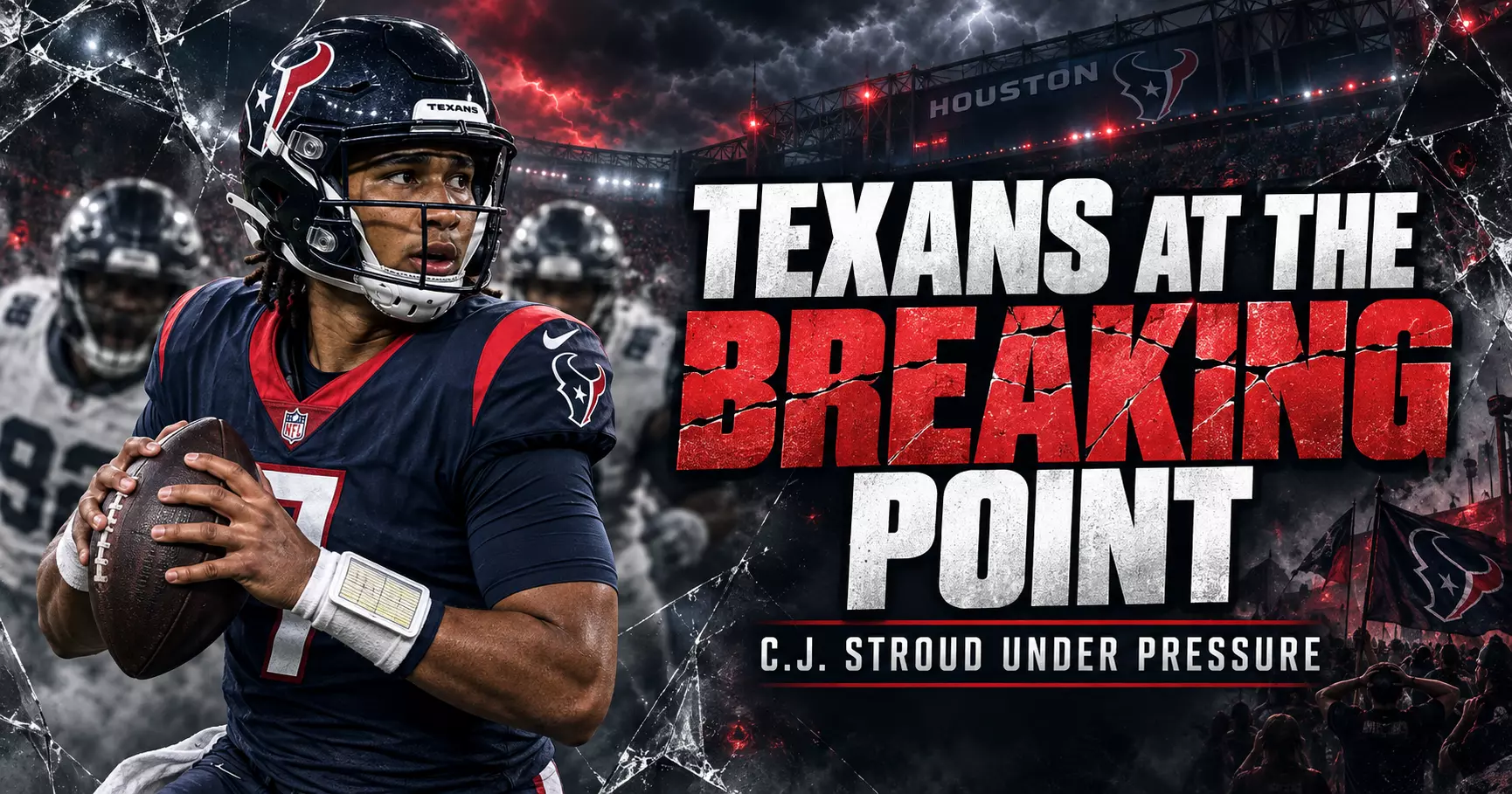
The Houston Texans have spent the past several years asking their fans to believe that the franchise was building toward something meaningful.
The Houston Texans have spent the past several years asking their fans to believe that the franchise was building toward something meaningful.
C.J. Stroud was supposed to be the quarterback who changed everything. DeMeco Ryans brought credibility, discipline and defensive toughness to the organization. Consecutive playoff appearances created the expectation that Houston was ready to become a genuine AFC contender rather than merely the best team in a weak division.
Two games into the 2026 season, that progress is in danger of unraveling.
The Texans are 0–2 after losing their first two games at home. Their offense has failed to score a touchdown in consecutive weeks and has now gone 16 straight possessions without reaching the end zone.
Houston’s 20–6 loss
to Cincinnati was particularly alarming. The Texans produced 374 total yards, reached Bengals territory repeatedly and still managed only two field goals.
Stroud threw for 353 yards, but Houston finished with six points. The running game produced almost nothing. The offensive line struggled in critical situations. Special teams wasted additional opportunities, and the coaching staff failed to find solutions.
The Texans will visit the equally winless Indianapolis Colts in Week 3. It is too early to call the game a literal elimination contest, but it carries the pressure of one.
Something has to change immediately.
Houston’s Offense Is Producing Empty Yards
The Texans’ performance against Cincinnati demonstrated why total yardage can be misleading.
Houston moved the football between the 20-yard lines. Stroud completed 30 passes, and tight end Dalton Schultz established career highs with 12 receptions and 140 yards. The Texans ran 75 offensive plays and outgained the Bengals 374–267.
None of it mattered.
Houston failed to convert any of its four fourth-down attempts and finished without a touchdown. The Texans entered Cincinnati territory several times but repeatedly sabotaged themselves with poor execution, penalties, protection failures and special-teams mistakes.
The result was another afternoon filled with empty statistics.
Stroud can throw for more than 350 yards every week, but that number means little if the offense cannot finish drives. Houston must become more efficient on early downs and create manageable situations near the goal line.
Instead, the Texans are forcing their quarterback to attempt far too many difficult throws. Stroud attempted 55 passes against Cincinnati because Houston could not establish its running game.
That is not a sustainable offensive formula.
The Running Game Has Completely Disappeared
Houston’s inability to run the football might be the offense’s biggest problem.
David Montgomery and the rest of the backfield combined for almost no meaningful production against Cincinnati. The Texans repeatedly found themselves behind schedule, allowing the Bengals’ defensive front to attack Stroud without respecting the possibility of a run.
The most revealing play came during the second quarter.
Houston faced fourth-and-inches at Cincinnati’s 18-yard line. Ryans decided to keep the offense on the field, and offensive coordinator Nick Caley called a run up the middle for Montgomery.
The Bengals knew exactly what was coming.
Defensive tackle Dexter Lawrence split rookie guard Keylan Rutledge and center Evan Brown almost immediately, dropping Montgomery for a one-yard loss. Ryans later explained that Brown and Rutledge were supposed to double-team Lawrence, but the execution broke down.
That failed conversion represented Houston’s entire afternoon.
The Texans had an opportunity to produce points. The play call challenged the strongest part of Cincinnati’s defense. Houston’s offensive line failed to execute the assignment, and another promising possession ended without anything to show for it.
An offense cannot function when it cannot gain a few inches in a critical situation.
The Offensive Line Is Failing Stroud
Houston’s offensive line has been a recurring concern throughout Stroud’s career.
The Texans have changed personnel and attempted to improve the unit, but the same problems continue appearing. Stroud rarely receives a consistently clean pocket, the running game lacks dependable blocking and communication failures occur at the worst possible times.
Cincinnati sacked Stroud four times during the fourth quarter alone.
By then, Houston had abandoned any serious attempt to run the football.
The Bengals
knew Stroud had to pass, allowing their defensive front to attack without hesitation.
No quarterback can consistently overcome that kind of pressure.
Stroud deserves criticism for holding the football too long on certain plays and occasionally failing to take available checkdowns. He has also missed opportunities to create touchdowns instead of settling for shorter completions.
Those mistakes become far more damaging when the offensive line gives him no margin for error.
Houston does not need five Pro Bowl linemen. It needs a group capable of creating a functional pocket and gaining one yard when everybody in the stadium knows the Texans are going to run.
Right now, even those modest expectations appear unrealistic.
Stroud Is Not Blameless
It would be unfair to place Houston’s offensive failures entirely on Stroud. It would be equally dishonest to pretend the quarterback has played well enough.
Franchise quarterbacks are judged by touchdowns, victories and performances in critical situations—not just passing yardage.
Stroud has not thrown a touchdown this season. He has struggled to turn productive drives into points and has not consistently elevated the offense when the structure around him breaks down.
The great quarterbacks compensate for weaknesses. They recognize pressure, change protection, escape collapsing pockets and create touchdowns when the original play fails.
Stroud showed many of those traits early in his career. The anticipation, confidence and downfield aggressiveness that made him look like a future superstar have appeared less consistently.
Part of that regression belongs to the organization. Constant pressure can change how a quarterback processes the field. An unreliable running game makes play-action less effective. Missing Nico Collins against Cincinnati removed Houston’s most dangerous receiving weapon.
Stroud still has to be better.
The Texans did not select him to become a high-volume passer who accumulates yards in losses. They drafted him to win games like Sunday’s.
Nick Caley Is Already Under Pressure
Houston hired Caley to modernize the offense and help Stroud regain the form that made him one of the NFL’s most exciting young quarterbacks.
The early returns have been terrible.
The Texans have not scored a touchdown through two games. Their running game has disappeared, their red-zone offense lacks creativity and their protection plan has failed to keep Stroud comfortable.
The fourth-and-inches call against Cincinnati deserves particular scrutiny. Running directly at Lawrence was predictable and played into the strength of the Bengals’ defensive front.
Houston needed movement, misdirection or some attempt to make Cincinnati defend the entire field. Instead, the Texans called a basic interior run and trusted an offensive line that had not earned that confidence.
Caley cannot block defensive linemen or catch passes for his players. He can put them in more favorable situations.
So far, Houston’s offense looks complicated without being effective.
If the Texans continue struggling, Caley will become one of the first coordinators in the league to face serious job pressure.
Ryans Must Find Answers Beyond the Defense
Ryans has earned respect because of his leadership and defensive expertise. His Texans teams have recovered from slow starts before, and Houston has reached the playoffs despite beginning two previous seasons 0–2.
That history gives Ryans credibility. It does not guarantee another recovery.
The Texans have now opened 0–2 for the third consecutive season. At some point, repeatedly placing the team in an early hole stops being an unfortunate trend and becomes an organizational problem.
Ryans said responsibility for the offensive failures belongs to everyone. That is true, but the head coach ultimately owns the operation.
Houston’s defense has played well enough to win. The Texans held Cincinnati to 20 points and limited Burrow to 207 passing yards. They created pressure and prevented the Bengals from completely controlling the game.
The offense and special teams wasted that effort.
Ryans must demand changes before Houston’s defensive players become frustrated by repeatedly watching winnable games disappear.
The Colts Game Has Become Close to a Must-Win
Indianapolis is also 0–2, but the Colts enter Week 3 with considerably more offensive confidence.
The Colts pushed Kansas City into overtime at Arrowhead Stadium before losing 33–30. Daniel Jones completed more than 70 percent of his passes, Jonathan Taylor rushed for 92 yards and two touchdowns, and Indianapolis demonstrated that it could compete with Patrick Mahomes.
The Colts have now lost nine consecutive games dating to last season, but their performance against Kansas City looked nothing like Houston’s offensive collapse against Cincinnati.
That makes Sunday’s AFC South matchup dangerous for the Texans.
If Houston wins, it will improve to 1–2, earn a divisional road victory and create an opportunity to reset its season.
If the Texans lose, they will fall to 0–3 with a division defeat against another struggling team. The questions surrounding Stroud, Caley and the offensive line will become considerably louder.
Houston cannot afford another afternoon of empty yardage and missed opportunities.
The Texans Are Running Out of Time
The season is only two games old, but the pressure surrounding Houston is real.
The Texans were not supposed to be rebuilding. They were supposed to challenge the AFC’s best teams and take another step toward championship contention.
Instead, they are 0–2, have not scored a touchdown and appear incapable of executing the most basic offensive assignments when the game reaches a critical moment.
Stroud remains talented enough to become one of the NFL’s best quarterbacks. Ryans remains capable of leading a successful team. Houston’s defense remains strong enough to keep the Texans competitive.
Talent and potential are no longer enough.
The Texans need touchdowns. They need victories. They need their franchise quarterback to regain his confidence and their coaching staff to construct an offense that makes sense.
Indianapolis represents an opportunity to stop the panic before it consumes the season.
Another loss would push Houston past concern and into crisis.
C.J. Stroud and the Texans are not at the breaking point yet—but they are getting dangerously close.
Up To $1500 in Bonus Bets Paid Back if your First Bet Does Not Win
T&Cs apply
4.5/5
Gambling problem? Call 1-800-GAMBLER or 1-800-MY-RESET (Available in the US) 877-8-HOPENY or text HOPENY (467369) (NY) 1-800-327-5050 (MA), 1-800-BETS-OFF (IA), 1-800-981-0023 (PR). 21+ only. Please Gamble Responsibly. See BetMGM.com for Terms. First Bet Offer for new customers only (if applicable). Subject to eligibility requirements. Bonus bets are non-withdrawable. In partnership with Kansas Crossing Casino and Hotel. Promotional offers not available in Mississippi, Massachusetts, New York, Ontario, or Puerto Rico.
New DraftKings Customers: Spend $5+ Get $150 in Bonuses
T&Cs apply
4.5/5
GAMBLING PROBLEM? CALL 1-800-GAMBLER or 1-800-MY-RESET, (800) 327-5050 or visit gamblinghelplinema.org (MA). Please Gamble Responsibly. 888-789-7777/visit ccpg.org (CT), or visit www.mdgamblinghelp.org (MD), 1-800-981-0023 (PR). 21+ and present in most states. (18+ DC/NH/PR/WY). Void in CAN. Eligibility restrictions apply. On behalf of Boot Hill Casino (KS). Pass-thru of per wager tax may apply in IL. 1 per new DraftKings customer. $5+ first-time bet req. Max. $150 issued as non-withdrawable Bonus Bets. Stake removed from payout. Reward issued as $50 in Bonus Bets every 7 days via click-to-claim for 14 days. Bonus Bets and click-to-claims expire 7 days (168hrs) after issuance. Terms: sportsbook.draftkings.com/promos. Ends 10/11/26 at 11:59 PM ET. Sponsored by DK.
Must be 21+. GAMBLING PROBLEM? CALL 1-800-GAMBLER OR CALL 1-800-MY-RESET, www.mdgamblinghelp.org (MD), (800)-327-5050 or gamblinghelplinema.org (MA), Call (877)8-HOPENY or text HOPENY (467369) (NY), (888) 789-7777 or ccpg.org (CT), morethanagame.nc.gov (NC), 1800gambler.net (WV)
Bet $1 and get double the winnings up to $25 for your next 10 bets
T&Cs apply
4.4/5
21+ New users only. Must register using eligible promo code. First bet after registration must qualify. Max. Bonus Bet: $1,000. Bonus Bet expires 14 days after receipt. Void where prohibited. See Caesars.com/promos for full terms. Gambling Problem? 1-800-GAMBLER (1-800-426-2537)
21+ and present in OH. Gambling Problem? Call 1-800-GAMBLER.
This site is using
Cloudflare
and adheres to the
Google Safe Browsing Program. We adapted
Google's Privacy Guidelines
to keep your data safe at all times.
Close
Ready to Win Big? Join the Elite with Our Sports Betting Deals!
FanDuel Promo
New Users – Get $250 in Bonus Bets when you wager $5 for 5 days
Up To $1500 in Bonus Bets Paid Back if your First Bet Does Not Win
Best Slots
T&Cs and 21+ apply
Gambling problem? Call 1-800-GAMBLER or 1-800-MY-RESET (Available in the US) 877-8-HOPENY or text HOPENY (467369) (NY) 1-800-327-5050 (MA), 1-800-BETS-OFF (IA), 1-800-981-0023 (PR). 21+ only. Please Gamble Responsibly. See BetMGM.com for Terms. First Bet Offer for new customers only (if applicable). Subject to eligibility requirements. Bonus bets are non-withdrawable. In partnership with Kansas Crossing Casino and Hotel. Promotional offers not available in Mississippi, Massachusetts, New York, Ontario, or Puerto Rico.
Code:
Open BetMGM
Get Bonus
DraftKings Promo
New DraftKings Customers: Spend $5+ Get $150 in Bonuses
Newcomer
T&Cs and 21+ apply
GAMBLING PROBLEM? CALL 1-800-GAMBLER or 1-800-MY-RESET, (800) 327-5050 or visit gamblinghelplinema.org (MA). Please Gamble Responsibly. 888-789-7777/visit ccpg.org (CT), or visit www.mdgamblinghelp.org (MD), 1-800-981-0023 (PR). 21+ and present in most states. (18+ DC/NH/PR/WY). Void in CAN. Eligibility restrictions apply. On behalf of Boot Hill Casino (KS). Pass-thru of per wager tax may apply in IL. 1 per new DraftKings customer. $5+ first-time bet req. Max. $150 issued as non-withdrawable Bonus Bets. Stake removed from payout. Reward issued as $50 in Bonus Bets every 7 days via click-to-claim for 14 days. Bonus Bets and click-to-claims expire 7 days (168hrs) after issuance. Terms: sportsbook.draftkings.com/promos. Ends 10/11/26 at 11:59 PM ET. Sponsored by DK.
Code:
Open DraftKings
Get Bonus
Find out what the legends have to say about sports this week....