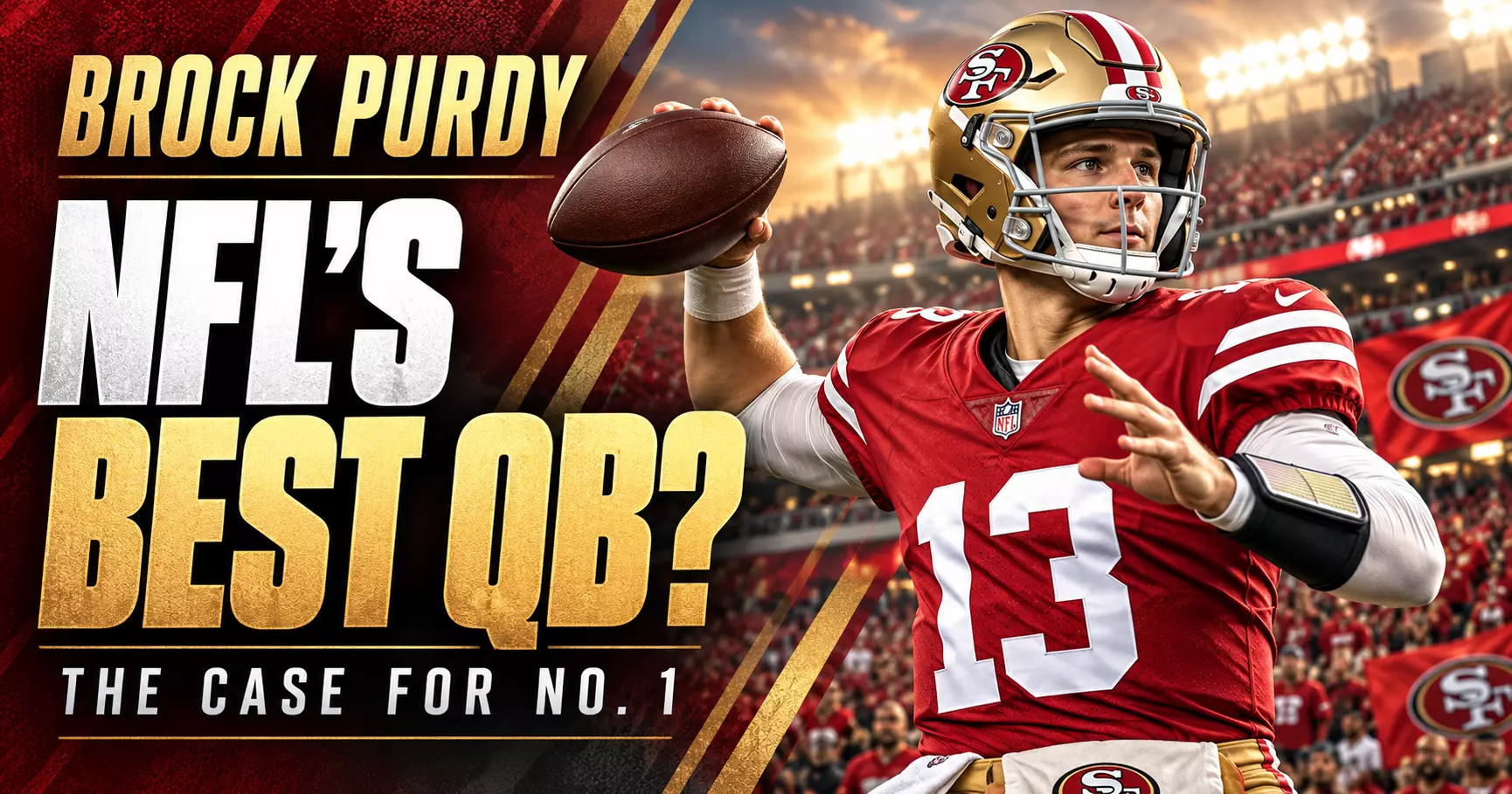
The NFL’s best quarterback conversation usually starts with Patrick Mahomes, Josh Allen, Lamar Jackson and Joe Burrow.
The NFL’s best quarterback conversation usually starts with Patrick Mahomes, Josh Allen, Lamar Jackson and Joe Burrow. Brock Purdy often gets discussed afterward, accompanied by an explanation of how much help he receives.
Through four games of the 2026 season, that approach is becoming difficult to defend.
Purdy has thrown 11 touchdown passes against one interception, posted a 126.2 passer rating and helped San Francisco start 4–0. He leads the league in passer rating and shares the lead in touchdown passes. Those are credentials that deserve serious consideration at the top of the quarterback discussion.
Four games cannot settle an entire season. But if the question is who is playing the position best
right now, Purdy has a compelling argument.
The Numbers Show More Than a Hot Streak
Purdy’s production through Sunday provides the foundation for that argument:
Statistic Through four games Completions/attempts 79/113 Completion percentage 69.9% Passing yards 1,007Yards per attempt 8.9 Passing touchdowns 11 Interceptions 1Passer rating 126.2 Rushing yards 122 Rushing touchdowns 1 Sacks taken 0
Those totals combine accuracy, explosive production, scoring and ball security.
The combination matters more than any single category. A quarterback can protect the football by avoiding difficult throws. He can pile up yards while making costly mistakes. Purdy has produced substantial gains and touchdowns while keeping interceptions to a minimum.
His touchdown rate is approximately one for every 10 passing attempts. That is
remarkable efficiency.
San Francisco has not needed him to throw constantly to generate offense. Purdy is making his opportunities count.
Miami Showed His Accuracy; Arizona Showed His Explosiveness
Purdy’s first four games have featured different routes to success.
Against Miami, he completed 20 of 22 passes for 287 yards and two touchdowns without an interception, adding a rushing score in a 35–13 victory. That was an afternoon of exceptional accuracy and efficient scoring.
Against Arizona, the completion percentage dropped considerably. Purdy went 15 of 27, but those completions produced 297 yards and four touchdowns, with no interceptions, in a 36–30 win.
That contrast explains why completion percentage alone an incomplete measure of quarterback performance is. The Arizona game was less accurate by that standard, yet Cincinnati—or any other NFL team—would gladly take four touchdown passes and no interceptions.
Purdy’s season includes both sustained precision and explosive scoring.
The 49ers’ official highlights document touchdown throws of 10 and 20 yards to George Kittle, a 23-yard scoring pass to Mike Evans and a long touchdown connection with Deebo Samuel against Arizona. The offense generated points through multiple targets and different areas of the field.
That variety makes an offense harder to defend. Opponents cannot simply eliminate one receiver and expect the passing game to disappear.
Denver Tested His Patience
Sunday’s 24–14 victory over Denver was a different kind of game.
The teams reached halftime tied 3–3. San Francisco benefited from a Denver muffed punt in the third quarter, and Purdy finished with 218 passing yards, two touchdowns and no interceptions. His 56-yard touchdown connection with Kittle helped put the game away.
This was a team victory. The defense and special teams contributed substantially, and Purdy’s early performance was hardly flawless.
That makes the game useful when assessing his season.
An elite quarterback must handle afternoons when the offense takes time to find its footing. Forcing a spectacular play can turn a manageable situation into a disastrous one. Purdy finished the game without an interception and helped turn a tight contest into another victory.
His case does not require pretending every possession has been brilliant. It rests on how consistently his full-game production has helped San Francisco.
The Mobility Deserves More Attention
Purdy’s rushing contribution is another reason to take his season seriously.
He has gained 122 yards on the ground and scored once. PFF credits him with 91 scramble yards and gives him a 91.1 rushing grade, second among its qualified quarterbacks.
Those contributions expand what a defense must account for.
Purdy does not need to match Allen’s power or Jackson’s speed to hurt opponents with his legs. A scramble that converts a third down or salvages a broken passing play can be enormously valuable.
The question is whether the quarterback can recognize an opening and use it. Purdy’s early rushing production suggests opponents must respect that possibility.
That also complicates the idea that he simply stands behind a good offensive line and distributes the football. His ability to create outside the original structure contributes to San Francisco’s success.
Shanahan Deserves Credit—and So Does Purdy
Kyle Shanahan’s offense is a significant advantage. So are talented receivers, effective blocking and players who can create yards after the catch.
Acknowledging that help is necessary. Using it to dismiss Purdy is unreasonable.
A well-designed offense still needs its quarterback to execute. Open receivers do not guarantee accurate passes. A favorable matchup does not guarantee the right decision. Protection does not guarantee that a quarterback will use the available time effectively.
Purdy’s sack-free start deserves shared credit. The offensive line has protected him exceptionally well, and the scheme contributes. His decision-making and movement belong in that discussion too.
The reasonable conclusion is that San Francisco has a productive partnership between its coach, quarterback and supporting cast.
Purdy’s performance is part of what makes the system work.
The Argument Against Him Still Matters
There is a credible counterargument to calling Purdy the NFL’s best quarterback.
Passer rating does not account for every part of the position. Supporting talent, defensive quality, game situations and rushing production all matter. Four games also leave considerable room for the standings and statistical rankings to change.
PFF’s evaluation provides another reason to keep the debate open. It ranks Purdy fourth among qualified quarterbacks in overall grade, while his passing grade ranks 10th. That assessment is less enthusiastic than his traditional passing statistics.
That distinction should be acknowledged.
It does not erase his argument. It means his case is strongest when framed around his early-season effectiveness rather than a claim that every independent measure identifies him as the best.
Mahomes remains a
formidable rival. Jackson and Allen bring rushing threats that passing statistics cannot fully capture. Burrow’s ability also demands respect.
Purdy belongs alongside them.
Right Now, Purdy Has Earned the Top Spot in the Conversation
The most persuasive part of Purdy’s season is the balance.
He has been accurate enough to sustain offense, aggressive enough to generate explosive gains and careful enough to avoid giving opponents many interceptions. He has contributed as a runner and helped San Francisco win games that required different kinds of performances.
His résumé already includes NFC Offensive Player of the Month recognition for September. The recognition is beginning to reflect the production.
He still has to sustain it. Defenses will adjust, tougher situations will arrive and the season will demand much more than four strong starts.
But Purdy should not have to wait until January to receive credit for what he is doing in October.
If we judge quarterbacks by their performance this season, rather than the order in which we are accustomed to discussing them, Brock Purdy has earned a legitimate claim to No. 1.
Right now, he might be the best quarterback in the NFL.
New Users – Get $350 in Bonus Bets when you wager $5 for 7 days
T&Cs apply
4.6/5
Gambling Problem? Call 1-800-GAMBLER or 1-800-MY-RESET. Call 1-888-789-7777 or visit ccpgg.org/chat (CT). Hope is here. GamblingHelpLineMA.org or call (800) 327-5050 for 24/7 support (MA). Visit www.mdgamblinghelp.org (MD). Call 1-877-8HOPE-NY or text HOPENY (NY). 21+ (18+ DC, WY) and present in select states (for KS, in affiliation with Kansas Star Casino). Find online real money wagering only. Min $5 wager required for 7 consecutive days. $5 free play credit. Bonus issued as non-withdrawable bonus with cash withdrawable bonus with cash withdrawable. Bonus bets which expire 7 days after receipt. Restrictions apply. See terms at sportsbook.fanduel.com. Call 1-877-770-7867 (LA).
Up To $1500 in Bonus Bets Paid Back if your First Bet Does Not Win
T&Cs apply
4.5/5
Gambling problem? Call 1-800-GAMBLER or 1-800-MY-RESET (Available in the US) 877-8-HOPENY or text HOPENY (467369) (NY) 1-800-327-5050 (MA), 1-800-BETS-OFF (IA), 1-800-981-0023 (PR). 21+ only. Please Gamble Responsibly. See BetMGM.com for Terms. First Bet Offer for new customers only (if applicable). Subject to eligibility requirements. Bonus bets are non-withdrawable. In partnership with Kansas Crossing Casino and Hotel. Promotional offers not available in Mississippi, Massachusetts, New York, Ontario, or Puerto Rico.
New DraftKings Customers: Bet $5, Get $200 + 3 Months of NBA League Pass!
T&Cs apply
4.5/5
GAMBLING PROBLEM? CALL 1-800-GAMBLER or 1-800-MY-RESET, (800) 327-5050 or visit gamblinghelplinema.org (MA). Please Gamble Responsibly. 888-789-7777/visit ccpg.org (CT), or visit www.mdgamblinghelp.org (MD), 1-800-981-0023 (PR). 21+ and present in most states. (18+ DC/NH/PR/WY). Void in CAN. Eligibility restrictions apply. On behalf of Boot Hill Casino (KS). Pass-thru of per wager tax may apply in IL. 1 per new Sportsbook customer. $5+ first-time bet req. Max. $200 issued as non-withdrawable Bonus Bets. Stake removed from payout. Reward issued as $50 in Bonus Bets every 7 days via click-to-claim for 21 days. Bonus Bets and click-to-claims expire 7 days (168hrs) after issuance. Terms: dkng.co/offer. Get 1 promo code to redeem a 3-month NBA League Pass subscription, complimentary of DraftKings. Subscription auto-renews monthly at then-current price (currently $16.99/mo); cancel anytime. Terms, restrictions, and eligibility requirements apply. Redeem League Pass by 12/19/26 at 11:59 PM ET. Addt’l terms: support.watch.nba.com/hc/en-us/articles/9165532876183-League-Pass-Terms-of-Use_. Ends 11/29/26 at 11:59 PM ET. Sponsored by DK.
Must be 21+. GAMBLING PROBLEM? CALL 1-800-GAMBLER OR CALL 1-800-MY-RESET, www.mdgamblinghelp.org (MD), (800)-327-5050 or gamblinghelplinema.org (MA), Call (877)8-HOPENY or text HOPENY (467369) (NY), (888) 789-7777 or ccpg.org (CT), morethanagame.nc.gov (NC), 1800gambler.net (WV)
Bet $1 and get double the winnings up to $25 for your next 10 bets
T&Cs apply
4.4/5
21+ New users only. Must register using eligible promo code. First bet after registration must qualify. Max. Bonus Bet: $1,000. Bonus Bet expires 14 days after receipt. Void where prohibited. See Caesars.com/promos for full terms. Gambling Problem? 1-800-GAMBLER (1-800-426-2537)
21+ and present in OH. Gambling Problem? Call 1-800-GAMBLER.
This site is using
Cloudflare
and adheres to the
Google Safe Browsing Program. We adapted
Google's Privacy Guidelines
to keep your data safe at all times.
Close
Ready to Win Big? Join the Elite with Our Sports Betting Deals!
FanDuel Promo
New Users – Get $350 in Bonus Bets when you wager $5 for 7 days
Our Favorite
T&Cs and 21+ apply
Gambling Problem? Call 1-800-GAMBLER or 1-800-MY-RESET. Call 1-888-789-7777 or visit ccpgg.org/chat (CT). Hope is here. GamblingHelpLineMA.org or call (800) 327-5050 for 24/7 support (MA). Visit www.mdgamblinghelp.org (MD). Call 1-877-8HOPE-NY or text HOPENY (NY). 21+ (18+ DC, WY) and present in select states (for KS, in affiliation with Kansas Star Casino). Find online real money wagering only. Min $5 wager required for 7 consecutive days. $5 free play credit. Bonus issued as non-withdrawable bonus with cash withdrawable bonus with cash withdrawable. Bonus bets which expire 7 days after receipt. Restrictions apply. See terms at sportsbook.fanduel.com. Call 1-877-770-7867 (LA).
Code:
Open FanDuel
Get Bonus
BetMGM Promo
Up To $1500 in Bonus Bets Paid Back if your First Bet Does Not Win
Best Slots
T&Cs and 21+ apply
Gambling problem? Call 1-800-GAMBLER or 1-800-MY-RESET (Available in the US) 877-8-HOPENY or text HOPENY (467369) (NY) 1-800-327-5050 (MA), 1-800-BETS-OFF (IA), 1-800-981-0023 (PR). 21+ only. Please Gamble Responsibly. See BetMGM.com for Terms. First Bet Offer for new customers only (if applicable). Subject to eligibility requirements. Bonus bets are non-withdrawable. In partnership with Kansas Crossing Casino and Hotel. Promotional offers not available in Mississippi, Massachusetts, New York, Ontario, or Puerto Rico.
Code:
Open BetMGM
Get Bonus
DraftKings Promo
New DraftKings Customers: Bet $5, Get $200 + 3 Months of NBA League Pass!
Newcomer
T&Cs and 21+ apply
GAMBLING PROBLEM? CALL 1-800-GAMBLER or 1-800-MY-RESET, (800) 327-5050 or visit gamblinghelplinema.org (MA). Please Gamble Responsibly. 888-789-7777/visit ccpg.org (CT), or visit www.mdgamblinghelp.org (MD), 1-800-981-0023 (PR). 21+ and present in most states. (18+ DC/NH/PR/WY). Void in CAN. Eligibility restrictions apply. On behalf of Boot Hill Casino (KS). Pass-thru of per wager tax may apply in IL. 1 per new Sportsbook customer. $5+ first-time bet req. Max. $200 issued as non-withdrawable Bonus Bets. Stake removed from payout. Reward issued as $50 in Bonus Bets every 7 days via click-to-claim for 21 days. Bonus Bets and click-to-claims expire 7 days (168hrs) after issuance. Terms: dkng.co/offer. Get 1 promo code to redeem a 3-month NBA League Pass subscription, complimentary of DraftKings. Subscription auto-renews monthly at then-current price (currently $16.99/mo); cancel anytime. Terms, restrictions, and eligibility requirements apply. Redeem League Pass by 12/19/26 at 11:59 PM ET. Addt’l terms: support.watch.nba.com/hc/en-us/articles/9165532876183-League-Pass-Terms-of-Use_. Ends 11/29/26 at 11:59 PM ET. Sponsored by DK.
Code:
Open DraftKings
Get Bonus
Find out what the legends have to say about sports this week....
New Users – Get $350 in Bonus Bets when you wager $5 for 7 days
Gambling Problem? Call 1-800-GAMBLER or 1-800-MY-RESET. Call 1-888-789-7777 or visit ccpgg.org/chat (CT). Hope is here. GamblingHelpLineMA.org or call (800) 327-5050 for 24/7 support (MA). Visit www.mdgamblinghelp.org (MD). Call 1-877-8HOPE-NY or text HOPENY (NY). 21+ (18+ DC, WY) and present in select states (for KS, in affiliation with Kansas Star Casino). Find online real money wagering only. Min $5 wager required for 7 consecutive days. $5 free play credit. Bonus issued as non-withdrawable bonus with cash withdrawable bonus with cash withdrawable. Bonus bets which expire 7 days after receipt. Restrictions apply. See terms at sportsbook.fanduel.com. Call 1-877-770-7867 (LA).