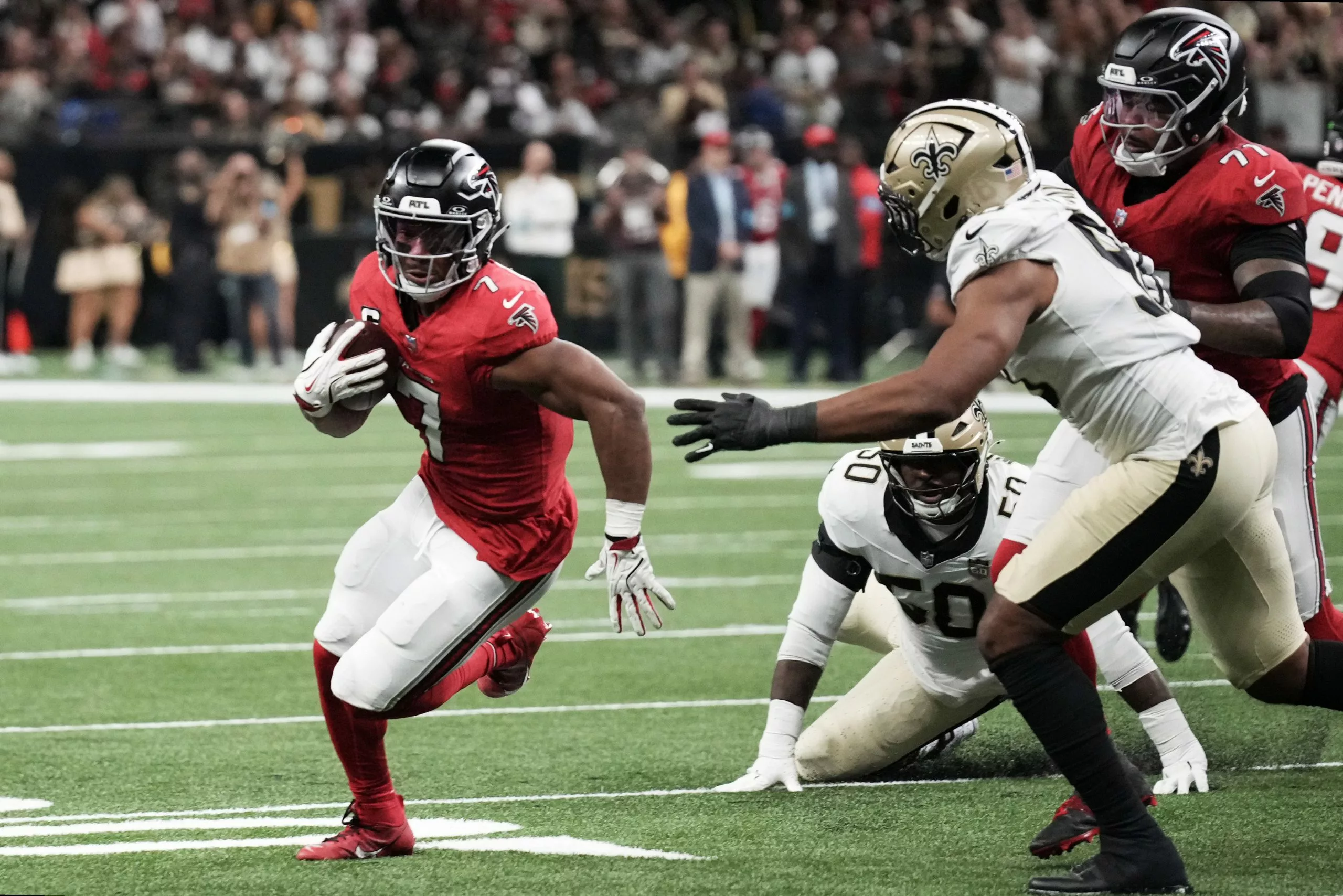
Oct 5, 2026; New Orleans, Louisiana, USA; Atlanta Falcons running back Bijan Robinson (7) runs against New Orleans Saints defensive end Tyree Wilson (98) during the first half at Caesars Superdome. Mandatory Credit: Matthew Hinton-Imagn Images
Bijan Robinson needed only one touch to change the atmosphere in New Orleans.
His 59-yard touchdown run on Atlanta’s third offensive play gave the Falcons an immediate lead and established the central problem the Saints would spend the evening trying to solve.
They never solved it.
Robinson finished with 145 rushing yards and two touchdowns in Atlanta’s 45–24 Monday night victory. Brian Robinson Jr. added 62 yards and three rushing scores, giving the Falcons five touchdowns on the ground.
Atlanta is 2–2, so declaring the Falcons a finished championship contender would be premature. But dismissing this as one spectacular night would overlook what is developing.
This running game gives Atlanta a foundation that can make the entire offense harder to defend. With Michael Penix Jr. providing efficient quarterback play, the Falcons are beginning to show how dangerous that combination can become.
This Was a Follow-Up Performance, Not an Isolated Breakout
Robinson’s Monday night production followed an even bigger rushing performance at Green Bay.
He carried 29 times for 194 yards and two touchdowns in Atlanta’s 35–14 victory over the Packers. Against New Orleans, he needed only 19 carries to produce another 145 yards and two scores.
Across those two road victories, Robinson totaled 339 rushing yards and four rushing touchdowns on 48 carries—just over seven yards per attempt.
That is a substantial stretch of production.
It also matters that Atlanta has generated those performances away from home. The Falcons have taken their offense into opposing stadiums and established enough control to win comfortably.
Two games do not prove that every defense will struggle the same way. They do provide evidence that Atlanta has found something worth building around.
Robinson’s ability is becoming the centerpiece of an offensive identity.
Explosive Runs Change What a Defense Can Afford to Do
A reliable running game helps an offense stay on schedule. An explosive running game adds another problem: one missed assignment or tackle can become a touchdown.
Robinson demonstrated that immediately
Monday night.
Defenses must fit the run correctly, maintain pursuit angles and finish tackles. A mistake against him can cost far more than a few additional yards.
That creates pressure beyond the carries themselves.
If an opponent commits another defender to the box, Atlanta can look for opportunities through the air. If the defense keeps extra help deep, the Falcons can test whether the remaining front can handle the running game.
Those are potential advantages, not automatic outcomes. Penix must recognize the coverage, the line must execute and the receivers must finish their assignments.
But Robinson gives Atlanta a credible threat that forces opponents to make those choices.
That is how a running back can influence plays even when he never receives the ball.
Brian Robinson Jr. Makes the Backfield More Complete
Bijan deserves the headline. Brian’s contribution deserves more than a passing mention.
Three rushing touchdowns and 62 yards represent a meaningful share of Atlanta’s offensive success. The Falcons had another back capable of turning possessions into points.
That matters over a full season.
Atlanta should want Bijan involved heavily, but it should also want an offense that functions when he comes off the field. A dependable second back gives the coaching staff more freedom to distribute carries and manage the workload.
It can also complicate defensive preparation. Opponents have to account for the personnel actually in the game rather than assuming the offense loses its rushing threat whenever Bijan rests.
Monday’s performance showed the value of having both backs contribute.
The Falcons were able to keep producing rushing touchdowns without asking one player to supply every finish.
Penix Gives the Running Game a Passing Partner
Penix completed 15 of 20 passes for 223 yards and a touchdown against New Orleans. His scoring throw went 31 yards to Jahan Dotson.
That is the kind of complementary production Atlanta needs.
A strong running game can make the quarterback’s job more manageable, but the quarterback still has to punish defenses when opportunities appear. An opponent willing to crowd the line must face consequences through the air.
Penix does not need 40 passing attempts every week for this offense to be dangerous. He needs to make productive use of the attempts the game demands.
Monday, Atlanta gained more than 11 passing yards per attempt. That efficiency gave the Saints another problem while they were already struggling with the backs.
The passing game reinforced the running game’s threat.
As Penix continues developing, that relationship offers Atlanta a practical route to sustained offensive success.
The Offensive Line Belongs in the Conversation
A star running back can create yards beyond the blocking. He still needs an offense that gives him a reasonable chance to reach those opportunities.
Atlanta’s production deserves to be evaluated as a collective achievement.
The line must coordinate its blocks, handle movement from the defensive front and prevent penetration from disrupting a play before the back can make a decision.
The backs must recognize the available lanes and avoid turning a manageable gain into a loss by searching for something larger.
The recent results suggest those parts are working together effectively.
Credit Bijan for the acceleration and open-field danger. Credit Brian for his contribution. Credit the blocking and offensive preparation that allowed Atlanta to keep returning to the run.
The sustainable version of this offense depends on all of them.
Atlanta’s Identity Can Help It Win Difficult Games
The Falcons never trailed Monday and finished with 207 rushing yards, while New Orleans managed 50.
That contrast illustrates how thoroughly Atlanta controlled this matchup on the ground.
Future games will be less comfortable. The Falcons will face defenses that tackle better, offenses that put them behind and situations that require Penix to carry a larger burden.
A productive running game still helps in those circumstances.
It can create manageable downs, make play-action credible and provide a dependable option when the passing attack struggles to find rhythm.
When Atlanta has a lead, it also has a way to keep pursuing first downs without immediately placing every possession in the quarterback’s hands.
The goal should be an offense that can adjust while retaining its strengths.
Robinson gives the Falcons an excellent place to start.
The Next Test Is What Happens When Opponents Adjust
There are reasons to remain measured.
New Orleans fell to 1–3, and Atlanta’s overall record remains .500. The Falcons have shown encouraging progress, but they still need to establish consistency across a larger sample.
Defenses will study the explosive runs and adjust their approach. They may attack the blocking differently or place a greater burden on Penix to win through the air.
Atlanta must demonstrate that it can respond.
Can it sustain drives when the longest run is 12 yards instead of 59? Can Penix convert a difficult third down when the defense knows he must throw? Can the offense recover from an early deficit?
Those questions will determine how far this team can go.
The encouraging development is that Atlanta now has a clear strength around which to build its answers.
The Falcons Have Given the NFL a Reason to Pay Attention
Monday night was more than a showcase for an exceptional running back.
It was another demonstration of what Atlanta can become when its backs, blocking and quarterback work together.
Bijan supplied the explosiveness. Brian helped
finish possessions. Penix provided efficient passing production. The Falcons turned that combination into a second consecutive convincing road victory.
Atlanta still has substantial work ahead before it can demand a place among the NFC’s best teams.
But opponents now have an obvious preparation priority: find a way to slow this running game without leaving the passing attack opportunities it can exploit.
That is a difficult problem to solve.
Bijan Robinson has given the Falcons a genuine advantage—and Atlanta is beginning to use it.
New Users – Get $350 in Bonus Bets when you wager $5 for 7 days
T&Cs apply
4.6/5
Gambling Problem? Call 1-800-GAMBLER or 1-800-MY-RESET. Call 1-888-789-7777 or visit ccpgg.org/chat (CT). Hope is here. GamblingHelpLineMA.org or call (800) 327-5050 for 24/7 support (MA). Visit www.mdgamblinghelp.org (MD). Call 1-877-8HOPE-NY or text HOPENY (NY). 21+ (18+ DC, WY) and present in select states (for KS, in affiliation with Kansas Star Casino). Find online real money wagering only. Min $5 wager required for 7 consecutive days. $5 free play credit. Bonus issued as non-withdrawable bonus with cash withdrawable bonus with cash withdrawable. Bonus bets which expire 7 days after receipt. Restrictions apply. See terms at sportsbook.fanduel.com. Call 1-877-770-7867 (LA).
Up To $1500 in Bonus Bets Paid Back if your First Bet Does Not Win
T&Cs apply
4.5/5
Gambling problem? Call 1-800-GAMBLER or 1-800-MY-RESET (Available in the US) 877-8-HOPENY or text HOPENY (467369) (NY) 1-800-327-5050 (MA), 1-800-BETS-OFF (IA), 1-800-981-0023 (PR). 21+ only. Please Gamble Responsibly. See BetMGM.com for Terms. First Bet Offer for new customers only (if applicable). Subject to eligibility requirements. Bonus bets are non-withdrawable. In partnership with Kansas Crossing Casino and Hotel. Promotional offers not available in Mississippi, Massachusetts, New York, Ontario, or Puerto Rico.
New DraftKings Customers: Bet $5, Get $200 + 3 Months of NBA League Pass!
T&Cs apply
4.5/5
GAMBLING PROBLEM? CALL 1-800-GAMBLER or 1-800-MY-RESET, (800) 327-5050 or visit gamblinghelplinema.org (MA). Please Gamble Responsibly. 888-789-7777/visit ccpg.org (CT), or visit www.mdgamblinghelp.org (MD), 1-800-981-0023 (PR). 21+ and present in most states. (18+ DC/NH/PR/WY). Void in CAN. Eligibility restrictions apply. On behalf of Boot Hill Casino (KS). Pass-thru of per wager tax may apply in IL. 1 per new Sportsbook customer. $5+ first-time bet req. Max. $200 issued as non-withdrawable Bonus Bets. Stake removed from payout. Reward issued as $50 in Bonus Bets every 7 days via click-to-claim for 21 days. Bonus Bets and click-to-claims expire 7 days (168hrs) after issuance. Terms: dkng.co/offer. Get 1 promo code to redeem a 3-month NBA League Pass subscription, complimentary of DraftKings. Subscription auto-renews monthly at then-current price (currently $16.99/mo); cancel anytime. Terms, restrictions, and eligibility requirements apply. Redeem League Pass by 12/19/26 at 11:59 PM ET. Addt’l terms: support.watch.nba.com/hc/en-us/articles/9165532876183-League-Pass-Terms-of-Use_. Ends 11/29/26 at 11:59 PM ET. Sponsored by DK.
Must be 21+. GAMBLING PROBLEM? CALL 1-800-GAMBLER OR CALL 1-800-MY-RESET, www.mdgamblinghelp.org (MD), (800)-327-5050 or gamblinghelplinema.org (MA), Call (877)8-HOPENY or text HOPENY (467369) (NY), (888) 789-7777 or ccpg.org (CT), morethanagame.nc.gov (NC), 1800gambler.net (WV)
Bet $1 and get double the winnings up to $25 for your next 10 bets
T&Cs apply
4.4/5
21+ New users only. Must register using eligible promo code. First bet after registration must qualify. Max. Bonus Bet: $1,000. Bonus Bet expires 14 days after receipt. Void where prohibited. See Caesars.com/promos for full terms. Gambling Problem? 1-800-GAMBLER (1-800-426-2537)
21+ and present in OH. Gambling Problem? Call 1-800-GAMBLER.
This site is using
Cloudflare
and adheres to the
Google Safe Browsing Program. We adapted
Google's Privacy Guidelines
to keep your data safe at all times.
Close
Ready to Win Big? Join the Elite with Our Sports Betting Deals!
FanDuel Promo
New Users – Get $350 in Bonus Bets when you wager $5 for 7 days
Our Favorite
T&Cs and 21+ apply
Gambling Problem? Call 1-800-GAMBLER or 1-800-MY-RESET. Call 1-888-789-7777 or visit ccpgg.org/chat (CT). Hope is here. GamblingHelpLineMA.org or call (800) 327-5050 for 24/7 support (MA). Visit www.mdgamblinghelp.org (MD). Call 1-877-8HOPE-NY or text HOPENY (NY). 21+ (18+ DC, WY) and present in select states (for KS, in affiliation with Kansas Star Casino). Find online real money wagering only. Min $5 wager required for 7 consecutive days. $5 free play credit. Bonus issued as non-withdrawable bonus with cash withdrawable bonus with cash withdrawable. Bonus bets which expire 7 days after receipt. Restrictions apply. See terms at sportsbook.fanduel.com. Call 1-877-770-7867 (LA).
Code:
Open FanDuel
Get Bonus
BetMGM Promo
Up To $1500 in Bonus Bets Paid Back if your First Bet Does Not Win
Best Slots
T&Cs and 21+ apply
Gambling problem? Call 1-800-GAMBLER or 1-800-MY-RESET (Available in the US) 877-8-HOPENY or text HOPENY (467369) (NY) 1-800-327-5050 (MA), 1-800-BETS-OFF (IA), 1-800-981-0023 (PR). 21+ only. Please Gamble Responsibly. See BetMGM.com for Terms. First Bet Offer for new customers only (if applicable). Subject to eligibility requirements. Bonus bets are non-withdrawable. In partnership with Kansas Crossing Casino and Hotel. Promotional offers not available in Mississippi, Massachusetts, New York, Ontario, or Puerto Rico.
Code:
Open BetMGM
Get Bonus
DraftKings Promo
New DraftKings Customers: Bet $5, Get $200 + 3 Months of NBA League Pass!
Newcomer
T&Cs and 21+ apply
GAMBLING PROBLEM? CALL 1-800-GAMBLER or 1-800-MY-RESET, (800) 327-5050 or visit gamblinghelplinema.org (MA). Please Gamble Responsibly. 888-789-7777/visit ccpg.org (CT), or visit www.mdgamblinghelp.org (MD), 1-800-981-0023 (PR). 21+ and present in most states. (18+ DC/NH/PR/WY). Void in CAN. Eligibility restrictions apply. On behalf of Boot Hill Casino (KS). Pass-thru of per wager tax may apply in IL. 1 per new Sportsbook customer. $5+ first-time bet req. Max. $200 issued as non-withdrawable Bonus Bets. Stake removed from payout. Reward issued as $50 in Bonus Bets every 7 days via click-to-claim for 21 days. Bonus Bets and click-to-claims expire 7 days (168hrs) after issuance. Terms: dkng.co/offer. Get 1 promo code to redeem a 3-month NBA League Pass subscription, complimentary of DraftKings. Subscription auto-renews monthly at then-current price (currently $16.99/mo); cancel anytime. Terms, restrictions, and eligibility requirements apply. Redeem League Pass by 12/19/26 at 11:59 PM ET. Addt’l terms: support.watch.nba.com/hc/en-us/articles/9165532876183-League-Pass-Terms-of-Use_. Ends 11/29/26 at 11:59 PM ET. Sponsored by DK.
Code:
Open DraftKings
Get Bonus
Find out what the legends have to say about sports this week....
New Users – Get $350 in Bonus Bets when you wager $5 for 7 days
Gambling Problem? Call 1-800-GAMBLER or 1-800-MY-RESET. Call 1-888-789-7777 or visit ccpgg.org/chat (CT). Hope is here. GamblingHelpLineMA.org or call (800) 327-5050 for 24/7 support (MA). Visit www.mdgamblinghelp.org (MD). Call 1-877-8HOPE-NY or text HOPENY (NY). 21+ (18+ DC, WY) and present in select states (for KS, in affiliation with Kansas Star Casino). Find online real money wagering only. Min $5 wager required for 7 consecutive days. $5 free play credit. Bonus issued as non-withdrawable bonus with cash withdrawable bonus with cash withdrawable. Bonus bets which expire 7 days after receipt. Restrictions apply. See terms at sportsbook.fanduel.com. Call 1-877-770-7867 (LA).