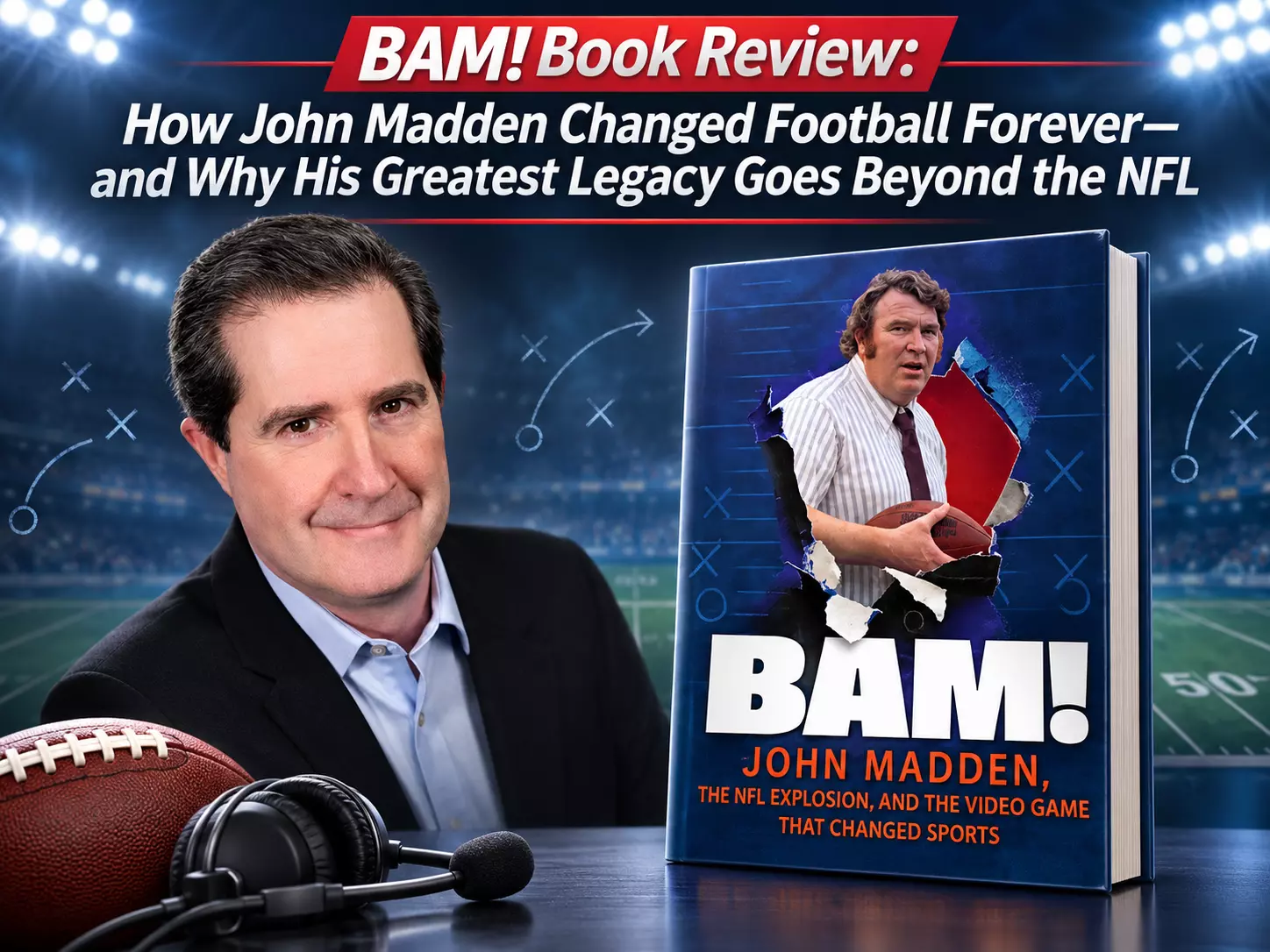
BAM! Book Review: How John Madden Changed Football Forever—and Why His Greatest Legacy Goes Beyond the NFL
Book:BAM!: John Madden, the NFL Explosion, and the Video Game That Changed Sports
Author:
Scott Howard-Cooper
Publisher:
Diversion Books
Publication:
October 27, 2026
Format:
Hardcover
List Price:
$29.99
Book details verified against the publisher and bookseller listings.
Few individuals in sports history have influenced a game as profoundly as John Madden. Some coaches are remembered for championships. Some broadcasters become synonymous with unforgettable moments. Others build business empires or introduce innovations that transform how fans experience their favorite sports.
John Madden accomplished all of those things.
In
BAM!: John Madden, the NFL Explosion, and the Video Game That Changed Sports, veteran sports journalist Scott Howard-Cooper examines the extraordinary life of a man whose influence extended far beyond the football field. Madden was a Super Bowl-winning coach, a legendary television personality, an advertising icon, and the driving personality behind a video game franchise that introduced millions of people to professional football.
But the central argument of Howard-Cooper’s biography is even more ambitious:
John Madden may have been the most influential individual in the history of the National Football League.
It is a bold proposition, especially when considering figures such as Vince Lombardi, Pete Rozelle, George Halas, and countless superstar players who helped build the NFL into America’s most popular sports league.
Yet Madden’s remarkable ability to connect football with everyday Americans makes that argument compelling.
Based on the book’s published descriptions, reporting background, and critical reception,
BAM!
offers a perspective that goes beyond the familiar stories of Madden’s coaching victories and broadcasting catchphrases.
The Coach Who Walked Away from Greatness
Before Madden became a television celebrity, he established himself as one of professional football’s most successful coaches.
Leading the Oakland Raiders from 1969 through 1978, Madden compiled a remarkable 103-32-7 regular-season record and guided the franchise to victory in Super Bowl XI.
His teams were physical, aggressive, talented, and unmistakably representative of the rebellious Raiders identity.
Working alongside legendary owner Al Davis, Madden helped build a franchise that embraced individuality while demanding excellence.
However, Howard-Cooper’s biography identifies a moment that profoundly affected Madden’s relationship with football.
During a 1978 preseason game, New England Patriots receiver Darryl Stingley suffered a catastrophic spinal cord injury following a collision with Raiders defensive back Jack Tatum.
Stingley was left paralyzed.
Although Madden was not responsible for the collision, the tragedy weighed heavily on him. It exposed the devastating human consequences of a sport he had spent his entire professional life celebrating.
In January 1979, Madden retired from coaching at just 42 years old.
The book explores how the Stingley tragedy became part of Madden’s complicated relationship with football, highlighting a man who loved the game but understood the terrible price some athletes paid to participate.
This emotional dimension is essential to understanding Madden beyond the caricature of an enthusiastic football personality.
The Broadcaster Who Made Football Accessible to Everyone
Madden’s second career arguably had an even greater impact than his first.
When he entered television broadcasting, football analysis frequently catered to viewers who already understood the complexities of formations, blocking schemes, and defensive assignments.
Madden changed that approach.
He brought infectious enthusiasm, humor, and an extraordinary ability to explain complicated football concepts in ways that casual fans could understand.
His famous use of the telestrator became a defining part of his broadcasting identity.
Madden could take a seemingly ordinary play and transform it into an educational experience, revealing the hidden battles between offensive linemen and defenders that often determined the outcome.
His explanations made viewers appreciate football differently.
Instead of focusing exclusively on quarterbacks and running backs, audiences learned why blocking, positioning, preparation, and individual assignments mattered.
Perhaps Madden’s greatest broadcasting achievement was his authenticity.
He never seemed interested in presenting himself as a polished television executive or distant celebrity. He approached the broadcast booth like a coach explaining football to a friend.
His booming voice, colorful expressions, and memorable enthusiasm made games more entertaining without sacrificing the educational value of his commentary.
Howard-Cooper positions this accessibility as a major reason Madden became instrumental in expanding the NFL’s national audience.
Through television, Madden was no longer influencing a single franchise.
He was teaching an entire country how to appreciate football.
Madden NFL: The Video Game That Created Generations of Fans
One of the book’s most fascinating subjects is Madden’s involvement in the development of the video game franchise bearing his name.
Today,
Madden NFL
is recognized around the world as a major sports entertainment property.
But its beginnings were far from guaranteed.
When Electronic Arts approached Madden about creating a football simulation, his involvement went beyond lending his name to a product.
Madden insisted that the game accurately represent football.
He wanted proper offensive and defensive formations, realistic strategy, and the ability to recreate the complexities of professional football.
That dedication to authenticity helped distinguish the franchise from more simplified sports games.
The consequences extended well beyond entertainment.
Young fans who had never played organized football began learning formations, playbooks, defensive coverages, and football terminology through their gaming consoles.
For some, Madden NFL became their introduction to the sport.
For others, the game deepened an existing passion by allowing them to experiment with coaching decisions and understand football strategy in new ways.
The franchise effectively created another classroom for football education.
Where television allowed Madden to explain the sport, video games allowed fans to experience a version of its strategic challenges themselves.
This relationship between gaming and football represents one of the strongest elements of Howard-Cooper’s central argument.
Madden did not simply benefit from the NFL’s growing popularity.
He helped create new generations of football fans who might otherwise never have developed the same relationship with the sport.
The Commercial Power of John Madden
Madden’s cultural influence extended far beyond stadiums, television studios, and video game consoles.
He became one of America’s most recognizable advertising personalities.
His endorsements succeeded because he came across as genuine, approachable, and enthusiastic.
Fans trusted Madden because he seemed like the same person whether he was analyzing a championship game, explaining offensive line play, or appearing in a commercial.
Howard-Cooper’s broader examination of Madden’s commercial influence is especially relevant to understanding modern sports.
Today’s professional athletes routinely build personal brands through sponsorships, entertainment projects, and digital platforms.
Madden helped demonstrate the extraordinary commercial possibilities available to a sports personality whose public appeal extended beyond traditional competition.
His success showed that football could become part of American culture even when games were not being played.
The NFL’s eventual dominance of television ratings, advertising, and entertainment did not emerge from one individual. Nevertheless, Madden helped connect the league with audiences and industries that stretched far beyond conventional football fandom.
Football’s Darkest Reality: The Price of Playing
While
BAM!
celebrates Madden’s remarkable achievements, its examination of football’s human cost provides an important counterweight.
The sport that made Madden famous also exposed players to devastating injuries and long-term health consequences.
The Darryl Stingley tragedy represents a particularly powerful example.
Madden’s concern about player safety complicates the image of a man who enthusiastically celebrated football’s physicality.
He understood the excitement created by powerful tackles, defensive battles, and the sport’s inherent toughness.
But he also recognized that players were human beings whose lives extended beyond their professional careers.
As football confronted increasing scrutiny involving concussions and long-term neurological damage, these concerns became even more significant.
This contradiction remains central to the modern NFL.
How does a league built around physical confrontation preserve the entertainment that attracts millions while adequately protecting the athletes responsible for that entertainment?
There are no simple answers.
By exploring Madden’s personal response to these issues, Howard-Cooper encourages readers to consider football’s ethical complexities rather than viewing its history exclusively through championships, television contracts, and commercial success.
That makes
BAM!
potentially valuable not only as a sports biography but also as an examination of the relationship between entertainment, business, and athlete welfare.
The Man Behind the Famous Voice
Another important aspect of the biography is its emphasis on Madden’s private life.
Publicly, Madden was larger than life.
Privately, he was a husband, father, teacher, and devoted student of football.
Howard-Cooper’s reporting draws upon interviews with Madden’s family and people close to him, attempting to illuminate the personality behind the familiar television image.
This approach matters because Madden’s public identity was so recognizable that it could easily overshadow the individual himself.
The broadcaster who enthusiastically celebrated touchdowns was also someone who spent years studying the details of the game.
The successful pitchman was a family man who valued personal relationships.
The legendary coach remained deeply connected to the sport even after leaving the sidelines.
Madden’s achievements were extraordinary, but the qualities that made him memorable were often remarkably ordinary: curiosity, enthusiasm, humor, loyalty, and an ability to make other people feel included.
Those characteristics helped distinguish him from the polished personalities typically associated with national television.
Where BAM! Faces Its Greatest Challenge
The book’s greatest strength—its ambitious effort to connect Madden’s life with the expansion of the NFL—also creates a narrative challenge.
Howard-Cooper is examining more than a single individual’s biography.
He is attempting to explain the transformation of professional football into a dominant American entertainment industry.
That requires covering television networks, advertising, business relationships, player safety, and technological innovation.
The result can occasionally shift attention away from Madden himself.
In its August 18, 2026 review,
Publishers Weekly
praised the book’s affectionate portrait while criticizing its occasionally scattered structure and passages that focus more broadly on NFL history than Madden’s personal story.
That is a meaningful distinction for potential readers.
Anyone seeking a strictly chronological biography centered exclusively on Madden’s private and professional life may find the broader industry history distracting.
However, readers interested in understanding the NFL’s transformation into a cultural powerhouse may appreciate the wider perspective.
Ultimately, the book’s central question is not merely what John Madden accomplished.
It is how those accomplishments changed the relationship between football and American society.
The Verdict: A Compelling Examination of Football’s Most Recognizable Ambassador
BAM!: John Madden, the NFL Explosion, and the Video Game That Changed Sports
presents an ambitious portrait of one of the most important personalities in American sports history.
Howard-Cooper’s approach connects coaching, broadcasting, commercial entertainment, and gaming to demonstrate why Madden’s legacy cannot be measured exclusively through victories or television awards.
His greatest contribution may have been his ability to make football accessible.
He helped ordinary fans understand a complicated sport.
He made televised football entertaining and educational.
He connected the NFL with advertisers and audiences who might never have viewed professional football as an essential part of their lives.
And through the Madden NFL franchise, his influence reached younger generations who continued learning about the sport long after his retirement from broadcasting.
Perhaps most importantly, the book also confronts the difficult reality that Madden’s beloved game could permanently alter the lives of those who played it.
That tension gives the story a seriousness that elevates it beyond a conventional celebration of sporting greatness.
For longtime NFL fans, football historians, sports journalists, and gamers who grew up playing Madden NFL, this is a worthwhile addition to the growing literature about football’s cultural influence.
Its value lies in exploring how the familiar voice of football helped shape the modern sports experience.
John Madden did not invent professional football, and he did not single-handedly make the NFL America’s dominant sports league. But few individuals have done more to change how fans understand, experience, and celebrate the game.
That is the enduring legacy at the heart of
BAM!.
And it is why John Madden’s influence will continue to be felt for generations.
Editorial note: This review-style article is based on the supplied book information, verified publisher materials, and publicly available critical coverage—not an independent cover-to-cover reading. It is therefore an informed critical assessment rather than a firsthand reading review.
About the Author:
Scott Howard-Cooper is a veteran sports journalist who has contributed to
NBA.com,
The Los Angeles Times, and other publications. His career includes coverage of Super Bowls, NBA Finals, and Olympic Games.
Book Information:BAM!: John Madden, the NFL Explosion, and the Video Game That Changed Sports
was published by Diversion Books on October 27, 2026, with a hardcover list price of $29.99.
Get $250 in Bonus Bets when you wager $5 for 5 days
T&Cs apply
4.6/5
Gambling Problem? Call 1-800-GAMBLER or 1-800-MY-RESET. Visit www.mdgamblinghelp.org (MD). 1-888-789-7777 or ccpg.org/chat (CT). Hope is here. GamblingHelpLineMA.org or (800) 327-5050 for 24/7 support (MA). 1-877-8-HOPENY or text HOPENY (467369) (NY). 21+ (18+ D.C., WY) and present in select states (for KS, in affiliation with Kansas Star Casino). First online real money wager only. Min $5 wager required for 4 consecutive days. $5 first deposit required. Bonus issued as nonwithdrawable bonus bets which expire 5 days after receipt. Restrictions apply. See terms at sportsbook.fanduel.com. Call 1-877-770-7867 (LA).
Get Up to $1,000 Back in Bonus Bets Over Your First 10 Days
T&Cs apply
4.5/5
Gambling problem? Call 1-800-GAMBLER or 1-800-MY-RESET (Available in the US) 877-8-HOPENY or text HOPENY (467369) (NY) 1-800-327-5050 (MA), 1-800-BETS-OFF (IA), 21+ only. Please Gamble Responsibly. Visit mdgamblinghelp.org (MD). See BetMGM.com for Terms. New Player Offer for new players only. Subject to eligibility requirements. Bonus bets are non-withdrawable. In partnership with Kansas Crossing Casino and Hotel. This promotional offer is not available in NJ, MA, MI, NV, NY, ON, PA, PR, and WV.
GAMBLING PROBLEM? CALL 1-800-GAMBLER or 1-800-MY-RESET, (800) 327-5050 or visit gamblinghelplinema.org (MA). Please Gamble Responsibly. 888-789-7777/visit ccpg.org (CT), or visit www.mdgamblinghelp.org (MD), 1-800-981-0023 (PR). 21+ and present in most states. (18+ DC/NH/PR/WY). Void in CAN. Eligibility restrictions apply. On behalf of Boot Hill Casino (KS). Pass-thru of per wager tax may apply in IL. 1 per new Sportsbook customer. $5+ first-time bet req. Max. $200 issued as non-withdrawable Bonus Bets. Stake removed from payout. Reward issued as $50 in Bonus Bets every 7 days via click-to-claim for 21 days. Bonus Bets and click-to-claims expire 7 days (168hrs) after issuance. Terms: dkng.co/offer. Get 1 promo code to redeem a 3-month NBA League Pass subscription, complimentary of DraftKings. Subscription auto-renews monthly at then-current price (currently $16.99/mo); cancel anytime. Terms, restrictions, and eligibility requirements apply. Redeem League Pass by 12/19/26 at 11:59 PM ET. Addt’l terms: support.watch.nba.com/hc/en-us/articles/9165532876183-League-Pass-Terms-of-Use_. Ends 11/29/26 at 11:59 PM ET. Sponsored by DK.
Must be 21+. GAMBLING PROBLEM? CALL 1-800-GAMBLER OR CALL 1-800-MY-RESET, www.mdgamblinghelp.org (MD), (800)-327-5050 or gamblinghelplinema.org (MA), Call (877)8-HOPENY or text HOPENY (467369) (NY), (888) 789-7777 or ccpg.org (CT), morethanagame.nc.gov (NC), 1800gambler.net (WV)
Bet $1 and get double the winnings up to $25 for your next 10 bets
T&Cs apply
4.4/5
21+ New users only. Must register using eligible promo code. First bet after registration must qualify. Max. Bonus Bet: $1,000. Bonus Bet expires 14 days after receipt. Void where prohibited. See Caesars.com/promos for full terms. Gambling Problem? 1-800-GAMBLER (1-800-426-2537)
21+ and present in OH. Gambling Problem? Call 1-800-GAMBLER.
The sweepstakes and social casinos featured here are for adults aged 18 or over. No purchase is necessary to enter or win, and every operator offers a free way to get Sweeps Coins. Availability in Ohio varies by operator. Offers are subject to each operator's terms. Need a break? Call or text 1-800-MY-RESET (24/7) or visit https://ncpgambling.org. We may earn a commission when you sign up through links on this site. This does not change how we review operators.
This site is using
Cloudflare
and adheres to the
Google Safe Browsing Program. We adapted
Google's Privacy Guidelines
to keep your data safe at all times.
Close
Ready to Win Big? Join the Elite with Our Sports Betting Deals!
FanDuel Promo
Get $250 in Bonus Bets when you wager $5 for 5 days
Our Favorite
T&Cs and 21+ apply
Gambling Problem? Call 1-800-GAMBLER or 1-800-MY-RESET. Visit www.mdgamblinghelp.org (MD). 1-888-789-7777 or ccpg.org/chat (CT). Hope is here. GamblingHelpLineMA.org or (800) 327-5050 for 24/7 support (MA). 1-877-8-HOPENY or text HOPENY (467369) (NY). 21+ (18+ D.C., WY) and present in select states (for KS, in affiliation with Kansas Star Casino). First online real money wager only. Min $5 wager required for 4 consecutive days. $5 first deposit required. Bonus issued as nonwithdrawable bonus bets which expire 5 days after receipt. Restrictions apply. See terms at sportsbook.fanduel.com. Call 1-877-770-7867 (LA).
Code:
Open FanDuel
Get Bonus
BetMGM Promo
Get Up to $1,000 Back in Bonus Bets Over Your First 10 Days
Best Slots
T&Cs and 21+ apply
Gambling problem? Call 1-800-GAMBLER or 1-800-MY-RESET (Available in the US) 877-8-HOPENY or text HOPENY (467369) (NY) 1-800-327-5050 (MA), 1-800-BETS-OFF (IA), 21+ only. Please Gamble Responsibly. Visit mdgamblinghelp.org (MD). See BetMGM.com for Terms. New Player Offer for new players only. Subject to eligibility requirements. Bonus bets are non-withdrawable. In partnership with Kansas Crossing Casino and Hotel. This promotional offer is not available in NJ, MA, MI, NV, NY, ON, PA, PR, and WV.
Code:
Open BetMGM
Get Bonus
DraftKings Promo
Bet $5, Get $200 + 3 Months of NBA League Pass
Newcomer
T&Cs and 21+ apply
GAMBLING PROBLEM? CALL 1-800-GAMBLER or 1-800-MY-RESET, (800) 327-5050 or visit gamblinghelplinema.org (MA). Please Gamble Responsibly. 888-789-7777/visit ccpg.org (CT), or visit www.mdgamblinghelp.org (MD), 1-800-981-0023 (PR). 21+ and present in most states. (18+ DC/NH/PR/WY). Void in CAN. Eligibility restrictions apply. On behalf of Boot Hill Casino (KS). Pass-thru of per wager tax may apply in IL. 1 per new Sportsbook customer. $5+ first-time bet req. Max. $200 issued as non-withdrawable Bonus Bets. Stake removed from payout. Reward issued as $50 in Bonus Bets every 7 days via click-to-claim for 21 days. Bonus Bets and click-to-claims expire 7 days (168hrs) after issuance. Terms: dkng.co/offer. Get 1 promo code to redeem a 3-month NBA League Pass subscription, complimentary of DraftKings. Subscription auto-renews monthly at then-current price (currently $16.99/mo); cancel anytime. Terms, restrictions, and eligibility requirements apply. Redeem League Pass by 12/19/26 at 11:59 PM ET. Addt’l terms: support.watch.nba.com/hc/en-us/articles/9165532876183-League-Pass-Terms-of-Use_. Ends 11/29/26 at 11:59 PM ET. Sponsored by DK.
Code:
Open DraftKings
Get Bonus
Find out what the legends have to say about sports this week....
Get $250 in Bonus Bets when you wager $5 for 5 days
Gambling Problem? Call 1-800-GAMBLER or 1-800-MY-RESET. Visit www.mdgamblinghelp.org (MD). 1-888-789-7777 or ccpg.org/chat (CT). Hope is here. GamblingHelpLineMA.org or (800) 327-5050 for 24/7 support (MA). 1-877-8-HOPENY or text HOPENY (467369) (NY). 21+ (18+ D.C., WY) and present in select states (for KS, in affiliation with Kansas Star Casino). First online real money wager only. Min $5 wager required for 4 consecutive days. $5 first deposit required. Bonus issued as nonwithdrawable bonus bets which expire 5 days after receipt. Restrictions apply. See terms at sportsbook.fanduel.com. Call 1-877-770-7867 (LA).