Baltimore is 1–1, but the record does not adequately describe what happened in its home opener. The Ravens led 14–3 and blew it
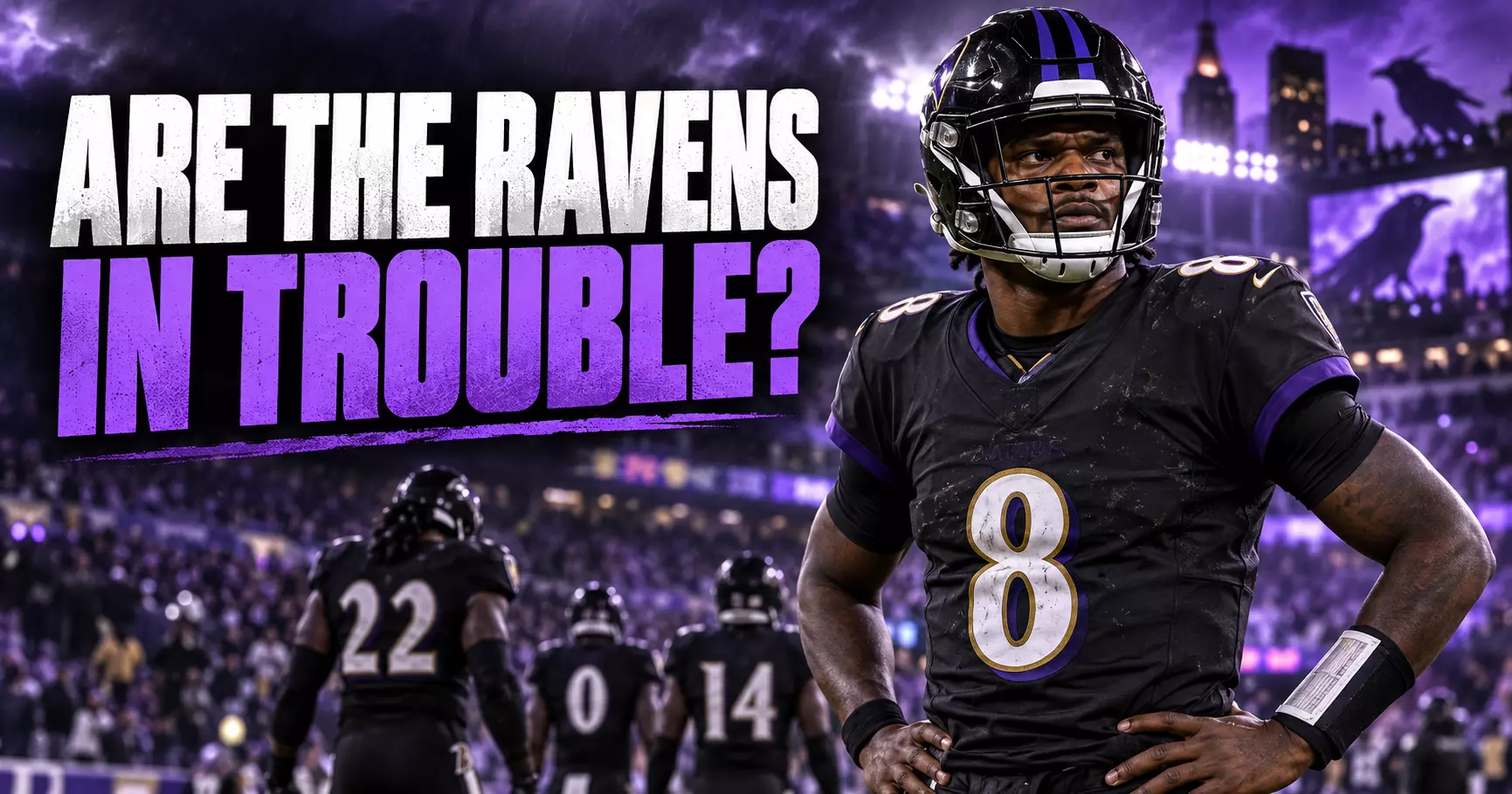
Two weeks into the 2026 NFL season, it would be ridiculous to declare the Baltimore Ravens finished. It would be equally foolish to pretend their 24–17 loss to the New Orleans Saints was merely one bad Sunday.
Baltimore is 1–1, but the record does not adequately describe what happened in its home opener. The Ravens led 14–3 during the second quarter and appeared to have control of a game they were expected to win. Instead, they scored only three points in the second half, surrendered 15 unanswered points and watched Tyler Shough direct the game-winning drive for New Orleans.
Lamar Jackson’s final opportunity ended with an interception, completing a collapse that felt painfully familiar.
The Ravens are not in a full-blown crisis. They are, however, displaying enough warning signs to make the question legitimate.
The Ravens Let Another Game Slip Away
Baltimore did not lose because the Saints dominated from the
opening kickoff.
The Ravens lost because they could not finish.
Jackson connected with Rashod Bateman for a 22-yard touchdown, and Derrick Henry added a rushing score as Baltimore established an early 14–3 advantage. The Ravens carried a 17–9 lead into the fourth quarter, when everything began to fall apart.
New Orleans tied the game on Shough’s touchdown pass to Chris Olave and a successful two-point conversion. Shough then led another late drive and scored the winning touchdown on a one-yard run with 1:28 remaining.
Jackson had one final opportunity to save Baltimore, but Julian Blackmon intercepted him with 21 seconds left.
The Ravens managed only three points during the entire second half and were shut out in the fourth quarter. New Orleans scored 15 consecutive points to turn what should have been a Baltimore victory into a 24–17 defeat.
That is not simply an execution problem. It is a mentality problem, a coaching problem and a game-management problem.
Teams with championship aspirations cannot repeatedly control games for three quarters and then become tentative when the pressure increases.
Baltimore Abandoned Derrick Henry at the Worst Time
Henry rushed for 68 yards and a touchdown on 16 carries against New Orleans. Those are not overwhelming numbers, but he was effective enough to remain central to the second-half game plan.
Instead, the Ravens moved away from him.
That decision is difficult to understand. Baltimore entered the fourth quarter with the lead. That should have been the perfect situation for Henry, whose physical running style can shorten games, punish tired defenders and keep Jackson out of obvious passing situations.
The Ravens have one of the most accomplished power backs in league history. They should not treat him like an accessory when protecting a fourth-quarter advantage.
Henry carried the ball just four times after halftime. Baltimore’s running game became less relevant precisely when it should have become the foundation of the offense.
There will be games when the Ravens need Jackson to throw 40 times. This was not one of them.
New offensive coordinator Declan Doyle deserves time to develop his system, but he must understand what makes Baltimore dangerous. The Ravens are at their best when opponents are forced to account for Jackson and Henry simultaneously.
Moving away from Henry made the offense more predictable and placed additional pressure on an offensive line that was already struggling.
The Offensive Line Is a Real Concern
Jackson was not consistently comfortable against the Saints. Baltimore’s offensive line dealt with pressure, penalties and communication problems throughout the game.
Ronnie Stanley and John Simpson were both active despite appearing on the injury report. Their availability helped, but the line never established complete control. Baltimore had trouble protecting Jackson during obvious passing situations, and its running game lacked the sustained push needed to finish drives.
This is where the Ravens’ offensive problems begin.
Jackson’s mobility can hide protection failures. He can escape pressure that would result in sacks against most quarterbacks. His ability to improvise occasionally makes a broken play look like a successful design.
That does not mean Baltimore should depend on Jackson to rescue the offense every week.
The Ravens need to create clean pockets, avoid drive-killing penalties and generate enough movement for Henry to attack defenses between the tackles. If the line cannot consistently accomplish those things, Baltimore will again become too dependent on Jackson producing something spectacular.
That may work against average opponents. It becomes much more difficult against the best teams in the AFC.
The Receiver Injuries Are Already Being Felt
Baltimore entered the season hoping to provide Jackson with a deeper collection of receiving options. That depth has already been tested.
Zay Flowers aggravated a hamstring injury after catching five passes for a career-high 150 yards and a touchdown in Baltimore’s 41–23 opening victory over Indianapolis. Rookie Ja’Kobi Lane later underwent wrist surgery and was placed on injured reserve, meaning he must miss at least four games.
Flowers did not play against New Orleans.
Bateman responded with seven receptions for 88 yards and a touchdown, providing one of the few encouraging performances from the defeat. Mark Andrews added 49 receiving yards, and Devontez Walker produced a 49-yard reception.
Those contributions were valuable, but the offense clearly missed Flowers’ explosiveness.
Without him, the Saints could play more aggressively near the line of scrimmage. Baltimore lacked a receiver who consistently forced the secondary to defend every blade of grass.
Flowers’ absence does not excuse the loss. The Ravens still had more than enough offensive talent to defeat New Orleans at home.
It does expose how quickly their receiving depth could become a serious problem.
The Defense Could Not Get Off the Field
Baltimore’s defense
did several things well. New Orleans rushed for only 65 yards, and the Ravens prevented the Saints from controlling the game on the ground.
But when Baltimore needed a stop, it could not produce one.
Shough completed 27 of 34 passes for 252 yards, one passing touchdown and the game-winning rushing score. Olave caught eight passes for 86 yards and repeatedly found space in important situations.
The Ravens struggled to generate consistent pressure, allowing a young quarterback to remain comfortable during the most important possessions of the game.
That should be especially concerning under new head coach Jesse Minter, whose defensive reputation helped him earn the job. Minter does not need to create an elite defense immediately, but Baltimore cannot allow an opposing quarterback to calmly direct consecutive fourth-quarter scoring drives at M&T Bank Stadium.
The secondary also surrendered too many completions at critical moments. Baltimore’s defensive talent is too good for communication failures and missed assignments to become recurring problems.
Minter’s defense will improve as players become more comfortable with the system. The Saints loss showed that the transition is not complete.
Special Teams Are No Longer an Automatic Advantage
For years, Baltimore’s special teams were considered one of the organization’s greatest strengths. The Ravens could depend on superior preparation, field position and Justin Tucker’s reliability in close games.
That advantage no longer feels automatic.
A blocked field-goal attempt against New Orleans eliminated a scoring opportunity. Baltimore also allowed a long kickoff return that helped place the Saints in position to generate points.
Those mistakes matter in a seven-point game.
The Ravens were not defeated by one catastrophic special-teams error. They lost because mistakes accumulated across all three phases. The offense stopped scoring, the defense could not close the game, and the special-teams units failed to provide an advantage.
That is why this defeat should bother Baltimore more than a typical September loss.
It was a complete team failure.
Lamar Jackson Cannot Solve Everything
Whenever the Ravens struggle, the easiest reaction is to focus on Jackson.
He completed approximately 67 percent of his passes against New Orleans and threw a touchdown, but his late interception ended Baltimore’s comeback attempt. Jackson deserves criticism for that decision.
He does not deserve all the blame.
Jackson is already asked to create explosive plays, compensate for protection breakdowns, threaten defenses with his legs and produce during high-pressure possessions. When the running game disappears and receivers struggle to separate, the entire offense becomes dependent on him.
That is not a sustainable championship formula.
Baltimore has spent years attempting to build the right structure around Jackson. The Ravens have added Henry, invested in the offensive line and tried to improve the receiving corps.
Yet the same problem continues to appear: When games become tight, Baltimore often stops dictating the action and asks Jackson to manufacture a victory.
A two-time MVP can occasionally do that. He should not have to do it every week.
The Dallas Game Has Become Much More Important
Baltimore will next face the Dallas Cowboys in Brazil.
The Ravens do not have to win in Week 3 to save their season, but their performance will tell us a great deal about their ability to respond. A victory would move Baltimore to 2–1 and make the New Orleans loss look like an early-season stumble.
Another fourth-quarter collapse would suggest something deeper is wrong.
After Dallas, Baltimore faces Tennessee, Atlanta and Cleveland before hosting Cincinnati. That portion of the schedule provides an opportunity to establish momentum, but it also leaves little room for repeated mistakes.
The Ravens cannot allow one bad loss to become an identity.
Jackson, Henry and a talented defense give Baltimore enough ability to contend in the AFC. The season’s opening victory at Indianapolis demonstrated the team’s ceiling: Jackson threw for 324 yards, Henry rushed for 144 and Flowers produced 150 receiving yards in a 41–23 win.
One week later, Baltimore showed its floor.
So, Are the Ravens in Trouble?
The answer is yes—but not because they are 1–1.
The Ravens are in trouble because the weaknesses that cost them against New Orleans are not isolated concerns. Fourth-quarter execution, questionable offensive decisions, inconsistent protection and an inability to close games have followed this organization through multiple seasons and different coaching structures.
Baltimore still has too much talent to panic.
Jackson remains one of the NFL’s most dangerous quarterbacks. Henry can still control games. Flowers should eventually return, and Minter’s defense should improve as it becomes more comfortable in the new system.
New Users – Get $350 in Bonus Bets when you wager $5 for 7 days
T&Cs apply
4.6/5
Gambling Problem? Call 1-800-GAMBLER or 1-800-MY-RESET. Call 1-888-789-7777 or visit ccpgg.org/chat (CT). Hope is here. GamblingHelpLineMA.org or call (800) 327-5050 for 24/7 support (MA). Visit www.mdgamblinghelp.org (MD). Call 1-877-8HOPE-NY or text HOPENY (NY). 21+ (18+ DC, WY) and present in select states (for KS, in affiliation with Kansas Star Casino). Find online real money wagering only. Min $5 wager required for 7 consecutive days. $5 free play credit. Bonus issued as non-withdrawable bonus with cash withdrawable bonus with cash withdrawable. Bonus bets which expire 7 days after receipt. Restrictions apply. See terms at sportsbook.fanduel.com. Call 1-877-770-7867 (LA).
Up To $1500 in Bonus Bets Paid Back if your First Bet Does Not Win
T&Cs apply
4.5/5
Gambling problem? Call 1-800-GAMBLER or 1-800-MY-RESET (Available in the US) 877-8-HOPENY or text HOPENY (467369) (NY) 1-800-327-5050 (MA), 1-800-BETS-OFF (IA), 1-800-981-0023 (PR). 21+ only. Please Gamble Responsibly. See BetMGM.com for Terms. First Bet Offer for new customers only (if applicable). Subject to eligibility requirements. Bonus bets are non-withdrawable. In partnership with Kansas Crossing Casino and Hotel. Promotional offers not available in Mississippi, Massachusetts, New York, Ontario, or Puerto Rico.
New DraftKings Customers: Bet $5, Get $200 + 3 Months of NBA League Pass!
T&Cs apply
4.5/5
GAMBLING PROBLEM? CALL 1-800-GAMBLER or 1-800-MY-RESET, (800) 327-5050 or visit gamblinghelplinema.org (MA). Please Gamble Responsibly. 888-789-7777/visit ccpg.org (CT), or visit www.mdgamblinghelp.org (MD), 1-800-981-0023 (PR). 21+ and present in most states. (18+ DC/NH/PR/WY). Void in CAN. Eligibility restrictions apply. On behalf of Boot Hill Casino (KS). Pass-thru of per wager tax may apply in IL. 1 per new Sportsbook customer. $5+ first-time bet req. Max. $200 issued as non-withdrawable Bonus Bets. Stake removed from payout. Reward issued as $50 in Bonus Bets every 7 days via click-to-claim for 21 days. Bonus Bets and click-to-claims expire 7 days (168hrs) after issuance. Terms: dkng.co/offer. Get 1 promo code to redeem a 3-month NBA League Pass subscription, complimentary of DraftKings. Subscription auto-renews monthly at then-current price (currently $16.99/mo); cancel anytime. Terms, restrictions, and eligibility requirements apply. Redeem League Pass by 12/19/26 at 11:59 PM ET. Addt’l terms: support.watch.nba.com/hc/en-us/articles/9165532876183-League-Pass-Terms-of-Use_. Ends 11/29/26 at 11:59 PM ET. Sponsored by DK.
Must be 21+. GAMBLING PROBLEM? CALL 1-800-GAMBLER OR CALL 1-800-MY-RESET, www.mdgamblinghelp.org (MD), (800)-327-5050 or gamblinghelplinema.org (MA), Call (877)8-HOPENY or text HOPENY (467369) (NY), (888) 789-7777 or ccpg.org (CT), morethanagame.nc.gov (NC), 1800gambler.net (WV)
Bet $1 and get double the winnings up to $25 for your next 10 bets
T&Cs apply
4.4/5
21+ New users only. Must register using eligible promo code. First bet after registration must qualify. Max. Bonus Bet: $1,000. Bonus Bet expires 14 days after receipt. Void where prohibited. See Caesars.com/promos for full terms. Gambling Problem? 1-800-GAMBLER (1-800-426-2537)
21+ and present in OH. Gambling Problem? Call 1-800-GAMBLER.
This site is using
Cloudflare
and adheres to the
Google Safe Browsing Program. We adapted
Google's Privacy Guidelines
to keep your data safe at all times.
Close
Ready to Win Big? Join the Elite with Our Sports Betting Deals!
FanDuel Promo
New Users – Get $350 in Bonus Bets when you wager $5 for 7 days
Our Favorite
T&Cs and 21+ apply
Gambling Problem? Call 1-800-GAMBLER or 1-800-MY-RESET. Call 1-888-789-7777 or visit ccpgg.org/chat (CT). Hope is here. GamblingHelpLineMA.org or call (800) 327-5050 for 24/7 support (MA). Visit www.mdgamblinghelp.org (MD). Call 1-877-8HOPE-NY or text HOPENY (NY). 21+ (18+ DC, WY) and present in select states (for KS, in affiliation with Kansas Star Casino). Find online real money wagering only. Min $5 wager required for 7 consecutive days. $5 free play credit. Bonus issued as non-withdrawable bonus with cash withdrawable bonus with cash withdrawable. Bonus bets which expire 7 days after receipt. Restrictions apply. See terms at sportsbook.fanduel.com. Call 1-877-770-7867 (LA).
Code:
Open FanDuel
Get Bonus
BetMGM Promo
Up To $1500 in Bonus Bets Paid Back if your First Bet Does Not Win
Best Slots
T&Cs and 21+ apply
Gambling problem? Call 1-800-GAMBLER or 1-800-MY-RESET (Available in the US) 877-8-HOPENY or text HOPENY (467369) (NY) 1-800-327-5050 (MA), 1-800-BETS-OFF (IA), 1-800-981-0023 (PR). 21+ only. Please Gamble Responsibly. See BetMGM.com for Terms. First Bet Offer for new customers only (if applicable). Subject to eligibility requirements. Bonus bets are non-withdrawable. In partnership with Kansas Crossing Casino and Hotel. Promotional offers not available in Mississippi, Massachusetts, New York, Ontario, or Puerto Rico.
Code:
Open BetMGM
Get Bonus
DraftKings Promo
New DraftKings Customers: Bet $5, Get $200 + 3 Months of NBA League Pass!
Newcomer
T&Cs and 21+ apply
GAMBLING PROBLEM? CALL 1-800-GAMBLER or 1-800-MY-RESET, (800) 327-5050 or visit gamblinghelplinema.org (MA). Please Gamble Responsibly. 888-789-7777/visit ccpg.org (CT), or visit www.mdgamblinghelp.org (MD), 1-800-981-0023 (PR). 21+ and present in most states. (18+ DC/NH/PR/WY). Void in CAN. Eligibility restrictions apply. On behalf of Boot Hill Casino (KS). Pass-thru of per wager tax may apply in IL. 1 per new Sportsbook customer. $5+ first-time bet req. Max. $200 issued as non-withdrawable Bonus Bets. Stake removed from payout. Reward issued as $50 in Bonus Bets every 7 days via click-to-claim for 21 days. Bonus Bets and click-to-claims expire 7 days (168hrs) after issuance. Terms: dkng.co/offer. Get 1 promo code to redeem a 3-month NBA League Pass subscription, complimentary of DraftKings. Subscription auto-renews monthly at then-current price (currently $16.99/mo); cancel anytime. Terms, restrictions, and eligibility requirements apply. Redeem League Pass by 12/19/26 at 11:59 PM ET. Addt’l terms: support.watch.nba.com/hc/en-us/articles/9165532876183-League-Pass-Terms-of-Use_. Ends 11/29/26 at 11:59 PM ET. Sponsored by DK.
Code:
Open DraftKings
Get Bonus
Find out what the legends have to say about sports this week....
New Users – Get $350 in Bonus Bets when you wager $5 for 7 days
Gambling Problem? Call 1-800-GAMBLER or 1-800-MY-RESET. Call 1-888-789-7777 or visit ccpgg.org/chat (CT). Hope is here. GamblingHelpLineMA.org or call (800) 327-5050 for 24/7 support (MA). Visit www.mdgamblinghelp.org (MD). Call 1-877-8HOPE-NY or text HOPENY (NY). 21+ (18+ DC, WY) and present in select states (for KS, in affiliation with Kansas Star Casino). Find online real money wagering only. Min $5 wager required for 7 consecutive days. $5 free play credit. Bonus issued as non-withdrawable bonus with cash withdrawable bonus with cash withdrawable. Bonus bets which expire 7 days after receipt. Restrictions apply. See terms at sportsbook.fanduel.com. Call 1-877-770-7867 (LA).