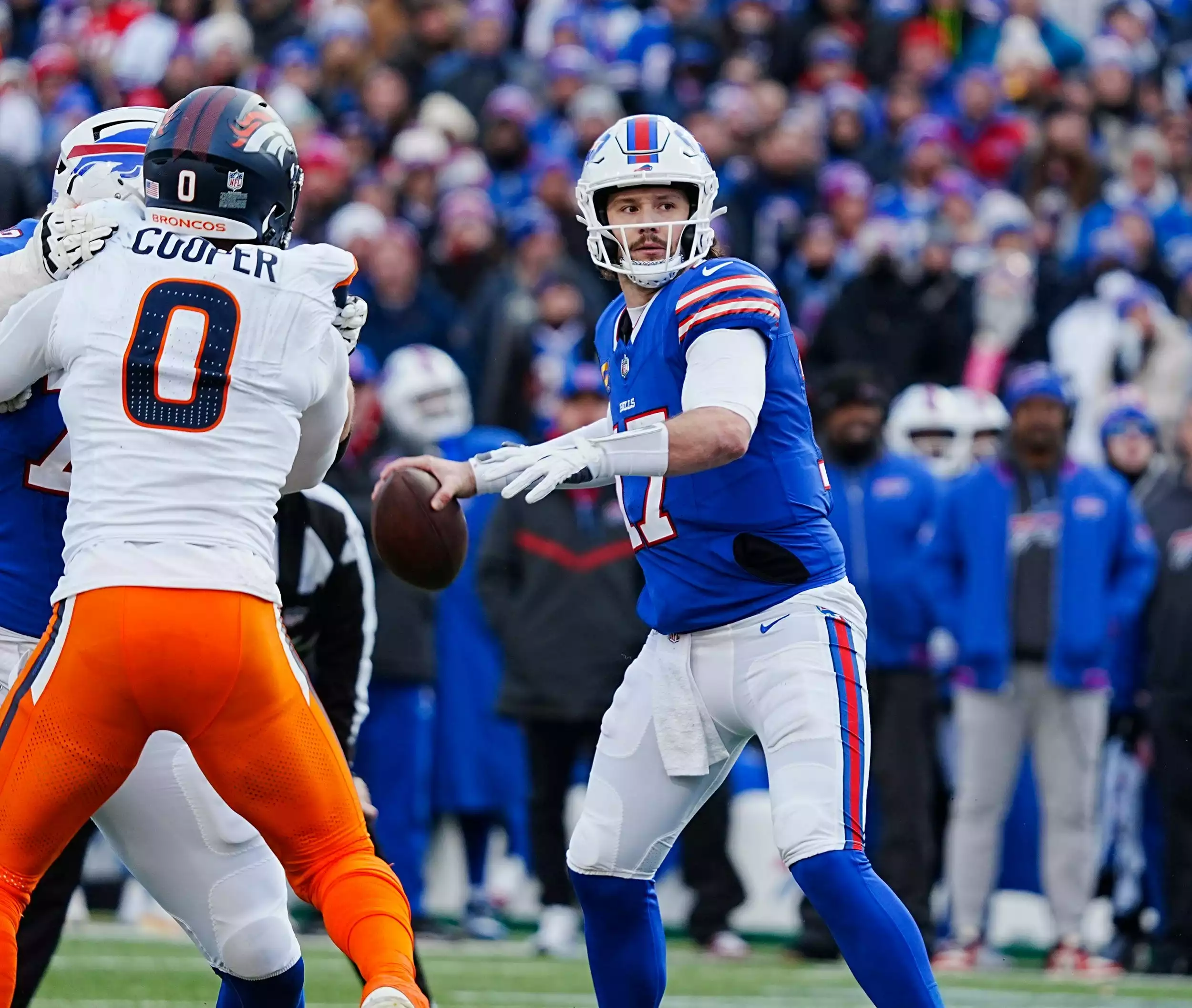
Buffalo Bills quarterback Josh Allen (17) throws a long pass during the second half of the Buffalo Bills wild card game against the Denver Broncos at Highmark Stadium in Orchard Park on Jan. 12, 2025.
The AFC East has two teams still trying to build and two expected to carry real pressure into the season. That makes the draft feel different for the Buffalo Bills and Miami Dolphins, even with both teams entering Year 1 under a new head coach. Buffalo is trying to protect a window. Miami is trying to build the next one.
Both are headed into this draft with a lot on the line, just in very different ways.
Buffalo Bills: This Draft Could Say a Lot About How Strong the Roster Really Is
The Bills are in the part of the draft where good teams can still get themselves in trouble. They’re picking late because they’re still built around Josh Allen, but there are enough soft spots on the roster for this draft to reveal a lot about how sturdy they really are.
This is not a team searching for answers everywhere.
Quarterback is settled. Running back is locked in. Tight end is one of the stronger groups on the roster. The core that matters is still there.
The issues are more specific, and those are the kinds of weaknesses that can show up at the wrong time.
Cornerback opposite
Christian Benford
is still a question, especially with Maxwell Hairston not fully established yet. Inside linebacker is a fit question in Jim Leonhard’s defense. Left guard still looks unsettled. These are not glamorous needs, but they are exactly the kind of spots that can get exposed when the season tightens up.
Buffalo sits in a familiar spot at No. 26. Too good to pick high, but not complete enough to miss. The board there feels more like an edge, linebacker, safety, or maybe wide receiver spot than a dream scenario. If the Bills want more speed off the edge, Cashius Howell (edge, Texas A&M), T.J. Parker (edge, Clemson), Akheem Mesidor (edge, Miami), or R Mason Thomas (edge, Oklahoma) are much more realistic names in that range.
If Buffalo wants to address the middle of the defense, CJ Allen (linebacker, Georgia) fits the type of player who could help right away in a changing scheme. Dillon Thienemen (safety, Oregon) also makes sense if the Bills want more defensive flexibility on the back end. And if they decide to help Allen instead, KC Concepcion (wide receiver, Texas A&M) is the kind of player who would fit the offense a lot more naturally than forcing a bigger swing that likely is not there at 26.
That is usually where teams like this get tested. Not by whether they can land the flashy player everyone talks about, but by whether they can come away with someone who makes them more complete. A good Bills draft probably looks pretty boring. More stability, fewer weak spots, and less pressure on Allen to drag everything uphill again.
The Bills need to ensure the small questions on the roster do not become the reason the season ends earlier than expected.
Miami Dolphins: This Draft Has To Build the Next Version of the Roster
Miami is operating in a completely different lane. There is no honest way to look at this roster and call it complete, even if the organization has avoided using the word rebuild. The direction is clear anyway. The Dolphins are getting younger, getting cheaper, and resetting their timeline under new general manager Jon-Eric Sullivan and head coach Jeff Hafley.
The Jaylen Waddle trade made that obvious. So did the amount of dead money they are carrying this year.
What stands out is how deliberate the approach has been.
Sullivan has talked about building for the long term, and the decisions line up with that.
De’Von Achane
is one of the few offensive pieces they are clearly trying to carry forward, and even there, the focus has been on managing his workload and building depth behind him rather than asking him to do everything.
This is not about finishing the roster for 2026. It is about stacking players who can still matter when the Dolphins are ready to compete again.
Defense feels like the priority.
Hafley is reshaping that side of the ball almost from the ground up, and the lack of continuity shows up across multiple position groups. Cornerback, pass rusher, and overall defensive depth all feel like areas that need attention early. If Miami stays at No. 11, Francis Mauigoa (tackle/guard, Miami), Mansoor Delane (cornerback, LSU), Sonny Styles (linebacker, Ohio State), and Caleb Downs (safety, Ohio State) are the kinds of names that actually fit both the board and the bigger direction of the roster. Mauigoa would make sense if Miami wants to keep building from the line out. Delane fits if the Dolphins want a long-term answer at corner. Styles or Downs would give the defense more versatility and range. If that cluster is gone, trading down would make plenty of sense.
By the time Miami gets to No. 30, the conversation could shift toward another long-view investment. That is where a defensive tackle like Christen Miller (defensive tackle, Georgia) becomes much more believable, especially if the Dolphins keep leaning into the idea that they are not trying to patch this thing together in one offseason.
Offensively, there are still questions, but they are different.
Malik Willis is expected to take over at quarterback, which brings upside but also uncertainty. The offensive line still needs attention, especially if Miami wants to give Willis a fair evaluation. The skill group has some pieces, but it is not deep enough to carry the team if things are uneven early. Another running back later in the draft would not be shocking either if the Dolphins want a sturdier complement behind Achane and more competition in that room.
Miami is too early in this reset to act like one draft solves the problem. The smarter outcome is to come out of it with more young defenders, more offensive line help, and a roster that makes a little more sense than the one they have right now. That would be a good start.
New Users – Get $350 in Bonus Bets when you wager $5 for 7 days
T&Cs apply
4.6/5
Gambling Problem? Call 1-800-GAMBLER or 1-800-MY-RESET. Call 1-888-789-7777 or visit ccpgg.org/chat (CT). Hope is here. GamblingHelpLineMA.org or call (800) 327-5050 for 24/7 support (MA). Visit www.mdgamblinghelp.org (MD). Call 1-877-8HOPE-NY or text HOPENY (NY). 21+ (18+ DC, WY) and present in select states (for KS, in affiliation with Kansas Star Casino). Find online real money wagering only. Min $5 wager required for 7 consecutive days. $5 free play credit. Bonus issued as non-withdrawable bonus with cash withdrawable bonus with cash withdrawable. Bonus bets which expire 7 days after receipt. Restrictions apply. See terms at sportsbook.fanduel.com. Call 1-877-770-7867 (LA).
Up To $1500 in Bonus Bets Paid Back if your First Bet Does Not Win
T&Cs apply
4.5/5
Gambling problem? Call 1-800-GAMBLER or 1-800-MY-RESET (Available in the US) 877-8-HOPENY or text HOPENY (467369) (NY) 1-800-327-5050 (MA), 1-800-BETS-OFF (IA), 1-800-981-0023 (PR). 21+ only. Please Gamble Responsibly. See BetMGM.com for Terms. First Bet Offer for new customers only (if applicable). Subject to eligibility requirements. Bonus bets are non-withdrawable. In partnership with Kansas Crossing Casino and Hotel. Promotional offers not available in Mississippi, Massachusetts, New York, Ontario, or Puerto Rico.
New DraftKings Customers: Bet $5, Get $200 + 3 Months of NBA League Pass!
T&Cs apply
4.5/5
GAMBLING PROBLEM? CALL 1-800-GAMBLER or 1-800-MY-RESET, (800) 327-5050 or visit gamblinghelplinema.org (MA). Please Gamble Responsibly. 888-789-7777/visit ccpg.org (CT), or visit www.mdgamblinghelp.org (MD), 1-800-981-0023 (PR). 21+ and present in most states. (18+ DC/NH/PR/WY). Void in CAN. Eligibility restrictions apply. On behalf of Boot Hill Casino (KS). Pass-thru of per wager tax may apply in IL. 1 per new Sportsbook customer. $5+ first-time bet req. Max. $200 issued as non-withdrawable Bonus Bets. Stake removed from payout. Reward issued as $50 in Bonus Bets every 7 days via click-to-claim for 21 days. Bonus Bets and click-to-claims expire 7 days (168hrs) after issuance. Terms: dkng.co/offer. Get 1 promo code to redeem a 3-month NBA League Pass subscription, complimentary of DraftKings. Subscription auto-renews monthly at then-current price (currently $16.99/mo); cancel anytime. Terms, restrictions, and eligibility requirements apply. Redeem League Pass by 12/19/26 at 11:59 PM ET. Addt’l terms: support.watch.nba.com/hc/en-us/articles/9165532876183-League-Pass-Terms-of-Use_. Ends 11/29/26 at 11:59 PM ET. Sponsored by DK.
Must be 21+. GAMBLING PROBLEM? CALL 1-800-GAMBLER OR CALL 1-800-MY-RESET, www.mdgamblinghelp.org (MD), (800)-327-5050 or gamblinghelplinema.org (MA), Call (877)8-HOPENY or text HOPENY (467369) (NY), (888) 789-7777 or ccpg.org (CT), morethanagame.nc.gov (NC), 1800gambler.net (WV)
Bet $1 and get double the winnings up to $25 for your next 10 bets
T&Cs apply
4.4/5
21+ New users only. Must register using eligible promo code. First bet after registration must qualify. Max. Bonus Bet: $1,000. Bonus Bet expires 14 days after receipt. Void where prohibited. See Caesars.com/promos for full terms. Gambling Problem? 1-800-GAMBLER (1-800-426-2537)
21+ and present in OH. Gambling Problem? Call 1-800-GAMBLER.
This site is using
Cloudflare
and adheres to the
Google Safe Browsing Program. We adapted
Google's Privacy Guidelines
to keep your data safe at all times.
Close
Ready to Win Big? Join the Elite with Our Sports Betting Deals!
FanDuel Promo
New Users – Get $350 in Bonus Bets when you wager $5 for 7 days
Our Favorite
T&Cs and 21+ apply
Gambling Problem? Call 1-800-GAMBLER or 1-800-MY-RESET. Call 1-888-789-7777 or visit ccpgg.org/chat (CT). Hope is here. GamblingHelpLineMA.org or call (800) 327-5050 for 24/7 support (MA). Visit www.mdgamblinghelp.org (MD). Call 1-877-8HOPE-NY or text HOPENY (NY). 21+ (18+ DC, WY) and present in select states (for KS, in affiliation with Kansas Star Casino). Find online real money wagering only. Min $5 wager required for 7 consecutive days. $5 free play credit. Bonus issued as non-withdrawable bonus with cash withdrawable bonus with cash withdrawable. Bonus bets which expire 7 days after receipt. Restrictions apply. See terms at sportsbook.fanduel.com. Call 1-877-770-7867 (LA).
Code:
Open FanDuel
Get Bonus
BetMGM Promo
Up To $1500 in Bonus Bets Paid Back if your First Bet Does Not Win
Best Slots
T&Cs and 21+ apply
Gambling problem? Call 1-800-GAMBLER or 1-800-MY-RESET (Available in the US) 877-8-HOPENY or text HOPENY (467369) (NY) 1-800-327-5050 (MA), 1-800-BETS-OFF (IA), 1-800-981-0023 (PR). 21+ only. Please Gamble Responsibly. See BetMGM.com for Terms. First Bet Offer for new customers only (if applicable). Subject to eligibility requirements. Bonus bets are non-withdrawable. In partnership with Kansas Crossing Casino and Hotel. Promotional offers not available in Mississippi, Massachusetts, New York, Ontario, or Puerto Rico.
Code:
Open BetMGM
Get Bonus
DraftKings Promo
New DraftKings Customers: Bet $5, Get $200 + 3 Months of NBA League Pass!
Newcomer
T&Cs and 21+ apply
GAMBLING PROBLEM? CALL 1-800-GAMBLER or 1-800-MY-RESET, (800) 327-5050 or visit gamblinghelplinema.org (MA). Please Gamble Responsibly. 888-789-7777/visit ccpg.org (CT), or visit www.mdgamblinghelp.org (MD), 1-800-981-0023 (PR). 21+ and present in most states. (18+ DC/NH/PR/WY). Void in CAN. Eligibility restrictions apply. On behalf of Boot Hill Casino (KS). Pass-thru of per wager tax may apply in IL. 1 per new Sportsbook customer. $5+ first-time bet req. Max. $200 issued as non-withdrawable Bonus Bets. Stake removed from payout. Reward issued as $50 in Bonus Bets every 7 days via click-to-claim for 21 days. Bonus Bets and click-to-claims expire 7 days (168hrs) after issuance. Terms: dkng.co/offer. Get 1 promo code to redeem a 3-month NBA League Pass subscription, complimentary of DraftKings. Subscription auto-renews monthly at then-current price (currently $16.99/mo); cancel anytime. Terms, restrictions, and eligibility requirements apply. Redeem League Pass by 12/19/26 at 11:59 PM ET. Addt’l terms: support.watch.nba.com/hc/en-us/articles/9165532876183-League-Pass-Terms-of-Use_. Ends 11/29/26 at 11:59 PM ET. Sponsored by DK.
Code:
Open DraftKings
Get Bonus
Find out what the legends have to say about sports this week....
New Users – Get $350 in Bonus Bets when you wager $5 for 7 days
Gambling Problem? Call 1-800-GAMBLER or 1-800-MY-RESET. Call 1-888-789-7777 or visit ccpgg.org/chat (CT). Hope is here. GamblingHelpLineMA.org or call (800) 327-5050 for 24/7 support (MA). Visit www.mdgamblinghelp.org (MD). Call 1-877-8HOPE-NY or text HOPENY (NY). 21+ (18+ DC, WY) and present in select states (for KS, in affiliation with Kansas Star Casino). Find online real money wagering only. Min $5 wager required for 7 consecutive days. $5 free play credit. Bonus issued as non-withdrawable bonus with cash withdrawable bonus with cash withdrawable. Bonus bets which expire 7 days after receipt. Restrictions apply. See terms at sportsbook.fanduel.com. Call 1-877-770-7867 (LA).