While the conference’s biggest names dominate the national conversation, the Badgers are building momentum with a quarterback
Wisconsin is giving the Big Ten a reason to pay attention.
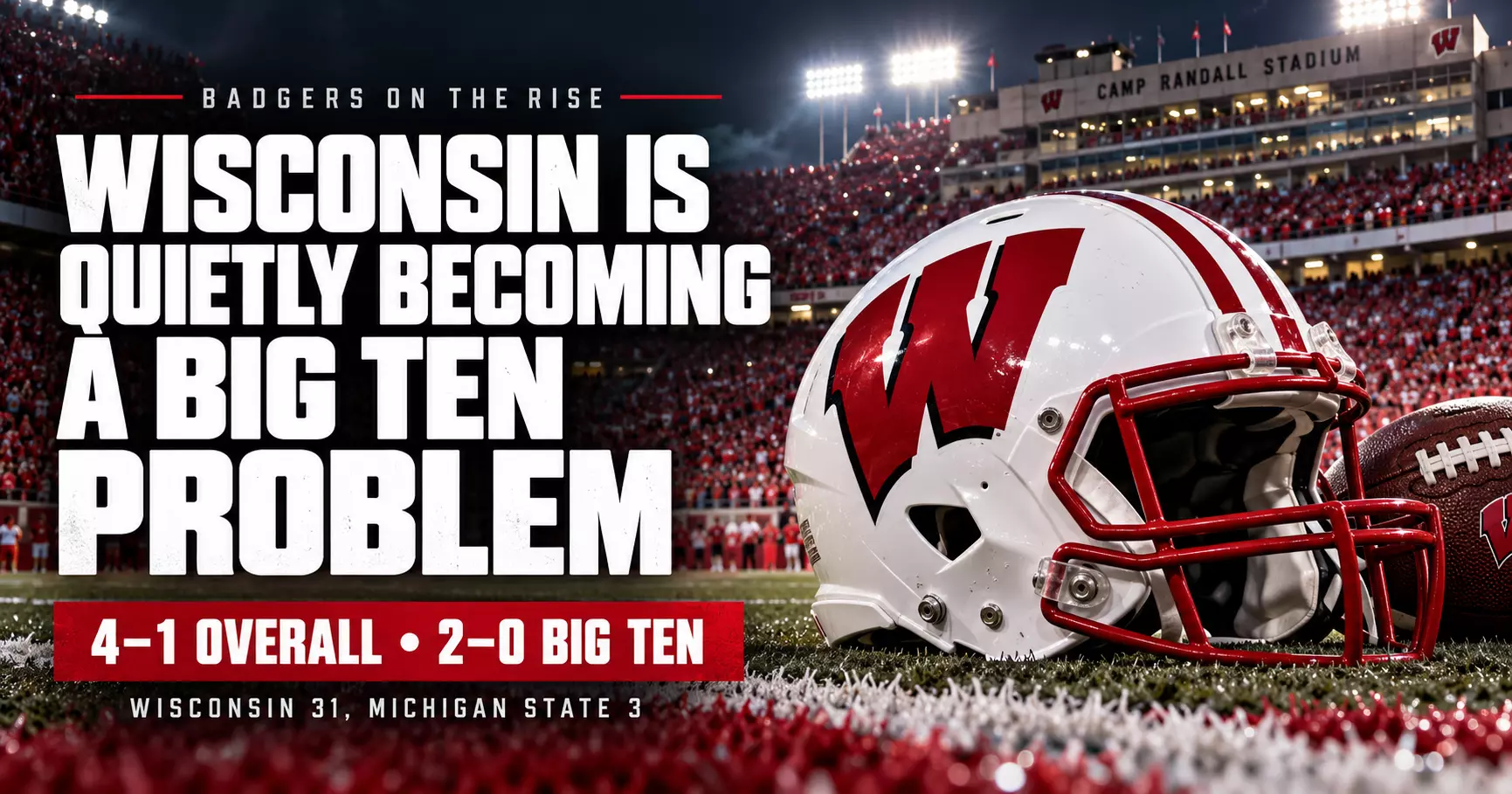
While the conference’s biggest names dominate the national conversation, the Badgers are building momentum with a quarterback who makes them increasingly difficult to defend. Saturday’s 31–3 victory over Michigan State pushed Wisconsin to 4–1 overall and 2–0 in conference play, extending its winning streak to four games.
Colton Joseph was at the center of it. He rushed for 141 yards and a touchdown while throwing for 145 yards and three more scores. His rushing total was the second-highest single-game mark by a quarterback in Wisconsin history.
Those numbers help explain why Wisconsin deserves more attention. Joseph gives the Badgers an offensive dimension that forces defenses to account for the quarterback long after the ball is snapped.
The question now is how far that dimension can take them. Where did the Badgers stand last week in the
Week 4 Big Ten Football Power Rankings
last week?
Colton Joseph Changes the Defensive Calculation
A mobile quarterback creates problems that go beyond his rushing statistics.
Against a quarterback who stays in the pocket, defenders can concentrate on the running back, the receivers and their assigned coverage responsibilities. When the quarterback can escape for a substantial gain, every defensive decision becomes more complicated.
Pass rushers have to maintain their lanes. Linebackers must balance their coverage responsibilities with the possibility of a scramble. Defenders playing man coverage risk turning their backs on a quarterback capable of taking advantage of open space.
Joseph makes those concerns relevant on every passing down.
Michigan State saw the consequences Saturday. His 141 rushing yards came on 13 carries, and his 47-yard touchdown run helped Wisconsin extend its advantage in the second half.
Wisconsin does not need Joseph to produce that rushing total every week. It needs opponents to respect the possibility.
That respect can create opportunities elsewhere. A defender who hesitates before pursuing a running back or dropping into coverage gives the offense a little more room to operate. Over the course of a game, those small advantages matter.
Wisconsin Set the Terms Early
The Badgers established control before Michigan State could settle into the game.
On Wisconsin’s opening possession, Joseph rushed for 39 yards before finding tight end Jacob Harris for a 20-yard touchdown. Joseph and Harris connected again for a 15-yard score later in the first quarter, helping Wisconsin build a 14–0 lead.
That sequence illustrated the difficulty of defending this offense. Joseph contributed on the ground, then finished possessions through the air.
For Wisconsin, the early lead also shaped the rest of the afternoon.
The Badgers
could play without the pressure of chasing the score, while Michigan State had to find answers against a defense that was making sustained drives difficult.
Starting quickly will become even more valuable against stronger opponents. Wisconsin cannot assume it will always dominate, but establishing an early rhythm gives its offense more options and prevents opponents from dictating the entire game.
Joseph’s Mobility Helps—but the Passing Game Must Keep Growing
There is a difference between having an exciting quarterback and having a complete offense.
Joseph gives Wisconsin a valuable escape route when a play breaks down. To challenge the best teams in the conference, the Badgers also need dependable production when defenses keep him contained.
Saturday offered both encouragement and a reason for continued improvement.
Joseph threw three touchdown passes, but completed nine of his 20 attempts. That combination shows an offense capable of converting important opportunities while still leaving room for greater consistency.
Against better defenses, missed throws can leave an offense facing third-and-long. Those situations allow opponents to narrow their focus and increase pressure.
Wisconsin needs Joseph’s passing game to complement his running ability consistently. Accurate early-down throws, reliable protection and receivers who finish plays will determine how often the offense can sustain drives without requiring its quarterback to rescue them.
The upside is clear. So is the next step.
The Defense Deserves Its Share of the Credit
Joseph was the headline, but Wisconsin’s defense made the victory comfortable.
Michigan State managed only a field goal and went scoreless after halftime. The Spartans finished with just 108 passing yards.
That defensive control is essential to Wisconsin’s broader prospects.
A mobile quarterback can produce spectacular moments, but a team becomes more dependable when it can win during the stretches when those moments do not arrive. The Badgers’ defense gave their offense that support.
It also kept Michigan State from turning a difficult possession into a meaningful shift in momentum. Wisconsin could continue playing its game rather than responding to an opponent’s comeback.
The strongest version of this team will combine Joseph’s ability to create with a defense that limits scoring opportunities. Saturday showed how effective that combination can be.
The Penn State Win Gives This Run More Substance
Wisconsin’s momentum extends beyond beating a struggling Michigan State team.
The Badgers went to Penn State the previous week and won 24–20. Following that road victory with a decisive home performance gives their unbeaten conference start more credibility.
Penn State’s subsequent struggles should temper any attempt to make that result look bigger than it is. Even so, winning a conference game away from home remains meaningful.
Wisconsin has now shown it can finish a tight matchup and take control of another. Those are different challenges, and handling both is encouraging.
The Badgers deserve to be evaluated on those performances. Their record has earned them a place in the conversation, even if the strongest evidence of their ceiling is still ahead.
UCLA and USC Will Help Define Wisconsin’s Ceiling
After an open week, Wisconsin travels to UCLA on October 17 before returning home to face USC on October 24. Those games will provide a useful measure of whether the Badgers can sustain their progress against stronger conference opposition.
The central questions are straightforward.
Can Wisconsin protect Joseph well enough to let the passing game develop? Can he remain efficient when defenders close off the running lanes? Can the defense hold up when the opposing offense presents more threats?
Those tests will reveal whether Wisconsin’s current strengths translate across different matchups.
Joseph’s legs give the Badgers a chance to create problems for almost anyone. Their ability to execute the ordinary plays—blocking, tackling, completing manageable throws and avoiding damaging mistakes—will determine how often those problems become victories.
Wisconsin Has Earned More Attention
It is too early to place Wisconsin alongside the conference’s strongest championship favorites. It is also becoming difficult to dismiss the Badgers as a team destined to settle into the middle of the standings.
They have momentum, an unbeaten conference record and a quarterback who expands what their offense can do.
Joseph forces opponents to prepare for more than a conventional passing game.
Wisconsin’s defense
is giving him room to operate without needing every possession to become a scoring drive.
That is a promising foundation.
The Badgers still have to prove they can reproduce it against better teams. Their passing consistency needs to improve, and upcoming opponents will test whether their defensive control can hold.
But Wisconsin has earned the opportunity to answer those questions from a position of strength. The rest of the Big Ten should be paying attention, because preparing for Colton Joseph and the Badgers is becoming a more demanding assignment.
New Users – Get $350 in Bonus Bets when you wager $5 for 7 days
T&Cs apply
4.6/5
Gambling Problem? Call 1-800-GAMBLER or 1-800-MY-RESET. Call 1-888-789-7777 or visit ccpgg.org/chat (CT). Hope is here. GamblingHelpLineMA.org or call (800) 327-5050 for 24/7 support (MA). Visit www.mdgamblinghelp.org (MD). Call 1-877-8HOPE-NY or text HOPENY (NY). 21+ (18+ DC, WY) and present in select states (for KS, in affiliation with Kansas Star Casino). Find online real money wagering only. Min $5 wager required for 7 consecutive days. $5 free play credit. Bonus issued as non-withdrawable bonus with cash withdrawable bonus with cash withdrawable. Bonus bets which expire 7 days after receipt. Restrictions apply. See terms at sportsbook.fanduel.com. Call 1-877-770-7867 (LA).
Up To $1500 in Bonus Bets Paid Back if your First Bet Does Not Win
T&Cs apply
4.5/5
Gambling problem? Call 1-800-GAMBLER or 1-800-MY-RESET (Available in the US) 877-8-HOPENY or text HOPENY (467369) (NY) 1-800-327-5050 (MA), 1-800-BETS-OFF (IA), 1-800-981-0023 (PR). 21+ only. Please Gamble Responsibly. See BetMGM.com for Terms. First Bet Offer for new customers only (if applicable). Subject to eligibility requirements. Bonus bets are non-withdrawable. In partnership with Kansas Crossing Casino and Hotel. Promotional offers not available in Mississippi, Massachusetts, New York, Ontario, or Puerto Rico.
New DraftKings Customers: Bet $5, Get $200 + 3 Months of NBA League Pass!
T&Cs apply
4.5/5
GAMBLING PROBLEM? CALL 1-800-GAMBLER or 1-800-MY-RESET, (800) 327-5050 or visit gamblinghelplinema.org (MA). Please Gamble Responsibly. 888-789-7777/visit ccpg.org (CT), or visit www.mdgamblinghelp.org (MD), 1-800-981-0023 (PR). 21+ and present in most states. (18+ DC/NH/PR/WY). Void in CAN. Eligibility restrictions apply. On behalf of Boot Hill Casino (KS). Pass-thru of per wager tax may apply in IL. 1 per new Sportsbook customer. $5+ first-time bet req. Max. $200 issued as non-withdrawable Bonus Bets. Stake removed from payout. Reward issued as $50 in Bonus Bets every 7 days via click-to-claim for 21 days. Bonus Bets and click-to-claims expire 7 days (168hrs) after issuance. Terms: dkng.co/offer. Get 1 promo code to redeem a 3-month NBA League Pass subscription, complimentary of DraftKings. Subscription auto-renews monthly at then-current price (currently $16.99/mo); cancel anytime. Terms, restrictions, and eligibility requirements apply. Redeem League Pass by 12/19/26 at 11:59 PM ET. Addt’l terms: support.watch.nba.com/hc/en-us/articles/9165532876183-League-Pass-Terms-of-Use_. Ends 11/29/26 at 11:59 PM ET. Sponsored by DK.
Must be 21+. GAMBLING PROBLEM? CALL 1-800-GAMBLER OR CALL 1-800-MY-RESET, www.mdgamblinghelp.org (MD), (800)-327-5050 or gamblinghelplinema.org (MA), Call (877)8-HOPENY or text HOPENY (467369) (NY), (888) 789-7777 or ccpg.org (CT), morethanagame.nc.gov (NC), 1800gambler.net (WV)
Bet $1 and get double the winnings up to $25 for your next 10 bets
T&Cs apply
4.4/5
21+ New users only. Must register using eligible promo code. First bet after registration must qualify. Max. Bonus Bet: $1,000. Bonus Bet expires 14 days after receipt. Void where prohibited. See Caesars.com/promos for full terms. Gambling Problem? 1-800-GAMBLER (1-800-426-2537)
21+ and present in OH. Gambling Problem? Call 1-800-GAMBLER.
This site is using
Cloudflare
and adheres to the
Google Safe Browsing Program. We adapted
Google's Privacy Guidelines
to keep your data safe at all times.
Close
Ready to Win Big? Join the Elite with Our Sports Betting Deals!
FanDuel Promo
New Users – Get $350 in Bonus Bets when you wager $5 for 7 days
Our Favorite
T&Cs and 21+ apply
Gambling Problem? Call 1-800-GAMBLER or 1-800-MY-RESET. Call 1-888-789-7777 or visit ccpgg.org/chat (CT). Hope is here. GamblingHelpLineMA.org or call (800) 327-5050 for 24/7 support (MA). Visit www.mdgamblinghelp.org (MD). Call 1-877-8HOPE-NY or text HOPENY (NY). 21+ (18+ DC, WY) and present in select states (for KS, in affiliation with Kansas Star Casino). Find online real money wagering only. Min $5 wager required for 7 consecutive days. $5 free play credit. Bonus issued as non-withdrawable bonus with cash withdrawable bonus with cash withdrawable. Bonus bets which expire 7 days after receipt. Restrictions apply. See terms at sportsbook.fanduel.com. Call 1-877-770-7867 (LA).
Code:
Open FanDuel
Get Bonus
BetMGM Promo
Up To $1500 in Bonus Bets Paid Back if your First Bet Does Not Win
Best Slots
T&Cs and 21+ apply
Gambling problem? Call 1-800-GAMBLER or 1-800-MY-RESET (Available in the US) 877-8-HOPENY or text HOPENY (467369) (NY) 1-800-327-5050 (MA), 1-800-BETS-OFF (IA), 1-800-981-0023 (PR). 21+ only. Please Gamble Responsibly. See BetMGM.com for Terms. First Bet Offer for new customers only (if applicable). Subject to eligibility requirements. Bonus bets are non-withdrawable. In partnership with Kansas Crossing Casino and Hotel. Promotional offers not available in Mississippi, Massachusetts, New York, Ontario, or Puerto Rico.
Code:
Open BetMGM
Get Bonus
DraftKings Promo
New DraftKings Customers: Bet $5, Get $200 + 3 Months of NBA League Pass!
Newcomer
T&Cs and 21+ apply
GAMBLING PROBLEM? CALL 1-800-GAMBLER or 1-800-MY-RESET, (800) 327-5050 or visit gamblinghelplinema.org (MA). Please Gamble Responsibly. 888-789-7777/visit ccpg.org (CT), or visit www.mdgamblinghelp.org (MD), 1-800-981-0023 (PR). 21+ and present in most states. (18+ DC/NH/PR/WY). Void in CAN. Eligibility restrictions apply. On behalf of Boot Hill Casino (KS). Pass-thru of per wager tax may apply in IL. 1 per new Sportsbook customer. $5+ first-time bet req. Max. $200 issued as non-withdrawable Bonus Bets. Stake removed from payout. Reward issued as $50 in Bonus Bets every 7 days via click-to-claim for 21 days. Bonus Bets and click-to-claims expire 7 days (168hrs) after issuance. Terms: dkng.co/offer. Get 1 promo code to redeem a 3-month NBA League Pass subscription, complimentary of DraftKings. Subscription auto-renews monthly at then-current price (currently $16.99/mo); cancel anytime. Terms, restrictions, and eligibility requirements apply. Redeem League Pass by 12/19/26 at 11:59 PM ET. Addt’l terms: support.watch.nba.com/hc/en-us/articles/9165532876183-League-Pass-Terms-of-Use_. Ends 11/29/26 at 11:59 PM ET. Sponsored by DK.
Code:
Open DraftKings
Get Bonus
Find out what the legends have to say about sports this week....
New Users – Get $350 in Bonus Bets when you wager $5 for 7 days
Gambling Problem? Call 1-800-GAMBLER or 1-800-MY-RESET. Call 1-888-789-7777 or visit ccpgg.org/chat (CT). Hope is here. GamblingHelpLineMA.org or call (800) 327-5050 for 24/7 support (MA). Visit www.mdgamblinghelp.org (MD). Call 1-877-8HOPE-NY or text HOPENY (NY). 21+ (18+ DC, WY) and present in select states (for KS, in affiliation with Kansas Star Casino). Find online real money wagering only. Min $5 wager required for 7 consecutive days. $5 free play credit. Bonus issued as non-withdrawable bonus with cash withdrawable bonus with cash withdrawable. Bonus bets which expire 7 days after receipt. Restrictions apply. See terms at sportsbook.fanduel.com. Call 1-877-770-7867 (LA).