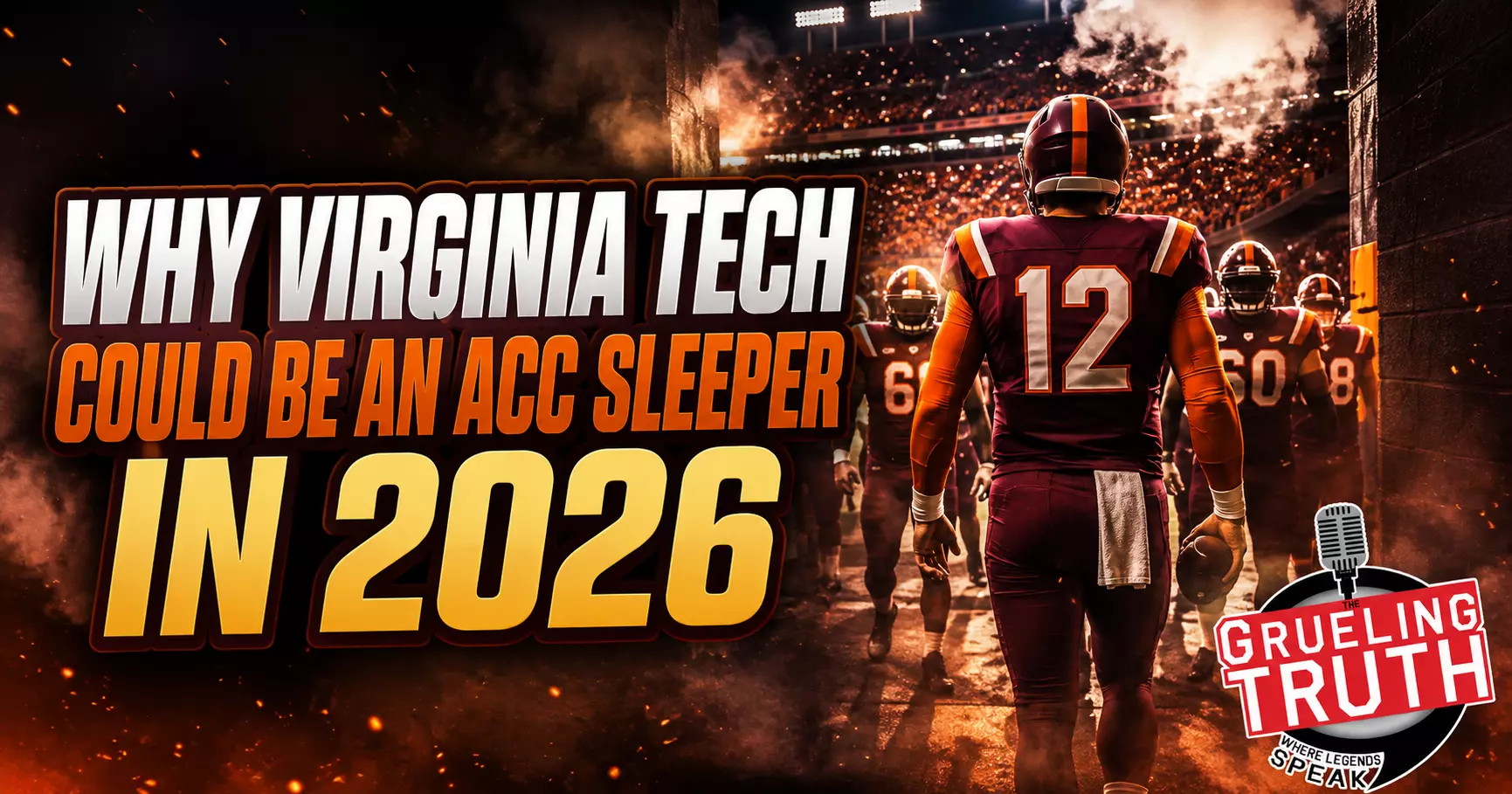
Virginia Tech does not enter the 2026 college football season as the favorite to win the ACC. Not a lot is expected of the Hokies
Virginia Tech does not enter the 2026 college football season as the favorite to win the ACC. The Hokies are not expected to possess Miami’s collection of talent, Clemson’s established recruiting depth or SMU’s recent momentum.
That is precisely what makes Virginia Tech interesting.
The Hokies are coming off a disastrous 3–9 season in which they finished 106th nationally in SP+, at minus-10.1 adjusted points per game. It was Virginia Tech’s worst SP+ ranking in 52 years and represented a stunning decline from a 2024 team that finished 30th despite going only 6–7.
Now James Franklin has arrived in
Blacksburg
with an upgraded roster, a semi-proven quarterback and considerably more institutional support than Virginia Tech’s previous coaching staffs enjoyed. SP+ projects the Hokies 33rd nationally, with a plus-9.1 rating and an average of 7.3 victories. ESPN’s Football Power Index offers a similar forecast, projecting approximately seven wins and giving Virginia Tech a 76.4 percent chance of reaching bowl eligibility.
Seven victories would represent an obvious improvement. However, if Franklin puts the pieces together more quickly than expected, the Hokies could become a genuine ACC sleeper.
The 2025 Collapse Was Not the Program’s True Talent Level
Virginia Tech’s 3–9 record cannot be dismissed, but it should not automatically be treated as the program’s new standard.
The Hokies entered 2024 with legitimate expectations and finished 30th in SP+. Their 6–7 record was shaped by several close defeats and an inability to finish games. Virginia Tech appeared much closer to becoming a consistent eight-win team than collapsing toward the bottom of the conference.
Then almost everything went wrong.
Brent Pry changed both coordinators, hoping the moves would produce the breakthrough that had eluded his program. Instead, Virginia Tech lost its identity on both sides of the football. The transfer class failed to deliver the expected immediate help, returning players did not develop and the Hokies began the season 0–3.
Pry was fired in September, and Virginia Tech spent the remainder of the year playing under interim leadership. The final 3–9 record reflected more than a simple lack of talent. It reflected instability, failed roster construction, poor quarterback play and a coaching staff that had already lost control of the program.
Virginia Tech was bad in 2025. It probably was not the 106th-most-talented team in the country.
That distinction matters when evaluating the possibility of a rebound.
James Franklin Immediately Raises the Program’s Floor
Whatever criticism James Franklin received at Penn State, he knows how to build and maintain a major college football program.
Franklin compiled a 104–45 record in 12 seasons at Penn State. He won the 2016 Big Ten championship, repeatedly produced double-digit-win seasons and led the Nittany Lions into the 2024 College Football Playoff. His teams recruited nationally, developed NFL players and generally defeated opponents they were supposed to beat.
Virginia Tech has struggled to do those things consistently since Frank Beamer’s retirement.
The Hokies do not need Franklin to defeat every national powerhouse immediately. They need him to establish a higher weekly standard, dominate inferior opponents, recruit Virginia more effectively and prevent disappointing losses from becoming season-destroying spirals.
Franklin’s five-year contract is worth at least $41.75 million, but the more important number may be Virginia Tech’s commitment of more than $15 million for assistant coaches and support personnel. The university has finally acknowledged that competing at the top of the ACC requires a serious financial investment.
Virginia Tech is no longer asking its head coach to restore the program with one hand tied behind his back.
Ethan Grunkemeyer Gives the Hokies a Real Quarterback Foundation
The most important addition followed Franklin from Penn State.
Ethan Grunkemeyer arrives in Blacksburg with more experience than the typical transfer quarterback his age. He completed approximately 69 percent of his passes and threw eight touchdown passes during the 2025 season, giving Virginia Tech a player who has already operated against Power Four defenses.
Grunkemeyer does not have to become the best quarterback in the ACC for the Hokies to become dangerous. He needs to provide accuracy, consistency and competent decision-making—three qualities Virginia Tech too frequently lacked in 2025.
His spring performance offered encouragement. Grunkemeyer completed 13 of 17 passes for 136 yards and a touchdown in Virginia Tech’s spring game. On the opening possession, he completed all five attempts for 66 yards, finishing the drive with a touchdown pass to Duke transfer Que’Sean Brown.
That performance did not guarantee him the starting job.
North Carolina
transfer Bryce Baker remains a legitimate competitor with excellent arm strength and mobility. Baker completed 15 of 27 passes for 140 yards and a touchdown in the spring game.
Having two capable quarterback options is hardly a problem. Grunkemeyer provides the experience and familiarity with Franklin’s expectations, while Baker gives the Hokies a talented alternative if the offense needs a spark.
Virginia Tech’s quarterback room is deeper and more stable than it was one year ago.
Franklin Upgraded the Talent Without Building a One-Year Rental Team
Virginia Tech needed more than a new quarterback. It needed a substantial roster correction.
Franklin added approximately 16 former blue-chip recruits through the freshman class and transfer portal. By one count, he also brought in roughly seven players with previous FBS starting experience.
Virginia Tech’s transfer class was ranked 14th nationally by ESPN and seventh by On3. The class included 27 incoming transfers, although the Hokies also lost 40 players through the portal.
The encouraging part is that Franklin did not construct the entire roster around one-year players. Many of Virginia Tech’s additions retain multiple seasons of eligibility, allowing the staff to develop them rather than demanding immediate perfection from every newcomer.
That approach raises both the short-term floor and the long-term ceiling.
Franklin has also retained several important holdovers. Receiver Ayden Greene and running backs Jeffrey Overton Jr. and Marcellous Hawkins give the offense players who understand Virginia Tech and have already contributed at the ACC level.
Four-star freshman running back Messiah Mickens, another Franklin connection, adds even more upside to the backfield. Tight end Luke Reynolds followed Grunkemeyer from Penn State and should provide his quarterback with a familiar target, particularly over the middle and in critical third-down situations.
Virginia Tech may not possess a nationally recognized superstar, but it has more functional depth than the team that collapsed in 2025.
The Defense Has More Building Blocks Than the 2025 Numbers Suggest
In one of the most unusual staff decisions in college football, Franklin brought former Virginia Tech head coach Brent Pry back as defensive coordinator.
Pry failed as the program’s head coach, but that does not mean he suddenly forgot how to coordinate a defense. He previously worked under Franklin at Vanderbilt and Penn State, eventually becoming one of the most respected defensive assistants in the country.
Removing the administrative, recruiting and public responsibilities of being a head coach allows Pry to concentrate on the job that established his reputation.
The defensive line begins with Kemari Copeland, Virginia Tech’s only selection on the preseason All-ACC team. Copeland started every game in 2025 and recorded 48 tackles, 7.5 tackles for loss and 4.5 sacks. He considered entering the NFL draft and could have pursued other opportunities in the portal, but he chose to return to Blacksburg.
Missouri transfer Javion Hilson gives the Hokies another high-upside defensive end. Aycen Stevens emerged during spring practice and could play his way into a significant role. Noah Chambers provides a returning presence at linebacker, while Quintin Reddish gives the secondary an experienced safety with NFL potential.
Cornerback Jaquez White, who transferred from Troy after beginning his career at Division II Washburn, could become one of the team’s most important newcomers.
Virginia Tech’s defense will not transform overnight. It should, however, be faster, deeper and much better organized than it was during last season’s collapse.
The Schedule Gives Virginia Tech Time to Grow
Virginia Tech’s entire schedule cannot be described as easy. The Hokies must play road games against Clemson, Miami and SMU, three teams expected to contend near the top of the ACC.
The sequencing, however, could help a new coaching staff.
Virginia Tech opens at home against VMI on September 5 and hosts Old Dominion one week later. The Hokies then travel to Maryland before beginning conference play at Boston College.
Those first four games give Franklin an opportunity to establish his starting lineup and build confidence before the season becomes more demanding. Virginia Tech then returns home for conference games against Pitt and California before receiving an open week.
Georgia Tech visits Lane Stadium on October 17. Virginia Tech then begins the brutal portion of its schedule with consecutive road games against Clemson and SMU. Stanford comes to Blacksburg before the Hokies travel to Miami and close the season at home against Virginia.
There is a conceivable path to a 6–1 or even 7–0 start before the trip to Clemson.
That would not mean Virginia Tech had suddenly become a national championship contender. It would mean the Hokies had accumulated momentum, learned Franklin’s system and placed themselves in the ACC race before confronting the schedule’s most difficult stretch.
If Virginia Tech reaches late October with one loss or fewer, Lane Stadium will become one of the most energized environments in college football again.
The ACC Is Open Enough for a Surprise Team
Miami enters the season with the conference’s most talented roster. Clemson remains dangerous, while SMU, Louisville and several others have legitimate ACC championship aspirations.
None is unbeatable.
The ACC does not have an overwhelming favorite comparable to the dominant Florida State teams of the 1990s or Clemson at its peak under Dabo Swinney. Even the league’s most talented teams have important questions.
That creates opportunity for a program with an experienced head coach, improved quarterback play and a favorable early schedule.
Virginia Tech does not necessarily have to beat Clemson, Miami and SMU to remain relevant. The Hokies need to avoid the inexplicable losses that destroyed previous seasons and find a way to win one of those marquee road games.
Franklin’s Penn State teams were frequently criticized for struggling against elite opponents. They were also exceptionally reliable against everyone else. That reliability would represent a massive improvement in Blacksburg.
A team that begins 6–1, protects Lane Stadium and steals one major road victory could enter November with a realistic path to Charlotte.
Why the SP+ Projection Is Aggressive—but Believable
A jump from 106th to 33rd in SP+ looks enormous. It represents a projected improvement of more than 19 adjusted points per game.
Part of that projection is simple regression toward the mean. Virginia Tech’s 2025 collapse was so extreme that a rebound is statistically likely. The Hokies were 30th only one season earlier, suggesting the program’s underlying talent and resources were never as poor as the final 2025 ranking indicated.
The remainder of the projection reflects Franklin’s arrival, Grunkemeyer’s experience, the influx of former blue-chip recruits and a schedule containing enough winnable games to generate seven or eight victories.
Virginia Tech does not need every transfer to become a star. It needs the quarterback position to become dependable, the offensive line to stabilize and the defense to regain basic competence.
If those three things happen, finishing near 33rd nationally is not unreasonable.
The projection should not be interpreted as proof that Virginia Tech is already back. It does demonstrate that objective models see more than the remains of a 3–9 team.
Virginia Tech’s Floor Is Higher—and Its Ceiling Is Interesting
The safest prediction is that
Virginia Tech
will improve substantially and reach a bowl game. Seven or eight victories would constitute a successful first season for Franklin and establish momentum for 2027.
The more interesting possibility is that the transition happens faster.
Grunkemeyer may provide immediate stability. The returning skill players could flourish in a more functional system. Pry could rediscover his effectiveness as a coordinator. Several of Franklin’s blue-chip additions could be ready earlier than expected.
Most importantly, Virginia Tech has a chance to build momentum before traveling to Clemson, SMU and Miami.
The Hokies are not the ACC favorite. They remain short of elite depth in several areas, and the second half of the schedule could expose those weaknesses.
But a sleeper does not have to be flawless. A sleeper needs a credible path to outperform expectations.
Virginia Tech has one.
After hitting its lowest point in more than half a century, the program now has a proven head coach, improved resources, legitimate quarterback options and a roster with considerably more talent. Seven victories should be the expectation.
If everything comes together quickly, the Hokies could win nine games, upset one of the conference’s heavyweights and remain in the ACC championship conversation deep into November.
That would make Virginia Tech much more than a rebuilding team. It would make the Hokies one of the most dangerous sleepers in the conference.
Up To $1500 in Bonus Bets Paid Back if your First Bet Does Not Win
T&Cs apply
4.5/5
Gambling problem? Call 1-800-GAMBLER or 1-800-MY-RESET (Available in the US) 877-8-HOPENY or text HOPENY (467369) (NY) 1-800-327-5050 (MA), 1-800-BETS-OFF (IA), 1-800-981-0023 (PR). 21+ only. Please Gamble Responsibly. See BetMGM.com for Terms. First Bet Offer for new customers only (if applicable). Subject to eligibility requirements. Bonus bets are non-withdrawable. In partnership with Kansas Crossing Casino and Hotel. Promotional offers not available in Mississippi, New York, Ontario, or Puerto Rico.
New DraftKings Customer Offer: SPEND $5, GET $200 IN BONUSES
T&Cs apply
4.5/5
To be eligible for DraftKings Sportsbook and the Promotion, you must be physically located in AR, AZ, CO, CT, DC, IA, IL, IN, KS, KY, LA (select parishes), MA, MD, ME, MI, MO, NC, NJ, NH, NY, OH, OR, PA, PR (residents only), TN, VA, VT, WY, WV, CA-ONT or CA-AB (each an “Eligible Jurisdiction” or, collectively, the “Eligible Jurisdictions”). Must be 21+ years of age or older (18+ if in DC/NH/PR/WY/CA-AB) (19+ in CA-ONT). GAMBLING PROBLEM? CALL 1-800-GAMBLER or 1-800-MY-RESET, (800) 327-5050 or visit gamblinghelplinema.org (MA) Please Gamble Responsibly. 888-789-7777/visit ccpg.org (CT), or visit www.mdgamblinghelp.org (MD), 1-800-981-0023 (PR). 21+ and present in most states. (18+ DC/NH/PR/WY). Void in CAN. Eligibility restrictions apply. On behalf of Boot Hill Casino (KS). Pass-thru of per wager tax may apply in IL. 1 per new DraftKings customer. $5+ first-time bet req. Max. $200 issued as non-withdrawable Bonus Bets. Stake removed from payout. Reward issued as $50 in Bonus Bets every 7 days via click-to-claim for 21 days. Bonus Bets and click-to-claims expire 7 days (168hrs) after issuance. Terms: Promos | DraftKings Sportsbook . Ends 9/20/26 at 11:59 PM ET. Sponsored by DK.
Must be 21+. GAMBLING PROBLEM? CALL 1-800-GAMBLER OR CALL 1-800-MY-RESET, www.mdgamblinghelp.org (MD), (800)-327-5050 or gamblinghelplinema.org (MA), Call (877)8-HOPENY or text HOPENY (467369) (NY), (888) 789-7777 or ccpg.org (CT), morethanagame.nc.gov (NC), 1800gambler.net (WV)
Bet $1 and get double the winnings up to $25 for your next 10 bets
T&Cs apply
4.4/5
21+ New users only. Must register using eligible promo code. First bet after registration must qualify. Max. Bonus Bet: $1,000. Bonus Bet expires 14 days after receipt. Void where prohibited. See Caesars.com/promos for full terms. Gambling Problem? 1-800-GAMBLER (1-800-426-2537)
21+ and present in OH. Gambling Problem? Call 1-800-GAMBLER.
This site is using
Cloudflare
and adheres to the
Google Safe Browsing Program. We adapted
Google's Privacy Guidelines
to keep your data safe at all times.
Close
Ready to Win Big? Join the Elite with Our Sports Betting Deals!
FanDuel Promo
New Users – Get $350 in Bonus Bets when you wager $5 for 7 days
Up To $1500 in Bonus Bets Paid Back if your First Bet Does Not Win
Best Slots
T&Cs and 21+ apply
Gambling problem? Call 1-800-GAMBLER or 1-800-MY-RESET (Available in the US) 877-8-HOPENY or text HOPENY (467369) (NY) 1-800-327-5050 (MA), 1-800-BETS-OFF (IA), 1-800-981-0023 (PR). 21+ only. Please Gamble Responsibly. See BetMGM.com for Terms. First Bet Offer for new customers only (if applicable). Subject to eligibility requirements. Bonus bets are non-withdrawable. In partnership with Kansas Crossing Casino and Hotel. Promotional offers not available in Mississippi, New York, Ontario, or Puerto Rico.
Code:
Open BetMGM
Get Bonus
DraftKings Promo
New DraftKings Customer Offer: SPEND $5, GET $200 IN BONUSES
Newcomer
T&Cs and 21+ apply
To be eligible for DraftKings Sportsbook and the Promotion, you must be physically located in AR, AZ, CO, CT, DC, IA, IL, IN, KS, KY, LA (select parishes), MA, MD, ME, MI, MO, NC, NJ, NH, NY, OH, OR, PA, PR (residents only), TN, VA, VT, WY, WV, CA-ONT or CA-AB (each an “Eligible Jurisdiction” or, collectively, the “Eligible Jurisdictions”). Must be 21+ years of age or older (18+ if in DC/NH/PR/WY/CA-AB) (19+ in CA-ONT). GAMBLING PROBLEM? CALL 1-800-GAMBLER or 1-800-MY-RESET, (800) 327-5050 or visit gamblinghelplinema.org (MA) Please Gamble Responsibly. 888-789-7777/visit ccpg.org (CT), or visit www.mdgamblinghelp.org (MD), 1-800-981-0023 (PR). 21+ and present in most states. (18+ DC/NH/PR/WY). Void in CAN. Eligibility restrictions apply. On behalf of Boot Hill Casino (KS). Pass-thru of per wager tax may apply in IL. 1 per new DraftKings customer. $5+ first-time bet req. Max. $200 issued as non-withdrawable Bonus Bets. Stake removed from payout. Reward issued as $50 in Bonus Bets every 7 days via click-to-claim for 21 days. Bonus Bets and click-to-claims expire 7 days (168hrs) after issuance. Terms: Promos | DraftKings Sportsbook . Ends 9/20/26 at 11:59 PM ET. Sponsored by DK.
Code:
Open DraftKings
Get Bonus
Find out what the legends have to say about sports this week....