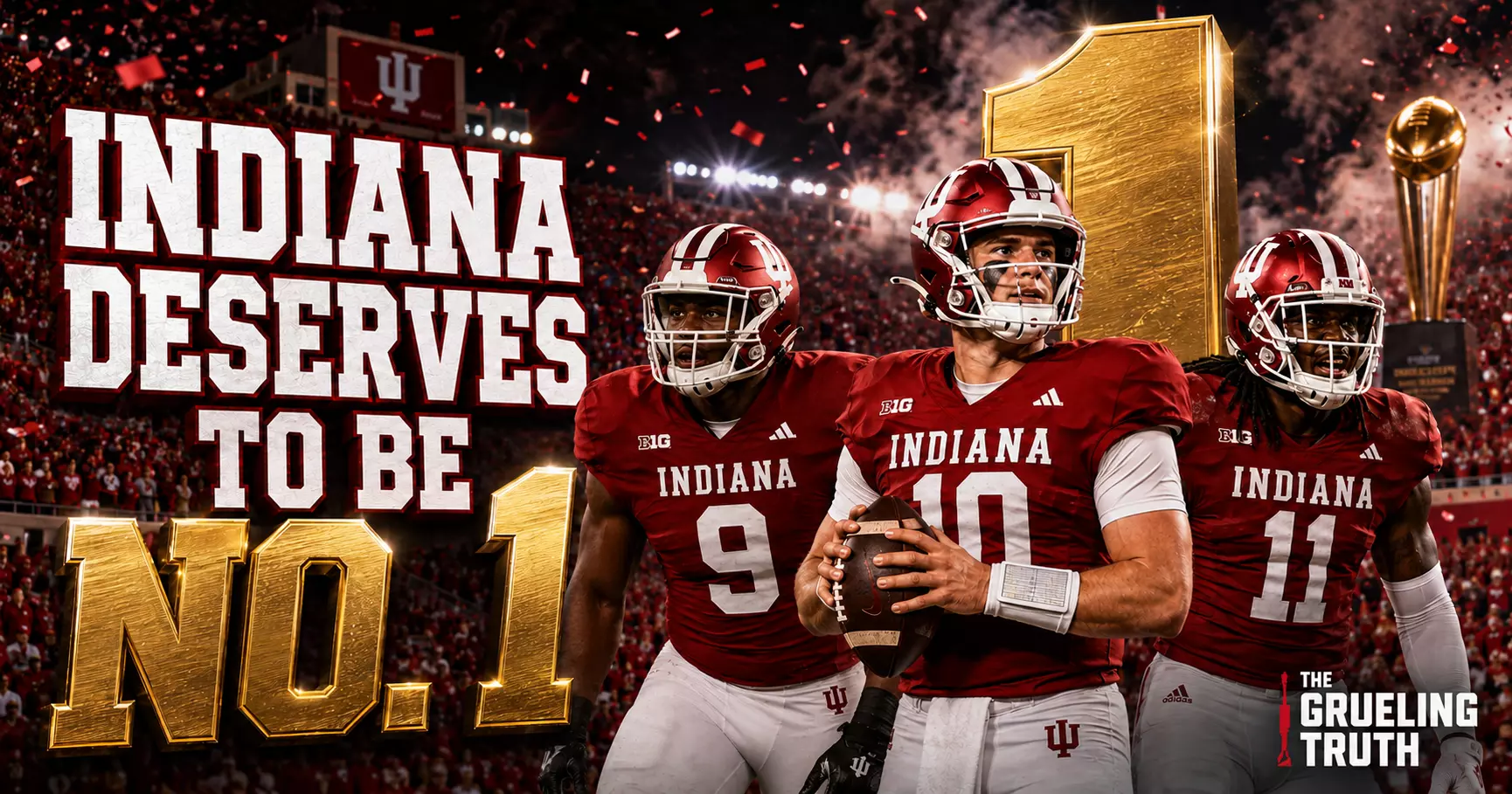
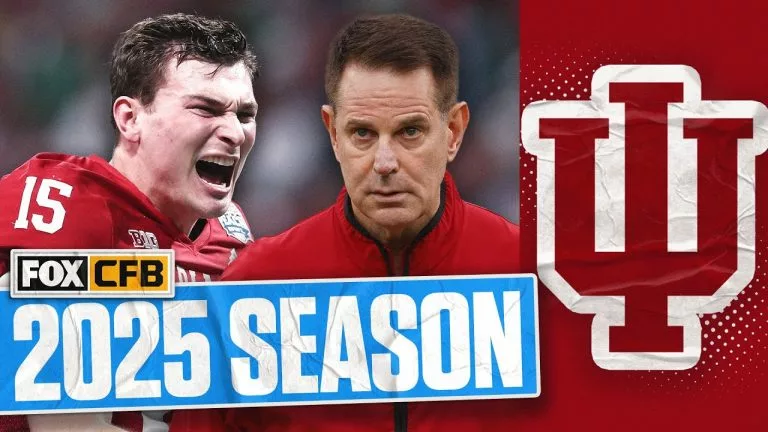
The Indiana Hoosiers completed one of the greatest seasons in college football history in 2025. They went 16-0.
The Indiana Hoosiers completed one of the greatest seasons in college football history in 2025. They went 16-0, won the Big Ten championship, defeated Ohio State when everything was at stake and beat Miami 27-21 to capture the first national championship in program history.
Indiana did not back into the title. It did not survive because of a favorable call or one miraculous play. The Hoosiers dominated opponents with a balanced offense, a violent defense and the discipline of a team that was almost always better prepared than the opponent standing across from it.
Yet Indiana enters the 2026 season ranked sixth in the preseason Coaches Poll, behind Ohio State, Oregon, Texas, Georgia and Notre Dame. The defending national champions received only 14 first-place votes.
The justification is obvious. Indiana lost
Heisman Trophy-winning quarterback Fernando Mendoza and several other stars to the NFL. Voters are more comfortable trusting familiar brands with highly rated recruiting classes than a program that college football spent generations treating like an afterthought.
That reasoning ignores what Curt Cignetti has built.
Indiana is stronger, deeper and more talented entering the 2026 season than it was at this point last year. The Hoosiers have an accomplished veteran quarterback, potentially the best offensive line in college football, an explosive collection of receivers and one of the deepest defensive fronts in the country. They also return both coordinators and the head coach who has gone 27-2 during his first two seasons in Bloomington.
Until someone proves otherwise, the reigning undefeated national champion deserves to begin at No. 1.
Indiana Hoosiers Full Season Highlights 🍿
Indiana Has Already Earned the Benefit of the Doubt
Preseason rankings are supposed to project the best teams, but they inevitably reward reputation. Ohio State, Georgia, Alabama and Texas receive the benefit of the doubt because voters recognize their recruiting rankings, NFL prospects and championship histories.
Indiana is still being evaluated as if 2025 were an isolated miracle.
It was not.
Cignetti went 11-2 during his first season at Indiana and followed it with a perfect 16-0 championship campaign. The Hoosiers are 27-2 under him despite turning over significant portions of the roster between seasons. They have proven that their success is built on a repeatable system involving player evaluation, development, preparation and coaching continuity.
Indiana did not merely win games last season. The Hoosiers ranked third nationally in scoring at 41.6 points per game, averaged 452 yards and rushed for 212.9 yards per contest. They defeated every opponent on their schedule and survived the pressure of a four-game postseason run.
A defending champion should not automatically remain No. 1 if its roster has been stripped bare. That is not what happened in Bloomington. Indiana lost outstanding players but replaced them with proven veterans while retaining elite talent at several important positions.
The voters appear to be grading Indiana primarily on what departed. They should be looking more closely at what remains—and what arrived.
Josh Hoover Is Not an Unproven Replacement
Replacing Fernando Mendoza is the strongest argument against Indiana at No. 1.
Mendoza was extraordinary in 2025. He completed 72 percent of his passes, won the Heisman Trophy and led the country with a touchdown on 10.8 percent of his attempts. He provided elite accuracy, leadership and poise throughout Indiana’s championship run.
No one should casually assume Josh Hoover will duplicate that season.
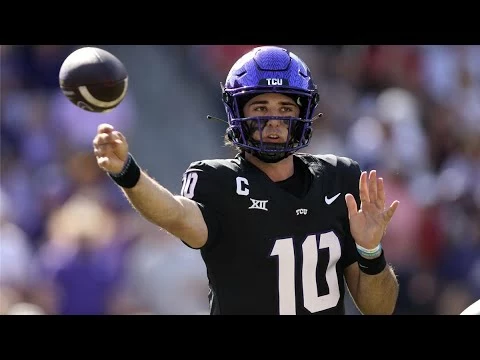
But Indiana is not handing its offense to an inexperienced quarterback. Hoover arrives from TCU with 31 career starts, 9,629 passing yards and 71 touchdown passes. He finished his TCU career ranked second in program history in completion percentage, fourth in passing yardage and fourth in touchdown passes.
Hoover threw for a school-record 3,949 yards in 2024. He followed that with 3,472 yards and 27 touchdowns in 2025, producing five 300-yard performances and four games with at least four touchdown passes.
Those are not the numbers of a quarterback Indiana must hide. Hoover is an experienced, aggressive passer who has already succeeded against Power Four competition. He possesses a stronger statistical résumé entering the season than Mendoza had when he arrived from California before 2025.
Hoover’s turnover history is a legitimate concern. His willingness to challenge tight windows has occasionally produced unnecessary interceptions. But he is now working with Cignetti, offensive coordinator Mike Shanahan and quarterbacks coach Tino Sunseri—the same staff that transformed Kurtis Rourke and Mendoza into highly efficient quarterbacks.
Hoover does not need to become Mendoza. He needs to make intelligent decisions, distribute the football to an outstanding collection of weapons and take advantage of one of the best offensive lines in the country.
Everything surrounding him is better than what he had at TCU. If Indiana’s staff improves his decision-making without removing his aggressiveness, Hoover could become one of the most productive quarterbacks in college football.
Josh Hoover | 2025 TCU Highlights
The Best Offensive Line in the Country
Quarterback transitions become much easier when the new starter operates behind an elite offensive line.
Indiana returns four linemen who started during the 2025 postseason run: Carter Smith, Bray Lynch, Drew Evans and Adedamola Ajani. The Hoosiers also added Wisconsin transfer Joe Brunner, giving offensive line coach Bob Bostad five experienced and versatile blockers around whom to construct the starting unit.
CBS Sports ranked Indiana’s offensive line No. 1 in the country entering 2026. The five projected starters have appeared in a combined 156 college games.
Smith is the centerpiece. The returning
Big Ten Offensive Lineman of the Year
is an All-America candidate and potential first-round NFL draft pick. He provides Indiana with an elite protector at left tackle and sets the physical standard for the entire offense.
Lynch and Evans are multi-year starters who understand Bostad’s system. Ajani gained valuable experience during the championship run, while Brunner brings Big Ten toughness and positional flexibility. The only unresolved question is center following Pat Coogan’s departure, but the Hoosiers have enough veteran pieces to reorganize the interior without weakening the unit.
Indiana’s offensive line was a Joe Moore Award finalist last season. It may be even better in 2026.
That group gives Hoover time to throw, allows the Hoosiers to control games on the ground and reduces the likelihood that one poor matchup can derail the offense. Other contenders may have more highly rated quarterbacks, but few will provide their quarterback with a better foundation.
Nick Marsh and Charlie Becker Could Be an Elite Combination
Indiana lost Elijah Sarratt and Omar Cooper Jr., but the receiver room has not been emptied. It may possess more top-end physical talent than it did entering last season.
Charlie Becker developed from a rotational receiver into one of Indiana’s most important postseason performers. He finished 2025 with 34 receptions for 679 yards and four touchdowns, averaging nearly 20 yards per catch.
Becker’s numbers do not fully explain his importance. He became Indiana’s leading receiver in seven of its final eight games. He made a critical deep reception against Ohio State in the Big Ten Championship Game and caught touchdown passes in both the Rose Bowl and Peach Bowl.
At this point last year, Becker was fighting to establish a role. Entering 2026, he is a proven big-game receiver with the size, speed and confidence to become an All-Big Ten selection.
Nick Marsh gives Indiana another potential star on the opposite side.
Marsh led Michigan State in receiving during consecutive seasons despite playing in an inconsistent offense. He caught 59 passes for 662 yards and six touchdowns in 2025. At 6-foot-3 with excellent strength and body control, Marsh can win contested catches, create yards after contact and give Hoover a large target outside the numbers.
At Michigan State, defenses could concentrate on stopping Marsh. At Indiana, they must also account for Becker, the running game and several other receiving options.
Tulane transfer Shazz Preston adds experience after catching 43 passes for 723 yards and four touchdowns last season. Tyler Morris returns after missing 2025 with a knee injury and gives Hoover an experienced option in the slot. Lebron Bond and Davion Chandler provide young speed and additional depth.
Becker summed up Indiana’s offense during fall camp with a simple question: “Where do you see a hole?”
It is difficult to find one.
A Deeper Running Back Room
Indiana lost Roman Hemby, but it enters 2026 with multiple capable running backs rather than one player being asked to carry the entire workload.
Turbo Richard supplies speed and big-play potential. Khobie Martin has the size and physical style to run between the tackles. Lee Beebe Jr. brings experience, vision and receiving ability after transferring from UAB. Young backs behind them give Indiana additional options as the season develops.
The Hoosiers do not necessarily need one 1,500-yard runner. Shanahan can use a rotation that keeps everyone fresh and attacks defenses with different running styles.
More importantly, the backs will operate behind a veteran offensive line that helped Indiana average 212.9 rushing yards per game last season. Opponents cannot simply drop extra defenders into coverage and dare Hoover to remain patient. Indiana can still control games on the ground.
The offense may look different without Mendoza, Hemby, Sarratt and Cooper, but different does not mean worse. It may be deeper, less dependent on a handful of established stars and more difficult to defend because of the number of available combinations.
Indiana’s Defensive Front Could Be Better Than Last Year’s
The strongest reason to rank Indiana No. 1 may be its defensive front.
Stephen Daley led the Big Ten and finished third nationally with 19 tackles for loss in 2025. He also recorded 5.5 sacks and forced two fumbles despite needing several games to become comfortable in Indiana’s system. Cignetti eventually described him as the most dominant defensive lineman in the conference.
Daley suffered a knee injury after the Big Ten Championship Game and missed Indiana’s playoff run. A court ruling granted him another year of eligibility, allowing him to return for 2026. Indiana won the national championship without him on the field during the postseason. It now adds him back to an already loaded defense.
Kellan Wyatt was also granted another year. Wyatt recorded 28 tackles and 2.5 sacks in only seven games before suffering a season-ending knee injury. His ability to play on the edge or move to linebacker gives defensive coordinator Bryant Haines another versatile veteran.
The Hoosiers
also return Tyrique Tucker and Mario Landino inside. Tucker has already established himself as one of the Big Ten’s most reliable defensive tackles, while Landino gained valuable experience during the championship season.
Indiana then strengthened the group through the portal by adding Tobi Osunsanmi and Chiddi Obiazor from Kansas State. The result is a defensive front with experience, size, versatility and enough depth to rotate players without suffering a major decline.
Last year’s defense was outstanding. This year’s front could be more disruptive.
The Linebackers Are Championship-Proven
Indiana must replace Aiden Fisher’s leadership and production, but the linebacker room still features two of the best players in the Big Ten.
Rolijah Hardy finished 2025 with 102 tackles and eight sacks. His speed allows him to pursue runners from sideline to sideline, pressure quarterbacks and contribute in coverage. He is not merely a productive linebacker; he is one of the most versatile defenders in the country.
Isaiah Jones recorded 78 tackles, 15.5 tackles for loss and seven sacks. He also recovered a blocked punt for a touchdown in the national championship victory over Miami.
Hardy and Jones give Haines two experienced playmakers who already understand the system and have performed in championship environments. Their ability to blitz and disguise pressure is one reason Indiana’s defense is so difficult to diagnose before the snap.
Freshman Jacob Savage has already drawn attention during camp as one of the most physically prepared newcomers. Henry Ohlinger and Ja’Dyn Williams provide additional young talent. Indiana may need time to establish its complete rotation, but its starting tandem can match almost any in the country.
The Secondary Added Another Proven Corner
Indiana lost D’Angelo Ponds to the NFL, creating a major hole at cornerback. Cignetti addressed it by adding former Penn State corner A.J. Harris.
Harris began his career at Georgia before becoming an important player at Penn State. He has accumulated 89 tackles, six passes defended and an interception during his career. He possesses the experience and athletic ability to start immediately.
Jamari Sharpe returns on the opposite side after playing throughout Indiana’s championship season. Ryland Gandy appeared in all 16 games as a rotational corner and now has an opportunity to claim a larger role. Amare Ferrell and Preston Zachman provide veteran experience at safety, while Quan Sanks is another developing player with significant upside.
The secondary may not be quite as settled as the front seven, but it is hardly devoid of talent. Indiana added a proven Power Four corner to replace Ponds and will place him behind a pass rush capable of making every defensive back’s job easier.
Bryant Haines Is Still Calling the Defense
Personnel matters, but Indiana’s greatest defensive advantage may be the man designing the system.
Bryant Haines won the Broyles Award as the nation’s best assistant coach after directing Indiana’s championship defense. His unit can generate pressure without becoming predictable, change its structure based on opponents and force quarterbacks to process information after the snap.
Haines did not leave for a head-coaching job. Neither did Shanahan on offense. Cignetti kept the core of his staff together despite the championship and the attention that followed it.
That continuity matters enormously.
At this point last year, Indiana was integrating Mendoza and a collection of transfers while attempting to determine how the new pieces would fit. The 2026 roster contains more players who have already operated within Cignetti’s culture. The returning players understand the standards, terminology and daily expectations. The newcomers are joining an established championship operation instead of a program still trying to prove itself.
Indiana is not beginning again. It is reloading inside a system that has already worked.
The Hoosiers Look Further Ahead Than They Did Last August
There is a meaningful difference between having more returning starters and being more prepared.
Indiana entered August 2025 with enormous potential, but many of its most important players were still projections. Mendoza had never played in Cignetti’s offense. Becker had not become a featured receiver. Daley had not emerged as a dominant Big Ten lineman. Several players were still learning their roles.
The Hoosiers eventually became great, but they were not a finished product when camp opened.
The 2026 team begins from a much higher floor.
Hoover has 31 career starts and has been in Bloomington since the winter. Becker is no longer an unknown. Marsh has produced for two seasons in the Big Ten. Smith, Lynch and Evans have already played championship football together. Hardy, Jones, Tucker, Sharpe, Ferrell and other veterans understand exactly what Haines demands.
Cignetti also said the team made “very significant strides” physically during the summer, pointing to improvements in GPS measurements, body composition and vertical jumping. The first practice featured clean execution, no injuries and none of the snap problems that often disrupt the opening days of camp.
This team is deeper, physically more developed and far more familiar with championship expectations than Indiana was one year ago.
That does not guarantee another undefeated season. It does mean the Hoosiers look more complete in August 2026 than they did before producing perfection in 2025.
The Objections Do Not Outweigh the Résumé
There are legitimate questions.
Hoover must reduce turnovers. Indiana must settle the center position. The tight end room lacks proven production. Daley and Wyatt must demonstrate they are completely recovered from knee injuries. The secondary must replace Ponds, and the running backs must prove they can handle larger roles.
Every contender has questions.
Ohio State must replace important pieces despite returning Julian Sayin and Jeremiah Smith. Oregon possesses extraordinary talent but did not win the Big Ten or national championship last season. Texas continues to receive enormous preseason respect based partly on recruiting rankings and the promise of Arch Manning. Georgia remains formidable but is not automatically superior to an Indiana team that just completed a perfect season. Notre Dame lost elite offensive talent and must prove it can avoid another slow start.
The difference is that Indiana’s questions are being used to push it down to No. 6, while other programs’ questions are being excused because their helmet logos are more familiar.
That is not serious evaluation. It is brand-name bias.
Number One Until Someone Takes It Away
Preseason No. 1 does not mean a team is guaranteed to repeat. It means that, based on performance, personnel and coaching, it deserves to begin the season ahead of everyone else.
Indiana owns the best possible performance: a 16-0 national championship season.
It returns potentially the country’s best offensive line, two elite linebackers, a loaded defensive front, a breakout receiver in Charlie Becker and both coordinators. It added a quarterback with nearly 10,000 career passing yards, a proven Big Ten receiver in Nick Marsh, a veteran corner in A.J. Harris and several high-impact linemen.
Most importantly, it returns Curt Cignetti.
Cignetti has turned Indiana from a historic loser into the
standard of college football. His teams are prepared, disciplined, physical and unimpressed by reputation. Indiana has stopped hoping it belongs with Ohio State, Oregon, Georgia and Texas. The Hoosiers have beaten elite teams and collected the trophy everyone else wants.
Indiana looks better today than it did at this point last year. The roster is deeper. The offensive line is more experienced. The defensive front is stronger. The receiver room has more proven options. The program understands what championship preparation looks like because it has already completed the journey.
If another team wants to be No. 1, it should have to take that distinction from the undefeated national champions on the field.
New Users – Get $350 in Bonus Bets when you wager $5 for 7 days
T&Cs apply
4.6/5
Gambling Problem? Call 1-800-GAMBLER or 1-800-MY-RESET. Call 1-888-789-7777 or visit ccpgg.org/chat (CT). Hope is here. GamblingHelpLineMA.org or call (800) 327-5050 for 24/7 support (MA). Visit www.mdgamblinghelp.org (MD). Call 1-877-8HOPE-NY or text HOPENY (NY). 21+ (18+ DC, WY) and present in select states (for KS, in affiliation with Kansas Star Casino). Find online real money wagering only. Min $5 wager required for 7 consecutive days. $5 free play credit. Bonus issued as non-withdrawable bonus with cash withdrawable bonus with cash withdrawable. Bonus bets which expire 7 days after receipt. Restrictions apply. See terms at sportsbook.fanduel.com. Call 1-877-770-7867 (LA).
Up To $1500 in Bonus Bets Paid Back if your First Bet Does Not Win
T&Cs apply
4.5/5
Gambling problem? Call 1-800-GAMBLER or 1-800-MY-RESET (Available in the US) 877-8-HOPENY or text HOPENY (467369) (NY) 1-800-327-5050 (MA), 1-800-BETS-OFF (IA), 1-800-981-0023 (PR). 21+ only. Please Gamble Responsibly. See BetMGM.com for Terms. First Bet Offer for new customers only (if applicable). Subject to eligibility requirements. Bonus bets are non-withdrawable. In partnership with Kansas Crossing Casino and Hotel. Promotional offers not available in Mississippi, Massachusetts, New York, Ontario, or Puerto Rico.
New DraftKings Customers: Bet $5, Get $200 + 3 Months of NBA League Pass!
T&Cs apply
4.5/5
GAMBLING PROBLEM? CALL 1-800-GAMBLER or 1-800-MY-RESET, (800) 327-5050 or visit gamblinghelplinema.org (MA). Please Gamble Responsibly. 888-789-7777/visit ccpg.org (CT), or visit www.mdgamblinghelp.org (MD), 1-800-981-0023 (PR). 21+ and present in most states. (18+ DC/NH/PR/WY). Void in CAN. Eligibility restrictions apply. On behalf of Boot Hill Casino (KS). Pass-thru of per wager tax may apply in IL. 1 per new Sportsbook customer. $5+ first-time bet req. Max. $200 issued as non-withdrawable Bonus Bets. Stake removed from payout. Reward issued as $50 in Bonus Bets every 7 days via click-to-claim for 21 days. Bonus Bets and click-to-claims expire 7 days (168hrs) after issuance. Terms: dkng.co/offer. Get 1 promo code to redeem a 3-month NBA League Pass subscription, complimentary of DraftKings. Subscription auto-renews monthly at then-current price (currently $16.99/mo); cancel anytime. Terms, restrictions, and eligibility requirements apply. Redeem League Pass by 12/19/26 at 11:59 PM ET. Addt’l terms: support.watch.nba.com/hc/en-us/articles/9165532876183-League-Pass-Terms-of-Use_. Ends 11/29/26 at 11:59 PM ET. Sponsored by DK.
Must be 21+. GAMBLING PROBLEM? CALL 1-800-GAMBLER OR CALL 1-800-MY-RESET, www.mdgamblinghelp.org (MD), (800)-327-5050 or gamblinghelplinema.org (MA), Call (877)8-HOPENY or text HOPENY (467369) (NY), (888) 789-7777 or ccpg.org (CT), morethanagame.nc.gov (NC), 1800gambler.net (WV)
Bet $1 and get double the winnings up to $25 for your next 10 bets
T&Cs apply
4.4/5
21+ New users only. Must register using eligible promo code. First bet after registration must qualify. Max. Bonus Bet: $1,000. Bonus Bet expires 14 days after receipt. Void where prohibited. See Caesars.com/promos for full terms. Gambling Problem? 1-800-GAMBLER (1-800-426-2537)
21+ and present in OH. Gambling Problem? Call 1-800-GAMBLER.
This site is using
Cloudflare
and adheres to the
Google Safe Browsing Program. We adapted
Google's Privacy Guidelines
to keep your data safe at all times.
Close
Ready to Win Big? Join the Elite with Our Sports Betting Deals!
FanDuel Promo
New Users – Get $350 in Bonus Bets when you wager $5 for 7 days
Our Favorite
T&Cs and 21+ apply
Gambling Problem? Call 1-800-GAMBLER or 1-800-MY-RESET. Call 1-888-789-7777 or visit ccpgg.org/chat (CT). Hope is here. GamblingHelpLineMA.org or call (800) 327-5050 for 24/7 support (MA). Visit www.mdgamblinghelp.org (MD). Call 1-877-8HOPE-NY or text HOPENY (NY). 21+ (18+ DC, WY) and present in select states (for KS, in affiliation with Kansas Star Casino). Find online real money wagering only. Min $5 wager required for 7 consecutive days. $5 free play credit. Bonus issued as non-withdrawable bonus with cash withdrawable bonus with cash withdrawable. Bonus bets which expire 7 days after receipt. Restrictions apply. See terms at sportsbook.fanduel.com. Call 1-877-770-7867 (LA).
Code:
Open FanDuel
Get Bonus
BetMGM Promo
Up To $1500 in Bonus Bets Paid Back if your First Bet Does Not Win
Best Slots
T&Cs and 21+ apply
Gambling problem? Call 1-800-GAMBLER or 1-800-MY-RESET (Available in the US) 877-8-HOPENY or text HOPENY (467369) (NY) 1-800-327-5050 (MA), 1-800-BETS-OFF (IA), 1-800-981-0023 (PR). 21+ only. Please Gamble Responsibly. See BetMGM.com for Terms. First Bet Offer for new customers only (if applicable). Subject to eligibility requirements. Bonus bets are non-withdrawable. In partnership with Kansas Crossing Casino and Hotel. Promotional offers not available in Mississippi, Massachusetts, New York, Ontario, or Puerto Rico.
Code:
Open BetMGM
Get Bonus
DraftKings Promo
New DraftKings Customers: Bet $5, Get $200 + 3 Months of NBA League Pass!
Newcomer
T&Cs and 21+ apply
GAMBLING PROBLEM? CALL 1-800-GAMBLER or 1-800-MY-RESET, (800) 327-5050 or visit gamblinghelplinema.org (MA). Please Gamble Responsibly. 888-789-7777/visit ccpg.org (CT), or visit www.mdgamblinghelp.org (MD), 1-800-981-0023 (PR). 21+ and present in most states. (18+ DC/NH/PR/WY). Void in CAN. Eligibility restrictions apply. On behalf of Boot Hill Casino (KS). Pass-thru of per wager tax may apply in IL. 1 per new Sportsbook customer. $5+ first-time bet req. Max. $200 issued as non-withdrawable Bonus Bets. Stake removed from payout. Reward issued as $50 in Bonus Bets every 7 days via click-to-claim for 21 days. Bonus Bets and click-to-claims expire 7 days (168hrs) after issuance. Terms: dkng.co/offer. Get 1 promo code to redeem a 3-month NBA League Pass subscription, complimentary of DraftKings. Subscription auto-renews monthly at then-current price (currently $16.99/mo); cancel anytime. Terms, restrictions, and eligibility requirements apply. Redeem League Pass by 12/19/26 at 11:59 PM ET. Addt’l terms: support.watch.nba.com/hc/en-us/articles/9165532876183-League-Pass-Terms-of-Use_. Ends 11/29/26 at 11:59 PM ET. Sponsored by DK.
Code:
Open DraftKings
Get Bonus
Find out what the legends have to say about sports this week....
New Users – Get $350 in Bonus Bets when you wager $5 for 7 days
Gambling Problem? Call 1-800-GAMBLER or 1-800-MY-RESET. Call 1-888-789-7777 or visit ccpgg.org/chat (CT). Hope is here. GamblingHelpLineMA.org or call (800) 327-5050 for 24/7 support (MA). Visit www.mdgamblinghelp.org (MD). Call 1-877-8HOPE-NY or text HOPENY (NY). 21+ (18+ DC, WY) and present in select states (for KS, in affiliation with Kansas Star Casino). Find online real money wagering only. Min $5 wager required for 7 consecutive days. $5 free play credit. Bonus issued as non-withdrawable bonus with cash withdrawable bonus with cash withdrawable. Bonus bets which expire 7 days after receipt. Restrictions apply. See terms at sportsbook.fanduel.com. Call 1-877-770-7867 (LA).