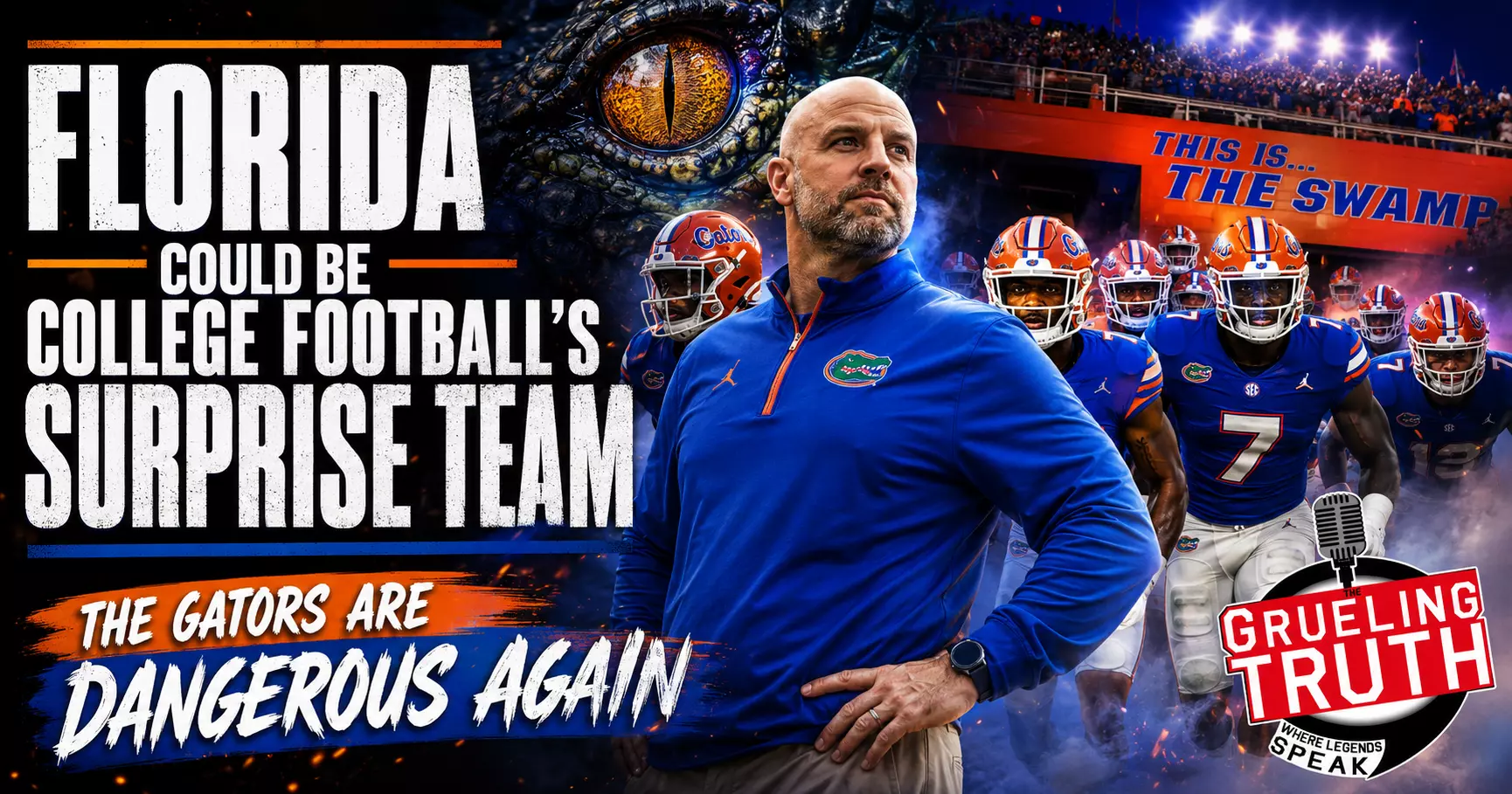
Florida has an accomplished new head coach, a proven running back, explosive receivers, young defensive talent and a schedule that is tough.
The Florida Gators are not receiving the same preseason attention as Georgia, Texas, Alabama or several other SEC contenders. That is understandable after Florida finished a miserable 4–8 in 2025, fired Billy Napier and watched quarterback DJ Lagway transfer to Baylor.
Florida enters 2026 with a new coaching staff, approximately 50 new players and an unsettled quarterback competition. On the surface, that sounds more like the beginning of a lengthy rebuilding project than the formula for an immediate breakthrough.
Look closer, however, and the Gators might possess the ingredients necessary to become one of college football’s biggest surprises.
Florida has an accomplished new head coach, a proven running back, explosive receivers, young defensive talent and a schedule that is difficult but more manageable than some of the brutal slates the program has faced in recent seasons. The Gators are unlikely to begin the year ranked among the national championship favorites, but that lack of attention may work to their advantage.
If Jon Sumrall can establish his identity quickly and find a dependable quarterback, Florida could make a much faster
return to relevance
than most people expect.
Jon Sumrall Knows How to Change a Program’s Culture
The most important reason for optimism is Sumrall.
Florida did not hire a coach based on one fortunate season or an impressive press conference. Sumrall built an exceptional résumé during four seasons at Troy and Tulane, compiling a 43–12 record and taking his team to a conference championship game every year. He won consecutive Sun Belt championships at Troy before maintaining Tulane’s position among the nation’s strongest Group of Five programs.
Sumrall’s teams have consistently played with physicality, discipline and defensive toughness. Those qualities were too often missing during Florida’s decline under Napier.
The Gators did not lack recruiting stars over the last several seasons. They lacked consistency, attention to detail and an identity that remained reliable when games became difficult. Florida committed too many damaging mistakes and repeatedly failed to finish close games. Talented players frequently looked less prepared than their opponents.
Sumrall’s first responsibility is changing those habits.
He has already made physicality and accountability central parts of the program. Florida does not need him to install a complicated football revolution. It needs him to make the Gators tougher, more organized and less likely to defeat themselves.
A team that finished 4–8 does not have to become dramatically more talented to produce a winning season. It must first stop wasting opportunities. Sumrall’s history suggests he can make that happen.
Jadan Baugh Gives Florida an Offensive Foundation
Quarterback uncertainty will dominate Florida’s preseason discussion, but the Gators do not need to place the entire offense on the winner of that competition.
They can build around Jadan Baugh.
Baugh rushed for 1,170 yards and eight touchdowns in 2025 despite playing in an inconsistent offense. His decision to remain at Florida following the coaching change was one of Sumrall’s biggest early victories. Several programs would have welcomed the talented running back, but Baugh stayed in Gainesville and gives the new staff a proven SEC playmaker.
At his best, Baugh combines power, balance and enough burst to turn a solid run into a major gain. He has already demonstrated that he can handle a substantial workload against high-level competition.
A dependable rushing attack can transform the entire offense. It reduces the pressure on a young quarterback, creates manageable third downs and allows the coaching staff to control the tempo. It also gives Florida the ability to protect a lead instead of asking an inexperienced passer to win every game through the air.
New offensive coordinator Buster Faulkner should understand how to use that advantage. Faulkner arrives after helping coordinate Georgia’s offense and has experience developing game plans around different quarterback skill sets.
Florida’s offense does not have to become the most explosive unit in the SEC immediately. If the Gators run the ball effectively, protect possession and create occasional big plays, they can improve substantially.
Florida Has More Explosive Receivers Than People Realize
Sumrall also managed to retain three important young players: Vernell Brown III, Dallas Wilson and Baugh. Brown and Wilson give the next Florida quarterback two gifted targets capable of developing into nationally recognized receivers.
Brown is a polished and instinctive playmaker who understands how to create separation. Wilson offers size, athleticism and the ability to threaten defenses vertically. Their decision to remain with the program prevented Florida’s offensive reset from becoming a complete rebuild.
The Gators also added Eric Singleton Jr., one of the most intriguing offensive players in the transfer portal. Singleton’s speed allows Florida to use him as a traditional receiver, on quick throws and on plays designed to get the football into his hands immediately.
Transfer receiver Anthony Mays also impressed during the spring with his route running, ball tracking and ability to make plays downfield. Sumrall specifically praised the improvement Mays made in becoming a more physical receiver.
Florida suddenly possesses multiple players who can stretch a defense.
That matters because opposing safeties cannot devote all their attention to stopping Baugh. If Florida’s quarterback can hit enough throws downfield, defenses will have to choose between crowding the line of scrimmage and protecting against explosive passes.
The Gators’ offense might be inexperienced in some important places, but it is not short on athletic ability.
The Quarterback Competition Could Produce an Unexpected Answer
The departure of Lagway was understandably viewed as a significant setback. He arrived at Florida as a
five-star prospect
and appeared capable of becoming the face of the program. His uneven 2025 season, however, included 14 interceptions, the most in the SEC.
Florida is not replacing a consistently dominant quarterback. It is replacing a gifted but inconsistent player who never completely fulfilled expectations in Gainesville.
That makes the competition between Aaron Philo and Tramell Jones Jr. especially important.
Philo transferred from Georgia Tech after showing promise as a freshman. He offers collegiate experience, confidence as a passer and the toughness necessary to compete in the SEC. Jones is younger but brings significant upside, mobility and familiarity with high-level Florida high school football.
Neither player needs to become Tim Tebow in 2026. Florida needs competent quarterback play: accurate short and intermediate passing, good decisions, ball security and enough downfield production to punish defenses for concentrating on Baugh.
The competition could also benefit both quarterbacks. Instead of entering the season with a predetermined starter who feels no pressure, Florida has two players attempting to earn the job under a new staff.
If one of them emerges as a steady and efficient starter, the offense’s ceiling will rise quickly.
Sumrall and Brad White Can Revive the Defense
Sumrall built his reputation largely through defense, and his selection of Brad White as defensive coordinator fits the identity he wants to establish.
White brings extensive SEC experience after coordinating Kentucky’s defense. His units were generally physical, organized and capable of forcing opponents to sustain long drives. Florida needs exactly that kind of structural reliability.
Linebacker Myles Graham and edge rusher Jayden Woods are two of the most important young defenders Sumrall persuaded to remain in Gainesville. Both possess the talent to become foundational players in the new system.
Graham has the athletic ability to develop into an excellent all-around SEC linebacker. Woods can provide the edge pressure every defense needs against the conference’s collection of talented quarterbacks.
The Gators also added experienced players through the portal, including defensive back Devin Coleman. His comments during spring practice—that Sumrall “doesn’t allow anything soft”—offered a glimpse into the new program’s mentality.
Florida may not immediately field an elite defense, especially with so many new players learning to operate together. But the Gators can become more aggressive, fundamentally sound and difficult to run against.
Even moderate defensive improvement would change several outcomes. Florida does not need to shut out every opponent. It needs to create more third-and-long situations, limit explosive plays and give its offense reasonable opportunities.
The Schedule Provides Florida a Chance to Build Confidence
There is no such thing as an easy SEC schedule, and Florida must face Texas and Missouri on the road while playing Georgia in Atlanta. The Gators also host Ole Miss, South Carolina, Oklahoma and Vanderbilt before finishing the regular season at Florida State.
That is challenging, but the opening two games provide Florida with an opportunity it desperately needs.
The Gators begin at home against Florida Atlantic and Campbell. Those games should allow the coaching staff to settle the quarterback competition, establish rotations and give a roster filled with newcomers time to develop chemistry.
Florida then travels to Auburn before hosting Ole Miss. Those games will reveal whether the Gators are truly ready to surprise people.
More importantly, Florida avoids an opening month filled with several national championship contenders. The Gators have time to establish themselves before the schedule becomes more demanding.
They also receive several important opponents in The Swamp. Ole Miss, South Carolina, Oklahoma and Vanderbilt must all visit Gainesville, where Florida has sold out 18 consecutive games entering the season.
A revitalized home-field advantage could be worth one or two additional victories.
Nobody Is Expecting Florida to Contend Immediately
Florida’s lack of national hype creates an unusual situation for one of college football’s most recognizable programs.
The Gators are normally burdened by championship expectations, even when the roster is not prepared to meet them. In 2026, the pressure will be placed mostly on Sumrall’s long-term rebuilding project rather than immediate SEC contention.
That gives Florida room to develop.
Opponents will concentrate their attention on Georgia, Texas, Alabama and other highly ranked teams. The Gators can operate outside the center of the preseason spotlight while developing a new identity.
This is still Florida. The program has access to elite recruiting territory, major financial resources, outstanding facilities and one of the conference’s most intimidating home stadiums. The Gators should never accept being treated like a rebuilding underdog, but they can certainly use that perception as motivation.
What Would Qualify as a Surprise Season?
Predicting Florida to win the SEC in Sumrall’s first season would be premature. The roster has undergone too much change, and the quarterback situation carries too much uncertainty.
But surprise teams do not always have to win a national championship.
If Florida improves from 4–8 to 8–4, defeats one or two ranked opponents and enters November with a chance to reach the College Football Playoff, the Gators will have produced one of the country’s most impressive turnarounds.
A 9–3 record is not impossible if the quarterback play exceeds expectations and the defense develops quickly. Florida has enough playmakers to beat good teams, particularly inside The Swamp.
Sumrall has never failed to reach a conference championship game as a head coach. Maintaining that streak in his first SEC season would be his most difficult achievement yet, but his record shows that he should not be underestimated.
The Gators Are Dangerous Again
Florida still has serious questions to answer. The offensive line must protect an
inexperienced quarterback. The new defensive pieces must develop chemistry. Philo or Jones must prove capable of handling the pressure that comes with playing quarterback in Gainesville.
The Gators are not a finished product.
They are, however, more talented than the average team coming off a 4–8 season. They possess one of the SEC’s best running backs, several explosive receivers, promising young defenders and a head coach who has won everywhere he has been given an opportunity.
That combination makes Florida dangerous.
The Gators may not be ready to reclaim the national dominance of the Steve Spurrier or Urban Meyer eras. But they no longer need to look lost, undisciplined or overmatched.
If Sumrall quickly gives Florida the toughness and identity it lacked, the Gators could enter November as one of the SEC’s most uncomfortable opponents—and finish 2026 as the surprise team nobody saw coming.
Up To $1500 in Bonus Bets Paid Back if your First Bet Does Not Win
T&Cs apply
4.5/5
Gambling problem? Call 1-800-GAMBLER or 1-800-MY-RESET (Available in the US) 877-8-HOPENY or text HOPENY (467369) (NY) 1-800-327-5050 (MA), 1-800-BETS-OFF (IA), 1-800-981-0023 (PR). 21+ only. Please Gamble Responsibly. See BetMGM.com for Terms. First Bet Offer for new customers only (if applicable). Subject to eligibility requirements. Bonus bets are non-withdrawable. In partnership with Kansas Crossing Casino and Hotel. Promotional offers not available in Mississippi, Massachusetts, New York, Ontario, or Puerto Rico.
New DraftKings Customers: Spend $5+ Get $150 in Bonuses
T&Cs apply
4.5/5
GAMBLING PROBLEM? CALL 1-800-GAMBLER or 1-800-MY-RESET, (800) 327-5050 or visit gamblinghelplinema.org (MA). Please Gamble Responsibly. 888-789-7777/visit ccpg.org (CT), or visit www.mdgamblinghelp.org (MD), 1-800-981-0023 (PR). 21+ and present in most states. (18+ DC/NH/PR/WY). Void in CAN. Eligibility restrictions apply. On behalf of Boot Hill Casino (KS). Pass-thru of per wager tax may apply in IL. 1 per new DraftKings customer. $5+ first-time bet req. Max. $150 issued as non-withdrawable Bonus Bets. Stake removed from payout. Reward issued as $50 in Bonus Bets every 7 days via click-to-claim for 14 days. Bonus Bets and click-to-claims expire 7 days (168hrs) after issuance. Terms: sportsbook.draftkings.com/promos. Ends 10/11/26 at 11:59 PM ET. Sponsored by DK.
Must be 21+. GAMBLING PROBLEM? CALL 1-800-GAMBLER OR CALL 1-800-MY-RESET, www.mdgamblinghelp.org (MD), (800)-327-5050 or gamblinghelplinema.org (MA), Call (877)8-HOPENY or text HOPENY (467369) (NY), (888) 789-7777 or ccpg.org (CT), morethanagame.nc.gov (NC), 1800gambler.net (WV)
Bet $1 and get double the winnings up to $25 for your next 10 bets
T&Cs apply
4.4/5
21+ New users only. Must register using eligible promo code. First bet after registration must qualify. Max. Bonus Bet: $1,000. Bonus Bet expires 14 days after receipt. Void where prohibited. See Caesars.com/promos for full terms. Gambling Problem? 1-800-GAMBLER (1-800-426-2537)
21+ and present in OH. Gambling Problem? Call 1-800-GAMBLER.
This site is using
Cloudflare
and adheres to the
Google Safe Browsing Program. We adapted
Google's Privacy Guidelines
to keep your data safe at all times.
Close
Ready to Win Big? Join the Elite with Our Sports Betting Deals!
FanDuel Promo
New Users – Get $250 in Bonus Bets when you wager $5 for 5 days
Up To $1500 in Bonus Bets Paid Back if your First Bet Does Not Win
Best Slots
T&Cs and 21+ apply
Gambling problem? Call 1-800-GAMBLER or 1-800-MY-RESET (Available in the US) 877-8-HOPENY or text HOPENY (467369) (NY) 1-800-327-5050 (MA), 1-800-BETS-OFF (IA), 1-800-981-0023 (PR). 21+ only. Please Gamble Responsibly. See BetMGM.com for Terms. First Bet Offer for new customers only (if applicable). Subject to eligibility requirements. Bonus bets are non-withdrawable. In partnership with Kansas Crossing Casino and Hotel. Promotional offers not available in Mississippi, Massachusetts, New York, Ontario, or Puerto Rico.
Code:
Open BetMGM
Get Bonus
DraftKings Promo
New DraftKings Customers: Spend $5+ Get $150 in Bonuses
Newcomer
T&Cs and 21+ apply
GAMBLING PROBLEM? CALL 1-800-GAMBLER or 1-800-MY-RESET, (800) 327-5050 or visit gamblinghelplinema.org (MA). Please Gamble Responsibly. 888-789-7777/visit ccpg.org (CT), or visit www.mdgamblinghelp.org (MD), 1-800-981-0023 (PR). 21+ and present in most states. (18+ DC/NH/PR/WY). Void in CAN. Eligibility restrictions apply. On behalf of Boot Hill Casino (KS). Pass-thru of per wager tax may apply in IL. 1 per new DraftKings customer. $5+ first-time bet req. Max. $150 issued as non-withdrawable Bonus Bets. Stake removed from payout. Reward issued as $50 in Bonus Bets every 7 days via click-to-claim for 14 days. Bonus Bets and click-to-claims expire 7 days (168hrs) after issuance. Terms: sportsbook.draftkings.com/promos. Ends 10/11/26 at 11:59 PM ET. Sponsored by DK.
Code:
Open DraftKings
Get Bonus
Find out what the legends have to say about sports this week....