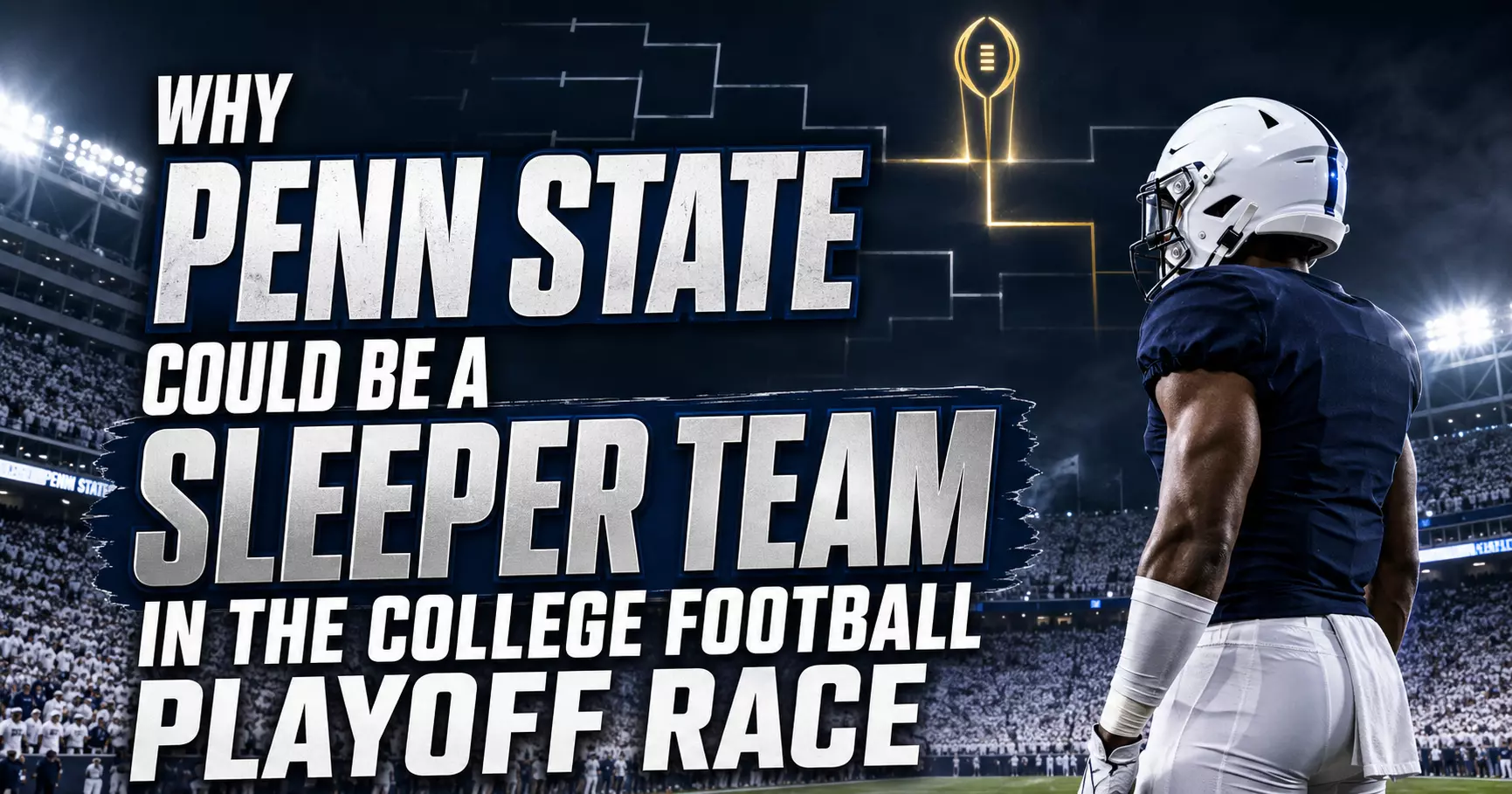
The Nittany Lions entered the 2025 season ranked No. 2 nationally and were widely considered a serious national championship contender.
Calling Penn State a sleeper would have sounded ridiculous one year ago.
The Nittany Lions entered the 2025 season ranked No. 2 nationally and were widely considered a serious national championship contender. Instead, the season unraveled. Penn State lost to Oregon in double overtime, suffered shocking defeats against UCLA and Northwestern and fired James Franklin after a 3–3 start. Quarterback Drew Allar was lost to injury, the offense became unstable and a team built to reach the College Football Playoff fell completely out of contention.
Penn State eventually recovered under interim coach Terry Smith, winning its final four games and defeating Clemson 22–10 in the Pinstripe Bowl. Still, a 7–6 record represented a massive disappointment for a program that had reached the CFP semifinals only one season earlier.
Now almost everything has changed.
Matt Campbell
has replaced Franklin. Rocco Becht followed Campbell from Iowa State to become Penn State’s quarterback. Nearly 40 players were added through the transfer portal, creating one of the most dramatic roster transformations in major college football. The Nittany Lions also have a schedule that avoids Ohio State, Oregon and defending national champion Indiana.
Penn State is not receiving the preseason respect it normally commands because its roster is unfamiliar and its coaching staff is new. Those concerns are understandable.
But the Nittany Lions possess an experienced quarterback, a proven head coach, a deep collection of skill players, a talented linebacker tandem and a legitimate route to ten or eleven victories.
Penn State may be unpredictable, but it is also one of the most dangerous sleeper teams in the 2026 College Football Playoff race.
Matt Campbell Has Been Preparing for This Opportunity
Campbell did not inherit an easy situation.
Penn State’s coaching search extended beyond the early signing period, and the roster was hit hard by portal departures. More than two dozen players left, including quarterback Ethan Grunkemeyer, tight end Andrew Olesh, defensive end Jaylen Harvey and multiple offensive linemen and defensive backs.
Campbell responded by bringing much of his Iowa State infrastructure to State College.
The large number of former Cyclones on Penn State’s roster has produced some jokes about the Nittany Lions becoming “Iowa State East,” but Campbell needed players who understood his standards, terminology and practice expectations. With so much roster turnover, familiarity had genuine value.
Campbell left Iowa State as the winningest coach in program history. He produced eight of the Cyclones’ nine winning conference seasons during the Big 12 era, led Iowa State to a Fiesta Bowl victory and recorded the program’s first 11-win season in 2024.
He did those things without Penn State’s recruiting territory, facilities, financial resources or national brand.
The question is no longer whether Campbell can develop players or build a program. He has already answered that. The question is whether he can take those skills and win against the elite teams of the Big Ten.
Penn State gives Campbell a higher ceiling than he had at Iowa State. Even after the offseason departures, the roster contains more size, athleticism and recruiting talent than Campbell usually possessed in Ames.
He is no longer being asked to defeat more talented opponents with fewer resources. He is being asked to combine Penn State’s natural advantages with the culture and development model that made Iowa State consistently competitive.
That combination could work more quickly than expected.
Rocco Becht Gives Penn State Stability at Quarterback
Becht is the most important addition to the roster.
He arrives at Penn State with 39 career starts, 26 victories, 9,274 passing yards and 64 touchdown passes. He also rushed for 499 yards and 19 touchdowns during his Iowa State career. That experience separates him from many quarterbacks entering new situations in 2026.
Penn State Athletics
Becht’s best season came in 2024, when he passed for 3,505 yards and 25 touchdowns while leading Iowa State to an 11–3 record. The Cyclones reached the Big 12 Championship Game and defeated Miami in the Pop-Tarts Bowl.
His production declined in 2025. Becht completed 205 of 339 passes for 2,584 yards, 16 touchdowns and nine interceptions. He remained effective near the goal line, adding eight rushing touchdowns, but he was not as consistently explosive as he had been the previous year.
A torn labrum contributed to those struggles, and Becht underwent surgery following the season. His health is one of Penn State’s most significant concerns entering 2026.
If Becht is fully recovered, Penn State has an experienced quarterback who already understands Campbell and offensive coordinator Taylor Mouser. That familiarity should make the transition considerably easier. Becht will not need half a season to learn the offense or understand what his coaches expect from him.
He also brings leadership to a roster filled with new players. Becht represented Penn State at Big Ten Media Days alongside Anthony Donkoh and Tony Rojas, a clear indication that Campbell views him as one of the program’s central voices.
Penn State does not need Becht to become a Heisman Trophy candidate. It needs him to make sound decisions, protect the football and create explosive plays when opponents commit additional defenders to stopping the run.
The Nittany Lions are not relying on an inexperienced quarterback to figure everything out against Michigan in October. They are relying on someone who has already won 26 games and played for a conference championship.
That gives Penn State a chance to contend immediately.
The Running Back Room Has Been Rebuilt
Penn State lost both Nicholas Singleton and Kaytron Allen to the NFL Draft. Together, they formed one of the best running back tandems in the country and provided stability throughout the Franklin era.
Replacing them will not be easy, but Campbell assembled a promising group.
Carson Hansen followed Campbell from Iowa State after rushing for 952 yards and six touchdowns in 2025. Hansen averaged 5.1 yards per carry and ended his season with five consecutive 100-yard performances. He also caught 19 passes for 134 yards.
At 6-foot-2 and approximately 220 pounds, Hansen is capable of handling a substantial workload. He is not merely an Iowa State player who received a roster spot because of his relationship with Campbell. He was a second-team All-Big 12 selection and has rushed for 1,771 yards and 19 touchdowns during his career.
Ohio State transfer James Peoples brings a different type of upside. Peoples was a highly regarded recruit who rushed for 344 yards and three touchdowns on 61 carries in 2025. His 5.6-yard average showed his potential, but he was stuck behind Bo Jackson in a loaded Ohio State backfield.
Peoples now has an opportunity to earn a larger role.
Hansen gives Penn State experience and power. Peoples brings speed, athleticism and the potential to become a breakout player. Cam Wallace and Quinton Martin Jr. provide additional depth.
The
Nittany Lions
may not have another Singleton-Allen combination, but they do not need to rely on one back for 25 carries every week. Campbell has traditionally preferred using multiple running backs, and Mouser’s offense should create opportunities for each player.
A dependable running game would protect Becht, reduce pressure on the receivers and allow Penn State to control games against the weaker portion of its schedule.
The Receivers Are More Interesting Than Proven
Penn State has spent several seasons searching for consistent production at wide receiver.
The 2026 group is almost completely rebuilt.
Chase Sowell headlines the room after catching 32 passes for 500 yards and two touchdowns at Iowa State last season. His 15.9 yards per reception ranked ninth in the Big 12. In 2024, he averaged 19.9 yards per catch and recorded seven receptions of at least 40 yards.
Sowell’s size and downfield ability give Penn State something it has often lacked: an outside receiver capable of winning vertically.
Brett Eskildsen, Karon Brookins and Zay Robinson also transferred from Iowa State. Their familiarity with Becht and Mouser should help the offense operate more smoothly early in the season.
However, familiarity does not guarantee high-level Big Ten production. Penn State still needs someone to emerge as a true No. 1 receiver. Sowell is the most likely candidate, but he has never produced more than 678 yards in a season.
Koby Howard, Amarion Jackson and Grambling transfer Keith Jones Jr. provide additional options, but much of the room remains unproven at this level.
The good news is that Penn State may not require one receiver to dominate the passing game. Campbell’s offense can distribute the ball among wideouts, running backs and tight ends. Becht also has experience working with many of these players.
Still, Penn State’s playoff ceiling may depend on whether Sowell or another receiver becomes capable of consistently winning against Michigan, USC and the better defenses on the schedule.
Benjamin Brahmer Could Become Becht’s Most Important Target
Tight end Benjamin Brahmer may be Penn State’s most dependable returning pass catcher—even though he has never played a game for the Nittany Lions.
Brahmer caught 37 passes for 446 yards and six touchdowns at Iowa State in 2025. His six touchdown receptions tied for sixth nationally among FBS tight ends. He also produced 15 receptions of at least 15 yards.
At 6-foot-7 and approximately 260 pounds, Brahmer gives Becht an enormous target in the middle of the field and near the goal line. He already understands how to find openings in Campbell’s offense and has established chemistry with his quarterback.
Penn State also returns Andrew Rappleyea and added former Iowa State tight ends Gabe Burkle and Cooper Alexander. Mouser coached tight ends at Iowa State and regularly used multiple-tight-end formations.
That flexibility could become one of Penn State’s offensive strengths. The Nittany Lions can use heavier personnel to run the football while still presenting legitimate receiving threats. That makes it more difficult for defenses to determine whether Penn State intends to run or pass based on personnel.
Brahmer may not receive the same attention as the Big Ten’s star receivers, but he could become one of the conference’s most productive tight ends.
The Offensive Line Must Come Together Quickly
The offensive line represents both a potential strength and a significant concern.
Penn State returns Anthony Donkoh and Cooper Cousins, two players with considerable talent and experience. Donkoh represented the program at Big Ten Media Days, signaling his importance to Campbell’s first team.
The Nittany Lions also added multiple linemen through the portal, including Trevor Buhr, Vaea Ikakoula, Will Tompkins, Kuol Kuol II, Brock Riker, Tyshon Huff and others.
Buhr played eight games and made six starts for Iowa State in 2025. He did not allow a sack in 218 pass-blocking snaps and helped Hansen earn second-team All-Big 12 recognition.
There is enough size and experience to build a solid starting five. The uncertainty comes from determining the correct combination.
An offensive line depends on communication and continuity. Penn State cannot simply assemble five talented players from different programs and assume the unit will immediately function at a championship level.
The three nonconference games against Marshall, Temple and Buffalo should give the staff time to identify its best lineup before Big Ten competition begins. Penn State cannot afford to still be experimenting when USC visits Beaver Stadium or when the Nittany Lions travel to Michigan.
If the offensive line develops quickly, Penn State should have a balanced and difficult-to-defend offense. If it struggles, Becht’s lack of elite mobility and the absence of a proven No. 1 receiver could become larger problems.
Tony Rojas Can Become the Face of the Defense
Penn State lost considerable defensive talent to the NFL and transfer portal. Dani Dennis-Sutton, Zane Durant and Zakee Wheatley were drafted, while several other contributors departed.
Tony Rojas gives the rebuilt defense a legitimate star.
Rojas was on his way to a breakout 2025 season before suffering a torn ACL after four games. He recorded 25 tackles, 4.5 tackles for loss and two sacks during that short stretch. His combination of speed, range and aggression allows him to make plays across the field.
The injury is an obvious concern. Penn State needs Rojas to regain his explosiveness and confidence, and it would be unfair to assume he will immediately look exactly like the player he was before the ACL tear.
But if he returns at full strength, Rojas has the talent to become one of the Big Ten’s best linebackers.
He is also one of the most important remaining connections to the previous Penn State roster. With so many newcomers, the defense needs returning leaders who understand the program and its expectations.
Rojas can provide that leadership while becoming the centerpiece of D’Anton Lynn’s defense.
Caleb Bacon Gives the Linebackers Experience and Toughness
Rojas will be joined by Iowa State transfer Caleb Bacon, giving Penn State one of the more intriguing linebacker combinations in the Big Ten.
Bacon began his Iowa State career as a walk-on and developed into a team captain. He started all 12 games in 2025, recording 68 tackles, 9.5 tackles for loss, three sacks, a forced fumble and three pass breakups.
At 6-foot-4 and approximately 240 pounds, Bacon adds size and experience to a unit that lost several players during the offseason. He understands Campbell’s culture and brings a reputation for toughness and preparation.
Alex Tatsch showed promise as a freshman, while Kooper Ebel, Cael Brezina, Chris Fileppo and LaVar Arrington II provide additional depth and versatility.
The Nittany Lions may not have the established defensive line that characterized some of Franklin’s best teams, so the linebackers will be asked to do more. Rojas and Bacon must help defend the run, pressure quarterbacks and prevent explosive plays in space.
If Rojas is healthy, this could become the most dependable unit on Penn State’s defense.
The Defensive Line Is the Biggest Concern
Penn State has been accustomed to producing
NFL defensive linemen. That tradition will be tested in 2026.
Dennis-Sutton, Durant and several other linemen are gone. The Nittany Lions do not have an obvious returning star capable of replacing their pass-rushing production.
Campbell addressed the problem with size and numbers.
Ikenna Ezeogu and Alijah Carnell followed him from Iowa State. Siale Taupaki and Keanu Williams transferred from UCLA, while Dallas Vakalahi arrived from Utah. Armstrong Nnodim transferred from Oklahoma State, and Penn State returns Ty Blanding and several younger players.
The interior is noticeably bigger than it was earlier in the offseason. Vakalahi is listed at approximately 326 pounds, Nnodim has reportedly reached 310 and Blanding is around 300. That additional size should help Penn State defend the powerful running games it will encounter in the Big Ten.
The greater question is where the pass rush will come from.
Ezeogu has experience and length, but Penn State needs him or another edge defender to emerge as a consistent pressure producer. Defensive coordinator D’Anton Lynn cannot be forced to manufacture pressure with blitzes every week.
This does not have to become an elite defensive line immediately. It must hold up against the run, keep blockers away from Rojas and Bacon and create enough pressure to prevent opposing quarterbacks from becoming comfortable.
Penn State’s CFP chances could ultimately depend on whether this unit exceeds expectations.
D’Anton Lynn Was an Important Hire
Campbell did not simply bring his entire Iowa State coaching staff with him.
Hiring Lynn as defensive coordinator gave Penn State an experienced coach with both college and NFL experience. Lynn spent two seasons as USC’s defensive coordinator before accepting the Penn State position.
His challenge will be blending players from several different systems into one functional defense.
Campbell’s Iowa State teams traditionally used three-safety structures and created confusion through alignment and coverage. Lynn has worked with four-man fronts and has experience adapting his system to different personnel.
Penn State’s roster should allow him to be flexible. The safety room is deep, the linebackers are athletic and the defensive front contains several large interior players.
The Nittany Lions may not resemble a traditional Penn State defense in September. That does not mean the unit cannot become effective by the time the most important games arrive.
Lynn must simplify the system enough for a transfer-heavy roster to play quickly while gradually adding complexity throughout the season.
The Secondary Has Experience but Must Stay Healthy
Campbell added several familiar defensive backs from Iowa State, including Marcus Neal Jr., Jamison Patton and Jeremiah Cooper.
Cooper is the most accomplished. He started 36 games during his Iowa State career, recording 134 tackles, eight interceptions and 22 pass breakups. He earned first-team All-Big 12 recognition in 2023 after intercepting five passes.
Like Rojas, Cooper is returning from a serious knee injury. He suffered a torn ACL early in the 2025 season. His recovery will be important because he can play safety, nickel corner or outside corner.
Omarion Davis transferred from Boston College, while Penn State returns Vaboue Toure and several younger defensive backs. The secondary has options, but its most experienced players must remain healthy.
The presence of multiple safeties who understand Campbell’s system should allow Penn State to disguise coverages. That becomes especially important if the defensive line does not generate consistent pressure.
This secondary may surrender some yardage while the new defense develops. Its ability to create turnovers could compensate for those growing pains.
The Schedule Gives Penn State a Genuine Opportunity
Penn State’s schedule is the strongest reason to consider the Nittany Lions a playoff sleeper.
The nonconference portion consists of Marshall, Temple and Buffalo. Penn State should be heavily favored in all three games.
The Nittany Lions then open Big Ten play with Wisconsin at Beaver Stadium before traveling to Northwestern. After that comes the most important stretch of the season:
USC at home
At Michigan
Bye week
Purdue at home
At Washington
Penn State then closes with home games against Minnesota and Rutgers before traveling to Maryland.
The most important fact is who does not appear on the schedule.
Penn State avoids Ohio State, Oregon and defending national champion Indiana. It also does not face Iowa, Nebraska or Illinois.
Michigan in Ann Arbor will be difficult, and USC possesses enough offensive talent to test Penn State’s rebuilt defense. Washington is dangerous at Husky Stadium, especially following a cross-country trip. Wisconsin could also become a physical early-season challenge.
But there is no game Penn State is incapable of winning.
The first three weeks should allow Campbell to establish his system without facing an elite opponent. The schedule then gradually becomes more difficult rather than immediately placing the new roster under extreme pressure.
A 5–0 start is realistic. If Penn State splits the USC and Michigan games, it could enter November at 6–1. From there, the Nittany Lions would have a favorable path to ten or eleven wins.
Penn State Has Two CFP Routes
The 2026 College Football Playoff remains a 12-team tournament. The champions of the ACC, Big Ten, Big 12 and SEC are guaranteed automatic bids, while seven additional teams receive at-large invitations.
Penn State therefore has two possible routes.
The first is reaching and winning the Big Ten Championship Game. That will be difficult because Ohio State, Indiana, Oregon, Michigan and several other teams have championship expectations.
The second—and more realistic—route is earning an at-large bid.
Penn State probably needs to finish 11–1 to feel secure. A 10–2 record could be enough depending on the quality of the victories, the competitiveness of the losses and the strength of other at-large candidates.
A win at Michigan would significantly strengthen the résumé. Beating USC would also provide a valuable national result. If Penn State wins both, it could become a serious contender to reach the Big Ten title game.
Unlike Louisville,
Penn State
cannot rely on winning a less predictable conference race. The Big Ten is loaded with national contenders. However, the Nittany Lions’ favorable schedule allows them to avoid several of those teams.
Penn State does not need to prove it is better than Ohio State, Oregon and Indiana during the regular season.
It only needs to accumulate enough victories to earn one of seven at-large positions.
What Could Keep Penn State Out?
The roster turnover cannot be ignored.
Penn State added nearly 40 transfers, and many of them followed Campbell from Iowa State. Those players understand the coach, but they have not experienced the weekly size and speed of the Big Ten. Several were productive Big 12 players, but succeeding at Iowa State does not automatically make someone a championship-level player at Penn State.
Becht’s shoulder is another concern. A quarterback coming off labrum surgery must prove he can regain his arm strength, accuracy and confidence.
The offensive line has talent but limited continuity. The wide receivers lack a proven star. The defensive line does not have an obvious elite pass rusher. Rojas and Cooper are both returning from ACL injuries.
There is also the challenge of expectations.
Campbell is moving from a program where eight wins could be considered successful to one where ten wins may still produce criticism. He must coach more aggressively in major games and avoid the conservative decisions that sometimes limited Iowa State against talented opponents.
Finally, Penn State must prove it has recovered mentally from 2025. The Nittany Lions entered last season expecting to compete for a national championship and instead experienced one of the most disappointing seasons in program history.
A new coach and new roster can create energy, but they can also create uncertainty.
New Users – Get $350 in Bonus Bets when you wager $5 for 7 days
T&Cs apply
4.6/5
Gambling Problem? Call 1-800-GAMBLER or 1-800-MY-RESET. Call 1-888-789-7777 or visit ccpgg.org/chat (CT). Hope is here. GamblingHelpLineMA.org or call (800) 327-5050 for 24/7 support (MA). Visit www.mdgamblinghelp.org (MD). Call 1-877-8HOPE-NY or text HOPENY (NY). 21+ (18+ DC, WY) and present in select states (for KS, in affiliation with Kansas Star Casino). Find online real money wagering only. Min $5 wager required for 7 consecutive days. $5 free play credit. Bonus issued as non-withdrawable bonus with cash withdrawable bonus with cash withdrawable. Bonus bets which expire 7 days after receipt. Restrictions apply. See terms at sportsbook.fanduel.com. Call 1-877-770-7867 (LA).
Up To $1500 in Bonus Bets Paid Back if your First Bet Does Not Win
T&Cs apply
4.5/5
Gambling problem? Call 1-800-GAMBLER or 1-800-MY-RESET (Available in the US) 877-8-HOPENY or text HOPENY (467369) (NY) 1-800-327-5050 (MA), 1-800-BETS-OFF (IA), 1-800-981-0023 (PR). 21+ only. Please Gamble Responsibly. See BetMGM.com for Terms. First Bet Offer for new customers only (if applicable). Subject to eligibility requirements. Bonus bets are non-withdrawable. In partnership with Kansas Crossing Casino and Hotel. Promotional offers not available in Mississippi, Massachusetts, New York, Ontario, or Puerto Rico.
New DraftKings Customers: Bet $5, Get $200 + 3 Months of NBA League Pass!
T&Cs apply
4.5/5
GAMBLING PROBLEM? CALL 1-800-GAMBLER or 1-800-MY-RESET, (800) 327-5050 or visit gamblinghelplinema.org (MA). Please Gamble Responsibly. 888-789-7777/visit ccpg.org (CT), or visit www.mdgamblinghelp.org (MD), 1-800-981-0023 (PR). 21+ and present in most states. (18+ DC/NH/PR/WY). Void in CAN. Eligibility restrictions apply. On behalf of Boot Hill Casino (KS). Pass-thru of per wager tax may apply in IL. 1 per new Sportsbook customer. $5+ first-time bet req. Max. $200 issued as non-withdrawable Bonus Bets. Stake removed from payout. Reward issued as $50 in Bonus Bets every 7 days via click-to-claim for 21 days. Bonus Bets and click-to-claims expire 7 days (168hrs) after issuance. Terms: dkng.co/offer. Get 1 promo code to redeem a 3-month NBA League Pass subscription, complimentary of DraftKings. Subscription auto-renews monthly at then-current price (currently $16.99/mo); cancel anytime. Terms, restrictions, and eligibility requirements apply. Redeem League Pass by 12/19/26 at 11:59 PM ET. Addt’l terms: support.watch.nba.com/hc/en-us/articles/9165532876183-League-Pass-Terms-of-Use_. Ends 11/29/26 at 11:59 PM ET. Sponsored by DK.
Must be 21+. GAMBLING PROBLEM? CALL 1-800-GAMBLER OR CALL 1-800-MY-RESET, www.mdgamblinghelp.org (MD), (800)-327-5050 or gamblinghelplinema.org (MA), Call (877)8-HOPENY or text HOPENY (467369) (NY), (888) 789-7777 or ccpg.org (CT), morethanagame.nc.gov (NC), 1800gambler.net (WV)
Bet $1 and get double the winnings up to $25 for your next 10 bets
T&Cs apply
4.4/5
21+ New users only. Must register using eligible promo code. First bet after registration must qualify. Max. Bonus Bet: $1,000. Bonus Bet expires 14 days after receipt. Void where prohibited. See Caesars.com/promos for full terms. Gambling Problem? 1-800-GAMBLER (1-800-426-2537)
21+ and present in OH. Gambling Problem? Call 1-800-GAMBLER.
This site is using
Cloudflare
and adheres to the
Google Safe Browsing Program. We adapted
Google's Privacy Guidelines
to keep your data safe at all times.
Close
Ready to Win Big? Join the Elite with Our Sports Betting Deals!
FanDuel Promo
New Users – Get $350 in Bonus Bets when you wager $5 for 7 days
Our Favorite
T&Cs and 21+ apply
Gambling Problem? Call 1-800-GAMBLER or 1-800-MY-RESET. Call 1-888-789-7777 or visit ccpgg.org/chat (CT). Hope is here. GamblingHelpLineMA.org or call (800) 327-5050 for 24/7 support (MA). Visit www.mdgamblinghelp.org (MD). Call 1-877-8HOPE-NY or text HOPENY (NY). 21+ (18+ DC, WY) and present in select states (for KS, in affiliation with Kansas Star Casino). Find online real money wagering only. Min $5 wager required for 7 consecutive days. $5 free play credit. Bonus issued as non-withdrawable bonus with cash withdrawable bonus with cash withdrawable. Bonus bets which expire 7 days after receipt. Restrictions apply. See terms at sportsbook.fanduel.com. Call 1-877-770-7867 (LA).
Code:
Open FanDuel
Get Bonus
BetMGM Promo
Up To $1500 in Bonus Bets Paid Back if your First Bet Does Not Win
Best Slots
T&Cs and 21+ apply
Gambling problem? Call 1-800-GAMBLER or 1-800-MY-RESET (Available in the US) 877-8-HOPENY or text HOPENY (467369) (NY) 1-800-327-5050 (MA), 1-800-BETS-OFF (IA), 1-800-981-0023 (PR). 21+ only. Please Gamble Responsibly. See BetMGM.com for Terms. First Bet Offer for new customers only (if applicable). Subject to eligibility requirements. Bonus bets are non-withdrawable. In partnership with Kansas Crossing Casino and Hotel. Promotional offers not available in Mississippi, Massachusetts, New York, Ontario, or Puerto Rico.
Code:
Open BetMGM
Get Bonus
DraftKings Promo
New DraftKings Customers: Bet $5, Get $200 + 3 Months of NBA League Pass!
Newcomer
T&Cs and 21+ apply
GAMBLING PROBLEM? CALL 1-800-GAMBLER or 1-800-MY-RESET, (800) 327-5050 or visit gamblinghelplinema.org (MA). Please Gamble Responsibly. 888-789-7777/visit ccpg.org (CT), or visit www.mdgamblinghelp.org (MD), 1-800-981-0023 (PR). 21+ and present in most states. (18+ DC/NH/PR/WY). Void in CAN. Eligibility restrictions apply. On behalf of Boot Hill Casino (KS). Pass-thru of per wager tax may apply in IL. 1 per new Sportsbook customer. $5+ first-time bet req. Max. $200 issued as non-withdrawable Bonus Bets. Stake removed from payout. Reward issued as $50 in Bonus Bets every 7 days via click-to-claim for 21 days. Bonus Bets and click-to-claims expire 7 days (168hrs) after issuance. Terms: dkng.co/offer. Get 1 promo code to redeem a 3-month NBA League Pass subscription, complimentary of DraftKings. Subscription auto-renews monthly at then-current price (currently $16.99/mo); cancel anytime. Terms, restrictions, and eligibility requirements apply. Redeem League Pass by 12/19/26 at 11:59 PM ET. Addt’l terms: support.watch.nba.com/hc/en-us/articles/9165532876183-League-Pass-Terms-of-Use_. Ends 11/29/26 at 11:59 PM ET. Sponsored by DK.
Code:
Open DraftKings
Get Bonus
Find out what the legends have to say about sports this week....
New Users – Get $350 in Bonus Bets when you wager $5 for 7 days
Gambling Problem? Call 1-800-GAMBLER or 1-800-MY-RESET. Call 1-888-789-7777 or visit ccpgg.org/chat (CT). Hope is here. GamblingHelpLineMA.org or call (800) 327-5050 for 24/7 support (MA). Visit www.mdgamblinghelp.org (MD). Call 1-877-8HOPE-NY or text HOPENY (NY). 21+ (18+ DC, WY) and present in select states (for KS, in affiliation with Kansas Star Casino). Find online real money wagering only. Min $5 wager required for 7 consecutive days. $5 free play credit. Bonus issued as non-withdrawable bonus with cash withdrawable bonus with cash withdrawable. Bonus bets which expire 7 days after receipt. Restrictions apply. See terms at sportsbook.fanduel.com. Call 1-877-770-7867 (LA).