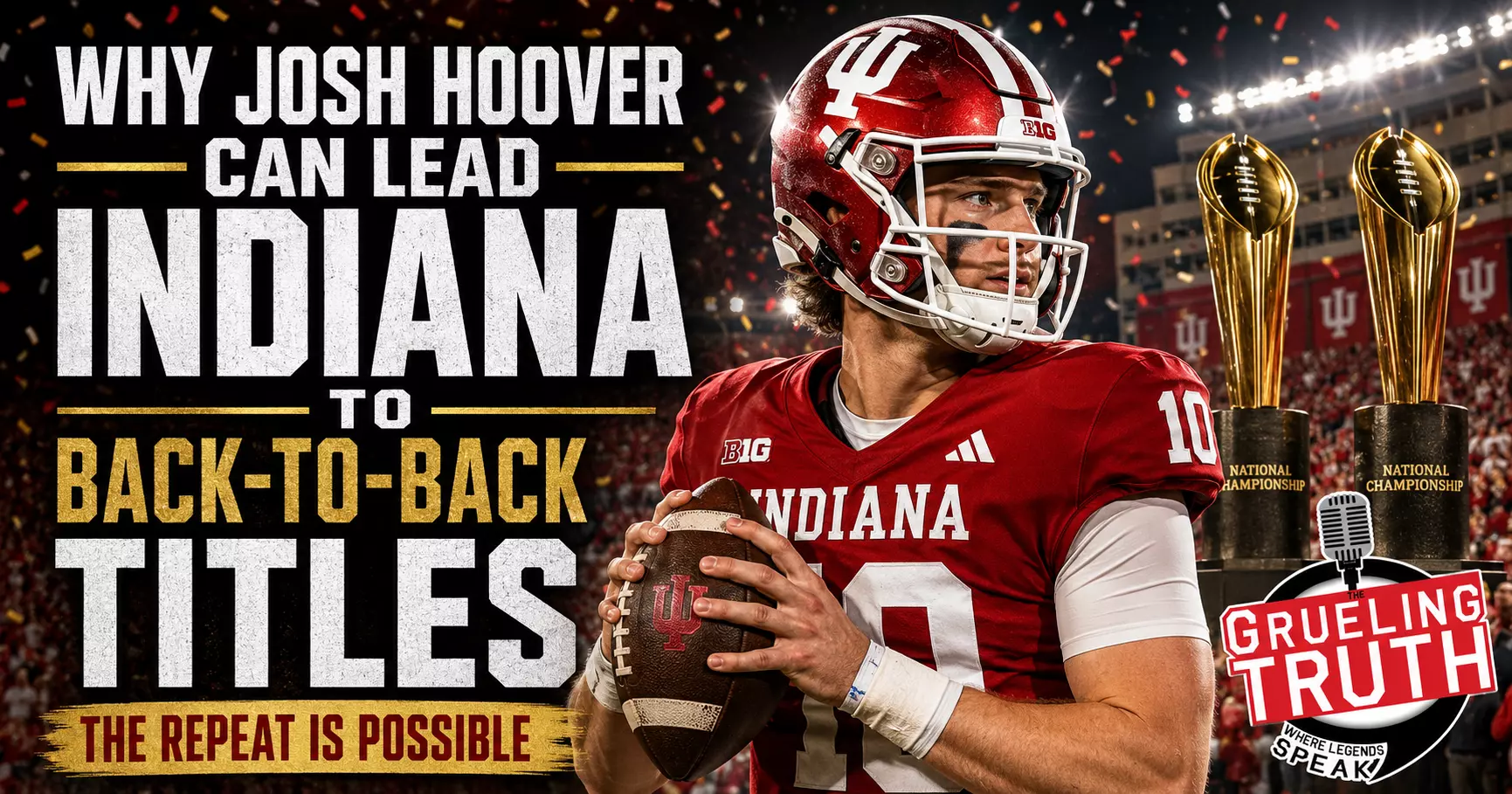
The challenge confronting Josh Hoover could intimidate almost any quarterback in college football. Hoover is replacing Fernando Mendoza.
The challenge confronting Josh Hoover could intimidate almost any quarterback in college football.
Hoover is replacing Fernando Mendoza, the reigning Heisman Trophy winner who led Indiana to a perfect 16–0 season and the first national championship in program history. Mendoza threw 41 touchdown passes, became the face of Indiana’s remarkable transformation and delivered the championship-winning performance against Miami.
Following that act will not be easy. Hoover, however, is not arriving in Bloomington to imitate Mendoza. He is coming to Indiana with enough experience, arm talent and production to write his own championship story.
The Hoosiers will face a more demanding challenge in 2026. Every opponent will prepare for Indiana as the defending national champion. The Hoosiers will receive everyone’s best effort, and anything short of another deep College Football Playoff run will be treated as a disappointment.
But Indiana has not disappeared with Mendoza’s departure.
Curt Cignetti
has built an organization capable of sustaining success, and Hoover may be the ideal quarterback to help the Hoosiers win back-to-back national championships.
Hoover Is Already a Proven College Quarterback
Indiana is not asking an inexperienced player to replace the best quarterback in the country. Hoover arrives from TCU as one of college football’s most productive returning passers.
During his career with the Horned Frogs, Hoover passed for 9,629 yards and 71 touchdowns while completing 65.2 percent of his throws. He started games in three different seasons and experienced almost every situation a quarterback can encounter—road games, fourth-quarter pressure, offensive shootouts and the weekly demands of leading a Power Four program.
Hoover threw for 3,949 yards and 27 touchdowns in 2024, setting TCU’s single-season record for passing yardage. He followed that performance by completing 65.9 percent of his passes for 3,472 yards and 29 touchdowns in 2025.
Those are not the numbers of a quarterback Indiana must hide. Hoover can take control of games with his arm.
His best performances demonstrate how dangerous he can become in Indiana’s offense. Against SMU last season, Hoover threw for 379 yards and five touchdowns in a 35–24 victory. He has repeatedly shown the ability to attack defenses vertically, throw receivers open and produce explosive plays when opponents crowd the line of scrimmage.
Indiana lost a Heisman winner, but it replaced him with a quarterback who has already produced at a national level.
Cignetti’s System Can Make Hoover Better
The strongest reason to believe in Hoover is not simply what he accomplished at TCU. It is what Indiana’s coaching staff can help him become.
Cignetti has developed an impressive record with transfer quarterbacks. Kurtis Rourke arrived from Ohio and immediately became one of the Big Ten’s most efficient passers in 2024. Mendoza transferred from California and developed into a Heisman Trophy winner, national champion and elite NFL prospect.
Now Hoover enters the same environment.
Indiana’s offense does not require its quarterback to make spectacular plays on every snap. Cignetti and offensive coordinator Mike Shanahan build answers into the system. They use formations, motion and play-action concepts to reveal coverages, create favorable matchups and give the quarterback clearly defined opportunities.
The Hoosiers also emphasize preparation and decision-making. Their quarterbacks are expected to understand where the football should go before the snap, recognize pressure and avoid turning a manageable situation into a disastrous one.
That structure could unlock Hoover’s full potential.
At TCU, Hoover was frequently asked to carry an offense that depended heavily upon its passing game. He attempted 413 passes in 12 games last season and averaged nearly 290 passing yards per appearance. That responsibility produced impressive statistics, but it also encouraged Hoover to force throws when the offense fell behind schedule.
Indiana will not need him to rescue the team on every possession. If the Hoosiers remain balanced and protect him properly, Hoover can become more efficient without sacrificing the aggressive mentality that makes him dangerous.
At 6-foot-2 and 200 pounds, he is comfortable throwing from the pocket and has the arm strength to challenge every area of the field. He can drive the ball outside the numbers, attack the middle against split-safety coverage and punish defenses that lose discipline on play-action.
Hoover is especially effective when he establishes rhythm. Once he completes a few early passes, he begins playing with confidence and anticipation. He is willing to deliver throws before receivers come out of their breaks, an essential quality against the speed and complexity of Big Ten defenses.
His experience also allows Indiana to maintain a larger playbook. The coaching staff will not need to spend half the season teaching him how to identify basic fronts or handle road environments. Hoover has already played 36 college games and attempted nearly 1,500 passes.
That experience matters for a team pursuing another championship. Indiana cannot afford to treat September as an extended training camp for its new quarterback. Hoover should be prepared to operate the entire offense from the beginning of the season.
Indiana Still Has Weapons Around Him
Hoover will not be expected to manufacture offense by himself.
Charlie Becker returns after contributing to Indiana’s championship run, while Michigan State transfer Nick Marsh gives the Hoosiers a physically imposing target. Marsh is 6-foot-3 and approximately 213 pounds, providing Hoover with the type of receiver who can win contested catches and create opportunities after the catch.
Tyler Morris also returns after working his way back from injury, giving the offense another experienced option. The Hoosiers have spent the offseason building chemistry between Hoover and his receivers, with Becker praising the quarterback’s willingness to remain after workouts for additional throwing sessions.
That work is important. Hoover’s success will depend upon timing and trust, particularly when facing pressure or throwing into tight coverage.
Indiana also has the opportunity to build a more balanced offense. Running back Turbo Richard offers speed and explosiveness, while Cignetti has consistently emphasized the importance of controlling games on the ground. A reliable running attack would force defenses to respect Indiana’s play-action game and reduce the number of obvious passing situations Hoover faces.
Joe Brunner should become one of the critical pieces along the offensive line. He did not allow a sack during the 2025 season and transferred to Indiana with the intention of helping protect Hoover. Drew Evans provides additional experience after starting all 21 games in which he appeared during his college career.
Hoover does not need the most talented supporting cast in the country. He needs a dependable offensive line, a credible running game and receivers capable of converting favorable matchups. Indiana appears to have the pieces necessary to provide all three.
The Defense Will Reduce the Pressure
Quarterbacks receive most of the credit for championships, but Indiana’s ability to repeat will depend just as heavily upon its defense.
Cignetti’s program is built around complete-team football. The Hoosiers do not expect the offense to score 45 points every week. Their defensive structure, physicality and preparation allow Indiana to control games even when the offense is not operating perfectly.
That is important for Hoover.
At TCU, he sometimes played as if every possession had to produce a touchdown. That mentality contributed to turnovers because Hoover attempted low-percentage throws rather than accepting a punt or taking an available checkdown.
Indiana’s defense should allow him to play with greater patience. If Hoover understands that the Hoosiers can win games 24–17 as well as 45–38, he will not feel compelled to force the ball into coverage.
The goal should not be to eliminate Hoover’s aggressiveness. Indiana needs his willingness to attack. The goal is to help him recognize when a potential big play is worth pursuing and when protecting possession is the smarter decision.
Turnovers Are the Biggest Question
There is one legitimate concern that cannot be ignored: Hoover must take better care of the football.
He threw 13 interceptions during the 2025 season and 33 over his TCU career. According to Pro Football Focus data cited by
Sports Illustrated, Hoover produced a 4.4 percent turnover-worthy play rate, placing him near the bottom of the national rankings in that category.
Indiana cannot win another championship if Hoover continues giving opponents extra possessions.
Mendoza and Rourke combined for only 11 interceptions during their two seasons as Indiana’s starting quarterbacks. Their efficiency was one of the main reasons the Hoosiers consistently controlled games. They understood that an incompletion or punt was preferable to a reckless attempt that placed the defense in a difficult position.
Hoover must learn the same lesson.
The encouraging part is that his turnover problem appears correctable. Many of his mistakes resulted from forcing throws while trying to compensate for problems elsewhere in the offense. Indiana’s structure should give him cleaner reads and fewer situations in which he feels responsible for creating something from nothing.
Cignetti will not tolerate repeated careless decisions, and Hoover knows it. If he reduces his interceptions without losing his confidence, his ceiling becomes exceptionally high.
Hoover Does Not Have to Be Fernando Mendoza
Comparisons with Mendoza are unavoidable, but they are also unfair.
Indiana does not need Hoover to reproduce Mendoza’s exact statistics or personality. The Hoosiers need him to be the best version of Josh Hoover.
Mendoza excelled through precision, composure and remarkable command of the offense. Hoover may create more explosive passing plays and take more chances downfield. His approach will look different, but different does not mean worse.
The 2026 Hoosiers will also be a different team. They will possess new strengths, new leaders and a new identity. Trying to recreate every detail of the
championship season
would be a mistake. Cignetti’s greatest strength is his ability to build an offense around the players he has rather than forcing every quarterback into precisely the same role.
Hoover can make Indiana more aggressive vertically.
New Users – Get $350 in Bonus Bets when you wager $5 for 7 days
T&Cs apply
4.6/5
Gambling Problem? Call 1-800-GAMBLER or 1-800-MY-RESET. Call 1-888-789-7777 or visit ccpgg.org/chat (CT). Hope is here. GamblingHelpLineMA.org or call (800) 327-5050 for 24/7 support (MA). Visit www.mdgamblinghelp.org (MD). Call 1-877-8HOPE-NY or text HOPENY (NY). 21+ (18+ DC, WY) and present in select states (for KS, in affiliation with Kansas Star Casino). Find online real money wagering only. Min $5 wager required for 7 consecutive days. $5 free play credit. Bonus issued as non-withdrawable bonus with cash withdrawable bonus with cash withdrawable. Bonus bets which expire 7 days after receipt. Restrictions apply. See terms at sportsbook.fanduel.com. Call 1-877-770-7867 (LA).
Up To $1500 in Bonus Bets Paid Back if your First Bet Does Not Win
T&Cs apply
4.5/5
Gambling problem? Call 1-800-GAMBLER or 1-800-MY-RESET (Available in the US) 877-8-HOPENY or text HOPENY (467369) (NY) 1-800-327-5050 (MA), 1-800-BETS-OFF (IA), 1-800-981-0023 (PR). 21+ only. Please Gamble Responsibly. See BetMGM.com for Terms. First Bet Offer for new customers only (if applicable). Subject to eligibility requirements. Bonus bets are non-withdrawable. In partnership with Kansas Crossing Casino and Hotel. Promotional offers not available in Mississippi, Massachusetts, New York, Ontario, or Puerto Rico.
New DraftKings Customers: Bet $5, Get $200 + 3 Months of NBA League Pass!
T&Cs apply
4.5/5
GAMBLING PROBLEM? CALL 1-800-GAMBLER or 1-800-MY-RESET, (800) 327-5050 or visit gamblinghelplinema.org (MA). Please Gamble Responsibly. 888-789-7777/visit ccpg.org (CT), or visit www.mdgamblinghelp.org (MD), 1-800-981-0023 (PR). 21+ and present in most states. (18+ DC/NH/PR/WY). Void in CAN. Eligibility restrictions apply. On behalf of Boot Hill Casino (KS). Pass-thru of per wager tax may apply in IL. 1 per new Sportsbook customer. $5+ first-time bet req. Max. $200 issued as non-withdrawable Bonus Bets. Stake removed from payout. Reward issued as $50 in Bonus Bets every 7 days via click-to-claim for 21 days. Bonus Bets and click-to-claims expire 7 days (168hrs) after issuance. Terms: dkng.co/offer. Get 1 promo code to redeem a 3-month NBA League Pass subscription, complimentary of DraftKings. Subscription auto-renews monthly at then-current price (currently $16.99/mo); cancel anytime. Terms, restrictions, and eligibility requirements apply. Redeem League Pass by 12/19/26 at 11:59 PM ET. Addt’l terms: support.watch.nba.com/hc/en-us/articles/9165532876183-League-Pass-Terms-of-Use_. Ends 11/29/26 at 11:59 PM ET. Sponsored by DK.
Must be 21+. GAMBLING PROBLEM? CALL 1-800-GAMBLER OR CALL 1-800-MY-RESET, www.mdgamblinghelp.org (MD), (800)-327-5050 or gamblinghelplinema.org (MA), Call (877)8-HOPENY or text HOPENY (467369) (NY), (888) 789-7777 or ccpg.org (CT), morethanagame.nc.gov (NC), 1800gambler.net (WV)
Bet $1 and get double the winnings up to $25 for your next 10 bets
T&Cs apply
4.4/5
21+ New users only. Must register using eligible promo code. First bet after registration must qualify. Max. Bonus Bet: $1,000. Bonus Bet expires 14 days after receipt. Void where prohibited. See Caesars.com/promos for full terms. Gambling Problem? 1-800-GAMBLER (1-800-426-2537)
21+ and present in OH. Gambling Problem? Call 1-800-GAMBLER.
This site is using
Cloudflare
and adheres to the
Google Safe Browsing Program. We adapted
Google's Privacy Guidelines
to keep your data safe at all times.
Close
Ready to Win Big? Join the Elite with Our Sports Betting Deals!
FanDuel Promo
New Users – Get $350 in Bonus Bets when you wager $5 for 7 days
Our Favorite
T&Cs and 21+ apply
Gambling Problem? Call 1-800-GAMBLER or 1-800-MY-RESET. Call 1-888-789-7777 or visit ccpgg.org/chat (CT). Hope is here. GamblingHelpLineMA.org or call (800) 327-5050 for 24/7 support (MA). Visit www.mdgamblinghelp.org (MD). Call 1-877-8HOPE-NY or text HOPENY (NY). 21+ (18+ DC, WY) and present in select states (for KS, in affiliation with Kansas Star Casino). Find online real money wagering only. Min $5 wager required for 7 consecutive days. $5 free play credit. Bonus issued as non-withdrawable bonus with cash withdrawable bonus with cash withdrawable. Bonus bets which expire 7 days after receipt. Restrictions apply. See terms at sportsbook.fanduel.com. Call 1-877-770-7867 (LA).
Code:
Open FanDuel
Get Bonus
BetMGM Promo
Up To $1500 in Bonus Bets Paid Back if your First Bet Does Not Win
Best Slots
T&Cs and 21+ apply
Gambling problem? Call 1-800-GAMBLER or 1-800-MY-RESET (Available in the US) 877-8-HOPENY or text HOPENY (467369) (NY) 1-800-327-5050 (MA), 1-800-BETS-OFF (IA), 1-800-981-0023 (PR). 21+ only. Please Gamble Responsibly. See BetMGM.com for Terms. First Bet Offer for new customers only (if applicable). Subject to eligibility requirements. Bonus bets are non-withdrawable. In partnership with Kansas Crossing Casino and Hotel. Promotional offers not available in Mississippi, Massachusetts, New York, Ontario, or Puerto Rico.
Code:
Open BetMGM
Get Bonus
DraftKings Promo
New DraftKings Customers: Bet $5, Get $200 + 3 Months of NBA League Pass!
Newcomer
T&Cs and 21+ apply
GAMBLING PROBLEM? CALL 1-800-GAMBLER or 1-800-MY-RESET, (800) 327-5050 or visit gamblinghelplinema.org (MA). Please Gamble Responsibly. 888-789-7777/visit ccpg.org (CT), or visit www.mdgamblinghelp.org (MD), 1-800-981-0023 (PR). 21+ and present in most states. (18+ DC/NH/PR/WY). Void in CAN. Eligibility restrictions apply. On behalf of Boot Hill Casino (KS). Pass-thru of per wager tax may apply in IL. 1 per new Sportsbook customer. $5+ first-time bet req. Max. $200 issued as non-withdrawable Bonus Bets. Stake removed from payout. Reward issued as $50 in Bonus Bets every 7 days via click-to-claim for 21 days. Bonus Bets and click-to-claims expire 7 days (168hrs) after issuance. Terms: dkng.co/offer. Get 1 promo code to redeem a 3-month NBA League Pass subscription, complimentary of DraftKings. Subscription auto-renews monthly at then-current price (currently $16.99/mo); cancel anytime. Terms, restrictions, and eligibility requirements apply. Redeem League Pass by 12/19/26 at 11:59 PM ET. Addt’l terms: support.watch.nba.com/hc/en-us/articles/9165532876183-League-Pass-Terms-of-Use_. Ends 11/29/26 at 11:59 PM ET. Sponsored by DK.
Code:
Open DraftKings
Get Bonus
Find out what the legends have to say about sports this week....
New Users – Get $350 in Bonus Bets when you wager $5 for 7 days
Gambling Problem? Call 1-800-GAMBLER or 1-800-MY-RESET. Call 1-888-789-7777 or visit ccpgg.org/chat (CT). Hope is here. GamblingHelpLineMA.org or call (800) 327-5050 for 24/7 support (MA). Visit www.mdgamblinghelp.org (MD). Call 1-877-8HOPE-NY or text HOPENY (NY). 21+ (18+ DC, WY) and present in select states (for KS, in affiliation with Kansas Star Casino). Find online real money wagering only. Min $5 wager required for 7 consecutive days. $5 free play credit. Bonus issued as non-withdrawable bonus with cash withdrawable bonus with cash withdrawable. Bonus bets which expire 7 days after receipt. Restrictions apply. See terms at sportsbook.fanduel.com. Call 1-877-770-7867 (LA).