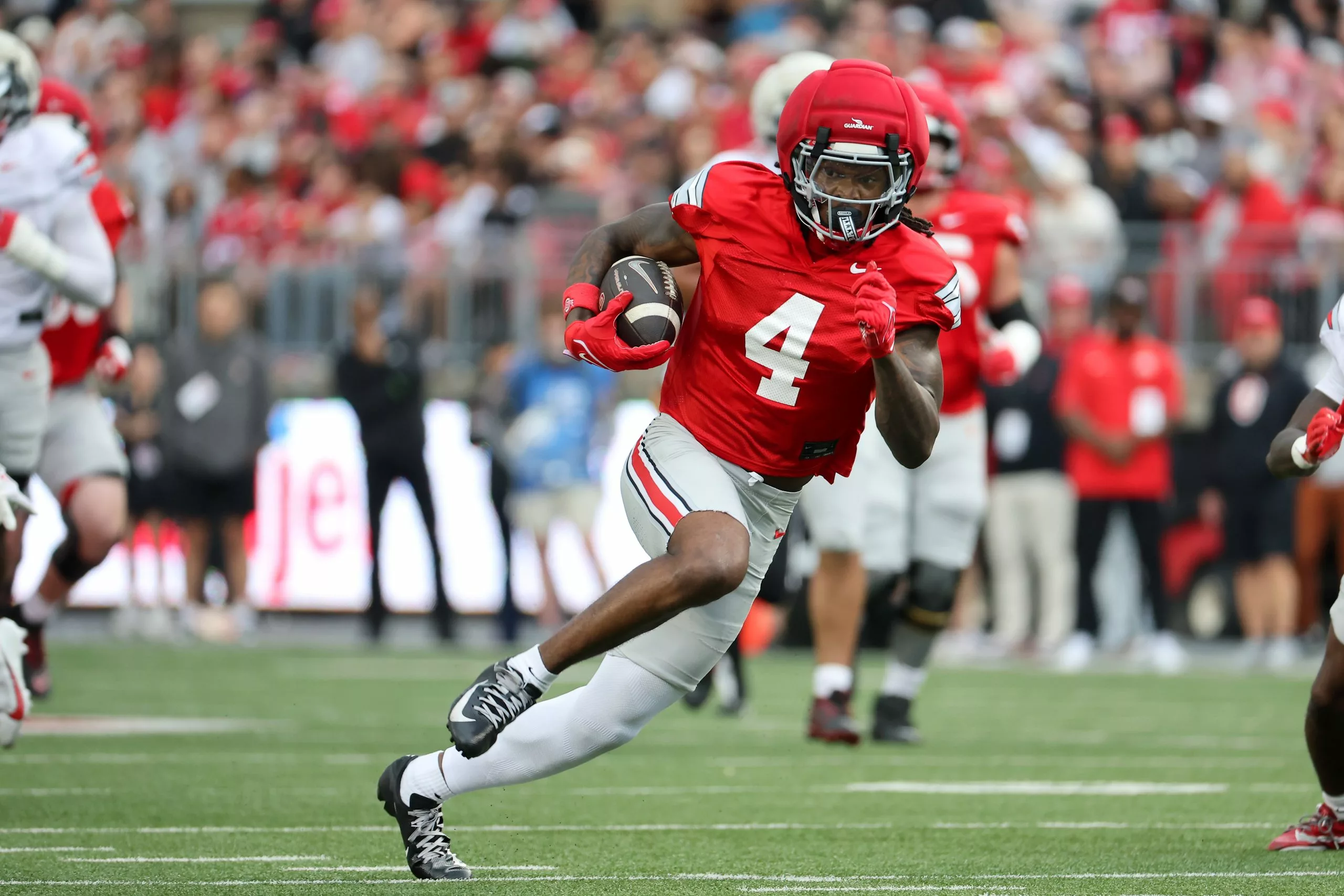
Apr 18, 2026; Columbus, OH, USA; Ohio State Wide receiver Jeremiah Smith (4) runs after catching the ball during the annual spring game at Ohio Stadium. Mandatory Credit: Joseph Maiorana-Imagn Images
Not so many people have the guts to walk away from a million dollars, let alone $10 million. A 21-year-old just did exactly that to stay where he already was. That is the call Jeremiah Smith made this offseason, and it tells you everything about how Ohio State has learned to win. The Buckeyes are once again among the most expensive teams in college football, and they are not apologizing for it. When Ohio State won the first national title of the 12-team Playoff era, athletic director Ross Bjork said the program had taken in around $20 million in NIL money, believed to be the highest in the country. The lesson everyone took from it was simple. Spend $20 million, win a ring. The real lesson was more interesting than that.
They spent big on keeping the core
Ohio State worked because it stuck to its retention strategy rather than going on a shopping spree. Most of that money is believed to have gone toward keeping the program’s own stars rather than raiding the portal for strangers. A wave of players who could have left for the NFL Drafts, including Jack Sawyer, JT Tuimoloau, and Emeka Egbuka, chose to run it back for one more year. Nick Saban put it bluntly on College GameDay, warning that a $20 million roster means nothing if you pay the wrong guys. The right guys, in Ohio State’s case, were experienced players who already knew the building, the opposite of the rent-a-roster approach that has burned so many programs.
Loyalty got expensive, and the stars paid it
The clearest proof came this offseason. Jeremiah Smith, the
best wide receiver in college football
and the third most valuable athlete in all of college sports, turned down an offer he described as “over $10 million, easy” to leave, reportedly from Miami, and stayed in Columbus. His valuation already sits near $4.2 million, and he still left money on the table to stay home. That kind of decision only happens when a player believes the team is worth more than the check, and it is the strongest signal a locker room can send.
Money can divide a locker room if it’s not managed well
None of this means the money comes without friction. The fear with heavy spending is the pay gap, the resentment that arises when a high-priced transfer earns more than a veteran who bled for the program. It is real enough that programs deliberately lowball their public NIL numbers to keep the locker room calm. You can even see the quieter version inside Ohio State, where quarterback Julian Sayin’s valuation of around $2.4 million would likely be higher if Jeremiah were not soaking up so much of the spotlight and the money. Two stars, one pool of attention, and a staff that has to keep both happy.
Ohio State leans into that balance on purpose. The Buckeyes were quiet in the portal this cycle, bringing in only a handful of transfers while pouring resources into retention and a large high school class, because general manager Mark Pantoni believes a locker room full of players who grew up in the program holds together better than one assembled out of strangers. The cautionary tales back him up. Florida State and Colorado both leaned hard on the portal in recent years and still came up short of the playoff, proof that a pile of expensive names does not automatically become a team.
So far, Ohio State has managed it better than anyone, which is why it keeps spending and winning. The programs that fall short in this era will not be the ones that spend the most. They will be the ones who spend on the wrong people, fill a locker room with strangers, and wonder why it never clicks. Ohio State already learned the trick. The money matters, but the math that wins championships is the part that nobody can put a price tag on.
Up To $1500 in Bonus Bets Paid Back if your First Bet Does Not Win
T&Cs apply
4.5/5
Gambling problem? Call 1-800-GAMBLER or 1-800-MY-RESET (Available in the US) 877-8-HOPENY or text HOPENY (467369) (NY) 1-800-327-5050 (MA), 1-800-BETS-OFF (IA), 1-800-981-0023 (PR). 21+ only. Please Gamble Responsibly. See BetMGM.com for Terms. First Bet Offer for new customers only (if applicable). Subject to eligibility requirements. Bonus bets are non-withdrawable. In partnership with Kansas Crossing Casino and Hotel. Promotional offers not available in Mississippi, Massachusetts, New York, Ontario, or Puerto Rico.
New DraftKings Customers: Spend $5+ Get $150 in Bonuses
T&Cs apply
4.5/5
GAMBLING PROBLEM? CALL 1-800-GAMBLER or 1-800-MY-RESET, (800) 327-5050 or visit gamblinghelplinema.org (MA). Please Gamble Responsibly. 888-789-7777/visit ccpg.org (CT), or visit www.mdgamblinghelp.org (MD), 1-800-981-0023 (PR). 21+ and present in most states. (18+ DC/NH/PR/WY). Void in CAN. Eligibility restrictions apply. On behalf of Boot Hill Casino (KS). Pass-thru of per wager tax may apply in IL. 1 per new DraftKings customer. $5+ first-time bet req. Max. $150 issued as non-withdrawable Bonus Bets. Stake removed from payout. Reward issued as $50 in Bonus Bets every 7 days via click-to-claim for 14 days. Bonus Bets and click-to-claims expire 7 days (168hrs) after issuance. Terms: sportsbook.draftkings.com/promos. Ends 10/11/26 at 11:59 PM ET. Sponsored by DK.
Must be 21+. GAMBLING PROBLEM? CALL 1-800-GAMBLER OR CALL 1-800-MY-RESET, www.mdgamblinghelp.org (MD), (800)-327-5050 or gamblinghelplinema.org (MA), Call (877)8-HOPENY or text HOPENY (467369) (NY), (888) 789-7777 or ccpg.org (CT), morethanagame.nc.gov (NC), 1800gambler.net (WV)
Bet $1 and get double the winnings up to $25 for your next 10 bets
T&Cs apply
4.4/5
21+ New users only. Must register using eligible promo code. First bet after registration must qualify. Max. Bonus Bet: $1,000. Bonus Bet expires 14 days after receipt. Void where prohibited. See Caesars.com/promos for full terms. Gambling Problem? 1-800-GAMBLER (1-800-426-2537)
21+ and present in OH. Gambling Problem? Call 1-800-GAMBLER.
This site is using
Cloudflare
and adheres to the
Google Safe Browsing Program. We adapted
Google's Privacy Guidelines
to keep your data safe at all times.
Close
Ready to Win Big? Join the Elite with Our Sports Betting Deals!
FanDuel Promo
New Users – Get $250 in Bonus Bets when you wager $5 for 5 days
Up To $1500 in Bonus Bets Paid Back if your First Bet Does Not Win
Best Slots
T&Cs and 21+ apply
Gambling problem? Call 1-800-GAMBLER or 1-800-MY-RESET (Available in the US) 877-8-HOPENY or text HOPENY (467369) (NY) 1-800-327-5050 (MA), 1-800-BETS-OFF (IA), 1-800-981-0023 (PR). 21+ only. Please Gamble Responsibly. See BetMGM.com for Terms. First Bet Offer for new customers only (if applicable). Subject to eligibility requirements. Bonus bets are non-withdrawable. In partnership with Kansas Crossing Casino and Hotel. Promotional offers not available in Mississippi, Massachusetts, New York, Ontario, or Puerto Rico.
Code:
Open BetMGM
Get Bonus
DraftKings Promo
New DraftKings Customers: Spend $5+ Get $150 in Bonuses
Newcomer
T&Cs and 21+ apply
GAMBLING PROBLEM? CALL 1-800-GAMBLER or 1-800-MY-RESET, (800) 327-5050 or visit gamblinghelplinema.org (MA). Please Gamble Responsibly. 888-789-7777/visit ccpg.org (CT), or visit www.mdgamblinghelp.org (MD), 1-800-981-0023 (PR). 21+ and present in most states. (18+ DC/NH/PR/WY). Void in CAN. Eligibility restrictions apply. On behalf of Boot Hill Casino (KS). Pass-thru of per wager tax may apply in IL. 1 per new DraftKings customer. $5+ first-time bet req. Max. $150 issued as non-withdrawable Bonus Bets. Stake removed from payout. Reward issued as $50 in Bonus Bets every 7 days via click-to-claim for 14 days. Bonus Bets and click-to-claims expire 7 days (168hrs) after issuance. Terms: sportsbook.draftkings.com/promos. Ends 10/11/26 at 11:59 PM ET. Sponsored by DK.
Code:
Open DraftKings
Get Bonus
Find out what the legends have to say about sports this week....