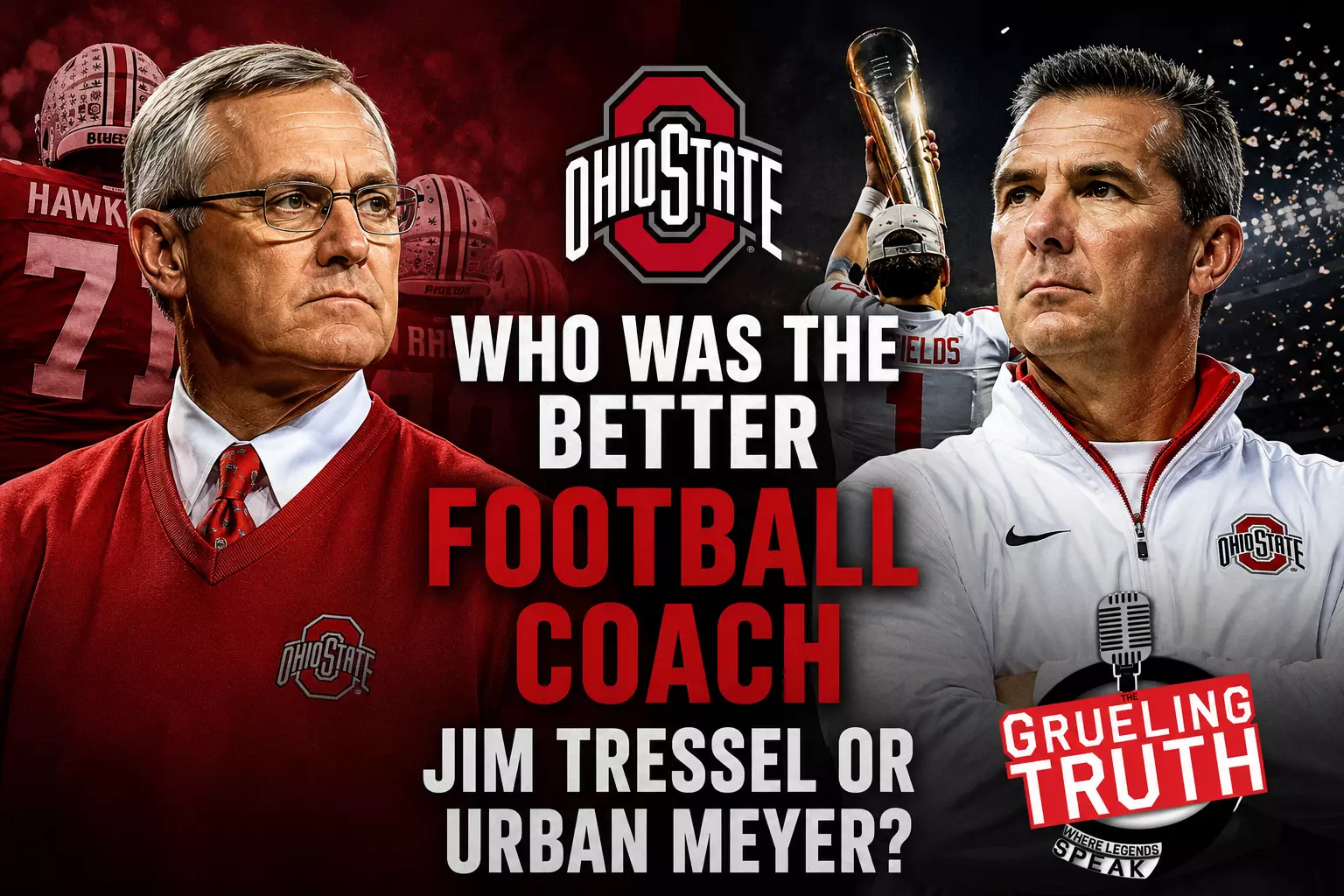
Few debates in Ohio State football history generate more passion than comparing Jim Tressel and Urban Meyer.
Few debates in Ohio State football history generate more passion than comparing Jim Tressel and Urban Meyer. Both won national championships. Both dominated the Big Ten. Both defeated Michigan with remarkable consistency. Both belong among the greatest coaches in Buckeye history.
However, when the discussion shifts from who was the more innovative offensive mind to who was the better overall head football coach, the argument leans toward Jim Tressel.
Winning Under Harder Circumstances
Urban Meyer
inherited a program loaded with elite talent despite NCAA sanctions. While the sanctions limited postseason opportunities in 2012, Ohio State still possessed one of the most talented rosters in America. Meyer immediately went 12-0 and eventually posted an incredible 83-9 record at Ohio State.
Tressel inherited a different situation in 2001. Ohio State had gone 14-10 over the previous two seasons and had not beaten Michigan since 1998. The Buckeyes had talent but lacked direction and confidence. Within two years, Tressel transformed the program into a national champion. He finished his Ohio State career with a 106-22 record on the field, winning six Big Ten championships and capturing the 2002 national title.
The difference is that Tressel rebuilt Ohio State. Meyer elevated an already elite program. Rebuilding is generally the more difficult task.
The 2002 National Championship Was More Impressive
Urban Meyer’s 2014 national championship team was phenomenal. The Buckeyes won the inaugural College Football Playoff and defeated Alabama and Oregon in consecutive games. It remains one of the greatest postseason runs in college football history.
But Tressel’s 2002 championship may have been the greater coaching achievement.
That Ohio State team was not considered the most talented team in the country. It entered the season unranked in some preseason polls and relied on defense, special teams, discipline, and situational football. The Buckeyes finished 14-0 and defeated the heavily favored Miami Hurricanes, a team many consider one of the most talented college football teams ever assembled.
Tressel didn’t out-recruit everyone. He out-coached them.
Tressel Built a Culture That Lasted
Great head coaches do more than win games. They build programs.
Tressel established a culture of accountability, toughness, and attention to detail that still influences Ohio State football today. His teams consistently played disciplined football, excelled in close games, and rarely beat themselves.
Urban Meyer brought tremendous intensity and innovation, but many of the cultural foundations he inherited were established during the Tressel era. Players frequently describe Tressel as a mentor and leader whose impact extended far beyond football.
The fact that Ohio State recently selected Tressel for its Ring of Honor—joining only Woody Hayes and Paul Brown among coaches—demonstrates the lasting respect he commands within the program.
Tressel Did More With Less
Urban Meyer consistently signed top-three recruiting classes. His Ohio State teams were usually among the most talented rosters in America.
Tressel recruited exceptionally well, but not at the same level as Meyer. Yet he routinely won games against more talented opponents. His teams developed overlooked players into stars and maximized their potential.
The hallmark of elite coaching is not simply winning with superior talent. It is winning when talent is equal—or even slightly inferior.
Tressel excelled in that area.
The Michigan Factor
Both coaches dominated Michigan.
Tressel’s famous introductory speech in 2001 promised Buckeye fans they would be proud “310 days in Ann Arbor.” He then backed it up by going 9-1 against the Wolverines.
Meyer was even more dominant, going a perfect 7-0 against Michigan.
This category is close, but context matters. Tressel inherited a rivalry that Michigan largely controlled during the John Cooper years. He changed the psychology of the rivalry and restored Ohio State’s confidence.
Without Tressel’s transformation of the rivalry, Meyer may not have inherited such a favorable situation.
Success Beyond Ohio State
One area where Tressel clearly separates himself is his entire coaching career.
Before arriving in Columbus, Tressel built
Youngstown State
into an FCS dynasty. He won four national championships and compiled a 135-57-2 record. During the 1990s, Youngstown State became one of the most successful programs in all of college football.
Meyer had tremendous success at Bowling Green, Utah, Florida, and Ohio State. However, Tressel’s ability to create a dynasty at a program with far fewer resources demonstrates extraordinary coaching ability.
Leadership Matters
Head coaching is about more than schemes and recruiting rankings.
Players, administrators, and fans often viewed Tressel as the embodiment of stability and leadership. His calm demeanor never changed regardless of the circumstances. Whether facing a championship game or a rivalry showdown, his teams reflected his personality.
Meyer was brilliant and relentless, but his coaching career was frequently accompanied by controversy, burnout, and organizational turmoil. His difficult NFL tenure with the Jacksonville Jaguars only reinforced concerns about his leadership style outside the college environment.
Tressel’s reputation as a leader has remained remarkably strong, leading to his roles as president of Youngstown State University and later Lieutenant Governor of Ohio.
Final Verdict
Urban Meyer was probably the better offensive strategist. He won at an extraordinary rate and captured national championships at multiple schools. His .902 winning percentage at Ohio State is unmatched.
But the job of a head coach is larger than calling plays or assembling recruiting classes.
Jim Tressel rebuilt Ohio State, restored dominance over Michigan, won a national championship against overwhelming odds, created a culture that endured long after his departure, and built a dynasty at Youngstown State before ever arriving in Columbus.
Urban Meyer may have been the more explosive winner.
Up To $1500 in Bonus Bets Paid Back if your First Bet Does Not Win
T&Cs apply
4.5/5
Gambling problem? Call 1-800-GAMBLER or 1-800-MY-RESET (Available in the US) 877-8-HOPENY or text HOPENY (467369) (NY) 1-800-327-5050 (MA), 1-800-BETS-OFF (IA), 1-800-981-0023 (PR). 21+ only. Please Gamble Responsibly. See BetMGM.com for Terms. First Bet Offer for new customers only (if applicable). Subject to eligibility requirements. Bonus bets are non-withdrawable. In partnership with Kansas Crossing Casino and Hotel. Promotional offers not available in Mississippi, Massachusetts, New York, Ontario, or Puerto Rico.
New DraftKings Customers: Spend $5+ Get $150 in Bonuses
T&Cs apply
4.5/5
GAMBLING PROBLEM? CALL 1-800-GAMBLER or 1-800-MY-RESET, (800) 327-5050 or visit gamblinghelplinema.org (MA). Please Gamble Responsibly. 888-789-7777/visit ccpg.org (CT), or visit www.mdgamblinghelp.org (MD), 1-800-981-0023 (PR). 21+ and present in most states. (18+ DC/NH/PR/WY). Void in CAN. Eligibility restrictions apply. On behalf of Boot Hill Casino (KS). Pass-thru of per wager tax may apply in IL. 1 per new DraftKings customer. $5+ first-time bet req. Max. $150 issued as non-withdrawable Bonus Bets. Stake removed from payout. Reward issued as $50 in Bonus Bets every 7 days via click-to-claim for 14 days. Bonus Bets and click-to-claims expire 7 days (168hrs) after issuance. Terms: sportsbook.draftkings.com/promos. Ends 10/11/26 at 11:59 PM ET. Sponsored by DK.
Must be 21+. GAMBLING PROBLEM? CALL 1-800-GAMBLER OR CALL 1-800-MY-RESET, www.mdgamblinghelp.org (MD), (800)-327-5050 or gamblinghelplinema.org (MA), Call (877)8-HOPENY or text HOPENY (467369) (NY), (888) 789-7777 or ccpg.org (CT), morethanagame.nc.gov (NC), 1800gambler.net (WV)
Bet $1 and get double the winnings up to $25 for your next 10 bets
T&Cs apply
4.4/5
21+ New users only. Must register using eligible promo code. First bet after registration must qualify. Max. Bonus Bet: $1,000. Bonus Bet expires 14 days after receipt. Void where prohibited. See Caesars.com/promos for full terms. Gambling Problem? 1-800-GAMBLER (1-800-426-2537)
21+ and present in OH. Gambling Problem? Call 1-800-GAMBLER.
This site is using
Cloudflare
and adheres to the
Google Safe Browsing Program. We adapted
Google's Privacy Guidelines
to keep your data safe at all times.
Close
Ready to Win Big? Join the Elite with Our Sports Betting Deals!
FanDuel Promo
New Users – Get $250 in Bonus Bets when you wager $5 for 5 days
Up To $1500 in Bonus Bets Paid Back if your First Bet Does Not Win
Best Slots
T&Cs and 21+ apply
Gambling problem? Call 1-800-GAMBLER or 1-800-MY-RESET (Available in the US) 877-8-HOPENY or text HOPENY (467369) (NY) 1-800-327-5050 (MA), 1-800-BETS-OFF (IA), 1-800-981-0023 (PR). 21+ only. Please Gamble Responsibly. See BetMGM.com for Terms. First Bet Offer for new customers only (if applicable). Subject to eligibility requirements. Bonus bets are non-withdrawable. In partnership with Kansas Crossing Casino and Hotel. Promotional offers not available in Mississippi, Massachusetts, New York, Ontario, or Puerto Rico.
Code:
Open BetMGM
Get Bonus
DraftKings Promo
New DraftKings Customers: Spend $5+ Get $150 in Bonuses
Newcomer
T&Cs and 21+ apply
GAMBLING PROBLEM? CALL 1-800-GAMBLER or 1-800-MY-RESET, (800) 327-5050 or visit gamblinghelplinema.org (MA). Please Gamble Responsibly. 888-789-7777/visit ccpg.org (CT), or visit www.mdgamblinghelp.org (MD), 1-800-981-0023 (PR). 21+ and present in most states. (18+ DC/NH/PR/WY). Void in CAN. Eligibility restrictions apply. On behalf of Boot Hill Casino (KS). Pass-thru of per wager tax may apply in IL. 1 per new DraftKings customer. $5+ first-time bet req. Max. $150 issued as non-withdrawable Bonus Bets. Stake removed from payout. Reward issued as $50 in Bonus Bets every 7 days via click-to-claim for 14 days. Bonus Bets and click-to-claims expire 7 days (168hrs) after issuance. Terms: sportsbook.draftkings.com/promos. Ends 10/11/26 at 11:59 PM ET. Sponsored by DK.
Code:
Open DraftKings
Get Bonus
Find out what the legends have to say about sports this week....