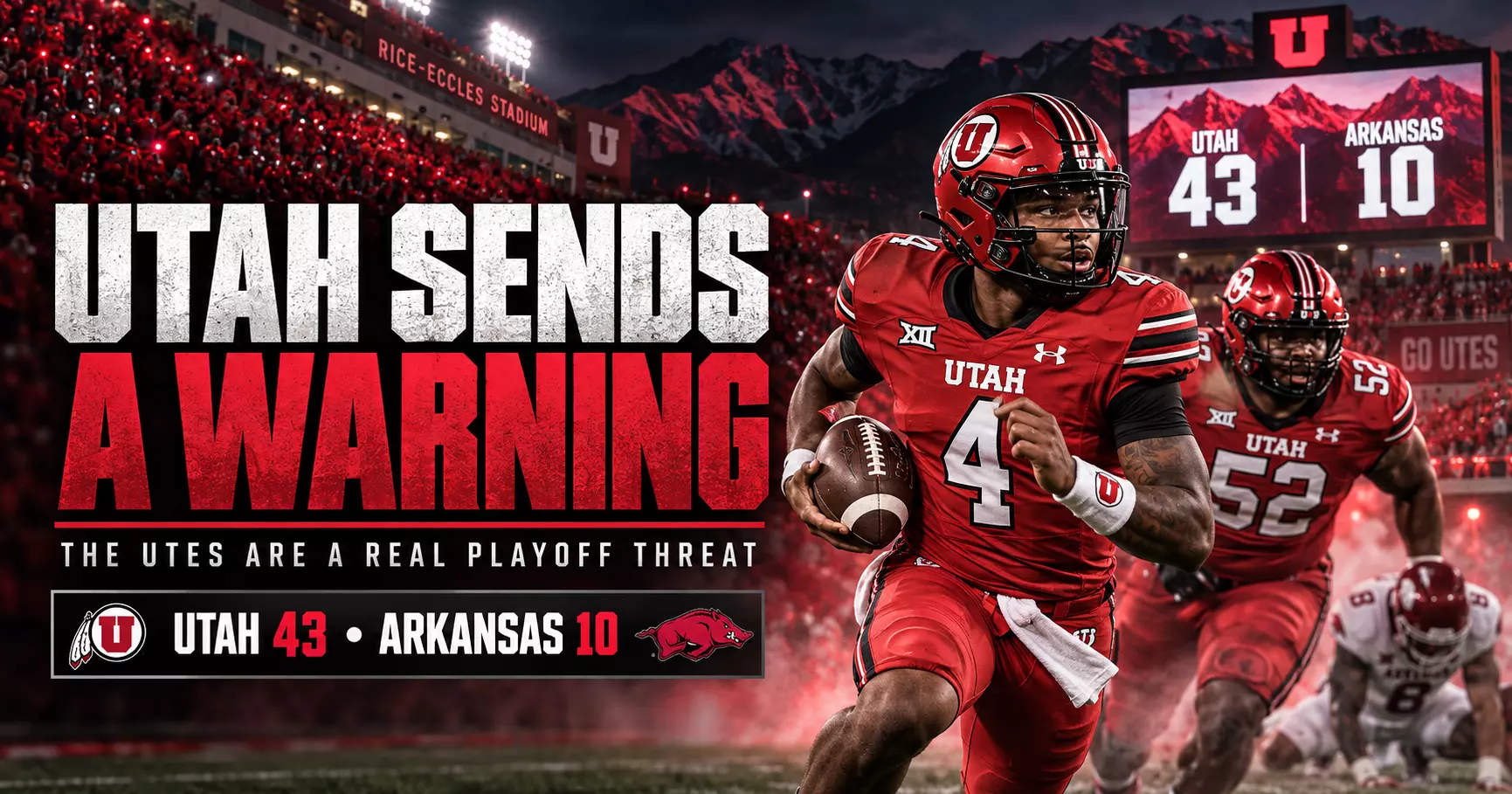
Utah did not merely defeat an SEC opponent Saturday night.The Utes physically dismantled Arkansas. No. 20 Utah dominated the Razorbacks 43–10
Utah did not merely defeat an SEC opponent Saturday night.
The Utes physically dismantled Arkansas.
No. 20 Utah dominated the Razorbacks 43–10 at Rice-Eccles Stadium, producing the kind of performance that should force voters and playoff analysts to reconsider where Morgan Scalley’s team belongs in the national picture.
Quarterback Devon Dampier threw two touchdown passes and ran for two more. Running back Wayshawn Parker scored three times. Utah controlled the line of scrimmage, dictated the style of the game and turned what appeared to be a significant nonconference test into a three-hour demonstration of the program’s identity.
The opponent was not Georgia, Texas or Alabama. Arkansas entered the season projected to finish near the bottom of the SEC, and nobody should pretend otherwise.
But Utah did exactly what a serious playoff contender is supposed to do against a rebuilding opponent.
The Utes overwhelmed it.
They did not survive. They did not require a late field goal or fortunate turnover. They did not allow the SEC label attached to Arkansas to make the game appear more competitive than it was.
Utah imposed its will and won by 33 points.
After two weeks, the Utes are 2–0 and have outscored Idaho and Arkansas 109–24. They have a dynamic veteran quarterback, a dangerous running game, a defense shaped by one of the best defensive minds in college football and a program that understands how to win physical games.
Utah is not merely a contender in the Big 12.
The Utes are a real threat to reach the College Football Playoff.
Devon Dampier Has Become the Quarterback Utah Needed
For years, Utah’s national ceiling was limited by its passing game.
The Utes could play defense, control the line of scrimmage and punish opponents physically. They could win 10 games, compete for conference championships and make life miserable for more talented teams.
But when Utah fell behind or needed to win a high-scoring game, the offense was not always capable of responding.
Dampier has changed that equation.
He entered the Arkansas game after producing 2,490 passing yards, 24 touchdown passes and only five interceptions during the 2025 season. He also rushed for 835 yards and 10 touchdowns, giving Utah a genuine dual-threat quarterback who could punish defenses in multiple ways.
Against Arkansas, Dampier accounted for four touchdowns.
He threw two and ran for two, forcing the Razorbacks to defend the entire field. Arkansas could not concentrate exclusively on Parker or overload the line of scrimmage because Dampier could pull the football and attack the perimeter. If the defense moved forward to contain his running ability, passing opportunities developed behind it.
Dampier operated the offense with confidence and control. He did not need to throw for 400 yards or attempt 50 passes. Utah’s dominance allowed him to play efficiently, distribute the football and strike when Arkansas became vulnerable.
That is precisely what Utah needs from its quarterback.
Dampier does not have to become a traditional pocket passer who spends every Saturday chasing statistical records. He needs to make good decisions, protect the football and convert scoring opportunities.
His athleticism provides the element that transforms Utah’s offense from functional into dangerous.
Defenses already understand that the Utes want to run the ball. Dampier makes knowing what is coming very different from stopping it.
Wayshawn Parker Gives Utah a Punishing Finisher
A physical offense
requires a running back who can turn control of the line of scrimmage into points.
Parker delivered three touchdowns against Arkansas.
Dampier’s mobility forces defenders to hesitate, but Parker makes them pay for that hesitation. He runs decisively, attacks the space created by Utah’s blocking scheme and gives the offense a dependable finisher near the goal line.
The combination creates a terrible choice for opposing defenses.
Commit too heavily to Dampier, and Parker attacks the middle. Collapse on Parker, and Dampier keeps the ball. Attempt to bring an extra defender into the box, and Utah can create favorable passing matchups.
The Utes are not trying to hide what they want to do. They want to establish physical control, remain ahead of the chains and force the defense to become tired of tackling.
Arkansas knew that.
It still could not stop it.
Parker’s three touchdowns were evidence of more than one player’s ability to find the end zone. They reflected Utah’s control of the most important areas of the field. The Utes consistently created manageable situations and converted their opportunities.
Strong teams do not have to make offense complicated. When the blocking is sound, the quarterback makes the correct read and the running back finishes plays, simplicity becomes a weapon.
Dampier and Parker give Utah one of the Big 12’s most dangerous backfields.
Utah Beat Arkansas at the SEC’s Own Game
The SEC has spent decades defining itself through size, strength and control of the line of scrimmage.
On Saturday night, Utah looked like the more physical team.
The Utes did not attempt to defeat Arkansas by avoiding contact or transforming the game into a finesse contest. They attacked the Razorbacks directly. Utah’s offensive line created running lanes, its backs finished plays, and its defense prevented Arkansas from establishing any consistent rhythm.
That is what made the victory so impressive.
Arkansas may be rebuilding under Ryan Silverfield, but the Razorbacks still possess SEC-caliber size and athleticism. Utah made those advantages disappear.
The Utes were better conditioned, more disciplined and more comfortable in a physical game. As the night progressed, the separation became increasingly obvious.
Utah did not look like a Big 12 team earning a surprising victory over an SEC opponent. It looked like the stronger program handling an inferior team exactly as expected.
That distinction matters.
College football’s national conversation frequently grants SEC teams additional respect simply because of their conference affiliation. Utah had an opportunity to make a statement against one of those programs and left no room for excuses.
The Utes won by 33 points.
If an SEC contender defeated a ranked Big 12 opponent 43–10, it would be praised as a national championship threat. Utah deserves the same treatment.
Morgan Scalley Has Preserved Utah’s Identity
Kyle Whittingham’s departure created the most important transition Utah had faced in more than two decades.
Whittingham built the Utes into one of college football’s most dependable programs. Utah became known for defense, player development, special teams and a level of physical toughness that allowed it to defeat more highly recruited opponents.
Replacing a coach who shaped every part of the program could have caused Utah to lose its identity.
Scalley has prevented that from happening.
He was the logical successor because he did not need to learn Utah’s culture. He played for Whittingham, joined the program’s staff in 2006 and became defensive coordinator in 2016. His professional development occurred almost entirely inside the organization he now leads.
The transition has therefore looked more like a continuation than a rebuild.
Utah still plays with defensive aggression. The Utes still attack the line of scrimmage, tackle well and force opponents to earn everything. The difference is that Scalley now has an offense capable of complementing that identity.
Utah scored 66 points against Idaho and 43 against Arkansas. The Utes are averaging 54.5 points through two games while continuing to play the disciplined, physical defense associated with Whittingham’s best teams.
That balance should concern the rest of the Big 12.
The traditional Utah formula was already difficult to defeat. Adding a dynamic quarterback and an explosive offense raises the program’s ceiling considerably.
The 2025 Season Created the Foundation
Utah did not suddenly become dangerous Saturday night.
The Utes won 11 games in 2025, losing only to the two teams that ultimately established themselves as the Big 12’s best: Texas Tech and BYU.
Those defeats exposed areas Utah needed to improve. Texas Tech overwhelmed the Utes 34–10 in Salt Lake City, while BYU won a close rivalry game in Provo. Utah was good enough to defeat most of its schedule but not quite complete enough to claim the conference championship.
Dampier’s continued development may close that gap.
The quarterback now has another season of experience directing the offense. He has already demonstrated that he can produce as both a passer and runner. With Parker beside him, Utah has the balance required to challenge the conference’s strongest defenses.
The Utes also understand exactly where they fell short last season.
They do not have to build a winning culture from the beginning. They need to improve the details that prevented a good team from becoming a championship team.
The destruction of Arkansas suggests that process is already underway.
Utah looked more explosive than it did during parts of 2025. The Utes finished drives, produced touchdowns and refused to allow the opponent to remain competitive.
That is the behavior of a program that remembers why it failed to reach the playoff and has no interest in repeating the experience.
The Big 12 Race Will Be Brutal
Utah’s path to the playoff will not be easy.
The Big 12
contains several legitimate contenders, including Texas Tech, BYU and an Oklahoma State team that just stunned No. 6 Oregon. Houston has also started impressively, while Iowa State, TCU and other programs are capable of defeating anyone in the conference.
Utah must play BYU, Houston, Kansas, West Virginia and Oklahoma State at home. Road trips include Arizona, Cincinnati, Colorado, Iowa State and TCU.
That schedule contains very few automatic victories.
It also gives the Utes repeated opportunities to construct a playoff résumé.
Utah’s physical style travels well. Defense and the running game are less vulnerable to poor weather, hostile crowds or difficult road conditions than offenses dependent entirely on timing and explosive passing plays.
Dampier’s presence gives Utah the ability to adjust when the original plan stops working.
That could be the decisive difference in November.
Conference championship contenders eventually encounter a game in which the running lanes disappear, the defense surrenders unexpected points or an opponent forces the quarterback to produce late.
Dampier has the experience and versatility to win that kind of game.
The Utes will not overpower every Big 12 opponent as completely as they overwhelmed Arkansas. They may not need to.
Utah’s Defense Remains the Foundation
Dampier and Parker will receive most of the attention after accounting for all six Utah touchdowns, but the defense created the conditions for the blowout.
Holding an SEC opponent to 10 points should never be treated as routine.
Scalley built his reputation as one of the nation’s most respected defensive coordinators. His scheme has consistently generated pressure, disguised coverages and turned overlooked recruits into highly productive players.
The Utes lost important personnel from last season, but the system remains intact. Utah added experienced transfers to its defensive front and continues to develop players who understand the demands of the scheme.
Arkansas never appeared comfortable.
The Razorbacks could not create enough explosive plays, sustain enough drives or force Utah into a game played at a faster pace. Every empty Arkansas possession allowed the Utes to return to their running game and increase the pressure.
That is how Utah wins.
The defense does not simply prevent points. It helps dictate the entire structure of the game. Opponents become impatient, take risks and eventually give Utah’s offense favorable situations.
When the offense is scoring 40 points instead of hoping to reach 24, the formula becomes overwhelming.
The Ranking Beside Utah’s Name Is Too Low
Utah entered Saturday ranked No. 20.
That ranking reflected uncertainty more than ability. Voters questioned how the Utes would respond to Whittingham’s departure, whether Scalley could manage the entire program and whether the offense would continue improving.
Two games have provided strong initial answers.
Utah destroyed Idaho 66–14 and Arkansas 43–10. The Utes have not played a top-10 opponent, but they have handled both assignments with the decisiveness expected from a highly ranked team.
Several teams positioned above Utah have struggled or lost.
No. 6 Oregon was dominated by Oklahoma State. No. 11 Oklahoma lost to Michigan. Other ranked teams required difficult second halves to escape opponents they were expected to handle comfortably.
Utah has not created that kind of doubt.
The Utes should move significantly higher in the rankings. More importantly, they should enter the
playoff conversation
as something more than a possible Big 12 spoiler.
This roster is good enough to win the conference.
Utah Is a Real Playoff Threat
One September victory does not guarantee anything. Arkansas could struggle throughout the SEC, and Utah will face much stronger teams during conference play.
But legitimate contenders reveal certain qualities before they face their most difficult opponents.
They overwhelm weaker teams. They control the line of scrimmage. They finish drives. They possess experienced quarterback play and establish a clear identity.
Utah has checked every box through two games.
Dampier gives the Utes the most dynamic quarterback they have had in years. Parker provides a punishing complement in the backfield. Scalley has preserved the defensive culture while overseeing an offense capable of producing championship-level point totals.
The Utes are physical enough to control games and explosive enough to recover when control is lost.
That combination travels.
Utah’s 43–10 victory over Arkansas should not be dismissed because the Razorbacks are rebuilding. The Utes faced an SEC opponent with a chance to strengthen their national reputation and destroyed it.
They delivered precisely the performance a playoff team should deliver.
The rest of the Big 12 has been warned.
Utah is not merely chasing a winning season or hoping to remain relevant in November. The Utes are pursuing the conference championship, and they have the quarterback, running game, defense and physical identity required to win it.
Saturday night proved Utah belongs in the College Football Playoff conversation.
The next several months will determine whether anyone in the Big 12 can remove the Utes from it.
New Users – Get $350 in Bonus Bets when you wager $5 for 7 days
T&Cs apply
4.6/5
Gambling Problem? Call 1-800-GAMBLER or 1-800-MY-RESET. Call 1-888-789-7777 or visit ccpgg.org/chat (CT). Hope is here. GamblingHelpLineMA.org or call (800) 327-5050 for 24/7 support (MA). Visit www.mdgamblinghelp.org (MD). Call 1-877-8HOPE-NY or text HOPENY (NY). 21+ (18+ DC, WY) and present in select states (for KS, in affiliation with Kansas Star Casino). Find online real money wagering only. Min $5 wager required for 7 consecutive days. $5 free play credit. Bonus issued as non-withdrawable bonus with cash withdrawable bonus with cash withdrawable. Bonus bets which expire 7 days after receipt. Restrictions apply. See terms at sportsbook.fanduel.com. Call 1-877-770-7867 (LA).
Up To $1500 in Bonus Bets Paid Back if your First Bet Does Not Win
T&Cs apply
4.5/5
Gambling problem? Call 1-800-GAMBLER or 1-800-MY-RESET (Available in the US) 877-8-HOPENY or text HOPENY (467369) (NY) 1-800-327-5050 (MA), 1-800-BETS-OFF (IA), 1-800-981-0023 (PR). 21+ only. Please Gamble Responsibly. See BetMGM.com for Terms. First Bet Offer for new customers only (if applicable). Subject to eligibility requirements. Bonus bets are non-withdrawable. In partnership with Kansas Crossing Casino and Hotel. Promotional offers not available in Mississippi, Massachusetts, New York, Ontario, or Puerto Rico.
New DraftKings Customers: Bet $5, Get $200 + 3 Months of NBA League Pass!
T&Cs apply
4.5/5
GAMBLING PROBLEM? CALL 1-800-GAMBLER or 1-800-MY-RESET, (800) 327-5050 or visit gamblinghelplinema.org (MA). Please Gamble Responsibly. 888-789-7777/visit ccpg.org (CT), or visit www.mdgamblinghelp.org (MD), 1-800-981-0023 (PR). 21+ and present in most states. (18+ DC/NH/PR/WY). Void in CAN. Eligibility restrictions apply. On behalf of Boot Hill Casino (KS). Pass-thru of per wager tax may apply in IL. 1 per new Sportsbook customer. $5+ first-time bet req. Max. $200 issued as non-withdrawable Bonus Bets. Stake removed from payout. Reward issued as $50 in Bonus Bets every 7 days via click-to-claim for 21 days. Bonus Bets and click-to-claims expire 7 days (168hrs) after issuance. Terms: dkng.co/offer. Get 1 promo code to redeem a 3-month NBA League Pass subscription, complimentary of DraftKings. Subscription auto-renews monthly at then-current price (currently $16.99/mo); cancel anytime. Terms, restrictions, and eligibility requirements apply. Redeem League Pass by 12/19/26 at 11:59 PM ET. Addt’l terms: support.watch.nba.com/hc/en-us/articles/9165532876183-League-Pass-Terms-of-Use_. Ends 11/29/26 at 11:59 PM ET. Sponsored by DK.
Must be 21+. GAMBLING PROBLEM? CALL 1-800-GAMBLER OR CALL 1-800-MY-RESET, www.mdgamblinghelp.org (MD), (800)-327-5050 or gamblinghelplinema.org (MA), Call (877)8-HOPENY or text HOPENY (467369) (NY), (888) 789-7777 or ccpg.org (CT), morethanagame.nc.gov (NC), 1800gambler.net (WV)
Bet $1 and get double the winnings up to $25 for your next 10 bets
T&Cs apply
4.4/5
21+ New users only. Must register using eligible promo code. First bet after registration must qualify. Max. Bonus Bet: $1,000. Bonus Bet expires 14 days after receipt. Void where prohibited. See Caesars.com/promos for full terms. Gambling Problem? 1-800-GAMBLER (1-800-426-2537)
21+ and present in OH. Gambling Problem? Call 1-800-GAMBLER.
This site is using
Cloudflare
and adheres to the
Google Safe Browsing Program. We adapted
Google's Privacy Guidelines
to keep your data safe at all times.
Close
Ready to Win Big? Join the Elite with Our Sports Betting Deals!
FanDuel Promo
New Users – Get $350 in Bonus Bets when you wager $5 for 7 days
Our Favorite
T&Cs and 21+ apply
Gambling Problem? Call 1-800-GAMBLER or 1-800-MY-RESET. Call 1-888-789-7777 or visit ccpgg.org/chat (CT). Hope is here. GamblingHelpLineMA.org or call (800) 327-5050 for 24/7 support (MA). Visit www.mdgamblinghelp.org (MD). Call 1-877-8HOPE-NY or text HOPENY (NY). 21+ (18+ DC, WY) and present in select states (for KS, in affiliation with Kansas Star Casino). Find online real money wagering only. Min $5 wager required for 7 consecutive days. $5 free play credit. Bonus issued as non-withdrawable bonus with cash withdrawable bonus with cash withdrawable. Bonus bets which expire 7 days after receipt. Restrictions apply. See terms at sportsbook.fanduel.com. Call 1-877-770-7867 (LA).
Code:
Open FanDuel
Get Bonus
BetMGM Promo
Up To $1500 in Bonus Bets Paid Back if your First Bet Does Not Win
Best Slots
T&Cs and 21+ apply
Gambling problem? Call 1-800-GAMBLER or 1-800-MY-RESET (Available in the US) 877-8-HOPENY or text HOPENY (467369) (NY) 1-800-327-5050 (MA), 1-800-BETS-OFF (IA), 1-800-981-0023 (PR). 21+ only. Please Gamble Responsibly. See BetMGM.com for Terms. First Bet Offer for new customers only (if applicable). Subject to eligibility requirements. Bonus bets are non-withdrawable. In partnership with Kansas Crossing Casino and Hotel. Promotional offers not available in Mississippi, Massachusetts, New York, Ontario, or Puerto Rico.
Code:
Open BetMGM
Get Bonus
DraftKings Promo
New DraftKings Customers: Bet $5, Get $200 + 3 Months of NBA League Pass!
Newcomer
T&Cs and 21+ apply
GAMBLING PROBLEM? CALL 1-800-GAMBLER or 1-800-MY-RESET, (800) 327-5050 or visit gamblinghelplinema.org (MA). Please Gamble Responsibly. 888-789-7777/visit ccpg.org (CT), or visit www.mdgamblinghelp.org (MD), 1-800-981-0023 (PR). 21+ and present in most states. (18+ DC/NH/PR/WY). Void in CAN. Eligibility restrictions apply. On behalf of Boot Hill Casino (KS). Pass-thru of per wager tax may apply in IL. 1 per new Sportsbook customer. $5+ first-time bet req. Max. $200 issued as non-withdrawable Bonus Bets. Stake removed from payout. Reward issued as $50 in Bonus Bets every 7 days via click-to-claim for 21 days. Bonus Bets and click-to-claims expire 7 days (168hrs) after issuance. Terms: dkng.co/offer. Get 1 promo code to redeem a 3-month NBA League Pass subscription, complimentary of DraftKings. Subscription auto-renews monthly at then-current price (currently $16.99/mo); cancel anytime. Terms, restrictions, and eligibility requirements apply. Redeem League Pass by 12/19/26 at 11:59 PM ET. Addt’l terms: support.watch.nba.com/hc/en-us/articles/9165532876183-League-Pass-Terms-of-Use_. Ends 11/29/26 at 11:59 PM ET. Sponsored by DK.
Code:
Open DraftKings
Get Bonus
Find out what the legends have to say about sports this week....
New Users – Get $350 in Bonus Bets when you wager $5 for 7 days
Gambling Problem? Call 1-800-GAMBLER or 1-800-MY-RESET. Call 1-888-789-7777 or visit ccpgg.org/chat (CT). Hope is here. GamblingHelpLineMA.org or call (800) 327-5050 for 24/7 support (MA). Visit www.mdgamblinghelp.org (MD). Call 1-877-8HOPE-NY or text HOPENY (NY). 21+ (18+ DC, WY) and present in select states (for KS, in affiliation with Kansas Star Casino). Find online real money wagering only. Min $5 wager required for 7 consecutive days. $5 free play credit. Bonus issued as non-withdrawable bonus with cash withdrawable bonus with cash withdrawable. Bonus bets which expire 7 days after receipt. Restrictions apply. See terms at sportsbook.fanduel.com. Call 1-877-770-7867 (LA).