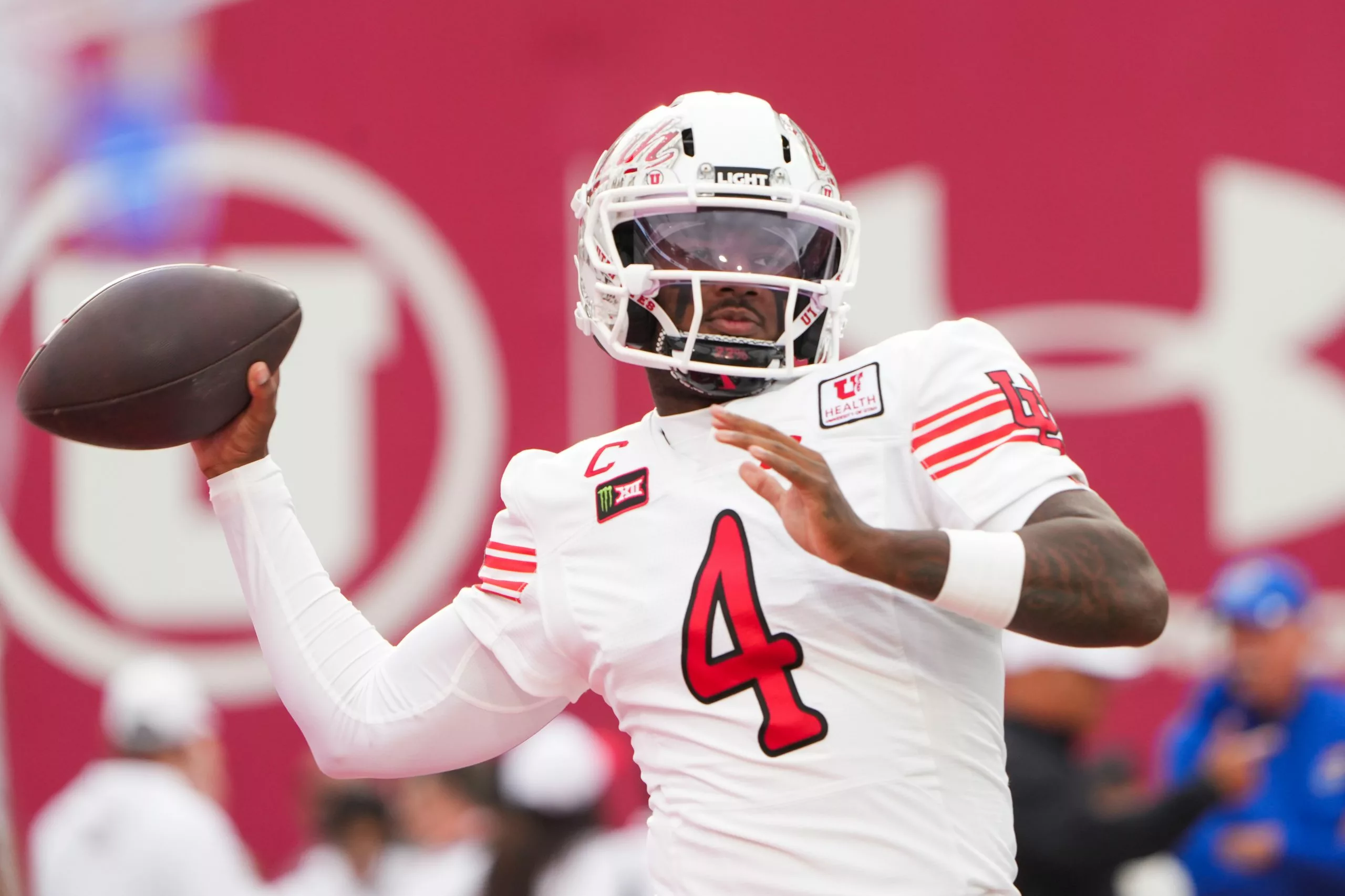
Oct 10, 2026; Salt Lake City, Utah, USA; Utah Utes quarterback Devon Dampier (4) arms up prior to a game against the Kansas Jayhawks at Rice-Eccles Stadium. Mandatory Credit: Aaron Baker-Imagn Images
Utah has earned the attention that comes with a perfect record. Saturday offers an opportunity to show how firmly the Utes belong among the Big 12’s leading championship contenders.
No. 10 Utah hosts No. 14 Houston at Rice-Eccles Stadium on October 24, bringing together two teams with legitimate conference ambitions. The Utes enter 6–0 overall and 3–0 in league play. The Cougars arrive 6–1 and 3–1, close enough that this game matters for both sides.
For Utah, the challenge is to control a ranked opponent after escaping Colorado with a 27–24 victory. For Houston, the opportunity is to earn a road win that would strengthen its standing in the conference race and add another substantial result to its national résumé.
The matchup deserves attention on both terms. Houston has the production to test Utah’s strengths, while the Utes have an opportunity to demonstrate that their unbeaten start can withstand a different level of pressure.
Utah Has Established More Than a Perfect Record
Morgan Scalley became the first
Utah head coach
to open his first full season 6–0. His team is averaging 40.2 points and 486.5 yards per game while allowing 14.8 points per game.
Those numbers suggest a team capable of winning through several approaches.
Utah can generate enough offense to create separation. Its defensive results give it a foundation when possessions become more difficult. That combination matters because championship contenders eventually encounter opponents who take away their preferred method of winning.
The Colorado game supplied an early reminder.
Utah preserved its unbeaten record, but the three-point margin was its narrowest of the season. Its previous victories included a 43–10 win over Arkansas and a 31–17 win at Iowa State.
Surviving a close game has value. It also creates an obligation to examine why the game remained close.
Against Houston, Utah needs to demonstrate control through repeatable execution: productive early downs, sound tackling and possessions that end with something better than a missed opportunity.
Houston Has Earned Equal Billing
Houston enters this matchup after beating Oklahoma State 35–32. Quarterback Conner Weigman threw for a career-high 343 yards and matched his career best with five touchdown passes.
That performance gives Utah a concrete reason to respect the Cougars’ passing game.
A defense preparing for Weigman must account for an offense capable of finishing drives through the air. It cannot assume that stopping the run will automatically make Houston ineffective.
The Cougars also bring evidence that they can travel. They are 2–1 on the road this season and 9–1 away from home over the past two seasons.
Rice-Eccles Stadium presents its own challenge, but Houston’s recent road record offers a stronger basis for confidence than simply hoping to survive the atmosphere.
The Cougars should approach this game as a contender with an opportunity to improve its position. A victory would put them at 7–1 overall and 4–1 in conference play while handing Utah its first loss.
That would materially change the discussion around Houston.
The Running Game Will Shape Both Quarterbacks’ Assignments
Houston averages 220 rushing yards per game and allows just 82.6, placing it among the country’s strongest teams in those categories entering the weekend. Utah’s defense allows 88.7 rushing yards per game.
Those figures identify one of the game’s central questions: which offense can remain functional when the running lanes become smaller?
Neither team needs to dominate the ground game on every possession. Both need enough production to avoid repeatedly handing their quarterback an obvious passing situation.
For Utah, that means resisting the temptation to force runs simply to establish a physical tone. If Houston commits additional defenders to the line, the passing game must provide an answer.
For Houston, patience matters. An unsuccessful early run does not require abandoning the ground game. Repeated negative plays, however, would allow Utah to dictate the circumstances of the next snap.
The most important rushing gains may be ordinary ones. Four or five yards on first down can preserve an offense’s options. A loss can make the entire possession more difficult.
Devon Dampier Must Make Houston Defend the Whole Field
Utah quarterback Devon Dampier enters the game with 15 touchdown passes and a 68.6% completion rate.
His task is to keep Utah’s offense moving without allowing Houston to narrow its attention to a predictable set of plays.
That requires accurate throws when the defense concedes space and disciplined decisions when the deeper routes are covered. A quick completion can be valuable if it keeps Utah ahead of the chains. A downfield attempt becomes worthwhile when the protection and matchup support it.
Houston, meanwhile, needs to make Dampier work through decisions after the snap.
Disguising coverage can complicate a quarterback’s first read, but the disguise only helps if defenders reach their assignments in time. An aggressive call that leaves a receiver uncovered would give Utah the kind of easy opportunity Houston must limit.
The Cougars’ defensive objective should be to make Utah sustain drives through sound execution. They cannot afford to supply explosive plays through communication failures.
Houston has three players with at least five receiving touchdowns: tight end Patrick Overmyer has seven, Amare Thomas has six and Koby Young has five.
That distribution complicates Utah’s coverage decisions, especially near the end zone.
The Utes must account for multiple finishing options rather than treating one receiver as the entire passing threat. Help directed toward one target can create space for another.
Houston can use that variety to make Utah defend different areas of the field. The execution must begin with protection, though. Weigman needs enough time to identify where the advantage develops.
Utah’s response should emphasize coordinated pressure and coverage. Rushing the quarterback becomes less useful if an easy outlet is available immediately. Covering well becomes harder if the rush never forces a decision.
The defense needs those elements working together.
A Championship Opportunity for Both Programs
Saturday’s result will strengthen one team’s position without settling the
Big 12 race.
Utah can remain unbeaten and add a victory over a ranked conference opponent. Houston can establish itself more firmly among the league’s leading candidates by winning in a difficult road environment.
Neither outcome guarantees a championship-game appearance or a College Football Playoff berth. Both would provide meaningful evidence for the winner.
Utah’s strongest case would be a performance built on control: staying ahead of the chains, limiting Houston’s explosive opportunities and finishing scoring possessions.
Houston’s would be a complete road performance in which its running game, passing options and defense remain effective under pressure.
The Utes have spent six games building an unbeaten record. The Cougars have spent seven building a case that they belong alongside the conference’s best.
Saturday gives both a chance to make their argument against an opponent capable of answering back.
New Users – Get $350 in Bonus Bets when you wager $5 for 7 days
T&Cs apply
4.6/5
Gambling Problem? Call 1-800-GAMBLER or 1-800-MY-RESET. Call 1-888-789-7777 or visit ccpgg.org/chat (CT). Hope is here. GamblingHelpLineMA.org or call (800) 327-5050 for 24/7 support (MA). Visit www.mdgamblinghelp.org (MD). Call 1-877-8HOPE-NY or text HOPENY (NY). 21+ (18+ DC, WY) and present in select states (for KS, in affiliation with Kansas Star Casino). Find online real money wagering only. Min $5 wager required for 7 consecutive days. $5 free play credit. Bonus issued as non-withdrawable bonus with cash withdrawable bonus with cash withdrawable. Bonus bets which expire 7 days after receipt. Restrictions apply. See terms at sportsbook.fanduel.com. Call 1-877-770-7867 (LA).
Up To $1500 in Bonus Bets Paid Back if your First Bet Does Not Win
T&Cs apply
4.5/5
Gambling problem? Call 1-800-GAMBLER or 1-800-MY-RESET (Available in the US) 877-8-HOPENY or text HOPENY (467369) (NY) 1-800-327-5050 (MA), 1-800-BETS-OFF (IA), 1-800-981-0023 (PR). 21+ only. Please Gamble Responsibly. See BetMGM.com for Terms. First Bet Offer for new customers only (if applicable). Subject to eligibility requirements. Bonus bets are non-withdrawable. In partnership with Kansas Crossing Casino and Hotel. Promotional offers not available in Mississippi, Massachusetts, New York, Ontario, or Puerto Rico.
New DraftKings Customers: Bet $5, Get $200 + 3 Months of NBA League Pass!
T&Cs apply
4.5/5
GAMBLING PROBLEM? CALL 1-800-GAMBLER or 1-800-MY-RESET, (800) 327-5050 or visit gamblinghelplinema.org (MA). Please Gamble Responsibly. 888-789-7777/visit ccpg.org (CT), or visit www.mdgamblinghelp.org (MD), 1-800-981-0023 (PR). 21+ and present in most states. (18+ DC/NH/PR/WY). Void in CAN. Eligibility restrictions apply. On behalf of Boot Hill Casino (KS). Pass-thru of per wager tax may apply in IL. 1 per new Sportsbook customer. $5+ first-time bet req. Max. $200 issued as non-withdrawable Bonus Bets. Stake removed from payout. Reward issued as $50 in Bonus Bets every 7 days via click-to-claim for 21 days. Bonus Bets and click-to-claims expire 7 days (168hrs) after issuance. Terms: dkng.co/offer. Get 1 promo code to redeem a 3-month NBA League Pass subscription, complimentary of DraftKings. Subscription auto-renews monthly at then-current price (currently $16.99/mo); cancel anytime. Terms, restrictions, and eligibility requirements apply. Redeem League Pass by 12/19/26 at 11:59 PM ET. Addt’l terms: support.watch.nba.com/hc/en-us/articles/9165532876183-League-Pass-Terms-of-Use_. Ends 11/29/26 at 11:59 PM ET. Sponsored by DK.
Must be 21+. GAMBLING PROBLEM? CALL 1-800-GAMBLER OR CALL 1-800-MY-RESET, www.mdgamblinghelp.org (MD), (800)-327-5050 or gamblinghelplinema.org (MA), Call (877)8-HOPENY or text HOPENY (467369) (NY), (888) 789-7777 or ccpg.org (CT), morethanagame.nc.gov (NC), 1800gambler.net (WV)
Bet $1 and get double the winnings up to $25 for your next 10 bets
T&Cs apply
4.4/5
21+ New users only. Must register using eligible promo code. First bet after registration must qualify. Max. Bonus Bet: $1,000. Bonus Bet expires 14 days after receipt. Void where prohibited. See Caesars.com/promos for full terms. Gambling Problem? 1-800-GAMBLER (1-800-426-2537)
21+ and present in OH. Gambling Problem? Call 1-800-GAMBLER.
This site is using
Cloudflare
and adheres to the
Google Safe Browsing Program. We adapted
Google's Privacy Guidelines
to keep your data safe at all times.
Close
Ready to Win Big? Join the Elite with Our Sports Betting Deals!
FanDuel Promo
New Users – Get $350 in Bonus Bets when you wager $5 for 7 days
Our Favorite
T&Cs and 21+ apply
Gambling Problem? Call 1-800-GAMBLER or 1-800-MY-RESET. Call 1-888-789-7777 or visit ccpgg.org/chat (CT). Hope is here. GamblingHelpLineMA.org or call (800) 327-5050 for 24/7 support (MA). Visit www.mdgamblinghelp.org (MD). Call 1-877-8HOPE-NY or text HOPENY (NY). 21+ (18+ DC, WY) and present in select states (for KS, in affiliation with Kansas Star Casino). Find online real money wagering only. Min $5 wager required for 7 consecutive days. $5 free play credit. Bonus issued as non-withdrawable bonus with cash withdrawable bonus with cash withdrawable. Bonus bets which expire 7 days after receipt. Restrictions apply. See terms at sportsbook.fanduel.com. Call 1-877-770-7867 (LA).
Code:
Open FanDuel
Get Bonus
BetMGM Promo
Up To $1500 in Bonus Bets Paid Back if your First Bet Does Not Win
Best Slots
T&Cs and 21+ apply
Gambling problem? Call 1-800-GAMBLER or 1-800-MY-RESET (Available in the US) 877-8-HOPENY or text HOPENY (467369) (NY) 1-800-327-5050 (MA), 1-800-BETS-OFF (IA), 1-800-981-0023 (PR). 21+ only. Please Gamble Responsibly. See BetMGM.com for Terms. First Bet Offer for new customers only (if applicable). Subject to eligibility requirements. Bonus bets are non-withdrawable. In partnership with Kansas Crossing Casino and Hotel. Promotional offers not available in Mississippi, Massachusetts, New York, Ontario, or Puerto Rico.
Code:
Open BetMGM
Get Bonus
DraftKings Promo
New DraftKings Customers: Bet $5, Get $200 + 3 Months of NBA League Pass!
Newcomer
T&Cs and 21+ apply
GAMBLING PROBLEM? CALL 1-800-GAMBLER or 1-800-MY-RESET, (800) 327-5050 or visit gamblinghelplinema.org (MA). Please Gamble Responsibly. 888-789-7777/visit ccpg.org (CT), or visit www.mdgamblinghelp.org (MD), 1-800-981-0023 (PR). 21+ and present in most states. (18+ DC/NH/PR/WY). Void in CAN. Eligibility restrictions apply. On behalf of Boot Hill Casino (KS). Pass-thru of per wager tax may apply in IL. 1 per new Sportsbook customer. $5+ first-time bet req. Max. $200 issued as non-withdrawable Bonus Bets. Stake removed from payout. Reward issued as $50 in Bonus Bets every 7 days via click-to-claim for 21 days. Bonus Bets and click-to-claims expire 7 days (168hrs) after issuance. Terms: dkng.co/offer. Get 1 promo code to redeem a 3-month NBA League Pass subscription, complimentary of DraftKings. Subscription auto-renews monthly at then-current price (currently $16.99/mo); cancel anytime. Terms, restrictions, and eligibility requirements apply. Redeem League Pass by 12/19/26 at 11:59 PM ET. Addt’l terms: support.watch.nba.com/hc/en-us/articles/9165532876183-League-Pass-Terms-of-Use_. Ends 11/29/26 at 11:59 PM ET. Sponsored by DK.
Code:
Open DraftKings
Get Bonus
Find out what the legends have to say about sports this week....
New Users – Get $350 in Bonus Bets when you wager $5 for 7 days
Gambling Problem? Call 1-800-GAMBLER or 1-800-MY-RESET. Call 1-888-789-7777 or visit ccpgg.org/chat (CT). Hope is here. GamblingHelpLineMA.org or call (800) 327-5050 for 24/7 support (MA). Visit www.mdgamblinghelp.org (MD). Call 1-877-8HOPE-NY or text HOPENY (NY). 21+ (18+ DC, WY) and present in select states (for KS, in affiliation with Kansas Star Casino). Find online real money wagering only. Min $5 wager required for 7 consecutive days. $5 free play credit. Bonus issued as non-withdrawable bonus with cash withdrawable bonus with cash withdrawable. Bonus bets which expire 7 days after receipt. Restrictions apply. See terms at sportsbook.fanduel.com. Call 1-877-770-7867 (LA).