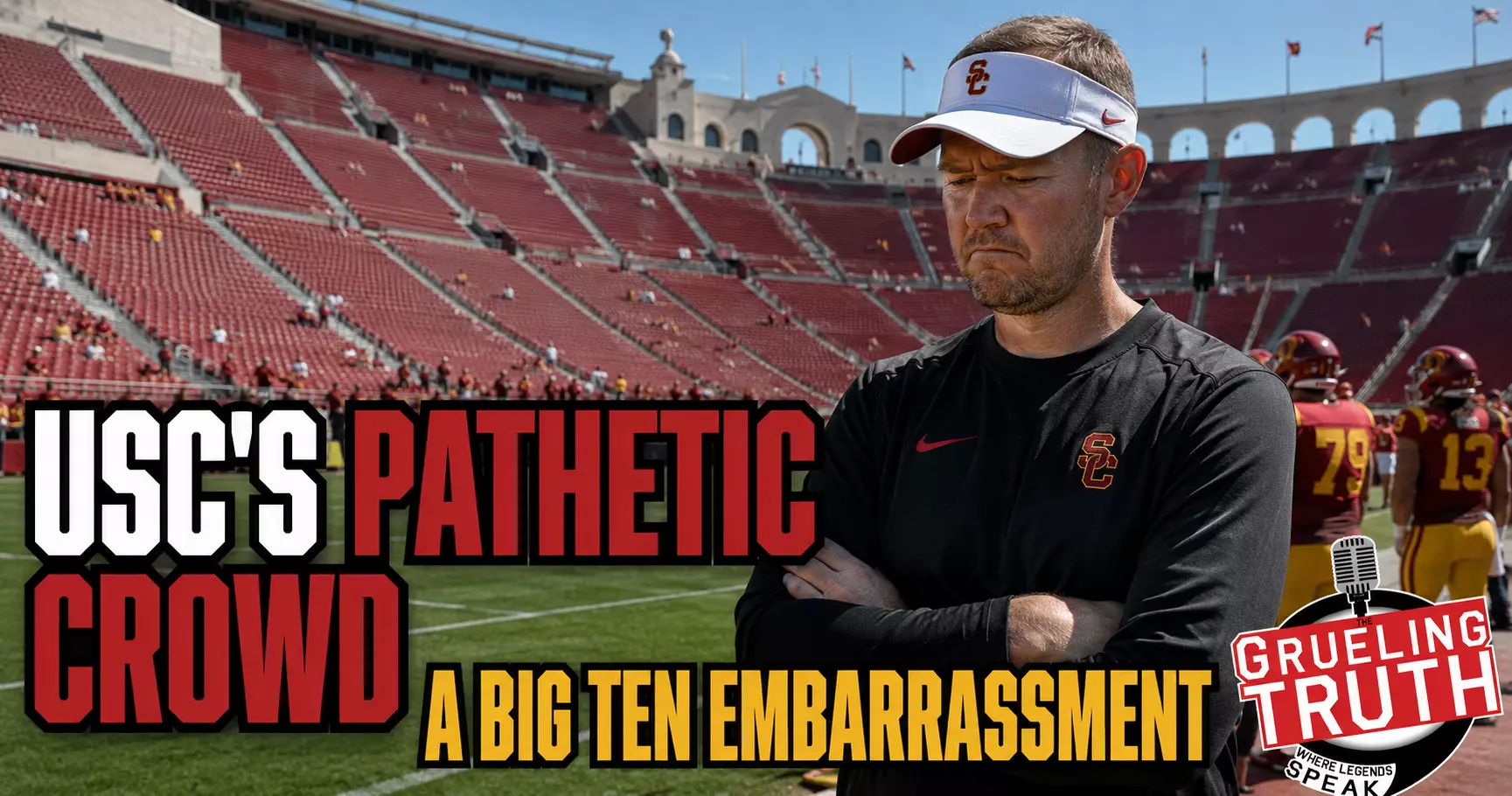
The Trojans announced an attendance of 51,144, yet television cameras showed enormous sections of empty seats
USC defeated San José State 42–26 in its 2026 season opener, but the final score was almost secondary to the depressing scene inside the Los Angeles Memorial Coliseum. The Trojans announced an attendance of 51,144, yet television cameras showed enormous sections of empty seats throughout one of college football’s most historic stadiums.
Even that announced figure represented USC’s smallest home crowd of the
Lincoln Riley era
and its lowest reported attendance since 2018. The number of people actually sitting in the Coliseum appeared considerably smaller.
The excuses arrived immediately.
It was hot. The opponent was San José State. The game started at noon on the West Coast. The matchup was added late. Fans did not want to sit in direct sunlight while watching USC play an opponent it was favored to beat comfortably.
All of those explanations carry some truth. None of them excuses what happened.
USC is not an ordinary college football program. It has won 11 claimed national championships, produced eight Heisman Trophy winners and sent generations of stars to the NFL. The Trojans play in the nation’s second-largest media market and entered the season ranked No. 14. They now compete in the richest and most powerful conference in college football.
A program with those advantages should never look abandoned on national television.
The Coliseum Once Represented the Center of College Football
USC has played at the Los Angeles Memorial Coliseum since the stadium opened in 1923. The Trojans defeated Pomona College 23–7 in their first game there before an announced crowd of 12,836. Over the next century, the Coliseum became one of the defining buildings in American sports.
It hosted two Olympic Games and will become the first stadium to host events in three Olympics when Los Angeles welcomes the Games again in 2028. It has hosted Super Bowls, World Series games, international soccer matches, presidential appearances and countless historic USC victories.
For decades, the Coliseum did not simply provide USC with a place to play. It gave the Trojans an identity.
When USC was dominating college football under Pete Carroll, the Coliseum became the place to be in Los Angeles. The Trojans set school attendance records in four consecutive seasons, averaging 77,804 fans in 2003, 85,229 in 2004, 90,812 in 2005 and more than 91,000 in 2006. USC established another school attendance record in 2007. During the height of the Carroll era, the Trojans routinely averaged more than 90,000 fans per game.
USC was effectively Los Angeles’ NFL team during that period. Celebrities attended practices and packed the sidelines. National television broadcasts treated home games like major events. The Coliseum provided a stage worthy of Matt Leinart, Reggie Bush, LenDale White and a program competing for national championships every season.
That history makes Saturday’s scene even more damaging.
The Coliseum’s current capacity is 77,500 following a privately financed $315 million renovation completed before the 2019 season. USC reduced the number of seats while adding premium areas, suites and modern amenities. In other words, filling the building should be easier now than it was when Carroll’s teams regularly attracted more than 90,000 people.
Instead, the Trojans could not come close.
The Announced Attendance Does Not Pass the Eye Test
USC officially reported 51,144 fans for the San José State game. That meant nearly 26,400 seats were unaccounted for even by the university’s own figure.
But announced attendance typically reflects tickets distributed or sold rather than the precise number of people who enter the stadium. The televised images suggested thousands of ticket holders never arrived. Large areas appeared almost completely deserted, producing an atmosphere more appropriate for a spring scrimmage than the opening game of a nationally ranked Big Ten program.
Tickets reportedly dropped below $10 on the secondary market. Price was not the primary barrier. Demand was.
USC averaged 67,782 fans in 2025, filling approximately 87.5 percent of the Coliseum. The Trojans drew 62,841 for last season’s opener against Missouri State—an opponent with even less national appeal than San José State. Saturday’s announced crowd was 11,697 lower than that Missouri State turnout.
The problem did not suddenly begin this weekend. In 2016, USC’s average attendance declined from 75,358 to 68,459. In October 2018, an announced crowd of 47,406 for a home game against Arizona State was reportedly the program’s smallest since only 44,880 watched USC play Oregon State in 2001.
The difference is that USC now operates in a much less forgiving environment.
The Trojans are no longer competing in a declining Pac-12 in which disappointing attendance could be dismissed as another West Coast problem. They joined the Big Ten, where packed stadiums, traveling supporters and intense game-day traditions help define the conference’s identity.
This Is Not What Big Ten Football Is Supposed to Look Like
USC’s 2025 average of 67,782 was respectable nationally, but it looked ordinary compared with the Big Ten’s attendance giants.
Michigan averaged 110,842 fans per game in 2025. Penn State averaged 107,093, Ohio State 104,105 and Nebraska 86,549. Iowa filled every seat at Kinnick Stadium and averaged 69,250. Wisconsin averaged 70,403, Michigan State 70,389 and Washington 68,237.
Those programs do not require perfect conditions or a marquee opponent to generate an atmosphere. Nebraska has continued filling Memorial Stadium despite years of disappointing results. Iowa fans show up when the offense struggles to score. Penn State, Michigan and Ohio State treat home Saturdays as civic events rather than optional entertainment.
Oregon averaged fewer people than USC because Autzen Stadium is smaller, but the Ducks reported crowds exceeding the stadium’s official capacity. Oregon averaged approximately 107.7 percent of capacity in 2025. USC averaged 87.5 percent—and that was before the embarrassing start to 2026.
The
Big Ten
did not add USC because it needed another program that could quietly win seven or eight games. It wanted the Los Angeles market, the USC brand, its national following and its championship history.
Saturday’s crowd undermined every part of that value proposition.
Conference realignment has transformed college sports into a competition for television audiences, sponsorship money, donor support and national relevance. Every home game is a three-hour advertisement for the program. When the cameras show a packed stadium, recruits see passion and tradition. When they show thousands of empty seats, recruits see apathy.
USC’s Week Zero opener advertised a fan base that could not be bothered.
Empty Seats Destroy Home-Field Advantage
The impact is not limited to appearance.
A packed Coliseum should make visiting Big Ten teams uncomfortable. Programs such as Michigan, Ohio State, Penn State, Nebraska, Wisconsin and Iowa should feel as though they have entered hostile territory after traveling thousands of miles across multiple time zones.
Instead, USC risks turning its home games into neutral-site events.
Big Ten supporters travel exceptionally well, and many conference alumni already live in Southern California. If USC fans do not purchase tickets, visiting fans will. We have already seen opposing colors spread across supposedly intimidating stadiums when home supporters lose interest.
Imagine Ohio State, Michigan, Nebraska or Penn State arriving at the Coliseum and discovering that 20,000 of its own fans can control the noise. That eliminates one of the few natural advantages USC should possess after joining a geographically absurd conference.
The Trojans must travel across the country for conference games, deal with early kickoffs and adjust to unfamiliar weather conditions. Their compensation should be a meaningful advantage when Midwestern teams make the reverse trip.
That advantage disappears when the Coliseum looks half-empty.
The Crowd Reflects USC’s Loss of Trust
Los Angeles has always been called a winning town. Critics sometimes use that description to dismiss Southern California supporters as frontrunners, but there is a harsher truth USC must confront: the program has trained its audience to stop believing the hype.
Every offseason brings promises that the Trojans are back. USC signs highly rated recruits, adds celebrated transfers and receives generous preseason rankings. Lincoln Riley was hired to return the program to national championship contention, but the results have not consistently matched the expectations.
USC reached the Pac-12 Championship Game during Riley’s first season and produced a Heisman winner in Caleb Williams. Since then, the Trojans have repeatedly struggled with defensive inconsistency, physicality and late-season collapses.
Against San José State, USC built a 35–3 advantage but allowed the Spartans to score 23 points afterward. Quarterback Jayden Maiava played well, passing for 286 yards and two touchdowns while running for another score. The Trojans displayed enough talent to win comfortably, but the final quarter did little to convince skeptical fans that all the program’s old problems have disappeared.
USC supporters are not staying away because they do not understand the program’s history. They are staying away because too many of them no longer trust the product.
That should frighten the administration more than online ridicule.
A disengaged fan base affects ticket revenue, concessions, merchandise, donations and recruiting. It weakens the atmosphere around the program and makes every disappointing loss feel heavier. Once attendance becomes conditional on an elite opponent or championship season, rebuilding enthusiasm becomes extremely difficult.
USC Must Earn Back Los Angeles—but Fans Must Respond Too
The responsibility is shared.
USC must schedule intelligently, improve the game-day experience and avoid placing supporters in brutal afternoon heat whenever it has control over kickoff conditions. The administration must make attending games easier and more appealing. Riley and his players must produce a program that feels worthy of the financial and emotional investment.
But USC fans also need to decide what they want their program to be.
They cannot demand national championships, elite recruiting classes and Big Ten respect while leaving tens of thousands of seats empty for the opener. Major programs are supported before every game becomes glamorous. Their fans create the atmosphere instead of waiting for the team to manufacture one first.
The Trojans defeated San José State, but USC lost something Saturday. It lost the optics battle, surrendered another piece of its home-field identity and gave the rest of the Big Ten a reason to question whether one of college football’s most recognizable brands still commands genuine passion.
The Coliseum has hosted some of the greatest teams and largest crowds in the sport’s history. Seeing it look deserted for a nationally ranked USC team was not merely disappointing.
It was devastating—and unless USC reverses the trend, the empty seats may become a more accurate symbol of the program than its championship banners.
The 1200×630 article image has also been created with your official Grueling Truth logo in the bottom-right corner.
Up To $1500 in Bonus Bets Paid Back if your First Bet Does Not Win
T&Cs apply
4.5/5
Gambling problem? Call 1-800-GAMBLER or 1-800-MY-RESET (Available in the US) 877-8-HOPENY or text HOPENY (467369) (NY) 1-800-327-5050 (MA), 1-800-BETS-OFF (IA), 1-800-981-0023 (PR). 21+ only. Please Gamble Responsibly. See BetMGM.com for Terms. First Bet Offer for new customers only (if applicable). Subject to eligibility requirements. Bonus bets are non-withdrawable. In partnership with Kansas Crossing Casino and Hotel. Promotional offers not available in Mississippi, Massachusetts, New York, Ontario, or Puerto Rico.
New DraftKings Customers: Spend $5+ Get $150 in Bonuses
T&Cs apply
4.5/5
GAMBLING PROBLEM? CALL 1-800-GAMBLER or 1-800-MY-RESET, (800) 327-5050 or visit gamblinghelplinema.org (MA). Please Gamble Responsibly. 888-789-7777/visit ccpg.org (CT), or visit www.mdgamblinghelp.org (MD), 1-800-981-0023 (PR). 21+ and present in most states. (18+ DC/NH/PR/WY). Void in CAN. Eligibility restrictions apply. On behalf of Boot Hill Casino (KS). Pass-thru of per wager tax may apply in IL. 1 per new DraftKings customer. $5+ first-time bet req. Max. $150 issued as non-withdrawable Bonus Bets. Stake removed from payout. Reward issued as $50 in Bonus Bets every 7 days via click-to-claim for 14 days. Bonus Bets and click-to-claims expire 7 days (168hrs) after issuance. Terms: sportsbook.draftkings.com/promos. Ends 10/11/26 at 11:59 PM ET. Sponsored by DK.
Must be 21+. GAMBLING PROBLEM? CALL 1-800-GAMBLER OR CALL 1-800-MY-RESET, www.mdgamblinghelp.org (MD), (800)-327-5050 or gamblinghelplinema.org (MA), Call (877)8-HOPENY or text HOPENY (467369) (NY), (888) 789-7777 or ccpg.org (CT), morethanagame.nc.gov (NC), 1800gambler.net (WV)
Bet $1 and get double the winnings up to $25 for your next 10 bets
T&Cs apply
4.4/5
21+ New users only. Must register using eligible promo code. First bet after registration must qualify. Max. Bonus Bet: $1,000. Bonus Bet expires 14 days after receipt. Void where prohibited. See Caesars.com/promos for full terms. Gambling Problem? 1-800-GAMBLER (1-800-426-2537)
21+ and present in OH. Gambling Problem? Call 1-800-GAMBLER.
This site is using
Cloudflare
and adheres to the
Google Safe Browsing Program. We adapted
Google's Privacy Guidelines
to keep your data safe at all times.
Close
Ready to Win Big? Join the Elite with Our Sports Betting Deals!
FanDuel Promo
New Users – Get $250 in Bonus Bets when you wager $5 for 5 days
Up To $1500 in Bonus Bets Paid Back if your First Bet Does Not Win
Best Slots
T&Cs and 21+ apply
Gambling problem? Call 1-800-GAMBLER or 1-800-MY-RESET (Available in the US) 877-8-HOPENY or text HOPENY (467369) (NY) 1-800-327-5050 (MA), 1-800-BETS-OFF (IA), 1-800-981-0023 (PR). 21+ only. Please Gamble Responsibly. See BetMGM.com for Terms. First Bet Offer for new customers only (if applicable). Subject to eligibility requirements. Bonus bets are non-withdrawable. In partnership with Kansas Crossing Casino and Hotel. Promotional offers not available in Mississippi, Massachusetts, New York, Ontario, or Puerto Rico.
Code:
Open BetMGM
Get Bonus
DraftKings Promo
New DraftKings Customers: Spend $5+ Get $150 in Bonuses
Newcomer
T&Cs and 21+ apply
GAMBLING PROBLEM? CALL 1-800-GAMBLER or 1-800-MY-RESET, (800) 327-5050 or visit gamblinghelplinema.org (MA). Please Gamble Responsibly. 888-789-7777/visit ccpg.org (CT), or visit www.mdgamblinghelp.org (MD), 1-800-981-0023 (PR). 21+ and present in most states. (18+ DC/NH/PR/WY). Void in CAN. Eligibility restrictions apply. On behalf of Boot Hill Casino (KS). Pass-thru of per wager tax may apply in IL. 1 per new DraftKings customer. $5+ first-time bet req. Max. $150 issued as non-withdrawable Bonus Bets. Stake removed from payout. Reward issued as $50 in Bonus Bets every 7 days via click-to-claim for 14 days. Bonus Bets and click-to-claims expire 7 days (168hrs) after issuance. Terms: sportsbook.draftkings.com/promos. Ends 10/11/26 at 11:59 PM ET. Sponsored by DK.
Code:
Open DraftKings
Get Bonus
Find out what the legends have to say about sports this week....