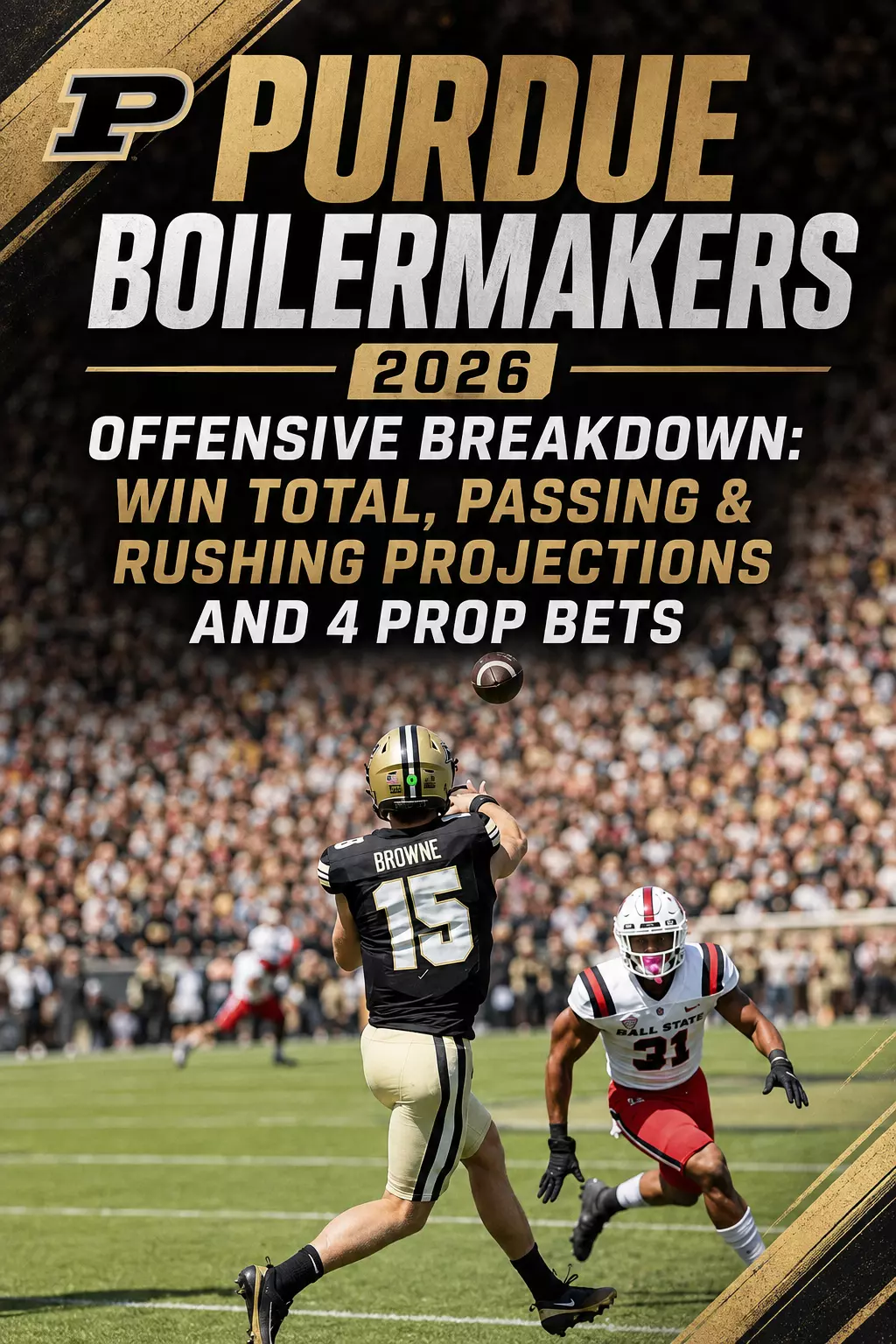
The Purdue Boilermakers enter the 2026 college football season looking for a significant Year 2 improvement under head coach
Barry Odom.
Purdue finished just
2-10 in 2025, averaging 18.8 points per game. The Boilermakers generated approximately
4,123 yards of total offense, including 2,606 passing yards and 1,517 rushing yards. Purdue finished with 15 passing touchdowns and struggled to consistently finish drives against Big Ten competition.
There are several legitimate reasons to expect improvement in 2026.
First, Purdue returns starting quarterback
Ryan Browne, giving the offense continuity at the most important position.
Browne started all 12 games last season, throwing for
2,153 yards and nine touchdowns
while rushing for another 206 yards and four scores.
Second, Purdue aggressively upgraded the supporting cast through the transfer portal. Odom signed a 32-player portal class that Purdue said ranked
24th nationally and fourth in the Big Ten according to On3, with 14 offensive additions. Five offensive linemen, five wide receivers and three running backs were among the newcomers.
The Boilermakers also return experienced offensive linemen such as
Joey Tanona and Ethan Trent, while USC transfer
Micah Banuelos
brings additional Power Four starting experience.
Purdue isn’t suddenly going to become Ohio State offensively.
The goal is much more realistic: become significantly more consistent, establish a better rushing attack and turn more competitive games into victories.
Purdue Boilermakers 2026 Offensive Projections
Projected Record:
4-8
Projected Team Passing Yards:
2,550
Projected Team Rushing Yards:
1,850
Projected Total Offense:
4,400 yards
Projected Passing Touchdowns:
20
Projected Rushing Touchdowns:
16
Projected Offensive Touchdowns:
36-38
Projected Points Per Game:
23-25
Biggest Offensive Strength:
Experienced Starting Quarterback and Improved Backfield Depth
Biggest Offensive Question:
Can Purdue become more efficient against Big Ten defenses?
Quarterback Breakdown: Ryan Browne
Ryan Browne gives Purdue something many rebuilding programs don’t have: an experienced quarterback returning for another season in the same system.
Browne started all 12 games in 2025 and completed
199 of 338 passes for 2,153 yards and nine touchdowns. He also rushed 66 times for 206 yards and four touchdowns.
The final numbers were inconsistent, but Browne demonstrated a much higher ceiling at times.
He opened the season by completing 18 of 26 passes for
311 yards and two touchdowns
against Ball State.
He threw for 305 yards against USC.
He produced another 302-yard game against Illinois.
Browne became one of only four Purdue quarterbacks since 1995 to record three 300-yard passing performances within the first five games of a season.
Those performances provide the argument for optimism.
The issue was sustaining that production.
Browne finished the season with only nine touchdown passes, and Purdue’s offense became much less explosive during portions of the Big Ten schedule.
Year 2 in Josh Henson’s offense should help.
Henson returns as offensive coordinator, and Purdue entered fall camp with the coaching staff emphasizing greater depth and more competition throughout the offense than it had in 2025.
Browne should also benefit from having an entire offseason as the established starter.
During spring practice, Purdue highlighted the importance of Browne receiving extended work in the system after starting every game during Odom’s first season.
His mobility provides another advantage.
Browne isn’t a traditional dual-threat quarterback, but he has demonstrated the ability to create with his legs. In 2024, he rushed for 118 yards during his first collegiate start against Illinois. Last season, he added 206 yards and four rushing touchdowns.
Purdue doesn’t need Browne to suddenly throw for 4,000 yards.
If he pushes his completion percentage into the low-to-mid 60s, gets his passing-touchdown total into the upper teens and reduces empty possessions, the offense should improve substantially.
Ryan Browne Projection: 2,400-2,550 passing yards, 18-20 passing touchdowns, 250-300 rushing yards and 4-5 rushing touchdowns.
Purdue Running Game Breakdown
Purdue’s running back room looks completely different entering 2026.
The Boilermakers have moved on from longtime starter
Devin Mockobee, forcing Odom and his staff to rebuild the position.
They attacked the transfer portal aggressively.
The biggest addition may be former Texas running back
Jerrick Gibson.
Gibson appeared in 19 games during his Texas career and rushed for
529 yards and five touchdowns. As a freshman in 2024, he produced 377 yards and four scores, including a 100-yard performance against Florida.
The former highly ranked recruit gives Purdue legitimate Power Four talent.
Fame Ijeboi
arrives from Minnesota.
Ijeboi was Minnesota’s No. 2 running back last season and rushed
97 times for 441 yards and two touchdowns, while adding 12 receptions for 54 yards and another score. His season included a 108-yard rushing performance against Michigan State.
Purdue also added
Travis Terrell Jr.
from Jackson State. The former honorable mention AP FCS All-American accumulated more than 1,200 yards of offense during two seasons before transferring to West Lafayette.
Then there is returning running back
Antonio Harris.
Harris received increased opportunities when Mockobee was injured late last season and started Purdue’s final two games. He finished with
305 rushing yards and two touchdowns on 69 carries, while catching 17 passes for another 137 yards.
That gives Purdue four viable options.
Gibson provides the highest recruiting pedigree.
Ijeboi has already produced against Big Ten defenses.
Terrell adds explosiveness.
Harris understands Purdue’s offense and has meaningful experience within the program.
The Boilermakers do not need one running back to carry the ball 250 times.
A committee could actually make the offense more difficult to defend.
Purdue rushed for only about
1,517 yards as a team in 2025, so the bar for improvement is manageable.
If the offensive line improves and Browne contributes another 250-plus yards himself, getting Purdue into the 1,800-1,900-yard range is realistic.
Projected Team Rushing Yards: 1,850
Projected Rushing Touchdowns: 16
Purdue Offensive Line Breakdown
Purdue’s offensive line may ultimately determine whether the Boilermakers win two games again or make a legitimate push toward bowl eligibility.
There is more experience than a year ago.
Joey Tanona
started all 12 games at left tackle last season, playing 793 offensive snaps.
Ethan Trent
appeared in all 12 games and started six times at right guard, giving Purdue another returning lineman with meaningful experience.
Odom also added several offensive linemen through the portal.
The most interesting may be former USC guard
Micah Banuelos.
Banuelos appeared in 10 games with five starts for USC in 2025, starting at both left and right guard. He played 401 offensive snaps for a Trojans offense that led the Big Ten in passing offense and total offense.
Purdue’s portal class also included Oklahoma State transfer
Nuku Mafi, USC transfer
Makai Saina, South Carolina transfer
Jatavius Shivers
and South Carolina transfer
Boaz Stanley.
That is a dramatic infusion of size and competition.
Browne came out of spring practice encouraged by the progress Purdue had made in the trenches, specifically pointing to the offensive line as an area he believed had improved.
The line doesn’t have to become elite.
It needs to become more consistent.
Purdue’s offense averaged only around 343 yards per game last season. Creating cleaner pockets for Browne and turning two-yard rushing gains into four- or five-yard gains would dramatically change Henson’s playbook.
The portal additions give Purdue significantly more options than it had a year ago.
Now the group has to develop chemistry.
Purdue Passing Game Breakdown
The passing game may be the most difficult portion of Purdue’s offense to project because the receiving corps has undergone substantial change.
Odom added
five transfer receivers
during the offseason.
One of the most intriguing is
Xavier Townsend, who arrives from Iowa State.
Townsend caught
18 passes for 243 yards in 2025, including a 92-yard performance against Arkansas State. He previously played at UCF, where he caught 33 passes for 325 yards and three touchdowns during the 2023 season while also contributing as a runner and returner.
His versatility gives Henson opportunities to use him in the slot, on motions and potentially out of the backfield.
Corey Smith
is one of Purdue’s more interesting returning receivers.
Smith caught 14 passes for
237 yards and one touchdown
last season while averaging nearly 17 yards per reception. His season included a 60-yard touchdown against Illinois and a 48-yard reception against Northwestern.
That type of explosiveness is important.
Purdue desperately needs receivers capable of creating touchdowns without requiring 12-play drives.
Jesse Watson
also returns after catching eight passes for 80 yards and two touchdowns last season.
The portal adds more size.
Jaylan Hornsby
comes from Syracuse at 6-foot-3.
Bisi Owens
is listed at 6-foot-4.
Ricky Sampson
is another 6-foot-4 target.
Asaad Waseem
adds another experienced option.
Purdue also has veterans such as
Chauncey Magwood
and
De’Nylon Morrissette
in the receiver room. Morrissette missed the 2025 season with an injury but previously caught two touchdown passes for Purdue in 2024.
At tight end,
George Burhenn
returns after battling injuries throughout his career. Purdue’s coaching staff has emphasized the chemistry he has developed with Browne since they arrived in the program together.
There may not be a proven 1,000-yard receiver on this roster.
That doesn’t automatically mean Purdue’s passing game will struggle.
Henson has emphasized wanting enough weapons to attack defenses in multiple ways rather than becoming predictable.
If Townsend, Smith and one of the bigger portal additions emerge, Browne should have enough weapons to improve his touchdown production.
Projected Team Passing Yards: 2,550
Projected Passing Touchdowns: 20
Purdue Boilermakers 2026 Win Total
Purdue’s current regular-season win total is
3.5 victories
at BetMGM.
As of July 31, BetMGM listed
Over 3.5 at +115 and Under 3.5 at -140.
That number reflects Purdue’s difficult position within the Big Ten but also recognizes that the Boilermakers should be improved from last year’s 2-10 team.
The schedule provides opportunities early.
Purdue opens at home against
Indiana State
before hosting Wake Forest. The Boilermakers then travel to UCLA and host Notre Dame.
The Indiana State game needs to be a victory.
Wake Forest and UCLA could determine whether Purdue has a realistic chance to exceed the win total before October arrives.
Conference play then becomes difficult.
Purdue travels to Illinois before hosting Minnesota and Washington. After a bye, the Boilermakers travel to Penn State.
November creates several more possibilities.
Maryland and Wisconsin visit Ross-Ade Stadium, while Purdue travels to Iowa and ends the year at defending national champion Indiana in the Old Oaken Bucket game.
Purdue doesn’t have an easy schedule.
But getting to four wins does not require the Boilermakers to suddenly become a Big Ten contender.
Indiana State should provide one victory.
Wake Forest, UCLA, Minnesota, Maryland and Wisconsin provide the most realistic additional opportunities.
My projection has Purdue finishing
4-8, narrowly clearing the 3.5-win total.
Four Purdue Boilermakers 2026 Prop Bets
Note:
Purdue’s 3.5-win total is a current sportsbook market. The statistical season props below are
projection-based betting benchmarks
because full-season college football team passing, rushing and touchdown props are not consistently available at every sportsbook.
Prop Bet #1: Purdue Over 3.5 Regular-Season Wins
DraftKings
4.5/5
Tip: Purdue Over 3.5 Regular-Season Wins
Returning Starting Quarterback
Top-25 Portal Class
More Winnable Home Games
New DraftKings Customers: Bet $5, Get $200 + 3 Months of NBA League Pass!
Get bonus now
GAMBLING PROBLEM? CALL 1-800-GAMBLER or 1-800-MY-RESET, (800) 327-5050 or visit gamblinghelplinema.org (MA). Please Gamble Responsibly. 888-789-7777/visit ccpg.org (CT), or visit www.mdgamblinghelp.org (MD), 1-800-981-0023 (PR). 21+ and present in most states. (18+ DC/NH/PR/WY). Void in CAN. Eligibility restrictions apply. On behalf of Boot Hill Casino (KS). Pass-thru of per wager tax may apply in IL. 1 per new Sportsbook customer. $5+ first-time bet req. Max. $200 issued as non-withdrawable Bonus Bets. Stake removed from payout. Reward issued as $50 in Bonus Bets every 7 days via click-to-claim for 21 days. Bonus Bets and click-to-claims expire 7 days (168hrs) after issuance. Terms: dkng.co/offer. Get 1 promo code to redeem a 3-month NBA League Pass subscription, complimentary of DraftKings. Subscription auto-renews monthly at then-current price (currently $16.99/mo); cancel anytime. Terms, restrictions, and eligibility requirements apply. Redeem League Pass by 12/19/26 at 11:59 PM ET. Addt’l terms: support.watch.nba.com/hc/en-us/articles/9165532876183-League-Pass-Terms-of-Use_. Ends 11/29/26 at 11:59 PM ET. Sponsored by DK.
Why the Over Is a Good Bet
Purdue only needs four victories.
That makes the Over attractive for a roster that should be considerably deeper than the one Odom inherited last season.
The biggest advantage is quarterback continuity.
Browne started every game last season and now receives an entire offseason in the same offensive system.
Purdue also signed 32 transfer players, with its portal class ranked 24th nationally and fourth in the Big Ten by On3 according to Purdue Athletics. Twenty of those newcomers came from Power Four programs.
The schedule creates opportunities.
Indiana State should be a win.
Wake Forest comes to Ross-Ade.
Minnesota, Maryland and Wisconsin also visit West Lafayette.
UCLA is another game where Purdue should have a chance.
The Boilermakers do not need a massive breakthrough.
Going from 2-10 to 4-8 is enough.
Why the Under Is a Good Bet
Purdue is still playing in one of the deepest conferences in college football.
The schedule includes Notre Dame, Illinois, Washington, Penn State, Iowa and Indiana in addition to other Big Ten opponents.
Three-and-a-half victories also becomes dangerous if Purdue loses one of the more manageable early games.
A loss to Wake Forest or UCLA could force Purdue to find multiple Big Ten victories late in the season.
The offense is also replacing Mockobee and has substantially rebuilt the receiving corps.
The offensive line may be deeper, but several newcomers still have to develop chemistry.
Purdue improved its roster on paper.
That still has to translate to Saturdays.
Projection: Purdue finishes 4-8
Bet: Over 3.5 Wins
Confidence: 6.5/10
Prop Bet #2: Ryan Browne Over 2,399.5 Passing Yards
FanDuel
4.6/5
Tip: Ryan Browne Over 2,399.5 Passing Yards
Second Year as Starter
Upgraded Receiver Depth
Proven 300-Yard Game Ceiling
New Users – Get $350 in Bonus Bets when you wager $5 for 7 days
Get bonus now
Gambling Problem? Call 1-800-GAMBLER or 1-800-MY-RESET. Call 1-888-789-7777 or visit ccpgg.org/chat (CT). Hope is here. GamblingHelpLineMA.org or call (800) 327-5050 for 24/7 support (MA). Visit www.mdgamblinghelp.org (MD). Call 1-877-8HOPE-NY or text HOPENY (NY). 21+ (18+ DC, WY) and present in select states (for KS, in affiliation with Kansas Star Casino). Find online real money wagering only. Min $5 wager required for 7 consecutive days. $5 free play credit. Bonus issued as non-withdrawable bonus with cash withdrawable bonus with cash withdrawable. Bonus bets which expire 7 days after receipt. Restrictions apply. See terms at sportsbook.fanduel.com. Call 1-877-770-7867 (LA).
Why the Over Is a Good Bet
Browne threw for
2,153 yards last season, so he needs an increase of only about 250 yards to exceed this benchmark.
That is approximately 21 additional passing yards per game.
The supporting cast should be deeper.
Townsend brings Big 12 experience.
Smith already demonstrated big-play ability at Purdue.
Five transfer receivers joined the roster, giving Henson more options than he had last season.
Browne has also proven that 300-yard performances are within his range.
He produced three during the first five games of 2025.
The schedule could help the Over as well.
Purdue is likely to trail in games against Notre Dame, Penn State and Indiana, which could force Henson to increase passing volume.
Why the Under Is a Good Bet
Purdue may want to become a more balanced offense.
The Boilermakers added Gibson, Ijeboi and Terrell because the coaching staff clearly wants greater depth in the running game.
If Purdue runs more efficiently, Browne may actually throw less.
His 58.9% completion percentage from last season also shows that efficiency must improve.
The Big Ten schedule presents another issue.
Penn State, Iowa and Indiana could all create difficult passing environments, while Notre Dame brings another high-level defense to Ross-Ade.
Purdue’s receiving room is deeper but still lacks an established elite target.
Browne could improve substantially as a quarterback without reaching 2,400 yards.
Projection: 2,450-2,550 Passing Yards
Bet: Over 2,399.5 Passing Yards
Confidence: 7/10
Prop Bet #3: Purdue Over 1,699.5 Team Rushing Yards
Caesars
4.4/5
Tip: Purdue Over 1,699.5 Team Rushing Yards
Jerrick Gibson Upside
Fame Ijeboi’s Big Ten Experience
Deeper Offensive Line
Bet $1 and get double the winnings up to $25 for your next 10 bets
–
21+ New users only. Must register using eligible promo code. First bet after registration must qualify. Max. Bonus Bet: $1,000. Bonus Bet expires 14 days after receipt. Void where prohibited. See Caesars.com/promos for full terms. Gambling Problem? 1-800-GAMBLER (1-800-426-2537)
Why the Over Is a Good Bet
This is my favorite Purdue offensive statistical prop.
The Boilermakers rushed for approximately
1,517 yards in 2025, so Purdue only needs a modest improvement to clear 1,699.5.
The running back room should be deeper.
Gibson accumulated 529 rushing yards and five touchdowns at Texas.
Ijeboi rushed for 441 yards at Minnesota last season and already has experience against Big Ten defenses.
Terrell adds another explosive option, while Harris returns after rushing for 305 yards last season.
Purdue can spread the workload among four running backs.
Browne also contributes to the rushing total. He produced 206 yards and four touchdowns last season.
The offensive line has more depth after Purdue added five transfer linemen to a group returning Tanona and Trent.
Purdue only needs to average approximately
142 rushing yards per game
to clear this number.
That is realistic.
Why the Under Is a Good Bet
The running back rotation is talented but unproven as a group.
Gibson has never been a full-season feature back.
Ijeboi produced 441 yards last season.
Harris has only 305 career rushing yards from 2025.
Terrell is making the jump from the FCS level.
Replacing Mockobee’s leadership and experience may take time.
Purdue could also spend significant portions of games playing from behind.
Notre Dame, Washington, Penn State, Iowa and Indiana could force Purdue into pass-heavy second halves.
The offensive line also has multiple new pieces, so improved depth does not automatically mean immediate continuity.
Projection: 1,850 Team Rushing Yards
Bet: Over 1,699.5 Team Rushing Yards
Confidence: 7.5/10
Prop Bet #4: Purdue Over 32.5 Offensive Touchdowns
BetMGM
4.5/5
Tip: Purdue Over 32.5 Offensive Touchdowns
Returning Quarterback
Improved Backfield Talent
More Explosive Receiving Options
Up To $1500 in Bonus Bets Paid Back if your First Bet Does Not Win
Get bonus now
Gambling problem? Call 1-800-GAMBLER or 1-800-MY-RESET (Available in the US) 877-8-HOPENY or text HOPENY (467369) (NY) 1-800-327-5050 (MA), 1-800-BETS-OFF (IA), 1-800-981-0023 (PR). 21+ only. Please Gamble Responsibly. See BetMGM.com for Terms. First Bet Offer for new customers only (if applicable). Subject to eligibility requirements. Bonus bets are non-withdrawable. In partnership with Kansas Crossing Casino and Hotel. Promotional offers not available in Mississippi, Massachusetts, New York, Ontario, or Puerto Rico.
Why the Over Is a Good Bet
Purdue’s offensive ceiling should be significantly higher in Year 2.
Browne accounted for nine passing touchdowns and four rushing scores last season.
If he simply pushes his passing total into the 18-20 range while maintaining his rushing contribution, Purdue will already be significantly closer to this benchmark.
The backfield should also generate more scoring opportunities.
Gibson has Power Four experience.
Ijeboi scored three combined rushing and receiving touchdowns at Minnesota last year.
Harris scored twice on the ground for Purdue.
Terrell gives Henson another potential explosive weapon.
The schedule provides opportunities for some higher-scoring performances.
Indiana State is the most obvious.
Wake Forest, UCLA, Minnesota and Maryland are also games where Purdue should have opportunities to move the football.
An average of roughly 2.75 offensive touchdowns per game gets Purdue past the number.
That is not an unreasonable expectation for an offense entering its second season in the system.
Why the Under Is a Good Bet
Purdue’s biggest problem in 2025 was not simply moving the football.
It was consistently finishing possessions with touchdowns.
The Boilermakers averaged only
18.8 points per game
during their 2-10 season.
Improving from that level to more than 32 offensive touchdowns requires meaningful progress.
The schedule will also create several difficult scoring matchups.
Notre Dame, Penn State, Iowa and Indiana could all hold Purdue below its season scoring average.
Browne must also improve on nine passing touchdowns.
The receivers must prove they can consistently separate in the red zone.
And the new running back rotation needs to establish reliable goal-line options.
There is enough talent for improvement, but significant improvement shouldn’t simply be assumed.
Projection: 36-38 Offensive Touchdowns
Bet: Over 32.5 Offensive Touchdowns
Confidence: 6.5/10
Best Purdue Boilermakers 2026 Prop Bet
Purdue’s rushing-yardage Over is the offensive wager I trust the most.
The number does not require the Boilermakers to suddenly become one of the Big Ten’s elite rushing teams.
Purdue needs approximately 142 rushing yards per game.
The personnel gives the Boilermakers multiple paths to get there.
Gibson brings talent and Power Four experience from Texas.
Ijeboi already rushed for 441 yards against a Big Ten schedule at Minnesota.
Harris produced 305 yards in a limited role last season.
Terrell gives the backfield another explosive option.
Browne should contribute another 200-plus yards himself if he remains healthy.
Most importantly, Purdue has invested heavily in improving the offensive line.
Five transfer linemen joined the program, while Tanona and Trent bring starting experience back from last year’s group.
Purdue doesn’t need one 1,000-yard running back.
A committee approach should be enough to push the Boilermakers beyond 1,700 rushing yards.
Conclusion
The Purdue Boilermakers enter the 2026 season with a much more encouraging offensive foundation than their 2-10 record from last season might suggest.
The most important piece is already established.
Ryan Browne returns after starting all 12 games, throwing for 2,153 yards and demonstrating enough mobility to account for another four rushing touchdowns.
That experience matters.
Purdue isn’t asking a first-year quarterback to learn Henson’s offense while simultaneously trying to survive a Big Ten schedule.
Browne has already been through that process.
The supporting cast should also be significantly better.
The running back room is deeper with Jerrick Gibson, Fame Ijeboi and Travis Terrell Jr. joining Antonio Harris.
The receiving corps has been reshaped through the portal, with Xavier Townsend joining returning players such as Corey Smith and Jesse Watson.
And the offensive line has been strengthened with five transfer additions surrounding experienced players such as Joey Tanona and Ethan Trent.
Odom’s portal class included 32 total newcomers and was ranked 24th nationally and fourth among Big Ten programs by On3 according to Purdue Athletics.
That doesn’t guarantee immediate success.
Purdue still has to prove it can execute against Big Ten defenses.
My projection has the Boilermakers finishing with approximately
2,550 passing yards, 1,850 rushing yards and 36-38 offensive touchdowns while averaging 23-25 points per game.
That would represent significant progress from last year’s 18.8-point offense.
The schedule remains Purdue’s biggest obstacle.
Indiana State provides an opportunity to start with a victory, but Wake Forest, UCLA and Notre Dame will tell us much more about how far the program has progressed before the heart of Big Ten play.
Later games against Minnesota, Maryland and Wisconsin may ultimately decide Purdue’s win-total wager.
The current market sits at
3.5 victories, with BetMGM pricing the Over at +115 and Under at -140 as of July 31.
My prediction is
4-8, narrowly cashing the Over.
That may not look like a dramatic turnaround, but doubling the win total while becoming more competitive against Big Ten opponents would represent meaningful progress in Odom’s second season.
From an offensive betting perspective, the strongest wager is
Purdue Over 1,699.5 team rushing yards.
The Boilermakers have completely rebuilt their running back room, strengthened the offensive line and return a quarterback capable of contributing with his legs.
The passing game should improve as well, but Purdue’s most reliable route toward offensive consistency is establishing the run and preventing Browne from being asked to carry the team every Saturday.
If Gibson and Ijeboi provide immediate production, the new offensive linemen come together quickly and Browne takes a Year 2 step forward, the Purdue offense should be noticeably better in 2026.
The Boilermakers may still be a year away from seriously challenging the Big Ten’s better teams, but this roster has enough offensive talent to win four or five games — and potentially make Purdue one of the conference’s more improved programs.
New Users – Get $350 in Bonus Bets when you wager $5 for 7 days
T&Cs apply
4.6/5
Gambling Problem? Call 1-800-GAMBLER or 1-800-MY-RESET. Call 1-888-789-7777 or visit ccpgg.org/chat (CT). Hope is here. GamblingHelpLineMA.org or call (800) 327-5050 for 24/7 support (MA). Visit www.mdgamblinghelp.org (MD). Call 1-877-8HOPE-NY or text HOPENY (NY). 21+ (18+ DC, WY) and present in select states (for KS, in affiliation with Kansas Star Casino). Find online real money wagering only. Min $5 wager required for 7 consecutive days. $5 free play credit. Bonus issued as non-withdrawable bonus with cash withdrawable bonus with cash withdrawable. Bonus bets which expire 7 days after receipt. Restrictions apply. See terms at sportsbook.fanduel.com. Call 1-877-770-7867 (LA).
Up To $1500 in Bonus Bets Paid Back if your First Bet Does Not Win
T&Cs apply
4.5/5
Gambling problem? Call 1-800-GAMBLER or 1-800-MY-RESET (Available in the US) 877-8-HOPENY or text HOPENY (467369) (NY) 1-800-327-5050 (MA), 1-800-BETS-OFF (IA), 1-800-981-0023 (PR). 21+ only. Please Gamble Responsibly. See BetMGM.com for Terms. First Bet Offer for new customers only (if applicable). Subject to eligibility requirements. Bonus bets are non-withdrawable. In partnership with Kansas Crossing Casino and Hotel. Promotional offers not available in Mississippi, Massachusetts, New York, Ontario, or Puerto Rico.
New DraftKings Customers: Bet $5, Get $200 + 3 Months of NBA League Pass!
T&Cs apply
4.5/5
GAMBLING PROBLEM? CALL 1-800-GAMBLER or 1-800-MY-RESET, (800) 327-5050 or visit gamblinghelplinema.org (MA). Please Gamble Responsibly. 888-789-7777/visit ccpg.org (CT), or visit www.mdgamblinghelp.org (MD), 1-800-981-0023 (PR). 21+ and present in most states. (18+ DC/NH/PR/WY). Void in CAN. Eligibility restrictions apply. On behalf of Boot Hill Casino (KS). Pass-thru of per wager tax may apply in IL. 1 per new Sportsbook customer. $5+ first-time bet req. Max. $200 issued as non-withdrawable Bonus Bets. Stake removed from payout. Reward issued as $50 in Bonus Bets every 7 days via click-to-claim for 21 days. Bonus Bets and click-to-claims expire 7 days (168hrs) after issuance. Terms: dkng.co/offer. Get 1 promo code to redeem a 3-month NBA League Pass subscription, complimentary of DraftKings. Subscription auto-renews monthly at then-current price (currently $16.99/mo); cancel anytime. Terms, restrictions, and eligibility requirements apply. Redeem League Pass by 12/19/26 at 11:59 PM ET. Addt’l terms: support.watch.nba.com/hc/en-us/articles/9165532876183-League-Pass-Terms-of-Use_. Ends 11/29/26 at 11:59 PM ET. Sponsored by DK.
Must be 21+. GAMBLING PROBLEM? CALL 1-800-GAMBLER OR CALL 1-800-MY-RESET, www.mdgamblinghelp.org (MD), (800)-327-5050 or gamblinghelplinema.org (MA), Call (877)8-HOPENY or text HOPENY (467369) (NY), (888) 789-7777 or ccpg.org (CT), morethanagame.nc.gov (NC), 1800gambler.net (WV)
Bet $1 and get double the winnings up to $25 for your next 10 bets
T&Cs apply
4.4/5
21+ New users only. Must register using eligible promo code. First bet after registration must qualify. Max. Bonus Bet: $1,000. Bonus Bet expires 14 days after receipt. Void where prohibited. See Caesars.com/promos for full terms. Gambling Problem? 1-800-GAMBLER (1-800-426-2537)
21+ and present in OH. Gambling Problem? Call 1-800-GAMBLER.
This site is using
Cloudflare
and adheres to the
Google Safe Browsing Program. We adapted
Google's Privacy Guidelines
to keep your data safe at all times.
Close
Ready to Win Big? Join the Elite with Our Sports Betting Deals!
FanDuel Promo
New Users – Get $350 in Bonus Bets when you wager $5 for 7 days
Our Favorite
T&Cs and 21+ apply
Gambling Problem? Call 1-800-GAMBLER or 1-800-MY-RESET. Call 1-888-789-7777 or visit ccpgg.org/chat (CT). Hope is here. GamblingHelpLineMA.org or call (800) 327-5050 for 24/7 support (MA). Visit www.mdgamblinghelp.org (MD). Call 1-877-8HOPE-NY or text HOPENY (NY). 21+ (18+ DC, WY) and present in select states (for KS, in affiliation with Kansas Star Casino). Find online real money wagering only. Min $5 wager required for 7 consecutive days. $5 free play credit. Bonus issued as non-withdrawable bonus with cash withdrawable bonus with cash withdrawable. Bonus bets which expire 7 days after receipt. Restrictions apply. See terms at sportsbook.fanduel.com. Call 1-877-770-7867 (LA).
Code:
Open FanDuel
Get Bonus
BetMGM Promo
Up To $1500 in Bonus Bets Paid Back if your First Bet Does Not Win
Best Slots
T&Cs and 21+ apply
Gambling problem? Call 1-800-GAMBLER or 1-800-MY-RESET (Available in the US) 877-8-HOPENY or text HOPENY (467369) (NY) 1-800-327-5050 (MA), 1-800-BETS-OFF (IA), 1-800-981-0023 (PR). 21+ only. Please Gamble Responsibly. See BetMGM.com for Terms. First Bet Offer for new customers only (if applicable). Subject to eligibility requirements. Bonus bets are non-withdrawable. In partnership with Kansas Crossing Casino and Hotel. Promotional offers not available in Mississippi, Massachusetts, New York, Ontario, or Puerto Rico.
Code:
Open BetMGM
Get Bonus
DraftKings Promo
New DraftKings Customers: Bet $5, Get $200 + 3 Months of NBA League Pass!
Newcomer
T&Cs and 21+ apply
GAMBLING PROBLEM? CALL 1-800-GAMBLER or 1-800-MY-RESET, (800) 327-5050 or visit gamblinghelplinema.org (MA). Please Gamble Responsibly. 888-789-7777/visit ccpg.org (CT), or visit www.mdgamblinghelp.org (MD), 1-800-981-0023 (PR). 21+ and present in most states. (18+ DC/NH/PR/WY). Void in CAN. Eligibility restrictions apply. On behalf of Boot Hill Casino (KS). Pass-thru of per wager tax may apply in IL. 1 per new Sportsbook customer. $5+ first-time bet req. Max. $200 issued as non-withdrawable Bonus Bets. Stake removed from payout. Reward issued as $50 in Bonus Bets every 7 days via click-to-claim for 21 days. Bonus Bets and click-to-claims expire 7 days (168hrs) after issuance. Terms: dkng.co/offer. Get 1 promo code to redeem a 3-month NBA League Pass subscription, complimentary of DraftKings. Subscription auto-renews monthly at then-current price (currently $16.99/mo); cancel anytime. Terms, restrictions, and eligibility requirements apply. Redeem League Pass by 12/19/26 at 11:59 PM ET. Addt’l terms: support.watch.nba.com/hc/en-us/articles/9165532876183-League-Pass-Terms-of-Use_. Ends 11/29/26 at 11:59 PM ET. Sponsored by DK.
Code:
Open DraftKings
Get Bonus
Find out what the legends have to say about sports this week....
New Users – Get $350 in Bonus Bets when you wager $5 for 7 days
Gambling Problem? Call 1-800-GAMBLER or 1-800-MY-RESET. Call 1-888-789-7777 or visit ccpgg.org/chat (CT). Hope is here. GamblingHelpLineMA.org or call (800) 327-5050 for 24/7 support (MA). Visit www.mdgamblinghelp.org (MD). Call 1-877-8HOPE-NY or text HOPENY (NY). 21+ (18+ DC, WY) and present in select states (for KS, in affiliation with Kansas Star Casino). Find online real money wagering only. Min $5 wager required for 7 consecutive days. $5 free play credit. Bonus issued as non-withdrawable bonus with cash withdrawable bonus with cash withdrawable. Bonus bets which expire 7 days after receipt. Restrictions apply. See terms at sportsbook.fanduel.com. Call 1-877-770-7867 (LA).