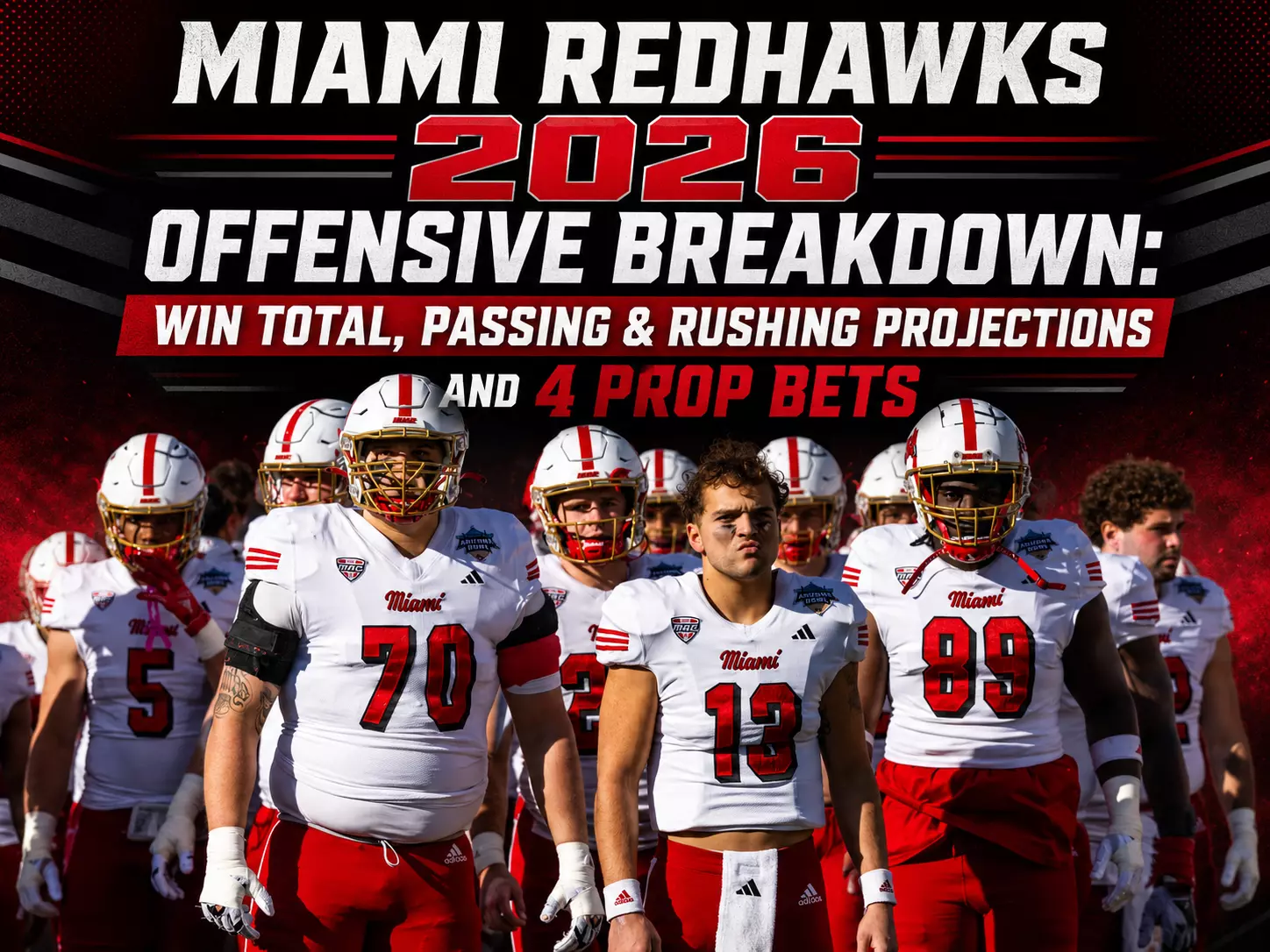
The Miami RedHawks enter the 2026 college football season attempting to make another run at the Mid-American Conference championship, but the offense will have to improve for Chuck Martin’s team to reach its ceiling.
Miami finished 7-7 overall and 6-2 in the MAC in 2025, advancing to the conference championship game before finishing the year with a bowl loss to Fresno State. The RedHawks averaged 23.5 points and 337.6 yards per game, finishing with
2,622 passing yards, 2,104 rushing yards, 17 passing touchdowns and 17 rushing touchdowns.
The encouraging news is that Miami enters 2026 with considerably more continuity along the offensive line. Four players from last year’s group —
Kris Manu, Eric Smith, Greg Smith Jr. and Jacob Schorsch
— are back, while Northern Illinois transfer Evan Malcore brings 32 career starts and additional experience up front.
The biggest question remains quarterback.
Miami entered August with
Thomas Gotkowski and David McComb competing for the starting job, with both receiving first-team opportunities during fall camp.
If Miami gets consistent quarterback play, the combination of an experienced offensive line, a deep running back rotation and a dramatically rebuilt receiver room gives the RedHawks a chance to take a meaningful step forward offensively.
Miami RedHawks 2026 Offensive Projections
Projected Record:
8-4
Projected Team Passing Yards:
2,450
Projected Team Rushing Yards:
2,150
Projected Total Offense:
4,600 yards
Projected Passing Touchdowns:
21
Projected Rushing Touchdowns:
20
Projected Offensive Touchdowns:
40-42
Projected Points Per Game:
27-29
Biggest Offensive Strength:
Experienced Offensive Line
Biggest Offensive Question:
Quarterback
Quarterback Breakdown: Thomas Gotkowski vs. David McComb
Miami’s quarterback competition could determine whether this offense becomes one of the better units in the MAC or remains a group that depends heavily on the defense.
Gotkowski brings the most meaningful game experience.
The redshirt sophomore appeared in five games and made three starts last season. He threw for
575 yards and four touchdowns with only one interception. Gotkowski also threw for 226 yards and three touchdowns in Miami’s regular-season victory over Ball State before starting the MAC Championship Game and Arizona Bowl.
That experience gives Gotkowski an advantage.
However, McComb may have the higher physical ceiling.
The 6-foot-4, 220-pound Kansas transfer did not play during his freshman season with the Jayhawks, but he was a productive high school quarterback. McComb threw for 3,009 yards and 29 touchdowns as a high school junior while adding 520 yards rushing.
Miami’s coaching staff has been giving both quarterbacks opportunities with the first-team offense during camp rather than immediately naming a starter.
That competition should continue to be one of the most important stories of the preseason.
Gotkowski provides familiarity with the offense and experience in meaningful games. McComb provides size, arm talent and intriguing long-term upside.
For Miami, the most important thing may not be which quarterback wins the competition. It will be whether the eventual starter can improve the passing game’s efficiency.
Miami completed only 49.5% of its passes last season and averaged 187.3 passing yards per game.
If the RedHawks can push that average beyond 200 yards while maintaining their rushing attack, the offense becomes considerably more dangerous.
Projected Miami Team Passing Production: 2,450 yards and 21 touchdowns.
Miami Running Game Breakdown
Miami’s running game should be one of the offense’s most dependable areas.
The RedHawks rushed for
2,104 yards and 17 touchdowns
last season despite rebuilding an offensive line that entered the year without a returning starter.
That situation is completely different in 2026.
Miami returns four offensive linemen who played significant roles last season and has added veteran transfer help, giving the RedHawks the potential to control the line of scrimmage against MAC competition.
The backfield also offers several different options.
Kenny Tracy
returns for a sixth season after his 2025 campaign was cut short by injury. Tracy started Miami’s first five games and rushed for 272 yards while adding 121 receiving yards and two receiving touchdowns. He produced 104 rushing yards against UNLV and 134 against Lindenwood before the injury ended his season.
Lazaro Rogers
could become one of the most interesting newcomers on the offense.
The Northern Illinois transfer rushed for 189 yards in seven games as a true freshman, including a career-best 98 yards and a touchdown on only nine carries against Miami. He also produced one of the RedHawks’ notable long runs during the opening week of 2026 fall camp.
Miami also has
Rodney Nelson
and additional depth available in what could become a committee-based approach.
The RedHawks don’t necessarily need one 1,000-yard running back. With several capable runners operating behind an experienced offensive line, Miami can distribute carries and keep its backs fresh.
Expect the running game to become particularly important while the quarterback situation is being settled.
Projected Team Rushing Yards: 2,150
Projected Rushing Touchdowns: 20
Miami Passing Game Breakdown
Miami may have more uncertainty at quarterback, but the receiving corps has intriguing upside.
Returners
Braylon Isom and Lynel Billups-Williams
are being counted on to provide leadership after playing significant roles in the offense last season. Isom caught two first-quarter touchdown passes in Miami’s regular-season finale against Ball State, a victory that sent the RedHawks to the MAC Championship Game.
The RedHawks then attacked the transfer portal aggressively.
Miami added
Maleek Huggins from Bethune-Cookman, Devin Hyatt from Arizona, Carl Jenkins from UCF, Leo Scheidler from Notre Dame, Quintin Simmons from Kentucky and Damarion Witten from Ohio State.
That is a major infusion of athleticism.
Jenkins has already provided a glimpse of his big-play ability during fall camp, producing a 70-yard touchdown reception during Miami’s August 11 practice.
Hyatt has also flashed downfield ability, including a roughly 40-yard contested reception from Gotkowski during the opening practice of camp.
The question is production.
Many of Miami’s new receivers arrive from larger programs where they were not necessarily featured players. Potential and recruiting pedigree are encouraging, but the RedHawks still need someone to emerge as a consistent No. 1 target.
The depth, however, is difficult to ignore.
Miami should be able to rotate receivers, create favorable matchups against MAC defensive backs and potentially generate more explosive passing plays than it did in 2025.
Projected Team Passing Yards: 2,450
Projected Passing Touchdowns: 21
Miami RedHawks 2026 Win Total
Miami’s 2026 regular-season win total is currently
7.5 victories, with multiple sportsbooks continuing to list the RedHawks around that number entering August.
It is an interesting number because Miami has a difficult beginning but a manageable path once MAC play begins.
The RedHawks open at Pittsburgh before hosting Holy Cross. They then travel to Cincinnati for the Victory Bell rivalry and host Connecticut to finish nonconference play.
Miami’s MAC schedule includes Bowling Green, UMass, Akron, Central Michigan, Buffalo, Ohio, Kent State and Western Michigan.
The RedHawks could realistically enter conference play at 2-2 or even 1-3 and still have an opportunity to reach eight victories.
Miami has proven capable of navigating the MAC schedule under Martin, and the experienced offensive line combined with what should again be a competitive defense gives the RedHawks a strong foundation.
My projection has Miami finishing
8-4, narrowly clearing the 7.5-win total.
Four Miami RedHawks 2026 Prop Bets
Note:
The 7.5-win total is a current betting market. The statistical season props below are projection-based betting benchmarks because full-season college team passing, rushing and touchdown markets are not consistently offered by every sportsbook.
Prop Bet #1: Miami Over 7.5 Regular-Season Wins
DraftKings
4.5/5
Tip: Miami Over 7.5 Regular-Season Wins
Manageable MAC Schedule
Experienced Offensive Line
Three Straight MAC Title Game Appearances
New DraftKings Customers: Bet $5, Get $200 + 3 Months of NBA League Pass!
Get bonus now
GAMBLING PROBLEM? CALL 1-800-GAMBLER or 1-800-MY-RESET, (800) 327-5050 or visit gamblinghelplinema.org (MA). Please Gamble Responsibly. 888-789-7777/visit ccpg.org (CT), or visit www.mdgamblinghelp.org (MD), 1-800-981-0023 (PR). 21+ and present in most states. (18+ DC/NH/PR/WY). Void in CAN. Eligibility restrictions apply. On behalf of Boot Hill Casino (KS). Pass-thru of per wager tax may apply in IL. 1 per new Sportsbook customer. $5+ first-time bet req. Max. $200 issued as non-withdrawable Bonus Bets. Stake removed from payout. Reward issued as $50 in Bonus Bets every 7 days via click-to-claim for 21 days. Bonus Bets and click-to-claims expire 7 days (168hrs) after issuance. Terms: dkng.co/offer. Get 1 promo code to redeem a 3-month NBA League Pass subscription, complimentary of DraftKings. Subscription auto-renews monthly at then-current price (currently $16.99/mo); cancel anytime. Terms, restrictions, and eligibility requirements apply. Redeem League Pass by 12/19/26 at 11:59 PM ET. Addt’l terms: support.watch.nba.com/hc/en-us/articles/9165532876183-League-Pass-Terms-of-Use_. Ends 11/29/26 at 11:59 PM ET. Sponsored by DK.
Why the Over Is a Good Bet
Miami doesn’t need to dominate its nonconference schedule to get to eight victories.
Holy Cross should provide an excellent opportunity for a win, while Connecticut is a game Miami can compete in at Yager Stadium. Even if the RedHawks lose road games against Pittsburgh and Cincinnati, a 2-2 nonconference record would leave them needing six MAC victories.
That is achievable.
Miami went 6-2 in conference play last season and has reached three consecutive MAC Championship Games.
The schedule also includes favorable opportunities against UMass, Akron and Kent State, along with home games against Bowling Green, Buffalo and Ohio.
The return of four offensive linemen should help stabilize the offense while the quarterback competition is resolved.
Why the Under Is a Good Bet
Seven-and-a-half victories leaves little room for mistakes.
Miami could easily begin 1-3 if it loses to Pittsburgh, Cincinnati and Connecticut. At that point, the RedHawks would essentially need to dominate the MAC schedule to reach eight victories.
Quarterback is another major concern.
Neither Gotkowski nor McComb enters the season as an established full-season FBS starter. If the passing game struggles, opponents could crowd the line of scrimmage and force Miami into low-scoring games.
Trips to Central Michigan and Western Michigan could also become difficult, while the rivalry game against Ohio is rarely simple.
Prediction: Miami finishes 8-4
Bet: Over 7.5 Wins
Confidence: 6.5/10
Prop Bet #2: Miami Over 2,299.5 Team Passing Yards
FanDuel
4.6/5
Tip: Miami Over 2,299.5 Team Passing Yards
Deep Transfer Receiver Group
Improved Offensive Line Continuity
Multiple Quarterback Options
New Users – Get $350 in Bonus Bets when you wager $5 for 7 days
Get bonus now
Gambling Problem? Call 1-800-GAMBLER or 1-800-MY-RESET. Call 1-888-789-7777 or visit ccpgg.org/chat (CT). Hope is here. GamblingHelpLineMA.org or call (800) 327-5050 for 24/7 support (MA). Visit www.mdgamblinghelp.org (MD). Call 1-877-8HOPE-NY or text HOPENY (NY). 21+ (18+ DC, WY) and present in select states (for KS, in affiliation with Kansas Star Casino). Find online real money wagering only. Min $5 wager required for 7 consecutive days. $5 free play credit. Bonus issued as non-withdrawable bonus with cash withdrawable bonus with cash withdrawable. Bonus bets which expire 7 days after receipt. Restrictions apply. See terms at sportsbook.fanduel.com. Call 1-877-770-7867 (LA).
Why the Over Is a Good Bet
Miami threw for 2,622 yards last season despite completing less than half of its passes and using three different quarterbacks.
The RedHawks now have considerably more experience along the offensive line and a deeper collection of receivers.
Isom and Billups-Williams return, while Hyatt, Jenkins, Huggins, Scheidler, Simmons and Witten give Miami significantly more options in the passing game.
Even if Miami uses more than one quarterback, the team does not need elite passing production to surpass this number.
Averaging approximately 192 passing yards over 12 games would be enough to reach 2,300 yards.
Why the Under Is a Good Bet
Quarterback uncertainty matters.
Gotkowski completed only 44.2% of his passes last season, while McComb has yet to attempt a college pass.
Miami could decide its best path to winning games is protecting the quarterback and leaning on the running game.
The RedHawks also have a coaching philosophy that doesn’t require huge passing numbers if the defense and rushing attack are controlling games.
If Miami averages closer to last season’s 187 passing yards per game, the number becomes extremely tight.
Projection: 2,450 Team Passing Yards
Bet: Over 2,299.5 Team Passing Yards
Confidence: 6.5/10
Prop Bet #3: Miami Over 2,049.5 Team Rushing Yards
Caesars
4.4/5
Tip: Miami Over 2,049.5 Team Rushing Yards
Four Returning Offensive Linemen
Deep Running Back Rotation
Veteran Transfer Reinforcements
Bet $1 and get double the winnings up to $25 for your next 10 bets
–
21+ New users only. Must register using eligible promo code. First bet after registration must qualify. Max. Bonus Bet: $1,000. Bonus Bet expires 14 days after receipt. Void where prohibited. See Caesars.com/promos for full terms. Gambling Problem? 1-800-GAMBLER (1-800-426-2537)
Why the Over Is a Good Bet
This is my favorite Miami offensive statistical prop.
The RedHawks rushed for 2,104 yards last season despite entering the year with an offensive line that returned zero starters.
Now four players from that line are back.
Miami has also added experienced offensive linemen such as Malcore and Brian Beidatsch, creating significantly greater competition and depth up front.
The running back room has plenty of options as well.
Tracy provides veteran experience, Rogers brings explosiveness and Miami has enough depth to rotate backs rather than relying on one player.
The uncertainty at quarterback could actually help this wager because Miami may emphasize the running game even more early in the season.
Why the Under Is a Good Bet
Miami’s 2,104 rushing yards last season came over a 14-game schedule because the RedHawks played in both the MAC Championship Game and a bowl.
Reaching more than 2,049 yards during a 12-game regular season therefore requires an increase in rushing production per game.
Tracy has also dealt with injuries, while several of the backs competing for carries remain relatively unproven.
Miami’s first month includes Pittsburgh, Cincinnati and Connecticut. Falling behind in those games could force the RedHawks to throw more frequently than they would prefer.
Projection: 2,150 Team Rushing Yards
Bet: Over 2,049.5 Team Rushing Yards
Confidence: 7.5/10
Prop Bet #4: Miami Over 37.5 Offensive Touchdowns
BetMGM
4.5/5
Tip: Miami Over 37.5 Offensive Touchdowns
Improved Skill-Position Depth
Experienced Offensive Line
Favorable MAC Matchups
Up To $1500 in Bonus Bets Paid Back if your First Bet Does Not Win
Get bonus now
Gambling problem? Call 1-800-GAMBLER or 1-800-MY-RESET (Available in the US) 877-8-HOPENY or text HOPENY (467369) (NY) 1-800-327-5050 (MA), 1-800-BETS-OFF (IA), 1-800-981-0023 (PR). 21+ only. Please Gamble Responsibly. See BetMGM.com for Terms. First Bet Offer for new customers only (if applicable). Subject to eligibility requirements. Bonus bets are non-withdrawable. In partnership with Kansas Crossing Casino and Hotel. Promotional offers not available in Mississippi, Massachusetts, New York, Ontario, or Puerto Rico.
Why the Over Is a Good Bet
Miami scored 17 passing touchdowns and 17 rushing touchdowns last season despite inconsistent quarterback play.
There are reasons to expect improvement in both categories.
The offensive line has considerably more experience, the receiving room is deeper and the RedHawks have multiple running backs capable of contributing near the goal line.
Miami also gets several MAC opponents that could allow the offense to produce larger scoring totals.
Games against UMass, Akron and Kent State provide opportunities for Miami to score four or five offensive touchdowns if the unit performs to expectations.
The addition of bigger and more athletic receivers could particularly help in the red zone.
Why the Under Is a Good Bet
Miami scored only 23.5 points per game last season.
A major offensive jump shouldn’t automatically be assumed simply because the RedHawks added players through the transfer portal.
The quarterback position remains unsettled, and several new receivers have limited proven college production.
Miami could also remain a team built around defense, field position and controlling possession rather than producing 35 points every week.
Pittsburgh and Cincinnati could make scoring difficult during the first three weeks, which would immediately put pressure on the Over.
Projection: 40-42 Offensive Touchdowns
Bet: Over 37.5 Offensive Touchdowns
Confidence: 6.5/10
Best Miami RedHawks 2026 Prop Bet
Miami’s rushing-yardage Over is the offensive wager I trust the most.
The biggest difference between the 2025 and 2026 offenses is the experience up front.
Last year’s offensive line entered the season without a returning starter. This season’s group brings back four players from the 2025 line and adds experienced transfers.
That should allow Miami to establish its rushing attack earlier and more consistently.
The depth at running back also means the RedHawks don’t need Tracy, Rogers or any other individual player to become a 1,000-yard rusher.
A committee approach can get Miami beyond 2,050 yards.
Conclusion
The Miami RedHawks enter the 2026 season with enough offensive talent to improve significantly from a unit that averaged only 23.5 points per game last year.
Everything begins with the quarterback competition.
Gotkowski has the advantage of meaningful game experience, including starts in the MAC Championship Game and bowl game, while McComb brings intriguing size and developmental upside.
Whoever wins the job will have more help than Miami’s quarterbacks had a year ago.
The offensive line returns four experienced players, and Malcore gives the RedHawks another veteran option with extensive starting experience.
Miami’s running back room has a strong mixture of experience and upside with Tracy, Rogers and the rest of the rotation.
The receiver room could be even more intriguing.
Isom and Billups-Williams provide continuity, while the RedHawks added transfers from Arizona, UCF, Notre Dame, Kentucky, Ohio State and other programs.
The question is whether all of those pieces can become a consistent offense.
My projection has Miami finishing with approximately
2,450 passing yards, 2,150 rushing yards and 40-42 offensive touchdowns
while averaging somewhere around
27-29 points per game.
That would represent a meaningful improvement over 2025.
From a team perspective, I project the RedHawks to finish
8-4, narrowly clearing their 7.5-win total and once again putting themselves in position to compete for a MAC Championship Game appearance.
The Over 7.5 wins is attractive, but the margin for error is limited because Miami has three challenging nonconference games against Pittsburgh, Cincinnati and Connecticut.
The strongest offensive wager is the rushing-yardage Over.
With four offensive linemen returning, additional veteran help up front and several capable running backs, Miami should be able to establish the rushing attack as the foundation of its offense.
If the RedHawks also find consistent quarterback play, this offense has the potential to become much more dangerous than the one Miami put on the field in 2025 — and that could be enough to produce eight victories and another serious run at the MAC championship.
New Users – Get $350 in Bonus Bets when you wager $5 for 7 days
T&Cs apply
4.6/5
Gambling Problem? Call 1-800-GAMBLER or 1-800-MY-RESET. Call 1-888-789-7777 or visit ccpgg.org/chat (CT). Hope is here. GamblingHelpLineMA.org or call (800) 327-5050 for 24/7 support (MA). Visit www.mdgamblinghelp.org (MD). Call 1-877-8HOPE-NY or text HOPENY (NY). 21+ (18+ DC, WY) and present in select states (for KS, in affiliation with Kansas Star Casino). Find online real money wagering only. Min $5 wager required for 7 consecutive days. $5 free play credit. Bonus issued as non-withdrawable bonus with cash withdrawable bonus with cash withdrawable. Bonus bets which expire 7 days after receipt. Restrictions apply. See terms at sportsbook.fanduel.com. Call 1-877-770-7867 (LA).
Up To $1500 in Bonus Bets Paid Back if your First Bet Does Not Win
T&Cs apply
4.5/5
Gambling problem? Call 1-800-GAMBLER or 1-800-MY-RESET (Available in the US) 877-8-HOPENY or text HOPENY (467369) (NY) 1-800-327-5050 (MA), 1-800-BETS-OFF (IA), 1-800-981-0023 (PR). 21+ only. Please Gamble Responsibly. See BetMGM.com for Terms. First Bet Offer for new customers only (if applicable). Subject to eligibility requirements. Bonus bets are non-withdrawable. In partnership with Kansas Crossing Casino and Hotel. Promotional offers not available in Mississippi, Massachusetts, New York, Ontario, or Puerto Rico.
New DraftKings Customers: Bet $5, Get $200 + 3 Months of NBA League Pass!
T&Cs apply
4.5/5
GAMBLING PROBLEM? CALL 1-800-GAMBLER or 1-800-MY-RESET, (800) 327-5050 or visit gamblinghelplinema.org (MA). Please Gamble Responsibly. 888-789-7777/visit ccpg.org (CT), or visit www.mdgamblinghelp.org (MD), 1-800-981-0023 (PR). 21+ and present in most states. (18+ DC/NH/PR/WY). Void in CAN. Eligibility restrictions apply. On behalf of Boot Hill Casino (KS). Pass-thru of per wager tax may apply in IL. 1 per new Sportsbook customer. $5+ first-time bet req. Max. $200 issued as non-withdrawable Bonus Bets. Stake removed from payout. Reward issued as $50 in Bonus Bets every 7 days via click-to-claim for 21 days. Bonus Bets and click-to-claims expire 7 days (168hrs) after issuance. Terms: dkng.co/offer. Get 1 promo code to redeem a 3-month NBA League Pass subscription, complimentary of DraftKings. Subscription auto-renews monthly at then-current price (currently $16.99/mo); cancel anytime. Terms, restrictions, and eligibility requirements apply. Redeem League Pass by 12/19/26 at 11:59 PM ET. Addt’l terms: support.watch.nba.com/hc/en-us/articles/9165532876183-League-Pass-Terms-of-Use_. Ends 11/29/26 at 11:59 PM ET. Sponsored by DK.
Must be 21+. GAMBLING PROBLEM? CALL 1-800-GAMBLER OR CALL 1-800-MY-RESET, www.mdgamblinghelp.org (MD), (800)-327-5050 or gamblinghelplinema.org (MA), Call (877)8-HOPENY or text HOPENY (467369) (NY), (888) 789-7777 or ccpg.org (CT), morethanagame.nc.gov (NC), 1800gambler.net (WV)
Bet $1 and get double the winnings up to $25 for your next 10 bets
T&Cs apply
4.4/5
21+ New users only. Must register using eligible promo code. First bet after registration must qualify. Max. Bonus Bet: $1,000. Bonus Bet expires 14 days after receipt. Void where prohibited. See Caesars.com/promos for full terms. Gambling Problem? 1-800-GAMBLER (1-800-426-2537)
21+ and present in OH. Gambling Problem? Call 1-800-GAMBLER.
This site is using
Cloudflare
and adheres to the
Google Safe Browsing Program. We adapted
Google's Privacy Guidelines
to keep your data safe at all times.
Close
Ready to Win Big? Join the Elite with Our Sports Betting Deals!
FanDuel Promo
New Users – Get $350 in Bonus Bets when you wager $5 for 7 days
Our Favorite
T&Cs and 21+ apply
Gambling Problem? Call 1-800-GAMBLER or 1-800-MY-RESET. Call 1-888-789-7777 or visit ccpgg.org/chat (CT). Hope is here. GamblingHelpLineMA.org or call (800) 327-5050 for 24/7 support (MA). Visit www.mdgamblinghelp.org (MD). Call 1-877-8HOPE-NY or text HOPENY (NY). 21+ (18+ DC, WY) and present in select states (for KS, in affiliation with Kansas Star Casino). Find online real money wagering only. Min $5 wager required for 7 consecutive days. $5 free play credit. Bonus issued as non-withdrawable bonus with cash withdrawable bonus with cash withdrawable. Bonus bets which expire 7 days after receipt. Restrictions apply. See terms at sportsbook.fanduel.com. Call 1-877-770-7867 (LA).
Code:
Open FanDuel
Get Bonus
BetMGM Promo
Up To $1500 in Bonus Bets Paid Back if your First Bet Does Not Win
Best Slots
T&Cs and 21+ apply
Gambling problem? Call 1-800-GAMBLER or 1-800-MY-RESET (Available in the US) 877-8-HOPENY or text HOPENY (467369) (NY) 1-800-327-5050 (MA), 1-800-BETS-OFF (IA), 1-800-981-0023 (PR). 21+ only. Please Gamble Responsibly. See BetMGM.com for Terms. First Bet Offer for new customers only (if applicable). Subject to eligibility requirements. Bonus bets are non-withdrawable. In partnership with Kansas Crossing Casino and Hotel. Promotional offers not available in Mississippi, Massachusetts, New York, Ontario, or Puerto Rico.
Code:
Open BetMGM
Get Bonus
DraftKings Promo
New DraftKings Customers: Bet $5, Get $200 + 3 Months of NBA League Pass!
Newcomer
T&Cs and 21+ apply
GAMBLING PROBLEM? CALL 1-800-GAMBLER or 1-800-MY-RESET, (800) 327-5050 or visit gamblinghelplinema.org (MA). Please Gamble Responsibly. 888-789-7777/visit ccpg.org (CT), or visit www.mdgamblinghelp.org (MD), 1-800-981-0023 (PR). 21+ and present in most states. (18+ DC/NH/PR/WY). Void in CAN. Eligibility restrictions apply. On behalf of Boot Hill Casino (KS). Pass-thru of per wager tax may apply in IL. 1 per new Sportsbook customer. $5+ first-time bet req. Max. $200 issued as non-withdrawable Bonus Bets. Stake removed from payout. Reward issued as $50 in Bonus Bets every 7 days via click-to-claim for 21 days. Bonus Bets and click-to-claims expire 7 days (168hrs) after issuance. Terms: dkng.co/offer. Get 1 promo code to redeem a 3-month NBA League Pass subscription, complimentary of DraftKings. Subscription auto-renews monthly at then-current price (currently $16.99/mo); cancel anytime. Terms, restrictions, and eligibility requirements apply. Redeem League Pass by 12/19/26 at 11:59 PM ET. Addt’l terms: support.watch.nba.com/hc/en-us/articles/9165532876183-League-Pass-Terms-of-Use_. Ends 11/29/26 at 11:59 PM ET. Sponsored by DK.
Code:
Open DraftKings
Get Bonus
Find out what the legends have to say about sports this week....
New Users – Get $350 in Bonus Bets when you wager $5 for 7 days
Gambling Problem? Call 1-800-GAMBLER or 1-800-MY-RESET. Call 1-888-789-7777 or visit ccpgg.org/chat (CT). Hope is here. GamblingHelpLineMA.org or call (800) 327-5050 for 24/7 support (MA). Visit www.mdgamblinghelp.org (MD). Call 1-877-8HOPE-NY or text HOPENY (NY). 21+ (18+ DC, WY) and present in select states (for KS, in affiliation with Kansas Star Casino). Find online real money wagering only. Min $5 wager required for 7 consecutive days. $5 free play credit. Bonus issued as non-withdrawable bonus with cash withdrawable bonus with cash withdrawable. Bonus bets which expire 7 days after receipt. Restrictions apply. See terms at sportsbook.fanduel.com. Call 1-877-770-7867 (LA).