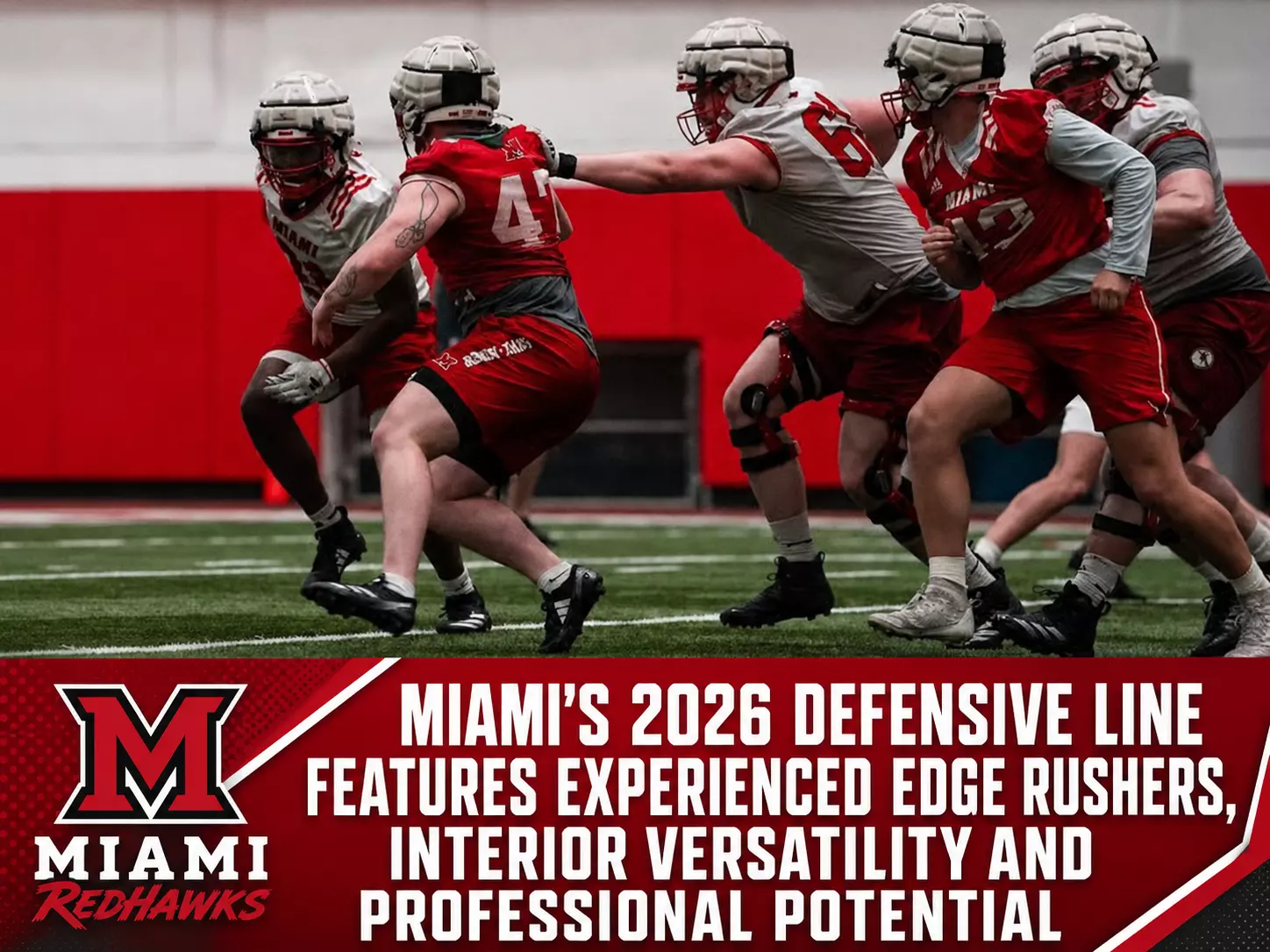
Miami’s 2026 Defensive Line Features Experienced Edge Rushers, Interior Versatility and Professional Potential
The Miami University RedHawks
enter the 2026 season with an intriguing defensive line built around experienced edge rushers, compact interior defenders and several young players who could develop into future stars.
Miami’s official roster
lists every front-line player simply as a defensive lineman. However, the RedHawks have traditionally used a multiple defensive structure that separates edge rushers, defensive tackles and nose tackles depending on the situation. For this preview, the players are grouped according to their size, experience and most likely role within the defense.
The edge group appears to be the strength of the unit. Bai Jobe and James Schott each recorded 3.5 sacks in 2025, Mikah Coleman arrives after producing 33 tackles and two sacks at Cincinnati, and veteran Kam Wilson returns after missing the entire 2025 season because of an injury.
The interior rotation carries more uncertainty. Roosevelt Andrews III started every game last season, while Brach Rice became a valuable rotational contributor. OJ Alexander and William Goodvine III are younger players expected to assume larger responsibilities.
Purdue and Akron transfer Marcus Moore gives Miami a true 310-pound nose tackle, while Donovan Davis provides another powerful interior option at 307 pounds. Miami also has additional developmental depth in Logan Howell, Carmine Orozco, Aariz Taylor and several younger defensive linemen.
Defensive Ends
Bai Jobe — No. 22
Position:
Defensive End
Height:
6’4”
Weight:
249 pounds
Class:
Redshirt Junior
Hometown:
Norman, Oklahoma
Previous Schools:
Kansas and Michigan State
Background
Bai Jobe enters the 2026 season as one of Miami’s most physically gifted defensive players.
Born in Senegal, Jobe moved to the United States as an exchange student in eighth grade. He developed into one of the country’s most highly recruited defensive prospects at Community Christian School in Oklahoma.
Jobe was a consensus four-star recruit, participated in the All-American Bowl and was ranked among the nation’s top overall players by several major recruiting services. He recorded 16.5 sacks during his junior high school season and was considered the top prospect in Oklahoma by multiple outlets.
He began his college career at Michigan State, appearing in one game and making two tackles in 2023. Jobe transferred to Kansas for the 2024 season, playing seven games and recording nine tackles.
Jobe transferred to Miami before the 2025 season and immediately became an important part of the rotation. He appeared in all 14 games, finishing with 16 tackles, four tackles for loss and 3.5 sacks. He recorded his first college sack against Rutgers and finished the season with a career-high five tackles against Fresno State in the Arizona Bowl.
Strengths
Jobe possesses an impressive combination of length, athleticism and developmental upside.
At 6’4” and nearly 250 pounds, he has the frame to play with his hand on the ground or rush from a stand-up alignment. His long arms can help him create separation from offensive tackles and affect passing lanes when he cannot reach the
quarterback.
Jobe’s basketball background is visible in his movement skills. He changes direction well for a defensive lineman and has enough range to pursue quarterbacks outside the pocket.
His 3.5 sacks during his first season at Miami were encouraging because he entered the year with limited college experience. Jobe began converting his highly regarded recruiting profile into meaningful production.
He also has room to add additional muscle. A stronger 255- to 260-pound version of Jobe could become a more complete defensive end without sacrificing the quickness that makes him dangerous.
Weaknesses
Jobe must become more consistent from one game to the next.
Despite playing all 14 games in 2025, he recorded only 16 total tackles. He flashed the ability to disrupt plays but did not consistently control his side of the formation.
His run defense remains a developmental area. At 249 pounds, Jobe can be moved when larger offensive tackles or tight ends establish contact before he gains leverage.
He must also improve his hand usage. Athletic ability allowed him to overwhelm many high school blockers, but professional-caliber offensive tackles require a more detailed pass-rush plan.
Developing a dependable inside counter will be important. When tackles overset to stop his outside rush, Jobe must be able to plant, redirect and attack the inside shoulder.
Professional Future
Jobe may possess the highest NFL ceiling among Miami’s defensive linemen.
His combination of recruiting pedigree, length, athleticism and emerging production should attract professional scouts. A 2026 season featuring six to eight sacks and improved run defense could move him into the late-round NFL Draft conversation.
Jobe still has eligibility remaining, so he does not need to rush his development. Another full season after 2026 could give him an opportunity to become one of the MAC’s best edge defenders.
Should he not immediately establish himself as an NFL prospect, Jobe’s athletic profile would make him an attractive UFL player. His length and closing speed could also translate effectively to indoor or arena football.
Current projection:
Developmental NFL prospect with late-round potential; strong future UFL option.
James Schott — No. 32
Position:
Defensive End
Height:
6’4”
Weight:
246 pounds
Class:
Redshirt Junior
Hometown:
Greenwood, Indiana
Previous School:
Michigan State
Background
James Schott enters the season as one of Miami’s most dependable returning pass rushers.
Schott starred at Center Grove High School in Indiana, where he helped the program win a second consecutive Class 6A state championship and complete a perfect 14-0 season. He recorded 51 tackles and 11 tackles for loss as a senior while earning first-team all-state recognition.
Recruiting services ranked Schott among Indiana’s leading prospects and one of the top edge defenders in his class.
He began his college career at Michigan State, appearing in 19 games between 2022 and 2024. Schott recorded five tackles during his time with the Spartans before transferring to Miami.
His role expanded dramatically with the RedHawks. Schott played in all 14 games in 2025 and finished with 18 tackles, 3.5 sacks and one forced fumble. He recorded four tackles and a sack against Ball State and forced a fumble during Miami’s victory over Northern Illinois.
Strengths
Schott has a well-proportioned frame for an edge defender.
At 6’4” and 246 pounds, he has enough length to challenge offensive tackles while maintaining the movement skills necessary to pursue plays away from his initial alignment.
He plays with good effort and does not abandon a rush when his first move is stopped. Some of Schott’s most effective pressures come through persistence rather than immediate victories off the snap.
His forced fumble in 2025 demonstrates an ability to attack the football when reaching the quarterback. Developing that turnover-producing instinct could make him particularly valuable.
Schott also has experience within a Big Ten program. Although he did not play a major role at Michigan State, he practiced against Power Four offensive linemen and spent several years developing physically.
Weaknesses
Schott must become more productive against the run.
His 18 tackles were an improvement over his time at Michigan State, but he needs to become more involved when opponents run directly toward his side.
He can also struggle when blockers get underneath his pads. At 246 pounds, he does not possess overwhelming mass and must win with leverage, hand placement and quickness.
Schott needs a more diverse pass-rush plan. His effort and length create opportunities, but professional evaluators will want to see him win cleanly with speed, power and counter moves.
He must also prove that his 3.5-sack season was the beginning of sustained production rather than a temporary improvement created by increased playing time.
Professional Future
Schott has a realistic opportunity to develop into an NFL free-agent prospect.
His height, length and pass-rush production provide an encouraging foundation. A season featuring five or more sacks, improved run defense and strong athletic testing could earn him a priority-free-agent contract or rookie minicamp invitation.
His current projection fits the UFL particularly well. Schott could become a dependable rotational edge defender capable of playing special teams and multiple defensive alignments.
His size and effort would also create opportunities in indoor football, where he could play outside or reduce inside in passing situations.
Current projection:
NFL priority-free-agent or rookie-camp candidate; strong UFL potential.
Mikah Coleman — No. 14
Position:
Defensive End
Height:
6’4”
Weight:
265 pounds
Class:
Redshirt Senior
Hometown:
Reynoldsburg, Ohio
Previous Schools:
Cincinnati and Eastern Michigan
Background
Mikah Coleman arrives at Miami as the most experienced defensive lineman in the projected rotation.
Coleman began his college career at Eastern Michigan, appearing in 28 games and recording 50 tackles, 9.5 tackles for loss and 6.5 sacks. His best season came in 2023 when he produced 38 tackles, 6.5 tackles for loss and 4.5 sacks.
He later transferred to Cincinnati and played in all 12 games during the 2025 season. Coleman finished with 33 tackles, four tackles for loss and two sacks. He recorded a season-high eight tackles against Arizona.
Coleman now returns to the Mid-American Conference with extensive FBS experience and a chance to become one of Miami’s defensive leaders.
Strengths
Coleman has the most complete physical profile among Miami’s defensive ends.
At 6’4” and 265 pounds, he is large enough to handle traditional defensive-end responsibilities. Unlike some of Miami’s lighter edge rushers, Coleman should be capable of setting the edge against tight ends and offensive tackles.
His career production demonstrates versatility. He recorded 4.5 sacks during his best season at Eastern Michigan but also made 33 tackles at Cincinnati, showing that he can contribute beyond obvious passing situations.
Coleman understands MAC offensive systems and has also competed against Big 12 opponents. That experience should allow him to recognize blocking schemes and backfield action quickly.
He can play several alignments. Miami could use Coleman as a traditional end, move him inside during passing downs or align him over a tight end when the RedHawks need additional size.
Weaknesses
Coleman has not developed into an elite pass rusher despite his size and experience.
His two sacks at Cincinnati were useful, but Miami will need more disruption if he is going to become the leader of the front.
He does not possess the same pure first-step explosiveness as some lighter edge defenders. Coleman generally wins through strength, effort and experience rather than overwhelming offensive tackles with speed.
His pad level can also become inconsistent. At 6’4” and 265 pounds, he must avoid presenting his chest to blockers and allowing them to control his upper body.
Coleman is entering his final college season, making 2026 his last major opportunity to improve his professional résumé.
Professional Future
Coleman has enough experience and size to earn consideration from NFL teams.
His best route would likely be as a priority free agent capable of competing for a rotational defensive-end and special-teams position. Professional teams may value his ability to play multiple alignments more than his sack totals.
A productive final season featuring 40 or more tackles and five to seven sacks would significantly strengthen his NFL argument.
Coleman would project as a high-level UFL defensive lineman. His size and experience should allow him to contribute immediately against both the run and pass.
His 265-pound frame could also make him a disruptive indoor defender, particularly if he moves inside against guards.
Current projection:
NFL priority-free-agent candidate; potential UFL starter with indoor versatility.
Kam Wilson enters the season as Miami’s biggest defensive-line wild card.
Wilson was a four-star linebacker at Mount Zion High School in Georgia. He recorded 123 tackles, 47 tackles for loss and 25.5 sacks during his high school career while earning first-team all-state recognition.
He began his college career at Louisville, appearing in 29 games between 2020 and 2023. Wilson recorded 21 tackles, 2.5 tackles for loss and two sacks for the Cardinals.
Wilson transferred to Cincinnati for the 2024 season. He played in 12 games, finishing with 10 tackles, 2.5 tackles for loss and two sacks.
He joined Miami before the 2025 season but missed the entire year because of an injury. Wilson returns in 2026 hoping to reestablish himself during his final college season.
Strengths
Wilson brings significant experience and positional flexibility.
His background as a linebacker gives him experience rushing from a stand-up alignment, moving through space and contributing on special teams. He can align as a defensive end or hybrid outside linebacker depending on the formation.
At 6’2” and 253 pounds, Wilson has a compact frame that can help him play with leverage. Taller offensive tackles may struggle to get underneath him when he maintains a strong base.
Wilson has also faced high-level competition throughout his career. His time at Louisville and Cincinnati exposed him to ACC and Big 12 offensive linemen.
His high school production demonstrates that he once possessed strong pass-rushing instincts. Miami must determine whether he can rediscover that explosiveness after his injury.
Weaknesses
Health is the primary concern.
Wilson did not play during the 2025 season, and he must prove that he has recovered his acceleration, flexibility and ability to change direction.
He has also produced only four sacks during five college seasons. His experience is valuable, but his statistical production has not matched his original recruiting profile.
Wilson lacks ideal height and length for an NFL defensive end. Longer offensive tackles can control him if he does not win quickly with leverage or hand placement.
He must also shake off considerable game rust. Missing an entire season can affect timing, conditioning and confidence.
Professional Future
Wilson’s professional future depends on his health and 2026 production.
A strong season could earn him an NFL rookie minicamp invitation because of his experience, versatility and special-teams background. However, he will need to demonstrate that his previous injury no longer limits him.
The UFL may be his most realistic professional destination. His ability to play defensive end, outside linebacker and special teams would be valuable on a smaller roster.
Wilson’s compact build and experience rushing from different positions could also translate to indoor or arena football.
Current projection:
NFL rookie-camp possibility; realistic UFL and indoor prospect.
Roosevelt Andrews III enters the 2026 season as Miami’s most experienced returning interior defender.
Andrews was a dominant high school pass rusher at Barberton. He recorded a school-record 21 sacks as a junior and added 17 sacks during his senior season. He earned district defensive player of the year and first-team all-state recognition.
Andrews was also an accomplished wrestler, setting a school record with 44 pins during his junior season.
After redshirting in 2023, he appeared in 11 games in 2024 and recorded six tackles with half a sack.
Andrews became a full-time starter in 2025. He started all 13 games in which he appeared and finished with 19 tackles, one sack, one fumble recovery and two quarterback hurries. He recorded three tackles against Akron and Fresno State while recovering a fumble against Western Michigan.
Strengths
Andrews plays with excellent natural leverage.
At 6’1”, he can get underneath taller offensive linemen and attack their center of gravity. His wrestling background should help him understand balance, hand placement and how to use an opponent’s momentum.
His high school sack production also demonstrates natural pass-rushing instincts. Although that production has not fully translated to college, he understands how to find the quarterback from an interior alignment.
Andrews has valuable starting experience. Playing every available game in 2025 should make him more comfortable recognizing blocking combinations and reacting to offensive adjustments.
His compact frame gives him the ability to slip through gaps. He is more effective when attacking a shoulder than when attempting to overpower blockers directly.
Weaknesses
Size is the biggest concern.
At 255 pounds, Andrews is extremely light for a traditional defensive tackle. Larger guards can move him when they establish square contact or catch him before he penetrates.
His production also needs to improve. One sack and 19 tackles across 13 starts are modest totals for a player who was on the field so frequently.
Andrews can struggle against double teams because he lacks the mass to anchor against two offensive linemen. Miami may need to protect him by using slants, movement and attacking fronts.
He must convert more quarterback hurries into sacks and create more negative plays against the run.
Professional Future
Andrews does not have a traditional NFL defensive-tackle frame, but his leverage and wrestling background could earn him opportunities.
He would need an exceptionally productive season and strong athletic testing to attract NFL interest. A possible professional transition back toward defensive end could also be explored.
The UFL appears to be his most realistic path. Andrews could contribute as an attacking interior lineman in a scheme that emphasizes movement rather than size.
His compact build, leverage and short-area quickness could make him particularly effective in indoor football.
Current projection:
Strong UFL or indoor prospect; outside chance at an NFL rookie-camp invitation.
Brach Rice is one of the most intriguing young defenders in Miami’s rotation.
Rice starred at Dixie Heights High School in Northern Kentucky, earning first-team all-state and all-tristate recognition. He set school records with 28 tackles in a single game and 184 tackles during one season.
After playing seven games and recording two tackles in 2024, Rice assumed a larger role during the 2025 season.
He appeared in 13 games with four starts, finishing with 16 tackles and two sacks. Both sacks came during an impressive performance against UNLV, when Rice also recorded three tackles.
Strengths
Rice plays with excellent effort.
His high school tackling records demonstrate a defender who consistently pursues the football. That mentality has carried into his college career, where he earned four starts despite being undersized for an interior lineman.
Rice has a low center of gravity and can create leverage against taller guards. When he fires off the ball with proper pad level, he can get underneath blockers and disrupt their balance.
His two-sack performance against UNLV demonstrated legitimate interior pass-rushing potential. Rice showed that he can finish plays when given a favorable matchup.
He still has multiple seasons of eligibility, giving Miami time to improve his strength, technique and understanding of the position.
Weaknesses
Like Andrews, Rice is undersized for a traditional defensive tackle.
At 260 pounds, he may struggle against powerful rushing teams that use double teams and vertical blocking schemes.
His pass-rush production was concentrated in one game. Rice did not record another sack outside his performance against UNLV, so he must become more consistent.
He also needs to improve his ability to disengage. Once larger blockers control his chest, Rice can have difficulty separating and reaching the ball carrier.
Adding functional strength without reducing his quickness will be essential.
Professional Future
Rice is still early in his development and should not be given a definitive professional label.
His effort, tackling instincts and interior quickness give him a chance to become one of Miami’s most productive defenders over the next two seasons.
To become an NFL prospect, he may need to add weight or demonstrate enough athleticism to play defensive end. A hybrid role could ultimately become his best professional fit.
Rice already has traits that could appeal to the UFL or indoor football. His low center of gravity and willingness to pursue the ball would work well in a condensed defensive front.
Current projection:
Developmental future NFL or UFL prospect; potentially strong indoor fit.
OJ Alexander gives Miami one of its most promising young interior defenders.
Alexander attended Providence Christian Academy in Georgia. During his senior season, he recorded 25 tackles for loss, seven sacks and four forced fumbles while earning region defensive lineman of the year recognition. He also produced 40 tackles and nine tackles for loss as a junior.
After redshirting during the 2024 season, Alexander appeared in 12 games in 2025. He finished with 13 tackles and recorded a career-high three stops against Fresno State in the Arizona Bowl.
Alexander also recorded two tackles against UNLV, Western Michigan and Ohio.
Strengths
Alexander possesses one of the best interior frames on Miami’s roster.
At 6’2” and 291 pounds, he has enough size to handle defensive-tackle responsibilities while maintaining room to add more functional strength.
His high school production suggests considerable disruptive potential. Recording 25 tackles for loss, seven sacks and four forced fumbles demonstrates that he was capable of affecting games in several ways.
Alexander has a balanced build and should be able to play either shaded over a guard or closer to the center.
His 12 appearances in 2025 provided valuable experience without forcing him to handle a full starting workload before he was ready.
Weaknesses
Alexander must translate his high school backfield production to the college level.
He recorded 13 tackles in 2025 but did not emerge as a consistent source of tackles for loss or sacks. Miami needs him to become more disruptive rather than simply occupying a rotational role.
His hand usage remains developmental. Alexander must learn to defeat blocks more quickly and avoid allowing guards to establish control.
He also needs to improve his conditioning if Miami increases his snap count. Young interior defenders often lose leverage when fatigue causes them to play upright.
Professional Future
Alexander has legitimate long-term professional potential.
His size, high school production and early college experience provide a strong foundation. If he develops into a multiyear starter and begins producing consistent tackles for loss, NFL scouts should become interested.
Alexander has enough remaining eligibility to develop patiently. A major statistical breakout does not necessarily need to occur immediately, but he must show clear progress in 2026.
His size would also make him an attractive future UFL player. With continued development, he could play either defensive tackle or nose tackle professionally.
Current projection:
Long-term developmental NFL prospect with strong UFL potential.
William Goodvine III enters the season as another young interior defender competing for an expanded role.
Goodvine was a team captain at Westfield High School and was named Indiana’s Mr. Football Defensive Lineman of the Year in 2023.
He recorded 32 tackles, 13 tackles for loss and four sacks during his senior season. Goodvine previously earned all-state recognition as a junior after producing 48 tackles, 7.5 tackles for loss and 2.5 sacks.
He redshirted during his first season at Miami before appearing in 11 games in 2025. Goodvine finished the season with five tackles and half a tackle for loss.
Strengths
Goodvine has a strong high school résumé and a compact interior frame.
At 6’1” and 279 pounds, he has the potential to play with natural leverage. He should be difficult for taller guards to control when he maintains proper pad level.
His high school production demonstrates that he can penetrate and finish plays behind the line of scrimmage.
Goodvine also gained experience in 11 games during his first active college season. That playing time should help him enter 2026 better prepared for a meaningful rotational role.
He appears capable of playing several interior alignments. Miami could use him as a three-technique, one-technique or occasional nose tackle in quicker packages.
Weaknesses
Goodvine remains largely unproven at the college level.
Five tackles and half a tackle for loss are limited production, even for a young rotational player. He must demonstrate that his high school success can translate against FBS offensive lines.
He is not as large as Miami’s true nose tackles and has not yet shown the pass-rushing production necessary to be considered a proven three-technique.
Goodvine must improve his ability to disengage from blocks and locate the football after initial contact.
He also needs to establish a defining trait. Whether it is quickness, power, run defense or interior pressure, Goodvine must show coaches one skill that demands playing time.
Professional Future
Goodvine’s professional outlook will depend on his development during the next two seasons.
His high school recognition and physical build provide reasons for optimism, but he needs significantly more college production before becoming an NFL prospect.
A larger role in 2026 could position him for a breakout as an upperclassman.
His compact frame and versatility could eventually appeal to the UFL. He may also fit indoor football because of his ability to play with leverage in confined spaces.
Current projection:
Developmental college player with future UFL or indoor potential.
Nose Tackles
Marcus Moore — No. 52
Position:
Nose Tackle
Height:
6’1”
Weight:
310 pounds
Class:
Redshirt Junior
Hometown:
Massillon, Ohio
Previous Schools:
Purdue and Akron
Background
Marcus Moore enters the 2026 season as Miami’s most experienced true nose tackle.
Moore began his college career at Akron. His best season came in 2024 when he appeared in 12 games with eight starts and recorded 31 tackles, one tackle for loss and one fumble recovery.
He recorded a career-high five tackles against Eastern Michigan and finished five games with at least four tackles.
Moore transferred to Purdue for the 2025 season. He appeared in three games and recorded two tackles, including both during his Purdue debut against Northwestern.
He transferred to Miami after the season and joins the RedHawks at 6’1” and 310 pounds.
Strengths
Moore has the size and body type necessary to play nose tackle.
At 310 pounds with a compact 6’1” frame, he possesses a naturally low center of gravity. He can create leverage against taller centers and make himself difficult to move in short-yardage situations.
His 31 tackles during the 2024 season demonstrate that he can do more than simply occupy blockers. Moore has shown an ability to disengage and participate in tackles.
He also brings starting experience. Eight starts at Akron should help him communicate with linebackers and recognize common blocking combinations.
Moore’s presence may allow Miami’s lighter defensive tackles to play more aggressively. If he commands double teams, Andrews, Rice and Alexander could receive more one-on-one opportunities.
Weaknesses
Moore has not demonstrated significant backfield production.
One tackle for loss during his best season suggests that he has primarily functioned as a run defender rather than an interior disruptor.
His shorter arms may create problems against longer offensive linemen. Moore must win the hand battle quickly and avoid allowing centers to lock onto his chest.
He also needs to prove that he can handle a large workload. Moore played only three games at Purdue in 2025 and must reestablish himself after a limited season.
Conditioning will be important. Miami needs Moore to maintain leverage and effort throughout extended drives.
Professional Future
Moore has a clearly defined professional role.
NFL teams occasionally seek powerful nose tackles who can control early downs and short-yardage situations. To earn that opportunity, Moore must become one of the MAC’s most reliable run defenders and create more plays behind the line.
His most realistic immediate professional destination may be the UFL. His size, starting experience and ability to occupy blockers would give him value as a rotational nose tackle.
Indoor football may be less natural because smaller rosters often reward versatility, but his power could still make him effective in goal-line and short-yardage situations.
Current projection:
Strong UFL nose-tackle candidate with NFL rookie-camp potential.
Donovan Davis represents the developmental future of Miami’s nose-tackle position.
Davis played at Bishop Hartley High School in Ohio, where he served as a team captain.
He earned first-team all-state honors and was named district defensive player of the year during his senior season. Davis had previously received second-team all-state recognition as a junior.
He redshirted during the 2024 season and remained a developmental squad member in 2025.
Davis enters 2026 at 6’1” and 307 pounds, giving Miami a second true interior space-eater behind Moore.
Strengths
Davis already possesses the physical mass required to play nose tackle.
His 6’1”, 307-pound frame gives him natural leverage and allows him to occupy significant space in the middle of the formation.
His high school honors indicate that he was more than simply the largest player on the field. Being named district defensive player of the year suggests consistent production and impact.
Davis has also had two seasons to develop within Miami’s strength and conditioning program. That familiarity should help him compete for playing time without needing to learn an entirely new system.
With Moore available to handle the starting role, Miami can gradually introduce Davis into the rotation.
Weaknesses
Davis has no meaningful college production entering the season.
He must prove that he can translate his high school success to FBS competition. Size alone will not defeat experienced MAC centers and guards.
Conditioning may determine whether he earns rotational snaps. Nose tackles must maintain a low pad level even when tired, and Davis has not yet demonstrated that ability during extended game action.
His pass-rushing skills are also unknown. To increase his long-term value, Davis must develop enough power and hand technique to collapse the pocket rather than serving exclusively as a run defender.
Professional Future
Davis remains too early in his development for a reliable professional projection.
His size gives him a foundation that cannot be taught. If he develops into Miami’s starting nose tackle and becomes a dependable run defender, he could eventually attract NFL or UFL interest.
The immediate goal is earning rotational snaps behind Moore and proving that he can handle college competition.
His long-term professional value will depend on conditioning, run defense and whether he can provide any interior pressure.
Current projection:
Developmental future UFL prospect with possible NFL upside if he becomes a multiyear starter.
Projected Rotation
Miami’s likely starting edge combination features Bai Jobe and Mikah Coleman.
Jobe provides the athletic upside and speed, while Coleman supplies size, experience and stronger early-down run defense. James Schott should rotate heavily with both players and could function as a passing-down specialist.
Kam Wilson’s role will depend on his recovery. If healthy, he could play defensive end, stand-up edge rusher and special teams.
On the interior, Roosevelt Andrews III is the most experienced returning starter. OJ Alexander has the size and developmental profile to become the other primary tackle.
Marcus Moore projects as the starting nose tackle because of his 310-pound frame and previous starting experience. Brach Rice should remain an important rotational interior rusher, while William Goodvine III and Donovan Davis compete for larger roles.
Miami’s strongest passing-down combination could include Jobe and Schott on the edges, with Coleman moving inside next to Andrews or Rice. That alignment would sacrifice some size but place four potential pass rushers on the field.
Against physical running teams, Miami could use Coleman at strong-side end with Alexander and Moore inside. That package would provide considerably more mass at the point of attack.
Overall Strengths
Miami’s greatest strength is its edge depth.
Jobe and Schott each recorded 3.5 sacks in 2025, while Coleman has accumulated 13 career sacks across his time at Eastern Michigan and Cincinnati. Wilson provides another veteran option if he returns to full health.
The RedHawks also have useful positional variety. Coleman can play outside or reduce inside, Andrews and Rice are compact attacking tackles, Alexander has a more traditional defensive-tackle frame, and Moore supplies true nose-tackle size.
The group has a strong blend of experience and youth. Coleman, Wilson and Moore have played at multiple FBS programs, while Jobe, Schott, Rice, Alexander, Goodvine and Davis still have room to develop.
Miami’s defensive line should also have enough depth to rotate players and preserve their energy. The official roster includes several additional developmental linemen beyond the 10 featured in this preview.
Overall Concerns
The RedHawks do not have a proven dominant pass rusher.
Jobe and Schott led the returning edge group with 3.5 sacks apiece. Those are encouraging totals, but Miami needs someone to emerge as a player who consistently affects opposing quarterbacks.
Interior size is another concern when Moore is not on the field. Andrews and Rice are both approximately 260 pounds or lighter, creating potential problems against large offensive lines and downhill rushing attacks.
The interior group also lacks established pass-rushing production. Alexander, Goodvine and Davis have not recorded a college sack, while Moore produced only one tackle for loss during his best season at Akron.
Wilson’s health creates another unanswered question. He has valuable experience, but missing the entire 2025 season makes it difficult to predict his role.
Miami must also replace several departed contributors and create chemistry among returning players and transfers. Moore and Coleman bring valuable experience, but both must adapt quickly to new responsibilities.
Professional Outlook
Bai Jobe possesses the highest long-term NFL ceiling. His length, athleticism and former four-star recruiting profile give him tools that professional teams value. He must now turn those tools into more consistent production.
Mikah Coleman has the best immediate opportunity to reach professional football because of his experience, size and versatility. His final college season will determine whether he receives an NFL opportunity or begins his career in the UFL.
James Schott has the frame and emerging pass-rush production to become an NFL priority free agent. Another season with at least four or five sacks would significantly improve his outlook.
Marcus Moore has a defined professional role as a nose tackle. His size could earn him NFL camp consideration, but the UFL currently appears to be his most likely professional destination.
Roosevelt Andrews III and Brach Rice have nontraditional interior builds but could appeal to the UFL or indoor football because of their leverage and effort.
Kam Wilson must prove that he is healthy, while OJ Alexander, William Goodvine III and Donovan Davis remain developmental prospects with multiple seasons to improve their evaluations.
Conclusion
Miami’s 2026 defensive line has enough experience, athleticism and depth to become one of the more dependable units on the roster.
The RedHawks’ greatest potential is on the edge.
Bai Jobe has the physical traits to become a breakout star, James Schott returns after producing 3.5 sacks, and Mikah Coleman brings extensive experience from Eastern Michigan and Cincinnati. A healthy Kam Wilson would give Miami another veteran pass rusher with experience at the Power Four level.
The interior presents more questions.
Roosevelt Andrews III is an experienced starter, but he must become more productive. Brach Rice flashed interior pass-rushing ability against UNLV, while OJ Alexander has the size and developmental upside to claim a larger role.
Marcus Moore may become the key to the entire group. Miami did not have another experienced 310-pound nose tackle among its leading returning contributors. If Moore can control the middle, he will make life easier for the defensive ends, tackles and linebackers around him.
This unit does not currently feature a guaranteed NFL Draft selection. However, Jobe has the physical ceiling to become one, Coleman and Schott have legitimate NFL free-agent possibilities, and Moore has a realistic professional role as a run-defending nose tackle.
Several other players could eventually continue their careers in the UFL or indoor football.
For Miami to reach another MAC Championship Game, the defensive line must accomplish three things: generate more sacks, remain sturdy against the run and receive breakout production from at least one young interior defender.
If Jobe emerges as a premier edge rusher, Coleman provides dependable veteran play and Moore stabilizes the middle, the RedHawks could field a balanced and disruptive defensive front capable of helping Miami compete for the 2026 MAC championship.
New Users – Get $350 in Bonus Bets when you wager $5 for 7 days
T&Cs apply
4.6/5
Gambling Problem? Call 1-800-GAMBLER or 1-800-MY-RESET. Call 1-888-789-7777 or visit ccpgg.org/chat (CT). Hope is here. GamblingHelpLineMA.org or call (800) 327-5050 for 24/7 support (MA). Visit www.mdgamblinghelp.org (MD). Call 1-877-8HOPE-NY or text HOPENY (NY). 21+ (18+ DC, WY) and present in select states (for KS, in affiliation with Kansas Star Casino). Find online real money wagering only. Min $5 wager required for 7 consecutive days. $5 free play credit. Bonus issued as non-withdrawable bonus with cash withdrawable bonus with cash withdrawable. Bonus bets which expire 7 days after receipt. Restrictions apply. See terms at sportsbook.fanduel.com. Call 1-877-770-7867 (LA).
Up To $1500 in Bonus Bets Paid Back if your First Bet Does Not Win
T&Cs apply
4.5/5
Gambling problem? Call 1-800-GAMBLER or 1-800-MY-RESET (Available in the US) 877-8-HOPENY or text HOPENY (467369) (NY) 1-800-327-5050 (MA), 1-800-BETS-OFF (IA), 1-800-981-0023 (PR). 21+ only. Please Gamble Responsibly. See BetMGM.com for Terms. First Bet Offer for new customers only (if applicable). Subject to eligibility requirements. Bonus bets are non-withdrawable. In partnership with Kansas Crossing Casino and Hotel. Promotional offers not available in Mississippi, Massachusetts, New York, Ontario, or Puerto Rico.
New DraftKings Customers: Bet $5, Get $200 + 3 Months of NBA League Pass!
T&Cs apply
4.5/5
GAMBLING PROBLEM? CALL 1-800-GAMBLER or 1-800-MY-RESET, (800) 327-5050 or visit gamblinghelplinema.org (MA). Please Gamble Responsibly. 888-789-7777/visit ccpg.org (CT), or visit www.mdgamblinghelp.org (MD), 1-800-981-0023 (PR). 21+ and present in most states. (18+ DC/NH/PR/WY). Void in CAN. Eligibility restrictions apply. On behalf of Boot Hill Casino (KS). Pass-thru of per wager tax may apply in IL. 1 per new Sportsbook customer. $5+ first-time bet req. Max. $200 issued as non-withdrawable Bonus Bets. Stake removed from payout. Reward issued as $50 in Bonus Bets every 7 days via click-to-claim for 21 days. Bonus Bets and click-to-claims expire 7 days (168hrs) after issuance. Terms: dkng.co/offer. Get 1 promo code to redeem a 3-month NBA League Pass subscription, complimentary of DraftKings. Subscription auto-renews monthly at then-current price (currently $16.99/mo); cancel anytime. Terms, restrictions, and eligibility requirements apply. Redeem League Pass by 12/19/26 at 11:59 PM ET. Addt’l terms: support.watch.nba.com/hc/en-us/articles/9165532876183-League-Pass-Terms-of-Use_. Ends 11/29/26 at 11:59 PM ET. Sponsored by DK.
Must be 21+. GAMBLING PROBLEM? CALL 1-800-GAMBLER OR CALL 1-800-MY-RESET, www.mdgamblinghelp.org (MD), (800)-327-5050 or gamblinghelplinema.org (MA), Call (877)8-HOPENY or text HOPENY (467369) (NY), (888) 789-7777 or ccpg.org (CT), morethanagame.nc.gov (NC), 1800gambler.net (WV)
Bet $1 and get double the winnings up to $25 for your next 10 bets
T&Cs apply
4.4/5
21+ New users only. Must register using eligible promo code. First bet after registration must qualify. Max. Bonus Bet: $1,000. Bonus Bet expires 14 days after receipt. Void where prohibited. See Caesars.com/promos for full terms. Gambling Problem? 1-800-GAMBLER (1-800-426-2537)
21+ and present in OH. Gambling Problem? Call 1-800-GAMBLER.
This site is using
Cloudflare
and adheres to the
Google Safe Browsing Program. We adapted
Google's Privacy Guidelines
to keep your data safe at all times.
Close
Ready to Win Big? Join the Elite with Our Sports Betting Deals!
FanDuel Promo
New Users – Get $350 in Bonus Bets when you wager $5 for 7 days
Our Favorite
T&Cs and 21+ apply
Gambling Problem? Call 1-800-GAMBLER or 1-800-MY-RESET. Call 1-888-789-7777 or visit ccpgg.org/chat (CT). Hope is here. GamblingHelpLineMA.org or call (800) 327-5050 for 24/7 support (MA). Visit www.mdgamblinghelp.org (MD). Call 1-877-8HOPE-NY or text HOPENY (NY). 21+ (18+ DC, WY) and present in select states (for KS, in affiliation with Kansas Star Casino). Find online real money wagering only. Min $5 wager required for 7 consecutive days. $5 free play credit. Bonus issued as non-withdrawable bonus with cash withdrawable bonus with cash withdrawable. Bonus bets which expire 7 days after receipt. Restrictions apply. See terms at sportsbook.fanduel.com. Call 1-877-770-7867 (LA).
Code:
Open FanDuel
Get Bonus
BetMGM Promo
Up To $1500 in Bonus Bets Paid Back if your First Bet Does Not Win
Best Slots
T&Cs and 21+ apply
Gambling problem? Call 1-800-GAMBLER or 1-800-MY-RESET (Available in the US) 877-8-HOPENY or text HOPENY (467369) (NY) 1-800-327-5050 (MA), 1-800-BETS-OFF (IA), 1-800-981-0023 (PR). 21+ only. Please Gamble Responsibly. See BetMGM.com for Terms. First Bet Offer for new customers only (if applicable). Subject to eligibility requirements. Bonus bets are non-withdrawable. In partnership with Kansas Crossing Casino and Hotel. Promotional offers not available in Mississippi, Massachusetts, New York, Ontario, or Puerto Rico.
Code:
Open BetMGM
Get Bonus
DraftKings Promo
New DraftKings Customers: Bet $5, Get $200 + 3 Months of NBA League Pass!
Newcomer
T&Cs and 21+ apply
GAMBLING PROBLEM? CALL 1-800-GAMBLER or 1-800-MY-RESET, (800) 327-5050 or visit gamblinghelplinema.org (MA). Please Gamble Responsibly. 888-789-7777/visit ccpg.org (CT), or visit www.mdgamblinghelp.org (MD), 1-800-981-0023 (PR). 21+ and present in most states. (18+ DC/NH/PR/WY). Void in CAN. Eligibility restrictions apply. On behalf of Boot Hill Casino (KS). Pass-thru of per wager tax may apply in IL. 1 per new Sportsbook customer. $5+ first-time bet req. Max. $200 issued as non-withdrawable Bonus Bets. Stake removed from payout. Reward issued as $50 in Bonus Bets every 7 days via click-to-claim for 21 days. Bonus Bets and click-to-claims expire 7 days (168hrs) after issuance. Terms: dkng.co/offer. Get 1 promo code to redeem a 3-month NBA League Pass subscription, complimentary of DraftKings. Subscription auto-renews monthly at then-current price (currently $16.99/mo); cancel anytime. Terms, restrictions, and eligibility requirements apply. Redeem League Pass by 12/19/26 at 11:59 PM ET. Addt’l terms: support.watch.nba.com/hc/en-us/articles/9165532876183-League-Pass-Terms-of-Use_. Ends 11/29/26 at 11:59 PM ET. Sponsored by DK.
Code:
Open DraftKings
Get Bonus
Find out what the legends have to say about sports this week....
New Users – Get $350 in Bonus Bets when you wager $5 for 7 days
Gambling Problem? Call 1-800-GAMBLER or 1-800-MY-RESET. Call 1-888-789-7777 or visit ccpgg.org/chat (CT). Hope is here. GamblingHelpLineMA.org or call (800) 327-5050 for 24/7 support (MA). Visit www.mdgamblinghelp.org (MD). Call 1-877-8HOPE-NY or text HOPENY (NY). 21+ (18+ DC, WY) and present in select states (for KS, in affiliation with Kansas Star Casino). Find online real money wagering only. Min $5 wager required for 7 consecutive days. $5 free play credit. Bonus issued as non-withdrawable bonus with cash withdrawable bonus with cash withdrawable. Bonus bets which expire 7 days after receipt. Restrictions apply. See terms at sportsbook.fanduel.com. Call 1-877-770-7867 (LA).