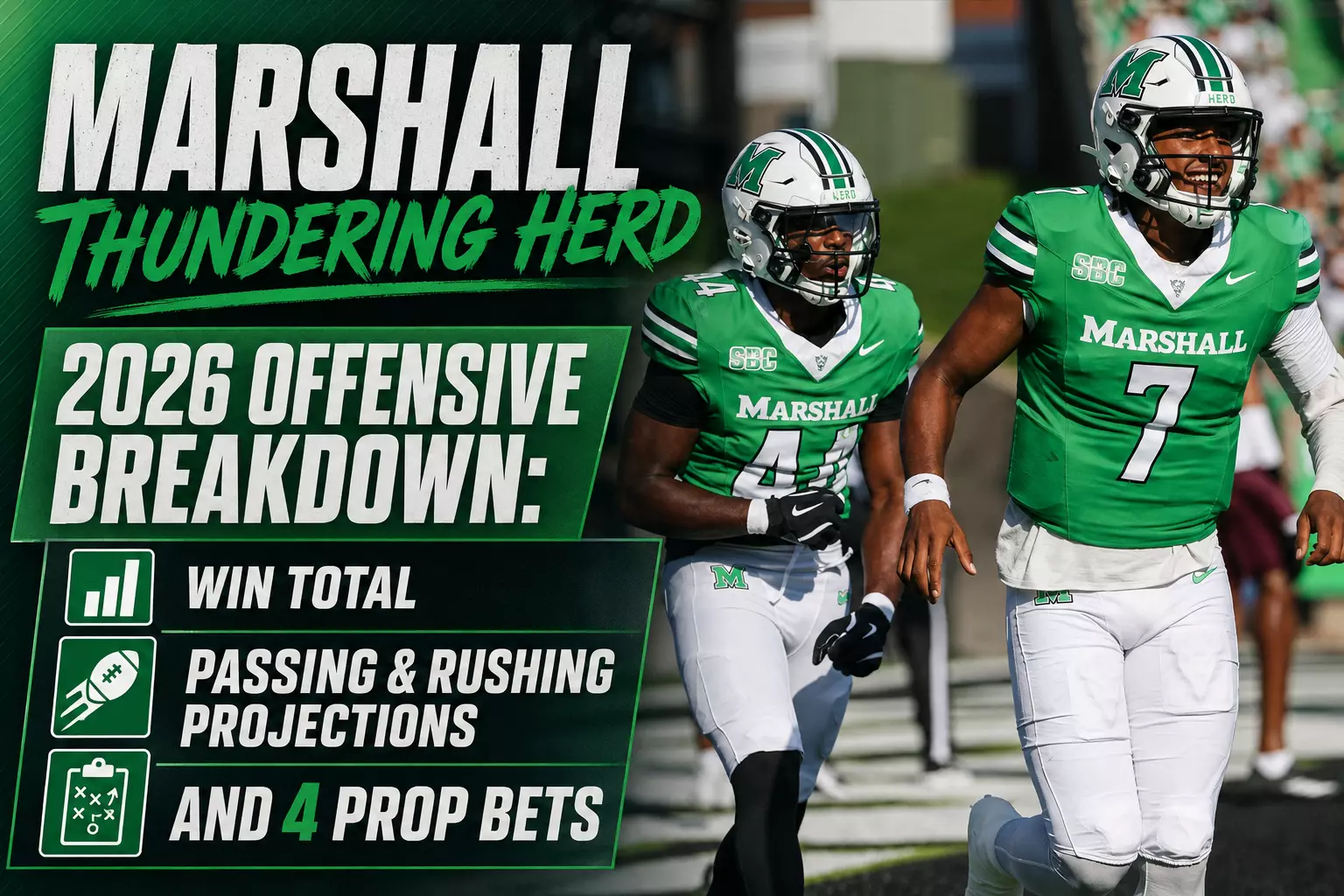
The Marshall Thundering Herd enter the 2026 college football season with an offense capable of making them a legitimate contender in the Sun Belt Conference.
Marshall finished
5-7 overall and 3-5 in Sun Belt play in 2025, but the record doesn’t tell the entire story. The Herd averaged
30.8 points and 405.5 yards per game, producing 4,866 yards of total offense. Marshall finished with
2,495 passing yards, 2,371 rushing yards, 18 passing touchdowns and 23 rushing touchdowns.
The biggest reason for optimism is continuity at quarterback.
Carlos Del Rio-Wilson
returns after emerging as one of the Sun Belt’s most dynamic dual-threat quarterbacks. He threw for 2,043 yards and 17 touchdowns while completing 66.8% of his passes in 2025 and broke Marshall’s 43-year-old single-season quarterback rushing record with 661 yards.
The Sun Belt recognized that production by naming Del Rio-Wilson the
2026 Preseason Offensive Player of the Year. Marshall also placed five offensive players on the preseason All-Sun Belt First Team: Del Rio-Wilson, wide receiver Adrian Norton, tight end Toby Payne and offensive linemen Jalen Slappy and Tariq Montgomery.
That gives offensive coordinator
Rod Smith
considerably more continuity than Marshall had entering Tony Gibson’s first season.
The Herd also return major pieces along the offensive line and receiving corps while adding several intriguing running backs.
Marshall’s offense was already productive in 2025.
The challenge in 2026 is turning that production into more victories.
Biggest Offensive Strength:
Dual-Threat Quarterback and Running Game
Biggest Offensive Question:
Can Marshall consistently finish drives and turn offensive production into wins?
Quarterback Breakdown: Carlos Del Rio-Wilson
Carlos Del Rio-Wilson gives Marshall something many Group of Five programs don’t have entering 2026: an established quarterback with legitimate conference Player of the Year potential.
Del Rio-Wilson completed
171 of 256 passes for 2,043 yards, 17 touchdowns and only five interceptions
in 2025. His 66.8% completion percentage and 151.8 quarterback rating demonstrated that he wasn’t simply an athlete playing quarterback.
He was efficient as a passer while also becoming one of the country’s most dangerous rushing quarterbacks.
Del Rio-Wilson ran for
661 yards, breaking a Marshall single-season record for rushing yards by a quarterback that had stood for 43 years. He enters 2026 as one of only two returning FBS quarterbacks who threw for at least 2,000 yards, rushed for at least 600 and completed at least 65% of their passes last season.
That combination makes Marshall difficult to defend.
Opposing defenses must account for Del Rio-Wilson on every rushing play.
If the defensive end crashes toward the running back, Del Rio-Wilson can keep the football.
If linebackers aggressively attack the line of scrimmage, Marshall can use play-action concepts to create opportunities downfield.
And when traditional passing plays break down, Del Rio-Wilson can turn a potential sack into a significant rushing gain.
His performance against Georgia State last November demonstrated his ceiling.
Del Rio-Wilson completed 22 of 27 passes for
321 yards and three touchdowns
while adding 97 rushing yards in Marshall’s 30-18 victory. That gave him 418 total yards in one of his best performances of the season.
The next step is consistency.
Marshall averaged more than 30 points per game last season but was held below 25 points in five games.
Del Rio-Wilson also did not start the entire season.
With an offseason as the established starter and a second year in Rod Smith’s offense, his passing volume and efficiency could both improve.
Carlos Del Rio-Wilson Projection: 2,500-2,700 passing yards, 22-24 passing touchdowns, 650-750 rushing yards and 7-9 rushing touchdowns.
Marshall Running Game Breakdown
Marshall’s rushing attack was one of the offense’s biggest strengths in 2025.
The Herd rushed for
2,371 yards and 23 touchdowns, averaging 197.6 yards per game and 4.7 yards per attempt. Marshall’s offensive line helped the Herd finish among the nation’s top rushing offenses.
The remarkable part is that the quarterback was a huge portion of that production.
Del Rio-Wilson’s ability to contribute more than 600 rushing yards changes the mathematics of the running game.
Marshall doesn’t need a 1,500-yard feature back if its quarterback is essentially producing running-back numbers himself.
The Herd have also assembled an intriguing group of backs.
Jo’Shon Barbie
brings substantial previous college production. Before arriving at Marshall, Barbie rushed for
1,252 yards and 11 touchdowns in 17 games at McNeese, including 831 yards and eight scores during the 2024 season.
At 5-foot-9 and 188 pounds, Barbie provides quickness and experience.
Marshall also added
TJ Lester
from West Georgia.
Lester rushed for
432 yards and six touchdowns as a true freshman in 2025, earning a three-star transfer rating before joining the Herd.
At 5-foot-9 and 205 pounds, Lester gives Marshall a more physical option who could immediately become part of the primary rotation.
The current roster also includes
Judah Price
and
Anthony Quinn Jr., giving running backs coach Rod McDowell several different options.
That depth is important.
Marshall doesn’t need one running back carrying the football 25 times every week.
The combination of Barbie, Lester and Del Rio-Wilson gives the Herd multiple ways to attack defenses on the ground.
The quarterback run game also makes conventional running backs more dangerous because defenders cannot automatically pursue the ball carrier.
If Marshall’s offensive line remains one of the best in the Sun Belt, another season around 200 rushing yards per game is realistic.
Projected Team Rushing Yards: 2,400
Projected Rushing Touchdowns: 24
Marshall Offensive Line Breakdown
Marshall’s offensive line should once again be one of the foundations of the offense.
The most important returner is
Jalen Slappy.
Slappy enters 2026 on the Outland Trophy preseason watch list after earning All-Sun Belt recognition. He started all 12 games last season and enters the year having started
25 consecutive games, with 29 career starts overall.
Slappy isn’t the only experienced piece.
Tariq Montgomery
also returns after starting all 11 games in which he appeared during 2025. Both Slappy and Montgomery earned preseason first-team All-Sun Belt recognition.
That matters because Marshall’s offensive line already proved it could create rushing production.
The Herd averaged roughly
197 rushing yards per game
last season, ranking among the nation’s top rushing attacks.
Marshall also attacked offensive-line depth aggressively during recruiting.
The Herd’s 2026 signing class included
nine offensive linemen, showing Gibson’s determination to maintain depth and competition up front.
There is still room for improvement.
Marshall surrendered
29 sacks for 193 yards
last season.
That number isn’t disastrous, but lowering it would help Del Rio-Wilson take another step forward as a passer.
The offensive line’s biggest strength is the impact it has on Marshall’s entire identity.
If Slappy and Montgomery anchor another productive group, the Herd can run the football, control possession and put Del Rio-Wilson into manageable third-down situations.
That should make Marshall difficult to defend throughout Sun Belt play.
Marshall Passing Game Breakdown
Marshall doesn’t have to completely rebuild its receiving corps.
That is another major advantage entering 2026.
Adrian Norton
returns as one of the Sun Belt’s more intriguing receivers.
Norton caught
27 passes for 363 yards and five touchdowns
last season and earned 2026 preseason first-team All-Sun Belt recognition.
Those numbers don’t immediately look enormous, but the touchdown production is significant.
Norton averaged more than 13 yards per reception and developed into one of Del Rio-Wilson’s trusted targets.
With another offseason together, there is a realistic path toward a 600-700-yard season.
Xayvion Turner-Bradshaw
provides another explosive element.
Turner-Bradshaw led Marshall’s returning players with a
14.1-yard-per-catch average
and also produced 510 kickoff return yards last season. He earned preseason second-team All-Sun Belt honors as a return specialist.
His spring performance provided additional encouragement.
Turner-Bradshaw caught four passes for
77 yards
in Marshall’s April spring game.
Marshall also has
Chris Culliver, De’Andre Tamarez, Christian Hamilton, Sherone White Jr., Josiah McLaurin and several other receivers competing for roles.
One of the offense’s most important receiving threats may actually play tight end.
Toby Payne
returns after catching
37 passes for 393 yards and two touchdowns
in 2025. He earned first-team All-Sun Belt honors last season and was again selected to the conference’s preseason first team entering 2026.
Payne gives Del Rio-Wilson an experienced target in the middle of the field.
That can become particularly valuable on third down and in the red zone.
Marshall doesn’t necessarily have one 1,000-yard receiver.
It may not need one.
Norton can provide touchdown production.
Turner-Bradshaw can create explosive plays.
Payne can work the middle.
The rest of the receiving rotation provides depth.
With Del Rio-Wilson entering Year 2 as the starter, Marshall’s passing game should become more productive even if the Herd remain a run-first offense.
Projected Team Passing Yards: 2,650
Projected Passing Touchdowns: 23
Marshall Thundering Herd 2026 Win Total
Marshall’s current regular-season win total is
7.5 victories.
BetMGM listed the Herd at
Over 7.5 (-105) and Under 7.5 (-115)
as of July 31, while VegasInsider’s current Sun Belt win-total board also lists Marshall at 7.5.
That is a significant increase from the expectations surrounding a team that finished 5-7 last season.
There are reasons for the optimism.
Marshall returns the Sun Belt’s preseason Offensive Player of the Year and five preseason first-team all-conference offensive selections.
The schedule also gives the Herd opportunities.
Marshall opens on the road against
Penn State, easily the most difficult nonconference game on the schedule.
The Herd then host Middle Tennessee, travel to Missouri State and host Gardner-Webb before beginning the heart of Sun Belt competition.
Conference play includes road games at James Madison, Old Dominion, Georgia Southern and ULM, along with home games against Coastal Carolina, South Alabama, App State and Georgia State.
The road game at James Madison is probably Marshall’s toughest conference matchup.
Old Dominion could also be difficult.
However, there are plenty of opportunities for victories.
Middle Tennessee, Missouri State and Gardner-Webb give Marshall three favorable nonconference chances.
Coastal Carolina, South Alabama, App State, Georgia State and ULM are all games where an experienced Marshall offense should be competitive.
Getting to eight victories is realistic.
The question is whether Marshall can turn close games into wins.
The Herd lost
21-20 to Missouri State, 26-24 to App State and 24-19 to Georgia Southern
last season.
Flip two of those types of games in 2026 and the record changes dramatically.
My prediction: Marshall finishes 8-4 and narrowly clears the 7.5-win total.
Four Marshall Thundering Herd 2026 Prop Bets
Note:
Marshall’s 7.5-win total is a current sportsbook market. The statistical season props below are
projection-based betting benchmarks
because full-season Group of Five passing, rushing and touchdown markets are not consistently available at every sportsbook.
Prop Bet #1: Marshall Over 7.5 Regular-Season Wins
DraftKings
4.5/5
Tip: Marshall Over 7.5 Regular-Season Wins
Sun Belt Player of the Year at QB
Experienced Offensive Core
Multiple Winnable Home Games
New DraftKings Customers: Bet $5, Get $200 + 3 Months of NBA League Pass!
Get bonus now
GAMBLING PROBLEM? CALL 1-800-GAMBLER or 1-800-MY-RESET, (800) 327-5050 or visit gamblinghelplinema.org (MA). Please Gamble Responsibly. 888-789-7777/visit ccpg.org (CT), or visit www.mdgamblinghelp.org (MD), 1-800-981-0023 (PR). 21+ and present in most states. (18+ DC/NH/PR/WY). Void in CAN. Eligibility restrictions apply. On behalf of Boot Hill Casino (KS). Pass-thru of per wager tax may apply in IL. 1 per new Sportsbook customer. $5+ first-time bet req. Max. $200 issued as non-withdrawable Bonus Bets. Stake removed from payout. Reward issued as $50 in Bonus Bets every 7 days via click-to-claim for 21 days. Bonus Bets and click-to-claims expire 7 days (168hrs) after issuance. Terms: dkng.co/offer. Get 1 promo code to redeem a 3-month NBA League Pass subscription, complimentary of DraftKings. Subscription auto-renews monthly at then-current price (currently $16.99/mo); cancel anytime. Terms, restrictions, and eligibility requirements apply. Redeem League Pass by 12/19/26 at 11:59 PM ET. Addt’l terms: support.watch.nba.com/hc/en-us/articles/9165532876183-League-Pass-Terms-of-Use_. Ends 11/29/26 at 11:59 PM ET. Sponsored by DK.
Why the Over Is a Good Bet
Marshall was better offensively than its 5-7 record suggests last season.
The Herd averaged 30.8 points and more than 400 yards per game.
Now many of the offense’s most important pieces return.
Del Rio-Wilson is back at quarterback.
Norton and Payne return as established receiving options.
Slappy and Montgomery provide continuity along the offensive line. All five earned preseason first-team All-Sun Belt recognition.
Marshall also has several favorable opportunities on the schedule.
Middle Tennessee and Gardner-Webb visit Huntington, while Missouri State represents a winnable road game.
The Sun Belt schedule gives Marshall home games against Coastal Carolina, South Alabama, App State and Georgia State.
The Herd don’t need to beat Penn State or run the table in conference play.
A 3-1 nonconference record followed by a 5-3 Sun Belt season gets Marshall to eight.
That is realistic.
Why the Under Is a Good Bet
The 7.5 number requires a three-win improvement from last season.
That isn’t insignificant.
Marshall went only 3-5 in Sun Belt play last year and lost several games against teams that appear again on the 2026 schedule.
The Herd also have difficult road games against James Madison and Old Dominion.
Georgia Southern beat Marshall last season and gets the Herd at home this year.
Penn State is likely to leave Marshall with very little margin for error in nonconference play.
Defense could also impact this wager even though the offense is the focus here.
Marshall allowed 30.3 points and 410.6 yards per game last season.
The offense can play well and still lose games if the defense doesn’t improve.
Projection: Marshall finishes 8-4
Bet: Over 7.5 Wins
Confidence: 6.5/10
Prop Bet #2: Carlos Del Rio-Wilson Over 2,299.5 Passing Yards
FanDuel
4.6/5
Tip: Carlos Del Rio-Wilson Over 2,299.5 Passing Yards
Established Starting Quarterback
Returning Receiving Weapons
Second Year in Offensive System
New Users – Get $350 in Bonus Bets when you wager $5 for 7 days
Get bonus now
Gambling Problem? Call 1-800-GAMBLER or 1-800-MY-RESET. Call 1-888-789-7777 or visit ccpgg.org/chat (CT). Hope is here. GamblingHelpLineMA.org or call (800) 327-5050 for 24/7 support (MA). Visit www.mdgamblinghelp.org (MD). Call 1-877-8HOPE-NY or text HOPENY (NY). 21+ (18+ DC, WY) and present in select states (for KS, in affiliation with Kansas Star Casino). Find online real money wagering only. Min $5 wager required for 7 consecutive days. $5 free play credit. Bonus issued as non-withdrawable bonus with cash withdrawable bonus with cash withdrawable. Bonus bets which expire 7 days after receipt. Restrictions apply. See terms at sportsbook.fanduel.com. Call 1-877-770-7867 (LA).
Why the Over Is a Good Bet
Del Rio-Wilson threw for
2,043 yards despite appearing in 11 games and starting only 10
last season.
A full season as the unquestioned starter should increase his opportunities.
He only needs approximately
192 passing yards per game
over 12 contests to surpass 2,299.5.
Del Rio-Wilson averaged 185.7 passing yards per appearance last season.
That means only modest improvement is required.
He also returns three important targets in Norton, Turner-Bradshaw and Payne.
Norton caught five touchdowns last season.
Payne caught 37 passes.
Turner-Bradshaw provides big-play ability.
Del Rio-Wilson should also benefit from entering his second year in Smith’s offensive system rather than learning everything from the beginning.
Why the Under Is a Good Bet
Marshall doesn’t need Del Rio-Wilson to throw for 300 yards every week.
The Herd rushed for nearly 200 yards per game last season.
If the ground game remains that productive, Marshall could continue attempting fewer than 30 passes most weeks.
Del Rio-Wilson’s own rushing ability also works against his passing-yardage total.
When protection breaks down, he often creates yards with his legs instead of forcing a throw.
Games against Penn State, James Madison and Old Dominion could also suppress passing production.
And because Del Rio-Wilson is such an important runner, his physical style creates additional injury risk compared with a traditional pocket quarterback.
Projection: 2,500-2,700 Passing Yards
Bet: Over 2,299.5 Passing Yards
Confidence: 7/10
Prop Bet #3: Marshall Over 2,199.5 Team Rushing Yards
Caesars
4.4/5
Tip: Marshall Over 2,199.5 Team Rushing Yards
Carlos Del Rio-Wilson’s Mobility
Proven Offensive Line
Deep Running Back Rotation
Bet $1 and get double the winnings up to $25 for your next 10 bets
–
21+ New users only. Must register using eligible promo code. First bet after registration must qualify. Max. Bonus Bet: $1,000. Bonus Bet expires 14 days after receipt. Void where prohibited. See Caesars.com/promos for full terms. Gambling Problem? 1-800-GAMBLER (1-800-426-2537)
Why the Over Is a Good Bet
This is my favorite Marshall offensive prop.
The Herd rushed for
2,371 yards last season, exceeding this benchmark by more than 170 yards.
Much of what made that rushing attack successful returns.
Del Rio-Wilson is back after setting Marshall’s quarterback rushing record with 661 yards.
Slappy and Montgomery return along the offensive line.
Slappy has 29 career starts, while Montgomery started 11 games last season.
Marshall also has experienced running back options.
Barbie rushed for more than 1,200 yards during his McNeese career before joining Marshall, while Lester arrives after producing 432 yards and six touchdowns as a true freshman at West Georgia.
The quarterback run element gives Marshall an advantage that traditional rushing offenses don’t have.
Even if the running backs combine for only 1,600-1,700 yards, Del Rio-Wilson could push the team comfortably beyond 2,200.
Why the Under Is a Good Bet
Del Rio-Wilson is also the biggest risk.
A large portion of Marshall’s rushing projection depends on its quarterback remaining healthy.
If he misses several games, the Herd lose one of their most productive runners.
The running back rotation also lacks a proven 1,000-yard FBS feature back entering the season.
Marshall may be depending on multiple players rather than one established star.
The schedule includes difficult defensive matchups against Penn State, James Madison and Old Dominion.
There is also a chance Marshall throws more frequently in Del Rio-Wilson’s second year as the starter, especially if Norton and the receiving corps develop.
Projection: 2,400 Team Rushing Yards
Bet: Over 2,199.5 Team Rushing Yards
Confidence: 8/10
Prop Bet #4: Marshall Over 44.5 Offensive Touchdowns
BetMGM
4.5/5
Tip: Marshall Over 44.5 Offensive Touchdowns
Elite Dual-Threat Quarterback
Productive Returning Playmakers
Top Sun Belt Rushing Attack
Up To $1500 in Bonus Bets Paid Back if your First Bet Does Not Win
Get bonus now
Gambling problem? Call 1-800-GAMBLER or 1-800-MY-RESET (Available in the US) 877-8-HOPENY or text HOPENY (467369) (NY) 1-800-327-5050 (MA), 1-800-BETS-OFF (IA), 1-800-981-0023 (PR). 21+ only. Please Gamble Responsibly. See BetMGM.com for Terms. First Bet Offer for new customers only (if applicable). Subject to eligibility requirements. Bonus bets are non-withdrawable. In partnership with Kansas Crossing Casino and Hotel. Promotional offers not available in Mississippi, Massachusetts, New York, Ontario, or Puerto Rico.
Why the Over Is a Good Bet
Marshall produced
44 total offensive touchdowns
last season, including 18 through the air and 23 rushing touchdowns, with the official team total also including additional offensive scoring.
The offense now returns its most important player.
Del Rio-Wilson accounted for 17 passing touchdowns and added major production on the ground.
Norton returns after catching five touchdown passes.
Payne remains an experienced red-zone target.
The running game should again produce scoring opportunities behind Slappy and Montgomery.
The schedule also gives Marshall several opportunities for big offensive performances.
Middle Tennessee, Gardner-Webb, Coastal Carolina, Georgia State and ULM could provide games where the Herd scores four or five offensive touchdowns.
Marshall already scored
42 points against Middle Tennessee, 48 against Old Dominion, 40 against Texas State and 51 against Louisiana
during stretches of last season.
The offense has demonstrated that kind of ceiling.
Why the Under Is a Good Bet
Marshall’s biggest offensive weakness last season was finishing drives.
The Herd made
49 red-zone trips but scored touchdowns on only 27 of them.
That is only about a 55% touchdown rate.
Marshall often moved the football well enough to score but settled for field goals.
The Herd attempted 26 field goals and made 21.
If that red-zone trend continues, Marshall could again accumulate strong yardage without producing enough touchdowns to clear this benchmark.
Penn State could also hold the Herd to a low total in Week 1, immediately putting pressure on the season-long number.
A couple of additional defensive battles in conference play would make 45 offensive touchdowns difficult.
Projection: 47-49 Offensive Touchdowns
Bet: Over 44.5 Offensive Touchdowns
Confidence: 6.5/10
Best Marshall Thundering Herd 2026 Prop Bet
Marshall’s rushing-yardage Over is the offensive wager I trust the most.
The Herd don’t need to reinvent their offensive identity for this bet to cash.
Marshall already rushed for
2,371 yards and averaged 197.6 yards per game
last season.
The most important piece of that rushing attack returns.
Del Rio-Wilson rushed for 661 yards and established a new Marshall single-season quarterback rushing record.
The offensive line retains two major pieces in Slappy and Montgomery, both preseason first-team All-Sun Belt selections.
And the running back room offers multiple options with Barbie, Lester, Price and others.
Marshall only needs to average approximately
184 rushing yards per game
to surpass 2,199.5.
The Herd averaged nearly 198 last season.
That makes this number extremely attractive if Del Rio-Wilson remains healthy.
Conclusion
The Marshall Thundering Herd enter the 2026 season with an unusual combination for a Group of Five offense: proven quarterback play, experience along the offensive line and multiple returning receiving weapons.
Everything begins with Carlos Del Rio-Wilson.
He threw for
2,043 yards and 17 touchdowns, completed 66.8% of his passes and rushed for a Marshall quarterback-record 661 yards last season.
That combination earned him recognition as the
2026 Sun Belt Preseason Offensive Player of the Year.
Del Rio-Wilson isn’t carrying the offense alone.
Adrian Norton returns after producing five receiving touchdowns.
Toby Payne is back after a 37-catch, 393-yard season.
Xayvion Turner-Bradshaw gives Marshall another explosive weapon.
And Slappy and Montgomery return to lead an offensive line that helped the Herd produce one of the nation’s better rushing attacks last season.
Marshall has also added more running back depth with TJ Lester joining Jo’Shon Barbie and the rest of the backfield.
My projection has the Herd producing approximately
2,650 passing yards, 2,400 rushing yards and 47-49 offensive touchdowns while averaging 31-33 points per game.
Those numbers would make Marshall one of the Sun Belt’s more productive offenses.
The difficult part is converting production into victories.
Marshall averaged more than 30 points and 400 yards last season and still finished only 5-7.
The Herd lost three games by five points or fewer, including one-point, two-point and five-point defeats.
A little more consistency could completely change the 2026 season.
The schedule begins with a difficult trip to Penn State, and Marshall also has challenging Sun Belt road games at James Madison, Old Dominion and Georgia Southern. But the Herd have enough favorable opportunities elsewhere to build a winning record.
My prediction is
8-4, narrowly clearing the current
7.5-win total.
A 9-3 season isn’t unrealistic if the defense improves and Marshall starts winning the close games it lost last season.
From an offensive betting perspective, the strongest play is
Marshall Over 2,199.5 team rushing yards.
The Herd already surpassed that number in 2025.
Del Rio-Wilson remains one of college football’s most productive rushing quarterbacks.
Slappy and Montgomery provide proven blocking up front.
And Marshall has enough depth at running back to distribute the workload.
The offense doesn’t need a dramatic transformation.
It needs refinement.
If Del Rio-Wilson improves as a passer, Marshall maintains its rushing identity and the Herd become more efficient in the red zone, this offense has enough talent to carry Marshall from a five-win team into a legitimate
Sun Belt championship contender in 2026.
New Users – Get $350 in Bonus Bets when you wager $5 for 7 days
T&Cs apply
4.6/5
Gambling Problem? Call 1-800-GAMBLER or 1-800-MY-RESET. Call 1-888-789-7777 or visit ccpgg.org/chat (CT). Hope is here. GamblingHelpLineMA.org or call (800) 327-5050 for 24/7 support (MA). Visit www.mdgamblinghelp.org (MD). Call 1-877-8HOPE-NY or text HOPENY (NY). 21+ (18+ DC, WY) and present in select states (for KS, in affiliation with Kansas Star Casino). Find online real money wagering only. Min $5 wager required for 7 consecutive days. $5 free play credit. Bonus issued as non-withdrawable bonus with cash withdrawable bonus with cash withdrawable. Bonus bets which expire 7 days after receipt. Restrictions apply. See terms at sportsbook.fanduel.com. Call 1-877-770-7867 (LA).
Up To $1500 in Bonus Bets Paid Back if your First Bet Does Not Win
T&Cs apply
4.5/5
Gambling problem? Call 1-800-GAMBLER or 1-800-MY-RESET (Available in the US) 877-8-HOPENY or text HOPENY (467369) (NY) 1-800-327-5050 (MA), 1-800-BETS-OFF (IA), 1-800-981-0023 (PR). 21+ only. Please Gamble Responsibly. See BetMGM.com for Terms. First Bet Offer for new customers only (if applicable). Subject to eligibility requirements. Bonus bets are non-withdrawable. In partnership with Kansas Crossing Casino and Hotel. Promotional offers not available in Mississippi, Massachusetts, New York, Ontario, or Puerto Rico.
New DraftKings Customers: Bet $5, Get $200 + 3 Months of NBA League Pass!
T&Cs apply
4.5/5
GAMBLING PROBLEM? CALL 1-800-GAMBLER or 1-800-MY-RESET, (800) 327-5050 or visit gamblinghelplinema.org (MA). Please Gamble Responsibly. 888-789-7777/visit ccpg.org (CT), or visit www.mdgamblinghelp.org (MD), 1-800-981-0023 (PR). 21+ and present in most states. (18+ DC/NH/PR/WY). Void in CAN. Eligibility restrictions apply. On behalf of Boot Hill Casino (KS). Pass-thru of per wager tax may apply in IL. 1 per new Sportsbook customer. $5+ first-time bet req. Max. $200 issued as non-withdrawable Bonus Bets. Stake removed from payout. Reward issued as $50 in Bonus Bets every 7 days via click-to-claim for 21 days. Bonus Bets and click-to-claims expire 7 days (168hrs) after issuance. Terms: dkng.co/offer. Get 1 promo code to redeem a 3-month NBA League Pass subscription, complimentary of DraftKings. Subscription auto-renews monthly at then-current price (currently $16.99/mo); cancel anytime. Terms, restrictions, and eligibility requirements apply. Redeem League Pass by 12/19/26 at 11:59 PM ET. Addt’l terms: support.watch.nba.com/hc/en-us/articles/9165532876183-League-Pass-Terms-of-Use_. Ends 11/29/26 at 11:59 PM ET. Sponsored by DK.
Must be 21+. GAMBLING PROBLEM? CALL 1-800-GAMBLER OR CALL 1-800-MY-RESET, www.mdgamblinghelp.org (MD), (800)-327-5050 or gamblinghelplinema.org (MA), Call (877)8-HOPENY or text HOPENY (467369) (NY), (888) 789-7777 or ccpg.org (CT), morethanagame.nc.gov (NC), 1800gambler.net (WV)
Bet $1 and get double the winnings up to $25 for your next 10 bets
T&Cs apply
4.4/5
21+ New users only. Must register using eligible promo code. First bet after registration must qualify. Max. Bonus Bet: $1,000. Bonus Bet expires 14 days after receipt. Void where prohibited. See Caesars.com/promos for full terms. Gambling Problem? 1-800-GAMBLER (1-800-426-2537)
21+ and present in OH. Gambling Problem? Call 1-800-GAMBLER.
This site is using
Cloudflare
and adheres to the
Google Safe Browsing Program. We adapted
Google's Privacy Guidelines
to keep your data safe at all times.
Close
Ready to Win Big? Join the Elite with Our Sports Betting Deals!
FanDuel Promo
New Users – Get $350 in Bonus Bets when you wager $5 for 7 days
Our Favorite
T&Cs and 21+ apply
Gambling Problem? Call 1-800-GAMBLER or 1-800-MY-RESET. Call 1-888-789-7777 or visit ccpgg.org/chat (CT). Hope is here. GamblingHelpLineMA.org or call (800) 327-5050 for 24/7 support (MA). Visit www.mdgamblinghelp.org (MD). Call 1-877-8HOPE-NY or text HOPENY (NY). 21+ (18+ DC, WY) and present in select states (for KS, in affiliation with Kansas Star Casino). Find online real money wagering only. Min $5 wager required for 7 consecutive days. $5 free play credit. Bonus issued as non-withdrawable bonus with cash withdrawable bonus with cash withdrawable. Bonus bets which expire 7 days after receipt. Restrictions apply. See terms at sportsbook.fanduel.com. Call 1-877-770-7867 (LA).
Code:
Open FanDuel
Get Bonus
BetMGM Promo
Up To $1500 in Bonus Bets Paid Back if your First Bet Does Not Win
Best Slots
T&Cs and 21+ apply
Gambling problem? Call 1-800-GAMBLER or 1-800-MY-RESET (Available in the US) 877-8-HOPENY or text HOPENY (467369) (NY) 1-800-327-5050 (MA), 1-800-BETS-OFF (IA), 1-800-981-0023 (PR). 21+ only. Please Gamble Responsibly. See BetMGM.com for Terms. First Bet Offer for new customers only (if applicable). Subject to eligibility requirements. Bonus bets are non-withdrawable. In partnership with Kansas Crossing Casino and Hotel. Promotional offers not available in Mississippi, Massachusetts, New York, Ontario, or Puerto Rico.
Code:
Open BetMGM
Get Bonus
DraftKings Promo
New DraftKings Customers: Bet $5, Get $200 + 3 Months of NBA League Pass!
Newcomer
T&Cs and 21+ apply
GAMBLING PROBLEM? CALL 1-800-GAMBLER or 1-800-MY-RESET, (800) 327-5050 or visit gamblinghelplinema.org (MA). Please Gamble Responsibly. 888-789-7777/visit ccpg.org (CT), or visit www.mdgamblinghelp.org (MD), 1-800-981-0023 (PR). 21+ and present in most states. (18+ DC/NH/PR/WY). Void in CAN. Eligibility restrictions apply. On behalf of Boot Hill Casino (KS). Pass-thru of per wager tax may apply in IL. 1 per new Sportsbook customer. $5+ first-time bet req. Max. $200 issued as non-withdrawable Bonus Bets. Stake removed from payout. Reward issued as $50 in Bonus Bets every 7 days via click-to-claim for 21 days. Bonus Bets and click-to-claims expire 7 days (168hrs) after issuance. Terms: dkng.co/offer. Get 1 promo code to redeem a 3-month NBA League Pass subscription, complimentary of DraftKings. Subscription auto-renews monthly at then-current price (currently $16.99/mo); cancel anytime. Terms, restrictions, and eligibility requirements apply. Redeem League Pass by 12/19/26 at 11:59 PM ET. Addt’l terms: support.watch.nba.com/hc/en-us/articles/9165532876183-League-Pass-Terms-of-Use_. Ends 11/29/26 at 11:59 PM ET. Sponsored by DK.
Code:
Open DraftKings
Get Bonus
Find out what the legends have to say about sports this week....
New Users – Get $350 in Bonus Bets when you wager $5 for 7 days
Gambling Problem? Call 1-800-GAMBLER or 1-800-MY-RESET. Call 1-888-789-7777 or visit ccpgg.org/chat (CT). Hope is here. GamblingHelpLineMA.org or call (800) 327-5050 for 24/7 support (MA). Visit www.mdgamblinghelp.org (MD). Call 1-877-8HOPE-NY or text HOPENY (NY). 21+ (18+ DC, WY) and present in select states (for KS, in affiliation with Kansas Star Casino). Find online real money wagering only. Min $5 wager required for 7 consecutive days. $5 free play credit. Bonus issued as non-withdrawable bonus with cash withdrawable bonus with cash withdrawable. Bonus bets which expire 7 days after receipt. Restrictions apply. See terms at sportsbook.fanduel.com. Call 1-877-770-7867 (LA).