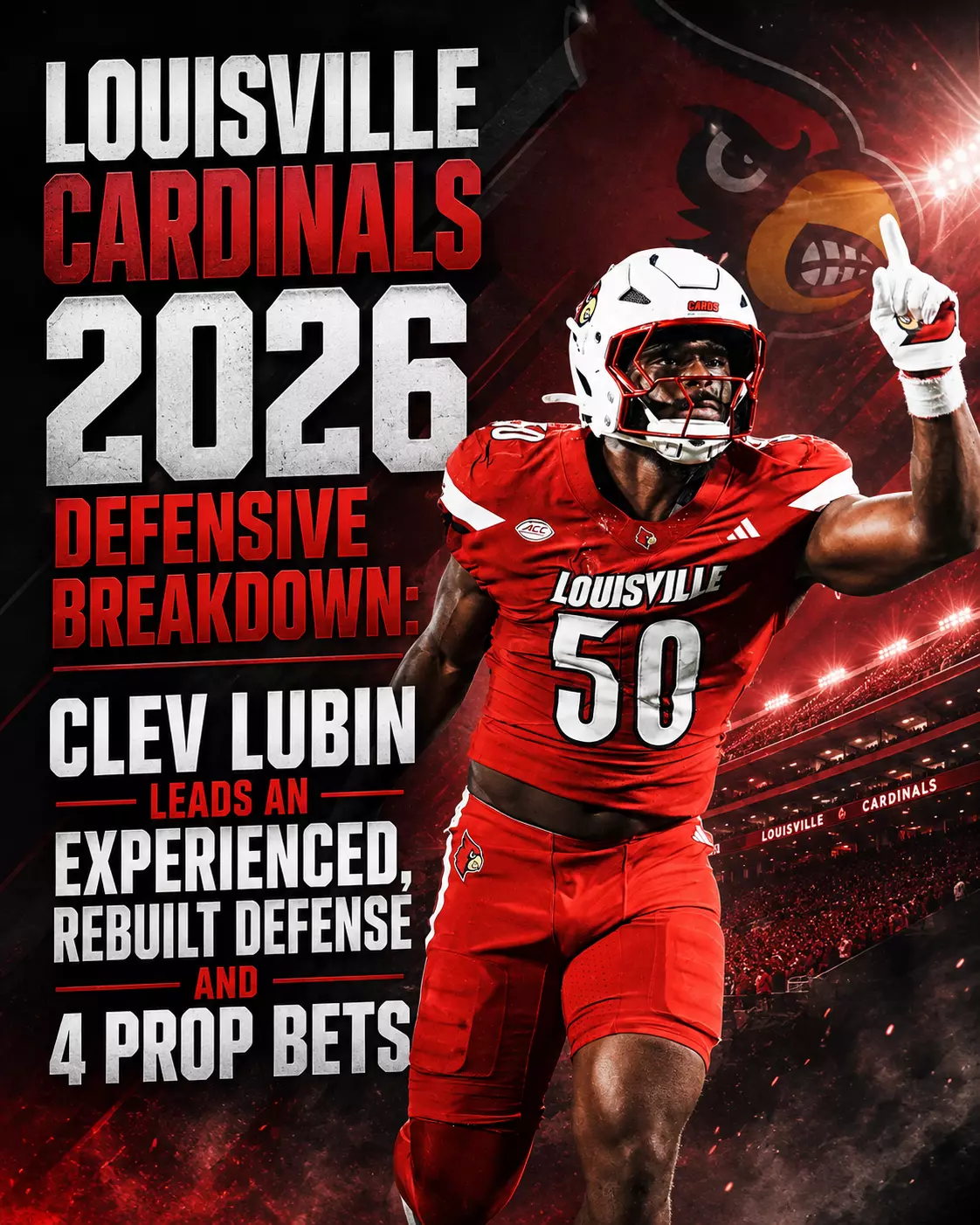
add this information to the image "Louisville Cardinals 2026 Defensive Breakdown: Clev Lubin Leads an Experienced, Rebuilt Defense and 4 Prop Bets" and make a professional backgrounf
The
Louisville Cardinals enter the 2026 college football season attempting to maintain one of the best defenses in the ACC despite significant personnel and coaching changes.
The standard is extremely high.
Louisville finished
9-4 in 2025
while allowing only
21.2 points and 303.1 total yards per game. Opponents averaged just
114.3 rushing yards and 188.8 passing yards per game, while the Cardinals generated
31 sacks and 14 interceptions. Louisville finished
No. 16 nationally in total defense.
Those numbers made defense one of the primary reasons Louisville remained competitive throughout the season.
The Cardinals held Kentucky scoreless.
They limited Clemson to 20 points.
They held Virginia Tech to 16.
They beat No. 2 Miami 24-21.
Even when Louisville’s offense struggled, the defense repeatedly gave Jeff Brohm’s team an opportunity to win.
Now comes the challenge.
Louisville returns only
five defensive starters, but several of those returning players are among the most important defenders on the roster.
Clev Lubin
returns after becoming one of the ACC’s premier pass rushers.
Tayon Holloway
returns after starting every game at cornerback.
Antonio Watts
returns after leading Louisville in interceptions.
T.J. Capers
returns after making seven starts at linebacker.
And
Stanquan Clark
returns after an injury-shortened 2025 season.
Louisville supplemented those players with an aggressive transfer-portal class featuring
Koen Entringer, DJ Waller Jr., Kaleb Beasley, T.J. Banks, Brycen Scott, Benjamin Perry, Demeco Kennedy, Daylen Russell, Tommy Ziesmer, Jacob Smith and Jerod Smith II.
This isn’t a complete rebuilding project.
It is a reconstruction around several proven stars.
And if the new pieces fit, Louisville could once again possess one of the ACC’s most difficult defenses to attack.
Louisville Cardinals 2026 Defensive Projections
Projected Record:
9-3
Projected Points Allowed Per Game:
21-23
Projected Total Defense:
305-320 yards per game
Projected Rushing Defense:
115-125 yards per game
Projected Passing Defense:
190-200 yards per game
Projected Team Sacks:
32-36
Projected Interceptions:
12-15
Projected Total Takeaways:
20-23
Projected Tackles for Loss:
75-82
Biggest Defensive Strength:
Pass Rush and Secondary Experience
Biggest Defensive Question:
Can Louisville replace enough production around its five returning starters to remain a top-20 national defense?
Louisville’s New Co-Defensive Coordinator Structure
Louisville enters 2026 with a new leadership structure on defense.
Mark Ivey and Steve Ellis are serving as co-defensive coordinators, with Ivey returning to coach the defensive line and Ellis overseeing the cornerbacks. Ivey previously coached Louisville’s linebackers, while Ellis has been instrumental in developing the Cardinals’ defensive backs.
That makes this more of an evolution than a complete defensive reset.
Both coaches were already part of Louisville’s 2025 staff.
Both understand Brohm’s expectations.
Both helped build the defense that ranked No. 16 nationally last season.
That continuity matters.
Louisville doesn’t have to teach an entirely different defensive identity.
The Cardinals can retain many of the principles that made the previous defense successful while adjusting personnel and responsibilities.
Ivey’s move back to the defensive line is particularly interesting.
He previously coached that position at Louisville before moving to linebackers and has a history of developing productive pass rushers. During his first stint with the defensive line, Louisville increased its sack total from 11 to 27 in one season.
Ellis gives Louisville similar continuity in the secondary.
Louisville has sent several defensive backs to professional football during his tenure, and Ellis inherits another group loaded with size and experience.
The Cardinals aren’t trying to reinvent what worked.
They are trying to preserve it.
Louisville Defensive Line Breakdown
Any discussion of Louisville’s defense begins with
Clev Lubin.
Lubin was outstanding during his first season with the Cardinals.
The Coastal Carolina transfer finished 2025 with
61 tackles, 13.5 tackles for loss, 8.5 sacks and three forced fumbles. His 8.5 sacks ranked fourth in the ACC and 25th nationally, while his 13.5 tackles for loss ranked seventh in the conference. He earned Third-Team All-ACC honors.
And there is nothing fluky about his production.
Lubin recorded
9.5 sacks in only 10 games at Coastal Carolina in 2024.
Before that, he produced
11.5 sacks and 23.5 tackles for loss
while helping Iowa Western win the junior-college national championship.
That gives Louisville something every defense wants.
A proven quarterback hunter.
Lubin enters 2026 on the
Bronko Nagurski Trophy watch list
and was voted to the
Preseason All-ACC Team.
The challenge is replacing the production around him.
Louisville addressed the interior aggressively through the transfer portal.
Demeco Kennedy
arrives from Purdue.
Daylen Russell
transferred from Miami after appearing in five games and recording six tackles with a tackle for loss in 2025.
Tommy Ziesmer
arrives from Eastern Kentucky.
Jerod Smith II
comes from Kentucky.
Joshua Donald
transfers from Houston.
The Cardinals also return players such as
Micah Carter, AJ Green and Maurice Davis.
There is substantial size.
Kennedy is listed around 305 pounds.
Russell is approximately 300.
Ziesmer is around 300.
Donald is listed at 310.
Jerod Smith II brings a 6-foot-4, 270-pound frame.
That matters because Lubin becomes even more dangerous when offenses cannot devote all of their protection toward him.
If the interior consistently collapses pockets, quarterbacks won’t have room to step away from Lubin’s edge pressure.
Louisville doesn’t necessarily need an All-ACC defensive tackle.
It needs several reliable interior players capable of occupying blockers, stopping the run and creating enough pressure to prevent quarterbacks from simply stepping forward.
The depth gives Ivey multiple options.
Projected Louisville Team Sacks: 32-36
Clev Lubin: Louisville’s Defensive Star
Clev Lubin enters 2026 with a legitimate opportunity to become one of the best defensive players in the ACC.
His consistency is remarkable.
In 2023, he recorded 11.5 sacks at Iowa Western.
In 2024, he recorded 9.5 at Coastal Carolina.
In 2025, he produced 8.5 against ACC competition.
That is
29.5 sacks over three seasons.
The competition has become more difficult each year.
The production has remained.
Lubin was particularly dominant against Kentucky in the 2025 regular-season finale, recording three tackles for loss and two sacks as Louisville shut out the Wildcats 41-0.
Now opponents know exactly what he can do.
Protection schemes will slide toward him.
Running backs will chip.
Tight ends may remain in protection.
Quarterbacks will be coached to understand where No. 50 is before every snap.
That is the next challenge.
Elite pass rushers eventually become the center of the opponent’s protection plan.
Lubin must continue producing anyway.
If Louisville’s rebuilt interior line creates pressure, he should get enough one-on-one opportunities to remain among the ACC sack leaders.
Clev Lubin Projection: 50-60 tackles, 12-15 tackles for loss, 8-10 sacks and 2-4 forced fumbles.
Louisville Linebacker Breakdown
Louisville loses one of its most productive defensive players in
TJ Quinn, who led the Cardinals with
95 tackles in 2025
and became the first Louisville player since Mark Sander from 1988-90 to lead the team in tackles three consecutive seasons.
Replacing Quinn is the biggest challenge in the linebacker room.
Fortunately, Louisville has options.
T.J. Capers
appears ready for an expanded role.
Capers played in all 13 games last season, made seven starts and recorded
46 tackles, three tackles for loss and an interception. His interception at Miami helped seal Louisville’s upset victory.
Capers was one of the highest-rated recruits in Louisville history and enters his fourth season in the program.
The physical talent has never been questioned.
Now the opportunity matches it.
Then there is
Stanquan Clark.
Clark’s 2025 season was largely lost because of a leg injury.
He played only five games and recorded 19 tackles. But the previous season demonstrated what a healthy Clark can provide.
In 2024, Clark finished second on Louisville with
76 tackles and 7.5 tackles for loss, earning honorable mention All-ACC recognition.
That makes his return significant.
If Clark is completely healthy, Louisville essentially adds a proven ACC starting linebacker back into the lineup.
The Cardinals also added
Benjamin Perry
from UCLA.
Perry recorded 29 tackles, 2.5 tackles for loss, 1.5 sacks and a forced fumble during the 2024 season before appearing in only one game in 2025.
Louisville also has Trent Carter and several younger linebackers competing for expanded roles.
The combination of Capers and Clark provides the key.
Capers has the athletic upside.
Clark has already demonstrated high-level production.
If both stay healthy, replacing Quinn becomes considerably more realistic.
Projected Leading Tackler: Stanquan Clark, 80-90 tackles
T.J. Capers Projection: 65-75 tackles, 5-7 tackles for loss and 2-3 sacks
Louisville Secondary Breakdown
Louisville’s secondary could become the deepest part of the defense.
The Cardinals return two proven veterans and added several experienced transfers.
Start with
Tayon Holloway.
Holloway started all 13 games last season and earned honorable mention All-ACC recognition while recording
42 tackles and two interceptions.
He provides something extremely important to a reconstructed secondary.
That allows Louisville to build the rest of the secondary around a proven veteran.
Then there is
Antonio Watts.
Watts missed three games because of injury in 2025 but still recorded
42 tackles and a team-high three interceptions
while earning honorable mention All-ACC recognition. He intercepted passes against Bowling Green, Pittsburgh and Miami.
Watts is particularly intriguing because Louisville now lists him as a defensive back after previously using him at linebacker.
At 6-foot-2 and 225 pounds, he gives Ellis unusual versatility.
Watts can tackle.
He can cover.
He can play near the line.
He can attack underneath routes.
And he has already demonstrated excellent ball production.
The biggest newcomer is
Koen Entringer.
Entringer transfers from Iowa after starting all 13 games at strong safety in 2025.
He finished with
73 tackles, 3.5 tackles for loss, four pass breakups, a forced fumble and a fumble recovery
while serving as a permanent team captain. Iowa finished eighth nationally in scoring defense and ninth in total defense.
That is a massive addition.
Entringer isn’t merely experienced.
He comes from one of college football’s most consistently disciplined defensive programs.
He understands tackling.
He understands leverage.
He understands coverage communication.
And he has played against high-level Big Ten offenses.
Louisville also added
DJ Waller Jr., who previously played at Michigan and Kentucky.
Waller contributed to Michigan’s 2023 national championship team before transferring to Kentucky, where injuries limited his availability.
Brycen Scott
arrives from Elon after recording 35 tackles and seven pass breakups in 2025.
Kaleb Beasley
transfers from Tennessee.
T.J. Banks
comes from Ole Miss.
Santana Wilson
arrives from Texas.
Myles Norwood
previously played at South Carolina.
The secondary isn’t short on options.
The question is chemistry.
Several of those players have never taken a meaningful snap together.
Communication becomes especially important when Louisville faces experienced quarterbacks and aggressive passing systems.
Still, there is too much talent and experience here to expect a major collapse.
Louisville allowed only
188.8 passing yards per game in 2025
and intercepted 14 passes.
Matching those numbers won’t be easy.
It is possible.
Projected Louisville Interceptions: 12-15
Antonio Watts: Louisville’s Defensive Wild Card
One of the most interesting players on Louisville’s defense is
Antonio Watts.
His official position has changed.
His impact shouldn’t.
Watts has played linebacker and defensive back during his Louisville career, giving the Cardinals a 225-pound coverage defender with legitimate experience playing near the line of scrimmage.
That versatility allows Ellis and Ivey to disguise what Louisville is doing.
Watts can align like a safety.
Move into the box.
Cover a tight end.
Attack the run.
Blitz.
Or drop underneath a passing lane.
His 2025 production proves that he can create turnovers.
Watts intercepted three passes in only 10 games.
The biggest issue is health.
He missed the final three regular-season games last year because of injury.
If Watts plays a complete season, he could become one of Louisville’s most statistically productive defenders.
Antonio Watts Projection: 55-65 tackles, 4-6 tackles for loss, 2-4 interceptions and multiple forced turnovers.
Four Louisville Cardinals 2026 Defensive Prop Bets
Note:
Full-season college football defensive player and team props are not consistently offered by every sportsbook. The defensive statistical props below should therefore be treated as
projection-based betting benchmarks
rather than claims that every sportsbook currently offers these exact lines.
Prop Bet #1: Louisville Over 30.5 Team Sacks
DraftKings
4.5/5
Tip: Louisville Over 30.5 Team Sacks
31 Sacks Last Season
Clev Lubin Returns
Deep Transfer Defensive Front
New DraftKings Customers: Bet $5, Get $200 + 3 Months of NBA League Pass!
Get bonus now
GAMBLING PROBLEM? CALL 1-800-GAMBLER or 1-800-MY-RESET, (800) 327-5050 or visit gamblinghelplinema.org (MA). Please Gamble Responsibly. 888-789-7777/visit ccpg.org (CT), or visit www.mdgamblinghelp.org (MD), 1-800-981-0023 (PR). 21+ and present in most states. (18+ DC/NH/PR/WY). Void in CAN. Eligibility restrictions apply. On behalf of Boot Hill Casino (KS). Pass-thru of per wager tax may apply in IL. 1 per new Sportsbook customer. $5+ first-time bet req. Max. $200 issued as non-withdrawable Bonus Bets. Stake removed from payout. Reward issued as $50 in Bonus Bets every 7 days via click-to-claim for 21 days. Bonus Bets and click-to-claims expire 7 days (168hrs) after issuance. Terms: dkng.co/offer. Get 1 promo code to redeem a 3-month NBA League Pass subscription, complimentary of DraftKings. Subscription auto-renews monthly at then-current price (currently $16.99/mo); cancel anytime. Terms, restrictions, and eligibility requirements apply. Redeem League Pass by 12/19/26 at 11:59 PM ET. Addt’l terms: support.watch.nba.com/hc/en-us/articles/9165532876183-League-Pass-Terms-of-Use_. Ends 11/29/26 at 11:59 PM ET. Sponsored by DK.
Why the Over Is a Good Bet
Louisville recorded
31 sacks in 2025.
That means the Cardinals only need to essentially maintain last year’s production to cash this benchmark.
Lubin is the biggest reason to like the Over.
He produced 8.5 sacks last season and has accumulated 29.5 over his last three collegiate seasons.
Louisville also possesses significantly more defensive-line depth than one star player.
Kennedy.
Russell.
Ziesmer.
Smith.
Donald.
Carter.
Green.
Davis.
Those players give Ivey multiple combinations to use throughout games.
Capers and Clark can also contribute pressure from linebacker.
The Cardinals don’t need Lubin to record 12 sacks.
If he gets eight or nine again and Louisville receives production from five or six other defenders, surpassing 30.5 is realistic.
Why the Under Is a Good Bet
Louisville lost defensive production from last year’s roster.
A rebuilt interior defensive line may require time to develop chemistry.
And opponents will build entire protection plans around Lubin.
The schedule also contains several dangerous offenses.
Ole Miss opens the season.
SMU comes to Louisville in September.
Georgia Tech presents a difficult road matchup in November.
Quarterbacks facing elite edge rushers frequently compensate by throwing quickly.
That can reduce sack totals even when the defense generates pressure.
Louisville could remain an excellent defense and finish with 28 or 29 sacks.
Projection: 32-36 Team Sacks
Bet: Over 30.5 Team Sacks
Confidence: 8/10
Prop Bet #2: Louisville Over 11.5 Interceptions
FanDuel
4.6/5
Tip: Louisville Over 11.5 Interceptions
14 INTs in 2025
Watts and Holloway Return
Deep Transfer Secondary
New Users – Get $350 in Bonus Bets when you wager $5 for 7 days
Get bonus now
Gambling Problem? Call 1-800-GAMBLER or 1-800-MY-RESET. Call 1-888-789-7777 or visit ccpgg.org/chat (CT). Hope is here. GamblingHelpLineMA.org or call (800) 327-5050 for 24/7 support (MA). Visit www.mdgamblinghelp.org (MD). Call 1-877-8HOPE-NY or text HOPENY (NY). 21+ (18+ DC, WY) and present in select states (for KS, in affiliation with Kansas Star Casino). Find online real money wagering only. Min $5 wager required for 7 consecutive days. $5 free play credit. Bonus issued as non-withdrawable bonus with cash withdrawable bonus with cash withdrawable. Bonus bets which expire 7 days after receipt. Restrictions apply. See terms at sportsbook.fanduel.com. Call 1-877-770-7867 (LA).
Why the Over Is a Good Bet
Louisville intercepted
14 passes last season
while holding opposing quarterbacks to a 59.2% completion rate.
Several proven ball defenders return.
Watts intercepted three passes.
Holloway intercepted two.
Capers produced the game-sealing interception against Miami.
Then Louisville added experienced defensive backs.
Entringer brings 73 tackles and four pass breakups from Iowa.
Scott produced seven pass breakups last season at Elon.
Waller brings Power Four experience from Michigan and Kentucky.
The pass rush should also create turnover opportunities.
If Lubin and Louisville’s front force quarterbacks to speed up their decisions, the secondary should see rushed throws.
Twelve interceptions requires only one per regular-season game.
That is attainable.
Why the Under Is a Good Bet
Interceptions are one of the least predictable defensive statistics.
Louisville could play excellent pass defense and intercept only nine or 10 passes.
Opposing quarterbacks could simply stop challenging Watts and Holloway.
The new secondary also needs time to establish communication.
Entringer, Waller, Scott, Banks, Beasley and other newcomers must learn how to play together.
One coverage mistake can turn a potential takeaway into an explosive completion.
Louisville’s schedule also features several opponents capable of protecting the football and stressing defensive backs horizontally.
Projection: 12-15 Interceptions
Bet: Over 11.5 Interceptions
Confidence: 7/10
Prop Bet #3: Clev Lubin Over 7.5 Sacks
Caesars
4.4/5
Tip: Clev Lubin Over 7.5 Sacks
8.5 Sacks in 2025
29.5 Sacks Over Three Seasons
Preseason All-ACC Selection
Bet $1 and get double the winnings up to $25 for your next 10 bets
–
21+ New users only. Must register using eligible promo code. First bet after registration must qualify. Max. Bonus Bet: $1,000. Bonus Bet expires 14 days after receipt. Void where prohibited. See Caesars.com/promos for full terms. Gambling Problem? 1-800-GAMBLER (1-800-426-2537)
Why the Over Is a Good Bet
Few defensive-player props would have a stronger statistical foundation.
Lubin recorded
8.5 sacks in 2025.
He recorded
9.5 in 2024.
He recorded
11.5 in 2023.
He has surpassed 7.5 sacks in three consecutive seasons.
And unlike players making the jump from a smaller conference, Lubin has already demonstrated that his pass rush works against ACC competition.
He finished fourth in the conference in sacks last year.
Louisville’s defensive-line depth should also help.
If the interior defenders prevent quarterbacks from stepping comfortably into the pocket, Lubin gets additional finishing opportunities.
Eight sacks over 12 games requires approximately two sacks every three games.
For a player with Lubin’s résumé, that is reasonable.
Why the Under Is a Good Bet
Opponents are no longer discovering Lubin.
They know exactly who he is.
He is a preseason All-ACC selection.
He is on national award watch lists.
Offensive coordinators will design protections specifically to neutralize him.
That means chips.
Double teams.
Quick passes.
Moving pockets.
Screens.
Everything possible to prevent Lubin from controlling games.
There is also an injury risk with every full-season player prop.
Missing even two games could make eight sacks difficult.
And Louisville’s deeper defensive line may allow Ivey to reduce Lubin’s snap count in games the Cardinals control.
Projection: 8-10 Sacks
Bet: Over 7.5 Sacks
Confidence: 8.5/10
Prop Bet #4: Louisville Under 319.5 Total Defensive Yards Allowed Per Game
BetMGM
4.5/5
Tip: Louisville Under 319.5 Defensive Yards Per Game
303.1 Yards Allowed in 2025
Five Returning Starters
Elite Secondary Depth
Up To $1500 in Bonus Bets Paid Back if your First Bet Does Not Win
Get bonus now
Gambling problem? Call 1-800-GAMBLER or 1-800-MY-RESET (Available in the US) 877-8-HOPENY or text HOPENY (467369) (NY) 1-800-327-5050 (MA), 1-800-BETS-OFF (IA), 1-800-981-0023 (PR). 21+ only. Please Gamble Responsibly. See BetMGM.com for Terms. First Bet Offer for new customers only (if applicable). Subject to eligibility requirements. Bonus bets are non-withdrawable. In partnership with Kansas Crossing Casino and Hotel. Promotional offers not available in Mississippi, Massachusetts, New York, Ontario, or Puerto Rico.
Why the Under Is a Good Bet
Louisville allowed only
303.1 yards per game last season.
The Cardinals could regress by more than 16 yards per game and still remain Under this benchmark.
That provides some margin.
Lubin returns.
Holloway returns.
Watts returns.
Capers returns.
Clark returns after playing only five games because of injury.
Louisville then added Entringer, one of Iowa’s defensive captains, along with an extensive group of defensive backs and linemen from the transfer portal.
The Cardinals were particularly strong against the run last season, surrendering only 114.3 rushing yards per game.
Even moderate regression would still give Louisville an opportunity to remain below 320 total yards allowed.
Why the Over Is a Good Bet
Repeating a top-20 national defensive performance is extremely difficult.
Louisville returns five starters.
That also means the Cardinals are replacing six.
The interior defensive line has changed.
The secondary has several transfers.
And Louisville has a new co-coordinator structure.
Early-season chemistry could be a problem.
Then consider the schedule.
Louisville opens against
Ole Miss, faces
SMU
in Week 3 and later plays NC State, Florida State, Syracuse, Georgia Tech, North Carolina and Pittsburgh in ACC competition.
Several of those teams could produce significant yardage even if Louisville ultimately wins.
The Cardinals may remain good defensively without matching 303 yards per game.
Projection: 305-320 Defensive Yards Per Game
Bet: Under 319.5 Defensive Yards Per Game
Confidence: 7/10
Best Louisville Cardinals 2026 Defensive Prop Bet
Clev Lubin Over 7.5 sacks is my favorite Louisville defensive wager.
The résumé is simply too consistent to ignore.
11.5 sacks in 2023.
9.5 sacks in 2024.
8.5 sacks in 2025.
Lubin has changed teams.
Changed levels of competition.
Changed defensive environments.
And continued getting quarterbacks on the ground.
The ACC has already seen him do it.
There is no projection required about whether his ability translates.
It already has.
Louisville’s deeper defensive line should prevent offenses from completely selling out to stop him, while Ivey’s return to coaching the defensive front gives the Cardinals an experienced coach capable of creating favorable pass-rushing situations.
My projection is
8-10 sacks.
That makes Over 7.5 my strongest Louisville defensive prop.
How Louisville’s Defense Could Determine the 2026 Season
Louisville’s regular-season win total is listed at
8.5 victories on VegasInsider’s August 17 board, although prices and numbers can vary by sportsbook.
That number tells you what the market expects.
Louisville isn’t viewed as an ordinary bowl contender.
The Cardinals are expected to compete near the top of the ACC.
The defense is a major reason.
Louisville opens the season against
Ole Miss in Nashville on September 6.
Five days later comes Villanova.
Then SMU visits Louisville on September 19.
Wake Forest follows before the Cardinals begin a difficult October featuring road games at NC State and Syracuse along with a home game against Florida State.
November includes Stanford, Georgia Tech, North Carolina, Pittsburgh and the annual rivalry game at Kentucky.
There are opportunities.
There are also several games where Louisville’s defense may have to determine the outcome.
Ole Miss could test Louisville immediately.
SMU is dangerous.
Georgia Tech on the road could become a difficult schematic matchup.
Pittsburgh has historically produced physical games against Louisville.
And Kentucky will have enormous motivation after losing 41-0 in Louisville last season.
My projection is
9-3.
That would put Louisville Over the 8.5-win benchmark and squarely in the ACC championship discussion.
But reaching nine wins may depend on whether the defense can remain close to its 2025 standard.
If Louisville allows around 21 or 22 points per game again, this team can compete with almost everyone on its schedule.
If the rebuilt defense falls toward 27 or 28 points allowed, the pressure on the offense increases significantly.
Conclusion
The
Louisville Cardinals enter the 2026 season with one of the most fascinating defensive situations in the ACC.
The 2025 defense set an extremely high standard.
Louisville allowed only
21.2 points and 303.1 total yards per game.
Opponents rushed for only 114.3 yards per contest.
The Cardinals intercepted 14 passes.
They recorded 31 sacks.
And they finished No. 16 nationally in total defense.
Maintaining those numbers won’t be easy.
Louisville returns only five defensive starters.
But those returning starters matter.
Clev Lubin
may be one of the best pass rushers in college football after recording 8.5 sacks and 13.5 tackles for loss.
Tayon Holloway
brings 13 starts and two interceptions back to the secondary.
Antonio Watts
returns after leading Louisville with three interceptions despite missing three games.
T.J. Capers
recorded 46 tackles and now has an opportunity to assume a much larger linebacker role.
Stanquan Clark
returns after a leg injury limited him to five games, one year after he produced 76 tackles and 7.5 tackles for loss.
Then Louisville attacked the transfer portal.
Koen Entringer may be the most important addition.
He brings
73 tackles, Big Ten starting experience and captain-level leadership from Iowa.
DJ Waller provides experience from Michigan and Kentucky.
Brycen Scott produced seven pass breakups last season.
Kaleb Beasley and T.J. Banks add more Power Four talent.
Demeco Kennedy, Daylen Russell, Tommy Ziesmer, Joshua Donald and Jerod Smith II strengthen the defensive front.
There are questions.
The Cardinals must replace TJ Quinn’s 95 tackles.
The interior defensive line is significantly different.
Several defensive backs are new.
And Ivey and Ellis must successfully transition into their new co-coordinator responsibilities.
But Louisville isn’t rebuilding from nothing.
It is rebuilding around proven ACC production.
My projection has the Cardinals allowing approximately
21-23 points and 305-320 total yards per game while producing 32-36 sacks, 12-15 interceptions and 20-23 total takeaways.
Those numbers would keep Louisville among the ACC’s stronger defenses.
From a betting perspective, my strongest play is
Clev Lubin Over 7.5 sacks.
His production isn’t theoretical.
He has surpassed that benchmark in three consecutive seasons.
And unlike many transfer pass rushers, he has already proven he can consistently beat ACC offensive linemen.
The biggest question isn’t whether Louisville has enough defensive talent.
It does.
The question is how quickly the new pieces become one defense.
If Entringer immediately stabilizes the secondary, Clark remains healthy, Capers takes the next step and Lubin once again becomes one of the ACC’s premier pass rushers,
Louisville should possess a defense capable of keeping the Cardinals in the ACC championship race throughout the 2026 season — and potentially putting Jeff Brohm’s program in position for a College Football Playoff push.
New Users – Get $350 in Bonus Bets when you wager $5 for 7 days
T&Cs apply
4.6/5
Gambling Problem? Call 1-800-GAMBLER or 1-800-MY-RESET. Call 1-888-789-7777 or visit ccpgg.org/chat (CT). Hope is here. GamblingHelpLineMA.org or call (800) 327-5050 for 24/7 support (MA). Visit www.mdgamblinghelp.org (MD). Call 1-877-8HOPE-NY or text HOPENY (NY). 21+ (18+ DC, WY) and present in select states (for KS, in affiliation with Kansas Star Casino). Find online real money wagering only. Min $5 wager required for 7 consecutive days. $5 free play credit. Bonus issued as non-withdrawable bonus with cash withdrawable bonus with cash withdrawable. Bonus bets which expire 7 days after receipt. Restrictions apply. See terms at sportsbook.fanduel.com. Call 1-877-770-7867 (LA).
Up To $1500 in Bonus Bets Paid Back if your First Bet Does Not Win
T&Cs apply
4.5/5
Gambling problem? Call 1-800-GAMBLER or 1-800-MY-RESET (Available in the US) 877-8-HOPENY or text HOPENY (467369) (NY) 1-800-327-5050 (MA), 1-800-BETS-OFF (IA), 1-800-981-0023 (PR). 21+ only. Please Gamble Responsibly. See BetMGM.com for Terms. First Bet Offer for new customers only (if applicable). Subject to eligibility requirements. Bonus bets are non-withdrawable. In partnership with Kansas Crossing Casino and Hotel. Promotional offers not available in Mississippi, Massachusetts, New York, Ontario, or Puerto Rico.
New DraftKings Customers: Bet $5, Get $200 + 3 Months of NBA League Pass!
T&Cs apply
4.5/5
GAMBLING PROBLEM? CALL 1-800-GAMBLER or 1-800-MY-RESET, (800) 327-5050 or visit gamblinghelplinema.org (MA). Please Gamble Responsibly. 888-789-7777/visit ccpg.org (CT), or visit www.mdgamblinghelp.org (MD), 1-800-981-0023 (PR). 21+ and present in most states. (18+ DC/NH/PR/WY). Void in CAN. Eligibility restrictions apply. On behalf of Boot Hill Casino (KS). Pass-thru of per wager tax may apply in IL. 1 per new Sportsbook customer. $5+ first-time bet req. Max. $200 issued as non-withdrawable Bonus Bets. Stake removed from payout. Reward issued as $50 in Bonus Bets every 7 days via click-to-claim for 21 days. Bonus Bets and click-to-claims expire 7 days (168hrs) after issuance. Terms: dkng.co/offer. Get 1 promo code to redeem a 3-month NBA League Pass subscription, complimentary of DraftKings. Subscription auto-renews monthly at then-current price (currently $16.99/mo); cancel anytime. Terms, restrictions, and eligibility requirements apply. Redeem League Pass by 12/19/26 at 11:59 PM ET. Addt’l terms: support.watch.nba.com/hc/en-us/articles/9165532876183-League-Pass-Terms-of-Use_. Ends 11/29/26 at 11:59 PM ET. Sponsored by DK.
Must be 21+. GAMBLING PROBLEM? CALL 1-800-GAMBLER OR CALL 1-800-MY-RESET, www.mdgamblinghelp.org (MD), (800)-327-5050 or gamblinghelplinema.org (MA), Call (877)8-HOPENY or text HOPENY (467369) (NY), (888) 789-7777 or ccpg.org (CT), morethanagame.nc.gov (NC), 1800gambler.net (WV)
Bet $1 and get double the winnings up to $25 for your next 10 bets
T&Cs apply
4.4/5
21+ New users only. Must register using eligible promo code. First bet after registration must qualify. Max. Bonus Bet: $1,000. Bonus Bet expires 14 days after receipt. Void where prohibited. See Caesars.com/promos for full terms. Gambling Problem? 1-800-GAMBLER (1-800-426-2537)
21+ and present in OH. Gambling Problem? Call 1-800-GAMBLER.
This site is using
Cloudflare
and adheres to the
Google Safe Browsing Program. We adapted
Google's Privacy Guidelines
to keep your data safe at all times.
Close
Ready to Win Big? Join the Elite with Our Sports Betting Deals!
FanDuel Promo
New Users – Get $350 in Bonus Bets when you wager $5 for 7 days
Our Favorite
T&Cs and 21+ apply
Gambling Problem? Call 1-800-GAMBLER or 1-800-MY-RESET. Call 1-888-789-7777 or visit ccpgg.org/chat (CT). Hope is here. GamblingHelpLineMA.org or call (800) 327-5050 for 24/7 support (MA). Visit www.mdgamblinghelp.org (MD). Call 1-877-8HOPE-NY or text HOPENY (NY). 21+ (18+ DC, WY) and present in select states (for KS, in affiliation with Kansas Star Casino). Find online real money wagering only. Min $5 wager required for 7 consecutive days. $5 free play credit. Bonus issued as non-withdrawable bonus with cash withdrawable bonus with cash withdrawable. Bonus bets which expire 7 days after receipt. Restrictions apply. See terms at sportsbook.fanduel.com. Call 1-877-770-7867 (LA).
Code:
Open FanDuel
Get Bonus
BetMGM Promo
Up To $1500 in Bonus Bets Paid Back if your First Bet Does Not Win
Best Slots
T&Cs and 21+ apply
Gambling problem? Call 1-800-GAMBLER or 1-800-MY-RESET (Available in the US) 877-8-HOPENY or text HOPENY (467369) (NY) 1-800-327-5050 (MA), 1-800-BETS-OFF (IA), 1-800-981-0023 (PR). 21+ only. Please Gamble Responsibly. See BetMGM.com for Terms. First Bet Offer for new customers only (if applicable). Subject to eligibility requirements. Bonus bets are non-withdrawable. In partnership with Kansas Crossing Casino and Hotel. Promotional offers not available in Mississippi, Massachusetts, New York, Ontario, or Puerto Rico.
Code:
Open BetMGM
Get Bonus
DraftKings Promo
New DraftKings Customers: Bet $5, Get $200 + 3 Months of NBA League Pass!
Newcomer
T&Cs and 21+ apply
GAMBLING PROBLEM? CALL 1-800-GAMBLER or 1-800-MY-RESET, (800) 327-5050 or visit gamblinghelplinema.org (MA). Please Gamble Responsibly. 888-789-7777/visit ccpg.org (CT), or visit www.mdgamblinghelp.org (MD), 1-800-981-0023 (PR). 21+ and present in most states. (18+ DC/NH/PR/WY). Void in CAN. Eligibility restrictions apply. On behalf of Boot Hill Casino (KS). Pass-thru of per wager tax may apply in IL. 1 per new Sportsbook customer. $5+ first-time bet req. Max. $200 issued as non-withdrawable Bonus Bets. Stake removed from payout. Reward issued as $50 in Bonus Bets every 7 days via click-to-claim for 21 days. Bonus Bets and click-to-claims expire 7 days (168hrs) after issuance. Terms: dkng.co/offer. Get 1 promo code to redeem a 3-month NBA League Pass subscription, complimentary of DraftKings. Subscription auto-renews monthly at then-current price (currently $16.99/mo); cancel anytime. Terms, restrictions, and eligibility requirements apply. Redeem League Pass by 12/19/26 at 11:59 PM ET. Addt’l terms: support.watch.nba.com/hc/en-us/articles/9165532876183-League-Pass-Terms-of-Use_. Ends 11/29/26 at 11:59 PM ET. Sponsored by DK.
Code:
Open DraftKings
Get Bonus
Find out what the legends have to say about sports this week....
New Users – Get $350 in Bonus Bets when you wager $5 for 7 days
Gambling Problem? Call 1-800-GAMBLER or 1-800-MY-RESET. Call 1-888-789-7777 or visit ccpgg.org/chat (CT). Hope is here. GamblingHelpLineMA.org or call (800) 327-5050 for 24/7 support (MA). Visit www.mdgamblinghelp.org (MD). Call 1-877-8HOPE-NY or text HOPENY (NY). 21+ (18+ DC, WY) and present in select states (for KS, in affiliation with Kansas Star Casino). Find online real money wagering only. Min $5 wager required for 7 consecutive days. $5 free play credit. Bonus issued as non-withdrawable bonus with cash withdrawable bonus with cash withdrawable. Bonus bets which expire 7 days after receipt. Restrictions apply. See terms at sportsbook.fanduel.com. Call 1-877-770-7867 (LA).