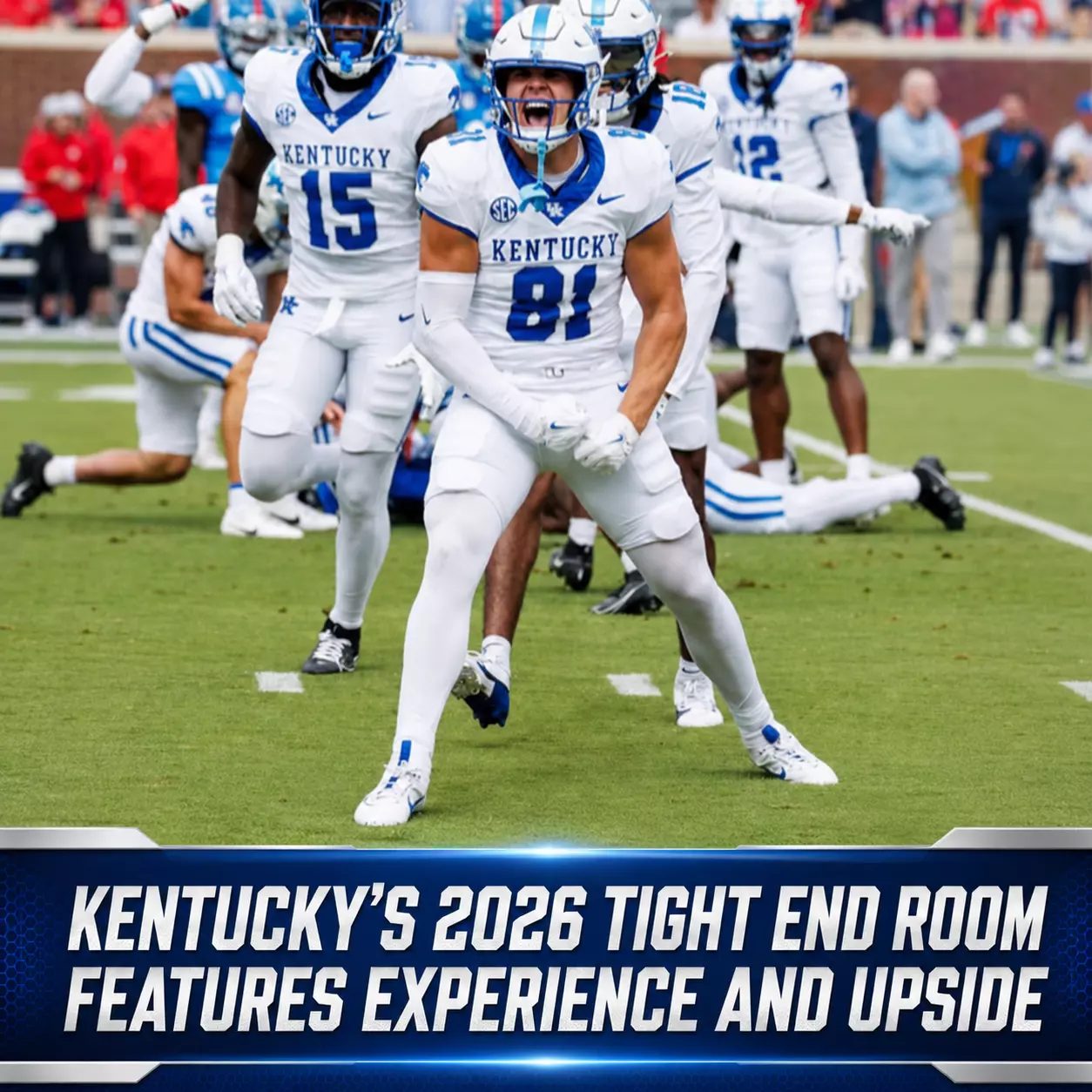
Kentucky’s 2026 Tight End Room Features Experience and Upside
The University of Kentucky Wildcats
enter the 2026 season with a tight end room that could become one of the most important parts of head coach Will Stein’s new offense.
Kentucky returns its leading tight end in Willie Rodriguez, an emerging All-SEC candidate who finished third on the team in receiving during the 2025 season. The Wildcats also bring back massive veteran blockers Henry Boyer and Elijah Brown, while former four-star prospect Mikkel Skinner provides the type of athletic versatility that could create mismatches throughout the formation.
Justin Kattus adds developmental depth and special teams potential, while freshman Lincoln Watkins arrives as a productive, multi-dimensional athlete with considerable long-term upside. Kentucky’s official 2026 roster lists six tight ends, giving new position coach Justin Burke a group that combines size, experience and multiple playing styles.
The position should also receive more opportunities under Stein and offensive coordinator Joe Sloan. During spring practice, Stein discussed finding ways to get the tight ends more involved, referencing how tight ends were used in previous offenses at Oregon and LSU.
With Kenny Minchey leading a rebuilt Kentucky offense, Rodriguez and the other tight ends could become important targets on play-action passes, third downs and red-zone possessions.
Projected 2026 Tight End Depth Chart
1. Willie Rodriguez — Junior
Height:
6-foot-4Weight:
249 pounds
Hometown:
Taylor Mill, Kentucky
High School:
Covington Catholic
Bio
Rodriguez enters the season as Kentucky’s projected starting tight end and the unquestioned leader of the position group.
He started seven of the 12 games he played during the 2025 season, finishing with 23 receptions for 310 yards and one touchdown. Rodriguez ranked third on the team in receptions and receiving yards while establishing himself as one of Kentucky’s most dependable offensive players.
His best performance came against Vanderbilt, when he caught six passes for 78 yards. Those six receptions were the most by a Kentucky tight end in a game since C.J. Conrad recorded six catches against Mississippi State in 2015.
Rodriguez also demonstrated big-play potential with a career-long 53-yard reception against Southern California. In two college seasons, he has totaled 28 receptions for 404 yards while averaging more than 14 yards per catch.
His development has already earned national and conference recognition. Athlon Sports selected Rodriguez to its preseason third-team All-SEC offense, and Kentucky chose him as one of its representatives at the 2026 SEC Football Media Days.
Strengths
Proven receiving production
Reliable hands
Ability to stretch the seam
Physical run blocker
Pass-protection experience
Strong after the catch
Leadership and starting experience
Red-zone potential
Areas for Improvement
Increase touchdown production
Become more consistent on contested catches
Continue improving route precision
Handle additional defensive attention
Establish himself as a weekly focal point
Outlook
Rodriguez has the potential to become one of the SEC’s breakout tight ends in 2026.
Stein has praised him as an all-around player capable of run blocking, pass protecting, catching the football and forcing missed tackles. That versatility should allow Kentucky to keep him on the field in nearly every personnel grouping.
Rodriguez has already proven that he can produce against SEC competition. The next step is turning occasional flashes into consistent weekly production.
If Kentucky’s new offense features the position as expected, Rodriguez could surpass 40 receptions and emerge as one of
quarterback Kenny Minchey’s
most dependable targets.
Boyer gives Kentucky a massive, experienced in-line tight end who can play an important role in the running game.
After spending three seasons at Illinois, Boyer transferred to Kentucky before the 2025 season. He appeared in all 12 games for the Wildcats and made one start against Eastern Michigan.
Boyer caught five passes for 62 yards, including a career-best two receptions for 25 yards against Vanderbilt. He also recovered a crucial fumble during Kentucky’s road victory over Auburn.
Before arriving in Lexington, Boyer appeared in 25 games with two starts for Illinois. He has now played in 37 career college games, giving Kentucky one of the more experienced blocking tight ends in the conference.
Strengths
Outstanding size
Proven in-line blocking experience
Physical at the point of attack
Extensive college experience
Reliable in short-yardage packages
Large catch radius
Ability to assist in pass protection
Areas for Improvement
Limited receiving production
Route-running quickness
Creating separation against linebackers
Becoming more dangerous after the catch
Improving overall offensive versatility
Outlook
Boyer may not produce eye-catching receiving numbers, but his value extends beyond the box score.
His size makes him well suited for Kentucky’s heavier personnel packages, particularly when the Wildcats want to establish the running game or protect the quarterback. He can align next to an offensive tackle, function as an additional blocker or release into the flat as a secondary receiving option.
Boyer also showed more receiving potential during spring practice. Stein praised his work as an in-line player and noted that he had made several impressive catches down the field.
Expect Boyer to have a regular role in two-tight end formations, short-yardage situations and goal-line packages.
3. Mikkel Skinner — Redshirt Freshman
Height:
6-foot-4Weight:
234 pounds
Hometown:
Greer, South Carolina
High School:
Riverside
Bio
Skinner may be the most intriguing player in Kentucky’s tight end room.
The former four-star recruit was considered one of South Carolina’s leading prospects in the 2025 recruiting class. On3 ranked him as the nation’s No. 10 tight end, while 247Sports rated him as the No. 2 overall prospect in South Carolina.
Skinner played wide receiver, tight end, running back, linebacker and defensive end during his high school career. As a senior, he caught 44 passes for 819 yards and 12 touchdowns while adding 321 rushing yards and six more scores.
He finished that season with 1,340 all-purpose yards and 18 offensive touchdowns. Skinner also recorded five sacks on defense.
As a freshman at Kentucky, Skinner appeared in four games before preserving his redshirt. He saw action against Texas, Tennessee, Auburn and Tennessee Tech.
Strengths
Exceptional versatility
Wide receiver-style ball skills
Athleticism in space
Ability to align throughout the formation
Strong high school production
Run-after-catch potential
Red-zone athleticism
High developmental ceiling
Areas for Improvement
Limited collegiate experience
In-line blocking technique
Functional strength
Learning a new offensive system
Developing consistency against SEC defenders
Outlook
Skinner could become Kentucky’s offensive wildcard.
Stein has described him as an all-around player who can align in the backfield, next to the offensive tackle or split outside. That versatility could allow Kentucky to create favorable matchups without changing personnel.
Skinner is athletic enough to challenge linebackers in coverage and large enough to create problems for defensive backs. Kentucky could use him as an H-back, slot receiver, traditional tight end or motion player.
He may not begin the season as an every-down starter, especially while developing as a blocker, but his receiving ability could make him difficult to keep off the field.
If Skinner adjusts quickly, he could become one of Kentucky’s most explosive offensive players.
4. Elijah Brown — Senior
Height:
6-foot-6Weight:
263 pounds
Hometown:
Dayton, Ohio
High School:
Wayne
Previous Schools:
Alabama, Florida Atlantic and UCF
Bio
Brown is one of the most physically impressive players in the room and has experienced several different levels of college football.
The former four-star recruit began his career at Alabama before transferring to Florida Atlantic. He appeared in 11 games with one start during his two seasons at FAU, recording a 22-yard reception against Charlotte.
Brown spent the 2025 spring semester at UCF before transferring to Kentucky. His first season with the Wildcats was limited, as he appeared against Eastern Michigan but did not become a regular member of the offensive rotation.
He enters 2026 having appeared in 12 career games with one start.
Strengths
Excellent height and weight
Former four-star recruiting pedigree
Experience in multiple college programs
Large catch radius
Blocking potential
Red-zone size
Physical upside
Areas for Improvement
Staying healthy
Limited career receiving production
Establishing a consistent role
Route-running development
Improving separation
Translating physical traits into production
Outlook
Brown enters an important season.
He has the size and background to become a valuable rotational tight end, but he must remain healthy and earn the confidence of Kentucky’s new coaching staff.
His 6-foot-6, 263-pound frame makes him a natural option in blocking situations and inside the red zone. Brown could also provide depth behind Boyer as an in-line tight end.
With Rodriguez, Boyer and Skinner expected to receive significant snaps, Brown will need a strong fall camp to establish a regular offensive role. Special teams could also provide another path to playing time.
5. Justin Kattus — Redshirt Sophomore
Height:
6-foot-1Weight:
216 pounds
Hometown:
Cincinnati, Ohio
High School:
St. Xavier
Bio
Kattus enters his third season in Kentucky’s program after spending his first two years developing behind his older brother, Josh Kattus.
Justin appeared against Murray State during his freshman season before redshirting. He practiced with the team throughout 2025 but did not record any offensive statistics.
Kattus played several positions at Cincinnati St. Xavier, including offensive line, defensive line, tight end and linebacker. He was also a two-year rugby letter winner, competing at flanker and inside center.
Football runs in the Kattus family. His father, Eric Kattus, played tight end at Michigan before spending seven seasons in the NFL with the Cincinnati Bengals and New York Jets.
Strengths
Football intelligence
Toughness and physicality
Positional versatility
Rugby background
Familiarity with Kentucky’s program
Special teams potential
Strong football bloodlines
Areas for Improvement
Undersized for an in-line SEC tight end
Limited collegiate experience
Receiving production
Blocking larger defensive linemen
Establishing a specialized offensive role
Outlook
Kattus provides developmental depth and could become a useful special teams player.
Although he does not possess the traditional size of Boyer or Brown, his athletic background and physical playing style could allow him to contribute as an H-back or movement tight end.
His experience on both sides of the football should also help him on coverage and return units.
Kattus faces considerable competition for offensive snaps, but his versatility gives the coaching staff several ways to use him.
6. Lincoln Watkins — Freshman
Height:
6-foot-4Weight:
234 pounds
Hometown:
Port Huron, Michigan
High School:
Port Huron Northern
Bio
Watkins arrives at Kentucky as one of the most productive and versatile players in the Wildcats’ 2026 recruiting class.
As a high school senior, he caught 47 passes for 809 yards while adding 185 rushing yards and 218 passing yards. He finished with 1,212 all-purpose yards and 17 touchdowns.
Watkins was equally productive on defense, recording 55 tackles, two interceptions and two forced fumbles. As a junior, he caught 39 passes for 668 yards, rushed for 245 yards and scored 17 total touchdowns.
The unanimous three-star recruit was rated as a top-40 tight end by the major recruiting services. He selected Kentucky over Florida, Indiana, Tennessee and North Carolina State.
Strengths
Excellent high school production
Multi-position versatility
Receiving ability
Experience carrying the football
Strong open-field instincts
Defensive toughness
Red-zone potential
Long-term upside
Areas for Improvement
Adjusting to SEC competition
Adding functional strength
Improving in-line blocking technique
Learning Kentucky’s offense
Overall college experience
Outlook
Watkins is an exciting developmental prospect who could eventually fill a role similar to the one Kentucky envisions for Skinner.
His high school production demonstrates that he can catch, run and even throw the football. That versatility could eventually allow the Wildcats to move him around the formation and use him in creative packages.
Kentucky does not need to rush his development because of the experience ahead of him. Watkins can spend his freshman season adding strength, improving as a blocker and learning the offensive system.
He could contribute on special teams or in selected offensive packages, but his greatest impact may come later in his career.
Position Strengths
Kentucky’s greatest strength is the variety of skill sets available within the room.
Rodriguez is the complete player who can remain on the field in almost every situation. Boyer provides size and blocking power, while Skinner gives the offense a versatile receiving weapon who can align in several different positions.
Brown offers additional size and experience. Kattus brings toughness and special teams potential, while Watkins gives Kentucky another athletic developmental prospect.
The Wildcats also possess considerable length. Four of the six tight ends are at least 6-foot-4, and Boyer and Brown both stand 6-foot-6 and weigh more than 260 pounds.
That size should help Kentucky in the running game, pass protection and red zone.
The room also benefits from continuity. Kentucky did not rely on the transfer portal to rebuild the position after the coaching change, allowing the returning players to continue developing together under Justin Burke.
Biggest Concerns
Kentucky’s biggest concern is proven receiving production beyond Rodriguez.
Rodriguez accounted for 23 catches and 310 yards last season. Boyer was the only other returning tight end to record multiple receptions for Kentucky, finishing with five catches for 62 yards.
Skinner has significant potential but has yet to record a college reception. Brown has one career catch, Kattus has not recorded an offensive statistic and Watkins is entering his freshman season.
The Wildcats must determine whether Skinner can immediately turn his athletic ability into SEC production. They also need Boyer or Brown to become a reliable secondary target rather than functioning almost exclusively as blockers.
Kentucky’s new offensive system creates another question. The scheme appears well suited for tight end involvement, but the players must learn new terminology, assignments and route concepts under a first-year coaching staff.
How Kentucky’s Tight End Room Compares to the SEC
Kentucky may not enter the season with the SEC’s most decorated tight end room, but it possesses enough talent to become one of the conference’s more productive groups.
Rodriguez gives the Wildcats a legitimate all-conference candidate. His receiving production, blocking ability and experience provide Kentucky with a dependable starter who compares favorably with many tight ends across the league.
The difference between Kentucky becoming an average SEC tight end room and an excellent one may be Skinner.
If Skinner develops into a dynamic receiving threat, the Wildcats would have two tight ends capable of creating significant matchup problems. Boyer’s blocking would then give the offense a complementary third option with an entirely different skill set.
The group has impressive depth, but much of that depth remains unproven as a receiving unit.
SEC Position Grades
Depth:
B+
Blocking:
A-
Receiving Ability:
B+
Athleticism:
B+
Experience:
A-
Red-Zone Potential:
A-
Long-Term Potential:
B+
Overall Grade:
B+
Kentucky’s tight end room has a high ceiling because its most important players complement one another.
Rodriguez is the established starter, Boyer is the physical blocker and Skinner is the athletic wildcard. If all three perform their expected roles, Kentucky could field one of the SEC’s most balanced tight end rotations.
Final Thoughts
The Kentucky Wildcats enter the 2026 season with a tight end room that possesses experience, size and untapped potential.
Willie Rodriguez is the clear leader. After catching 23 passes for 310 yards in 2025, the Northern Kentucky native enters his junior season as a preseason All-SEC selection and one of the Wildcats’ most dependable offensive players.
Rodriguez can block, protect the quarterback, work the middle of the field and create yards after the catch. If Kentucky’s new offense increases his target total, he could produce one of the best statistical seasons by a Wildcats tight end in recent memory.
Henry Boyer gives Kentucky a massive in-line blocker with extensive experience. His development as a receiver during spring practice could make him more valuable than his modest career statistics suggest.
Mikkel Skinner may determine the ceiling of the entire group. The former four-star prospect has the athleticism and positional versatility to become a major mismatch. Kentucky can align him in the backfield, beside the offensive tackle, in the slot or outside against defensive backs.
Elijah Brown provides additional size, Justin Kattus offers toughness and developmental depth, and Lincoln Watkins represents another versatile player for the future.
The Wildcats still need more proven receiving production behind Rodriguez. They must also adjust to a new offensive system and determine how snaps will be distributed among six players with different strengths.
However, the potential is obvious.
If Rodriguez develops into an All-SEC performer, Skinner emerges as a dangerous receiving threat and Boyer anchors the blocking responsibilities, Kentucky’s tight ends could become one of the strongest units on the offense.
In a season filled with changes, the tight end room gives Will Stein and Kenny Minchey something valuable: an experienced leader, multiple blocking options and enough athletic upside to create matchup problems throughout the field.
New Users – Get $350 in Bonus Bets when you wager $5 for 7 days
T&Cs apply
4.6/5
Gambling Problem? Call 1-800-GAMBLER or 1-800-MY-RESET. Call 1-888-789-7777 or visit ccpgg.org/chat (CT). Hope is here. GamblingHelpLineMA.org or call (800) 327-5050 for 24/7 support (MA). Visit www.mdgamblinghelp.org (MD). Call 1-877-8HOPE-NY or text HOPENY (NY). 21+ (18+ DC, WY) and present in select states (for KS, in affiliation with Kansas Star Casino). Find online real money wagering only. Min $5 wager required for 7 consecutive days. $5 free play credit. Bonus issued as non-withdrawable bonus with cash withdrawable bonus with cash withdrawable. Bonus bets which expire 7 days after receipt. Restrictions apply. See terms at sportsbook.fanduel.com. Call 1-877-770-7867 (LA).
Up To $1500 in Bonus Bets Paid Back if your First Bet Does Not Win
T&Cs apply
4.5/5
Gambling problem? Call 1-800-GAMBLER or 1-800-MY-RESET (Available in the US) 877-8-HOPENY or text HOPENY (467369) (NY) 1-800-327-5050 (MA), 1-800-BETS-OFF (IA), 1-800-981-0023 (PR). 21+ only. Please Gamble Responsibly. See BetMGM.com for Terms. First Bet Offer for new customers only (if applicable). Subject to eligibility requirements. Bonus bets are non-withdrawable. In partnership with Kansas Crossing Casino and Hotel. Promotional offers not available in Mississippi, Massachusetts, New York, Ontario, or Puerto Rico.
New DraftKings Customers: Bet $5, Get $200 + 3 Months of NBA League Pass!
T&Cs apply
4.5/5
GAMBLING PROBLEM? CALL 1-800-GAMBLER or 1-800-MY-RESET, (800) 327-5050 or visit gamblinghelplinema.org (MA). Please Gamble Responsibly. 888-789-7777/visit ccpg.org (CT), or visit www.mdgamblinghelp.org (MD), 1-800-981-0023 (PR). 21+ and present in most states. (18+ DC/NH/PR/WY). Void in CAN. Eligibility restrictions apply. On behalf of Boot Hill Casino (KS). Pass-thru of per wager tax may apply in IL. 1 per new Sportsbook customer. $5+ first-time bet req. Max. $200 issued as non-withdrawable Bonus Bets. Stake removed from payout. Reward issued as $50 in Bonus Bets every 7 days via click-to-claim for 21 days. Bonus Bets and click-to-claims expire 7 days (168hrs) after issuance. Terms: dkng.co/offer. Get 1 promo code to redeem a 3-month NBA League Pass subscription, complimentary of DraftKings. Subscription auto-renews monthly at then-current price (currently $16.99/mo); cancel anytime. Terms, restrictions, and eligibility requirements apply. Redeem League Pass by 12/19/26 at 11:59 PM ET. Addt’l terms: support.watch.nba.com/hc/en-us/articles/9165532876183-League-Pass-Terms-of-Use_. Ends 11/29/26 at 11:59 PM ET. Sponsored by DK.
Must be 21+. GAMBLING PROBLEM? CALL 1-800-GAMBLER OR CALL 1-800-MY-RESET, www.mdgamblinghelp.org (MD), (800)-327-5050 or gamblinghelplinema.org (MA), Call (877)8-HOPENY or text HOPENY (467369) (NY), (888) 789-7777 or ccpg.org (CT), morethanagame.nc.gov (NC), 1800gambler.net (WV)
Bet $1 and get double the winnings up to $25 for your next 10 bets
T&Cs apply
4.4/5
21+ New users only. Must register using eligible promo code. First bet after registration must qualify. Max. Bonus Bet: $1,000. Bonus Bet expires 14 days after receipt. Void where prohibited. See Caesars.com/promos for full terms. Gambling Problem? 1-800-GAMBLER (1-800-426-2537)
21+ and present in OH. Gambling Problem? Call 1-800-GAMBLER.
This site is using
Cloudflare
and adheres to the
Google Safe Browsing Program. We adapted
Google's Privacy Guidelines
to keep your data safe at all times.
Close
Ready to Win Big? Join the Elite with Our Sports Betting Deals!
FanDuel Promo
New Users – Get $350 in Bonus Bets when you wager $5 for 7 days
Our Favorite
T&Cs and 21+ apply
Gambling Problem? Call 1-800-GAMBLER or 1-800-MY-RESET. Call 1-888-789-7777 or visit ccpgg.org/chat (CT). Hope is here. GamblingHelpLineMA.org or call (800) 327-5050 for 24/7 support (MA). Visit www.mdgamblinghelp.org (MD). Call 1-877-8HOPE-NY or text HOPENY (NY). 21+ (18+ DC, WY) and present in select states (for KS, in affiliation with Kansas Star Casino). Find online real money wagering only. Min $5 wager required for 7 consecutive days. $5 free play credit. Bonus issued as non-withdrawable bonus with cash withdrawable bonus with cash withdrawable. Bonus bets which expire 7 days after receipt. Restrictions apply. See terms at sportsbook.fanduel.com. Call 1-877-770-7867 (LA).
Code:
Open FanDuel
Get Bonus
BetMGM Promo
Up To $1500 in Bonus Bets Paid Back if your First Bet Does Not Win
Best Slots
T&Cs and 21+ apply
Gambling problem? Call 1-800-GAMBLER or 1-800-MY-RESET (Available in the US) 877-8-HOPENY or text HOPENY (467369) (NY) 1-800-327-5050 (MA), 1-800-BETS-OFF (IA), 1-800-981-0023 (PR). 21+ only. Please Gamble Responsibly. See BetMGM.com for Terms. First Bet Offer for new customers only (if applicable). Subject to eligibility requirements. Bonus bets are non-withdrawable. In partnership with Kansas Crossing Casino and Hotel. Promotional offers not available in Mississippi, Massachusetts, New York, Ontario, or Puerto Rico.
Code:
Open BetMGM
Get Bonus
DraftKings Promo
New DraftKings Customers: Bet $5, Get $200 + 3 Months of NBA League Pass!
Newcomer
T&Cs and 21+ apply
GAMBLING PROBLEM? CALL 1-800-GAMBLER or 1-800-MY-RESET, (800) 327-5050 or visit gamblinghelplinema.org (MA). Please Gamble Responsibly. 888-789-7777/visit ccpg.org (CT), or visit www.mdgamblinghelp.org (MD), 1-800-981-0023 (PR). 21+ and present in most states. (18+ DC/NH/PR/WY). Void in CAN. Eligibility restrictions apply. On behalf of Boot Hill Casino (KS). Pass-thru of per wager tax may apply in IL. 1 per new Sportsbook customer. $5+ first-time bet req. Max. $200 issued as non-withdrawable Bonus Bets. Stake removed from payout. Reward issued as $50 in Bonus Bets every 7 days via click-to-claim for 21 days. Bonus Bets and click-to-claims expire 7 days (168hrs) after issuance. Terms: dkng.co/offer. Get 1 promo code to redeem a 3-month NBA League Pass subscription, complimentary of DraftKings. Subscription auto-renews monthly at then-current price (currently $16.99/mo); cancel anytime. Terms, restrictions, and eligibility requirements apply. Redeem League Pass by 12/19/26 at 11:59 PM ET. Addt’l terms: support.watch.nba.com/hc/en-us/articles/9165532876183-League-Pass-Terms-of-Use_. Ends 11/29/26 at 11:59 PM ET. Sponsored by DK.
Code:
Open DraftKings
Get Bonus
Find out what the legends have to say about sports this week....
New Users – Get $350 in Bonus Bets when you wager $5 for 7 days
Gambling Problem? Call 1-800-GAMBLER or 1-800-MY-RESET. Call 1-888-789-7777 or visit ccpgg.org/chat (CT). Hope is here. GamblingHelpLineMA.org or call (800) 327-5050 for 24/7 support (MA). Visit www.mdgamblinghelp.org (MD). Call 1-877-8HOPE-NY or text HOPENY (NY). 21+ (18+ DC, WY) and present in select states (for KS, in affiliation with Kansas Star Casino). Find online real money wagering only. Min $5 wager required for 7 consecutive days. $5 free play credit. Bonus issued as non-withdrawable bonus with cash withdrawable bonus with cash withdrawable. Bonus bets which expire 7 days after receipt. Restrictions apply. See terms at sportsbook.fanduel.com. Call 1-877-770-7867 (LA).