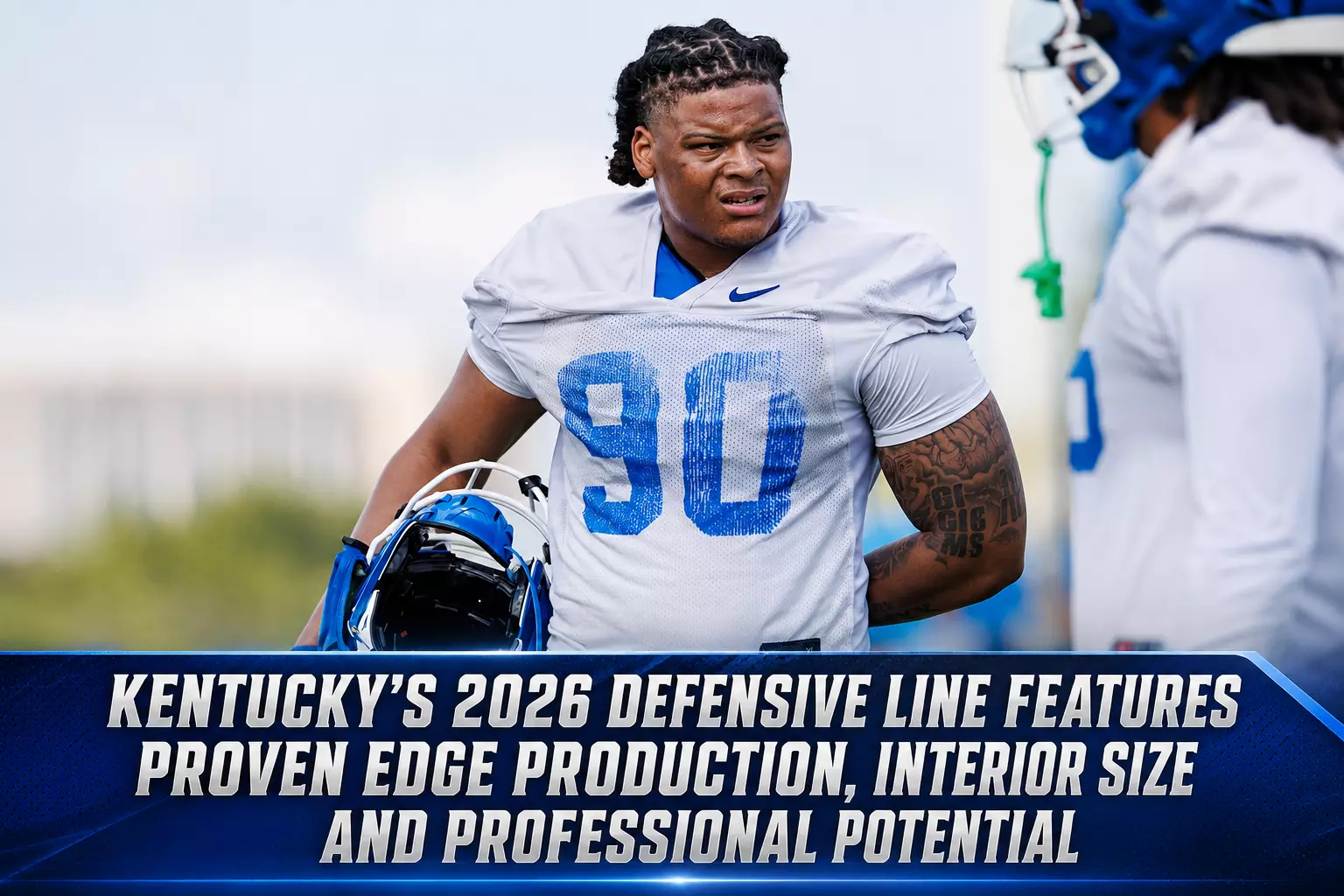
Kentucky’s 2026 Defensive Line Features Proven Edge Production, Interior Size and Professional Potential
The University of Kentucky
enters the 2026 season with a defensive front built around experience, size and several intriguing professional prospects.
Under first-year defensive coordinator Jay Bateman, Kentucky is expected to use a more aggressive system featuring additional four-man fronts. The change will require traditional defensive ends to play with their hands in the dirt while still incorporating stand-up pass rushers through the JACK position. Kentucky’s projected alignment separates the front into defensive end, defensive tackle, nose tackle and JACK responsibilities.
The Wildcats do not have a proven superstar comparable to some of the elite defensive linemen Kentucky has produced in previous seasons. However, they have assembled a potentially deep rotation featuring four experienced edge defenders, four athletic defensive tackles and two massive nose tackles.
Tavion Gadson and Mi’Quise Humphrey-Grace are the established leaders. Transfers Jamarrion Harkless, Ahmad Breaux, Dominic Wiseman and Tyler Thomas provide immediate experience, while Brian Robinson and Kalen Edwards represent the developmental upside of the group.
Defensive Ends
Mi’Quise Humphrey-Grace — No. 90
Position:
Defensive End
Height:
6’4”
Weight:
271 pounds
Class:
Senior
Hometown:
Cincinnati, Ohio
Previous School:
South Dakota
Background
Mi’Quise Humphrey-Grace enters the season as Kentucky’s most accomplished edge defender.
The Cincinnati Princeton graduate became one of the best defensive players at the FCS level during his time at South Dakota. In 2024, Humphrey-Grace recorded 59 tackles, 17 tackles for loss and 9.5 sacks while earning Missouri Valley Football Conference Defensive Player of the Year and multiple first-team All-America honors.
He transferred to Kentucky before the 2025 season and immediately became a starter. Humphrey-Grace recorded 31 tackles, a team-leading 7.5 tackles for loss, 3.5 sacks, six quarterback hurries, two pass breakups and one forced fumble.
Through his first four college seasons, he accumulated 128 tackles, 33.5 tackles for loss, 18.5 sacks, 20
quarterback
hurries and four forced fumbles.
Strengths
Humphrey-Grace has the best combination of production, experience and positional versatility in Kentucky’s defensive-line room.
He plays with excellent effort and consistently pursues the football from the backside. His 271-pound frame allows him to hold up against offensive tackles while maintaining enough quickness to attack gaps and chase mobile quarterbacks.
Humphrey-Grace also has experience playing several alignments. He can line up as a traditional defensive end, move inside on passing downs or rush from a stand-up position. Kentucky’s transition toward a more aggressive four-man front should allow him to attack instead of consistently reading and controlling multiple gaps.
His experience is another major strength. With 42 career appearances and 27 starts entering 2026, he understands blocking schemes and rarely appears overwhelmed by the speed of the game.
Weaknesses
Humphrey-Grace must turn more of his quarterback pressures into sacks. His production dropped from 9.5 sacks at South Dakota in 2024 to 3.5 during his first SEC season.
He can occasionally get too far upfield, creating running lanes underneath his pass rush. Improving his rush plan and developing a more effective inside counter would make him less predictable against experienced SEC offensive tackles.
There will also be questions about his top-end explosiveness. He wins through effort, strength and technique more than overwhelming first-step speed.
Professional Future
Humphrey-Grace has a legitimate opportunity to reach an NFL training camp.
A productive 2026 season could move him into the late-round or priority-free-agent conversation. His size, versatility, special-teams potential and established production should interest teams looking for a rotational defensive end capable of playing multiple alignments.
Should he not immediately secure an NFL roster position, Humphrey-Grace would project as an excellent UFL candidate. His physical style and ability to defend both the run and pass would also translate to indoor or arena football.
Current projection:
NFL priority free agent with late-round potential; strong UFL fallback.
Sam Greene began his career at USC before transferring to Kentucky.
He played in 15 games with three starts for the Trojans, recording 16 tackles, three tackles for loss and one sack. Greene became a full-time starter during his first season at Kentucky, starting nine games and producing 25 tackles, three tackles for loss, one sack, four quarterback hurries and one pass breakup.
His best performance came against Auburn when he recorded seven tackles, two tackles for loss, one sack, one pass breakup and one quarterback hurry.
Greene suffered a season-ending knee injury against Florida on November 8, 2025. He missed spring competition while rehabilitating, although spring reporting indicated he was progressing toward a potential return around the beginning of the season.
Strengths
Greene is one of Kentucky’s most dependable edge setters.
Although he is slightly undersized for a traditional SEC defensive end, he plays with good leverage and is willing to take on tight ends and offensive tackles. He uses his hands effectively to separate from blockers and has the awareness to locate the ball after establishing the edge.
Greene also brings positional versatility. He can play defensive end in an even front, stand up as the JACK linebacker or drop into short coverage. His discipline against the run could be especially important when Kentucky faces offenses built around outside zone and quarterback-read concepts.
His leadership was evident during his rehabilitation. Even while unable to participate fully in spring practice, Greene reportedly remained heavily involved as a player-coach within the position room.
Weaknesses
Health is the immediate concern. Greene must demonstrate that he has recovered his explosiveness, lateral movement and confidence following knee surgery.
His size may also limit his professional projection. At 6’2” and approximately 251 pounds, he does not possess ideal length for a full-time NFL defensive end. Longer offensive tackles can lock him out when he fails to win the initial hand battle.
Greene must also become a more productive pass rusher. Two sacks across his first three college seasons will not create significant NFL interest without a major increase in 2026.
Professional Future
Greene has enough athletic ability and versatility to earn professional consideration, but his future will depend heavily on his health and pass-rush production.
His most realistic NFL route would be as a special-teams contributor and hybrid linebacker who can provide depth on the edge. A breakout season could earn him a priority-free-agent opportunity.
His toughness and ability to defend the run would make him an attractive UFL player. His compact frame, motor and positional flexibility could also work well in indoor football.
Current projection:
NFL rookie-camp or priority-free-agent candidate; strong UFL and indoor potential.
Tyler Thomas — No. 97
Position:
Defensive End
Height:
6’5”
Weight:
260 pounds
Class:
Junior
Hometown:
Mobile, Alabama
Previous Schools:
South Alabama and UAB
Background
Tyler Thomas provides Kentucky with an experienced and physically developed transfer on the edge.
Thomas began his college career at UAB before transferring to South Alabama. He played in 28 games with four starts before arriving at Kentucky, recording 38 tackles, nine tackles for loss, 4.5 sacks, two forced fumbles and two quarterback hurries.
During the 2025 season, Thomas started four games for South Alabama and finished with 17 tackles, 3.5 tackles for loss and two sacks. He previously recorded 20 tackles, 3.5 tackles for loss, 2.5 sacks and two forced fumbles in 2024.
Strengths
Thomas possesses an attractive defensive-end frame. At 6’5” and 260 pounds, he has the length necessary to engage offensive tackles and disrupt passing lanes.
He has shown the ability to create turnovers by attacking the quarterback’s throwing arm and securing two forced fumbles during the 2024 season. Thomas also has enough experience to understand blocking combinations and should not need an extended adjustment period before joining Kentucky’s rotation.
His length gives him developmental pass-rushing potential. If he improves his hand placement and converts speed into power more consistently, he could become one of the surprises of the defense.
Weaknesses
Thomas has not yet produced consistently enough to be considered an established SEC starter. His 4.5 career sacks came across 28 games, and he has only four collegiate starts.
He must become stronger at the point of attack. Taller defensive ends sometimes play with an elevated pad level, allowing shorter offensive linemen to gain leverage underneath them. Thomas must bend his knees, maintain balance and avoid exposing his chest.
Developing a dependable secondary pass-rush move will also be important. He cannot rely exclusively on length and effort against SEC tackles.
Professional Future
Thomas has enough size to attract NFL evaluators, but he needs a productive season against SEC competition.
A season featuring six or more sacks and improved run defense could place him in the priority-free-agent conversation. Without that breakout, the UFL appears to be his most natural professional destination.
His height, length and ability to affect passing lanes could also create indoor opportunities, especially if he proves capable of moving inside in smaller defensive fronts.
Current projection:
Developmental NFL free agent or UFL defensive end.
Brian Robinson is the highest-upside developmental defensive end on Kentucky’s roster.
Robinson was a four-star prospect coming out of Westerville North High School. ESPN ranked him as the No. 14 edge defender nationally and the No. 3 overall prospect in Ohio.
He began his high school career as a quarterback before moving to defense. As a senior, Robinson recorded 58 tackles, seven tackles for loss, six sacks, one interception, one fumble recovery, one blocked field goal and five defensive touchdowns in only seven games.
He appeared in two games during his freshman season at Kentucky before redshirting and spent the 2025 season developing within the program.
Strengths
Robinson’s combination of length, athleticism and offensive background makes him one of Kentucky’s most intriguing young defenders.
His experience playing quarterback potentially helps him understand protections, backfield action and how offenses attempt to manipulate defenders. He has the movement skills to chase quarterbacks and running backs outside the pocket.
At 6’5” and 257 pounds, Robinson already possesses a strong physical foundation. He should be capable of adding more functional strength without sacrificing his athleticism.
His high school turnover production also demonstrates unusual instincts. Scoring five defensive touchdowns in seven games suggests he was more than simply a pass rusher; he consistently found the football and finished plays.
Weaknesses
Robinson remains largely unproven at the college level.
He must demonstrate that his athletic ability can translate into production against SEC offensive tackles. Playing quarterback early in his high school career also means he has fewer years of technical development as a defensive lineman than many players in his class.
Hand usage, pad level, run recognition and pass-rush sequencing remain developmental areas. Robinson cannot rely solely on being longer or more athletic than his opponent.
Professional Future
Robinson has one of the highest long-term ceilings in the group, but his professional evaluation should remain open.
If he develops into a productive SEC starter, his frame and athletic background could place him firmly on the NFL radar. He has the physical profile of a developmental draft prospect, but he needs meaningful college production before a reliable projection can be made.
Current projection:
Future NFL prospect based on physical upside; evaluation depends on development and playing time.
Tavion Gadson enters the 2026 season as Kentucky’s best professional prospect along the defensive front.
After battling a significant knee injury early in his career, Gadson emerged during the 2025 season. He appeared in 11 games with one start and recorded 28 tackles, four tackles for loss, 2.5 sacks and three quarterback hurries.
Gadson recorded four tackles against South Carolina, Georgia and Texas. His performance was particularly encouraging because it represented his first healthy and productive season at Kentucky.
Additional charting credited Gadson with 20 pressures on 345 defensive snaps in 2025. Kentucky’s more aggressive approach should allow him to attack gaps instead of being asked to control multiple blockers, making him a possible All-SEC breakout candidate.
Strengths
Gadson possesses outstanding length for an interior defender. At 6’5” and more than 300 pounds, he can extend his arms, create separation and disrupt passing lanes.
His pass-rushing ability separates him from the other defensive tackles. Gadson can collapse the pocket with power, but he also has enough quickness to attack a guard’s outside shoulder. That combination gives Kentucky a potential interior disruptor rather than simply a space-eating tackle.
He also plays with good pursuit effort for a 303-pound defender. Gadson does not stop when the play moves away from his initial gap.
Weaknesses
Durability remains the primary concern. Gadson’s early career was interrupted by knee problems, and Kentucky must manage his workload carefully.
He can also improve his leverage. His height becomes a disadvantage when shorter guards get underneath his pads. Maintaining a lower base would make him more consistent against double teams.
Gadson must now prove that his 2025 production was the beginning of a breakout rather than a single promising season. NFL scouts will want to see him maintain his effectiveness while handling a larger snap count.
Professional Future
Gadson has the strongest NFL outlook of Kentucky’s defensive linemen.
His length, size and interior pressure production give him the tools to play three-technique or strong-side defensive end in certain NFL systems. A healthy, productive 2026 season could elevate him into the middle rounds of the NFL Draft.
Even without a major statistical breakout, his physical traits should earn him an NFL opportunity.
Current projection:
Potential middle-to-late-round NFL Draft selection with a strong 2026 season.
Ahmad Breaux transferred to Kentucky after spending two seasons at LSU.
He appeared in 25 games with two starts for the Tigers, recording 36 tackles, four tackles for loss and half a sack. Breaux played in all 13 games as a true freshman and made consecutive starts against UCLA and South Alabama.
During the 2025 season, he recorded 19 tackles and 2.5 tackles for loss. Breaux originally arrived at LSU as one of Louisiana’s top defensive prospects after helping Ruston win a state championship.
Strengths
Breaux gives Kentucky an experienced three-technique tackle who has already competed against SEC offensive lines.
His quickness is more important than his size. At approximately 260 pounds, Breaux must win by penetrating gaps, defeating blocks early and disrupting plays before they develop.
He has experience playing significant snaps as both a freshman and sophomore. That background should allow him to contribute immediately without needing an extended developmental period.
Breaux also possesses enough movement ability to play defensive end in heavier packages or slide inside during passing situations.
Weaknesses
Breaux is undersized for a traditional SEC defensive tackle. Powerful guards can move him when they establish contact before he penetrates the gap.
He has also produced only half a sack in 25 career games. To become more than a rotational defender, he must finish more plays in the backfield.
Adding functional strength without losing quickness will be critical. Breaux must also show that he can withstand an increased snap count while facing double teams and downhill running attacks.
Professional Future
Breaux’s size could make his NFL evaluation difficult, but his experience and movement ability give him a chance.
His best professional role may be as a penetrating defensive tackle in an aggressive system. He could also receive consideration as a heavier defensive end.
The UFL appears to be a realistic path if he does not earn an NFL opportunity immediately. His quickness could translate effectively to indoor football, where he would have fewer blockers and more opportunities to attack.
Current projection:
NFL rookie-camp or undrafted-free-agent candidate; good UFL and indoor potential.
Jaden Williams began his career at Wyoming before transferring to Kentucky.
He has appeared in 29 college games with one start, accumulating 34 tackles, three tackles for loss, two sacks and seven quarterback hurries. Williams played in nine games for Kentucky during the 2025 season, finishing with 10 tackles, half a tackle for loss, half a sack and four quarterback hurries.
His best performance came against Florida when he recorded six tackles and two quarterback hurries.
Williams has experience at both nose tackle and three-technique, giving Kentucky another versatile rotational option.
Strengths
Williams provides experience, positional flexibility and dependable rotational depth.
At 6’4” and 290 pounds, he can play multiple interior alignments. He has enough size to handle early-down responsibilities but enough mobility to remain on the field in some passing situations.
His six-tackle performance against Florida demonstrated that he can make an impact when given extended playing time. Williams also produced four quarterback hurries despite playing a limited role in 2025.
Weaknesses
Williams must become more consistent. He has played nearly 30 college games but has only one career start and three tackles for loss.
He has not yet demonstrated a dominant individual trait. He is not the biggest nose tackle, the quickest interior rusher or the most productive lineman in the group.
Williams must improve his ability to disengage from blocks and finish plays. Becoming a dependable run defender would give him the clearest route to a larger role.
Professional Future
Williams’ experience and versatility could earn him an NFL rookie-camp invitation, but his current production projects more naturally toward the UFL.
A strong senior season featuring increased tackles for loss and interior pressure would improve his chances. His ability to play several positions should help him compete for opportunities in leagues with smaller rosters.
Current projection:
UFL prospect with NFL rookie-camp potential; possible indoor defensive lineman.
Dominic Wiseman — No. 96
Position:
Defensive Tackle
Height:
6’2”
Weight:
298 pounds
Class:
Senior
Hometown:
Davenport, Iowa
Previous Schools:
South Alabama and Iowa Western Community College
Background
Dominic Wiseman brings Kentucky an unusual combination of junior-college production and FBS starting experience.
Wiseman recorded 51 tackles, 17 tackles for loss and eight sacks during two seasons at Iowa Western. He helped the program reach consecutive national championship games and win a national title.
He transferred to South Alabama in 2025 and earned the starting defensive-tackle position for the final six games. Wiseman finished the season with 23 tackles, three tackles for loss, one sack and two quarterback hurries.
Strengths
Wiseman is a compact interior defender with a productive history.
His 6’2”, 298-pound frame gives him a naturally low center of gravity. He should be able to gain leverage against taller guards and centers while holding his position against the run.
Wiseman’s junior-college production shows that he can make plays behind the line of scrimmage when placed in favorable situations. He also demonstrated steady improvement at South Alabama, earning a starting role during the second half of the season.
His experience at multiple levels should make him prepared for competition and comfortable playing within a rotation.
Weaknesses
Wiseman must prove that his junior-college pass-rush production can translate against SEC blockers.
He recorded only three tackles for loss and one sack during his season at South Alabama. His shorter frame may also limit his ability to disrupt passing lanes or recover after losing the initial leverage battle.
Wiseman is an older prospect with one primary season to establish himself against Power Four competition. He needs immediate production rather than another developmental year.
Professional Future
Wiseman has the profile of a potential UFL defensive tackle.
His compact build, experience and ability to play nose tackle or one-technique should give him opportunities after college. A strong season against SEC competition could also earn him an NFL rookie-camp invitation or priority-free-agent consideration.
His leverage and interior quickness could make him an effective indoor player.
Current projection:
UFL defensive tackle with NFL rookie-camp and indoor possibilities.
Jamarrion Harkless returns home after beginning his college career at Purdue.
The former Frederick Douglass High School standout played in 22 games with 12 starts for the Boilermakers. He recorded 19 tackles, 2.5 tackles for loss and 2.5 sacks.
Harkless became a full-time starter in 2025, starting 12 games and producing 13 tackles, 2.5 sacks and four quarterback hurries. He previously helped Frederick Douglass win the 2022 Kentucky Class 5A state championship.
At approximately 346 pounds, Harkless is projected to become Kentucky’s primary nose tackle and one of the most important additions to the defense.
Strengths
Harkless possesses the size required to occupy multiple blockers and control the middle of the formation.
His value will not always appear in traditional statistics. By anchoring against double teams, Harkless can keep Kentucky’s linebackers clean and prevent offensive linemen from reaching the second level.
His 2.5 sacks during the 2025 season also suggest that he offers more pass-rushing potential than the average space-eating nose tackle. He can collapse the pocket when he maintains leverage and drives through the center.
Harkless has already handled a starting workload in the Big Ten, making him one of Kentucky’s most experienced interior defenders.
Weaknesses
Conditioning and snap-to-snap consistency will be essential.
At 346 pounds, Harkless must maintain his stamina and avoid becoming less effective during extended drives. Kentucky may need to rotate him frequently to preserve his explosiveness.
He also needs to increase his overall production. Nineteen tackles across 22 games is modest, even for a nose tackle whose primary job is occupying blockers.
Pad level will determine his effectiveness. When Harkless plays too high, offensive linemen can neutralize his size and turn him away from the running lane.
Professional Future
Harkless has rare size and a clearly defined professional role.
NFL teams continue to need powerful interior defenders capable of controlling early downs and short-yardage situations. If Harkless improves his conditioning and produces consistently in the SEC, he could become a late-round or priority-free-agent prospect.
His size would make him attractive to the UFL, although he may have fewer indoor opportunities than Kentucky’s quicker linemen because smaller-roster football rewards positional versatility.
Current projection:
Potential NFL nose tackle or priority free agent; high-level UFL prospect.
Kalen Edwards represents the future of Kentucky’s nose-tackle position.
Edwards appeared in five games as a freshman, recording five tackles and half a tackle for loss. He played offensive line, defensive line and
tight end
at Dyersburg High School and was rated as a four-star prospect by Rivals.
As a senior, Edwards recorded 35 tackles and 7.5 tackles for loss. During his junior season, he produced 47 tackles, 12 tackles for loss, two sacks, two forced fumbles and three blocked kicks while helping Dyersburg reach the state semifinals.
Strengths
Edwards has excellent developmental traits.
At 6’4” and 335 pounds, he possesses the size to play nose tackle in the SEC. His high school experience at several positions also suggests better movement skills than many players of his size.
His blocked-kick production demonstrates length, timing and explosiveness. Edwards also gained valuable experience as a true freshman instead of spending the entire season away from competitive action.
With Harkless handling the starting role, Kentucky can develop Edwards without forcing him to play an excessive number of snaps before he is ready.
Weaknesses
Edwards remains inexperienced and must continue developing his technique.
He cannot rely entirely on size. SEC guards and centers are strong enough to move large defenders who play with poor leverage or hand placement.
Conditioning will be another important area. Edwards must demonstrate that he can play multiple consecutive snaps without losing his pad level and explosiveness.
He also needs to develop a pass-rushing plan. Becoming more than an early-down run defender would dramatically increase his long-term value.
Professional Future
Edwards has legitimate long-term NFL potential, but he is several developmental steps away from a reliable projection.
His size, athletic background and early playing experience provide an excellent foundation. If he becomes Kentucky’s full-time starter in future seasons and develops into a disruptive interior defender, professional teams will become interested.
Current projection:
Developmental future NFL prospect with significant UFL potential.
Projected Rotation
Kentucky’s likely starting front would feature Mi’Quise Humphrey-Grace at defensive end, Sam Greene at JACK when healthy, Tavion Gadson at defensive tackle and Jamarrion Harkless at nose tackle.
Tyler Thomas and Brian Robinson should compete for defensive-end snaps. Ahmad Breaux projects as the first penetrating tackle off the bench, while Dominic Wiseman and Jaden Williams provide experience at multiple interior positions. Kalen Edwards gives Kentucky a second massive nose tackle who can spell Harkless on early downs.
The Wildcats can also create specialized passing-down combinations. Gadson could move inside next to Breaux, with Humphrey-Grace and Thomas attacking from the edges. That grouping would sacrifice some size but provide Kentucky with its most athletic four-man rush.
Overall Strengths
Kentucky’s greatest strength is its variety.
The Wildcats have traditional defensive ends, hybrid JACK linebackers, penetrating three-technique tackles and two nose tackles weighing more than 330 pounds. That gives Bateman the personnel to change fronts without making wholesale substitutions.
The group also has extensive college experience. Humphrey-Grace, Greene, Thomas, Breaux, Williams, Wiseman and Harkless have all played meaningful snaps at the FBS or FCS level.
Gadson provides potential star power, while Robinson and Edwards offer developmental upside beyond the 2026 season.
Overall Concerns
Kentucky does not have many proven SEC pass rushers.
Humphrey-Grace led the team with only 3.5 sacks in 2025, while several members of the projected rotation have never recorded more than three sacks in a college season. The Wildcats need Gadson, Humphrey-Grace or one of the transfers to emerge as a consistent pocket disruptor.
Health is another concern. Gadson has a history of knee trouble, and Greene is returning from knee surgery.
The interior rotation is deep, but much of that depth remains unproven against SEC competition. Kentucky is depending on transfers from Purdue, LSU and South Alabama to adapt quickly.
Conclusion
Kentucky’s 2026 defensive line has the potential to become one of the most improved position groups on the roster.
The Wildcats have an established edge defender in Mi’Quise Humphrey-Grace, a rising NFL prospect in Tavion Gadson and a massive starting nose tackle in Jamarrion Harkless. Tyler Thomas, Ahmad Breaux and Dominic Wiseman provide valuable transfer experience, while Brian Robinson and Kalen Edwards give the program two young players with considerable upside.
This group’s success will ultimately depend on three factors: keeping Gadson and Greene healthy, creating more sacks and receiving immediate production from the transfer additions.
Gadson currently has the clearest path to being selected in the NFL Draft. Humphrey-Grace and Harkless also have realistic NFL opportunities, while several other members of the rotation could continue their careers in the UFL or indoor football.
Kentucky may not enter the season with the SEC’s most decorated defensive line, but the Wildcats have enough size, experience and versatility to become difficult to block. If the new aggressive system creates more one-on-one opportunities, this defensive front could become one of the foundations of Kentucky’s rebuilding effort in 2026.
New Users – Get $350 in Bonus Bets when you wager $5 for 7 days
T&Cs apply
4.6/5
Gambling Problem? Call 1-800-GAMBLER or 1-800-MY-RESET. Call 1-888-789-7777 or visit ccpgg.org/chat (CT). Hope is here. GamblingHelpLineMA.org or call (800) 327-5050 for 24/7 support (MA). Visit www.mdgamblinghelp.org (MD). Call 1-877-8HOPE-NY or text HOPENY (NY). 21+ (18+ DC, WY) and present in select states (for KS, in affiliation with Kansas Star Casino). Find online real money wagering only. Min $5 wager required for 7 consecutive days. $5 free play credit. Bonus issued as non-withdrawable bonus with cash withdrawable bonus with cash withdrawable. Bonus bets which expire 7 days after receipt. Restrictions apply. See terms at sportsbook.fanduel.com. Call 1-877-770-7867 (LA).
Up To $1500 in Bonus Bets Paid Back if your First Bet Does Not Win
T&Cs apply
4.5/5
Gambling problem? Call 1-800-GAMBLER or 1-800-MY-RESET (Available in the US) 877-8-HOPENY or text HOPENY (467369) (NY) 1-800-327-5050 (MA), 1-800-BETS-OFF (IA), 1-800-981-0023 (PR). 21+ only. Please Gamble Responsibly. See BetMGM.com for Terms. First Bet Offer for new customers only (if applicable). Subject to eligibility requirements. Bonus bets are non-withdrawable. In partnership with Kansas Crossing Casino and Hotel. Promotional offers not available in Mississippi, Massachusetts, New York, Ontario, or Puerto Rico.
New DraftKings Customers: Bet $5, Get $200 + 3 Months of NBA League Pass!
T&Cs apply
4.5/5
GAMBLING PROBLEM? CALL 1-800-GAMBLER or 1-800-MY-RESET, (800) 327-5050 or visit gamblinghelplinema.org (MA). Please Gamble Responsibly. 888-789-7777/visit ccpg.org (CT), or visit www.mdgamblinghelp.org (MD), 1-800-981-0023 (PR). 21+ and present in most states. (18+ DC/NH/PR/WY). Void in CAN. Eligibility restrictions apply. On behalf of Boot Hill Casino (KS). Pass-thru of per wager tax may apply in IL. 1 per new Sportsbook customer. $5+ first-time bet req. Max. $200 issued as non-withdrawable Bonus Bets. Stake removed from payout. Reward issued as $50 in Bonus Bets every 7 days via click-to-claim for 21 days. Bonus Bets and click-to-claims expire 7 days (168hrs) after issuance. Terms: dkng.co/offer. Get 1 promo code to redeem a 3-month NBA League Pass subscription, complimentary of DraftKings. Subscription auto-renews monthly at then-current price (currently $16.99/mo); cancel anytime. Terms, restrictions, and eligibility requirements apply. Redeem League Pass by 12/19/26 at 11:59 PM ET. Addt’l terms: support.watch.nba.com/hc/en-us/articles/9165532876183-League-Pass-Terms-of-Use_. Ends 11/29/26 at 11:59 PM ET. Sponsored by DK.
Must be 21+. GAMBLING PROBLEM? CALL 1-800-GAMBLER OR CALL 1-800-MY-RESET, www.mdgamblinghelp.org (MD), (800)-327-5050 or gamblinghelplinema.org (MA), Call (877)8-HOPENY or text HOPENY (467369) (NY), (888) 789-7777 or ccpg.org (CT), morethanagame.nc.gov (NC), 1800gambler.net (WV)
Bet $1 and get double the winnings up to $25 for your next 10 bets
T&Cs apply
4.4/5
21+ New users only. Must register using eligible promo code. First bet after registration must qualify. Max. Bonus Bet: $1,000. Bonus Bet expires 14 days after receipt. Void where prohibited. See Caesars.com/promos for full terms. Gambling Problem? 1-800-GAMBLER (1-800-426-2537)
21+ and present in OH. Gambling Problem? Call 1-800-GAMBLER.
This site is using
Cloudflare
and adheres to the
Google Safe Browsing Program. We adapted
Google's Privacy Guidelines
to keep your data safe at all times.
Close
Ready to Win Big? Join the Elite with Our Sports Betting Deals!
FanDuel Promo
New Users – Get $350 in Bonus Bets when you wager $5 for 7 days
Our Favorite
T&Cs and 21+ apply
Gambling Problem? Call 1-800-GAMBLER or 1-800-MY-RESET. Call 1-888-789-7777 or visit ccpgg.org/chat (CT). Hope is here. GamblingHelpLineMA.org or call (800) 327-5050 for 24/7 support (MA). Visit www.mdgamblinghelp.org (MD). Call 1-877-8HOPE-NY or text HOPENY (NY). 21+ (18+ DC, WY) and present in select states (for KS, in affiliation with Kansas Star Casino). Find online real money wagering only. Min $5 wager required for 7 consecutive days. $5 free play credit. Bonus issued as non-withdrawable bonus with cash withdrawable bonus with cash withdrawable. Bonus bets which expire 7 days after receipt. Restrictions apply. See terms at sportsbook.fanduel.com. Call 1-877-770-7867 (LA).
Code:
Open FanDuel
Get Bonus
BetMGM Promo
Up To $1500 in Bonus Bets Paid Back if your First Bet Does Not Win
Best Slots
T&Cs and 21+ apply
Gambling problem? Call 1-800-GAMBLER or 1-800-MY-RESET (Available in the US) 877-8-HOPENY or text HOPENY (467369) (NY) 1-800-327-5050 (MA), 1-800-BETS-OFF (IA), 1-800-981-0023 (PR). 21+ only. Please Gamble Responsibly. See BetMGM.com for Terms. First Bet Offer for new customers only (if applicable). Subject to eligibility requirements. Bonus bets are non-withdrawable. In partnership with Kansas Crossing Casino and Hotel. Promotional offers not available in Mississippi, Massachusetts, New York, Ontario, or Puerto Rico.
Code:
Open BetMGM
Get Bonus
DraftKings Promo
New DraftKings Customers: Bet $5, Get $200 + 3 Months of NBA League Pass!
Newcomer
T&Cs and 21+ apply
GAMBLING PROBLEM? CALL 1-800-GAMBLER or 1-800-MY-RESET, (800) 327-5050 or visit gamblinghelplinema.org (MA). Please Gamble Responsibly. 888-789-7777/visit ccpg.org (CT), or visit www.mdgamblinghelp.org (MD), 1-800-981-0023 (PR). 21+ and present in most states. (18+ DC/NH/PR/WY). Void in CAN. Eligibility restrictions apply. On behalf of Boot Hill Casino (KS). Pass-thru of per wager tax may apply in IL. 1 per new Sportsbook customer. $5+ first-time bet req. Max. $200 issued as non-withdrawable Bonus Bets. Stake removed from payout. Reward issued as $50 in Bonus Bets every 7 days via click-to-claim for 21 days. Bonus Bets and click-to-claims expire 7 days (168hrs) after issuance. Terms: dkng.co/offer. Get 1 promo code to redeem a 3-month NBA League Pass subscription, complimentary of DraftKings. Subscription auto-renews monthly at then-current price (currently $16.99/mo); cancel anytime. Terms, restrictions, and eligibility requirements apply. Redeem League Pass by 12/19/26 at 11:59 PM ET. Addt’l terms: support.watch.nba.com/hc/en-us/articles/9165532876183-League-Pass-Terms-of-Use_. Ends 11/29/26 at 11:59 PM ET. Sponsored by DK.
Code:
Open DraftKings
Get Bonus
Find out what the legends have to say about sports this week....
New Users – Get $350 in Bonus Bets when you wager $5 for 7 days
Gambling Problem? Call 1-800-GAMBLER or 1-800-MY-RESET. Call 1-888-789-7777 or visit ccpgg.org/chat (CT). Hope is here. GamblingHelpLineMA.org or call (800) 327-5050 for 24/7 support (MA). Visit www.mdgamblinghelp.org (MD). Call 1-877-8HOPE-NY or text HOPENY (NY). 21+ (18+ DC, WY) and present in select states (for KS, in affiliation with Kansas Star Casino). Find online real money wagering only. Min $5 wager required for 7 consecutive days. $5 free play credit. Bonus issued as non-withdrawable bonus with cash withdrawable bonus with cash withdrawable. Bonus bets which expire 7 days after receipt. Restrictions apply. See terms at sportsbook.fanduel.com. Call 1-877-770-7867 (LA).