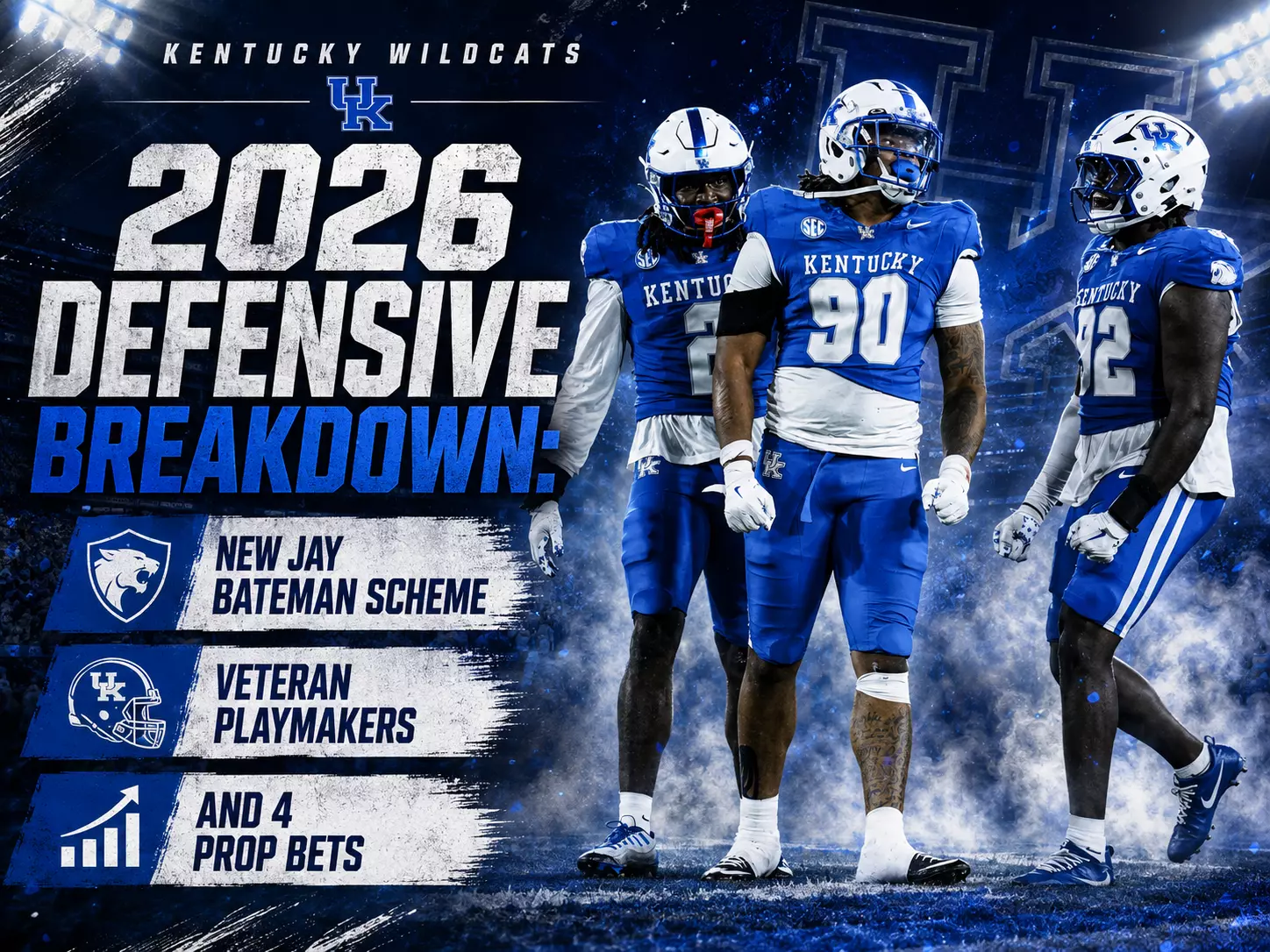
Kentucky Wildcats 2026 Defensive Breakdown: New Jay Bateman Scheme, Veteran Playmakers and 4 Prop Bets
The
Kentucky Wildcats enter the 2026 college football season with a new head coach, a new defensive coordinator and a significantly reconstructed roster.
But Kentucky isn’t starting completely over defensively.
There are legitimate building blocks.
Ty Bryant
returns after leading Kentucky with 76 tackles and leading the entire SEC with four interceptions.
Mi’Quise Humphrey-Grace
returns after leading the Wildcats with 7.5 tackles for loss and tying for the team lead with 3.5 sacks.
Tavion Gadson
returns along the defensive front after producing 28 tackles, four tackles for loss and 2.5 sacks.
And Kentucky supplemented that group with experienced transfers such as
Antonio O’Berry
and
Hasaan Sykes.
The bigger change comes from the coaching staff.
First-year head coach
Will Stein
hired veteran defensive coordinator
Jay Bateman, who brings more than 30 years of coaching experience and has previously coordinated defenses at Texas A&M, North Carolina and Army. Bateman said Kentucky’s new system will incorporate concepts from his previous stops at Texas A&M, Florida, North Carolina and Army rather than simply copying one scheme.
That versatility should become one of Kentucky’s defining characteristics.
The Wildcats need improvement.
Kentucky finished 5-7 last season while allowing
26.4 points and approximately 374.2 total yards per game. Opponents averaged 134.3 rushing yards and 239.9 passing yards per game. The defense generated
25 sacks and 12 interceptions.
Those numbers weren’t disastrous.
They also weren’t consistently good enough to survive an SEC schedule.
Kentucky’s defense demonstrated significant potential at times.
The Wildcats held Auburn to three points.
They held Florida to seven.
They forced Texas into a 16-13 game.
But Kentucky also surrendered 56 points to Tennessee, 45 at Vanderbilt and 41 at Louisville.
That inconsistency is what Bateman must eliminate.
If the Wildcats can combine an improved pass rush with one of the SEC’s best returning defensive backs and a deep defensive front, Kentucky could make meaningful defensive progress during Stein’s first season.
Kentucky Wildcats 2026 Defensive Projections
Projected Record:
5-7
Projected Points Allowed Per Game:
24-26
Projected Total Defense:
350-365 yards per game
Projected Rushing Defense:
125-135 yards per game
Projected Passing Defense:
225-235 yards per game
Projected Team Sacks:
29-33
Projected Interceptions:
12-14
Projected Total Takeaways:
18-21
Projected Tackles for Loss:
65-75
Biggest Defensive Strength:
Defensive Front and Secondary Playmakers
Biggest Defensive Question:
Can Kentucky’s new linebackers and defensive system develop quickly enough for SEC play?
Jay Bateman’s New Kentucky Defense
The most important addition to Kentucky’s defense may be
Jay Bateman.
Bateman has coached for more than three decades and arrives in Lexington after previously serving as defensive coordinator at Texas A&M.
His new Kentucky defense won’t simply reproduce one of his previous systems.
Bateman said during spring practice that he planned to take concepts from what worked at Texas A&M, combine them with ideas he learned while working alongside Patrick Toney and Austin Armstrong at Florida, and mix in elements from his defenses at North Carolina and Army.
That should make Kentucky difficult to define with one simple formation.
Personnel versatility will matter.
Kentucky has bigger defensive linemen capable of controlling the interior.
It has athletic edge players.
It has defensive backs who can tackle.
And it has multiple players who can potentially move between traditional positional responsibilities.
Bateman was particularly encouraged by the defensive front during spring practice and singled out Ty Bryant as an elite leader and high-level player.
The roster turnover is substantial.
Stein said Kentucky added
34 January transfer-portal players, including 14 on defense.
That creates two competing realities.
Kentucky has more experience than a normal rebuilding team because many newcomers have already played significant college football.
But playing experience isn’t the same thing as experience playing together.
Bateman must build chemistry.
Assignments must become automatic.
Communication must improve.
And Kentucky needs to generate more consistent quarterback pressure.
The Wildcats recorded only
25 sacks in 2025, averaging 2.08 per game.
With Humphrey-Grace returning, O’Berry arriving and CJ Works potentially taking a major step forward, that number should increase.
Kentucky Defensive Line Breakdown
Kentucky’s defensive line has a chance to become one of the strengths of the football team.
It starts with
Mi’Quise Humphrey-Grace.
Humphrey-Grace transferred from South Dakota before the 2025 season and immediately became one of Kentucky’s most disruptive defenders.
He started all 12 games and finished with
31 tackles, a team-high 7.5 tackles for loss, a team-high-tying 3.5 sacks, six quarterback hurries, two pass breakups and a forced fumble.
Those numbers only tell part of the story.
Humphrey-Grace has been productive throughout his college career.
He enters 2026 with
128 career tackles, 33.5 tackles for loss and 18.5 sacks.
His 2024 season at South Dakota was exceptional.
Humphrey-Grace recorded 17 tackles for loss and 9.5 sacks while earning Missouri Valley Football Conference Defensive Player of the Year honors and multiple All-America selections.
That previous pass-rushing production matters.
He already demonstrated that he can dominate at one level.
Last season proved he can still create negative plays against SEC competition.
The next challenge is turning those 3.5 Kentucky sacks into five or six.
Then there is
Tavion Gadson.
At 6-foot-5 and 303 pounds, Gadson provides the size Kentucky needs inside.
He appeared in 11 games last season and recorded
28 tackles, four tackles for loss, 2.5 sacks and three quarterback hurries.
Those were encouraging numbers considering he only started once.
Gadson should have an opportunity to assume a considerably larger role in 2026.
Kentucky also has veteran
Jaden Williams, massive interior defender
Jamarrion Harkless, Dominic Wiseman and several younger players competing for snaps.
Wiseman brings starting experience from South Alabama, where he recorded 23 tackles, three tackles for loss and a sack in 2025 after previously producing 17 tackles for loss and eight sacks during his junior-college career.
That gives defensive-line coach
Anwar Stewart
options.
Kentucky doesn’t have to ask the same three defensive linemen to play every meaningful snap.
Stewart, who remains on the staff under Stein, has developed multiple future NFL defensive linemen during his Kentucky tenure.
Depth should be especially valuable during the SEC schedule.
Alabama.
Texas A&M.
LSU.
Oklahoma.
Tennessee.
Those teams will test Kentucky physically.
If Gadson controls the interior and Humphrey-Grace consistently gets into opposing backfields, the Wildcats will have a chance to remain strong against the run while improving their pass rush.
Kentucky Edge-Rusher Breakdown
This may be the position group with the highest upside.
Antonio O’Berry
is one of Kentucky’s most intriguing transfer additions.
The Dayton, Ohio native arrives after two seasons at Gardner-Webb and three at Tiffin.
O’Berry started all 12 games for Gardner-Webb last season and produced
52 tackles, 10.5 tackles for loss, 4.5 sacks, seven pass breakups and a team-high 14 quarterback hurries.
He also forced two fumbles and recovered two while earning First-Team All-OVC-Big South honors.
And that wasn’t his first productive pass-rushing season.
O’Berry recorded
seven sacks in 2024
at Gardner-Webb and
8.5 sacks in 2023
at Tiffin.
The competition becomes substantially more difficult in the SEC.
Nobody should automatically project O’Berry to produce seven or eight sacks against Power Four offensive tackles.
But the pass-rushing ability is real.
He knows how to attack quarterbacks.
He knows how to finish plays.
And Kentucky doesn’t need him to dominate every snap.
Humphrey-Grace demands attention.
Gadson can generate interior pressure.
That should create one-on-one opportunities.
Then there is
CJ Works.
Works may become Kentucky’s breakout defender.
The former four-star recruit appeared in all 12 games as a true freshman, recording 16 tackles and two tackles for loss. He was ranked as the nation’s No. 11 edge prospect by 247Sports coming out of high school.
At 6-foot-5 and 247 pounds, Works possesses the physical profile necessary to become a disruptive SEC pass rusher.
His freshman season wasn’t about statistics.
It was about development.
Now the opportunity increases.
Kentucky can rotate O’Berry, Works, Humphrey-Grace and other front-seven defenders through multiple pressure packages.
That should create considerably more uncertainty for opposing offensive lines.
The Wildcats produced 25 sacks last season.
A jump into the low 30s is realistic.
Projected Kentucky Team Sacks: 29-33
Kentucky Linebacker Breakdown
Linebacker may be the biggest unknown on Kentucky’s defense.
The Wildcats have size.
They have athleticism.
They have options.
What they don’t have is the same level of established SEC production found at several other positions.
Grant Godfrey
gives Kentucky veteran experience inside.
Tavion Wallace
enters his sophomore season with tremendous physical upside.
Kentucky also added
Quintavion Norman
and has Devin Smith and younger players competing for roles.
Stein specifically praised the physical traits of Kentucky’s linebacker additions during his January press conference, pointing to their combination of size and speed and saying the staff believed they fit what SEC linebackers need to look like.
Still, this is where projection becomes difficult.
Kentucky knows what it has in Ty Bryant.
It knows Humphrey-Grace can create tackles for loss.
It knows Gadson can compete against SEC offensive linemen.
The inside linebacker rotation must establish itself.
That matters because Bateman’s defense will ask linebackers to process quickly.
They must fit the run.
Carry coverage responsibilities.
Communicate with the defensive line.
Identify offensive shifts.
And occasionally attack the quarterback.
Kentucky’s front can make their job easier.
If Gadson and the interior linemen occupy blockers, the linebackers should have cleaner paths to the football.
If O’Berry, Works and Humphrey-Grace generate pressure, linebackers won’t have to remain in coverage for as long.
But against Alabama, Texas A&M, LSU and Tennessee, hesitation becomes dangerous.
This group doesn’t necessarily need an All-SEC superstar.
It needs consistency.
If Kentucky gets that, the defense becomes much more complete.
Mi’Quise Humphrey-Grace may be Kentucky’s most important front-seven defender in 2026.
His versatility gives Bateman options.
Humphrey-Grace is listed at 6-foot-4 and 271 pounds.
He can play along the defensive line.
He can attack from the edge.
He can reduce inside in passing situations.
And his production shows that he understands how to create negative plays.
His career totals are impressive.
33.5 tackles for loss.
18.5 sacks.
20 quarterback hurries.
Four forced fumbles.
Kentucky needs more of that production to translate into sacks.
Humphrey-Grace led the Wildcats with 7.5 tackles for loss last season, but his 3.5 sacks were well below the 9.5 he accumulated at South Dakota in 2024.
The SEC explains part of that difference.
Offensive tackles are better.
Quarterbacks release the football faster.
Protection schemes are more sophisticated.
But the new defensive system could create additional opportunities.
Instead of asking Humphrey-Grace to attack from the same location repeatedly, Kentucky can move him and create favorable matchups.
O’Berry’s arrival should help.
Works’ development should help.
If offenses have to account for pressure from both edges, Humphrey-Grace becomes considerably more difficult to isolate.
Mi’Quise Humphrey-Grace Projection: 35-42 tackles, 9-11 tackles for loss, 5-6 sacks and multiple quarterback pressures per game stretch.
Kentucky Secondary Breakdown
Kentucky’s secondary begins with one of the best returning defensive backs in the SEC.
Ty Bryant
had a tremendous 2025 season.
The Lexington native started all 12 games and led Kentucky with
76 tackles.
Even more impressively, he intercepted
four passes, leading both Kentucky and the SEC.
Bryant earned Second-Team All-SEC recognition from the league’s coaches.
He made impact plays in major games.
Bryant intercepted Ole Miss twice.
He intercepted Florida.
He intercepted Vanderbilt.
And he finished the year with 12 tackles against Louisville.
That combination of tackling production and ball skills makes him extremely valuable.
Stein made keeping Bryant one of Kentucky’s offseason priorities, calling him a program builder, leader and all-conference player. Bateman also identified Bryant as an elite leader during spring practice.
Bryant won’t be alone.
Terhyon Nichols
could become one of Kentucky’s biggest breakout players if he stays healthy.
Nichols made six starts in 2025 but missed the final five games with an injury.
Despite appearing in only seven games, he finished with
18 tackles and a team-high five pass breakups.
That is significant.
Nichols has already shown the ability to challenge receivers.
Health is the biggest question.
If he can play a complete season, Kentucky potentially has a legitimate high-level corner opposite its other newcomers.
One of those newcomers is
Hasaan Sykes.
Sykes transferred from Western Carolina after starting 11 games in 2025 and recording
49 tackles, four tackles for loss, two sacks, five pass breakups and three interceptions.
That gives Kentucky another defensive back with proven ball production.
The Wildcats also added several experienced Power Four defensive backs, creating considerably more competition throughout the secondary.
Kentucky intercepted 12 passes last season.
Bryant accounted for one-third of them.
Maintaining that total will require somebody else to emerge.
Sykes is an obvious candidate.
Nichols can create opportunities if he remains healthy.
And increased quarterback pressure should create rushed throws.
Projected Kentucky Interceptions: 12-14
Four Kentucky Wildcats 2026 Defensive Prop Bets
Note:
Kentucky’s full-season defensive player and team statistical props are not consistently offered at every sportsbook. The numbers below should therefore be treated as
projection-based betting benchmarks, not as claims that every sportsbook currently offers these exact markets.
Prop Bet #1: Kentucky Over 27.5 Team Sacks
DraftKings
4.5/5
Tip: Kentucky Over 27.5 Team Sacks
Jay Bateman’s New Defense
Antonio O’Berry Adds Proven Production
Humphrey-Grace and Works Provide Upside
New DraftKings Customers: Bet $5, Get $200 + 3 Months of NBA League Pass!
Get bonus now
GAMBLING PROBLEM? CALL 1-800-GAMBLER or 1-800-MY-RESET, (800) 327-5050 or visit gamblinghelplinema.org (MA). Please Gamble Responsibly. 888-789-7777/visit ccpg.org (CT), or visit www.mdgamblinghelp.org (MD), 1-800-981-0023 (PR). 21+ and present in most states. (18+ DC/NH/PR/WY). Void in CAN. Eligibility restrictions apply. On behalf of Boot Hill Casino (KS). Pass-thru of per wager tax may apply in IL. 1 per new Sportsbook customer. $5+ first-time bet req. Max. $200 issued as non-withdrawable Bonus Bets. Stake removed from payout. Reward issued as $50 in Bonus Bets every 7 days via click-to-claim for 21 days. Bonus Bets and click-to-claims expire 7 days (168hrs) after issuance. Terms: dkng.co/offer. Get 1 promo code to redeem a 3-month NBA League Pass subscription, complimentary of DraftKings. Subscription auto-renews monthly at then-current price (currently $16.99/mo); cancel anytime. Terms, restrictions, and eligibility requirements apply. Redeem League Pass by 12/19/26 at 11:59 PM ET. Addt’l terms: support.watch.nba.com/hc/en-us/articles/9165532876183-League-Pass-Terms-of-Use_. Ends 11/29/26 at 11:59 PM ET. Sponsored by DK.
Why the Over Is a Good Bet
Kentucky recorded
25 sacks in 2025.
The Wildcats only need three more sacks to clear this benchmark.
There are multiple reasons to expect improvement.
Humphrey-Grace returns after tying for the team lead with 3.5 sacks.
O’Berry arrives after recording 4.5 sacks and 14 quarterback hurries at Gardner-Webb.
Works is entering his second collegiate season after appearing in every game as a freshman.
Gadson contributed 2.5 sacks from the interior last season.
Kentucky also has a new coordinator capable of creating different pressure looks.
The Wildcats don’t need one defender to produce 10 sacks.
If Humphrey-Grace reaches five or six, O’Berry produces four or five and Works takes a significant second-year step, Kentucky could comfortably reach 30.
Why the Under Is a Good Bet
The SEC schedule is brutal.
Kentucky faces
Alabama, Texas A&M, South Carolina, LSU, Oklahoma, Vanderbilt, Tennessee, Florida and Missouri
in conference play.
Several of those teams will possess experienced offensive lines and quarterbacks capable of getting the football out quickly.
There is also a projection risk with O’Berry.
His production came at Gardner-Webb and Tiffin.
SEC offensive tackles represent a major increase in competition.
Works remains young.
And Bateman is installing a new defense with a roster containing numerous transfer players.
Pressure may increase without every pressure becoming a sack.
Projection: 29-33 Team Sacks
Bet: Over 27.5 Team Sacks
Confidence: 8/10
Prop Bet #2: Kentucky Over 11.5 Interceptions
FanDuel
4.6/5
Tip: Kentucky Over 11.5 Interceptions
12 INTs Last Season
SEC INT Leader Ty Bryant Returns
Hasaan Sykes Adds Three-INT Production
New Users – Get $350 in Bonus Bets when you wager $5 for 7 days
Get bonus now
Gambling Problem? Call 1-800-GAMBLER or 1-800-MY-RESET. Call 1-888-789-7777 or visit ccpgg.org/chat (CT). Hope is here. GamblingHelpLineMA.org or call (800) 327-5050 for 24/7 support (MA). Visit www.mdgamblinghelp.org (MD). Call 1-877-8HOPE-NY or text HOPENY (NY). 21+ (18+ DC, WY) and present in select states (for KS, in affiliation with Kansas Star Casino). Find online real money wagering only. Min $5 wager required for 7 consecutive days. $5 free play credit. Bonus issued as non-withdrawable bonus with cash withdrawable bonus with cash withdrawable. Bonus bets which expire 7 days after receipt. Restrictions apply. See terms at sportsbook.fanduel.com. Call 1-877-770-7867 (LA).
Why the Over Is a Good Bet
Kentucky intercepted
12 passes last season.
The Wildcats return the player responsible for four of them.
Ty Bryant led the SEC with four interceptions.
Sykes arrives after recording three interceptions at Western Carolina.
Nichols has already demonstrated strong ball-disruption ability with five pass breakups in only seven games last season.
The pass rush could also improve.
More pressure means quarterbacks have less time.
Less time produces hurried decisions.
Hurried decisions create turnover opportunities.
Kentucky only needs to match last season’s 12 interceptions to cash an Over 11.5 benchmark.
Why the Under Is a Good Bet
Interceptions are unpredictable.
Bryant’s four-interception season was outstanding, but opponents now know exactly how dangerous he is.
Quarterbacks may become more reluctant to challenge his area of the field.
Sykes must prove his FCS interception production translates to SEC competition.
Kentucky also has new defensive personnel learning Bateman’s coverage system.
Communication mistakes could turn interception opportunities into completions.
And the schedule contains several quarterbacks and offensive systems capable of protecting the football.
Kentucky could improve its overall pass defense and still finish with only nine or 10 interceptions.
Projection: 12-14 Interceptions
Bet: Over 11.5 Interceptions
Confidence: 7/10
Prop Bet #3: Ty Bryant Over 2.5 Interceptions
Caesars
4.4/5
Tip: Ty Bryant Over 2.5 Interceptions
Led SEC With Four INTs
Proven Ball Skills
Veteran Leader in New Secondary
Bet $1 and get double the winnings up to $25 for your next 10 bets
–
21+ New users only. Must register using eligible promo code. First bet after registration must qualify. Max. Bonus Bet: $1,000. Bonus Bet expires 14 days after receipt. Void where prohibited. See Caesars.com/promos for full terms. Gambling Problem? 1-800-GAMBLER (1-800-426-2537)
Why the Over Is a Good Bet
Bryant has already surpassed this number.
He intercepted
four passes in 2025, leading the SEC.
And those interceptions weren’t all accumulated against inferior competition.
He picked off Ole Miss twice.
He intercepted Florida.
He intercepted Vanderbilt.
Bryant now enters his senior season with substantial starting experience and should serve as the leader of Kentucky’s secondary.
The potential increase in pass rush matters, too.
If Humphrey-Grace, O’Berry and Works consistently force quarterbacks off their preferred timing, Bryant should get opportunities to attack poorly placed throws.
Three interceptions isn’t an outrageous target.
He doesn’t need to reproduce last year’s four.
He needs three.
Why the Under Is a Good Bet
This is exactly the kind of statistic that can regress even when a player performs well.
Bryant may become a better defensive back and intercept fewer passes.
Opposing offensive coordinators now have an entire season of film showing what he can do.
Quarterbacks may simply stop attacking him.
There is also randomness involved.
A tipped pass goes somewhere else.
A quarterback throws away from coverage.
A potential interception gets dropped.
Kentucky’s improved defensive-back depth could also distribute interceptions among more players.
Sykes, Nichols and others may take opportunities that would have gone to Bryant last season.
Projection: 3-4 Interceptions
Bet: Over 2.5 Interceptions
Confidence: 7/10
Prop Bet #4: Mi’Quise Humphrey-Grace Over 4.5 Sacks
BetMGM
4.5/5
Tip: Mi’Quise Humphrey-Grace Over 4.5 Sacks
18.5 Career Sacks
9.5-Sack Season in 2024
More Pass-Rush Help Around Him
Up To $1500 in Bonus Bets Paid Back if your First Bet Does Not Win
Get bonus now
Gambling problem? Call 1-800-GAMBLER or 1-800-MY-RESET (Available in the US) 877-8-HOPENY or text HOPENY (467369) (NY) 1-800-327-5050 (MA), 1-800-BETS-OFF (IA), 1-800-981-0023 (PR). 21+ only. Please Gamble Responsibly. See BetMGM.com for Terms. First Bet Offer for new customers only (if applicable). Subject to eligibility requirements. Bonus bets are non-withdrawable. In partnership with Kansas Crossing Casino and Hotel. Promotional offers not available in Mississippi, Massachusetts, New York, Ontario, or Puerto Rico.
Why the Over Is a Good Bet
Humphrey-Grace has already proven that he can produce sacks at a high level.
He enters 2026 with
18.5 career sacks.
He recorded
9.5 sacks at South Dakota in 2024
before producing 3.5 during his first season at Kentucky.
The important number may actually be his 7.5 tackles for loss last season.
He was already getting into opposing backfields.
Turning a few more of those pressures into sacks would push him past 4.5.
The personnel around him is also improved from a pass-rushing standpoint.
O’Berry must be respected.
Works has breakout potential.
Gadson can attack from the interior.
Bateman has more ways to move Humphrey-Grace and prevent offenses from consistently sending multiple blockers toward him.
Five sacks over 12 games is attainable.
Why the Under Is a Good Bet
The competition remains the biggest concern.
Humphrey-Grace’s 9.5-sack season came at South Dakota.
He dropped to 3.5 during his first season facing an SEC schedule.
That isn’t a coincidence.
SEC tackles are bigger, faster and more experienced.
Kentucky also faces several potentially dangerous offenses.
If the Wildcats fall behind, opponents may control the game with quick passing rather than traditional deep-drop situations that create sacks.
Kentucky’s deeper pass-rushing rotation could also spread the production around.
Humphrey-Grace doesn’t have to record six sacks for the defense to improve.
Projection: 5-6 Sacks
Bet: Over 4.5 Sacks
Confidence: 6.5/10
Best Kentucky Wildcats 2026 Defensive Prop Bet
Kentucky Over 27.5 team sacks is my favorite defensive wager.
The Wildcats recorded only 25 last season.
They don’t need a massive statistical transformation.
They need three additional sacks.
The personnel provides multiple paths to get there.
Humphrey-Grace produced 3.5 sacks despite consistently facing SEC protection schemes.
O’Berry arrives with
20 sacks over his last three collegiate seasons, including 4.5 last year, seven in 2024 and 8.5 in 2023.
Works possesses legitimate breakout potential.
Gadson already produced 2.5 sacks from the interior.
And Bateman has enough versatility to manufacture pressure rather than expecting one edge rusher to win every one-on-one matchup.
My projection of
29-33 sacks
gives Kentucky some room above the 27.5 benchmark.
That doesn’t mean the Wildcats suddenly become one of the nation’s elite pass-rushing teams.
They don’t need to.
A relatively modest improvement from 25 to approximately 30 sacks would be enough.
How Kentucky’s Defense Could Determine the 2026 Season
Kentucky’s current regular-season win total is
4.5 victories
at BetMGM. The Wildcats finished 5-7 last season and 2-6 in SEC play.
The schedule explains why expectations remain modest.
Kentucky opens against Youngstown State before hosting
Alabama.
Then comes a road trip to
Texas A&M.
After South Alabama, Kentucky goes through an SEC stretch featuring
South Carolina, LSU, Oklahoma, Vanderbilt, Tennessee, Florida and Missouri
before closing against Louisville.
That’s difficult.
There aren’t many Saturdays where Kentucky can survive a poor defensive performance.
The defense may have to carry the Wildcats during portions of Stein’s first season.
That makes the front seven especially important.
Against Alabama, Texas A&M and LSU, Kentucky must prevent opponents from controlling the football on the ground.
Against Tennessee and other aggressive passing offenses, the Wildcats need pressure.
Against Vanderbilt, Florida and Missouri, turnovers could become the difference between winning and losing close games.
Kentucky’s defense showed last season that it can produce excellent individual performances.
The Wildcats held Auburn to three points.
They held Florida to seven.
They limited Texas to 16.
The problem was consistency.
Kentucky also surrendered at least 35 points five times.
Bateman doesn’t need to turn Kentucky into Georgia overnight.
He needs to eliminate the extremes.
If the Wildcats consistently hold opponents in the low-to-mid 20s rather than occasionally giving up 40 or 50, Kentucky will have opportunities to exceed its 4.5-win total.
My projection is
5-7, with the defense giving the Wildcats a chance to reach bowl eligibility entering the final portion of the schedule.
Conclusion
The
2026 Kentucky Wildcats defense enters a new era with legitimate reasons for optimism.
Kentucky wasn’t terrible defensively in 2025.
The Wildcats allowed
26.4 points and approximately 374 yards per game, held opponents to 3.66 yards per rushing attempt and generated 25 sacks and 12 interceptions.
But the defense wasn’t consistent enough.
Kentucky could hold Auburn to three points one week and later surrender 45 to Vanderbilt.
It could dominate Florida and then allow Louisville to score 41 in the season finale.
That is what Jay Bateman must change.
The good news is that Kentucky isn’t rebuilding without proven talent.
Ty Bryant
returns after leading the team with 76 tackles and leading the SEC with four interceptions.
Mi’Quise Humphrey-Grace
returns after producing 7.5 tackles for loss and 3.5 sacks.
Tavion Gadson
returns after contributing four tackles for loss and 2.5 sacks.
Terhyon Nichols
returns after producing five pass breakups in only seven games.
Kentucky also added help.
Antonio O’Berry brings years of proven pass-rushing production.
Hasaan Sykes brings three interceptions from last season.
And Stein’s massive transfer class gave Bateman numerous new pieces to build around.
My projection has Kentucky allowing approximately
24-26 points and 350-365 yards per game while producing 29-33 sacks, 12-14 interceptions and 18-21 total takeaways.
Those numbers wouldn’t make Kentucky the SEC’s best defense.
They would represent progress.
And progress could be enough to change Kentucky’s season.
The Wildcats’ current 4.5-win total reflects the difficulty of the schedule and the uncertainty surrounding a first-year coaching staff.
But Kentucky has enough defensive talent to keep games competitive.
The biggest key is quarterback pressure.
That is why
Kentucky Over 27.5 team sacks
is my strongest defensive prop.
Humphrey-Grace is proven.
O’Berry has consistently produced sacks throughout his college career.
Works has significant upside.
Gadson can generate pressure inside.
And Bateman should have enough personnel versatility to attack protection schemes from multiple directions.
The secondary provides another reason for optimism.
Bryant isn’t merely experienced.
He has demonstrated genuine playmaking ability against SEC competition.
If Nichols stays healthy and Sykes successfully makes the transition from Western Carolina to the SEC, Kentucky could possess enough depth to remain aggressive without constantly exposing the back end.
There will be difficult Saturdays.
Alabama.
Texas A&M.
LSU.
Oklahoma.
Tennessee.
Those opponents will test every weakness Kentucky has.
But the Wildcats don’t need to become an elite defense immediately.
They need to become a more consistent one.
If Bateman can improve the pass rush, Bryant continues creating turnovers, Humphrey-Grace becomes an even more productive SEC edge threat and the reconstructed linebacker group develops quickly,
Kentucky’s defense could become the foundation that gives Will Stein a legitimate opportunity to exceed expectations during his first season in Lexington.
New Users – Get $350 in Bonus Bets when you wager $5 for 7 days
T&Cs apply
4.6/5
Gambling Problem? Call 1-800-GAMBLER or 1-800-MY-RESET. Call 1-888-789-7777 or visit ccpgg.org/chat (CT). Hope is here. GamblingHelpLineMA.org or call (800) 327-5050 for 24/7 support (MA). Visit www.mdgamblinghelp.org (MD). Call 1-877-8HOPE-NY or text HOPENY (NY). 21+ (18+ DC, WY) and present in select states (for KS, in affiliation with Kansas Star Casino). Find online real money wagering only. Min $5 wager required for 7 consecutive days. $5 free play credit. Bonus issued as non-withdrawable bonus with cash withdrawable bonus with cash withdrawable. Bonus bets which expire 7 days after receipt. Restrictions apply. See terms at sportsbook.fanduel.com. Call 1-877-770-7867 (LA).
Up To $1500 in Bonus Bets Paid Back if your First Bet Does Not Win
T&Cs apply
4.5/5
Gambling problem? Call 1-800-GAMBLER or 1-800-MY-RESET (Available in the US) 877-8-HOPENY or text HOPENY (467369) (NY) 1-800-327-5050 (MA), 1-800-BETS-OFF (IA), 1-800-981-0023 (PR). 21+ only. Please Gamble Responsibly. See BetMGM.com for Terms. First Bet Offer for new customers only (if applicable). Subject to eligibility requirements. Bonus bets are non-withdrawable. In partnership with Kansas Crossing Casino and Hotel. Promotional offers not available in Mississippi, Massachusetts, New York, Ontario, or Puerto Rico.
New DraftKings Customers: Bet $5, Get $200 + 3 Months of NBA League Pass!
T&Cs apply
4.5/5
GAMBLING PROBLEM? CALL 1-800-GAMBLER or 1-800-MY-RESET, (800) 327-5050 or visit gamblinghelplinema.org (MA). Please Gamble Responsibly. 888-789-7777/visit ccpg.org (CT), or visit www.mdgamblinghelp.org (MD), 1-800-981-0023 (PR). 21+ and present in most states. (18+ DC/NH/PR/WY). Void in CAN. Eligibility restrictions apply. On behalf of Boot Hill Casino (KS). Pass-thru of per wager tax may apply in IL. 1 per new Sportsbook customer. $5+ first-time bet req. Max. $200 issued as non-withdrawable Bonus Bets. Stake removed from payout. Reward issued as $50 in Bonus Bets every 7 days via click-to-claim for 21 days. Bonus Bets and click-to-claims expire 7 days (168hrs) after issuance. Terms: dkng.co/offer. Get 1 promo code to redeem a 3-month NBA League Pass subscription, complimentary of DraftKings. Subscription auto-renews monthly at then-current price (currently $16.99/mo); cancel anytime. Terms, restrictions, and eligibility requirements apply. Redeem League Pass by 12/19/26 at 11:59 PM ET. Addt’l terms: support.watch.nba.com/hc/en-us/articles/9165532876183-League-Pass-Terms-of-Use_. Ends 11/29/26 at 11:59 PM ET. Sponsored by DK.
Must be 21+. GAMBLING PROBLEM? CALL 1-800-GAMBLER OR CALL 1-800-MY-RESET, www.mdgamblinghelp.org (MD), (800)-327-5050 or gamblinghelplinema.org (MA), Call (877)8-HOPENY or text HOPENY (467369) (NY), (888) 789-7777 or ccpg.org (CT), morethanagame.nc.gov (NC), 1800gambler.net (WV)
Bet $1 and get double the winnings up to $25 for your next 10 bets
T&Cs apply
4.4/5
21+ New users only. Must register using eligible promo code. First bet after registration must qualify. Max. Bonus Bet: $1,000. Bonus Bet expires 14 days after receipt. Void where prohibited. See Caesars.com/promos for full terms. Gambling Problem? 1-800-GAMBLER (1-800-426-2537)
21+ and present in OH. Gambling Problem? Call 1-800-GAMBLER.
This site is using
Cloudflare
and adheres to the
Google Safe Browsing Program. We adapted
Google's Privacy Guidelines
to keep your data safe at all times.
Close
Ready to Win Big? Join the Elite with Our Sports Betting Deals!
FanDuel Promo
New Users – Get $350 in Bonus Bets when you wager $5 for 7 days
Our Favorite
T&Cs and 21+ apply
Gambling Problem? Call 1-800-GAMBLER or 1-800-MY-RESET. Call 1-888-789-7777 or visit ccpgg.org/chat (CT). Hope is here. GamblingHelpLineMA.org or call (800) 327-5050 for 24/7 support (MA). Visit www.mdgamblinghelp.org (MD). Call 1-877-8HOPE-NY or text HOPENY (NY). 21+ (18+ DC, WY) and present in select states (for KS, in affiliation with Kansas Star Casino). Find online real money wagering only. Min $5 wager required for 7 consecutive days. $5 free play credit. Bonus issued as non-withdrawable bonus with cash withdrawable bonus with cash withdrawable. Bonus bets which expire 7 days after receipt. Restrictions apply. See terms at sportsbook.fanduel.com. Call 1-877-770-7867 (LA).
Code:
Open FanDuel
Get Bonus
BetMGM Promo
Up To $1500 in Bonus Bets Paid Back if your First Bet Does Not Win
Best Slots
T&Cs and 21+ apply
Gambling problem? Call 1-800-GAMBLER or 1-800-MY-RESET (Available in the US) 877-8-HOPENY or text HOPENY (467369) (NY) 1-800-327-5050 (MA), 1-800-BETS-OFF (IA), 1-800-981-0023 (PR). 21+ only. Please Gamble Responsibly. See BetMGM.com for Terms. First Bet Offer for new customers only (if applicable). Subject to eligibility requirements. Bonus bets are non-withdrawable. In partnership with Kansas Crossing Casino and Hotel. Promotional offers not available in Mississippi, Massachusetts, New York, Ontario, or Puerto Rico.
Code:
Open BetMGM
Get Bonus
DraftKings Promo
New DraftKings Customers: Bet $5, Get $200 + 3 Months of NBA League Pass!
Newcomer
T&Cs and 21+ apply
GAMBLING PROBLEM? CALL 1-800-GAMBLER or 1-800-MY-RESET, (800) 327-5050 or visit gamblinghelplinema.org (MA). Please Gamble Responsibly. 888-789-7777/visit ccpg.org (CT), or visit www.mdgamblinghelp.org (MD), 1-800-981-0023 (PR). 21+ and present in most states. (18+ DC/NH/PR/WY). Void in CAN. Eligibility restrictions apply. On behalf of Boot Hill Casino (KS). Pass-thru of per wager tax may apply in IL. 1 per new Sportsbook customer. $5+ first-time bet req. Max. $200 issued as non-withdrawable Bonus Bets. Stake removed from payout. Reward issued as $50 in Bonus Bets every 7 days via click-to-claim for 21 days. Bonus Bets and click-to-claims expire 7 days (168hrs) after issuance. Terms: dkng.co/offer. Get 1 promo code to redeem a 3-month NBA League Pass subscription, complimentary of DraftKings. Subscription auto-renews monthly at then-current price (currently $16.99/mo); cancel anytime. Terms, restrictions, and eligibility requirements apply. Redeem League Pass by 12/19/26 at 11:59 PM ET. Addt’l terms: support.watch.nba.com/hc/en-us/articles/9165532876183-League-Pass-Terms-of-Use_. Ends 11/29/26 at 11:59 PM ET. Sponsored by DK.
Code:
Open DraftKings
Get Bonus
Find out what the legends have to say about sports this week....
New Users – Get $350 in Bonus Bets when you wager $5 for 7 days
Gambling Problem? Call 1-800-GAMBLER or 1-800-MY-RESET. Call 1-888-789-7777 or visit ccpgg.org/chat (CT). Hope is here. GamblingHelpLineMA.org or call (800) 327-5050 for 24/7 support (MA). Visit www.mdgamblinghelp.org (MD). Call 1-877-8HOPE-NY or text HOPENY (NY). 21+ (18+ DC, WY) and present in select states (for KS, in affiliation with Kansas Star Casino). Find online real money wagering only. Min $5 wager required for 7 consecutive days. $5 free play credit. Bonus issued as non-withdrawable bonus with cash withdrawable bonus with cash withdrawable. Bonus bets which expire 7 days after receipt. Restrictions apply. See terms at sportsbook.fanduel.com. Call 1-877-770-7867 (LA).