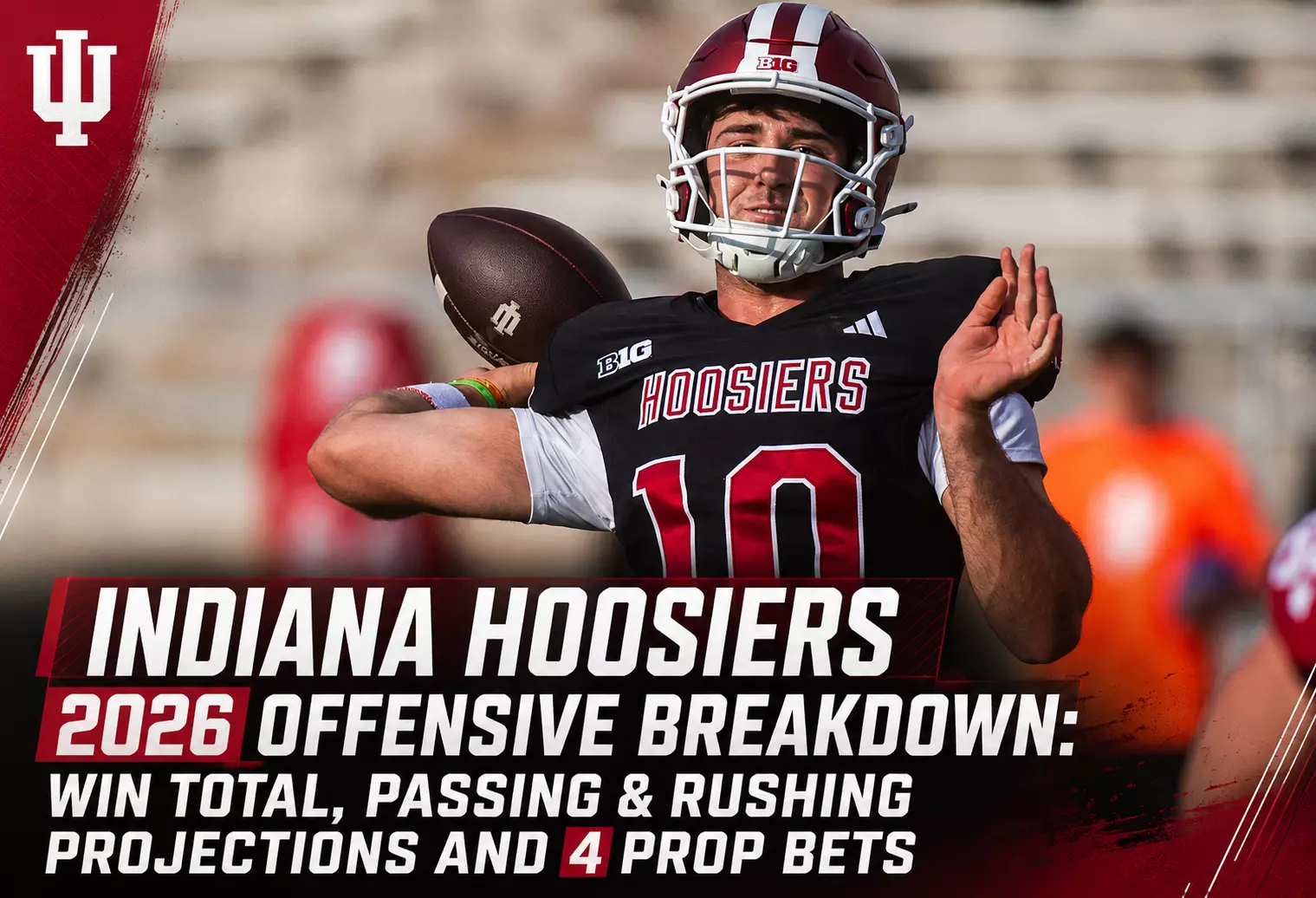
The Indiana Hoosiers enter the 2026 college football season in unfamiliar territory — as the
defending national champions
and one of the favorites to contend for another College Football Playoff berth.
Curt Cignetti’s historic 2025 team finished
16-0, won the Big Ten Championship and defeated Alabama, Oregon and Miami during its College Football Playoff run. Indiana averaged
41.6 points and 452.0 yards per game, finishing the extended 16-game season with 3,826 passing yards, 3,406 rushing yards, 46 passing touchdowns and 35 rushing touchdowns.
Repeating those numbers will be difficult.
The biggest loss is quarterback
Fernando Mendoza, who threw for 3,535 yards and 41 touchdowns while completing 72.0% of his passes during the championship season.
Indiana responded exactly the way a championship contender should.
The Hoosiers landed former TCU quarterback
Josh Hoover, one of the most experienced and productive quarterbacks available in the transfer portal.
Hoover brings
9,629 career passing yards, 71 touchdown passes and 31 career starts
to Bloomington. He threw for 3,949 yards in 2024 and another 3,472 yards in 2025 at TCU.
Indiana also rebuilt its offensive skill positions with transfers such as Boston College running back
Turbo Richard, Michigan State receiver
Nick Marsh
and Tulane receiver
Shazz Preston, while retaining an experienced offensive-line core.
The Hoosiers probably won’t replicate the statistical dominance of 2025.
They don’t necessarily need to.
This offense still has enough talent to rank among the Big Ten’s best.
Indiana Hoosiers 2026 Offensive Projections
Projected Record:
10-2
Projected Team Passing Yards:
3,100
Projected Team Rushing Yards:
2,100
Projected Total Offense:
5,200 yards
Projected Passing Touchdowns:
29
Projected Rushing Touchdowns:
20
Projected Offensive Touchdowns:
48-50
Projected Points Per Game:
33-35
Biggest Offensive Strength:
Quarterback Experience and Offensive Line
Biggest Offensive Question:
Can Indiana replace its elite 2025 touchdown efficiency?
Quarterback Breakdown: Josh Hoover
Indiana couldn’t realistically replace everything Mendoza brought to the offense, but Cignetti found about as experienced a replacement as possible.
Josh Hoover arrives after four seasons at TCU.
He has appeared in
35 career games with 31 starts, producing 9,629 passing yards and 71 touchdowns. Hoover finished his TCU career ranked second in school history in completion percentage, third in completions and fourth in passing yards and touchdown passes.
His two most recent seasons demonstrate why Indiana believes it can remain dangerous offensively.
Hoover threw for a TCU-record
3,949 yards in 2024, completing 66.5% of his passes and throwing 27 touchdowns.
He followed with
3,472 passing yards and 29 touchdowns in 2025, completing 65.9% of his passes. He threw for at least 300 yards five times and had four games with four or more touchdown passes.
That is an enormous amount of experience for a transfer quarterback.
Hoover has already faced Power Four defenses, played in difficult road environments and operated high-volume passing offenses.
That should significantly reduce the adjustment period.
The biggest question isn’t whether Hoover can throw the football.
It is whether he can play with the same efficiency Mendoza provided.
Indiana’s championship quarterback threw only six interceptions while completing 72% of his passes.
Hoover has traditionally played in a more aggressive passing offense, which can produce both explosive plays and additional turnover opportunities.
Indiana may ask him to play differently.
Instead of throwing 40 times every Saturday, Hoover could operate a more balanced offense built around an experienced line and multiple running backs.
That may lower his raw passing yardage from his TCU numbers while increasing his overall efficiency.
Indiana’s backfield will look significantly different after the championship run, but the Hoosiers have assembled another deep group.
The biggest newcomer is
Turbo Richard.
Richard started 11 games for Boston College in 2025 and rushed for
749 yards and nine touchdowns on 145 carries. He also caught 30 passes for 213 yards and two touchdowns.
That gives Indiana a proven Power Four running back capable of contributing as both a runner and receiver.
Richard produced three 100-yard rushing games last season and had three different games with multiple rushing touchdowns.
His explosiveness should fit Indiana’s offense particularly well.
The Hoosiers also get
Lee Beebe Jr.
back after his 2025 season was cut short by injury.
Beebe rushed for 73 yards against Old Dominion and 90 yards with a touchdown against Kennesaw State before suffering a season-ending injury against Indiana State. He had previously accumulated 1,485 career rushing yards and earned third-team All-American Athletic Conference honors at UAB.
That gives Indiana two experienced veteran backs.
Khobie Martin
and younger players provide additional depth behind them. Indiana’s current roster also includes Sean Cuono and freshman Jayreon Campbell.
The Hoosiers rushed for
3,406 yards and 35 touchdowns over 16 games
last season, averaging 212.9 yards per contest and 5.2 yards per attempt.
Matching 212 rushing yards per game may be unrealistic after losing major pieces from last year’s backfield.
Still, averaging approximately 175 yards per game would put Indiana around 2,100 rushing yards during the regular season.
With Richard, Beebe and an experienced offensive line, that is attainable.
Projected Team Rushing Yards: 2,100
Projected Rushing Touchdowns: 20
Indiana Offensive Line Breakdown
Indiana’s offensive line may be the biggest reason to believe the Hoosiers can remain an elite offense despite significant turnover at the skill positions.
The group has experience.
Bray Lynch, Carter Smith and Drew Evans
return, while Indiana added former Wisconsin lineman
Joe Brunner.
Lynch believes the group has the experience and versatility to remain one of the program’s strengths. Indiana’s offensive line has been a semifinalist for the Joe Moore Award in each of the previous two seasons.
The Hoosiers do have to replace center Pat Coogan, but Evans is among the candidates to assume a bigger interior role.
The overall depth remains encouraging.
Indiana also has
Adedamola Ajani, Austin Leibfried, Evan Parker and Baylor Wilkin
among the younger linemen competing for expanded roles.
That experience is extremely important for Hoover.
Indiana doesn’t want its new quarterback to feel like he has to replace Mendoza by himself.
If the offensive line protects Hoover and consistently creates rushing lanes, Indiana can remain balanced.
That allows offensive coordinator
Mike Shanahan
and Cignetti to attack defenses without becoming predictable. Shanahan remains Indiana’s offensive coordinator and wide receivers coach, while Bob Bostad continues to coach the offensive line and coordinate the running game.
The line gives Indiana an opportunity to maintain one of the most important characteristics of the championship offense: efficiency.
Indiana Passing Game Breakdown
Indiana lost major receiving production after its national championship season, but the Hoosiers attacked the transfer portal aggressively.
The most important addition may be
Nick Marsh.
The former Michigan State receiver has appeared in 23 career games with 20 starts and already has more than 1,300 career receiving yards.
Marsh caught
59 passes for 662 yards and six touchdowns in 2025
and earned honorable mention All-Big Ten recognition. He previously set Michigan State’s true-freshman records with 41 receptions and 649 receiving yards in 2024.
At 6-foot-3 and 213 pounds, Marsh gives Hoover a legitimate outside target who has already demonstrated that he can produce against Big Ten competition.
Indiana also added
Shazz Preston
from Tulane.
Preston caught
43 passes for 723 yards and four touchdowns
last season and produced five catches for 125 yards in Tulane’s College Football Playoff game against Ole Miss.
That gives Indiana two transfer receivers who combined for nearly 1,400 yards last season.
Then there is
Tyler Morris.
The former Michigan receiver missed the 2025 season because of injury but brings extensive Big Ten experience. Morris has appeared in 34 career games and made 14 starts, and he was part of Michigan’s 2023 national championship team.
Indiana also returns
Charlie Becker, Davion Chandler and Lebron Bond, giving Hoover multiple potential targets.
The receiver room may not have a proven replacement for everything Elijah Sarratt provided, but Indiana has tremendous depth.
Marsh can become the physical outside target.
Preston can stretch defenses.
Morris provides experience and versatility.
The younger receivers provide additional speed.
With Hoover throwing the football, Indiana should remain capable of generating explosive plays.
Projected Team Passing Yards: 3,100
Projected Passing Touchdowns: 29
Indiana Hoosiers 2026 Win Total
Indiana’s current regular-season win total is
10.5 victories.
BetMGM continued to list Indiana at 10.5 as of August 10, while VegasInsider’s current college football win-total board also lists the Hoosiers at 10.5.
That number demonstrates how dramatically expectations have changed in Bloomington.
Indiana isn’t being projected as a surprise bowl team anymore.
The market is essentially asking whether the defending national champions can go at least
11-1.
The schedule provides a path, but it isn’t easy.
Indiana opens with three consecutive home games against
North Texas, Howard and Western Kentucky
before beginning Big Ten play against Northwestern.
The schedule becomes significantly more difficult in October.
Indiana travels to Rutgers and Nebraska before hosting Ohio State. The Hoosiers then travel to Michigan and return home to face Minnesota.
After a bye, Indiana hosts USC, travels across the country to Washington and finishes the regular season against Purdue in Bloomington.
There are multiple legitimate loss opportunities.
Ohio State.
Michigan on the road.
Nebraska on the road.
USC.
Washington in Seattle.
Indiana could be one of the five best teams in college football and still finish 10-2.
That makes 10.5 an extremely aggressive number.
My prediction: Indiana finishes 10-2 and narrowly falls Under the 10.5-win total.
Four Indiana Hoosiers 2026 Prop Bets
Note:
Indiana’s 10.5-win total is a current sportsbook market. The statistical season props below are
projection-based betting benchmarks
because full-season college football passing, rushing and touchdown markets are not consistently available at every sportsbook.
Prop Bet #1: Indiana Under 10.5 Regular-Season Wins
DraftKings
4.5/5
Tip: Indiana Under 10.5 Regular-Season Wins
Eleven Wins Required
Difficult Big Ten Road Games
Major Championship-Roster Turnover
New DraftKings Customers: Bet $5, Get $200 + 3 Months of NBA League Pass!
Get bonus now
GAMBLING PROBLEM? CALL 1-800-GAMBLER or 1-800-MY-RESET, (800) 327-5050 or visit gamblinghelplinema.org (MA). Please Gamble Responsibly. 888-789-7777/visit ccpg.org (CT), or visit www.mdgamblinghelp.org (MD), 1-800-981-0023 (PR). 21+ and present in most states. (18+ DC/NH/PR/WY). Void in CAN. Eligibility restrictions apply. On behalf of Boot Hill Casino (KS). Pass-thru of per wager tax may apply in IL. 1 per new Sportsbook customer. $5+ first-time bet req. Max. $200 issued as non-withdrawable Bonus Bets. Stake removed from payout. Reward issued as $50 in Bonus Bets every 7 days via click-to-claim for 21 days. Bonus Bets and click-to-claims expire 7 days (168hrs) after issuance. Terms: dkng.co/offer. Get 1 promo code to redeem a 3-month NBA League Pass subscription, complimentary of DraftKings. Subscription auto-renews monthly at then-current price (currently $16.99/mo); cancel anytime. Terms, restrictions, and eligibility requirements apply. Redeem League Pass by 12/19/26 at 11:59 PM ET. Addt’l terms: support.watch.nba.com/hc/en-us/articles/9165532876183-League-Pass-Terms-of-Use_. Ends 11/29/26 at 11:59 PM ET. Sponsored by DK.
Why the Under Is a Good Bet
This isn’t necessarily a bet against Indiana.
It is a bet against an extremely demanding number.
The Hoosiers must finish
11-1 or 12-0
during the regular season for the Over to cash.
Indiana could finish 10-2, make the College Football Playoff and still lose this wager.
The schedule creates several difficult situations.
Indiana plays at Nebraska, at Michigan and at Washington while hosting Ohio State and USC.
Winning four or five of those games is possible.
Expecting Indiana to lose no more than once all season is much more difficult.
The Hoosiers are also replacing the quarterback who threw 41 touchdowns during the championship season.
Hoover is extremely experienced, but expecting Indiana to immediately recreate its 2025 efficiency may be unrealistic.
Why the Over Is a Good Bet
Cignetti has given bettors plenty of reasons not to underestimate Indiana.
The Hoosiers went 11-2 in his first season and followed with a
16-0 national championship season.
Indiana is no longer winning because opponents overlook it.
The program has established legitimate championship-level depth.
Hoover gives Indiana an experienced quarterback with nearly 10,000 career passing yards.
The offensive line remains strong.
The transfer portal produced proven players at running back and receiver.
The beginning of the schedule also creates an opportunity for Indiana to start 4-0 before its more difficult games arrive.
If the Hoosiers split the most difficult games and dominate everywhere else, 11 wins remains achievable.
Projection: Indiana finishes 10-2
Bet: Under 10.5 Wins
Confidence: 7/10
Prop Bet #2: Josh Hoover Over 2,899.5 Passing Yards
FanDuel
4.6/5
Tip: Josh Hoover Over 2,899.5 Passing Yards
9,629 Career Passing Yards
Proven Power Four Starter
Deep Transfer Receiver Group
New Users – Get $350 in Bonus Bets when you wager $5 for 7 days
Get bonus now
Gambling Problem? Call 1-800-GAMBLER or 1-800-MY-RESET. Call 1-888-789-7777 or visit ccpgg.org/chat (CT). Hope is here. GamblingHelpLineMA.org or call (800) 327-5050 for 24/7 support (MA). Visit www.mdgamblinghelp.org (MD). Call 1-877-8HOPE-NY or text HOPENY (NY). 21+ (18+ DC, WY) and present in select states (for KS, in affiliation with Kansas Star Casino). Find online real money wagering only. Min $5 wager required for 7 consecutive days. $5 free play credit. Bonus issued as non-withdrawable bonus with cash withdrawable bonus with cash withdrawable. Bonus bets which expire 7 days after receipt. Restrictions apply. See terms at sportsbook.fanduel.com. Call 1-877-770-7867 (LA).
Why the Over Is a Good Bet
Few transfer quarterbacks enter a new program with more statistical evidence than Hoover.
He threw for
3,949 yards in 2024 and 3,472 yards in 2025
at TCU.
That means Hoover could experience a substantial reduction in passing volume and still surpass 2,900 yards.
The receiver room also gives him options.
Marsh produced 662 receiving yards at Michigan State last season.
Preston produced 723 at Tulane.
Morris brings significant Big Ten experience.
Indiana shouldn’t have to depend on one receiver.
The schedule could also create some high-volume passing games.
Ohio State, Michigan, USC and Washington are opponents capable of forcing Indiana to continue attacking throughout the fourth quarter.
Hoover only needs to average approximately
242 passing yards per game
to reach 2,900.
Given his career résumé, that number is reasonable.
Why the Under Is a Good Bet
Indiana’s offensive philosophy may be substantially more balanced than the TCU offense Hoover previously operated.
The Hoosiers averaged 212.9 rushing yards per game last season.
If Richard and Beebe run effectively behind Indiana’s offensive line, Hoover may only need 25-30 pass attempts most weeks.
Game scripts also matter.
Indiana should be heavily favored against Howard and could build comfortable leads against several other opponents.
Those games may result in Hoover spending much of the fourth quarter on the sideline.
There is also the challenge of replacing Mendoza’s elite efficiency and developing chemistry with an almost completely different receiving corps.
Projection: 2,950-3,150 Passing Yards
Bet: Over 2,899.5 Passing Yards
Confidence: 7.5/10
Prop Bet #3: Indiana Over 1,999.5 Team Rushing Yards
Caesars
4.4/5
Tip: Indiana Over 1,999.5 Team Rushing Yards
Experienced Offensive Line
Turbo Richard Adds Explosiveness
Lee Beebe Returns
Bet $1 and get double the winnings up to $25 for your next 10 bets
–
21+ New users only. Must register using eligible promo code. First bet after registration must qualify. Max. Bonus Bet: $1,000. Bonus Bet expires 14 days after receipt. Void where prohibited. See Caesars.com/promos for full terms. Gambling Problem? 1-800-GAMBLER (1-800-426-2537)
Why the Over Is a Good Bet
This may be Indiana’s safest offensive identity entering the season.
The Hoosiers rushed for
3,406 yards over 16 games
during the championship season, averaging 212.9 yards per game.
Indiana obviously loses important rushing production, but the offensive line remains loaded with experience.
Lynch, Smith and Evans return, while Brunner adds another veteran option.
Richard gives Indiana a proven Power Four running back after rushing for 749 yards and nine touchdowns at Boston College last season.
Beebe is essentially another addition after appearing in only three games in 2025.
He rushed for 209 yards on just 27 carries before suffering his season-ending injury.
Indiana needs approximately
167 rushing yards per game
to reach 2,000.
That is considerably below last year’s 212.9-yard average.
Why the Under Is a Good Bet
The Hoosiers are replacing significant production from last year’s championship backfield.
Richard is talented, but 749 rushing yards at Boston College isn’t the same as replacing everything Indiana lost.
Beebe is also returning from a significant injury.
Hoover’s presence could change the offensive balance.
Because he is such an accomplished passer, Indiana may lean more heavily on the passing game than it did during stretches of last season.
The difficult portion of the Big Ten schedule could also reduce rushing efficiency.
Ohio State, Michigan and other elite defensive fronts may force Indiana into more obvious passing situations.
Projection: 2,100 Team Rushing Yards
Bet: Over 1,999.5 Team Rushing Yards
Confidence: 7/10
Prop Bet #4: Indiana Over 46.5 Offensive Touchdowns
BetMGM
4.5/5
Tip: Indiana Over 46.5 Offensive Touchdowns
Josh Hoover’s Proven Production
Multiple Red-Zone Weapons
Championship-Caliber Offensive Line
Up To $1500 in Bonus Bets Paid Back if your First Bet Does Not Win
Get bonus now
Gambling problem? Call 1-800-GAMBLER or 1-800-MY-RESET (Available in the US) 877-8-HOPENY or text HOPENY (467369) (NY) 1-800-327-5050 (MA), 1-800-BETS-OFF (IA), 1-800-981-0023 (PR). 21+ only. Please Gamble Responsibly. See BetMGM.com for Terms. First Bet Offer for new customers only (if applicable). Subject to eligibility requirements. Bonus bets are non-withdrawable. In partnership with Kansas Crossing Casino and Hotel. Promotional offers not available in Mississippi, Massachusetts, New York, Ontario, or Puerto Rico.
Why the Over Is a Good Bet
Indiana scored touchdowns at an extraordinary rate last season.
The Hoosiers finished the 16-game championship season with
46 passing touchdowns and 35 rushing touchdowns.
Nobody should project another 81 combined passing and rushing touchdowns over a regular season.
Indiana doesn’t need anything close to that level to surpass 46.5.
An average of roughly
four offensive touchdowns per game
would put the Hoosiers beyond this number.
The early schedule gives Indiana opportunities to build the total.
Howard should provide a favorable matchup, while home games against North Texas, Western Kentucky and Northwestern give the offense four consecutive games in Bloomington to begin the season.
Hoover has also proven he can generate touchdowns.
He threw
29 touchdown passes last season
and has 71 during his TCU career.
Richard scored 11 combined rushing and receiving touchdowns at Boston College last season, while Marsh and Preston combined for 10 receiving scores.
Indiana has plenty of red-zone options.
Why the Under Is a Good Bet
Touchdown efficiency is often difficult to repeat.
Indiana scored at an almost unbelievable rate last season, but Mendoza was one of the most efficient quarterbacks in the country.
Hoover may generate similar yardage without producing touchdowns at the same rate.
The Hoosiers could also settle for more field goals against Ohio State, Michigan, Nebraska, USC and Washington.
Personnel turnover matters as well.
The quarterback is new.
The top running back is new.
Several major receivers are new.
Even talented teams sometimes require several games to establish red-zone chemistry.
A couple of low-scoring Big Ten games could make the Over uncomfortable.
Projection: 48-50 Offensive Touchdowns
Bet: Over 46.5 Offensive Touchdowns
Confidence: 6.5/10
Best Indiana Hoosiers 2026 Prop Bet
Hoover’s passing-yardage Over is the Indiana offensive wager I trust the most.
There is simply too much proven production to ignore.
Hoover has thrown for
7,421 yards over the last two seasons alone
and enters Indiana with 31 career starts.
He doesn’t need to recreate his TCU passing volume.
He needs approximately 242 yards per game to reach 2,900.
Marsh, Preston and Morris give him an experienced receiver group, while the offensive line should provide the protection necessary to attack defenses vertically.
Indiana’s strong rushing game should also help Hoover by creating play-action opportunities and forcing safeties to respect the run.
There is always some risk when a quarterback changes systems, but Hoover’s combination of experience, production and surrounding talent makes the Over appealing.
Conclusion
The Indiana Hoosiers enter the 2026 season facing expectations that would have seemed almost impossible only a few years ago.
Indiana isn’t trying to become competitive.
It is trying to
defend a national championship.
The 2025 Hoosiers finished 16-0, averaged 41.6 points per game and produced more than 7,200 yards of total offense during their extended championship season.
Replacing Fernando Mendoza is the biggest challenge.
He threw for 3,535 yards and 41 touchdowns while completing 72% of his passes.
Those numbers shouldn’t automatically be expected from anyone.
Fortunately for Indiana, Josh Hoover isn’t a normal first-year starter.
He arrives in Bloomington with
9,629 career passing yards, 71 touchdowns and 31 starts.
That makes quarterback one of the least concerning areas of Indiana’s rebuild.
The running back room also has significant potential.
Turbo Richard provides proven Power Four production after rushing for 749 yards and nine touchdowns at Boston College, while Lee Beebe returns after looking extremely productive before his 2025 injury.
The receiver room may be even deeper.
Nick Marsh has more than 1,300 career receiving yards.
Shazz Preston is coming off a 723-yard season.
Tyler Morris provides additional Big Ten experience.
And Indiana’s offensive line retains enough veteran talent to remain one of the program’s biggest strengths.
My projection has Indiana producing approximately
3,100 passing yards, 2,100 rushing yards and 48-50 offensive touchdowns while averaging 33-35 points per game.
Those numbers would represent regression from 2025.
They would also still make Indiana one of the best offenses in the Big Ten.
The bigger concern is the win total.
At
10.5 victories, the market is asking Indiana to finish at least 11-1 for an Over wager to cash.
That is possible.
It is also an enormous expectation for a team that must play Ohio State, travel to Michigan, travel to Nebraska, host USC and make a November trip to Washington.
My prediction is
10-2, making the Under 10.5 my lean on the team win total.
That shouldn’t be confused with expecting a disappointing season.
A 10-2 Indiana team would remain squarely in the College Football Playoff conversation and could still have another championship run in front of it.
From an offensive betting perspective, my strongest play is
Josh Hoover Over 2,899.5 passing yards.
Hoover is proven, the receivers are talented and Indiana has enough strength along the offensive line and in the running game to prevent defenses from focusing exclusively on the quarterback.
The 2026 Indiana offense probably won’t reproduce the statistical perfection of the national championship team.
It doesn’t need to.
If Hoover transitions smoothly, Richard and Beebe provide a productive rushing rotation and Marsh emerges as the No. 1 receiving option, Indiana should once again possess enough offensive firepower to compete with anybody in the Big Ten — and potentially make another serious run at the national championship.
New Users – Get $350 in Bonus Bets when you wager $5 for 7 days
T&Cs apply
4.6/5
Gambling Problem? Call 1-800-GAMBLER or 1-800-MY-RESET. Call 1-888-789-7777 or visit ccpgg.org/chat (CT). Hope is here. GamblingHelpLineMA.org or call (800) 327-5050 for 24/7 support (MA). Visit www.mdgamblinghelp.org (MD). Call 1-877-8HOPE-NY or text HOPENY (NY). 21+ (18+ DC, WY) and present in select states (for KS, in affiliation with Kansas Star Casino). Find online real money wagering only. Min $5 wager required for 7 consecutive days. $5 free play credit. Bonus issued as non-withdrawable bonus with cash withdrawable bonus with cash withdrawable. Bonus bets which expire 7 days after receipt. Restrictions apply. See terms at sportsbook.fanduel.com. Call 1-877-770-7867 (LA).
Up To $1500 in Bonus Bets Paid Back if your First Bet Does Not Win
T&Cs apply
4.5/5
Gambling problem? Call 1-800-GAMBLER or 1-800-MY-RESET (Available in the US) 877-8-HOPENY or text HOPENY (467369) (NY) 1-800-327-5050 (MA), 1-800-BETS-OFF (IA), 1-800-981-0023 (PR). 21+ only. Please Gamble Responsibly. See BetMGM.com for Terms. First Bet Offer for new customers only (if applicable). Subject to eligibility requirements. Bonus bets are non-withdrawable. In partnership with Kansas Crossing Casino and Hotel. Promotional offers not available in Mississippi, Massachusetts, New York, Ontario, or Puerto Rico.
New DraftKings Customers: Bet $5, Get $200 + 3 Months of NBA League Pass!
T&Cs apply
4.5/5
GAMBLING PROBLEM? CALL 1-800-GAMBLER or 1-800-MY-RESET, (800) 327-5050 or visit gamblinghelplinema.org (MA). Please Gamble Responsibly. 888-789-7777/visit ccpg.org (CT), or visit www.mdgamblinghelp.org (MD), 1-800-981-0023 (PR). 21+ and present in most states. (18+ DC/NH/PR/WY). Void in CAN. Eligibility restrictions apply. On behalf of Boot Hill Casino (KS). Pass-thru of per wager tax may apply in IL. 1 per new Sportsbook customer. $5+ first-time bet req. Max. $200 issued as non-withdrawable Bonus Bets. Stake removed from payout. Reward issued as $50 in Bonus Bets every 7 days via click-to-claim for 21 days. Bonus Bets and click-to-claims expire 7 days (168hrs) after issuance. Terms: dkng.co/offer. Get 1 promo code to redeem a 3-month NBA League Pass subscription, complimentary of DraftKings. Subscription auto-renews monthly at then-current price (currently $16.99/mo); cancel anytime. Terms, restrictions, and eligibility requirements apply. Redeem League Pass by 12/19/26 at 11:59 PM ET. Addt’l terms: support.watch.nba.com/hc/en-us/articles/9165532876183-League-Pass-Terms-of-Use_. Ends 11/29/26 at 11:59 PM ET. Sponsored by DK.
Must be 21+. GAMBLING PROBLEM? CALL 1-800-GAMBLER OR CALL 1-800-MY-RESET, www.mdgamblinghelp.org (MD), (800)-327-5050 or gamblinghelplinema.org (MA), Call (877)8-HOPENY or text HOPENY (467369) (NY), (888) 789-7777 or ccpg.org (CT), morethanagame.nc.gov (NC), 1800gambler.net (WV)
Bet $1 and get double the winnings up to $25 for your next 10 bets
T&Cs apply
4.4/5
21+ New users only. Must register using eligible promo code. First bet after registration must qualify. Max. Bonus Bet: $1,000. Bonus Bet expires 14 days after receipt. Void where prohibited. See Caesars.com/promos for full terms. Gambling Problem? 1-800-GAMBLER (1-800-426-2537)
21+ and present in OH. Gambling Problem? Call 1-800-GAMBLER.
This site is using
Cloudflare
and adheres to the
Google Safe Browsing Program. We adapted
Google's Privacy Guidelines
to keep your data safe at all times.
Close
Ready to Win Big? Join the Elite with Our Sports Betting Deals!
FanDuel Promo
New Users – Get $350 in Bonus Bets when you wager $5 for 7 days
Our Favorite
T&Cs and 21+ apply
Gambling Problem? Call 1-800-GAMBLER or 1-800-MY-RESET. Call 1-888-789-7777 or visit ccpgg.org/chat (CT). Hope is here. GamblingHelpLineMA.org or call (800) 327-5050 for 24/7 support (MA). Visit www.mdgamblinghelp.org (MD). Call 1-877-8HOPE-NY or text HOPENY (NY). 21+ (18+ DC, WY) and present in select states (for KS, in affiliation with Kansas Star Casino). Find online real money wagering only. Min $5 wager required for 7 consecutive days. $5 free play credit. Bonus issued as non-withdrawable bonus with cash withdrawable bonus with cash withdrawable. Bonus bets which expire 7 days after receipt. Restrictions apply. See terms at sportsbook.fanduel.com. Call 1-877-770-7867 (LA).
Code:
Open FanDuel
Get Bonus
BetMGM Promo
Up To $1500 in Bonus Bets Paid Back if your First Bet Does Not Win
Best Slots
T&Cs and 21+ apply
Gambling problem? Call 1-800-GAMBLER or 1-800-MY-RESET (Available in the US) 877-8-HOPENY or text HOPENY (467369) (NY) 1-800-327-5050 (MA), 1-800-BETS-OFF (IA), 1-800-981-0023 (PR). 21+ only. Please Gamble Responsibly. See BetMGM.com for Terms. First Bet Offer for new customers only (if applicable). Subject to eligibility requirements. Bonus bets are non-withdrawable. In partnership with Kansas Crossing Casino and Hotel. Promotional offers not available in Mississippi, Massachusetts, New York, Ontario, or Puerto Rico.
Code:
Open BetMGM
Get Bonus
DraftKings Promo
New DraftKings Customers: Bet $5, Get $200 + 3 Months of NBA League Pass!
Newcomer
T&Cs and 21+ apply
GAMBLING PROBLEM? CALL 1-800-GAMBLER or 1-800-MY-RESET, (800) 327-5050 or visit gamblinghelplinema.org (MA). Please Gamble Responsibly. 888-789-7777/visit ccpg.org (CT), or visit www.mdgamblinghelp.org (MD), 1-800-981-0023 (PR). 21+ and present in most states. (18+ DC/NH/PR/WY). Void in CAN. Eligibility restrictions apply. On behalf of Boot Hill Casino (KS). Pass-thru of per wager tax may apply in IL. 1 per new Sportsbook customer. $5+ first-time bet req. Max. $200 issued as non-withdrawable Bonus Bets. Stake removed from payout. Reward issued as $50 in Bonus Bets every 7 days via click-to-claim for 21 days. Bonus Bets and click-to-claims expire 7 days (168hrs) after issuance. Terms: dkng.co/offer. Get 1 promo code to redeem a 3-month NBA League Pass subscription, complimentary of DraftKings. Subscription auto-renews monthly at then-current price (currently $16.99/mo); cancel anytime. Terms, restrictions, and eligibility requirements apply. Redeem League Pass by 12/19/26 at 11:59 PM ET. Addt’l terms: support.watch.nba.com/hc/en-us/articles/9165532876183-League-Pass-Terms-of-Use_. Ends 11/29/26 at 11:59 PM ET. Sponsored by DK.
Code:
Open DraftKings
Get Bonus
Find out what the legends have to say about sports this week....
New Users – Get $350 in Bonus Bets when you wager $5 for 7 days
Gambling Problem? Call 1-800-GAMBLER or 1-800-MY-RESET. Call 1-888-789-7777 or visit ccpgg.org/chat (CT). Hope is here. GamblingHelpLineMA.org or call (800) 327-5050 for 24/7 support (MA). Visit www.mdgamblinghelp.org (MD). Call 1-877-8HOPE-NY or text HOPENY (NY). 21+ (18+ DC, WY) and present in select states (for KS, in affiliation with Kansas Star Casino). Find online real money wagering only. Min $5 wager required for 7 consecutive days. $5 free play credit. Bonus issued as non-withdrawable bonus with cash withdrawable bonus with cash withdrawable. Bonus bets which expire 7 days after receipt. Restrictions apply. See terms at sportsbook.fanduel.com. Call 1-877-770-7867 (LA).