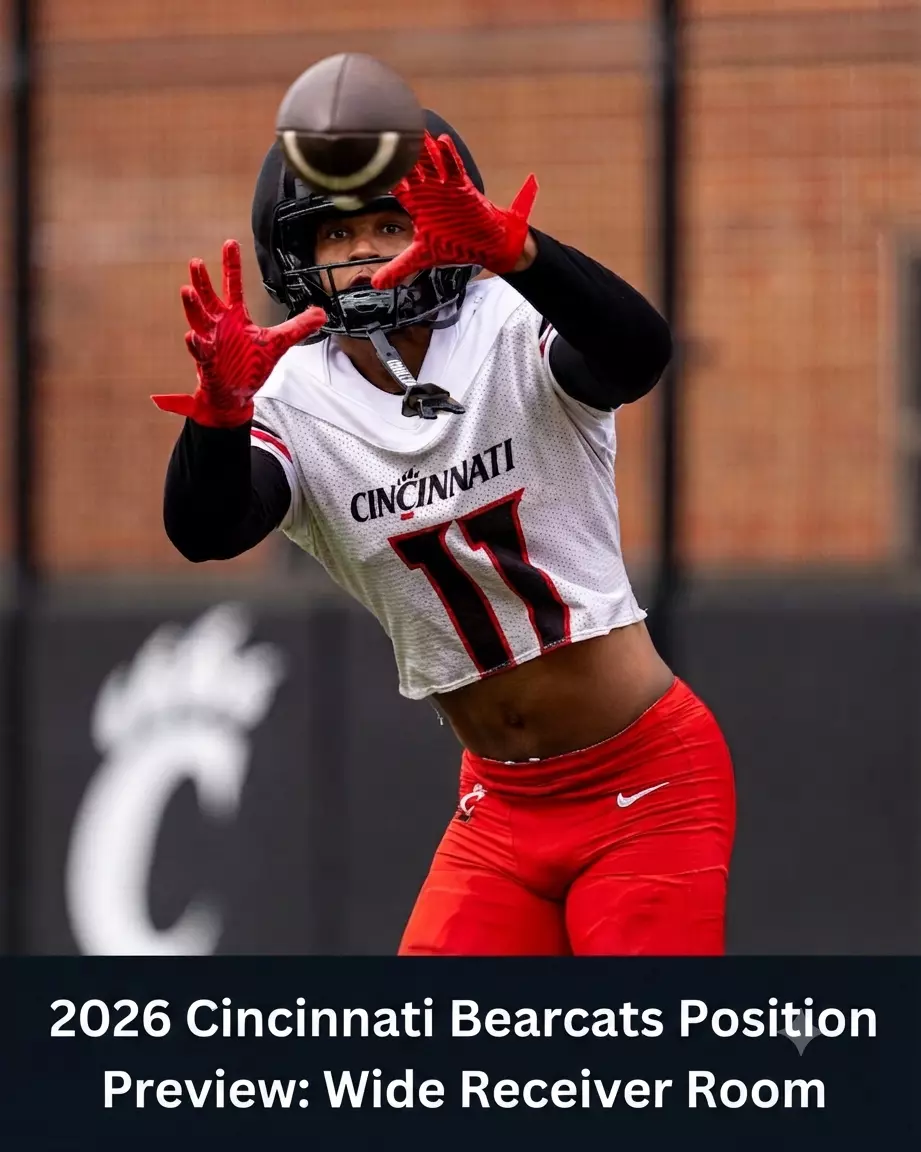
2026 Cincinnati Bearcats Position Preview: Wide Receiver Room
The University of Cincinnati
enters the 2026 season with one of its deepest and most experienced wide receiver groups since joining the Big 12. While the Bearcats may not feature a nationally recognized All-American at the position, they possess a balanced mix of proven transfers, experienced veterans, and young talent capable of making explosive plays.
With a new-look offense led by either
JC French or Samaj Jones at quarterback, the development of Cincinnati’s receiving corps will play a major role in determining whether the Bearcats can compete for bowl positioning or make a surprise run in the Big 12 standings.
The room, coached by Vijay Stingley, has plenty of athleticism, but consistency and creating explosive plays against elite conference defenses remain the biggest questions heading into the season.
Meet the Wide Receiver Room
According to the 2026 Cincinnati roster, the primary receivers include:
JV Gibson (Redshirt Senior)
Isaiah Johnson (Junior)
Larenzo Fenner (Redshirt Junior)
Malachi Henry (Redshirt Junior)
Elijah Jones (Redshirt Sophomore)
Cade Wolford (Redshirt Sophomore)
Pierce Ayers (Sophomore)
The group is largely built through the transfer portal, bringing valuable collegiate experience from several successful programs while blending in developing homegrown talent.
JV Gibson – The Veteran Leader
The Oklahoma transfer enters the season as the elder statesman of the receiver room.
Background
Transfer from Oklahoma
Redshirt Senior
6-foot-2, 208 pounds
Originally from Opelousas, Louisiana
Strengths
Gibson possesses ideal size for an outside receiver and has accumulated experience competing against Power Four competition. He runs physical routes, attacks contested catches, and provides a reliable target on intermediate throws.
His experience also makes him an important mentor for Cincinnati’s younger receivers.
Areas for Improvement
To become a true No. 1 receiver, Gibson needs to generate more separation against elite cornerbacks. Improving his consistency after the catch could also create additional explosive plays.
Isaiah Johnson – The Speed Threat
One of Cincinnati’s most intriguing additions is Western Carolina transfer Isaiah Johnson.
Background
Junior
Transfer from Western Carolina
Fort Walton Beach, Florida native
5-foot-10, 184 pounds
Strengths
Johnson brings outstanding quickness and acceleration.
His game is built around:
Vertical speed
Slot versatility
Ability to stretch defenses
Dangerous run-after-catch ability
He gives the Bearcats an element of explosiveness that has occasionally been missing over the past two seasons.
Areas for Improvement
The jump from the FCS level to the Big 12 is significant. Johnson will need to prove he can consistently beat Power Four defensive backs while improving his blocking in the running game.
Larenzo Fenner – The Reliable Route Runner
The South Dakota transfer quietly has the tools to become one of Cincinnati’s most dependable receivers.
Background
Redshirt Junior
Transfer from South Dakota
Independence, Missouri native
6-foot-1, 181 pounds
Strengths
Fenner is an excellent technician.
His strengths include:
Crisp route running
Reliable hands
Football IQ
Finding soft spots in zone coverage
Quarterbacks often develop trust with receivers like Fenner because they consistently run precise routes.
Areas for Improvement
Adding strength will help him against more physical Big 12 defensive backs while improving his ability to win contested catches.
Malachi Henry – The Physical Playmaker
Henry arrives after transferring from Central Arkansas.
Background
Redshirt Junior
Transfer from Central Arkansas
Van Buren, Arkansas
6-foot, 205 pounds
Strengths
Henry combines solid size with physicality.
He excels at:
Breaking tackles
Possession receiving
Working across the middle
Tough catches in traffic
His physical playing style makes him especially valuable on third down.
Areas for Improvement
Improving his top-end speed would allow him to become a more complete receiver capable of creating explosive vertical plays.
Elijah Jones – The Emerging Talent
The former St. Joseph’s Prep standout enters an important developmental season.
Strengths
Jones offers:
Excellent athletic upside
Strong hands
Versatility inside and outside
Long-term starting potential
Areas for Improvement
Experience.
Like many younger receivers, Jones needs additional game reps while improving consistency throughout an entire season.
Cade Wolford – The Versatile Contributor
Kent State transfer Cade Wolford brings valuable flexibility to the offense.
Background
Redshirt Sophomore
Transfer from Kent State
Jackson, Ohio native
Strengths
Wolford is capable of lining up at multiple receiver positions while contributing on special teams.
His versatility allows offensive coordinators to move him around to create favorable matchups.
Areas for Improvement
Adding explosiveness after the catch could elevate him from dependable depth piece to regular offensive contributor.
Pierce Ayers – Developmental Depth
The Wittenberg transfer gives Cincinnati additional receiving depth.
Strengths
Good athleticism
Strong work ethic
Developmental upside
Valuable special teams contributor
Areas for Improvement
Adjusting to the speed and physicality of Big 12 football will be his biggest challenge.
Overall Strengths of the Unit
This receiver room offers several encouraging qualities:
Experience
Nearly every projected contributor has meaningful collegiate playing experience, reducing the learning curve.
Portal Success
Scott Satterfield and his staff effectively used the transfer portal to upgrade depth without sacrificing athleticism.
Versatility
Several receivers can play both inside and outside, allowing the offense to disguise formations and create favorable matchups.
Depth
Unlike previous seasons, Cincinnati has legitimate options throughout the depth chart if injuries occur.
Biggest Areas Needing Improvement
Despite its talent, the room still has work to do.
Create More Explosive Plays
The Bearcats need more receptions of 20-plus yards against conference opponents.
Red Zone Production
The offense must convert more trips inside the 20 into touchdowns, and larger receivers need to become reliable jump-ball threats.
Consistency
Drops and missed opportunities plagued Cincinnati at times over recent seasons. Sustaining production every week will be critical.
Chemistry with the Quarterbacks
Whether JC French or Samaj Jones wins the starting quarterback job, timing and trust with this receiver group must develop quickly during fall camp.
How Cincinnati Compares to the Rest of the Big 12
The Big 12 features several elite receiving corps, including programs such as Arizona State, Texas Tech, Baylor, and BYU, which possess established stars and explosive passing attacks.
If two or three Bearcat receivers emerge as dependable 700-yard contributors, Cincinnati has the potential to move into the conference’s upper tier by season’s end.
Final Thoughts
The 2026 Cincinnati wide receiver room may not feature a household name, but it possesses something nearly as valuable: depth, experience, and versatility.
Transfers like JV Gibson, Isaiah Johnson, Larenzo Fenner, and Malachi Henry have the opportunity to elevate the offense immediately, while younger players such as Elijah Jones, Cade Wolford, and Pierce Ayers provide long-term upside.
Ultimately, the ceiling of this group will be determined by its ability to generate explosive plays, improve red-zone efficiency, and quickly build chemistry with Cincinnati’s quarterback. If those elements come together, the Bearcats could field one of their most balanced passing attacks since entering the Big 12 and position themselves to compete with the conference’s better offenses throughout the 2026 season.
New Users – Get $350 in Bonus Bets when you wager $5 for 7 days
T&Cs apply
4.6/5
Gambling Problem? Call 1-800-GAMBLER or 1-800-MY-RESET. Call 1-888-789-7777 or visit ccpgg.org/chat (CT). Hope is here. GamblingHelpLineMA.org or call (800) 327-5050 for 24/7 support (MA). Visit www.mdgamblinghelp.org (MD). Call 1-877-8HOPE-NY or text HOPENY (NY). 21+ (18+ DC, WY) and present in select states (for KS, in affiliation with Kansas Star Casino). Find online real money wagering only. Min $5 wager required for 7 consecutive days. $5 free play credit. Bonus issued as non-withdrawable bonus with cash withdrawable bonus with cash withdrawable. Bonus bets which expire 7 days after receipt. Restrictions apply. See terms at sportsbook.fanduel.com. Call 1-877-770-7867 (LA).
Up To $1500 in Bonus Bets Paid Back if your First Bet Does Not Win
T&Cs apply
4.5/5
Gambling problem? Call 1-800-GAMBLER or 1-800-MY-RESET (Available in the US) 877-8-HOPENY or text HOPENY (467369) (NY) 1-800-327-5050 (MA), 1-800-BETS-OFF (IA), 1-800-981-0023 (PR). 21+ only. Please Gamble Responsibly. See BetMGM.com for Terms. First Bet Offer for new customers only (if applicable). Subject to eligibility requirements. Bonus bets are non-withdrawable. In partnership with Kansas Crossing Casino and Hotel. Promotional offers not available in Mississippi, Massachusetts, New York, Ontario, or Puerto Rico.
New DraftKings Customers: Bet $5, Get $200 + 3 Months of NBA League Pass!
T&Cs apply
4.5/5
GAMBLING PROBLEM? CALL 1-800-GAMBLER or 1-800-MY-RESET, (800) 327-5050 or visit gamblinghelplinema.org (MA). Please Gamble Responsibly. 888-789-7777/visit ccpg.org (CT), or visit www.mdgamblinghelp.org (MD), 1-800-981-0023 (PR). 21+ and present in most states. (18+ DC/NH/PR/WY). Void in CAN. Eligibility restrictions apply. On behalf of Boot Hill Casino (KS). Pass-thru of per wager tax may apply in IL. 1 per new Sportsbook customer. $5+ first-time bet req. Max. $200 issued as non-withdrawable Bonus Bets. Stake removed from payout. Reward issued as $50 in Bonus Bets every 7 days via click-to-claim for 21 days. Bonus Bets and click-to-claims expire 7 days (168hrs) after issuance. Terms: dkng.co/offer. Get 1 promo code to redeem a 3-month NBA League Pass subscription, complimentary of DraftKings. Subscription auto-renews monthly at then-current price (currently $16.99/mo); cancel anytime. Terms, restrictions, and eligibility requirements apply. Redeem League Pass by 12/19/26 at 11:59 PM ET. Addt’l terms: support.watch.nba.com/hc/en-us/articles/9165532876183-League-Pass-Terms-of-Use_. Ends 11/29/26 at 11:59 PM ET. Sponsored by DK.
Must be 21+. GAMBLING PROBLEM? CALL 1-800-GAMBLER OR CALL 1-800-MY-RESET, www.mdgamblinghelp.org (MD), (800)-327-5050 or gamblinghelplinema.org (MA), Call (877)8-HOPENY or text HOPENY (467369) (NY), (888) 789-7777 or ccpg.org (CT), morethanagame.nc.gov (NC), 1800gambler.net (WV)
Bet $1 and get double the winnings up to $25 for your next 10 bets
T&Cs apply
4.4/5
21+ New users only. Must register using eligible promo code. First bet after registration must qualify. Max. Bonus Bet: $1,000. Bonus Bet expires 14 days after receipt. Void where prohibited. See Caesars.com/promos for full terms. Gambling Problem? 1-800-GAMBLER (1-800-426-2537)
21+ and present in OH. Gambling Problem? Call 1-800-GAMBLER.
This site is using
Cloudflare
and adheres to the
Google Safe Browsing Program. We adapted
Google's Privacy Guidelines
to keep your data safe at all times.
Close
Ready to Win Big? Join the Elite with Our Sports Betting Deals!
FanDuel Promo
New Users – Get $350 in Bonus Bets when you wager $5 for 7 days
Our Favorite
T&Cs and 21+ apply
Gambling Problem? Call 1-800-GAMBLER or 1-800-MY-RESET. Call 1-888-789-7777 or visit ccpgg.org/chat (CT). Hope is here. GamblingHelpLineMA.org or call (800) 327-5050 for 24/7 support (MA). Visit www.mdgamblinghelp.org (MD). Call 1-877-8HOPE-NY or text HOPENY (NY). 21+ (18+ DC, WY) and present in select states (for KS, in affiliation with Kansas Star Casino). Find online real money wagering only. Min $5 wager required for 7 consecutive days. $5 free play credit. Bonus issued as non-withdrawable bonus with cash withdrawable bonus with cash withdrawable. Bonus bets which expire 7 days after receipt. Restrictions apply. See terms at sportsbook.fanduel.com. Call 1-877-770-7867 (LA).
Code:
Open FanDuel
Get Bonus
BetMGM Promo
Up To $1500 in Bonus Bets Paid Back if your First Bet Does Not Win
Best Slots
T&Cs and 21+ apply
Gambling problem? Call 1-800-GAMBLER or 1-800-MY-RESET (Available in the US) 877-8-HOPENY or text HOPENY (467369) (NY) 1-800-327-5050 (MA), 1-800-BETS-OFF (IA), 1-800-981-0023 (PR). 21+ only. Please Gamble Responsibly. See BetMGM.com for Terms. First Bet Offer for new customers only (if applicable). Subject to eligibility requirements. Bonus bets are non-withdrawable. In partnership with Kansas Crossing Casino and Hotel. Promotional offers not available in Mississippi, Massachusetts, New York, Ontario, or Puerto Rico.
Code:
Open BetMGM
Get Bonus
DraftKings Promo
New DraftKings Customers: Bet $5, Get $200 + 3 Months of NBA League Pass!
Newcomer
T&Cs and 21+ apply
GAMBLING PROBLEM? CALL 1-800-GAMBLER or 1-800-MY-RESET, (800) 327-5050 or visit gamblinghelplinema.org (MA). Please Gamble Responsibly. 888-789-7777/visit ccpg.org (CT), or visit www.mdgamblinghelp.org (MD), 1-800-981-0023 (PR). 21+ and present in most states. (18+ DC/NH/PR/WY). Void in CAN. Eligibility restrictions apply. On behalf of Boot Hill Casino (KS). Pass-thru of per wager tax may apply in IL. 1 per new Sportsbook customer. $5+ first-time bet req. Max. $200 issued as non-withdrawable Bonus Bets. Stake removed from payout. Reward issued as $50 in Bonus Bets every 7 days via click-to-claim for 21 days. Bonus Bets and click-to-claims expire 7 days (168hrs) after issuance. Terms: dkng.co/offer. Get 1 promo code to redeem a 3-month NBA League Pass subscription, complimentary of DraftKings. Subscription auto-renews monthly at then-current price (currently $16.99/mo); cancel anytime. Terms, restrictions, and eligibility requirements apply. Redeem League Pass by 12/19/26 at 11:59 PM ET. Addt’l terms: support.watch.nba.com/hc/en-us/articles/9165532876183-League-Pass-Terms-of-Use_. Ends 11/29/26 at 11:59 PM ET. Sponsored by DK.
Code:
Open DraftKings
Get Bonus
Find out what the legends have to say about sports this week....
New Users – Get $350 in Bonus Bets when you wager $5 for 7 days
Gambling Problem? Call 1-800-GAMBLER or 1-800-MY-RESET. Call 1-888-789-7777 or visit ccpgg.org/chat (CT). Hope is here. GamblingHelpLineMA.org or call (800) 327-5050 for 24/7 support (MA). Visit www.mdgamblinghelp.org (MD). Call 1-877-8HOPE-NY or text HOPENY (NY). 21+ (18+ DC, WY) and present in select states (for KS, in affiliation with Kansas Star Casino). Find online real money wagering only. Min $5 wager required for 7 consecutive days. $5 free play credit. Bonus issued as non-withdrawable bonus with cash withdrawable bonus with cash withdrawable. Bonus bets which expire 7 days after receipt. Restrictions apply. See terms at sportsbook.fanduel.com. Call 1-877-770-7867 (LA).