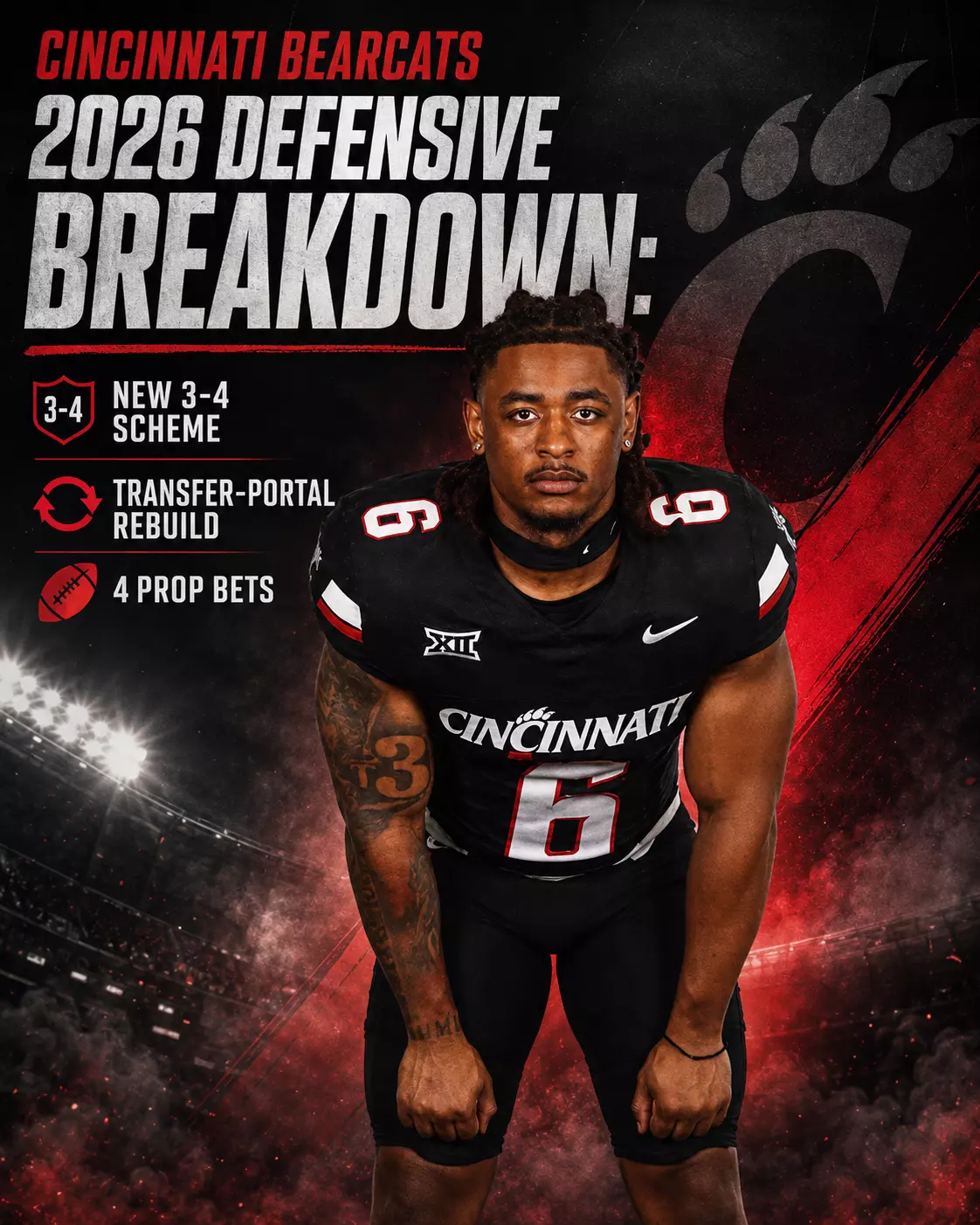
Cincinnati Bearcats 2026 Defensive Breakdown: New 3-4 Scheme, Transfer-Portal Rebuild and 4 Prop Bets
Cincinnati Bearcats 2026 Defensive Breakdown: New 3-4 Scheme, Transfer-Portal Rebuild and 4 Prop Bets
The
Cincinnati Bearcats enter the 2026 college football season with one of the most dramatically rebuilt defenses in the Big 12.
Cincinnati finished 7-6 in 2025, but the defense was too inconsistent. The Bearcats allowed
25.6 points and approximately 399 yards per game, generated only
23 sacks
and intercepted just
two passes
over 13 games.
Those numbers explain why head coach
Scott Satterfield
made a major change.
Cincinnati hired veteran defensive coordinator
Nate Woody, who spent the previous six seasons at Army. His Black Knights led their conference in total defense during each of the last two seasons, finished in the national top 15 in total defense three times during his tenure and led the country in total defense in 2020.
This isn’t simply a change in coordinator.
It is a philosophical reconstruction.
Cincinnati is moving away from its previous 3-3-5 approach and transitioning into Woody’s aggressive
3-4 defense, with more pressure, more movement before the snap and a greater emphasis on creating negative plays and turnovers. Cincinnati’s August camp report described the new system as an aggressive, blitzing front designed to create havoc and force takeaways.
The Bearcats need that change because almost everything else has changed, too.
Cincinnati is projected to replace
10 defensive starters, with
Antwan Peek Jr. and Jonathan Thompson
serving as the two primary returning anchors.
The transfer portal supplied the replacements.
Jasper Beeler.
MJ Cannon.
Jacob Finley.
Filip Maciorowski.
Thomas Johnson.
Chidera Otutu.
Patrick Bauer.
KK Meier.
Those players bring significant college experience, production and playmaking ability.
The result is an unusual defense.
Cincinnati may lack continuity, but it doesn’t lack experience.
The Bearcats could actually be more explosive defensively in 2026 than they were in 2025.
Cincinnati Bearcats 2026 Defensive Projections
Projected Record:
6-6
Projected Points Allowed Per Game:
23-25
Projected Total Defense:
370-385 yards per game
Projected Rushing Defense:
150-160 yards per game
Projected Passing Defense:
215-225 yards per game
Projected Team Sacks:
30-34
Projected Interceptions:
9-11
Projected Total Takeaways:
18-21
Projected Tackles for Loss:
70-75
Biggest Defensive Strength:
Edge Rush and Linebacker Versatility
Biggest Defensive Question:
Can a defense replacing 10 starters develop chemistry quickly enough?
Nate Woody’s New Cincinnati Defense
The most important addition to Cincinnati’s defense isn’t technically a player.
It is
Nate Woody.
Woody brings decades of defensive coaching experience to Clifton and has already demonstrated that he can build elite defenses without always possessing elite recruiting classes.
His work at Army is particularly encouraging.
The Black Knights led their conference in total defense in each of Woody’s final two seasons. His 2024 defense allowed only
15.5 points per game, ranked fourth nationally in scoring defense and led the country in red-zone defense by allowing opponents to score on just 60% of their trips. Army also intercepted
18 passes
that season.
That turnover number should immediately interest Cincinnati fans.
The Bearcats intercepted only
two passes in 2025.
Woody wants quarterbacks making decisions under pressure.
Instead of frequently dropping eight defenders into coverage, Cincinnati should present multiple pressure packages from its 3-4 alignment.
Satterfield has said the new system can bring pressure from virtually anywhere while presenting offenses with multiple looks.
That fits Cincinnati’s personnel.
Peek can cover or blitz.
Thomas Johnson can attack off the edge.
Thompson can pressure through the interior.
Beeler can play near the line of scrimmage.
The Bearcats aren’t necessarily going to become an elite defense immediately.
There are too many new players to make that assumption.
But stylistically, Cincinnati should become much more aggressive.
That alone could change the identity of the defense.
Cincinnati Defensive Line Breakdown
Replacing
Dontay Corleone
is impossible on a one-for-one basis.
Corleone finished his outstanding Cincinnati career with
123 tackles, 17 tackles for loss and 9.5 sacks, becoming one of the program’s most accomplished interior defensive linemen.
Cincinnati will try to replace his impact with depth rather than one superstar.
One of the most important newcomers is
Chidera Otutu.
The 6-foot-1, 300-pound UTSA transfer started the final 10 games of the 2025 season at nose tackle and finished with
27 tackles and 2.5 sacks.
He could become extremely important in Woody’s three-man front.
His job won’t always produce statistics.
The nose tackle must occupy blockers and prevent offensive linemen from reaching Cincinnati’s linebackers.
If Otutu can do that consistently, players such as Thompson and Maciorowski should have opportunities to attack downhill.
Marquaze Parker
provides returning experience.
Parker appeared in all 13 games last season, recording
19 tackles, 3.5 tackles for loss and 1.5 sacks.
Cam Roetherford
also returns after missing the 2025 season because of a preseason injury. He appeared in 10 games for Cincinnati during 2024.
That gives Woody several bigger bodies capable of rotating along the front.
The defensive line doesn’t need to dominate the stat sheet.
It needs to keep Cincinnati’s linebackers clean.
That is where this defense can become dangerous.
Cincinnati Edge-Rusher Breakdown
This may become Cincinnati’s most exciting defensive position.
Start with
Thomas Johnson.
Johnson arrives from North Carolina Central after producing one of the best pass-rushing seasons at the FCS level.
He recorded
49 tackles, 18 tackles for loss, 12 sacks and 14 quarterback hurries
in 2025. His 12 sacks ranked seventh nationally at the FCS level.
Now he gets Woody’s scheme.
That combination is intriguing.
Cincinnati’s system is specifically designed to create favorable pressure opportunities.
Johnson doesn’t necessarily have to defeat a Big 12 offensive tackle one-on-one on every play.
Woody can move him.
He can overload one side.
He can bring linebackers through the opposite gap.
He can disguise which outside linebacker is rushing.
Johnson entered August camp with a
90.0 PFF grade, and Cincinnati identified him as one of its most important transfer additions.
The question is competition.
Producing 12 sacks at North Carolina Central doesn’t automatically translate into double-digit sacks against Big 12 offensive tackles.
Kansas State, Texas Tech, Utah, Iowa State and BYU present considerably different challenges.
Still, Johnson doesn’t need 12 sacks to transform Cincinnati’s pass rush.
Seven or eight would represent a major contribution.
Cincinnati also has
Jaylon White-McClain, Brian Simms III, Terrell Holcomb, Myles Harrison and Patrick Bauer
among the players capable of contributing off the edge.
The depth gives Woody options.
That matters because pressure doesn’t always have to come from the same player.
Projected Cincinnati Team Sacks: 30-34
Cincinnati Linebacker Breakdown
If Cincinnati’s defense succeeds,
Jonathan Thompson
may be the player in the middle of everything.
Thompson finished second on the team with
74 tackles in 2025
and led the Bearcats with
8.5 tackles for loss. He also recorded two fumble recoveries and forced another.
He enters 2026 on the
Butkus Award watch list
and is one of Cincinnati’s two returning defensive starters.
His experience becomes extremely important because so many players around him are new.
Thompson understands Big 12 offenses.
He understands Cincinnati’s personnel.
He has already played extensively against Power Four competition.
Now he gets an opportunity to operate as an inside linebacker in Woody’s attacking 3-4.
That could increase his production.
Cincinnati also added
Filip Maciorowski
from Northern Illinois.
Maciorowski recorded
87 tackles, 6.5 tackles for loss and 2.5 sacks
for the Huskies last season.
That potentially gives Cincinnati two extremely productive inside linebackers.
Thompson had 74 tackles.
Maciorowski had 87.
Combined, that is
161 tackles of 2025 production
entering the middle of Cincinnati’s defense.
The Bearcats also have Simeon Coleman, who recorded 39 tackles last season, along with additional depth from Damaine Wilson, Ronan Casanova, George Leibold and others.
The position might not have a nationally recognized superstar.
It does have experience.
That is important behind an almost completely rebuilt defensive line.
Antwan Peek Jr.: Cincinnati’s Defensive Wild Card
Antwan Peek Jr. may be the most important player on Cincinnati’s entire defense.
Peek was outstanding in 2025.
He appeared in all 13 games, recorded
59 tackles, forced two fumbles and earned recognition as a
Jim Thorpe Award semifinalist. He also finished as PFF’s highest-graded Big 12 safety with an 85.0 grade.
Now Cincinnati is changing his role.
Peek is moving closer to the line of scrimmage as a hybrid outside linebacker/nickel defender in Woody’s defense.
That makes sense.
At 6-foot-1 and more than 220 pounds, Peek can tackle like a linebacker but possesses the coverage experience of a defensive back.
Woody can use him differently every week.
Rush the quarterback.
Cover a tight end.
Spy a mobile quarterback.
Drop underneath passing lanes.
Attack the run.
Blitz through the slot.
The CAT position in Cincinnati’s new system is expected to spend more time dropping into coverage while still serving as a situational pass rusher.
That versatility could make Peek difficult to account for.
He may not lead Cincinnati in sacks.
He may not lead Cincinnati in interceptions.
He could still be the player offenses spend the most time identifying before every snap.
Antwan Peek Projection: 65-75 tackles, 5-7 tackles for loss, 2-4 sacks and multiple forced turnovers.
Cincinnati Secondary Breakdown
The secondary represents both Cincinnati’s greatest uncertainty and one of its biggest reasons for optimism.
The 2025 Bearcats intercepted only
two passes.
That simply wasn’t enough.
Cincinnati attempted to solve the problem aggressively through the transfer portal.
Jasper Beeler
arrives from Northern Illinois after recording
77 tackles and three interceptions
last season.
He should immediately become one of Cincinnati’s most important defensive backs.
Beeler’s ability to play near the box also fits Woody’s system particularly well.
Then there is
MJ Cannon.
Cannon earned Third-Team All-MAC honors at Bowling Green after producing
57 tackles, seven tackles for loss, two sacks and two interceptions
in 2025.
Cincinnati also added
Jacob Finley
from Northern Illinois.
Finley brings 24 career starts over the previous three seasons and led Northern Illinois with
eight pass breakups
in 2025.
KK Meier adds even more experience after starting nine games for UTSA last season and recording five pass breakups.
That is a tremendous amount of transfer experience.
The challenge is turning individual experience into collective chemistry.
Playing secondary requires communication.
One missed assignment can produce a 60-yard touchdown.
One coverage misunderstanding can destroy an otherwise excellent defensive possession.
Cincinnati’s secondary may require several games to completely develop.
Fortunately, Woody’s pressure packages should help.
The faster Cincinnati forces quarterbacks to throw, the less time defensive backs must remain in coverage.
And if Johnson, Peek and the other edge players consistently create pressure, interceptions should increase.
Projected Cincinnati Interceptions: 9-11
Four Cincinnati Bearcats 2026 Defensive Prop Bets
Note:
Full-season college football defensive props are not consistently available at every sportsbook. The defensive statistical props below should therefore be treated as
projection-based betting benchmarks, while actual sportsbook numbers should be checked before wagering.
Prop Bet #1: Cincinnati Over 27.5 Team Sacks
DraftKings
4.5/5
Tip: Cincinnati Over 27.5 Team Sacks
Nate Woody’s Aggressive 3-4
Thomas Johnson Recorded 12 Sacks
Multiple Pressure Packages
New DraftKings Customers: Bet $5, Get $200 + 3 Months of NBA League Pass!
Get bonus now
GAMBLING PROBLEM? CALL 1-800-GAMBLER or 1-800-MY-RESET, (800) 327-5050 or visit gamblinghelplinema.org (MA). Please Gamble Responsibly. 888-789-7777/visit ccpg.org (CT), or visit www.mdgamblinghelp.org (MD), 1-800-981-0023 (PR). 21+ and present in most states. (18+ DC/NH/PR/WY). Void in CAN. Eligibility restrictions apply. On behalf of Boot Hill Casino (KS). Pass-thru of per wager tax may apply in IL. 1 per new Sportsbook customer. $5+ first-time bet req. Max. $200 issued as non-withdrawable Bonus Bets. Stake removed from payout. Reward issued as $50 in Bonus Bets every 7 days via click-to-claim for 21 days. Bonus Bets and click-to-claims expire 7 days (168hrs) after issuance. Terms: dkng.co/offer. Get 1 promo code to redeem a 3-month NBA League Pass subscription, complimentary of DraftKings. Subscription auto-renews monthly at then-current price (currently $16.99/mo); cancel anytime. Terms, restrictions, and eligibility requirements apply. Redeem League Pass by 12/19/26 at 11:59 PM ET. Addt’l terms: support.watch.nba.com/hc/en-us/articles/9165532876183-League-Pass-Terms-of-Use_. Ends 11/29/26 at 11:59 PM ET. Sponsored by DK.
Why the Over Is a Good Bet
This is the defensive statistic most likely to improve dramatically.
Cincinnati recorded only
23 sacks in 2025.
Everything about the new defense suggests that number should rise.
Woody’s scheme is specifically designed to generate pressure.
Johnson arrives after recording 12 sacks.
Peek is moving closer to the line of scrimmage.
Thompson already has experience attacking gaps.
The Bearcats also have multiple other edge defenders capable of rotating.
Cincinnati only needs
five additional sacks
compared with last season to surpass 27.5.
That feels attainable.
Why the Under Is a Good Bet
Projection doesn’t guarantee production.
Johnson’s 12 sacks came against FCS competition.
The Big 12 represents a major increase in offensive-line talent.
Cincinnati also has an almost entirely rebuilt defensive front.
Communication errors could neutralize some of Woody’s pressure packages early in the season.
Aggressive blitzing can also backfire.
If opponents consistently identify pressure and get the football out quickly, Cincinnati may generate quarterback pressure without finishing enough plays with sacks.
Projection: 30-34 Team Sacks
Bet: Over 27.5 Team Sacks
Confidence: 8/10
Prop Bet #2: Cincinnati Over 8.5 Interceptions
FanDuel
4.6/5
Tip: Cincinnati Over 8.5 Interceptions
Only Two INTs in 2025
Transfer Secondary Adds Playmakers
Increased Quarterback Pressure
New Users – Get $350 in Bonus Bets when you wager $5 for 7 days
Get bonus now
Gambling Problem? Call 1-800-GAMBLER or 1-800-MY-RESET. Call 1-888-789-7777 or visit ccpgg.org/chat (CT). Hope is here. GamblingHelpLineMA.org or call (800) 327-5050 for 24/7 support (MA). Visit www.mdgamblinghelp.org (MD). Call 1-877-8HOPE-NY or text HOPENY (NY). 21+ (18+ DC, WY) and present in select states (for KS, in affiliation with Kansas Star Casino). Find online real money wagering only. Min $5 wager required for 7 consecutive days. $5 free play credit. Bonus issued as non-withdrawable bonus with cash withdrawable bonus with cash withdrawable. Bonus bets which expire 7 days after receipt. Restrictions apply. See terms at sportsbook.fanduel.com. Call 1-877-770-7867 (LA).
Why the Over Is a Good Bet
Cincinnati almost has nowhere to go but up.
The Bearcats intercepted only
two passes in 2025.
That number should not be viewed as the new normal.
Beeler intercepted three passes last season.
Cannon intercepted two.
Finley had eight pass breakups.
Woody’s 2024 Army defense intercepted
18 passes.
Pressure creates poor throws.
Poor throws create interceptions.
If Cincinnati increases its sack and quarterback-pressure totals, the secondary should receive significantly more turnover opportunities.
Nine interceptions requires less than one per game.
That is reasonable.
Why the Under Is a Good Bet
The secondary is almost completely new.
Talent doesn’t automatically create chemistry.
Cincinnati could experience coverage mistakes early in the season while players learn how to communicate within Woody’s system.
There is also considerable randomness involved with interceptions.
Defenders can play excellent coverage without intercepting the football.
Some quarterbacks Cincinnati faces will also prioritize ball security when facing pressure, choosing checkdowns or throwing the ball away rather than risking turnovers.
Jumping from two interceptions to nine is significant.
Projection: 9-11 Interceptions
Bet: Over 8.5 Interceptions
Confidence: 7.5/10
Prop Bet #3: Jonathan Thompson Over 74.5 Tackles
Caesars
4.4/5
Tip: Jonathan Thompson Over 74.5 Tackles
74 Tackles Last Season
Returning Defensive Anchor
Ideal Role in 3-4 Defense
Bet $1 and get double the winnings up to $25 for your next 10 bets
–
21+ New users only. Must register using eligible promo code. First bet after registration must qualify. Max. Bonus Bet: $1,000. Bonus Bet expires 14 days after receipt. Void where prohibited. See Caesars.com/promos for full terms. Gambling Problem? 1-800-GAMBLER (1-800-426-2537)
Why the Over Is a Good Bet
Thompson recorded
74 tackles last season despite starting only nine games.
Now he enters 2026 as an unquestioned defensive leader.
The 3-4 alignment should also put Thompson in position to make plays.
The defensive linemen occupy blockers.
The inside linebackers attack the football.
Thompson has already demonstrated that he can produce against Big 12 competition.
He doesn’t need a major statistical jump.
One additional tackle over his 2025 total gets him beyond this benchmark.
If healthy for 12 games, 80-plus tackles is realistic.
Why the Under Is a Good Bet
Cincinnati has substantially better linebacker depth.
Maciorowski recorded 87 tackles at Northern Illinois.
Peek will play closer to the football.
Johnson and the edge rushers should create more negative plays.
That means Thompson may not have to clean up everything.
A better Cincinnati defense could actually reduce tackling opportunities because opponents run fewer plays.
Health also becomes increasingly important when wagering on full-season tackling totals.
Missing one or two games could turn an Over into an Under.
Projection: 80-88 Tackles
Bet: Over 74.5 Tackles
Confidence: 7/10
Prop Bet #4: Thomas Johnson Over 7.5 Sacks
BetMGM
4.5/5
Tip: Thomas Johnson Over 7.5 Sacks
12 Sacks in 2025
18 Tackles for Loss
Perfect Fit for Woody’s Pressure Scheme
Up To $1500 in Bonus Bets Paid Back if your First Bet Does Not Win
Get bonus now
Gambling problem? Call 1-800-GAMBLER or 1-800-MY-RESET (Available in the US) 877-8-HOPENY or text HOPENY (467369) (NY) 1-800-327-5050 (MA), 1-800-BETS-OFF (IA), 1-800-981-0023 (PR). 21+ only. Please Gamble Responsibly. See BetMGM.com for Terms. First Bet Offer for new customers only (if applicable). Subject to eligibility requirements. Bonus bets are non-withdrawable. In partnership with Kansas Crossing Casino and Hotel. Promotional offers not available in Mississippi, Massachusetts, New York, Ontario, or Puerto Rico.
Why the Over Is a Good Bet
Johnson has already proven that he knows how to finish quarterbacks.
He recorded
12 sacks and 18 tackles for loss
last season at North Carolina Central.
Those aren’t accidental numbers.
He also generated 14 quarterback hurries.
Johnson consistently lived in opposing backfields.
Now he enters a scheme specifically constructed to create pressure.
Woody can manufacture favorable matchups rather than simply asking Johnson to beat the opponent’s best tackle every snap.
Peek’s versatility also helps.
If offenses don’t know which outside linebacker is rushing, protection becomes more complicated.
Johnson has legitimate double-digit sack upside.
Why the Under Is a Good Bet
The level-of-competition question is substantial.
Big 12 offensive tackles are bigger, stronger and generally more technically developed than most of the blockers Johnson faced at the FCS level.
Opposing coaches will also know who he is.
Protection schemes can slide toward him.
Running backs can help chip.
Tight ends can stay in protection.
Cincinnati’s depth could also reduce his snap total because Woody should be able to rotate several edge rushers.
Johnson could have an excellent season with six or seven sacks and still miss this Over.
Projection: 7-9 Sacks
Bet: Over 7.5 Sacks
Confidence: 6.5/10
Best Cincinnati Bearcats 2026 Defensive Prop Bet
Cincinnati Over 27.5 team sacks is my favorite defensive wager.
The Bearcats produced only 23 sacks last season, but this is almost a completely different defensive philosophy.
Woody wants pressure.
He wants offenses reacting instead of dictating.
He has multiple players capable of attacking the quarterback.
Johnson recorded 12 sacks last season.
Peek is moving from safety toward the line of scrimmage.
Thompson led Cincinnati with 8.5 tackles for loss.
Maciorowski recorded 6.5 tackles for loss and 2.5 sacks at Northern Illinois.
The Bearcats don’t need one player to produce 12 sacks.
They need four or five defenders generating consistent pressure.
That is exactly what this roster appears capable of doing.
My projection of
30-34 sacks
puts Cincinnati comfortably above the 27.5 benchmark.
How Cincinnati’s Defense Could Determine the 2026 Season
Cincinnati’s current regular-season win total has been posted at
5.5 victories
at major sportsbooks.
The defense may ultimately determine which side wins.
The schedule isn’t easy.
Cincinnati hosts
Kansas State, Texas Tech, Utah and Colorado
and travels to
Arizona, West Virginia, Houston, Iowa State and BYU
during Big 12 play.
There aren’t many weeks when Woody’s defense can afford breakdowns.
The good news is the Bearcats begin with Boston College, Western Carolina and Miami (Ohio).
Those first three games provide an opportunity for a largely rebuilt defense to develop chemistry before the Big 12 schedule becomes significantly more difficult.
If the new secondary settles quickly and Cincinnati begins producing sacks and turnovers, the Bearcats could become considerably more dangerous than their preseason expectations suggest.
If communication remains an issue and the defense struggles against the run again, Cincinnati could find itself in too many shootouts.
That makes September extremely important.
Conclusion
The
2026 Cincinnati Bearcats defense will barely resemble the unit that finished the 2025 season.
And that may be exactly what Cincinnati needs.
The Bearcats allowed 25.6 points and approximately 399 yards per game last season while producing only 23 sacks and two interceptions.
Those numbers weren’t good enough for a program attempting to climb the Big 12 standings.
Scott Satterfield responded by hiring
Nate Woody.
Woody brings an aggressive 3-4 system to Clifton after overseeing some of the country’s most productive defenses at Army.
But scheme is only part of the story.
Cincinnati rebuilt the roster.
Jonathan Thompson returns after producing 74 tackles and a team-best 8.5 tackles for loss.
Antwan Peek Jr. returns after becoming a Jim Thorpe Award semifinalist and earning the Big 12’s best PFF safety grade.
Thomas Johnson arrives with 12 sacks.
Filip Maciorowski arrives with 87 tackles.
Jasper Beeler arrives with 77 tackles and three interceptions.
MJ Cannon arrives with 57 tackles, seven tackles for loss and two interceptions.
There is legitimate talent here.
There is also legitimate uncertainty.
Replacing 10 starters is difficult.
Learning a completely new defensive system is difficult.
Doing both while preparing for Big 12 offenses makes the challenge even greater.
My projection has Cincinnati allowing approximately
23-25 points and 370-385 yards per game, while increasing its production to approximately
30-34 sacks, 9-11 interceptions and 18-21 total takeaways.
Those numbers would represent meaningful improvement.
The key is pressure.
If Johnson establishes himself as a legitimate Big 12 edge rusher, Peek becomes a weapon in his new hybrid role and Thompson controls the middle, Cincinnati can force quarterbacks to speed up their decisions.
That should help the secondary.
And that should create turnovers.
From a betting perspective, my strongest defensive play is
Cincinnati Over 27.5 team sacks.
Woody’s scheme, Johnson’s proven pass-rushing ability and Cincinnati’s collection of versatile linebackers provide too many reasons to expect improvement from last year’s 23-sack performance.
The 2026 Cincinnati defense probably won’t become elite overnight.
It doesn’t necessarily need to.
If the Bearcats can become more aggressive, generate more negative plays and transform one of college football’s least productive interception totals into a respectable takeaway rate, Cincinnati should possess a considerably more complete football team.
For the Bearcats, the path to exceeding expectations in 2026 may not be about scoring more points.
It may be about finally making opposing offenses considerably less comfortable.
New Users – Get $350 in Bonus Bets when you wager $5 for 7 days
T&Cs apply
4.6/5
Gambling Problem? Call 1-800-GAMBLER or 1-800-MY-RESET. Call 1-888-789-7777 or visit ccpgg.org/chat (CT). Hope is here. GamblingHelpLineMA.org or call (800) 327-5050 for 24/7 support (MA). Visit www.mdgamblinghelp.org (MD). Call 1-877-8HOPE-NY or text HOPENY (NY). 21+ (18+ DC, WY) and present in select states (for KS, in affiliation with Kansas Star Casino). Find online real money wagering only. Min $5 wager required for 7 consecutive days. $5 free play credit. Bonus issued as non-withdrawable bonus with cash withdrawable bonus with cash withdrawable. Bonus bets which expire 7 days after receipt. Restrictions apply. See terms at sportsbook.fanduel.com. Call 1-877-770-7867 (LA).
Up To $1500 in Bonus Bets Paid Back if your First Bet Does Not Win
T&Cs apply
4.5/5
Gambling problem? Call 1-800-GAMBLER or 1-800-MY-RESET (Available in the US) 877-8-HOPENY or text HOPENY (467369) (NY) 1-800-327-5050 (MA), 1-800-BETS-OFF (IA), 1-800-981-0023 (PR). 21+ only. Please Gamble Responsibly. See BetMGM.com for Terms. First Bet Offer for new customers only (if applicable). Subject to eligibility requirements. Bonus bets are non-withdrawable. In partnership with Kansas Crossing Casino and Hotel. Promotional offers not available in Mississippi, Massachusetts, New York, Ontario, or Puerto Rico.
New DraftKings Customers: Bet $5, Get $200 + 3 Months of NBA League Pass!
T&Cs apply
4.5/5
GAMBLING PROBLEM? CALL 1-800-GAMBLER or 1-800-MY-RESET, (800) 327-5050 or visit gamblinghelplinema.org (MA). Please Gamble Responsibly. 888-789-7777/visit ccpg.org (CT), or visit www.mdgamblinghelp.org (MD), 1-800-981-0023 (PR). 21+ and present in most states. (18+ DC/NH/PR/WY). Void in CAN. Eligibility restrictions apply. On behalf of Boot Hill Casino (KS). Pass-thru of per wager tax may apply in IL. 1 per new Sportsbook customer. $5+ first-time bet req. Max. $200 issued as non-withdrawable Bonus Bets. Stake removed from payout. Reward issued as $50 in Bonus Bets every 7 days via click-to-claim for 21 days. Bonus Bets and click-to-claims expire 7 days (168hrs) after issuance. Terms: dkng.co/offer. Get 1 promo code to redeem a 3-month NBA League Pass subscription, complimentary of DraftKings. Subscription auto-renews monthly at then-current price (currently $16.99/mo); cancel anytime. Terms, restrictions, and eligibility requirements apply. Redeem League Pass by 12/19/26 at 11:59 PM ET. Addt’l terms: support.watch.nba.com/hc/en-us/articles/9165532876183-League-Pass-Terms-of-Use_. Ends 11/29/26 at 11:59 PM ET. Sponsored by DK.
Must be 21+. GAMBLING PROBLEM? CALL 1-800-GAMBLER OR CALL 1-800-MY-RESET, www.mdgamblinghelp.org (MD), (800)-327-5050 or gamblinghelplinema.org (MA), Call (877)8-HOPENY or text HOPENY (467369) (NY), (888) 789-7777 or ccpg.org (CT), morethanagame.nc.gov (NC), 1800gambler.net (WV)
Bet $1 and get double the winnings up to $25 for your next 10 bets
T&Cs apply
4.4/5
21+ New users only. Must register using eligible promo code. First bet after registration must qualify. Max. Bonus Bet: $1,000. Bonus Bet expires 14 days after receipt. Void where prohibited. See Caesars.com/promos for full terms. Gambling Problem? 1-800-GAMBLER (1-800-426-2537)
21+ and present in OH. Gambling Problem? Call 1-800-GAMBLER.
This site is using
Cloudflare
and adheres to the
Google Safe Browsing Program. We adapted
Google's Privacy Guidelines
to keep your data safe at all times.
Close
Ready to Win Big? Join the Elite with Our Sports Betting Deals!
FanDuel Promo
New Users – Get $350 in Bonus Bets when you wager $5 for 7 days
Our Favorite
T&Cs and 21+ apply
Gambling Problem? Call 1-800-GAMBLER or 1-800-MY-RESET. Call 1-888-789-7777 or visit ccpgg.org/chat (CT). Hope is here. GamblingHelpLineMA.org or call (800) 327-5050 for 24/7 support (MA). Visit www.mdgamblinghelp.org (MD). Call 1-877-8HOPE-NY or text HOPENY (NY). 21+ (18+ DC, WY) and present in select states (for KS, in affiliation with Kansas Star Casino). Find online real money wagering only. Min $5 wager required for 7 consecutive days. $5 free play credit. Bonus issued as non-withdrawable bonus with cash withdrawable bonus with cash withdrawable. Bonus bets which expire 7 days after receipt. Restrictions apply. See terms at sportsbook.fanduel.com. Call 1-877-770-7867 (LA).
Code:
Open FanDuel
Get Bonus
BetMGM Promo
Up To $1500 in Bonus Bets Paid Back if your First Bet Does Not Win
Best Slots
T&Cs and 21+ apply
Gambling problem? Call 1-800-GAMBLER or 1-800-MY-RESET (Available in the US) 877-8-HOPENY or text HOPENY (467369) (NY) 1-800-327-5050 (MA), 1-800-BETS-OFF (IA), 1-800-981-0023 (PR). 21+ only. Please Gamble Responsibly. See BetMGM.com for Terms. First Bet Offer for new customers only (if applicable). Subject to eligibility requirements. Bonus bets are non-withdrawable. In partnership with Kansas Crossing Casino and Hotel. Promotional offers not available in Mississippi, Massachusetts, New York, Ontario, or Puerto Rico.
Code:
Open BetMGM
Get Bonus
DraftKings Promo
New DraftKings Customers: Bet $5, Get $200 + 3 Months of NBA League Pass!
Newcomer
T&Cs and 21+ apply
GAMBLING PROBLEM? CALL 1-800-GAMBLER or 1-800-MY-RESET, (800) 327-5050 or visit gamblinghelplinema.org (MA). Please Gamble Responsibly. 888-789-7777/visit ccpg.org (CT), or visit www.mdgamblinghelp.org (MD), 1-800-981-0023 (PR). 21+ and present in most states. (18+ DC/NH/PR/WY). Void in CAN. Eligibility restrictions apply. On behalf of Boot Hill Casino (KS). Pass-thru of per wager tax may apply in IL. 1 per new Sportsbook customer. $5+ first-time bet req. Max. $200 issued as non-withdrawable Bonus Bets. Stake removed from payout. Reward issued as $50 in Bonus Bets every 7 days via click-to-claim for 21 days. Bonus Bets and click-to-claims expire 7 days (168hrs) after issuance. Terms: dkng.co/offer. Get 1 promo code to redeem a 3-month NBA League Pass subscription, complimentary of DraftKings. Subscription auto-renews monthly at then-current price (currently $16.99/mo); cancel anytime. Terms, restrictions, and eligibility requirements apply. Redeem League Pass by 12/19/26 at 11:59 PM ET. Addt’l terms: support.watch.nba.com/hc/en-us/articles/9165532876183-League-Pass-Terms-of-Use_. Ends 11/29/26 at 11:59 PM ET. Sponsored by DK.
Code:
Open DraftKings
Get Bonus
Find out what the legends have to say about sports this week....
New Users – Get $350 in Bonus Bets when you wager $5 for 7 days
Gambling Problem? Call 1-800-GAMBLER or 1-800-MY-RESET. Call 1-888-789-7777 or visit ccpgg.org/chat (CT). Hope is here. GamblingHelpLineMA.org or call (800) 327-5050 for 24/7 support (MA). Visit www.mdgamblinghelp.org (MD). Call 1-877-8HOPE-NY or text HOPENY (NY). 21+ (18+ DC, WY) and present in select states (for KS, in affiliation with Kansas Star Casino). Find online real money wagering only. Min $5 wager required for 7 consecutive days. $5 free play credit. Bonus issued as non-withdrawable bonus with cash withdrawable bonus with cash withdrawable. Bonus bets which expire 7 days after receipt. Restrictions apply. See terms at sportsbook.fanduel.com. Call 1-877-770-7867 (LA).