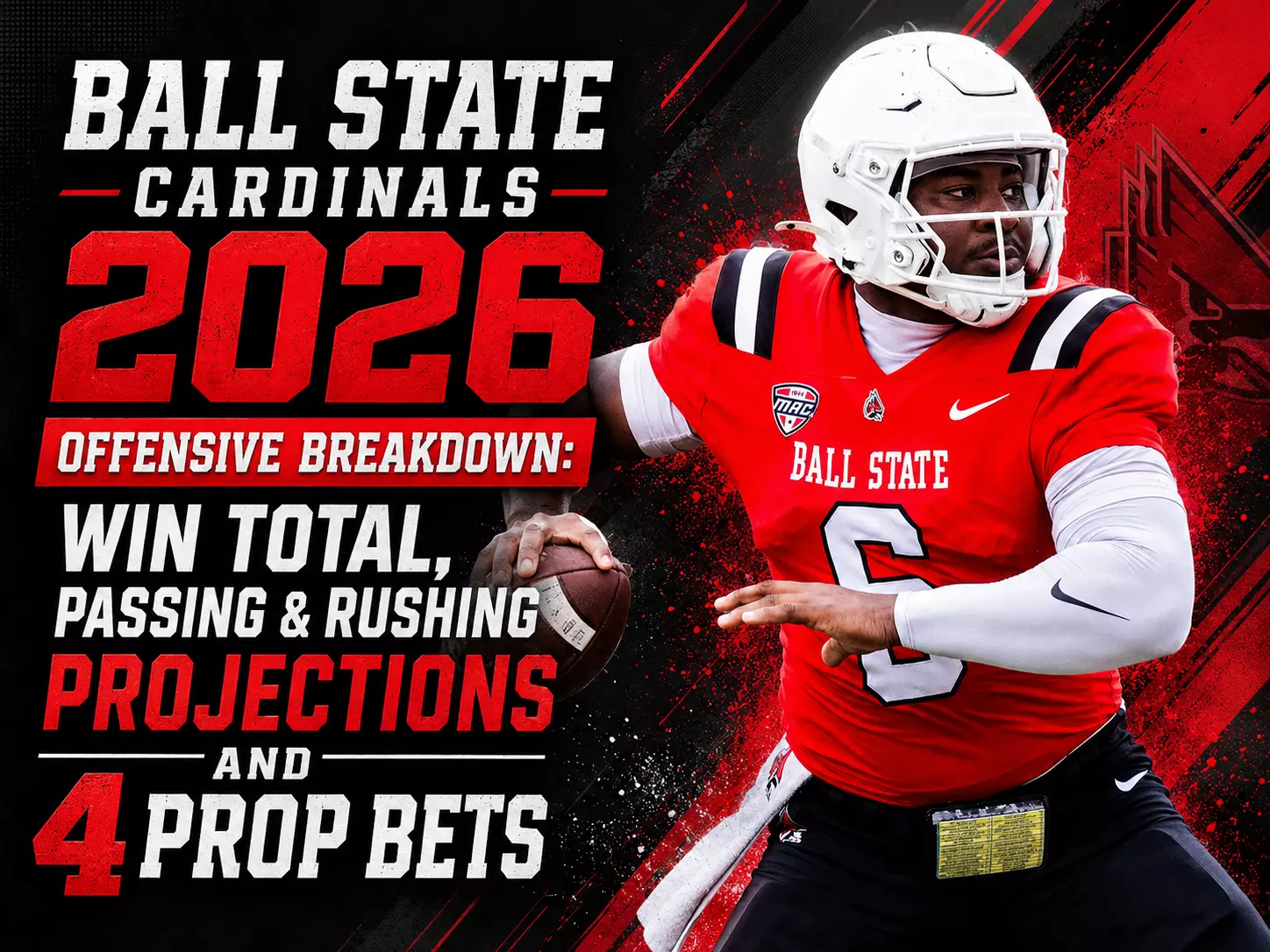
Ball State Cardinals 2026 Offensive Breakdown: Win Total, Passing & Rushing Projections and 4 Prop Bets
Ball State Cardinals 2026 Offensive Breakdown: Win Total, Passing & Rushing Projections and 4 Prop Bets
The Ball State Cardinals enter the 2026 college football season looking for a major offensive improvement in the second year under head coach
Mike Uremovich.
Ball State finished
4-8 overall and 3-5 in the MAC in 2025, but offense was the team’s biggest problem. The Cardinals averaged only
15.8 points and 271.7 yards per game, finishing with 3,260 yards of total offense. Ball State threw for only
1,679 yards and 12 touchdowns
while rushing for
1,581 yards and 10 scores.
The good news is that there are legitimate reasons to expect improvement.
Ball State returns three starting offensive linemen in
Chris Hood, Cole Mosier and Tristan Cook, giving the Cardinals considerably more continuity up front. Hood, Mosier and Cook entered the preseason with 43 combined career starts.
The Cardinals also completely rebuilt the quarterback room.
Transfers
Tyler Mizzell
and
Keldric Luster
handled the majority of the first-team quarterback work during the spring, creating one of Ball State’s most important position battles entering the season.
Mizzell brings significant production from Division II Concord, while Luster brings experience from Texas State and SMU.
Ball State also added several new skill-position players around them.
There are still plenty of questions, but the Cardinals should possess considerably more offensive upside than the team that struggled to score throughout 2025.
Ball State Cardinals 2026 Offensive Projections
Projected Record:
4-8
Projected Team Passing Yards:
2,250
Projected Team Rushing Yards:
1,750
Projected Total Offense:
4,000 yards
Projected Passing Touchdowns:
18
Projected Rushing Touchdowns:
16
Projected Offensive Touchdowns:
34-36
Projected Points Per Game:
22-24
Biggest Offensive Strength:
Experienced Offensive Line
Biggest Offensive Question:
Quarterback
Quarterback Breakdown: Tyler Mizzell vs. Keldric Luster
Ball State’s quarterback competition may ultimately determine how much improvement the offense makes in 2026.
The Cardinals lost Kiael Kelly after he completed 56.4% of his passes for
1,583 yards, 11 touchdowns and eight interceptions
last season. Kelly was also Ball State’s leading rusher with approximately 600 yards and five touchdowns.
That means Ball State isn’t simply replacing its starting passer.
It is replacing one of the most important pieces of its running game as well.
The most accomplished candidate is
Tyler Mizzell.
Mizzell began his college career at Wake Forest before transferring to Concord University. Last season he threw for
2,889 yards and 26 touchdowns, completing approximately 57% of his passes and averaging 262.6 passing yards per game.
He also rushed for
377 yards, making him Concord’s second-leading rusher. Mizzell surpassed 200 passing yards in nine of 11 games and topped 300 yards five times, including a 391-yard, three-touchdown performance against West Liberty.
Those numbers make Mizzell extremely intriguing.
Ball State desperately needs more explosiveness in the passing game, and Mizzell has already demonstrated the ability to generate significant yardage.
The obvious question is competition level.
Producing nearly 3,000 passing yards at the Division II level is impressive, but MAC defenses represent a significant jump.
Keldric Luster
provides a different option.
The former SMU and Texas State quarterback has appeared in nine collegiate games. His passing experience is limited — four completions on 12 attempts for 37 yards — but he has rushed 16 times for 76 yards.
Luster was also a three-star quarterback prospect coming out of high school and earned district MVP honors in Texas.
The most interesting possibility is that Ball State uses both quarterbacks.
Uremovich could choose the more experienced passer in Mizzell while finding specific packages for Luster’s athleticism.
However the competition concludes, Ball State needs dramatically more production.
The Cardinals averaged only
139.9 passing yards per game
in 2025.
Even increasing that number to approximately 185-190 yards per game would fundamentally change the offense.
Projected Ball State Team Passing Production: 2,250 yards and 18 touchdowns.
Ball State Running Game Breakdown
Replacing Kelly’s rushing production will be a major challenge, but Ball State has several intriguing options in the backfield.
TJ Horton
should receive a much larger opportunity.
Horton rushed 60 times for
180 yards
last season while adding 15 receptions for 71 yards. He was also one of the MAC’s better kickoff returners, averaging 24.5 yards per return and scoring on a 90-yard kickoff return against Akron.
Uremovich has praised Horton’s improvement and his ability to contribute as both a runner and receiver.
Another player to watch is
Jalen Bonds.
Bonds appeared in only three games as a freshman because of an early injury but became Ball State’s starting running back over the final three contests. He produced 112 yards from scrimmage against Toledo and scored his first collegiate rushing touchdown against Miami.
At 6-foot and 220 pounds, Bonds gives Ball State a more physical option between the tackles.
The Cardinals also added former Purdue running back
Elijah Jackson.
Jackson brings legitimate speed. He has been timed at 10.47 seconds in the 100 meters and rushed for 97 yards on only six career carries at Purdue, including a 69-yard touchdown against Indiana State.
That gives Ball State three very different options.
Horton provides versatility.
Bonds provides size and power.
Jackson provides explosiveness.
The biggest question is whether the offensive line can create enough opportunities for them.
Ball State rushed for only
1,581 yards and 10 touchdowns
in 2025 while averaging 3.5 yards per attempt.
Those numbers need to improve significantly.
The Cardinals don’t need one running back to become a 1,000-yard player. A committee approach combined with rushing production from Mizzell or Luster could push Ball State comfortably beyond last year’s total.
Projected Team Rushing Yards: 1,750
Projected Rushing Touchdowns: 16
Ball State Offensive Line Breakdown
The offensive line is the biggest reason to believe Ball State can make meaningful offensive progress.
Three starters return.
Chris Hood
enters the season with 20 career starts and anchors the line at left tackle. The 6-foot-10, 327-pound senior earned preseason All-MAC recognition and was named to the 2026 East-West Shrine Bowl 1000 Watch List.
Hood is joined by center
Cole Mosier
and right tackle
Tristan Cook.
The three returning starters entered the preseason with
43 combined career starts, giving Ball State a level of continuity it did not have when Uremovich installed his system in 2025.
Ball State also added veteran transfer help.
Jacob Jeudy
started 11 games at right tackle for Concord last season, where he played alongside Mizzell.
That familiarity could be particularly valuable if Mizzell wins the quarterback job.
The Cardinals have also added Vanderbilt transfer
Misael Sandoval, creating more size and competition up front.
However, returning starters alone don’t guarantee improvement.
Ball State allowed
49 sacks in 2025, the most in the MAC.
That number has to change.
The Cardinals cannot develop a more explosive passing game if Mizzell or Luster is constantly under pressure.
If the offensive line cuts the sack total significantly and improves the running game’s efficiency, the entire Ball State offense should benefit.
Ball State Passing Game Breakdown
Ball State’s receiving corps has more potential than it did a year ago.
The top returning option is
Donovan Hamilton.
The 6-foot-4 former Purdue receiver caught
20 passes for 244 yards
in his first season with Ball State. He recorded seven receptions against UConn and finished the year with four catches for a season-high 72 yards against Miami.
Hamilton’s combination of size and athleticism makes him a potential breakout candidate.
He is still looking for his first collegiate touchdown, but Ball State lists him as its top returning receiver and he received preseason All-MAC recognition from multiple publications.
The transfer portal gives Ball State additional options.
Jabari Smith Jr.
arrives from Florida Atlantic after catching
32 passes for 462 yards and six touchdowns
over two seasons. Smith showed legitimate big-play ability at FAU, including a 76-yard touchdown reception.
CJ Nelson
transfers from Eastern Illinois after catching
21 passes for 379 yards and three touchdowns
last season while averaging 18.0 yards per reception. His best performance included seven catches for 194 yards and two touchdowns against Illinois State.
That gives Ball State several different types of receivers.
Hamilton provides size.
Smith provides proven touchdown production.
Nelson provides big-play ability.
Players such as
Isaiah Thacker, Elisha Durham and Jamarion McDougle provide additional depth. Thacker can line up in the backfield, slot or outside and scored his first collegiate receiving touchdown last season.
The pieces are more interesting than Ball State’s 2025 passing statistics indicate.
The question is whether the quarterback and offensive line can give those receivers opportunities to make plays.
Projected Team Passing Yards: 2,250
Projected Passing Touchdowns: 18
Ball State Cardinals 2026 Win Total
Ball State’s current regular-season win total is
3.5 victories.
As of the latest available BetMGM market cited by HERO Sports, the
Over 3.5 was -125
and the Under was -105. Ball State was also listed at +9000 to win the MAC.
The number is understandable.
Ball State faces a difficult nonconference schedule.
The Cardinals open at
Ohio State, host Stony Brook and then travel to Liberty. Ball State also plays at Northwestern in October.
That likely leaves Stony Brook as the Cardinals’ best nonconference opportunity.
The MAC schedule, however, provides several chances to find victories.
Ball State travels to Kent State, Bowling Green, UMass and Ohio while hosting Toledo, Buffalo and Central Michigan. Sacramento State also visits Muncie for homecoming.
Perhaps most importantly, Ball State avoids
Miami (Ohio) and Western Michigan, two teams expected to be among the stronger programs in the conference.
Getting to four victories is realistic.
Getting beyond four or five becomes considerably more difficult.
My projection has Ball State finishing
4-8, matching last year’s record but showing considerably more competitiveness offensively.
Four Ball State Cardinals 2026 Prop Bets
Note:
Ball State’s 3.5-win total is a current sportsbook market. The statistical season props below are
projection-based betting benchmarks
because full-season college football team passing, rushing and touchdown markets are not consistently offered by every sportsbook.
Prop Bet #1: Ball State Over 3.5 Regular-Season Wins
DraftKings
4.5/5
Tip: Ball State Over 3.5 Regular-Season Wins
Manageable MAC Opportunities
Improved Offensive Depth
Three Returning Offensive Linemen
New DraftKings Customers: Bet $5, Get $200 + 3 Months of NBA League Pass!
Get bonus now
GAMBLING PROBLEM? CALL 1-800-GAMBLER or 1-800-MY-RESET, (800) 327-5050 or visit gamblinghelplinema.org (MA). Please Gamble Responsibly. 888-789-7777/visit ccpg.org (CT), or visit www.mdgamblinghelp.org (MD), 1-800-981-0023 (PR). 21+ and present in most states. (18+ DC/NH/PR/WY). Void in CAN. Eligibility restrictions apply. On behalf of Boot Hill Casino (KS). Pass-thru of per wager tax may apply in IL. 1 per new Sportsbook customer. $5+ first-time bet req. Max. $200 issued as non-withdrawable Bonus Bets. Stake removed from payout. Reward issued as $50 in Bonus Bets every 7 days via click-to-claim for 21 days. Bonus Bets and click-to-claims expire 7 days (168hrs) after issuance. Terms: dkng.co/offer. Get 1 promo code to redeem a 3-month NBA League Pass subscription, complimentary of DraftKings. Subscription auto-renews monthly at then-current price (currently $16.99/mo); cancel anytime. Terms, restrictions, and eligibility requirements apply. Redeem League Pass by 12/19/26 at 11:59 PM ET. Addt’l terms: support.watch.nba.com/hc/en-us/articles/9165532876183-League-Pass-Terms-of-Use_. Ends 11/29/26 at 11:59 PM ET. Sponsored by DK.
Why the Over Is a Good Bet
Ball State won four games last season despite producing one of the least effective offenses in college football.
That is the strongest argument for the Over.
The Cardinals averaged only 15.8 points and 271.7 yards per game and still managed to finish 4-8.
The offense should be better in 2026.
Mizzell gives Ball State a quarterback who threw for almost 2,900 yards last season at Concord, while Luster provides another athletic option.
The receiving room is deeper, and the offensive line brings back three starters.
The schedule also provides opportunities.
Stony Brook, Kent State, Bowling Green, Sacramento State, UMass, Buffalo and Central Michigan all represent games where Ball State should have a realistic chance to compete.
The Cardinals only need four victories.
Why the Under Is a Good Bet
The nonconference schedule creates almost no margin for error.
Ball State plays road games against Ohio State, Liberty and Northwestern.
If those all become losses, the Cardinals will need to win four of their other nine games.
That may sound manageable, but Ball State lost five MAC games by an average of more than 24 points last season.
Quarterback is also unsettled.
Mizzell’s production came at the Division II level, while Luster has almost no meaningful FBS passing experience.
The offensive line returns experience, but the same unit was part of an offense that surrendered 49 sacks last season.
Ball State needs improvement in several areas simultaneously for the Over to cash.
Projection: Ball State finishes 4-8
Bet: Over 3.5 Wins
Confidence: 6/10
Prop Bet #2: Ball State Over 2,099.5 Team Passing Yards
FanDuel
4.6/5
Tip: Ball State Over 2,099.5 Team Passing Yards
Tyler Mizzell’s Passing Production
Upgraded Transfer Receivers
More Offensive Explosiveness
New Users – Get $350 in Bonus Bets when you wager $5 for 7 days
Get bonus now
Gambling Problem? Call 1-800-GAMBLER or 1-800-MY-RESET. Call 1-888-789-7777 or visit ccpgg.org/chat (CT). Hope is here. GamblingHelpLineMA.org or call (800) 327-5050 for 24/7 support (MA). Visit www.mdgamblinghelp.org (MD). Call 1-877-8HOPE-NY or text HOPENY (NY). 21+ (18+ DC, WY) and present in select states (for KS, in affiliation with Kansas Star Casino). Find online real money wagering only. Min $5 wager required for 7 consecutive days. $5 free play credit. Bonus issued as non-withdrawable bonus with cash withdrawable bonus with cash withdrawable. Bonus bets which expire 7 days after receipt. Restrictions apply. See terms at sportsbook.fanduel.com. Call 1-877-770-7867 (LA).
Why the Over Is a Good Bet
Ball State only threw for 1,679 yards last season.
Projecting an increase of more than 400 yards may seem aggressive, but the quarterback and receiving rooms have been significantly upgraded.
Mizzell threw for
2,889 yards and 26 touchdowns
at Concord last season.
Even accounting for the jump in competition, that production demonstrates he can handle a high-volume passing offense.
Ball State also has more proven receiving options.
Hamilton returns after leading the current group with 244 yards last year, while Smith produced 462 yards and six touchdowns during his FAU career and Nelson had 379 yards at Eastern Illinois last season.
Ball State needs to average approximately
175 passing yards per game
to clear this benchmark.
That is a substantial improvement over last year’s 139.9, but it is achievable.
Why the Under Is a Good Bet
The offensive line allowed 49 sacks last season.
Until that problem is fixed, any passing-yardage Over carries significant risk.
Mizzell has also never started an FBS game.
Dominating at Division II is not the same as facing Ohio State, Liberty, Northwestern, Toledo and Ohio.
Ball State could also rotate quarterbacks.
If both Mizzell and Luster play significant snaps, the Cardinals may have difficulty developing consistency in the passing game.
The schedule includes several defenses capable of holding Ball State well below its season average.
Projection: 2,250 Team Passing Yards
Bet: Over 2,099.5 Team Passing Yards
Confidence: 6.5/10
Prop Bet #3: Ball State Over 1,649.5 Team Rushing Yards
Caesars
4.4/5
Tip: Ball State Over 1,649.5 Team Rushing Yards
Deep Running Back Rotation
Three Returning Offensive Linemen
Dual-Threat Quarterback Options
Bet $1 and get double the winnings up to $25 for your next 10 bets
–
21+ New users only. Must register using eligible promo code. First bet after registration must qualify. Max. Bonus Bet: $1,000. Bonus Bet expires 14 days after receipt. Void where prohibited. See Caesars.com/promos for full terms. Gambling Problem? 1-800-GAMBLER (1-800-426-2537)
Why the Over Is a Good Bet
This is my favorite Ball State offensive statistical prop.
The Cardinals rushed for
1,581 yards last season, meaning they only need modest improvement to get beyond 1,650.
The offensive line returns Hood, Mosier and Cook, giving Ball State three experienced starters.
The running back room should also be deeper.
Horton has shown the ability to contribute both as a runner and receiver.
Bonds provides a 220-pound physical option.
Jackson brings legitimate breakaway speed.
Mizzell could provide additional production after rushing for 377 yards at Concord last season.
Luster is also athletic enough to contribute if he receives playing time.
Ball State doesn’t need any individual player to rush for 1,000 yards.
A committee approach could be enough.
Why the Under Is a Good Bet
The biggest loss is Kelly.
Ball State’s quarterback was also its leading rusher last season, producing approximately 600 yards and five touchdowns.
That production won’t automatically be replaced.
Horton rushed for only 180 yards in 2025, and Bonds has only a small sample of collegiate carries.
Jackson has explosive speed but only six career collegiate rushing attempts.
Game situations also matter.
Ball State is likely to trail significantly against Ohio State and could fall behind against Liberty, Northwestern and several MAC opponents.
If that happens frequently, the Cardinals may be forced to abandon the running game.
Projection: 1,750 Team Rushing Yards
Bet: Over 1,649.5 Team Rushing Yards
Confidence: 7/10
Prop Bet #4: Ball State Over 31.5 Offensive Touchdowns
BetMGM
4.5/5
Tip: Ball State Over 31.5 Offensive Touchdowns
Major Quarterback Upgrade Potential
More Explosive Skill Players
Improved Offensive-Line Experience
Up To $1500 in Bonus Bets Paid Back if your First Bet Does Not Win
Get bonus now
Gambling problem? Call 1-800-GAMBLER or 1-800-MY-RESET (Available in the US) 877-8-HOPENY or text HOPENY (467369) (NY) 1-800-327-5050 (MA), 1-800-BETS-OFF (IA), 1-800-981-0023 (PR). 21+ only. Please Gamble Responsibly. See BetMGM.com for Terms. First Bet Offer for new customers only (if applicable). Subject to eligibility requirements. Bonus bets are non-withdrawable. In partnership with Kansas Crossing Casino and Hotel. Promotional offers not available in Mississippi, Massachusetts, New York, Ontario, or Puerto Rico.
Why the Over Is a Good Bet
Ball State has significant room for improvement.
The Cardinals managed only
12 passing touchdowns and 10 rushing touchdowns
last season.
Mizzell alone accounted for 26 passing touchdowns at Concord in 2025.
Nobody should expect him to duplicate that total automatically at Ball State, but his previous production shows the potential for a more explosive passing game.
Smith also provides proven red-zone production after scoring six receiving touchdowns during his two seasons at FAU.
Ball State should have more ways to score on the ground as well.
Bonds provides power near the goal line, Horton can contribute in space and Jackson has the speed to create long touchdowns.
The schedule includes Stony Brook, Kent State, Sacramento State, UMass and other games where Ball State should have opportunities to produce multiple offensive touchdowns.
Why the Under Is a Good Bet
Going from roughly 22 passing-and-rushing touchdowns to at least 32 would require a substantial offensive jump.
Ball State was one of the lowest-scoring teams in the country last season at only 15.8 points per game.
The Cardinals also struggled badly in the red zone.
They scored touchdowns on only 12 of 27 red-zone opportunities in 2025.
Quarterback uncertainty could continue those problems.
The schedule also includes several games where scoring opportunities could be extremely limited, particularly at Ohio State.
Ball State could improve significantly while still falling short of 32 offensive touchdowns.
Projection: 34-36 Offensive Touchdowns
Bet: Over 31.5 Offensive Touchdowns
Confidence: 6.5/10
Best Ball State Cardinals 2026 Prop Bet
Ball State’s rushing-yardage Over is the offensive wager I trust the most.
The Cardinals don’t need an enormous transformation.
They rushed for 1,581 yards last season, so getting beyond 1,649.5 requires fewer than 70 additional yards over the entire season.
The personnel should be better equipped to reach that number.
Hood, Mosier and Cook return along the offensive line.
Horton should receive an expanded role.
Bonds gives the Cardinals a physical runner who showed promise late last season.
Jackson adds legitimate speed.
Mizzell also demonstrated dual-threat ability at Concord, where he rushed for 377 yards.
The loss of Kelly’s rushing production creates risk, but the overall depth of the running game gives Ball State several different paths to surpass this benchmark.
Conclusion
The Ball State Cardinals enter the 2026 season needing significant offensive improvement if they want to take the next step under Mike Uremovich.
The bar is not particularly high.
Ball State averaged only
15.8 points and 271.7 yards per game
in 2025 while finishing 4-8.
That means the Cardinals don’t need to suddenly become one of the MAC’s elite offenses to improve their record.
They simply need to become competent and more explosive.
The quarterback competition will determine much of the ceiling.
Tyler Mizzell brings the most impressive statistical résumé after throwing for 2,889 yards and 26 touchdowns while rushing for another 377 yards at Concord.
Keldric Luster gives the Cardinals another athletic option with experience at Texas State and SMU.
Whoever wins the job should have more weapons around him.
Donovan Hamilton is a legitimate breakout candidate at receiver.
Jabari Smith Jr. brings proven touchdown production from Florida Atlantic.
CJ Nelson provides another potential big-play target after averaging 18 yards per reception at Eastern Illinois.
The running back room could also become considerably deeper with Horton, Bonds and Jackson providing different skill sets.
Most importantly, Ball State has experience along the offensive line.
Hood, Mosier and Cook give the Cardinals three returning starters and 43 combined career starts entering the year.
The line still must fix a pass-protection problem that resulted in 49 sacks last season, but continuity gives the group a better chance to improve.
My projection has Ball State producing approximately
2,250 passing yards, 1,750 rushing yards and 34-36 offensive touchdowns while averaging 22-24 points per game.
That would represent substantial improvement without requiring an unrealistic offensive transformation.
The schedule limits the overall ceiling.
Ball State travels to Ohio State, Liberty and Northwestern and also faces MAC opponents such as Toledo, Buffalo and Ohio. However, games against Stony Brook, Kent State, Bowling Green, Sacramento State, UMass and Central Michigan provide legitimate opportunities.
My prediction is
4-8, which would narrowly cash the
Over 3.5 regular-season wins.
A 5-7 finish is possible if the quarterback position exceeds expectations and the offensive line dramatically reduces the sack total.
From an offensive betting perspective, the strongest wager is
Ball State Over 1,649.5 team rushing yards.
The Cardinals have an experienced offensive-line foundation, more depth at running back and two quarterbacks capable of contributing with their legs.
Ball State probably isn’t ready to become one of the MAC’s highest-scoring offenses.
It doesn’t need to be.
If Mizzell or Luster provides stability at quarterback, the offensive line improves and the Cardinals generate more explosive plays, Ball State should be considerably more competitive in 2026 — and four or five victories are within reach.
New Users – Get $350 in Bonus Bets when you wager $5 for 7 days
T&Cs apply
4.6/5
Gambling Problem? Call 1-800-GAMBLER or 1-800-MY-RESET. Call 1-888-789-7777 or visit ccpgg.org/chat (CT). Hope is here. GamblingHelpLineMA.org or call (800) 327-5050 for 24/7 support (MA). Visit www.mdgamblinghelp.org (MD). Call 1-877-8HOPE-NY or text HOPENY (NY). 21+ (18+ DC, WY) and present in select states (for KS, in affiliation with Kansas Star Casino). Find online real money wagering only. Min $5 wager required for 7 consecutive days. $5 free play credit. Bonus issued as non-withdrawable bonus with cash withdrawable bonus with cash withdrawable. Bonus bets which expire 7 days after receipt. Restrictions apply. See terms at sportsbook.fanduel.com. Call 1-877-770-7867 (LA).
Up To $1500 in Bonus Bets Paid Back if your First Bet Does Not Win
T&Cs apply
4.5/5
Gambling problem? Call 1-800-GAMBLER or 1-800-MY-RESET (Available in the US) 877-8-HOPENY or text HOPENY (467369) (NY) 1-800-327-5050 (MA), 1-800-BETS-OFF (IA), 1-800-981-0023 (PR). 21+ only. Please Gamble Responsibly. See BetMGM.com for Terms. First Bet Offer for new customers only (if applicable). Subject to eligibility requirements. Bonus bets are non-withdrawable. In partnership with Kansas Crossing Casino and Hotel. Promotional offers not available in Mississippi, Massachusetts, New York, Ontario, or Puerto Rico.
New DraftKings Customers: Bet $5, Get $200 + 3 Months of NBA League Pass!
T&Cs apply
4.5/5
GAMBLING PROBLEM? CALL 1-800-GAMBLER or 1-800-MY-RESET, (800) 327-5050 or visit gamblinghelplinema.org (MA). Please Gamble Responsibly. 888-789-7777/visit ccpg.org (CT), or visit www.mdgamblinghelp.org (MD), 1-800-981-0023 (PR). 21+ and present in most states. (18+ DC/NH/PR/WY). Void in CAN. Eligibility restrictions apply. On behalf of Boot Hill Casino (KS). Pass-thru of per wager tax may apply in IL. 1 per new Sportsbook customer. $5+ first-time bet req. Max. $200 issued as non-withdrawable Bonus Bets. Stake removed from payout. Reward issued as $50 in Bonus Bets every 7 days via click-to-claim for 21 days. Bonus Bets and click-to-claims expire 7 days (168hrs) after issuance. Terms: dkng.co/offer. Get 1 promo code to redeem a 3-month NBA League Pass subscription, complimentary of DraftKings. Subscription auto-renews monthly at then-current price (currently $16.99/mo); cancel anytime. Terms, restrictions, and eligibility requirements apply. Redeem League Pass by 12/19/26 at 11:59 PM ET. Addt’l terms: support.watch.nba.com/hc/en-us/articles/9165532876183-League-Pass-Terms-of-Use_. Ends 11/29/26 at 11:59 PM ET. Sponsored by DK.
Must be 21+. GAMBLING PROBLEM? CALL 1-800-GAMBLER OR CALL 1-800-MY-RESET, www.mdgamblinghelp.org (MD), (800)-327-5050 or gamblinghelplinema.org (MA), Call (877)8-HOPENY or text HOPENY (467369) (NY), (888) 789-7777 or ccpg.org (CT), morethanagame.nc.gov (NC), 1800gambler.net (WV)
Bet $1 and get double the winnings up to $25 for your next 10 bets
T&Cs apply
4.4/5
21+ New users only. Must register using eligible promo code. First bet after registration must qualify. Max. Bonus Bet: $1,000. Bonus Bet expires 14 days after receipt. Void where prohibited. See Caesars.com/promos for full terms. Gambling Problem? 1-800-GAMBLER (1-800-426-2537)
21+ and present in OH. Gambling Problem? Call 1-800-GAMBLER.
This site is using
Cloudflare
and adheres to the
Google Safe Browsing Program. We adapted
Google's Privacy Guidelines
to keep your data safe at all times.
Close
Ready to Win Big? Join the Elite with Our Sports Betting Deals!
FanDuel Promo
New Users – Get $350 in Bonus Bets when you wager $5 for 7 days
Our Favorite
T&Cs and 21+ apply
Gambling Problem? Call 1-800-GAMBLER or 1-800-MY-RESET. Call 1-888-789-7777 or visit ccpgg.org/chat (CT). Hope is here. GamblingHelpLineMA.org or call (800) 327-5050 for 24/7 support (MA). Visit www.mdgamblinghelp.org (MD). Call 1-877-8HOPE-NY or text HOPENY (NY). 21+ (18+ DC, WY) and present in select states (for KS, in affiliation with Kansas Star Casino). Find online real money wagering only. Min $5 wager required for 7 consecutive days. $5 free play credit. Bonus issued as non-withdrawable bonus with cash withdrawable bonus with cash withdrawable. Bonus bets which expire 7 days after receipt. Restrictions apply. See terms at sportsbook.fanduel.com. Call 1-877-770-7867 (LA).
Code:
Open FanDuel
Get Bonus
BetMGM Promo
Up To $1500 in Bonus Bets Paid Back if your First Bet Does Not Win
Best Slots
T&Cs and 21+ apply
Gambling problem? Call 1-800-GAMBLER or 1-800-MY-RESET (Available in the US) 877-8-HOPENY or text HOPENY (467369) (NY) 1-800-327-5050 (MA), 1-800-BETS-OFF (IA), 1-800-981-0023 (PR). 21+ only. Please Gamble Responsibly. See BetMGM.com for Terms. First Bet Offer for new customers only (if applicable). Subject to eligibility requirements. Bonus bets are non-withdrawable. In partnership with Kansas Crossing Casino and Hotel. Promotional offers not available in Mississippi, Massachusetts, New York, Ontario, or Puerto Rico.
Code:
Open BetMGM
Get Bonus
DraftKings Promo
New DraftKings Customers: Bet $5, Get $200 + 3 Months of NBA League Pass!
Newcomer
T&Cs and 21+ apply
GAMBLING PROBLEM? CALL 1-800-GAMBLER or 1-800-MY-RESET, (800) 327-5050 or visit gamblinghelplinema.org (MA). Please Gamble Responsibly. 888-789-7777/visit ccpg.org (CT), or visit www.mdgamblinghelp.org (MD), 1-800-981-0023 (PR). 21+ and present in most states. (18+ DC/NH/PR/WY). Void in CAN. Eligibility restrictions apply. On behalf of Boot Hill Casino (KS). Pass-thru of per wager tax may apply in IL. 1 per new Sportsbook customer. $5+ first-time bet req. Max. $200 issued as non-withdrawable Bonus Bets. Stake removed from payout. Reward issued as $50 in Bonus Bets every 7 days via click-to-claim for 21 days. Bonus Bets and click-to-claims expire 7 days (168hrs) after issuance. Terms: dkng.co/offer. Get 1 promo code to redeem a 3-month NBA League Pass subscription, complimentary of DraftKings. Subscription auto-renews monthly at then-current price (currently $16.99/mo); cancel anytime. Terms, restrictions, and eligibility requirements apply. Redeem League Pass by 12/19/26 at 11:59 PM ET. Addt’l terms: support.watch.nba.com/hc/en-us/articles/9165532876183-League-Pass-Terms-of-Use_. Ends 11/29/26 at 11:59 PM ET. Sponsored by DK.
Code:
Open DraftKings
Get Bonus
Find out what the legends have to say about sports this week....
New Users – Get $350 in Bonus Bets when you wager $5 for 7 days
Gambling Problem? Call 1-800-GAMBLER or 1-800-MY-RESET. Call 1-888-789-7777 or visit ccpgg.org/chat (CT). Hope is here. GamblingHelpLineMA.org or call (800) 327-5050 for 24/7 support (MA). Visit www.mdgamblinghelp.org (MD). Call 1-877-8HOPE-NY or text HOPENY (NY). 21+ (18+ DC, WY) and present in select states (for KS, in affiliation with Kansas Star Casino). Find online real money wagering only. Min $5 wager required for 7 consecutive days. $5 free play credit. Bonus issued as non-withdrawable bonus with cash withdrawable bonus with cash withdrawable. Bonus bets which expire 7 days after receipt. Restrictions apply. See terms at sportsbook.fanduel.com. Call 1-877-770-7867 (LA).