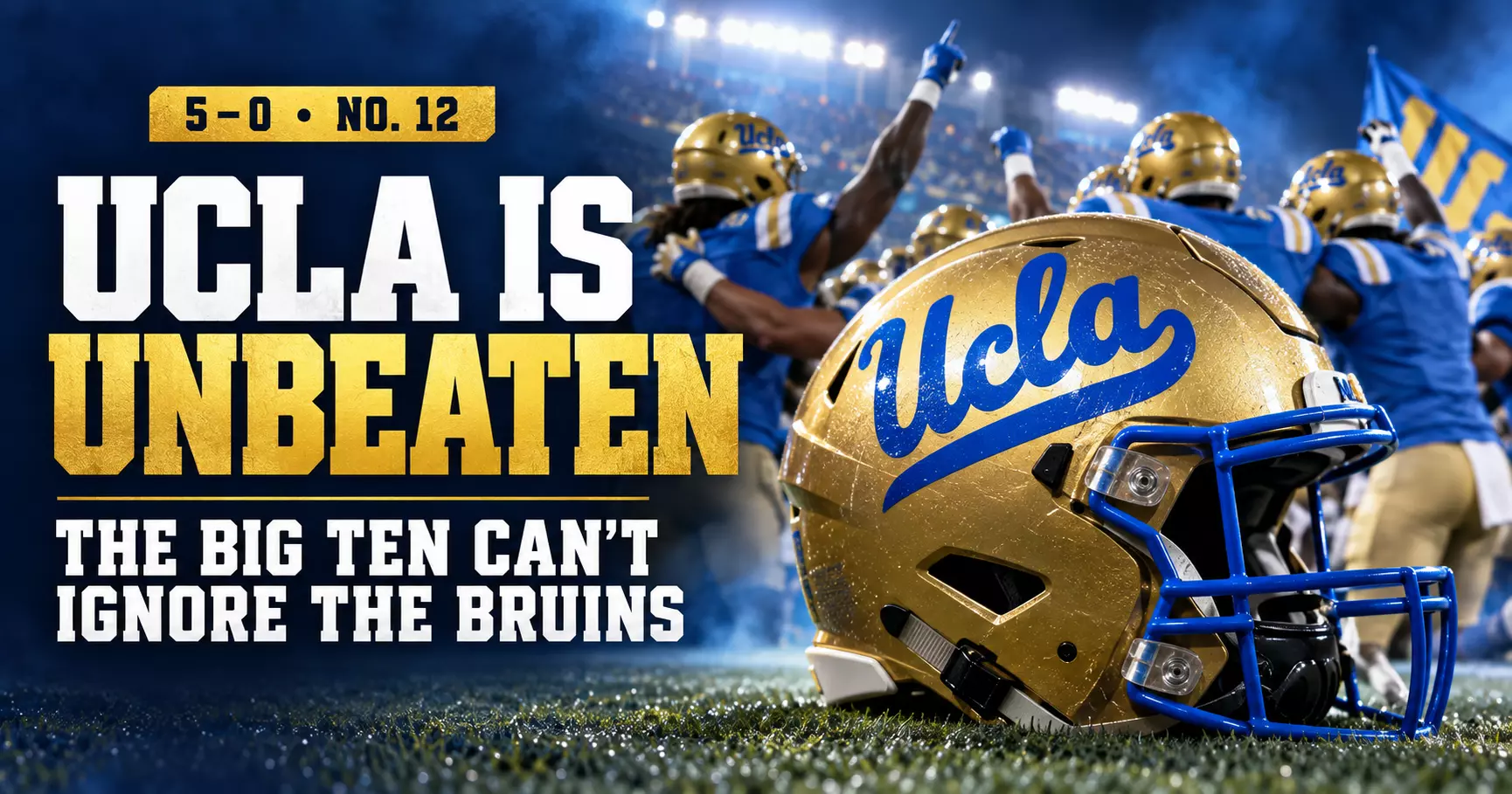
The Big Ten has spent plenty of time discussing Indiana, Ohio State and the programs expected to occupy the conference’s biggest stages. UCLA has earned its way into that discussion.
The Big Ten has spent plenty of time discussing Indiana, Ohio State and the programs expected to occupy the conference’s biggest stages. UCLA has earned its way into that discussion.
The Bruins beat Oregon 17–15 on Saturday, improving to 5–0 overall and 3–0 in conference play. Sunday’s AP poll rewarded them with a nine-place jump to No. 12.
That is more than a pleasant early-season development. UCLA has a road victory over a ranked opponent and a clean conference record approaching the middle of October.
The Bruins deserve to be treated as legitimate Big Ten contenders. Whether they are ready to beat the league’s best teams is a harder question—and the Oregon victory provided evidence in both directions.
Winning at Oregon Gives UCLA Something Real
UCLA’s victory
was its first at Autzen Stadium since 2004. Under first-year head coach Bob Chesney, the Bruins found a way to survive a difficult road environment, offensive mistakes and an injury to their starting quarterback.
That matters because conference contenders must win games that refuse to follow the script.
A team can look impressive when its quarterback is comfortable and its offense is scoring freely. The more revealing test comes when possessions stall, the crowd gets involved and the game becomes a series of uncomfortable decisions.
UCLA passed that test in Eugene.
The Bruins should also be judged against the Oregon team they actually faced. The Ducks are now 3–2 and have fallen out of the rankings. This was a valuable road victory, but it does not automatically establish UCLA as better than every other team in the conference.
It establishes something more defensible: the Bruins belong in the race.
Defense Is the Strongest Reason to Believe
UCLA forced seven turnovers and held Oregon to 272 total yards. Those are the two most striking numbers from the game, but they tell different stories.
Seven takeaways represent an exceptional afternoon. The yardage allowed offers another indication that UCLA’s defense made life difficult beyond the turnovers themselves.
My assessment is that the Bruins’ defensive performance gives their championship hopes a credible foundation. A team that can disrupt possessions has a chance to remain competitive when its own offense struggles.
That becomes especially valuable against the conference’s best teams. UCLA cannot assume it will score enough to win a shootout every week. It needs a defense capable of forcing opponents into difficult downs and making them work for touchdowns.
The challenge is repeating the quality of the performance without expecting the same extraordinary takeaway total.
Seven turnovers cannot become the weekly requirement for victory. If UCLA’s defense creates pressure, limits explosive plays and gets off the field without depending on a pile of recovered fumbles, the Bruins will have something sustainable.
Seventeen Points After Seven Takeaways Is a Warning
There is another way to read Saturday’s result: UCLA received repeated opportunities and still needed a late defensive stand to win by two.
That deserves scrutiny.
The Bruins cannot assume that Indiana, Ohio State or another strong opponent would leave so many possessions unfinished. Against better execution, the margin for offensive mistakes shrinks quickly.
My concern is that UCLA has shown it can survive an inefficient offensive afternoon, but has yet to establish through this game that it can consistently overcome one against the league’s strongest opponents.
The offense needs to turn favorable situations into points. It needs to finish drives, protect the ball and avoid putting the defense back on the field before it can recover.
A contender’s defense can rescue a game. It should not have to rescue every game.
Wayne Knight Gives the Bruins a Useful Weapon
Wayne Knight rushed for 103 yards against Oregon and scored both UCLA touchdowns, one on the ground and one as a receiver.
His versatility matters. An offense becomes harder to defend when a productive runner can also contribute to the passing game.
Against stronger defensive fronts, UCLA will need ways to keep moving when conventional runs produce little. Getting a back involved through the air can create manageable gains and force defenders to account for more than the quarterback and wide receivers.
The Bruins should also resist turning Knight into the answer to every offensive problem. The best defenses can concentrate on a featured player if the rest of the attack fails to command attention.
His performance gives UCLA a weapon to build around. The offense still needs enough balance to keep opponents from narrowing their focus.
Quarterback Health Could Change the Ceiling
Nico Iamaleava did not return for the second half against Oregon because of an injury. Ty Dieffenbach took over and threw the touchdown pass to Knight.
Winning after that disruption deserves credit. It also leaves an important question for the coming weeks.
Iamaleava’s availability and effectiveness could substantially influence UCLA’s offensive ceiling. Until his status is established, it would be premature to assume the Bruins will have their usual quarterback situation against Wisconsin.
Regardless of who starts, UCLA needs an offense that can function when an opponent takes away its first option. Protection, early-down efficiency and sound decisions become even more important when the quarterback situation is unsettled.
Dieffenbach helped finish a difficult victory. Building a consistent attack over multiple games presents a different challenge.
The Officiating Error Belongs in the Assessment
The Big Ten acknowledged that officials incorrectly spotted the ball on Oregon’s repeated two-point conversion attempt late in the game. The penalty should have been enforced from the end of the preceding run, rather than the original line of scrimmage.
That mistake affected an important opportunity for Oregon to tie the score. It does not establish that a correctly spotted attempt would have succeeded.
Both facts belong in an honest assessment. UCLA won the game, and the decisive sequence included an acknowledged officiating error.
The broader evaluation of the Bruins should rest on their entire performance and what they do next.
The Schedule Gives UCLA an Opportunity to Build
UCLA returns home for games against Wisconsin, Michigan State and Nevada. November includes road trips to Minnesota and Michigan, along with home games against Illinois and USC.
Indiana and Ohio State are absent from the Bruins’ regular-season schedule.
That creates an opportunity, but it guarantees nothing. UCLA still has to handle different styles, road environments and the demands of a rivalry game to finish the regular season.
The immediate test is Wisconsin. The Bruins must show they can follow an emotional road victory with another focused performance.
The next several weeks can also answer the questions Oregon exposed. Can the offense finish more consistently? Can the defense control games with fewer takeaways? Can UCLA keep winning when opponents have more evidence to study?
UCLA Belongs in the Race—Now It Must Stay There
The Bruins have earned serious consideration. Their unbeaten record, conference position and victory in Eugene give them more than a hopeful story.
My judgment is that UCLA is a legitimate
Big Ten contender
with an unfinished case.
The defense offers the strongest reason for confidence. Offensive efficiency and quarterback health are the largest uncertainties. Those issues will determine whether the Bruins can turn a promising start into a championship opportunity.
UCLA no longer needs to persuade the conference to notice it.
It needs to give the Big Ten a reason to keep watching.
Up To $1500 in Bonus Bets Paid Back if your First Bet Does Not Win
T&Cs apply
4.5/5
Gambling problem? Call 1-800-GAMBLER or 1-800-MY-RESET (Available in the US) 877-8-HOPENY or text HOPENY (467369) (NY) 1-800-327-5050 (MA), 1-800-BETS-OFF (IA), 1-800-981-0023 (PR). 21+ only. Please Gamble Responsibly. See BetMGM.com for Terms. First Bet Offer for new customers only (if applicable). Subject to eligibility requirements. Bonus bets are non-withdrawable. In partnership with Kansas Crossing Casino and Hotel. Promotional offers not available in Mississippi, Massachusetts, New York, Ontario, or Puerto Rico.
New DraftKings Customers: Spend $5+ Get $150 in Bonuses
T&Cs apply
4.5/5
GAMBLING PROBLEM? CALL 1-800-GAMBLER or 1-800-MY-RESET, (800) 327-5050 or visit gamblinghelplinema.org (MA). Please Gamble Responsibly. 888-789-7777/visit ccpg.org (CT), or visit www.mdgamblinghelp.org (MD), 1-800-981-0023 (PR). 21+ and present in most states. (18+ DC/NH/PR/WY). Void in CAN. Eligibility restrictions apply. On behalf of Boot Hill Casino (KS). Pass-thru of per wager tax may apply in IL. 1 per new DraftKings customer. $5+ first-time bet req. Max. $150 issued as non-withdrawable Bonus Bets. Stake removed from payout. Reward issued as $50 in Bonus Bets every 7 days via click-to-claim for 14 days. Bonus Bets and click-to-claims expire 7 days (168hrs) after issuance. Terms: sportsbook.draftkings.com/promos. Ends 10/11/26 at 11:59 PM ET. Sponsored by DK.
Must be 21+. GAMBLING PROBLEM? CALL 1-800-GAMBLER OR CALL 1-800-MY-RESET, www.mdgamblinghelp.org (MD), (800)-327-5050 or gamblinghelplinema.org (MA), Call (877)8-HOPENY or text HOPENY (467369) (NY), (888) 789-7777 or ccpg.org (CT), morethanagame.nc.gov (NC), 1800gambler.net (WV)
Bet $1 and get double the winnings up to $25 for your next 10 bets
T&Cs apply
4.4/5
21+ New users only. Must register using eligible promo code. First bet after registration must qualify. Max. Bonus Bet: $1,000. Bonus Bet expires 14 days after receipt. Void where prohibited. See Caesars.com/promos for full terms. Gambling Problem? 1-800-GAMBLER (1-800-426-2537)
21+ and present in OH. Gambling Problem? Call 1-800-GAMBLER.
This site is using
Cloudflare
and adheres to the
Google Safe Browsing Program. We adapted
Google's Privacy Guidelines
to keep your data safe at all times.
Close
Ready to Win Big? Join the Elite with Our Sports Betting Deals!
FanDuel Promo
New Users – Get $250 in Bonus Bets when you wager $5 for 5 days
Up To $1500 in Bonus Bets Paid Back if your First Bet Does Not Win
Best Slots
T&Cs and 21+ apply
Gambling problem? Call 1-800-GAMBLER or 1-800-MY-RESET (Available in the US) 877-8-HOPENY or text HOPENY (467369) (NY) 1-800-327-5050 (MA), 1-800-BETS-OFF (IA), 1-800-981-0023 (PR). 21+ only. Please Gamble Responsibly. See BetMGM.com for Terms. First Bet Offer for new customers only (if applicable). Subject to eligibility requirements. Bonus bets are non-withdrawable. In partnership with Kansas Crossing Casino and Hotel. Promotional offers not available in Mississippi, Massachusetts, New York, Ontario, or Puerto Rico.
Code:
Open BetMGM
Get Bonus
DraftKings Promo
New DraftKings Customers: Spend $5+ Get $150 in Bonuses
Newcomer
T&Cs and 21+ apply
GAMBLING PROBLEM? CALL 1-800-GAMBLER or 1-800-MY-RESET, (800) 327-5050 or visit gamblinghelplinema.org (MA). Please Gamble Responsibly. 888-789-7777/visit ccpg.org (CT), or visit www.mdgamblinghelp.org (MD), 1-800-981-0023 (PR). 21+ and present in most states. (18+ DC/NH/PR/WY). Void in CAN. Eligibility restrictions apply. On behalf of Boot Hill Casino (KS). Pass-thru of per wager tax may apply in IL. 1 per new DraftKings customer. $5+ first-time bet req. Max. $150 issued as non-withdrawable Bonus Bets. Stake removed from payout. Reward issued as $50 in Bonus Bets every 7 days via click-to-claim for 14 days. Bonus Bets and click-to-claims expire 7 days (168hrs) after issuance. Terms: sportsbook.draftkings.com/promos. Ends 10/11/26 at 11:59 PM ET. Sponsored by DK.
Code:
Open DraftKings
Get Bonus
Find out what the legends have to say about sports this week....