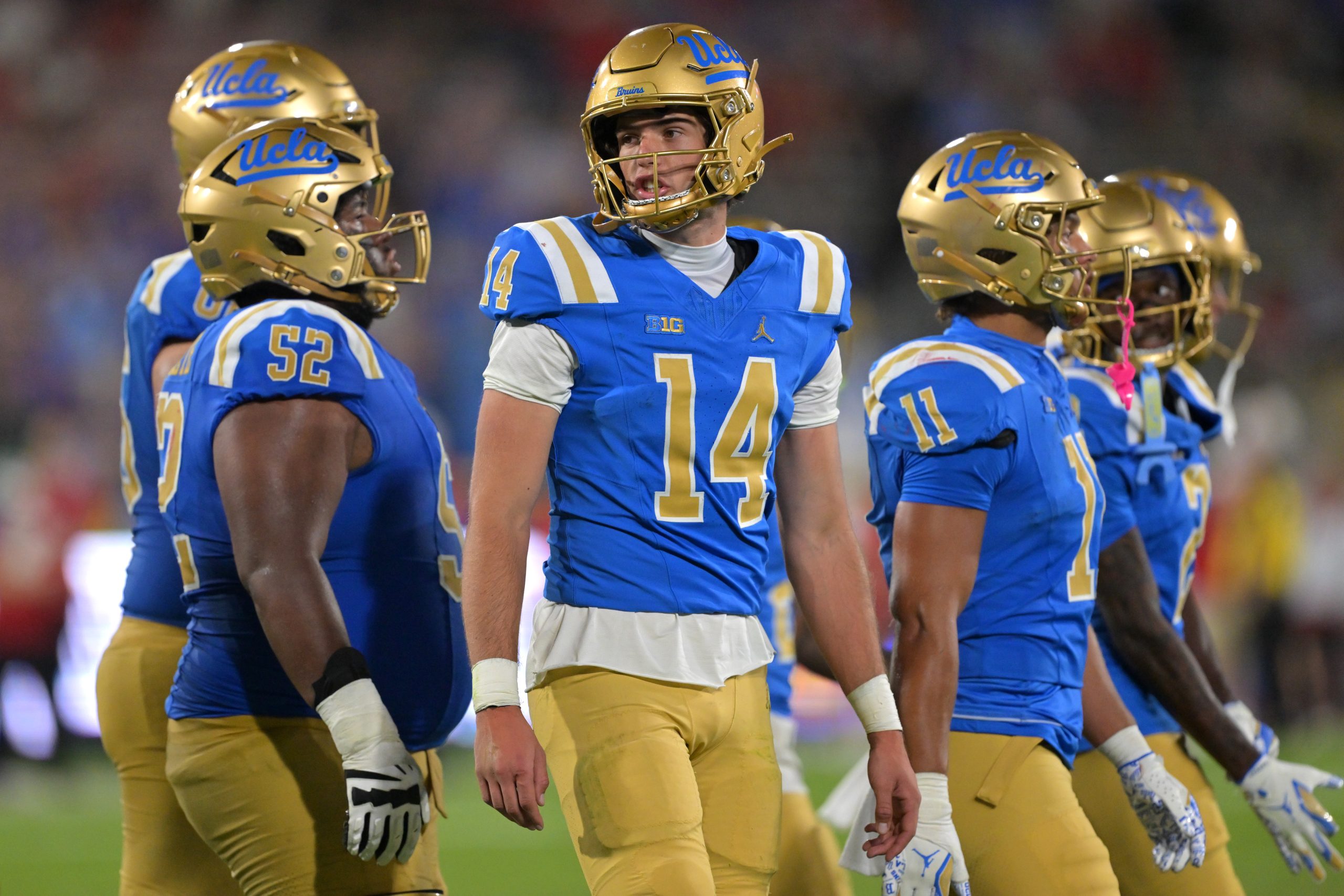
Oct 17, 2026; Pasadena, California, USA; UCLA Bruins quarterback Ty Dieffenbach (14) leaves the field following the game against the Wisconsin Badgers at the Rose Bowl. Mandatory Credit: Jayne Kamin-Oncea-Imagn Images
The Big Ten championship discussion needs to make more room for UCLA.
Ohio State earned the headlines by beating Indiana. The Hoosiers remain a major contender. Other programs will continue drawing attention because of their history, recruiting rankings and national following.
But the Bruins have something none of those teams can claim this morning:
an undefeated record.
UCLA improved to
6–0 overall and 4–0 in Big Ten play
with Saturday’s
17–7 victory over Wisconsin
at the Rose Bowl. The Bruins are the conference’s last unbeaten team, and they reached that position while navigating a change at quarterback.
That combination deserves serious consideration. UCLA is winning with a defense that gives its offense room to operate and a team structure strong enough to withstand adversity at its most important position.
The Bruins belong in the conference championship conversation because of what they are doing on the field.
UCLA’s Defense Is Giving This Team a Reliable Foundation
Wisconsin managed just
214 total yards and seven points, both season lows. Badgers quarterback Colton Joseph completed six of 16 passes for 66 yards. UCLA linebacker Jalen Woods finished with eight tackles, including a sack.
Those numbers explain why the Bruins could win without producing a huge offensive total.
When a defense limits passing production that severely, it reduces an opponent’s options. Sustaining drives becomes more difficult. Falling behind becomes more dangerous. A single negative play can leave an offense needing a completion it has struggled to produce.
That is the kind of support a quarterback making his first start needs.
UCLA did not require Ty Dieffenbach to win a shootout. It needed him to move the offense, make sound decisions and capitalize on opportunities. The defense helped establish conditions in which that assignment was manageable.
A team built that way can remain competitive even when its offense has an uneven possession or a difficult quarter.
Ty Dieffenbach Gave UCLA More Than Emergency Relief
Replacing an injured starting quarterback often changes a team’s expectations. UCLA’s performance suggested its ambitions can remain substantial.
With Nico Iamaleava unavailable following his injury against Oregon, Dieffenbach completed
22 of 33 passes for 264 yards, distributing completions among eight receivers. He had also finished the previous week’s victory in Eugene.
Saturday was an important step beyond simply finishing a game.
Preparing as the starter brings different demands. The opponent can study your tendencies. The game plan must account for what you do well. Teammates need to trust that the offense can function through the inevitable difficult situations.
Dieffenbach gave UCLA evidence that it can.
One start cannot establish how he will perform against every defense remaining on the schedule. It can establish that the Bruins have a quarterback capable of making this offense productive.
That distinction matters for a team trying to sustain a championship pursuit.
The Bruins Made Their Scoring Drives Count
UCLA’s three scoring possessions covered
84, 91 and 89 yards. Those drives produced a field goal and rushing touchdowns from Wayne Knight and Anthony Woods.
That is meaningful evidence of offensive competence.
The Bruins were able to move the length of the field with their new starter. They created scoring opportunities through sustained execution, demonstrating that the offense could function without relying on a succession of favorable starting positions.
Long drives also complement a strong defense.
They give defenders time to recover, limit the opponent’s possessions and make the other sideline wait for its next opportunity. When the offense finishes those drives, it places additional pressure on an opponent already struggling to move the ball.
UCLA’s final score was modest. The way the Bruins earned their points provided more encouragement than the number alone might suggest.
Winning Through a Quarterback Change Says Something About the Program
Bob Chesney’s team faced an immediate test of its preparation.
A quarterback injury affects protection calls, timing, communication and the relationship between the passer and his receivers. Even familiar plays can feel different when another player takes the snap.
UCLA managed that transition well enough to beat a Wisconsin team that entered with a winning record.
That reflects preparation across the offense. Dieffenbach deserves credit for executing, but his performance also required protection, available receivers and a plan he could operate.
There is a broader lesson here about evaluating contenders.
The strongest teams develop enough dependable habits that one personnel change does not erase their identity. They may need adjustments, but the rest of the roster continues doing its job.
Saturday gave UCLA a valuable example of that resilience.
The Big Ten Race Should Reflect Current Results
Ohio State deserves credit for its victory at Indiana. Indiana deserves respect for the quality it has demonstrated. UCLA’s unbeaten record deserves equal seriousness when discussing who can reach the conference championship game.
Those positions can coexist.
The Bruins do not need to be declared the conference’s best team this morning to warrant greater attention. They have earned consideration among its leading contenders.
Their 4–0 conference record already represents more Big Ten victories than UCLA recorded in either of its first two seasons in the league.
That is measurable progress. It also changes the standard for the rest of the season.
UCLA should now be assessed on whether it can sustain a championship challenge. Bowl eligibility is a milestone, but the Bruins have positioned themselves to pursue considerably more.
There Are Still Questions to Answer
UCLA’s success does not eliminate the need for improvement.
Seventeen points leaves limited protection against a sudden defensive breakdown or a costly turnover. Against stronger offenses, the Bruins may need to finish more possessions and create more separation.
Dieffenbach must also demonstrate consistency as opponents accumulate film on him. Defenses will adjust, and
UCLA
will need answers when his initial reads are unavailable.
The defense has its own responsibility: maintain this standard when opponents offer more explosive passing threats and greater offensive balance.
Those are legitimate questions for a contender. They should shape the discussion without overshadowing what UCLA has already accomplished.
UCLA Has Earned a Bigger Place in the Conversation
An unbeaten record, a productive first start from Dieffenbach and another strong defensive performance make a persuasive case.
UCLA has shown it can keep winning when circumstances become more difficult. Its defense provides stability. Its offense demonstrated that it can sustain drives through a quarterback transition.
The Bruins still must prove how high their ceiling reaches. But they have earned the opportunity to be judged alongside the teams setting the pace in the Big Ten.
UCLA is 6–0, and the conference’s last unbeaten team deserves to be treated like a championship contender.
New Users – Get $350 in Bonus Bets when you wager $5 for 7 days
T&Cs apply
4.6/5
Gambling Problem? Call 1-800-GAMBLER or 1-800-MY-RESET. Call 1-888-789-7777 or visit ccpgg.org/chat (CT). Hope is here. GamblingHelpLineMA.org or call (800) 327-5050 for 24/7 support (MA). Visit www.mdgamblinghelp.org (MD). Call 1-877-8HOPE-NY or text HOPENY (NY). 21+ (18+ DC, WY) and present in select states (for KS, in affiliation with Kansas Star Casino). Find online real money wagering only. Min $5 wager required for 7 consecutive days. $5 free play credit. Bonus issued as non-withdrawable bonus with cash withdrawable bonus with cash withdrawable. Bonus bets which expire 7 days after receipt. Restrictions apply. See terms at sportsbook.fanduel.com. Call 1-877-770-7867 (LA).
Up To $1500 in Bonus Bets Paid Back if your First Bet Does Not Win
T&Cs apply
4.5/5
Gambling problem? Call 1-800-GAMBLER or 1-800-MY-RESET (Available in the US) 877-8-HOPENY or text HOPENY (467369) (NY) 1-800-327-5050 (MA), 1-800-BETS-OFF (IA), 1-800-981-0023 (PR). 21+ only. Please Gamble Responsibly. See BetMGM.com for Terms. First Bet Offer for new customers only (if applicable). Subject to eligibility requirements. Bonus bets are non-withdrawable. In partnership with Kansas Crossing Casino and Hotel. Promotional offers not available in Mississippi, Massachusetts, New York, Ontario, or Puerto Rico.
New DraftKings Customers: Bet $5, Get $200 + 3 Months of NBA League Pass!
T&Cs apply
4.5/5
GAMBLING PROBLEM? CALL 1-800-GAMBLER or 1-800-MY-RESET, (800) 327-5050 or visit gamblinghelplinema.org (MA). Please Gamble Responsibly. 888-789-7777/visit ccpg.org (CT), or visit www.mdgamblinghelp.org (MD), 1-800-981-0023 (PR). 21+ and present in most states. (18+ DC/NH/PR/WY). Void in CAN. Eligibility restrictions apply. On behalf of Boot Hill Casino (KS). Pass-thru of per wager tax may apply in IL. 1 per new Sportsbook customer. $5+ first-time bet req. Max. $200 issued as non-withdrawable Bonus Bets. Stake removed from payout. Reward issued as $50 in Bonus Bets every 7 days via click-to-claim for 21 days. Bonus Bets and click-to-claims expire 7 days (168hrs) after issuance. Terms: dkng.co/offer. Get 1 promo code to redeem a 3-month NBA League Pass subscription, complimentary of DraftKings. Subscription auto-renews monthly at then-current price (currently $16.99/mo); cancel anytime. Terms, restrictions, and eligibility requirements apply. Redeem League Pass by 12/19/26 at 11:59 PM ET. Addt’l terms: support.watch.nba.com/hc/en-us/articles/9165532876183-League-Pass-Terms-of-Use_. Ends 11/29/26 at 11:59 PM ET. Sponsored by DK.
Must be 21+. GAMBLING PROBLEM? CALL 1-800-GAMBLER OR CALL 1-800-MY-RESET, www.mdgamblinghelp.org (MD), (800)-327-5050 or gamblinghelplinema.org (MA), Call (877)8-HOPENY or text HOPENY (467369) (NY), (888) 789-7777 or ccpg.org (CT), morethanagame.nc.gov (NC), 1800gambler.net (WV)
Bet $1 and get double the winnings up to $25 for your next 10 bets
T&Cs apply
4.4/5
21+ New users only. Must register using eligible promo code. First bet after registration must qualify. Max. Bonus Bet: $1,000. Bonus Bet expires 14 days after receipt. Void where prohibited. See Caesars.com/promos for full terms. Gambling Problem? 1-800-GAMBLER (1-800-426-2537)
21+ and present in OH. Gambling Problem? Call 1-800-GAMBLER.
This site is using
Cloudflare
and adheres to the
Google Safe Browsing Program. We adapted
Google's Privacy Guidelines
to keep your data safe at all times.
Close
Ready to Win Big? Join the Elite with Our Sports Betting Deals!
FanDuel Promo
New Users – Get $350 in Bonus Bets when you wager $5 for 7 days
Our Favorite
T&Cs and 21+ apply
Gambling Problem? Call 1-800-GAMBLER or 1-800-MY-RESET. Call 1-888-789-7777 or visit ccpgg.org/chat (CT). Hope is here. GamblingHelpLineMA.org or call (800) 327-5050 for 24/7 support (MA). Visit www.mdgamblinghelp.org (MD). Call 1-877-8HOPE-NY or text HOPENY (NY). 21+ (18+ DC, WY) and present in select states (for KS, in affiliation with Kansas Star Casino). Find online real money wagering only. Min $5 wager required for 7 consecutive days. $5 free play credit. Bonus issued as non-withdrawable bonus with cash withdrawable bonus with cash withdrawable. Bonus bets which expire 7 days after receipt. Restrictions apply. See terms at sportsbook.fanduel.com. Call 1-877-770-7867 (LA).
Code:
Open FanDuel
Get Bonus
BetMGM Promo
Up To $1500 in Bonus Bets Paid Back if your First Bet Does Not Win
Best Slots
T&Cs and 21+ apply
Gambling problem? Call 1-800-GAMBLER or 1-800-MY-RESET (Available in the US) 877-8-HOPENY or text HOPENY (467369) (NY) 1-800-327-5050 (MA), 1-800-BETS-OFF (IA), 1-800-981-0023 (PR). 21+ only. Please Gamble Responsibly. See BetMGM.com for Terms. First Bet Offer for new customers only (if applicable). Subject to eligibility requirements. Bonus bets are non-withdrawable. In partnership with Kansas Crossing Casino and Hotel. Promotional offers not available in Mississippi, Massachusetts, New York, Ontario, or Puerto Rico.
Code:
Open BetMGM
Get Bonus
DraftKings Promo
New DraftKings Customers: Bet $5, Get $200 + 3 Months of NBA League Pass!
Newcomer
T&Cs and 21+ apply
GAMBLING PROBLEM? CALL 1-800-GAMBLER or 1-800-MY-RESET, (800) 327-5050 or visit gamblinghelplinema.org (MA). Please Gamble Responsibly. 888-789-7777/visit ccpg.org (CT), or visit www.mdgamblinghelp.org (MD), 1-800-981-0023 (PR). 21+ and present in most states. (18+ DC/NH/PR/WY). Void in CAN. Eligibility restrictions apply. On behalf of Boot Hill Casino (KS). Pass-thru of per wager tax may apply in IL. 1 per new Sportsbook customer. $5+ first-time bet req. Max. $200 issued as non-withdrawable Bonus Bets. Stake removed from payout. Reward issued as $50 in Bonus Bets every 7 days via click-to-claim for 21 days. Bonus Bets and click-to-claims expire 7 days (168hrs) after issuance. Terms: dkng.co/offer. Get 1 promo code to redeem a 3-month NBA League Pass subscription, complimentary of DraftKings. Subscription auto-renews monthly at then-current price (currently $16.99/mo); cancel anytime. Terms, restrictions, and eligibility requirements apply. Redeem League Pass by 12/19/26 at 11:59 PM ET. Addt’l terms: support.watch.nba.com/hc/en-us/articles/9165532876183-League-Pass-Terms-of-Use_. Ends 11/29/26 at 11:59 PM ET. Sponsored by DK.
Code:
Open DraftKings
Get Bonus
Find out what the legends have to say about sports this week....
New Users – Get $350 in Bonus Bets when you wager $5 for 7 days
Gambling Problem? Call 1-800-GAMBLER or 1-800-MY-RESET. Call 1-888-789-7777 or visit ccpgg.org/chat (CT). Hope is here. GamblingHelpLineMA.org or call (800) 327-5050 for 24/7 support (MA). Visit www.mdgamblinghelp.org (MD). Call 1-877-8HOPE-NY or text HOPENY (NY). 21+ (18+ DC, WY) and present in select states (for KS, in affiliation with Kansas Star Casino). Find online real money wagering only. Min $5 wager required for 7 consecutive days. $5 free play credit. Bonus issued as non-withdrawable bonus with cash withdrawable bonus with cash withdrawable. Bonus bets which expire 7 days after receipt. Restrictions apply. See terms at sportsbook.fanduel.com. Call 1-877-770-7867 (LA).