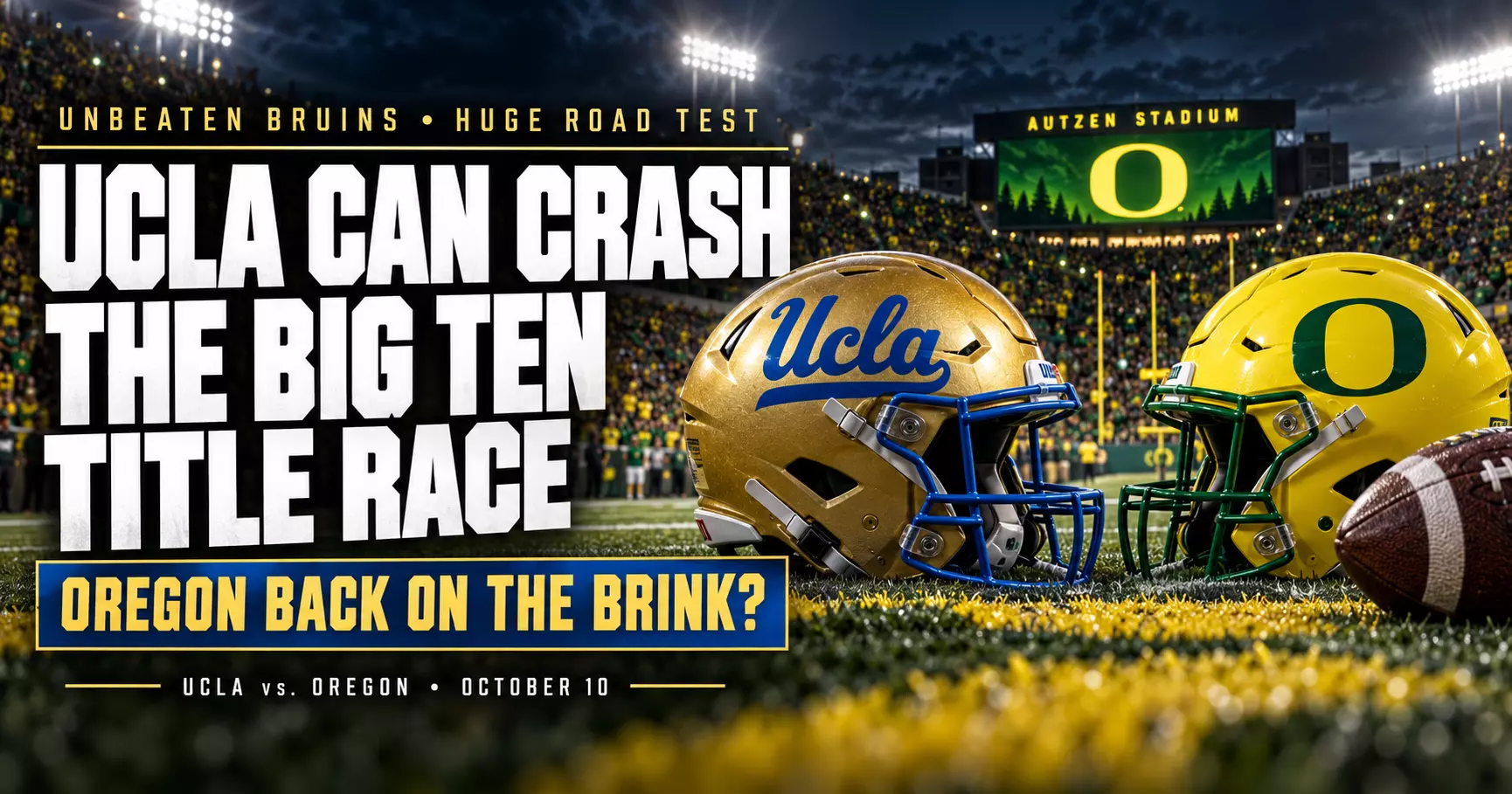
Unbeaten No. 21 UCLA visits No. 13 Oregon on Saturday, October 10, in a matchup that could change how both teams are viewed.
UCLA has spent the opening month giving people reasons to take it seriously. Now the Bruins have an opportunity to make that attention unavoidable.
Unbeaten No. 21 UCLA visits No. 13 Oregon on Saturday, October 10, in a matchup that could change how both teams are viewed in the Big Ten race. The Bruins enter 4–0, while the Ducks are 3–1 and looking to build on their victory at USC.
For UCLA, this is a chance to turn an encouraging start into a major conference statement.
For Oregon, it is a chance to demonstrate that its recovery from an early defeat is sustainable.
The Ducks have already shown they can respond to adversity. But another loss would renew questions about their consistency and make their championship path more difficult.
UCLA arrives with enough momentum to make that possibility worth taking seriously.
Bob Chesney Has Given UCLA a Reason to Believe
Bob Chesney’s first season
at UCLA has started with four consecutive victories. He became the first Bruins head coach to open his tenure 4–0 since Red Sanders in 1949.
That is meaningful progress, even with the strongest tests still ahead.
A new coach needs more than enthusiasm to change a program. Players need evidence that preparation and execution will produce results. UCLA’s opening month has provided that evidence.
The Bruins’ most recent performance was their strongest statement yet: a 54–3 victory at Maryland that improved them to 2–0 in Big Ten play.
Winning a conference road game by 51 points deserves recognition. UCLA took an opponent it was expected to compete with and made the afternoon overwhelmingly one-sided.
Oregon presents a different level of challenge. But the Bruins have earned the opportunity to approach that challenge with confidence.
Maryland Showed UCLA’s Potential—Oregon Will Test Its Limits
The Maryland victory demonstrated what UCLA can look like when it takes control.
The Bruins built a 20–3 halftime lead, then outscored the Terrapins 34–0 after the break. They continued extending their advantage rather than allowing a comfortable position to become a competitive finish.
That matters because good teams need to finish the assignments in front of them.
Still, Oregon will demand more.
UCLA cannot assume the same opportunities will appear or that a difficult stretch will be easy to overcome. The Bruins must protect possessions, avoid giving away field position and keep themselves in manageable situations.
Their unbeaten record has created interest. A victory in Eugene would provide much stronger evidence that they belong in the conference-title discussion.
That is the distinction this game offers: UCLA can move from a promising story to a team the Big Ten’s leaders must account for.
Oregon’s Recovery Is Real—but Incomplete
Oregon’s 39–31 loss at Oklahoma State remains part of its season. The Ducks responded by winning their next two games, including a 41–27 road victory over USC.
The USC result deserves substantial credit.
Oregon faced adversity during the game and still found enough offense to win against a quality conference opponent away from home. That performance showed resilience and kept the Ducks positioned to pursue their larger goals.
But one impressive victory does not eliminate the need for consistency.
Oregon now has to show it can carry that standard into another important matchup. The Ducks cannot rely on the emotional force of a comeback to solve every difficult afternoon.
Against UCLA, they need to establish control through ordinary execution: protection, tackling, disciplined coverage and productive early downs.
A convincing performance would strengthen the argument that Oregon has moved beyond its early stumble. A loss would make that conclusion much harder to defend.
The Quarterback Situation Remains Important
Dante Moore’s availability is a major issue to monitor entering the week. He suffered a concussion against USC, and the reports available ahead of this matchup have not established that he will play against UCLA.
Oregon’s preparation must account for that uncertainty.
Dylan Raiola helped lead the Ducks to victory after Moore left the USC game. His performance gave Oregon evidence that it could continue producing offense despite losing its starter.
That is valuable, but a full game against an opponent preparing for him presents a different challenge from entering during an unfolding matchup.
Whoever starts needs reliable protection and an offense that can stay out of predictable passing situations.
UCLA should prepare to defend Oregon’s entire offense rather than build its approach around an assumption about the quarterback. The Bruins cannot afford to treat uncertainty as an automatic advantage.
UCLA Must Make Oregon Earn Its Explosive Plays
Oregon demonstrated at USC that it can turn a competitive game into a winning performance through second-half offense. The Ducks produced 270 yards and four touchdown drives after halftime.
UCLA’s task is to prevent that kind of sustained acceleration.
The Bruins need to tackle well enough that modest gains remain modest. They need to avoid coverage mistakes that turn an ordinary possession into an immediate scoring opportunity.
Making Oregon drive the length of the field would increase the number of plays on which UCLA can create a stop. Giving away explosive gains would reduce those opportunities and place more pressure on the Bruins’ offense.
That does not mean UCLA should play passively. It means aggression must come with discipline.
The best chance to win is to make Oregon execute repeatedly, rather than allow a handful of breakdowns to decide the afternoon.
Oregon Needs to Test UCLA’s Composure
UCLA has earned confidence, but Oregon can challenge how well that confidence holds up when the game becomes uncomfortable.
The Ducks should aim to disrupt the Bruins’ rhythm early. A stalled possession, difficult third down or sudden change in field position can make an offense operate under different conditions than it enjoyed during a comfortable victory.
The important part is sustaining that pressure.
Oregon does not need to win the entire game in the opening quarter. It needs to avoid allowing UCLA to settle into the belief that its approach is working without resistance.
If the Ducks can limit easy gains and force the Bruins to solve tougher situations, they can make this matchup a test of UCLA’s adaptability.
That is where Oregon has an opportunity to show why it remains ranked higher.
A UCLA Victory Would Change the Conversation
Winning at Oregon
would carry more weight than another week of speculation about the Bruins’ potential.
It would give UCLA a victory over a ranked conference opponent away from home and preserve its unbeaten start. It would also give Chesney’s team a result that supports bigger expectations.
Oregon would face a different conversation.
A second loss would not automatically end every championship possibility, but it would reduce the Ducks’ room for further mistakes. It would also strengthen concerns that their best performances are not yet dependable from week to week.
That makes this game consequential for both teams.
UCLA can establish itself as a serious contender. Oregon can demonstrate that its response at USC was the beginning of a sustained run.
The Bruins Have Earned This Opportunity
Oregon should command respect after winning at USC. UCLA should command attention after opening Chesney’s tenure unbeaten and dominating its latest conference opponent.
The Bruins still have to show their strongest football holds up against a more demanding matchup. The Ducks still have to show they can deliver that demanding matchup consistently.
Saturday will provide evidence on both questions.
If UCLA wins, the Big Ten title race gains a contender with a major result behind it. If Oregon takes control, the Ducks strengthen their claim that the early-season defeat has given way to a more dependable team.
UCLA has done enough to make this game matter. Now the Bruins have a chance to make the rest of the conference take notice.
New Users – Get $350 in Bonus Bets when you wager $5 for 7 days
T&Cs apply
4.6/5
Gambling Problem? Call 1-800-GAMBLER or 1-800-MY-RESET. Call 1-888-789-7777 or visit ccpgg.org/chat (CT). Hope is here. GamblingHelpLineMA.org or call (800) 327-5050 for 24/7 support (MA). Visit www.mdgamblinghelp.org (MD). Call 1-877-8HOPE-NY or text HOPENY (NY). 21+ (18+ DC, WY) and present in select states (for KS, in affiliation with Kansas Star Casino). Find online real money wagering only. Min $5 wager required for 7 consecutive days. $5 free play credit. Bonus issued as non-withdrawable bonus with cash withdrawable bonus with cash withdrawable. Bonus bets which expire 7 days after receipt. Restrictions apply. See terms at sportsbook.fanduel.com. Call 1-877-770-7867 (LA).
Up To $1500 in Bonus Bets Paid Back if your First Bet Does Not Win
T&Cs apply
4.5/5
Gambling problem? Call 1-800-GAMBLER or 1-800-MY-RESET (Available in the US) 877-8-HOPENY or text HOPENY (467369) (NY) 1-800-327-5050 (MA), 1-800-BETS-OFF (IA), 1-800-981-0023 (PR). 21+ only. Please Gamble Responsibly. See BetMGM.com for Terms. First Bet Offer for new customers only (if applicable). Subject to eligibility requirements. Bonus bets are non-withdrawable. In partnership with Kansas Crossing Casino and Hotel. Promotional offers not available in Mississippi, Massachusetts, New York, Ontario, or Puerto Rico.
New DraftKings Customers: Bet $5, Get $200 + 3 Months of NBA League Pass!
T&Cs apply
4.5/5
GAMBLING PROBLEM? CALL 1-800-GAMBLER or 1-800-MY-RESET, (800) 327-5050 or visit gamblinghelplinema.org (MA). Please Gamble Responsibly. 888-789-7777/visit ccpg.org (CT), or visit www.mdgamblinghelp.org (MD), 1-800-981-0023 (PR). 21+ and present in most states. (18+ DC/NH/PR/WY). Void in CAN. Eligibility restrictions apply. On behalf of Boot Hill Casino (KS). Pass-thru of per wager tax may apply in IL. 1 per new Sportsbook customer. $5+ first-time bet req. Max. $200 issued as non-withdrawable Bonus Bets. Stake removed from payout. Reward issued as $50 in Bonus Bets every 7 days via click-to-claim for 21 days. Bonus Bets and click-to-claims expire 7 days (168hrs) after issuance. Terms: dkng.co/offer. Get 1 promo code to redeem a 3-month NBA League Pass subscription, complimentary of DraftKings. Subscription auto-renews monthly at then-current price (currently $16.99/mo); cancel anytime. Terms, restrictions, and eligibility requirements apply. Redeem League Pass by 12/19/26 at 11:59 PM ET. Addt’l terms: support.watch.nba.com/hc/en-us/articles/9165532876183-League-Pass-Terms-of-Use_. Ends 11/29/26 at 11:59 PM ET. Sponsored by DK.
Must be 21+. GAMBLING PROBLEM? CALL 1-800-GAMBLER OR CALL 1-800-MY-RESET, www.mdgamblinghelp.org (MD), (800)-327-5050 or gamblinghelplinema.org (MA), Call (877)8-HOPENY or text HOPENY (467369) (NY), (888) 789-7777 or ccpg.org (CT), morethanagame.nc.gov (NC), 1800gambler.net (WV)
Bet $1 and get double the winnings up to $25 for your next 10 bets
T&Cs apply
4.4/5
21+ New users only. Must register using eligible promo code. First bet after registration must qualify. Max. Bonus Bet: $1,000. Bonus Bet expires 14 days after receipt. Void where prohibited. See Caesars.com/promos for full terms. Gambling Problem? 1-800-GAMBLER (1-800-426-2537)
21+ and present in OH. Gambling Problem? Call 1-800-GAMBLER.
This site is using
Cloudflare
and adheres to the
Google Safe Browsing Program. We adapted
Google's Privacy Guidelines
to keep your data safe at all times.
Close
Ready to Win Big? Join the Elite with Our Sports Betting Deals!
FanDuel Promo
New Users – Get $350 in Bonus Bets when you wager $5 for 7 days
Our Favorite
T&Cs and 21+ apply
Gambling Problem? Call 1-800-GAMBLER or 1-800-MY-RESET. Call 1-888-789-7777 or visit ccpgg.org/chat (CT). Hope is here. GamblingHelpLineMA.org or call (800) 327-5050 for 24/7 support (MA). Visit www.mdgamblinghelp.org (MD). Call 1-877-8HOPE-NY or text HOPENY (NY). 21+ (18+ DC, WY) and present in select states (for KS, in affiliation with Kansas Star Casino). Find online real money wagering only. Min $5 wager required for 7 consecutive days. $5 free play credit. Bonus issued as non-withdrawable bonus with cash withdrawable bonus with cash withdrawable. Bonus bets which expire 7 days after receipt. Restrictions apply. See terms at sportsbook.fanduel.com. Call 1-877-770-7867 (LA).
Code:
Open FanDuel
Get Bonus
BetMGM Promo
Up To $1500 in Bonus Bets Paid Back if your First Bet Does Not Win
Best Slots
T&Cs and 21+ apply
Gambling problem? Call 1-800-GAMBLER or 1-800-MY-RESET (Available in the US) 877-8-HOPENY or text HOPENY (467369) (NY) 1-800-327-5050 (MA), 1-800-BETS-OFF (IA), 1-800-981-0023 (PR). 21+ only. Please Gamble Responsibly. See BetMGM.com for Terms. First Bet Offer for new customers only (if applicable). Subject to eligibility requirements. Bonus bets are non-withdrawable. In partnership with Kansas Crossing Casino and Hotel. Promotional offers not available in Mississippi, Massachusetts, New York, Ontario, or Puerto Rico.
Code:
Open BetMGM
Get Bonus
DraftKings Promo
New DraftKings Customers: Bet $5, Get $200 + 3 Months of NBA League Pass!
Newcomer
T&Cs and 21+ apply
GAMBLING PROBLEM? CALL 1-800-GAMBLER or 1-800-MY-RESET, (800) 327-5050 or visit gamblinghelplinema.org (MA). Please Gamble Responsibly. 888-789-7777/visit ccpg.org (CT), or visit www.mdgamblinghelp.org (MD), 1-800-981-0023 (PR). 21+ and present in most states. (18+ DC/NH/PR/WY). Void in CAN. Eligibility restrictions apply. On behalf of Boot Hill Casino (KS). Pass-thru of per wager tax may apply in IL. 1 per new Sportsbook customer. $5+ first-time bet req. Max. $200 issued as non-withdrawable Bonus Bets. Stake removed from payout. Reward issued as $50 in Bonus Bets every 7 days via click-to-claim for 21 days. Bonus Bets and click-to-claims expire 7 days (168hrs) after issuance. Terms: dkng.co/offer. Get 1 promo code to redeem a 3-month NBA League Pass subscription, complimentary of DraftKings. Subscription auto-renews monthly at then-current price (currently $16.99/mo); cancel anytime. Terms, restrictions, and eligibility requirements apply. Redeem League Pass by 12/19/26 at 11:59 PM ET. Addt’l terms: support.watch.nba.com/hc/en-us/articles/9165532876183-League-Pass-Terms-of-Use_. Ends 11/29/26 at 11:59 PM ET. Sponsored by DK.
Code:
Open DraftKings
Get Bonus
Find out what the legends have to say about sports this week....
New Users – Get $350 in Bonus Bets when you wager $5 for 7 days
Gambling Problem? Call 1-800-GAMBLER or 1-800-MY-RESET. Call 1-888-789-7777 or visit ccpgg.org/chat (CT). Hope is here. GamblingHelpLineMA.org or call (800) 327-5050 for 24/7 support (MA). Visit www.mdgamblinghelp.org (MD). Call 1-877-8HOPE-NY or text HOPENY (NY). 21+ (18+ DC, WY) and present in select states (for KS, in affiliation with Kansas Star Casino). Find online real money wagering only. Min $5 wager required for 7 consecutive days. $5 free play credit. Bonus issued as non-withdrawable bonus with cash withdrawable bonus with cash withdrawable. Bonus bets which expire 7 days after receipt. Restrictions apply. See terms at sportsbook.fanduel.com. Call 1-877-770-7867 (LA).