UCLA left Eugene with a victory that demands attention. It also left with a question that could determine the direction of its season.
UCLA left Eugene with a victory that demands attention. It also left with a question that could determine the direction of its season.
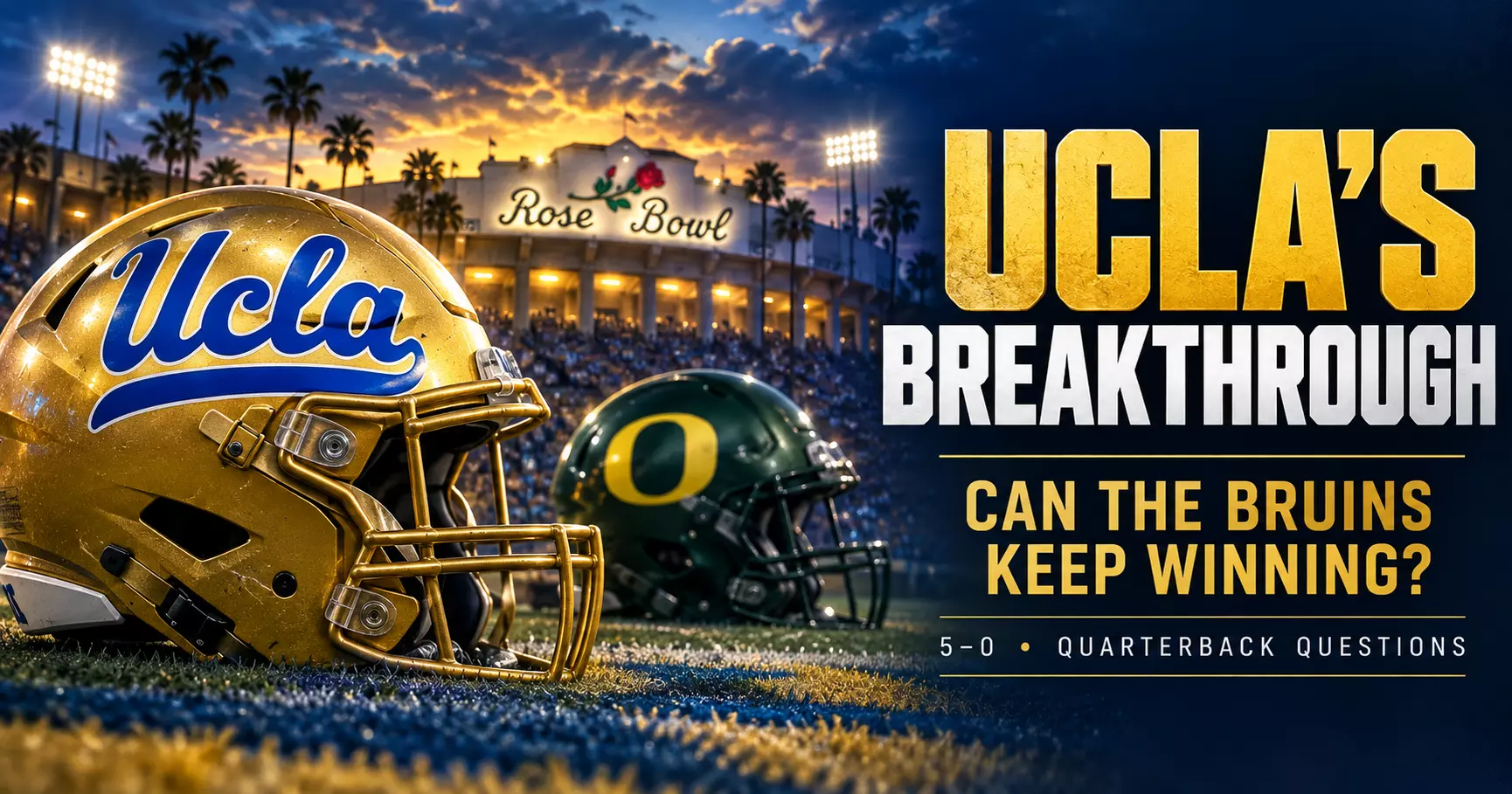
The Bruins beat Oregon 17–15, improved to 5–0 overall and 3–0 in the Big Ten, and climbed to No. 12 in the Associated Press poll. Bob Chesney’s first season has already produced a remarkable start, including UCLA’s first victory at Autzen Stadium since 2004.
But quarterback Nico Iamaleava’s knee injury has complicated the celebration. UCLA must now show that its breakthrough can survive a change under center—and games in which opponents do not surrender seven possessions.
The Bruins have earned their place in the conference conversation. Sustaining it will require a more complete offensive performance than they delivered against Oregon.
The Quarterback Situation Has Become the Defining Issue
Iamaleava was injured shortly before halftime against the Ducks. Ty Dieffenbach handled the second half, throwing for 43 yards and a touchdown.
The latest public assessment is more concerning than an ordinary week-to-week absence.
Chesney said Monday there was serious concern that Iamaleava could miss the remainder of the season, while emphasizing that doctors had not made a final determination. UCLA should therefore prepare for an extended absence without presenting a season-ending diagnosis as settled.
Dieffenbach and Madden Iamaleava, Nico’s younger brother, are the alternatives identified in that reporting. Neither had started an FBS game.
That changes the coaching challenge. Relieving an injured starter is different from preparing to lead an offense against a defense that has spent the week studying you.
UCLA needs a plan that gives its available quarterback clear reads, manageable situations and reliable protection. It also needs enough passing variety to prevent opponents from concentrating everything on stopping the run.
Dieffenbach Delivered the Play UCLA Needed
Dieffenbach’s nine-yard touchdown pass to Wayne Knight early in the fourth quarter extended
UCLA’s
lead to 17–6. It proved decisive.
That moment matters. A backup entered a difficult road environment and helped finish a ranked victory.
But the performance should be evaluated for what it demonstrated. Dieffenbach showed he could contribute under pressure. He did not have to prove that he could carry an entire offense through a full game of adjustments.
The next step is more demanding.
Can UCLA sustain drives when its defense does not provide favorable field position? Can the quarterback convert third downs when the first read is covered? Can the passing game punish opponents for bringing another defender into the box?
Those are the questions that will determine whether the transition is manageable.
Chesney should build around what his quarterback executes consistently. Short completions, movement passes and well-timed play-action can help establish rhythm. The important point is giving the offense usable answers rather than asking the replacement to reproduce every element of the original plan immediately.
The Running Game Gives UCLA a Real Foundation
UCLA’s success is not built entirely around its starting quarterback.
The Bruins lead the Big Ten with 253.2 rushing yards per game and 19 rushing touchdowns. Their running back trio of Knight, Jaivian Thomas and Anthony Woods has combined for 1,019 yards at 6.9 yards per carry.
That is a substantial reason to believe the offense can remain competitive.
Knight supplied 103 rushing yards against Oregon and scored both UCLA touchdowns, one on the ground and one through the air.
He gives the Bruins a dependable player to feature while they sort out the quarterback position.
Still, a strong rushing average does not guarantee control against every defense. Oregon held UCLA to 140 rushing yards, showing that the Bruins can be pushed below their usual production.
If future opponents crowd the line of scrimmage, UCLA must create enough passing success to make that approach costly. The running game can support a new quarterback, but the quarterback must also support the running game.
The Defense Deserves Credit Beyond Oregon’s Mistakes
Seven takeaways naturally raise questions about how much UCLA benefited from Oregon’s failures.
The Bruins deserve credit for putting themselves in position to capitalize.
UCLA recovered five fumbles and intercepted two passes. Its official postgame notes also credited the defense with holding opponents to two successful third-down conversions in 27 attempts across the Maryland and Oregon games.
That provides evidence of defensive effectiveness beyond a single afternoon’s turnover total.
Sammy Omosigho leads the FBS with four forced fumbles, according to UCLA’s Wisconsin preview. A defender who repeatedly attacks the ball is contributing a skill, even though the outcome of every loose ball cannot be controlled.
Pressure, disciplined coverage and secure tackling can remain consistent strengths.
Recovering five fumbles every week cannot be the expectation.
For UCLA to keep winning, its defense needs to succeed on possessions that end with punts as well as those that end with turnovers.
Seventeen Points Leaves an Uncomfortable Question
The Bruins gained seven extra opportunities through Oregon turnovers and still scored only 17 points. They also committed three turnovers themselves.
That is the clearest reason for caution.
The injury changed the game, and Oregon’s defense deserves credit. But a team trying to contend in the Big Ten must make better use of favorable situations.
An opening 62-yard completion helped put UCLA in scoring position, yet the Bruins settled for a field goal. Later, Oregon stopped Knight near the goal line on fourth down.
Those possessions show where improvement is needed.
UCLA must finish drives, reduce its own mistakes and avoid turning defensive opportunities into empty possessions. Against an opponent that protects the ball, the Bruins may have fewer chances to recover from those failures.
Wisconsin Will Test Whether the Breakthrough Travels Forward
UCLA hosts Wisconsin at the Rose Bowl on Saturday, October 17. The Badgers enter 4–1 overall and 2–0 in conference play.
This is an immediate test of adaptation.
The Bruins need to show that they can establish offensive rhythm with their available quarterback, continue running effectively and defend without depending on an extraordinary number of takeaways.
The schedule offers three consecutive home games before
November trips
to Minnesota and Michigan, with USC awaiting in the regular-season finale.
There is room to develop. There is also little reason to assume the challenges will disappear.
UCLA has shown resilience, a productive running game and a defense capable of disrupting opponents. Those qualities give its breakthrough substance.
Now Chesney must turn them into a formula that works when the quarterback changes and the turnover advantage is less generous.
Beating Oregon established that UCLA deserves attention. What happens next will establish how much.
New Users – Get $350 in Bonus Bets when you wager $5 for 7 days
T&Cs apply
4.6/5
Gambling Problem? Call 1-800-GAMBLER or 1-800-MY-RESET. Call 1-888-789-7777 or visit ccpgg.org/chat (CT). Hope is here. GamblingHelpLineMA.org or call (800) 327-5050 for 24/7 support (MA). Visit www.mdgamblinghelp.org (MD). Call 1-877-8HOPE-NY or text HOPENY (NY). 21+ (18+ DC, WY) and present in select states (for KS, in affiliation with Kansas Star Casino). Find online real money wagering only. Min $5 wager required for 7 consecutive days. $5 free play credit. Bonus issued as non-withdrawable bonus with cash withdrawable bonus with cash withdrawable. Bonus bets which expire 7 days after receipt. Restrictions apply. See terms at sportsbook.fanduel.com. Call 1-877-770-7867 (LA).
Up To $1500 in Bonus Bets Paid Back if your First Bet Does Not Win
T&Cs apply
4.5/5
Gambling problem? Call 1-800-GAMBLER or 1-800-MY-RESET (Available in the US) 877-8-HOPENY or text HOPENY (467369) (NY) 1-800-327-5050 (MA), 1-800-BETS-OFF (IA), 1-800-981-0023 (PR). 21+ only. Please Gamble Responsibly. See BetMGM.com for Terms. First Bet Offer for new customers only (if applicable). Subject to eligibility requirements. Bonus bets are non-withdrawable. In partnership with Kansas Crossing Casino and Hotel. Promotional offers not available in Mississippi, Massachusetts, New York, Ontario, or Puerto Rico.
New DraftKings Customers: Bet $5, Get $200 + 3 Months of NBA League Pass!
T&Cs apply
4.5/5
GAMBLING PROBLEM? CALL 1-800-GAMBLER or 1-800-MY-RESET, (800) 327-5050 or visit gamblinghelplinema.org (MA). Please Gamble Responsibly. 888-789-7777/visit ccpg.org (CT), or visit www.mdgamblinghelp.org (MD), 1-800-981-0023 (PR). 21+ and present in most states. (18+ DC/NH/PR/WY). Void in CAN. Eligibility restrictions apply. On behalf of Boot Hill Casino (KS). Pass-thru of per wager tax may apply in IL. 1 per new Sportsbook customer. $5+ first-time bet req. Max. $200 issued as non-withdrawable Bonus Bets. Stake removed from payout. Reward issued as $50 in Bonus Bets every 7 days via click-to-claim for 21 days. Bonus Bets and click-to-claims expire 7 days (168hrs) after issuance. Terms: dkng.co/offer. Get 1 promo code to redeem a 3-month NBA League Pass subscription, complimentary of DraftKings. Subscription auto-renews monthly at then-current price (currently $16.99/mo); cancel anytime. Terms, restrictions, and eligibility requirements apply. Redeem League Pass by 12/19/26 at 11:59 PM ET. Addt’l terms: support.watch.nba.com/hc/en-us/articles/9165532876183-League-Pass-Terms-of-Use_. Ends 11/29/26 at 11:59 PM ET. Sponsored by DK.
Must be 21+. GAMBLING PROBLEM? CALL 1-800-GAMBLER OR CALL 1-800-MY-RESET, www.mdgamblinghelp.org (MD), (800)-327-5050 or gamblinghelplinema.org (MA), Call (877)8-HOPENY or text HOPENY (467369) (NY), (888) 789-7777 or ccpg.org (CT), morethanagame.nc.gov (NC), 1800gambler.net (WV)
Bet $1 and get double the winnings up to $25 for your next 10 bets
T&Cs apply
4.4/5
21+ New users only. Must register using eligible promo code. First bet after registration must qualify. Max. Bonus Bet: $1,000. Bonus Bet expires 14 days after receipt. Void where prohibited. See Caesars.com/promos for full terms. Gambling Problem? 1-800-GAMBLER (1-800-426-2537)
21+ and present in OH. Gambling Problem? Call 1-800-GAMBLER.
This site is using
Cloudflare
and adheres to the
Google Safe Browsing Program. We adapted
Google's Privacy Guidelines
to keep your data safe at all times.
Close
Ready to Win Big? Join the Elite with Our Sports Betting Deals!
FanDuel Promo
New Users – Get $350 in Bonus Bets when you wager $5 for 7 days
Our Favorite
T&Cs and 21+ apply
Gambling Problem? Call 1-800-GAMBLER or 1-800-MY-RESET. Call 1-888-789-7777 or visit ccpgg.org/chat (CT). Hope is here. GamblingHelpLineMA.org or call (800) 327-5050 for 24/7 support (MA). Visit www.mdgamblinghelp.org (MD). Call 1-877-8HOPE-NY or text HOPENY (NY). 21+ (18+ DC, WY) and present in select states (for KS, in affiliation with Kansas Star Casino). Find online real money wagering only. Min $5 wager required for 7 consecutive days. $5 free play credit. Bonus issued as non-withdrawable bonus with cash withdrawable bonus with cash withdrawable. Bonus bets which expire 7 days after receipt. Restrictions apply. See terms at sportsbook.fanduel.com. Call 1-877-770-7867 (LA).
Code:
Open FanDuel
Get Bonus
BetMGM Promo
Up To $1500 in Bonus Bets Paid Back if your First Bet Does Not Win
Best Slots
T&Cs and 21+ apply
Gambling problem? Call 1-800-GAMBLER or 1-800-MY-RESET (Available in the US) 877-8-HOPENY or text HOPENY (467369) (NY) 1-800-327-5050 (MA), 1-800-BETS-OFF (IA), 1-800-981-0023 (PR). 21+ only. Please Gamble Responsibly. See BetMGM.com for Terms. First Bet Offer for new customers only (if applicable). Subject to eligibility requirements. Bonus bets are non-withdrawable. In partnership with Kansas Crossing Casino and Hotel. Promotional offers not available in Mississippi, Massachusetts, New York, Ontario, or Puerto Rico.
Code:
Open BetMGM
Get Bonus
DraftKings Promo
New DraftKings Customers: Bet $5, Get $200 + 3 Months of NBA League Pass!
Newcomer
T&Cs and 21+ apply
GAMBLING PROBLEM? CALL 1-800-GAMBLER or 1-800-MY-RESET, (800) 327-5050 or visit gamblinghelplinema.org (MA). Please Gamble Responsibly. 888-789-7777/visit ccpg.org (CT), or visit www.mdgamblinghelp.org (MD), 1-800-981-0023 (PR). 21+ and present in most states. (18+ DC/NH/PR/WY). Void in CAN. Eligibility restrictions apply. On behalf of Boot Hill Casino (KS). Pass-thru of per wager tax may apply in IL. 1 per new Sportsbook customer. $5+ first-time bet req. Max. $200 issued as non-withdrawable Bonus Bets. Stake removed from payout. Reward issued as $50 in Bonus Bets every 7 days via click-to-claim for 21 days. Bonus Bets and click-to-claims expire 7 days (168hrs) after issuance. Terms: dkng.co/offer. Get 1 promo code to redeem a 3-month NBA League Pass subscription, complimentary of DraftKings. Subscription auto-renews monthly at then-current price (currently $16.99/mo); cancel anytime. Terms, restrictions, and eligibility requirements apply. Redeem League Pass by 12/19/26 at 11:59 PM ET. Addt’l terms: support.watch.nba.com/hc/en-us/articles/9165532876183-League-Pass-Terms-of-Use_. Ends 11/29/26 at 11:59 PM ET. Sponsored by DK.
Code:
Open DraftKings
Get Bonus
Find out what the legends have to say about sports this week....
New Users – Get $350 in Bonus Bets when you wager $5 for 7 days
Gambling Problem? Call 1-800-GAMBLER or 1-800-MY-RESET. Call 1-888-789-7777 or visit ccpgg.org/chat (CT). Hope is here. GamblingHelpLineMA.org or call (800) 327-5050 for 24/7 support (MA). Visit www.mdgamblinghelp.org (MD). Call 1-877-8HOPE-NY or text HOPENY (NY). 21+ (18+ DC, WY) and present in select states (for KS, in affiliation with Kansas Star Casino). Find online real money wagering only. Min $5 wager required for 7 consecutive days. $5 free play credit. Bonus issued as non-withdrawable bonus with cash withdrawable bonus with cash withdrawable. Bonus bets which expire 7 days after receipt. Restrictions apply. See terms at sportsbook.fanduel.com. Call 1-877-770-7867 (LA).