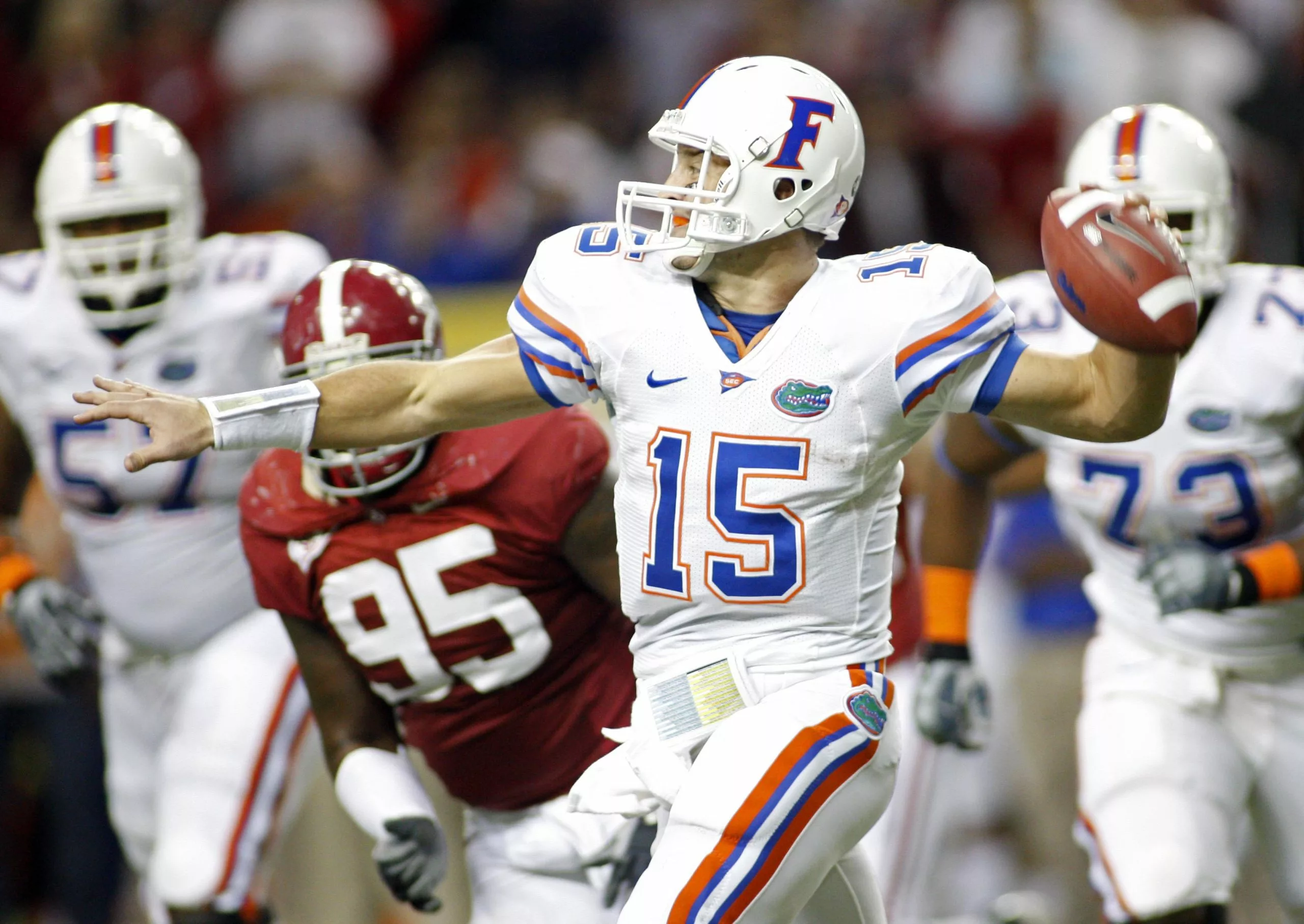
Dec 5, 2009; Atlanta, GA, USA; Florida Gators quarterback Tim Tebow (15) throws a pass during the second half of the 2009 SEC championship game against the Alabama Crimson Tide at the Georgia Dome. Mandatory Credit: John David Mercer-USA TODAY Sports
10) Fred Taylor
Fred Taylor was a critical piece of the most explosive offensive era in Florida football history. Playing under Steve Spurrier from 1994–1997, Taylor was part of the backfield rotation that helped power the Gators to their first national championship in 1996. Though injuries limited him at times early in his career, Taylor’s explosiveness was undeniable.
In 1997, as the featured back, Taylor rushed for 1,292 yards and 13 touchdowns, averaging over 6 yards per carry. He eclipsed 100 rushing yards in eight games that season, demonstrating both power and breakaway speed. Taylor finished his Florida career with 3,075 rushing yards and 31 touchdowns, ranking among the top rushers in program history at the time.
What made Taylor special was his ability to produce in Spurrier’s pass-heavy system. He forced defenses to respect the run, opening up the
“Fun ‘n’ Gun”
passing attack. His collegiate success translated into a long and productive NFL career, but his contributions to Florida’s first national title cement his legacy in Gainesville.
Classic Tailback – Fred Taylor Florida Highlights
9) Cris Collinsworth
Before becoming a legendary broadcaster, Cris Collinsworth was one of the most productive wide receivers in Florida history. Originally recruited as a quarterback, Collinsworth transitioned to wide receiver and quickly became a dynamic deep threat.
From 1978 to 1980, Collinsworth caught 120 passes for 1,937 yards and 14 touchdowns over his final three seasons. He earned All-SEC honors each year and averaged an impressive 16.1 yards per reception during his collegiate career. In 1978, he posted 39 receptions for 778 yards, showcasing his ability to stretch the field.
At 6-foot-5, Collinsworth combined size and speed, making him a matchup nightmare. He remains one of the most underrated receivers in Florida history because he played in an era that did not emphasize passing as heavily as later years.
Collinsworth’s impact extended beyond statistics; he helped modernize Florida’s passing attack and laid the groundwork for the high-powered offenses that would later define the program.
Honorary Mr. Two Bits: Cris Collinsworth
8) Percy Harvin
Percy Harvin was one of the most electrifying and versatile players in college football history. From 2006 to 2008, Harvin was the ultimate weapon in Urban Meyer’s spread offense. He could line up at receiver, running back, or take direct snaps in the backfield.
Harvin was the first Gator to rush for 100 yards and record 100 receiving yards in the same game. Over three seasons, he amassed 1,852 rushing yards and 1,929 receiving yards — becoming one of only two Division I-A players since 1996 to exceed 1,500 yards in both categories.
He was instrumental in Florida’s 2006 and 2008 national championship seasons, scoring 32 total touchdowns during his career. Harvin’s speed and explosiveness forced defenses into impossible decisions.
Few players have ever matched Harvin’s combination of versatility and big-play ability. He was the definition of a game-changer every time he touched the ball.
Percy Harvin 😤 Florida Highlights (2006-2008)
7) Emmitt Smith
Emmitt Smith’s Florida career lasted just three seasons (1987–1989), but the impact was historic. Smith rushed for 3,928 yards and 36 touchdowns, setting numerous school records that stood for years.
In 1989, he rushed for 1,599 yards and 14 touchdowns, earning unanimous All-American honors. Smith became the first player in SEC history to rush for 1,000 yards in three consecutive seasons from the start of his career.
Despite missing time due to injury in 1988, Smith still finished as Florida’s all-time leading rusher at the time of his departure. Had he stayed for his senior season, many believe he would rank even higher statistically in school history.
Smith’s toughness, vision, and durability translated into an NFL Hall of Fame career, but his dominance in Gainesville remains one of the greatest three-year stretches in Gator history.
Classic Tailback – Emmitt Smith Florida Highlights
6) Wes Chandler
Wes Chandler was one of the most explosive receivers in Florida history during the mid-1970s. From 1975 to 1977, Chandler led the Gators in receiving for three consecutive seasons.
He finished his collegiate career with 92 receptions for 1,963 yards and 22 touchdowns, averaging an astonishing 21.4 yards per catch — still one of the best marks in school history. Chandler’s speed made him a deep-ball threat long before Florida became known for wide-open offenses.
He earned All-SEC honors and was named an All-American in 1977. His ability to stretch defenses vertically forced opponents to adjust coverage schemes.
Chandler’s impact came during an era when passing was not as emphasized as it would become in later decades. His big-play ability set the tone for the explosive receivers that would later define Florida football.
Florida Football | Wes Chandler: 2015 College Football Hall of Fame Inductee
5) Jack Youngblood
Jack Youngblood is widely regarded as the greatest defensive lineman in Florida history. Playing from 1968 to 1970, Youngblood established himself as a dominant force in the trenches.
In 1969, he set a school record with 14 sacks, including a remarkable five-sack performance against Florida State. His relentless motor and physical dominance earned him All-American honors in 1970.
Youngblood’s impact went beyond statistics. He was the emotional leader of the defense and consistently disrupted opposing offenses. His toughness became legendary, later exemplified in his NFL career where he famously played through injury in the playoffs.
Youngblood set the standard for defensive excellence at Florida and remains one of the most respected defensive players in program history.
Jack Youngblood Tribute
4) Danny Wuerffel
Danny Wuerffel may be the most decorated quarterback in Florida history. Playing under Steve Spurrier from 1993 to 1996, Wuerffel led the Gators to their first national championship in 1996.
That same season, he won the Heisman Trophy after throwing for 3,625 yards and 39 touchdowns. Wuerffel finished his career with 10,875 passing yards and 114 touchdown passes, both school records at the time.
He was a two-time All-American and SEC Player of the Year. His poise, accuracy, and leadership perfectly complemented Spurrier’s offensive system.
Wuerffel’s legacy extends beyond the field due to his humanitarian work, but on the field, he was the quarterback who delivered Florida’s first national title.
Heisman Highlights – Danny Wuerffel
3) Wilber Marshall
Wilber Marshall was one of the most dominant defensive players in Florida history. From 1980 to 1983, Marshall terrorized offenses as a linebacker and defensive end hybrid.
He was a two-time consensus All-American and the 1983
National Defensive Player of the Year. Marshall’s combination of size, speed, and explosiveness allowed him to impact games in multiple ways.
He helped lead Florida to a 9–1–1 season in 1983, one of the strongest campaigns in school history at the time. Marshall’s intensity and playmaking ability made him one of the most feared defenders in college football.
He set the standard for defensive excellence at Florida and remains one of the program’s most physically dominant players.
Wilber Marshall clips – Florida Gators vs USC Trojans 1982
2) Steve Spurrier
Steve Spurrier changed Florida football forever. As a player from 1964 to 1966, Spurrier won the 1966 Heisman Trophy and was a two-time All-American.
He broke nearly every passing record in school history at the time and helped modernize Florida’s offense. Spurrier threw for 4,848 career yards — a significant number in that era.
His competitive fire and football IQ were evident even as a player. Though his coaching career would later define his legend in Gainesville, his playing career alone places him among the greatest Gators ever.
Spurrier laid the foundation for Florida’s offensive identity and remains one of the most influential figures in program history.
Florida Gators: Steve Spurrier Tribute
1) Tim Tebow
Tim Tebow is arguably the most iconic player in Florida football history. From 2006 to 2009, Tebow combined leadership, toughness, and production at an unprecedented level.
He won the Heisman Trophy in 2007 after accounting for 55 total touchdowns. Tebow led the Gators to two national championships (2006 and 2008) and finished his career with 9,286 passing yards and 88 passing touchdowns, along with 2,947 rushing yards and 57 rushing touchdowns.
Tebow’s physical running style, emotional leadership, and clutch performances made him one of the most beloved players in college football history.
His impact transcended statistics. Tebow represented toughness, faith, and competitive fire — and he delivered championships.
Up To $1500 in Bonus Bets Paid Back if your First Bet Does Not Win
T&Cs apply
4.5/5
Gambling problem? Call 1-800-GAMBLER or 1-800-MY-RESET (Available in the US) 877-8-HOPENY or text HOPENY (467369) (NY) 1-800-327-5050 (MA), 1-800-BETS-OFF (IA), 1-800-981-0023 (PR). 21+ only. Please Gamble Responsibly. See BetMGM.com for Terms. First Bet Offer for new customers only (if applicable). Subject to eligibility requirements. Bonus bets are non-withdrawable. In partnership with Kansas Crossing Casino and Hotel. Promotional offers not available in Mississippi, Massachusetts, New York, Ontario, or Puerto Rico.
New DraftKings Customers: Spend $5+ Get $150 in Bonuses
T&Cs apply
4.5/5
GAMBLING PROBLEM? CALL 1-800-GAMBLER or 1-800-MY-RESET, (800) 327-5050 or visit gamblinghelplinema.org (MA). Please Gamble Responsibly. 888-789-7777/visit ccpg.org (CT), or visit www.mdgamblinghelp.org (MD), 1-800-981-0023 (PR). 21+ and present in most states. (18+ DC/NH/PR/WY). Void in CAN. Eligibility restrictions apply. On behalf of Boot Hill Casino (KS). Pass-thru of per wager tax may apply in IL. 1 per new DraftKings customer. $5+ first-time bet req. Max. $150 issued as non-withdrawable Bonus Bets. Stake removed from payout. Reward issued as $50 in Bonus Bets every 7 days via click-to-claim for 14 days. Bonus Bets and click-to-claims expire 7 days (168hrs) after issuance. Terms: sportsbook.draftkings.com/promos. Ends 10/11/26 at 11:59 PM ET. Sponsored by DK.
Must be 21+. GAMBLING PROBLEM? CALL 1-800-GAMBLER OR CALL 1-800-MY-RESET, www.mdgamblinghelp.org (MD), (800)-327-5050 or gamblinghelplinema.org (MA), Call (877)8-HOPENY or text HOPENY (467369) (NY), (888) 789-7777 or ccpg.org (CT), morethanagame.nc.gov (NC), 1800gambler.net (WV)
Bet $1 and get double the winnings up to $25 for your next 10 bets
T&Cs apply
4.4/5
21+ New users only. Must register using eligible promo code. First bet after registration must qualify. Max. Bonus Bet: $1,000. Bonus Bet expires 14 days after receipt. Void where prohibited. See Caesars.com/promos for full terms. Gambling Problem? 1-800-GAMBLER (1-800-426-2537)
21+ and present in OH. Gambling Problem? Call 1-800-GAMBLER.
This site is using
Cloudflare
and adheres to the
Google Safe Browsing Program. We adapted
Google's Privacy Guidelines
to keep your data safe at all times.
Close
Ready to Win Big? Join the Elite with Our Sports Betting Deals!
FanDuel Promo
New Users – Get $250 in Bonus Bets when you wager $5 for 5 days
Up To $1500 in Bonus Bets Paid Back if your First Bet Does Not Win
Best Slots
T&Cs and 21+ apply
Gambling problem? Call 1-800-GAMBLER or 1-800-MY-RESET (Available in the US) 877-8-HOPENY or text HOPENY (467369) (NY) 1-800-327-5050 (MA), 1-800-BETS-OFF (IA), 1-800-981-0023 (PR). 21+ only. Please Gamble Responsibly. See BetMGM.com for Terms. First Bet Offer for new customers only (if applicable). Subject to eligibility requirements. Bonus bets are non-withdrawable. In partnership with Kansas Crossing Casino and Hotel. Promotional offers not available in Mississippi, Massachusetts, New York, Ontario, or Puerto Rico.
Code:
Open BetMGM
Get Bonus
DraftKings Promo
New DraftKings Customers: Spend $5+ Get $150 in Bonuses
Newcomer
T&Cs and 21+ apply
GAMBLING PROBLEM? CALL 1-800-GAMBLER or 1-800-MY-RESET, (800) 327-5050 or visit gamblinghelplinema.org (MA). Please Gamble Responsibly. 888-789-7777/visit ccpg.org (CT), or visit www.mdgamblinghelp.org (MD), 1-800-981-0023 (PR). 21+ and present in most states. (18+ DC/NH/PR/WY). Void in CAN. Eligibility restrictions apply. On behalf of Boot Hill Casino (KS). Pass-thru of per wager tax may apply in IL. 1 per new DraftKings customer. $5+ first-time bet req. Max. $150 issued as non-withdrawable Bonus Bets. Stake removed from payout. Reward issued as $50 in Bonus Bets every 7 days via click-to-claim for 14 days. Bonus Bets and click-to-claims expire 7 days (168hrs) after issuance. Terms: sportsbook.draftkings.com/promos. Ends 10/11/26 at 11:59 PM ET. Sponsored by DK.
Code:
Open DraftKings
Get Bonus
Find out what the legends have to say about sports this week....