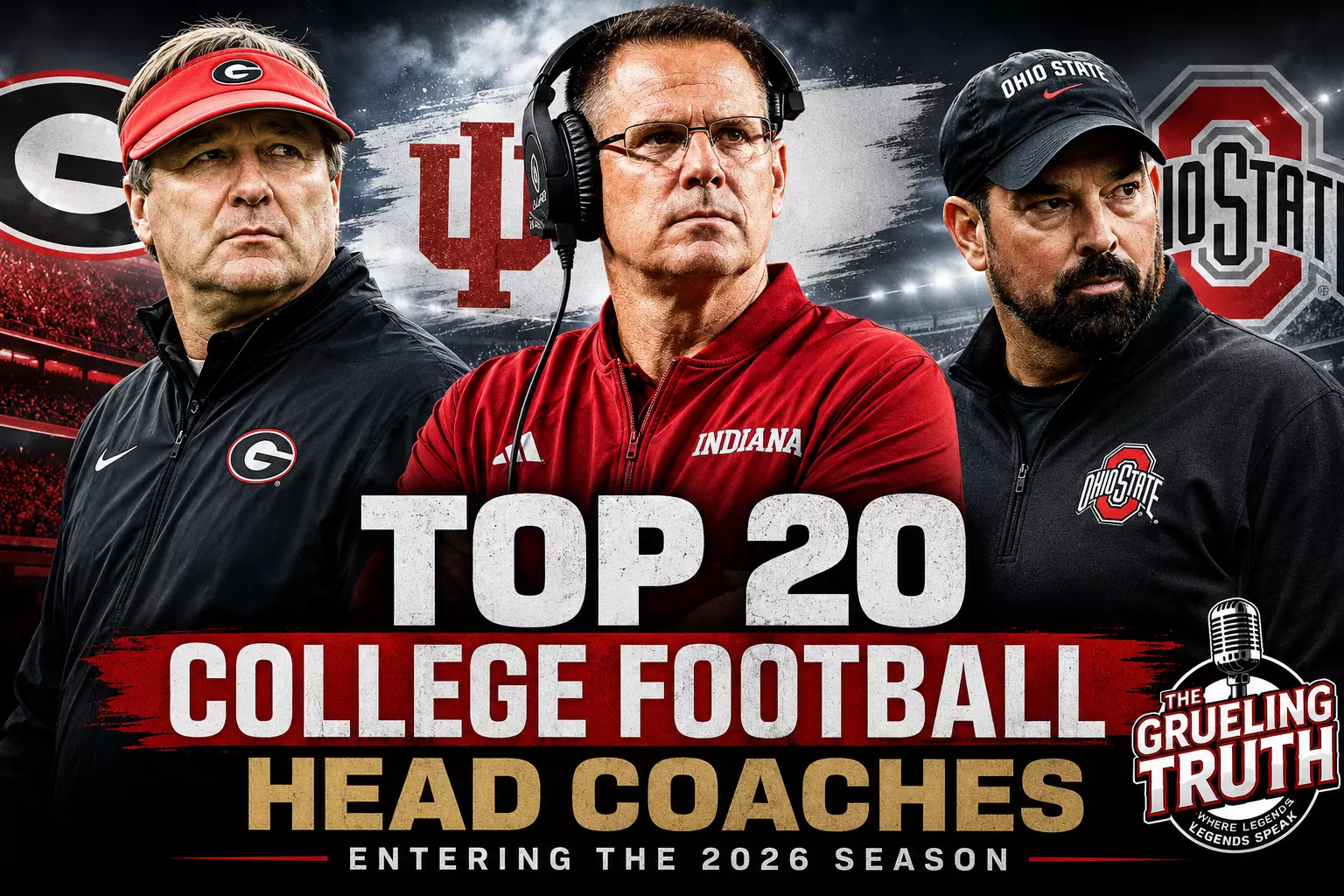
Ranking college football coaches today is not as simple as counting national championships. Championships matter.
Ranking college football coaches today is not as simple as counting national championships. Championships matter, but so does program building, recruiting, player development, culture, adaptability, and winning relative to resources.
Winning big at Georgia or Ohio State is difficult. Winning big at Indiana, Kansas, Vanderbilt, or Houston requires a different kind of coaching job. This ranking weighs both résumé and current momentum entering the 2026 college football season.
20. Rhett Lashlee — SMU
Rhett Lashlee has quickly become one of the better offensive minds in
college football. SMU’s move into the ACC could have been rocky, but Lashlee has helped make the Mustangs credible right away. His offense is modern, aggressive, and quarterback-friendly. More importantly, he understands what SMU can be in the NIL and transfer portal era. The school has resources, ambition, and a recruiting footprint that gives it a chance to become a real player in the ACC. Lashlee still has to prove he can win championships at the power-conference level, but the foundation is strong. SMU plays with confidence, and that confidence comes directly from its head coach. He is not yet in the elite category, but he is one of the fastest-rising coaches in America.
19. Bret Bielema — Illinois
Bret Bielema has quietly done an excellent job at Illinois. His teams are physical, tough, and built around the line of scrimmage. That may not always produce flashy headlines, but it wins football games. Bielema understands Big Ten football as well as almost anyone. He won big at Wisconsin, had mixed results at Arkansas, and has reestablished himself by making Illinois a legitimate threat again. The Illini are no longer an automatic win for anyone. They defend, they run the ball, and they usually play with an edge. Bielema may not be viewed as one of the sport’s modern innovators, but he knows how to build a team that can survive in November. In a sport obsessed with tempo and headlines, his physical approach still works.
18. James Franklin — Virginia Tech
James Franklin’s move to Virginia Tech immediately gives the Hokies national credibility. Franklin won at Vanderbilt, which remains one of the most difficult jobs in major college football. Then he won consistently at Penn State, where expectations are enormous and every loss feels magnified. The criticism is fair: Franklin did not win enough of the biggest games at Penn State. But his overall body of work is still very strong. He recruits well, organizes programs well, hires strong staffs, and builds teams that usually win nine or ten games. Virginia Tech has been searching for stability and national relevance for years. Franklin gives the Hokies both. If he can restore recruiting in the Mid-Atlantic and rebuild the old Lane Stadium edge, Virginia Tech could matter again fast.
17. Josh Heupel — Tennessee
Josh Heupel brought Tennessee back from the dead. When he arrived, the Volunteers were not just struggling; they were a mess. He installed one of the most explosive offensive systems in college football and quickly made Tennessee nationally relevant again. His teams play fast, attack vertically, and put pressure on defenses in ways few programs can match. Heupel also deserves credit for improving recruiting and restoring belief inside one of the sport’s most passionate fan bases. The next step is championship consistency. Tennessee can score with almost anyone, but to win the SEC, the Vols must continue improving defensively and at the line of scrimmage. Heupel has already proven he can rebuild a giant. Now he has to prove he can take it all the way.
16. Kalen DeBoer — Alabama
Kalen DeBoer took on the hardest job in college football: replacing Nick Saban. That alone would overwhelm most coaches. DeBoer has handled the transition with poise and confidence. His previous success at Washington proved he could build a championship-level offense and lead a team to the biggest stage. Alabama gives him more talent, more resources, and more pressure than he has ever had before. DeBoer’s strength is offensive design, quarterback development, and calm leadership. He does not have Saban’s personality, but nobody does. The key is whether he can keep Alabama recruiting at an elite level and maintain the program’s defensive toughness. So far, he has shown he belongs in the national elite. Winning big at Alabama is expected, but sustaining it after Saban is still a massive challenge.
15. Joey McGuire — Texas Tech
Joey McGuire has turned
Texas Tech
into one of the most interesting programs in the Big 12. His background as a legendary Texas high school coach gives him credibility in one of the most important recruiting states in America. Players respond to him, recruits believe in him, and Texas Tech fans have bought into his energy. McGuire has brought toughness and belief to a program long known mostly for offense. That matters. The Red Raiders are no longer just a fun passing team; they are becoming a program that expects to compete for conference championships. McGuire still needs to stack elite seasons and prove Texas Tech can sustain success, but the direction is obvious. He has momentum, personality, recruiting ability, and a program that fits him perfectly.
14. Willie Fritz — Houston
Willie Fritz may not have the flash of some bigger-name coaches, but he is one of the best program builders in college football. Everywhere he has gone, Fritz has made teams tougher, smarter, and more competitive. His work at Tulane was outstanding, and now he is trying to elevate Houston in the Big 12. That is not an easy assignment. The Cougars are in a talent-rich city, but they are also fighting for attention in a crowded football state. Fritz wins with discipline, player development, and a clear identity. His teams are rarely soft, and they usually improve the longer he is in charge. He may not recruit like the giants of the sport, but if you need someone to build a real football program from the ground up, Fritz belongs on this list.
13. Steve Sarkisian — Texas
Steve Sarkisian finally made Texas look like Texas again. For years, the Longhorns had every advantage imaginable but failed to turn resources into consistent national relevance. Sarkisian changed the tone. His offensive mind is elite, his quarterback development is outstanding, and his recruiting has restored championship-level talent to Austin. Texas now looks like a real national title contender, not just a brand name living off history. Sarkisian’s growth as a head coach has been impressive. He is more mature, more organized, and more comfortable leading a major program than he was earlier in his career. The Longhorns have size, speed, depth, and offensive creativity. The only thing left is winning the biggest prize. Sarkisian has Texas positioned to do exactly that.
12. Lance Leipold — Kansas
Lance Leipold’s work at Kansas remains one of the best coaching jobs of the last decade. Before he arrived, Kansas football was one of the worst Power Five programs in America. It was not just bad; it felt hopeless. Leipold changed that. He gave the Jayhawks structure, toughness, belief, and an actual football identity. That kind of turnaround does not happen by accident. Leipold has won at multiple levels, and his teams are usually well-coached, disciplined, and fundamentally sound. He does not rely on five-star talent. He develops players and builds systems that fit them. Kansas still has a lower ceiling than many national powers, but Leipold has made the program relevant. That alone earns him a spot among the top 20 coaches in college football today.
11. Kalani Sitake — BYU
Kalani Sitake deserves more national respect than he gets. BYU is one of the most unique jobs in college football. It comes with built-in advantages, but also recruiting limitations, cultural expectations, and roster-building challenges that most coaches never deal with. Sitake understands the place perfectly. His teams are physical, mature, disciplined, and mentally tough. BYU has successfully transitioned into the Big 12 and has proven it can compete with power-conference opponents. Sitake’s strength is culture. His players believe in him, the fan base trusts him, and the program has a clear identity. He may not get the same media attention as coaches in the SEC or Big Ten, but he has built a strong, sustainable program. In today’s unstable college football world, that matters more than ever.
10. Dan Lanning — Oregon
Dan Lanning has become one of the most valuable coaches in college football. He is young, aggressive, energetic, and already recruiting like a national championship coach. Oregon has always had resources, but Lanning has added a harder edge to the program. His defensive background, SEC experience, and fearless approach have helped the Ducks become one of the most dangerous teams in the country. He understands modern college football. He recruits nationally, embraces NIL, builds depth, and coaches with confidence. The only reason he is not higher is that he still needs the ultimate championship breakthrough. But if you were hiring a coach for the next decade, Lanning would be near the top of almost every list. Oregon is built to win big under him.
9. Dabo Swinney — Clemson
Dabo Swinney’s critics have gotten louder, but his résumé is still impossible to ignore. He built Clemson into a national powerhouse, won multiple national championships, developed elite quarterbacks, and produced NFL talent across the roster. Very few active coaches have ever reached the heights Swinney reached. The reason he is not higher is that Clemson has not looked as dominant in recent seasons. The sport changed quickly with the transfer portal and NIL, and Swinney was slower to adapt than some of his peers. Still, writing him off would be foolish. He knows how to build culture, recruit, and win at the highest level. If Clemson modernizes offensively and becomes more aggressive with roster management, Swinney could easily return to the top three, if they do not he will continue to fall.
8. Clark Lea — Vanderbilt
Clark Lea has accomplished something few believed was possible: he has made Vanderbilt football nationally relevant in the toughest conference in America. A former Commodore fullback and Notre Dame defensive coordinator, Lea returned to his alma mater in 2021 with the daunting task of rebuilding a program that had gone winless in SEC play the previous season. After early growing pains, Vanderbilt has steadily improved under his leadership, culminating in a historic 2025 campaign that included the program’s first 10-win season, its first six-win SEC season, and consecutive SEC Coach of the Year honors. Lea’s teams have developed a reputation for discipline, toughness, and resilience while proving they can compete with the conference’s traditional powers. Perhaps his greatest strength is building a culture that emphasizes player development and accountability rather than relying solely on recruiting rankings. Vanderbilt will never have the advantages of schools like Georgia, Alabama, or Texas, but Lea has shown that elite coaching, smart roster construction, and a unified locker room can dramatically narrow that gap. His remarkable turnaround has made Vanderbilt one of the SEC’s best stories and firmly established him as one of college football’s premier program builders.
7. Mario Cristobal — Miami
Mario Cristobal is one of the best recruiters and program builders in college football. Miami has always had talent nearby, but Cristobal has made the Hurricanes more serious, more physical, and more dangerous on the recruiting trail. He understands line-of-scrimmage football, which is exactly what Miami needed.
The Hurricanes
have too often relied on skill talent while lacking toughness up front. Cristobal has worked to change that. The criticism is game-day management and whether Miami can consistently turn talent into championships. That criticism is fair. But if this ranking is about building a roster and raising a program’s ceiling, Cristobal belongs high. Miami looks more like a national contender under him than it has in years. Now he has to finish the job.
6. Matt Campbell — Penn State
Matt Campbell has long been respected as one of college football’s best program builders. His work at Iowa State proved he could win at a difficult job against programs with more money, more tradition, and better recruiting bases. Now at Penn State, Campbell has a very different challenge. He no longer has to overachieve just to reach eight wins. He has to compete for Big Ten titles and playoff spots. That pressure will define this next chapter. Campbell’s teams are usually tough, disciplined, and well-prepared. He develops players and builds strong culture. The question is whether his style can produce elite results at an elite program. Penn State gives him the resources he never had at Iowa State. If he adapts quickly, this ranking may look too low.
5. Kyle Whittingham — Michigan
Kyle Whittingham is one of the best football coaches of the modern era. His Utah teams were tough, physical, disciplined, and almost always better than their recruiting rankings suggested. He built a program with a real identity and sustained it for years. Now at Michigan, Whittingham gets a chance to prove his approach can work at one of the sport’s blue-blood programs. His strengths are obvious: defense, toughness, culture, player development, and game preparation. He is not a gimmick coach. He builds real football teams. The only reason he is not higher is that he still has to prove himself in Ann Arbor. But based on his career résumé, there are not many coaches more trustworthy. Michigan hired a grown-up, and that matters.
4. Marcus Freeman — Notre Dame
Marcus Freeman has grown into one of the best young coaches in college football. Notre Dame is not an easy job. The expectations are national championship level, but the recruiting requirements, academic standards, and independent schedule create unique challenges. Freeman has handled them well. He recruits at a high level, connects with players, and has made Notre Dame more athletic on defense. He also improved as a game manager after early growing pains. That development matters. Freeman looks like a coach who learns quickly and adapts. Notre Dame has been close to breaking through nationally, and Freeman may be the coach who finally gets the Irish over the top. His energy, recruiting ability, and defensive background make him one of the most valuable coaches in the sport today.
3. Ryan Day — Ohio State
Ryan Day gets criticized because Ohio State expectations are almost unfair, but his results are elite. The Buckeyes win at a level almost every program in America would envy. Day recruits five-star talent, develops quarterbacks, produces explosive offenses, and keeps Ohio State in the national championship conversation every season. His critics focus on rivalry losses and moments where the Buckeyes have fallen short, but that should not erase the bigger picture. Day is one of the best offensive minds in the sport and one of the most consistent winners in college football. Ohio State is not slipping under him. It remains a monster. The standard in Columbus is national championships, and Day understands that. He belongs firmly among the top three coaches in the country.
2. Kirby Smart — Georgia
Kirby Smart has built the best overall program in college football. Georgia recruits at an elite level, develops NFL players, dominates the line of scrimmage, and plays with a physical identity that reflects its head coach. Smart learned under Nick Saban, but he has created his own monster in Athens. Multiple national championships and years of sustained excellence make his résumé stronger than almost anyone else’s. Georgia is not just talented; it is structured. The Bulldogs are disciplined, deep, and built to survive injuries and roster turnover. Smart’s defensive background still defines the program, but Georgia has also evolved offensively. If this ranking were based only on titles and roster construction, Smart would be No. 1. He is the safest answer in college football.
1. Curt Cignetti — Indiana
Curt Cignetti is the
top coach in college football
today because nobody has changed a program faster or more dramatically. Indiana was not supposed to become a national power. It was not supposed to dominate the Big Ten conversation. It was not supposed to be a destination. Cignetti changed all of that with confidence, toughness, player development, and a culture that demanded winning immediately. What he has done at Indiana is one of the greatest coaching jobs in modern college football. It is one thing to win at Georgia, Ohio State, Alabama, or Texas. It is another thing to make Indiana football feared. Cignetti has won everywhere he has been, and now he has done it on the biggest stage. If coaching is about maximizing a program, he is No. 1.
Final Thoughts
College football coaching rankings are always subjective. Kirby Smart has the strongest championship résumé. Ryan Day has one of the best winning percentages in the sport. Dan Lanning may be the best long-term hire. Steve Sarkisian has Texas back. Marcus Freeman and Kalen DeBoer are still rising.
But entering the 2026 season, Curt Cignetti deserves the top spot.
Up To $1500 in Bonus Bets Paid Back if your First Bet Does Not Win
T&Cs apply
4.5/5
Gambling problem? Call 1-800-GAMBLER or 1-800-MY-RESET (Available in the US) 877-8-HOPENY or text HOPENY (467369) (NY) 1-800-327-5050 (MA), 1-800-BETS-OFF (IA), 1-800-981-0023 (PR). 21+ only. Please Gamble Responsibly. See BetMGM.com for Terms. First Bet Offer for new customers only (if applicable). Subject to eligibility requirements. Bonus bets are non-withdrawable. In partnership with Kansas Crossing Casino and Hotel. Promotional offers not available in Mississippi, Massachusetts, New York, Ontario, or Puerto Rico.
New DraftKings Customers: Spend $5+ Get $150 in Bonuses
T&Cs apply
4.5/5
GAMBLING PROBLEM? CALL 1-800-GAMBLER or 1-800-MY-RESET, (800) 327-5050 or visit gamblinghelplinema.org (MA). Please Gamble Responsibly. 888-789-7777/visit ccpg.org (CT), or visit www.mdgamblinghelp.org (MD), 1-800-981-0023 (PR). 21+ and present in most states. (18+ DC/NH/PR/WY). Void in CAN. Eligibility restrictions apply. On behalf of Boot Hill Casino (KS). Pass-thru of per wager tax may apply in IL. 1 per new DraftKings customer. $5+ first-time bet req. Max. $150 issued as non-withdrawable Bonus Bets. Stake removed from payout. Reward issued as $50 in Bonus Bets every 7 days via click-to-claim for 14 days. Bonus Bets and click-to-claims expire 7 days (168hrs) after issuance. Terms: sportsbook.draftkings.com/promos. Ends 10/11/26 at 11:59 PM ET. Sponsored by DK.
Must be 21+. GAMBLING PROBLEM? CALL 1-800-GAMBLER OR CALL 1-800-MY-RESET, www.mdgamblinghelp.org (MD), (800)-327-5050 or gamblinghelplinema.org (MA), Call (877)8-HOPENY or text HOPENY (467369) (NY), (888) 789-7777 or ccpg.org (CT), morethanagame.nc.gov (NC), 1800gambler.net (WV)
Bet $1 and get double the winnings up to $25 for your next 10 bets
T&Cs apply
4.4/5
21+ New users only. Must register using eligible promo code. First bet after registration must qualify. Max. Bonus Bet: $1,000. Bonus Bet expires 14 days after receipt. Void where prohibited. See Caesars.com/promos for full terms. Gambling Problem? 1-800-GAMBLER (1-800-426-2537)
21+ and present in OH. Gambling Problem? Call 1-800-GAMBLER.
This site is using
Cloudflare
and adheres to the
Google Safe Browsing Program. We adapted
Google's Privacy Guidelines
to keep your data safe at all times.
Close
Ready to Win Big? Join the Elite with Our Sports Betting Deals!
FanDuel Promo
New Users – Get $250 in Bonus Bets when you wager $5 for 5 days
Up To $1500 in Bonus Bets Paid Back if your First Bet Does Not Win
Best Slots
T&Cs and 21+ apply
Gambling problem? Call 1-800-GAMBLER or 1-800-MY-RESET (Available in the US) 877-8-HOPENY or text HOPENY (467369) (NY) 1-800-327-5050 (MA), 1-800-BETS-OFF (IA), 1-800-981-0023 (PR). 21+ only. Please Gamble Responsibly. See BetMGM.com for Terms. First Bet Offer for new customers only (if applicable). Subject to eligibility requirements. Bonus bets are non-withdrawable. In partnership with Kansas Crossing Casino and Hotel. Promotional offers not available in Mississippi, Massachusetts, New York, Ontario, or Puerto Rico.
Code:
Open BetMGM
Get Bonus
DraftKings Promo
New DraftKings Customers: Spend $5+ Get $150 in Bonuses
Newcomer
T&Cs and 21+ apply
GAMBLING PROBLEM? CALL 1-800-GAMBLER or 1-800-MY-RESET, (800) 327-5050 or visit gamblinghelplinema.org (MA). Please Gamble Responsibly. 888-789-7777/visit ccpg.org (CT), or visit www.mdgamblinghelp.org (MD), 1-800-981-0023 (PR). 21+ and present in most states. (18+ DC/NH/PR/WY). Void in CAN. Eligibility restrictions apply. On behalf of Boot Hill Casino (KS). Pass-thru of per wager tax may apply in IL. 1 per new DraftKings customer. $5+ first-time bet req. Max. $150 issued as non-withdrawable Bonus Bets. Stake removed from payout. Reward issued as $50 in Bonus Bets every 7 days via click-to-claim for 14 days. Bonus Bets and click-to-claims expire 7 days (168hrs) after issuance. Terms: sportsbook.draftkings.com/promos. Ends 10/11/26 at 11:59 PM ET. Sponsored by DK.
Code:
Open DraftKings
Get Bonus
Find out what the legends have to say about sports this week....