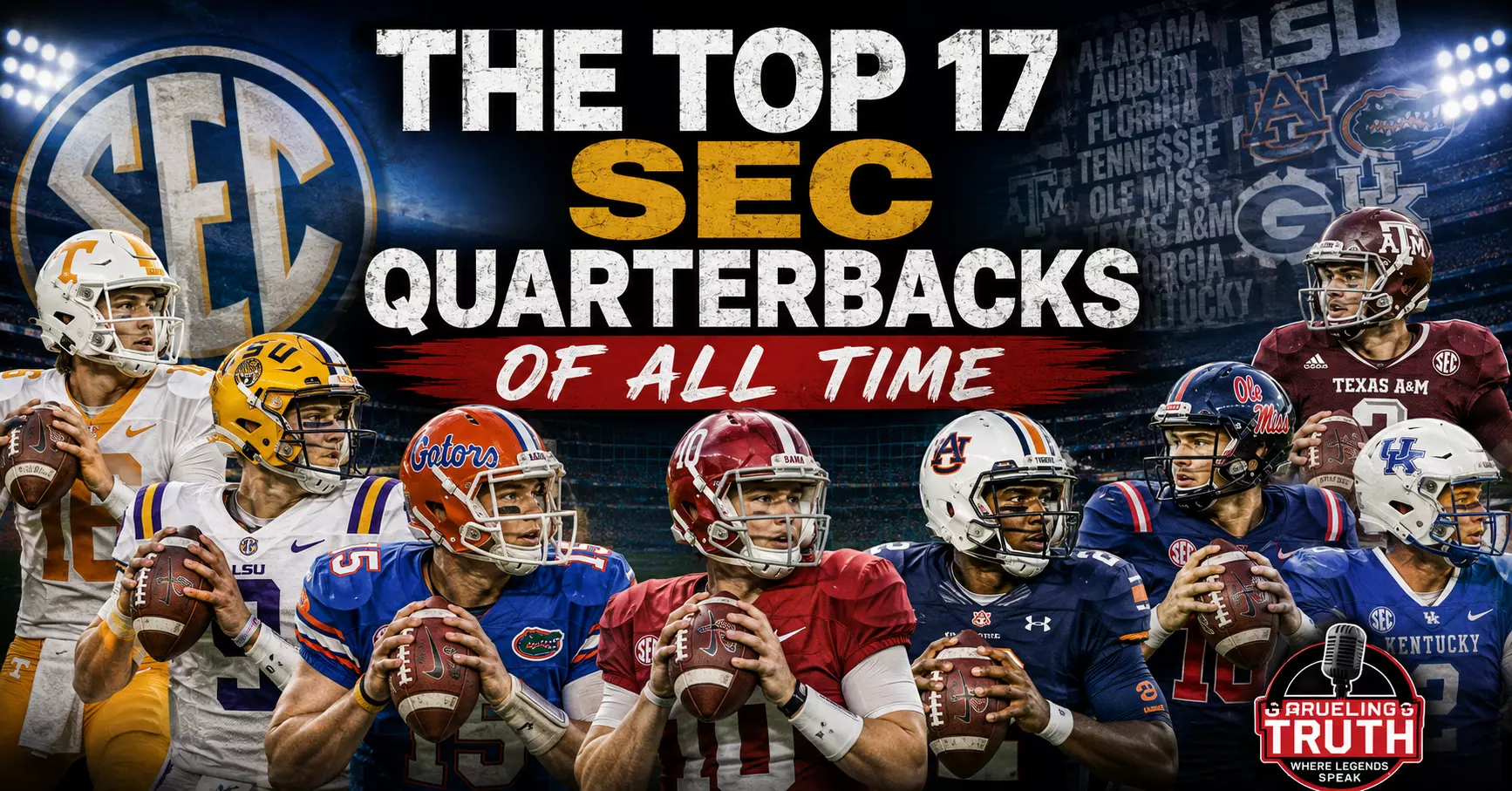
Ranking the greatest quarterbacks in SEC history! The SEC has had some great quarterbacks, but have any had a better career than Tim Tebow?
17. Jared Lorenzen (Kentucky, 2000-2003)
Jared Lorenzen was one of the most entertaining and unique quarterbacks in SEC history. Nicknamed the “Hefty Lefty,” Lorenzen shattered stereotypes about what a quarterback was supposed to look like while becoming one of the most prolific passers the conference had ever seen. At 6-foot-4 and well over 250 pounds for much of his collegiate career, Lorenzen possessed uncommon mobility, tremendous arm strength, and an uncanny ability to extend plays that made him nearly impossible to defend. He remains one of Kentucky’s all-time leaders in passing yards, passing touchdowns, and total offense while ranking among the SEC’s career leaders in numerous passing categories during his era. Lorenzen threw for 10,637 yards and 78 touchdowns during his remarkable career while helping elevate
Kentucky football
nationally. More importantly, he changed perceptions of what a quarterback could be and became one of the most beloved players in Wildcat history. His impact on Kentucky football is still felt today.
Hey Kentucky Tribute To Jared Lorenzen
16. Eli Manning (Ole Miss, 2000-2003)
Eli Manning may forever be associated with Ole Miss football. Following in the footsteps of his father Archie Manning, Eli somehow managed to create a legacy entirely his own in Oxford. Manning left Ole Miss holding or sharing 45 school records and established himself as one of the greatest quarterbacks in SEC history. His senior season in 2003 was among the finest ever produced by a Rebels quarterback as he threw for 3,600 yards and 29 touchdowns while earning First-Team All-American honors and winning the Maxwell Award as college football’s top player. He finished third in the Heisman Trophy voting and led Ole Miss to a 10-3 record, its first ten-win season since 1971. Manning finished his collegiate career with 10,119 passing yards and 81 touchdowns while demonstrating remarkable toughness, leadership, and accuracy. Few quarterbacks have ever meant more to a program than Eli Manning meant to Ole Miss, and he remains the standard by which all Rebel quarterbacks are measured.
Eli Manning Ole Miss Highlights ||| “1st Overall Pick In 2004 Draft”
15. Steve Spurrier (Florida, 1964-1966)
Long before Steve Spurrier revolutionized college football as a head coach, he was one of the greatest players in Florida football history. Spurrier became the first Heisman Trophy winner in school history in 1966 after leading the Gators to a 9-2 record while accounting for 2,012 yards of total offense. His dramatic 40-yard field goal to defeat Auburn remains one of the most iconic plays in Florida football history and helped propel him to college football’s most prestigious individual award. Spurrier finished his collegiate career with 4,848 yards of total offense, which remained a school record for many years, and became the only player from the losing team ever named the Most Valuable Player of the Sugar Bowl following his remarkable performance against Missouri. His intelligence, competitiveness, and leadership that would later define his Hall of Fame coaching career were already evident during his playing days. Steve Spurrier was Florida’s first great quarterback and helped establish the foundation for decades of future success in Gainesville.
Florida Gators Legend Steve Spurrier Opens up About His Life in Football
14. Pat Sullivan (Auburn, 1968-1971)
Pat Sullivan remains one of the greatest players in Auburn football history and one of the SEC’s most accomplished quarterbacks. The 1971 Heisman Trophy winner was the driving force behind one of the greatest offensive attacks of his era while helping Auburn achieve unprecedented national success. Sullivan led the Tigers to a remarkable 26-7 record as a starter and finished every season ranked among the nation’s top twenty teams. During his historic 1971 campaign, Sullivan threw for 2,012 yards and 20 touchdowns while becoming Auburn’s first Heisman Trophy winner. His remarkable chemistry with legendary receiver Terry Beasley helped create one of college football’s greatest quarterback-receiver combinations. Sullivan finished his career with over 6,000 yards of total offense and was a two-time SEC Player of the Year. More importantly, he helped elevate Auburn football into a national power during the early 1970s and established the standard of excellence for future Tigers quarterbacks.
Auburn Tigers: Pat Sullivan Coaching Tribute
13. A.J. McCarron (Alabama, 2010-2013)
A.J. McCarron is one of the most underrated quarterbacks in SEC history. Often labeled as merely a “game manager” because of the immense talent surrounding him at Alabama, McCarron was far more than that. He was an exceptionally accurate passer, a tremendous leader, and one of the most efficient quarterbacks Nick Saban ever coached. His command of the offense allowed Alabama to become the dominant program of the early 2010s and establish one of the greatest dynasties in college football history.
McCarron became the first quarterback in the BCS era to win back-to-back National Championships as a starter, leading Alabama to titles in both 2011 and 2012. He finished his collegiate career with a remarkable 36-4 record as a starter while throwing for 9,019 yards, 77 touchdowns, and just 15 interceptions. His senior season was his finest as he was named a First-Team All-American, finished second in the Heisman Trophy voting, and posted one of the highest passer ratings in college football. McCarron’s combination of winning, efficiency, and leadership make him one of the greatest quarterbacks the SEC has ever produced.
A.J. McCarron | Complete Alabama Highlights | No Music
12. Aaron Murray (Georgia, 2010-2013)
No quarterback in SEC history was more consistently productive than Aaron Murray. During his four seasons as Georgia’s starting quarterback, Murray became the conference’s all-time leader in passing yards, passing touchdowns, completions, and total offense at the time of his graduation. While Georgia fell just short of competing for a National Championship during his career, Murray’s individual accomplishments remain among the most impressive in conference history.
Murray became the first quarterback in SEC history to throw for more than 3,000 yards in four consecutive seasons while also throwing at least 30 touchdown passes three times. He finished his remarkable career with 13,166 passing yards, 121 touchdown passes, and a 36-7 record as Georgia’s starting quarterback. His leadership helped restore Georgia to national prominence, including an SEC Championship Game appearance in 2012 that came within five yards of sending the Bulldogs to play for the National Championship. Murray may not have won a Heisman Trophy or National Championship, but his consistency and statistical dominance place him firmly among the greatest quarterbacks in SEC history.
Aaron Murray – The Best Quarterback in SEC History
11. Tim Couch (Kentucky, 1996-1998)
Before the Air Raid offense became commonplace throughout college football, Tim Couch was putting up video-game numbers in Lexington. Under head coach Hal Mumme and offensive coordinator Mike Leach, Couch became one of the pioneers of modern spread football while transforming Kentucky into one of the nation’s most exciting teams to watch. His remarkable production helped revolutionize offensive football and changed perceptions about what Kentucky football could become.
During his final two seasons as Kentucky’s starting quarterback, Couch led the SEC in virtually every major passing category. His 1998 season remains one of the greatest individual campaigns in conference history as he threw for 4,275 yards and 36 touchdowns while completing an astonishing 72.3 percent of his passes. Couch finished fourth in the Heisman Trophy voting and led Kentucky to consecutive bowl appearances for the first time in nearly half a century. He completed his collegiate career with 8,435 passing yards and 74 touchdowns despite starting for just two seasons. Tim Couch didn’t simply put up impressive statistics—he helped usher college football into its modern offensive era.
10. Joe Namath (Alabama, 1962-1964)
Joe Namath possessed perhaps the greatest combination of athletic ability and natural talent Bear Bryant ever coached. Bryant himself famously called Namath the greatest athlete he had ever seen, praise that carries enormous significance considering the countless legends who played for the Crimson Tide. Had injuries not limited portions of his collegiate career, Namath may rank even higher on this list.
Namath led Alabama to a remarkable 29-4 record during his three seasons with the Crimson Tide while helping the program capture the 1964 National Championship and two SEC Championships. He guided Alabama to victories in both the Orange Bowl and Sugar Bowl and became one of the nation’s premier offensive players despite frequently playing through significant knee injuries. While his statistics don’t compare to those of modern quarterbacks because of the era in which he played, his impact on winning cannot be overstated. Namath was the ultimate field general whose leadership and playmaking abilities made Alabama nearly unbeatable during his tenure. Few quarterbacks in SEC history possessed his extraordinary talent or competitive spirit, making him one of the conference’s true all-time greats.
9. Bryce Young (Alabama, 2020-2022)
Bryce Young may have been the most naturally gifted passer
Nick Saban
ever coached at Alabama. Following Mac Jones wasn’t supposed to be easy, but Young somehow elevated the Crimson Tide offense to another level during his remarkable collegiate career. His poise under pressure, elite pocket awareness, and uncanny ability to create explosive plays made him one of the most exciting quarterbacks college football has seen in the modern era.
Young became just the fourth Alabama player to win the Heisman Trophy after throwing for 4,872 yards and 47 touchdowns during his spectacular sophomore season in 2021. He led Alabama to both an SEC Championship and an appearance in the College Football Playoff National Championship Game while delivering one of the greatest performances of his career against eventual National Champion Georgia in the SEC Championship Game. Young finished his collegiate career with 8,356 passing yards and 80 touchdown passes while establishing himself as one of Alabama’s all-time greats. His ability to consistently perform at an elite level despite frequently operating behind inconsistent offensive line play makes his accomplishments even more impressive. Bryce Young wasn’t simply a great quarterback—he was one of college football’s premier playmakers.
Bryce Young: Alabama Highlights I 1st Overall Pick In 2023 NFL Draft | CBS Sports
8. Johnny Manziel (Texas A&M, 2012-2013)
No quarterback has ever captivated college football quite like Johnny Manziel. “Johnny Football” immediately became one of the sport’s biggest stars after leading Texas A&M through its inaugural season in the SEC and delivering one of the greatest freshman campaigns in NCAA history. His improvisational brilliance and fearless style of play made every snap must-see television.
Manziel became the first freshman ever to win the Heisman Trophy after accounting for 47 total touchdowns and over 5,100 yards of total offense during the 2012 season. Perhaps his greatest accomplishment came when he led Texas A&M to a stunning upset victory over top-ranked Alabama in Tuscaloosa, throwing for 253 yards and accounting for two touchdowns against Nick Saban’s eventual National Champions. He followed his Heisman season by throwing for 4,114 passing yards and completing nearly 70 percent of his passes in 2013. During just two seasons as the Aggies’ starting quarterback, Manziel accumulated over 9,900 total yards and 93 touchdowns. Few quarterbacks have ever been more entertaining or electrifying than Johnny Football.
Ultimate Johnny Manziel Highlights (HD)
7. Tua Tagovailoa (Alabama, 2017-2019)
Few players in college football history have ever announced their arrival more dramatically than Tua Tagovailoa. Trailing Georgia at halftime of the 2018 College Football Playoff National Championship Game, Nick Saban made one of the boldest coaching decisions of his legendary career by inserting the true freshman quarterback into the game. The rest is college football history. Tagovailoa’s game-winning touchdown pass to DeVonta Smith in overtime instantly became one of the sport’s most iconic moments.
That remarkable performance was merely the beginning of his greatness. During his sophomore season, Tagovailoa threw for 3,966 yards and 43 touchdowns while leading Alabama to an undefeated regular season and winning both the Maxwell Award and Walter Camp Award. He finished his collegiate career with an astonishing 87 touchdown passes against just 11 interceptions while posting the highest career passer rating in NCAA history at the time of his graduation. Injuries prevented him from potentially becoming the greatest quarterback in Alabama history and cost him an opportunity to capture the Heisman Trophy, but his extraordinary efficiency and championship pedigree firmly place him among the greatest quarterbacks in SEC history.
“Thank You Tua” || Alabama QB Tua Tagovailoa Career Highlights ᴴᴰ
6. Chris Leak (Florida, 2003-2006)
Chris Leak is one of the most underrated quarterbacks in SEC history. Unfortunately, his legacy has often been overshadowed by Tim Tebow’s emergence during Florida’s 2006 National Championship season. That shouldn’t diminish what Leak accomplished during his remarkable four-year career in Gainesville. He arrived at Florida as one of the nation’s most highly touted recruits and immediately became the face of the program, starting every game during his collegiate career while thriving under three different offensive systems and two head coaches.
Leak saved his finest season for last, leading the Gators to a 13-1 record, an SEC Championship, and the 2006 BCS National Championship. He was named the Offensive Most Valuable Player of the National Championship Game after leading Florida’s dominant 41-14 victory over Ohio State. Leak finished his career with 11,213 passing yards and 88 touchdown passes while setting numerous school records. His toughness, consistency, and leadership helped lay the foundation for one of college football’s greatest dynasties. Chris Leak wasn’t simply Tim Tebow’s predecessor—he was one of the greatest quarterbacks the SEC has ever produced.
Chris Leak Career Football Highlights | The FIRST Ambidextrous QB EVER!
5. Danny Wuerffel (Florida, 1993-1996)
Danny Wuerffel was the perfect quarterback for Steve Spurrier’s revolutionary “Fun ‘n Gun” offense and became the player who transformed Florida football into a national powerhouse. His remarkable combination of intelligence, anticipation, and accuracy made him virtually unstoppable despite lacking elite physical tools. Wuerffel didn’t simply put up impressive statistics—he won championships while changing how offense was played throughout the SEC.
The 1996 Heisman Trophy winner threw for 10,875 yards and 114 touchdowns during his remarkable collegiate career while leading Florida to four consecutive SEC Championship Game appearances and four SEC Championships. He was a two-time Davey O’Brien Award winner, a two-time SEC Player of the Year, and captured both the Maxwell Award and Heisman Trophy during his senior season. Wuerffel led the nation in touchdown passes twice and helped deliver Florida’s first National Championship in school history following the 1996 season. His 114 touchdown passes ranked second in NCAA history at the time of his graduation. Few quarterbacks have ever been more efficient or accomplished than Danny Wuerffel, making him one of the greatest players in SEC history regardless of position.
Danny Wuerffel Mixtape – Florida
4. Peyton Manning (Tennessee, 1994-1997)
Peyton Manning may be the greatest pure passer in SEC history. During his four seasons at Tennessee, Manning elevated the Volunteers into a perennial National Championship contender while establishing virtually every major passing record in school history. His intelligence, leadership, and command of the game made him one of college football’s most complete quarterbacks long before his legendary professional career began.
Manning finished his remarkable career with 11,201 passing yards and 89 touchdown passes while leading Tennessee to a 39-6 record as a starting quarterback. He won the Maxwell Award, Davey O’Brien Award, Johnny Unitas Golden Arm Award, and SEC Championship during his senior season while finishing second in one of the most controversial Heisman Trophy races in history. Critics often point to the absence of a National Championship, but Manning’s individual accomplishments speak for themselves. He remains Tennessee’s greatest quarterback and was college football’s gold standard throughout the mid-1990s. Few quarterbacks have ever possessed his extraordinary combination of accuracy, preparation, and leadership. Had he captured a National Championship or Heisman Trophy, there would be a compelling argument for placing him at the very top of this list.
Peyton Manning Tennessee Highlights ||| “Best Quarterback in Tennessee History”
3. Cam Newton (Auburn, 2010)
There have been greater careers in SEC history, but there has never been a more dominant individual season than Cam Newton’s remarkable 2010 campaign at Auburn. Newton didn’t simply lead the Tigers to a National Championship—he carried them there. Auburn entered the season ranked outside the preseason Top 20 and finished it undefeated largely because Newton was virtually unstoppable every Saturday. His combination of size, speed, arm strength, and leadership made him one of the greatest dual-threat quarterbacks college football has ever seen.
The 2010 Heisman Trophy winner accounted for an astonishing 51 total touchdowns, throwing for 2,854 yards and 30 touchdowns while rushing for 1,473 yards and 20 more scores. He led Auburn to a perfect 14-0 record and its first National Championship since 1957 while producing one of the greatest comeback victories in SEC history after rallying Auburn from a 24-0 deficit against Alabama. Newton became the first player in SEC history to throw for 2,000 yards and rush for 1,000 yards in the same season. While he spent just one season at Auburn, it remains arguably the greatest individual season ever produced by an SEC quarterback.
Most Exciting QB in Auburn Football History || Auburn QB Cam Newton 2010 Highlights ᴴᴰ
2. Joe Burrow (LSU, 2018-2019)
Joe Burrow produced the single greatest season ever by an
SEC quarterback
and arguably the greatest season college football has ever witnessed. During LSU’s historic 15-0 National Championship run in 2019, Burrow accomplished things previously thought impossible while facing one of the most difficult schedules ever assembled by a National Champion. Week after week, he elevated his play against elite competition and left little doubt that LSU was the nation’s best team.
Burrow shattered SEC records by throwing for 5,671 yards and 60 touchdown passes while completing an astonishing 76.3 percent of his attempts. He won the Heisman Trophy by the largest margin in the award’s history and led LSU to victories over seven teams ranked in the Top Ten during one of college football’s most dominant championship seasons. His postseason performances were equally absurd as he accounted for seventeen touchdowns during LSU’s final three games. While others on this list compiled longer careers, no SEC quarterback ever reached a higher peak than Joe Burrow. His 2019 season isn’t simply the greatest season in conference history—it may very well be the greatest individual season in the history of college football.
Joe Burrow – Heisman Highlights ᴴᴰ
1. Tim Tebow (Florida, 2006-2009)
No quarterback in SEC history accomplished more than Tim Tebow. While Joe Burrow may have authored the greatest individual season and Peyton Manning may have been the greatest pure passer, Tebow combined elite individual production with championships, leadership, and perhaps the greatest legacy any player has ever left on the conference. He didn’t simply dominate SEC football—he became one of the defining figures in the history of college athletics.
The 2007 Heisman Trophy winner became the first sophomore ever to capture college football’s most prestigious individual award after accounting for an SEC-record 55 total touchdowns. Tebow remains the only player in SEC history to rush and throw for at least twenty touchdowns in the same season and finished his remarkable career with 145 total touchdowns. He led Florida to two National Championships, two SEC Championships, and a 35-6 record as a starting quarterback while becoming a three-time First-Team All-SEC selection and two-time SEC Player of the Year.
Statistics alone don’t adequately explain Tebow’s greatness. His leadership became legendary throughout college football, perhaps best exemplified by “The Promise Speech” following Florida’s loss to Ole Miss in 2008. The Gators would not lose another game that season, capturing both the SEC and National Championships. No quarterback in conference history better combined winning, production, and leadership than Tim Tebow. That is why he remains the greatest quarterback in SEC football history.
Editor’s Note:
Current SEC quarterbacks were not considered for this ranking, and NFL accomplishments played no role in these selections. This list is based solely on each player’s collegiate career and impact while playing in the Southeastern Conference.
Up To $1500 in Bonus Bets Paid Back if your First Bet Does Not Win
T&Cs apply
4.5/5
Gambling problem? Call 1-800-GAMBLER or 1-800-MY-RESET (Available in the US) 877-8-HOPENY or text HOPENY (467369) (NY) 1-800-327-5050 (MA), 1-800-BETS-OFF (IA), 1-800-981-0023 (PR). 21+ only. Please Gamble Responsibly. See BetMGM.com for Terms. First Bet Offer for new customers only (if applicable). Subject to eligibility requirements. Bonus bets are non-withdrawable. In partnership with Kansas Crossing Casino and Hotel. Promotional offers not available in Mississippi, Massachusetts, New York, Ontario, or Puerto Rico.
New DraftKings Customers: Spend $5+ Get $150 in Bonuses
T&Cs apply
4.5/5
GAMBLING PROBLEM? CALL 1-800-GAMBLER or 1-800-MY-RESET, (800) 327-5050 or visit gamblinghelplinema.org (MA). Please Gamble Responsibly. 888-789-7777/visit ccpg.org (CT), or visit www.mdgamblinghelp.org (MD), 1-800-981-0023 (PR). 21+ and present in most states. (18+ DC/NH/PR/WY). Void in CAN. Eligibility restrictions apply. On behalf of Boot Hill Casino (KS). Pass-thru of per wager tax may apply in IL. 1 per new DraftKings customer. $5+ first-time bet req. Max. $150 issued as non-withdrawable Bonus Bets. Stake removed from payout. Reward issued as $50 in Bonus Bets every 7 days via click-to-claim for 14 days. Bonus Bets and click-to-claims expire 7 days (168hrs) after issuance. Terms: sportsbook.draftkings.com/promos. Ends 10/11/26 at 11:59 PM ET. Sponsored by DK.
Must be 21+. GAMBLING PROBLEM? CALL 1-800-GAMBLER OR CALL 1-800-MY-RESET, www.mdgamblinghelp.org (MD), (800)-327-5050 or gamblinghelplinema.org (MA), Call (877)8-HOPENY or text HOPENY (467369) (NY), (888) 789-7777 or ccpg.org (CT), morethanagame.nc.gov (NC), 1800gambler.net (WV)
Bet $1 and get double the winnings up to $25 for your next 10 bets
T&Cs apply
4.4/5
21+ New users only. Must register using eligible promo code. First bet after registration must qualify. Max. Bonus Bet: $1,000. Bonus Bet expires 14 days after receipt. Void where prohibited. See Caesars.com/promos for full terms. Gambling Problem? 1-800-GAMBLER (1-800-426-2537)
21+ and present in OH. Gambling Problem? Call 1-800-GAMBLER.
This site is using
Cloudflare
and adheres to the
Google Safe Browsing Program. We adapted
Google's Privacy Guidelines
to keep your data safe at all times.
Close
Ready to Win Big? Join the Elite with Our Sports Betting Deals!
FanDuel Promo
New Users – Get $250 in Bonus Bets when you wager $5 for 5 days
Up To $1500 in Bonus Bets Paid Back if your First Bet Does Not Win
Best Slots
T&Cs and 21+ apply
Gambling problem? Call 1-800-GAMBLER or 1-800-MY-RESET (Available in the US) 877-8-HOPENY or text HOPENY (467369) (NY) 1-800-327-5050 (MA), 1-800-BETS-OFF (IA), 1-800-981-0023 (PR). 21+ only. Please Gamble Responsibly. See BetMGM.com for Terms. First Bet Offer for new customers only (if applicable). Subject to eligibility requirements. Bonus bets are non-withdrawable. In partnership with Kansas Crossing Casino and Hotel. Promotional offers not available in Mississippi, Massachusetts, New York, Ontario, or Puerto Rico.
Code:
Open BetMGM
Get Bonus
DraftKings Promo
New DraftKings Customers: Spend $5+ Get $150 in Bonuses
Newcomer
T&Cs and 21+ apply
GAMBLING PROBLEM? CALL 1-800-GAMBLER or 1-800-MY-RESET, (800) 327-5050 or visit gamblinghelplinema.org (MA). Please Gamble Responsibly. 888-789-7777/visit ccpg.org (CT), or visit www.mdgamblinghelp.org (MD), 1-800-981-0023 (PR). 21+ and present in most states. (18+ DC/NH/PR/WY). Void in CAN. Eligibility restrictions apply. On behalf of Boot Hill Casino (KS). Pass-thru of per wager tax may apply in IL. 1 per new DraftKings customer. $5+ first-time bet req. Max. $150 issued as non-withdrawable Bonus Bets. Stake removed from payout. Reward issued as $50 in Bonus Bets every 7 days via click-to-claim for 14 days. Bonus Bets and click-to-claims expire 7 days (168hrs) after issuance. Terms: sportsbook.draftkings.com/promos. Ends 10/11/26 at 11:59 PM ET. Sponsored by DK.
Code:
Open DraftKings
Get Bonus
Find out what the legends have to say about sports this week....