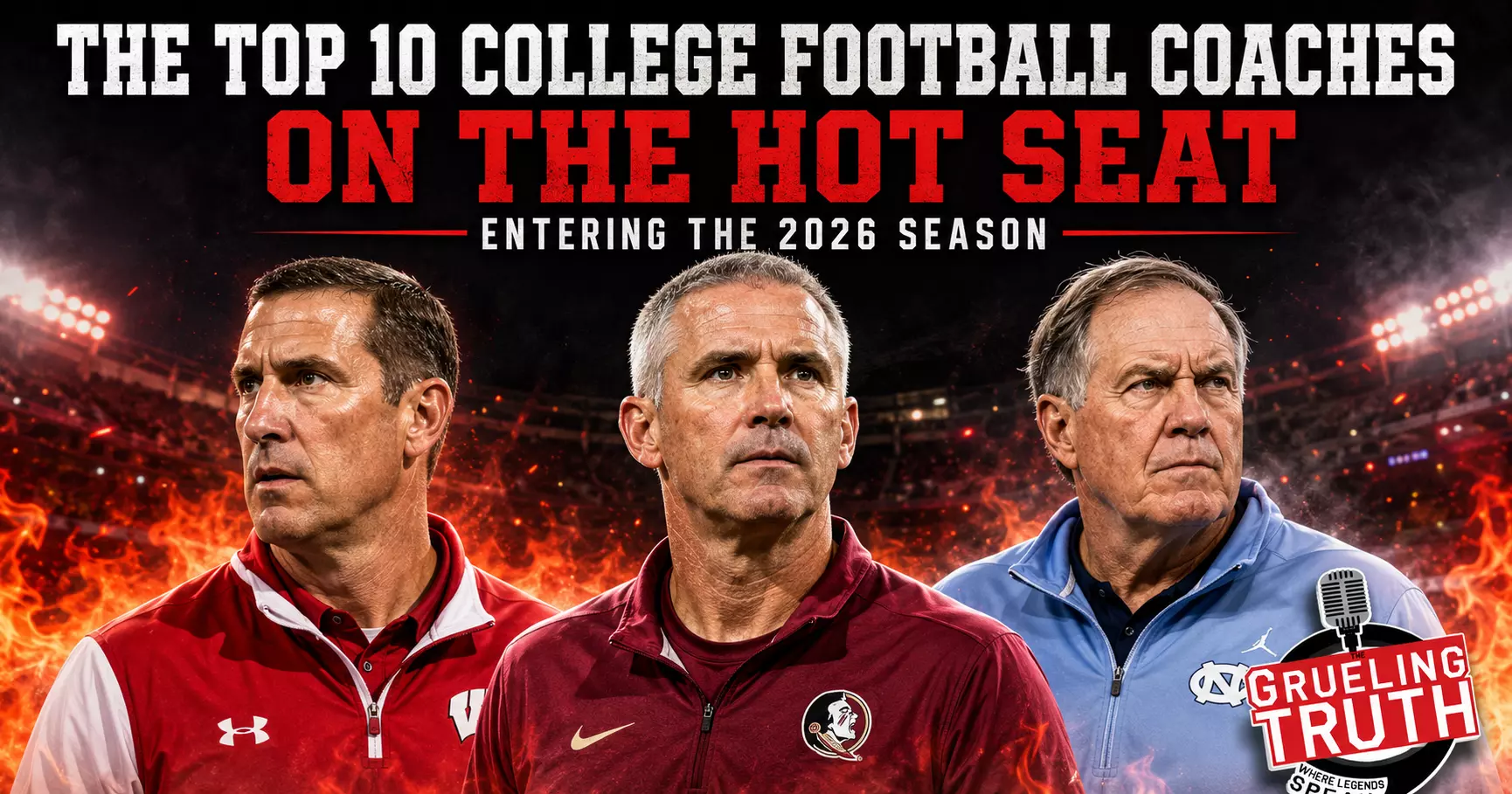
College football has become an unforgiving business. The transfer portal, revenue sharing, NIL spending puts more pressure.
College football has become an unforgiving business. The transfer portal, revenue sharing, NIL spending and the expanded College Football Playoff have eliminated many of the excuses coaches once used to buy additional time. Administrators and boosters expect immediate improvement because rosters can now be rebuilt almost overnight.
The 2025 coaching carousel removed several prominent names, but plenty of
established coaches
survived disappointing seasons. That survival should not be mistaken for long-term security. CBS Sports gave Mike Norvell, Luke Fickell and Dave Aranda the maximum possible hot-seat rating entering 2026, placing all three in its “win or be fired” category.
Here are the ten coaches facing the most pressure entering the 2026 college football season.
10. Scott Satterfield, Cincinnati
Scott Satterfield has never completely won over the Cincinnati fan base, and losing has made that difficult relationship even worse. He inherited a program transitioning into the Big 12, but that explanation cannot protect him forever. Cincinnati expects to compete for conference championships, not simply celebrate occasional signs of progress.
The Bearcats have struggled to establish a consistent identity under Satterfield. The offense has shown flashes, but inconsistent quarterback play, defensive breakdowns and an inability to finish close games have kept Cincinnati buried in the middle or lower portion of the conference. Satterfield must produce something tangible in 2026—most likely a winning record and bowl appearance. Another season of five or fewer victories would make it difficult for the administration to argue that the program is moving forward. Cincinnati did not join the Big 12 to become an afterthought, and Satterfield is running out of time to prove he can build a winner.
9. Jeff Lebby, Mississippi State
Jeff Lebby inherited one of the most challenging rebuilding projects in the SEC, so Mississippi State must maintain realistic expectations. The Bulldogs are not supposed to overtake Georgia, Alabama or Texas overnight. They must, however, begin looking like a competent SEC football program.
Lebby was hired because of his offensive reputation, but exciting schemes mean little when they do not produce victories. Mississippi State needs better quarterback play, improved line play and enough defensive resistance to remain competitive into the fourth quarter. Lebby probably does not need eight victories to survive, but he cannot afford another season in which the Bulldogs appear completely overmatched against conference opponents. Four or five wins accompanied by obvious improvement could buy him more time. Another disastrous SEC campaign may not. Rebuilding is a legitimate explanation during a coach’s first season. By Year 3, it starts sounding like an excuse. Mississippi State must show that Lebby’s plan is finally producing results.
8. Lincoln Riley, USC
Lincoln Riley has won plenty of games at USC, but he was not hired merely to produce respectable records and attractive offenses. The Trojans brought him to Los Angeles to compete for national championships. Entering his fifth season without a College Football Playoff appearance, Riley can no longer sell potential.
USC improved to nine wins in 2025, but that only raises expectations for 2026. The roster returns considerable experience, and Riley has indicated that the program is in its best position to make a playoff run during his tenure. That makes this a defining season. If USC reaches the playoff and proves it can compete with the Big Ten’s best programs, much of the criticism disappears. If the Trojans stumble to another seven- or eight-win campaign, Riley’s contract may become his strongest protection. His massive buyout complicates any decision, but financial obstacles eventually become secondary when boosters stop believing in the direction of a program. USC needs championship contention—not another collection of excuses.
7. Bill O’Brien, Boston College
Bill O’Brien appeared to have Boston College moving in the right direction after a 7-6 debut and a
Pinstripe Bowl
appearance in 2024. Everything collapsed one year later. The Eagles finished 2-10, endured a ten-game losing streak and looked increasingly hopeless before closing the season with a victory over Syracuse.
Boston College announced that O’Brien would return and promised increased financial and administrative support. That support also removes one of his potential defenses. If the school is investing more heavily in football, it has every right to demand improvement. O’Brien has extensive experience in college football and the NFL, so this cannot be treated like a young coach learning on the job. The Eagles do not need to win the ACC, but they must become competitive again. A bowl appearance would stabilize the program. Another two- or three-win season would probably end O’Brien’s tenure after only three years.
6. Mike Locksley, Maryland
Mike Locksley appeared to have established Maryland as a steady bowl program after three consecutive winning seasons from 2021 through 2023. That momentum has vanished. Consecutive 4-8 finishes in 2024 and 2025 have returned the Terrapins to the bottom of the Big Ten conversation, with both seasons producing only one conference victory.
Locksley has recruited well enough to give Maryland legitimate talent, particularly at the skill positions. The problem has been turning that talent into consistent results. Maryland’s 2026 schedule provides opportunities, and quarterback Malik Washington gives the offense a player around whom it can build. That leaves Locksley with fewer excuses than he had a year ago. A quick start is essential because a home game against Virginia Tech and former Penn State coach James Franklin could become an early referendum on the program. Locksley does not necessarily need nine victories, but Maryland must return to a bowl. A third consecutive losing season would make a coaching change extremely difficult to avoid.
5. Shane Beamer, South Carolina
Shane Beamer entered 2025 with major expectations after leading South Carolina to nine victories the previous season. Instead of building on that momentum, the Gamecocks crashed to 4-8. In the SEC, one terrible season can erase several years of goodwill.
Beamer remains popular with many players and supporters, but enthusiasm is no longer enough. South Carolina has invested heavily in its roster and possesses enough talent to be far more competitive than it was last season. Beamer must demonstrate that 2024 was the program’s real direction and that 2025 was the exception. The schedule provides little mercy, including an early trip to Alabama and a difficult stretch featuring Tennessee, Oklahoma and Texas A&M. A seven- or eight-win season would probably quiet the speculation. Another losing season could finish him. South Carolina may never have the easiest path in the SEC, but fans will not accept finishing near the bottom while rival programs continue moving forward.
4. Dave Aranda, Baylor
Dave Aranda’s 12-2 season and Big 12 championship in 2021 feel increasingly distant. Entering 2026, Aranda is 36-37 at Baylor—not 22-28—and has recorded four losing seasons in six years. The Bears have gone 16-21 over the past three seasons, making this one of the clearest win-or-be-fired situations in the country.
Baylor retained Aranda after a comprehensive review, but the circumstances hardly represent a strong endorsement. Athletic director Mack Rhoades departed, and the school indicated that the incoming athletic director would have the opportunity to evaluate the football program independently.
That means Aranda is coaching for an administration that did not hire him and has no reason to remain loyal if the Bears struggle. Early games against Auburn and SMU could determine the tone of the entire season. Baylor probably needs at least seven victories and a bowl appearance. Anything less may bring Aranda’s uneven tenure in Waco to an end.
3. Luke Fickell, Wisconsin
Luke Fickell arrived at Wisconsin as one of the most respected coaches in college football. He had taken Cincinnati to the playoff and appeared capable of modernizing a dependable Big Ten program. Instead, the Badgers have deteriorated.
Wisconsin enters 2026 after consecutive losing seasons for the first time since 1991 and 1992. Fickell owns a 17-21 record in Madison, and the offensive transformation he promised has never fully materialized. The Badgers have lost their physical identity without developing the explosive passing attack that was supposed to replace it. Fickell has publicly acknowledged the pressure, which shows how obvious the situation has become.
His contract and buyout provide some protection, but they will not save him from another losing campaign. Wisconsin avoids several of the Big Ten’s strongest teams, giving Fickell a reasonable path back to a bowl. Seven wins could be enough to survive. Another four- or five-win season would likely force Wisconsin to admit that the experiment failed.
2. Bill Belichick, North Carolina
Bill Belichick’s arrival at North Carolina was supposed to revolutionize college football. Instead, his first season produced a 4-8 record, an ineffective offense and enough off-field distractions to turn the program into a national punchline.
The Tar Heels averaged only 19.3 points and 288.8 yards per game in 2025, leading Belichick to dismiss offensive coordinator Freddie Kitchens and hire Bobby Petrino.That move gives North Carolina an experienced offensive coach, but it also increases the pressure to improve immediately.
Belichick’s legendary NFL résumé will buy patience that most coaches would never receive. However, his reputation cannot erase another losing season. North Carolina made an expensive, unconventional commitment because it expected Belichick to create a professional-style operation capable of winning the ACC. So far, the experiment has generated far more attention than success. If the Tar Heels miss another bowl while turmoil continues around the program, even Belichick’s six Super Bowl championships may not protect him.
1. Mike Norvell, Florida State
No coach enters 2026 under more pressure than Mike Norvell.
Florida State
went 13-0 and won the ACC in 2023, but the program has collapsed since that breakthrough. The Seminoles went 2-10 in 2024 and finished 5-7 in 2025 after losing seven of their final nine games. Norvell is now 38-34 at Florida State and just 7-17 over the past two seasons.
His enormous buyout—reportedly around $51 million—is the primary reason he survived. But buyouts delay firings; they do not prevent them forever. Florida State expects to contend nationally, and consecutive seasons without a bowl appearance are unacceptable.
Norvell has again turned to the transfer portal, but the roster returns only two offensive starters and faces a demanding schedule featuring Alabama, Miami, Clemson, Louisville and SMU. Six victories would represent improvement, but merely reaching a minor bowl may not be enough. Norvell probably needs eight wins and proof that Florida State has rediscovered a sustainable identity. If the Seminoles unravel again, the school may finally decide that paying the buyout is less expensive than allowing the program to sink any further.
New Users – Get $350 in Bonus Bets when you wager $5 for 7 days
T&Cs apply
4.6/5
Gambling Problem? Call 1-800-GAMBLER or 1-800-MY-RESET. Call 1-888-789-7777 or visit ccpgg.org/chat (CT). Hope is here. GamblingHelpLineMA.org or call (800) 327-5050 for 24/7 support (MA). Visit www.mdgamblinghelp.org (MD). Call 1-877-8HOPE-NY or text HOPENY (NY). 21+ (18+ DC, WY) and present in select states (for KS, in affiliation with Kansas Star Casino). Find online real money wagering only. Min $5 wager required for 7 consecutive days. $5 free play credit. Bonus issued as non-withdrawable bonus with cash withdrawable bonus with cash withdrawable. Bonus bets which expire 7 days after receipt. Restrictions apply. See terms at sportsbook.fanduel.com. Call 1-877-770-7867 (LA).
Up To $1500 in Bonus Bets Paid Back if your First Bet Does Not Win
T&Cs apply
4.5/5
Gambling problem? Call 1-800-GAMBLER or 1-800-MY-RESET (Available in the US) 877-8-HOPENY or text HOPENY (467369) (NY) 1-800-327-5050 (MA), 1-800-BETS-OFF (IA), 1-800-981-0023 (PR). 21+ only. Please Gamble Responsibly. See BetMGM.com for Terms. First Bet Offer for new customers only (if applicable). Subject to eligibility requirements. Bonus bets are non-withdrawable. In partnership with Kansas Crossing Casino and Hotel. Promotional offers not available in Mississippi, Massachusetts, New York, Ontario, or Puerto Rico.
New DraftKings Customers: Bet $5, Get $200 + 3 Months of NBA League Pass!
T&Cs apply
4.5/5
GAMBLING PROBLEM? CALL 1-800-GAMBLER or 1-800-MY-RESET, (800) 327-5050 or visit gamblinghelplinema.org (MA). Please Gamble Responsibly. 888-789-7777/visit ccpg.org (CT), or visit www.mdgamblinghelp.org (MD), 1-800-981-0023 (PR). 21+ and present in most states. (18+ DC/NH/PR/WY). Void in CAN. Eligibility restrictions apply. On behalf of Boot Hill Casino (KS). Pass-thru of per wager tax may apply in IL. 1 per new Sportsbook customer. $5+ first-time bet req. Max. $200 issued as non-withdrawable Bonus Bets. Stake removed from payout. Reward issued as $50 in Bonus Bets every 7 days via click-to-claim for 21 days. Bonus Bets and click-to-claims expire 7 days (168hrs) after issuance. Terms: dkng.co/offer. Get 1 promo code to redeem a 3-month NBA League Pass subscription, complimentary of DraftKings. Subscription auto-renews monthly at then-current price (currently $16.99/mo); cancel anytime. Terms, restrictions, and eligibility requirements apply. Redeem League Pass by 12/19/26 at 11:59 PM ET. Addt’l terms: support.watch.nba.com/hc/en-us/articles/9165532876183-League-Pass-Terms-of-Use_. Ends 11/29/26 at 11:59 PM ET. Sponsored by DK.
Must be 21+. GAMBLING PROBLEM? CALL 1-800-GAMBLER OR CALL 1-800-MY-RESET, www.mdgamblinghelp.org (MD), (800)-327-5050 or gamblinghelplinema.org (MA), Call (877)8-HOPENY or text HOPENY (467369) (NY), (888) 789-7777 or ccpg.org (CT), morethanagame.nc.gov (NC), 1800gambler.net (WV)
Bet $1 and get double the winnings up to $25 for your next 10 bets
T&Cs apply
4.4/5
21+ New users only. Must register using eligible promo code. First bet after registration must qualify. Max. Bonus Bet: $1,000. Bonus Bet expires 14 days after receipt. Void where prohibited. See Caesars.com/promos for full terms. Gambling Problem? 1-800-GAMBLER (1-800-426-2537)
21+ and present in OH. Gambling Problem? Call 1-800-GAMBLER.
This site is using
Cloudflare
and adheres to the
Google Safe Browsing Program. We adapted
Google's Privacy Guidelines
to keep your data safe at all times.
Close
Ready to Win Big? Join the Elite with Our Sports Betting Deals!
FanDuel Promo
New Users – Get $350 in Bonus Bets when you wager $5 for 7 days
Our Favorite
T&Cs and 21+ apply
Gambling Problem? Call 1-800-GAMBLER or 1-800-MY-RESET. Call 1-888-789-7777 or visit ccpgg.org/chat (CT). Hope is here. GamblingHelpLineMA.org or call (800) 327-5050 for 24/7 support (MA). Visit www.mdgamblinghelp.org (MD). Call 1-877-8HOPE-NY or text HOPENY (NY). 21+ (18+ DC, WY) and present in select states (for KS, in affiliation with Kansas Star Casino). Find online real money wagering only. Min $5 wager required for 7 consecutive days. $5 free play credit. Bonus issued as non-withdrawable bonus with cash withdrawable bonus with cash withdrawable. Bonus bets which expire 7 days after receipt. Restrictions apply. See terms at sportsbook.fanduel.com. Call 1-877-770-7867 (LA).
Code:
Open FanDuel
Get Bonus
BetMGM Promo
Up To $1500 in Bonus Bets Paid Back if your First Bet Does Not Win
Best Slots
T&Cs and 21+ apply
Gambling problem? Call 1-800-GAMBLER or 1-800-MY-RESET (Available in the US) 877-8-HOPENY or text HOPENY (467369) (NY) 1-800-327-5050 (MA), 1-800-BETS-OFF (IA), 1-800-981-0023 (PR). 21+ only. Please Gamble Responsibly. See BetMGM.com for Terms. First Bet Offer for new customers only (if applicable). Subject to eligibility requirements. Bonus bets are non-withdrawable. In partnership with Kansas Crossing Casino and Hotel. Promotional offers not available in Mississippi, Massachusetts, New York, Ontario, or Puerto Rico.
Code:
Open BetMGM
Get Bonus
DraftKings Promo
New DraftKings Customers: Bet $5, Get $200 + 3 Months of NBA League Pass!
Newcomer
T&Cs and 21+ apply
GAMBLING PROBLEM? CALL 1-800-GAMBLER or 1-800-MY-RESET, (800) 327-5050 or visit gamblinghelplinema.org (MA). Please Gamble Responsibly. 888-789-7777/visit ccpg.org (CT), or visit www.mdgamblinghelp.org (MD), 1-800-981-0023 (PR). 21+ and present in most states. (18+ DC/NH/PR/WY). Void in CAN. Eligibility restrictions apply. On behalf of Boot Hill Casino (KS). Pass-thru of per wager tax may apply in IL. 1 per new Sportsbook customer. $5+ first-time bet req. Max. $200 issued as non-withdrawable Bonus Bets. Stake removed from payout. Reward issued as $50 in Bonus Bets every 7 days via click-to-claim for 21 days. Bonus Bets and click-to-claims expire 7 days (168hrs) after issuance. Terms: dkng.co/offer. Get 1 promo code to redeem a 3-month NBA League Pass subscription, complimentary of DraftKings. Subscription auto-renews monthly at then-current price (currently $16.99/mo); cancel anytime. Terms, restrictions, and eligibility requirements apply. Redeem League Pass by 12/19/26 at 11:59 PM ET. Addt’l terms: support.watch.nba.com/hc/en-us/articles/9165532876183-League-Pass-Terms-of-Use_. Ends 11/29/26 at 11:59 PM ET. Sponsored by DK.
Code:
Open DraftKings
Get Bonus
Find out what the legends have to say about sports this week....
New Users – Get $350 in Bonus Bets when you wager $5 for 7 days
Gambling Problem? Call 1-800-GAMBLER or 1-800-MY-RESET. Call 1-888-789-7777 or visit ccpgg.org/chat (CT). Hope is here. GamblingHelpLineMA.org or call (800) 327-5050 for 24/7 support (MA). Visit www.mdgamblinghelp.org (MD). Call 1-877-8HOPE-NY or text HOPENY (NY). 21+ (18+ DC, WY) and present in select states (for KS, in affiliation with Kansas Star Casino). Find online real money wagering only. Min $5 wager required for 7 consecutive days. $5 free play credit. Bonus issued as non-withdrawable bonus with cash withdrawable bonus with cash withdrawable. Bonus bets which expire 7 days after receipt. Restrictions apply. See terms at sportsbook.fanduel.com. Call 1-877-770-7867 (LA).