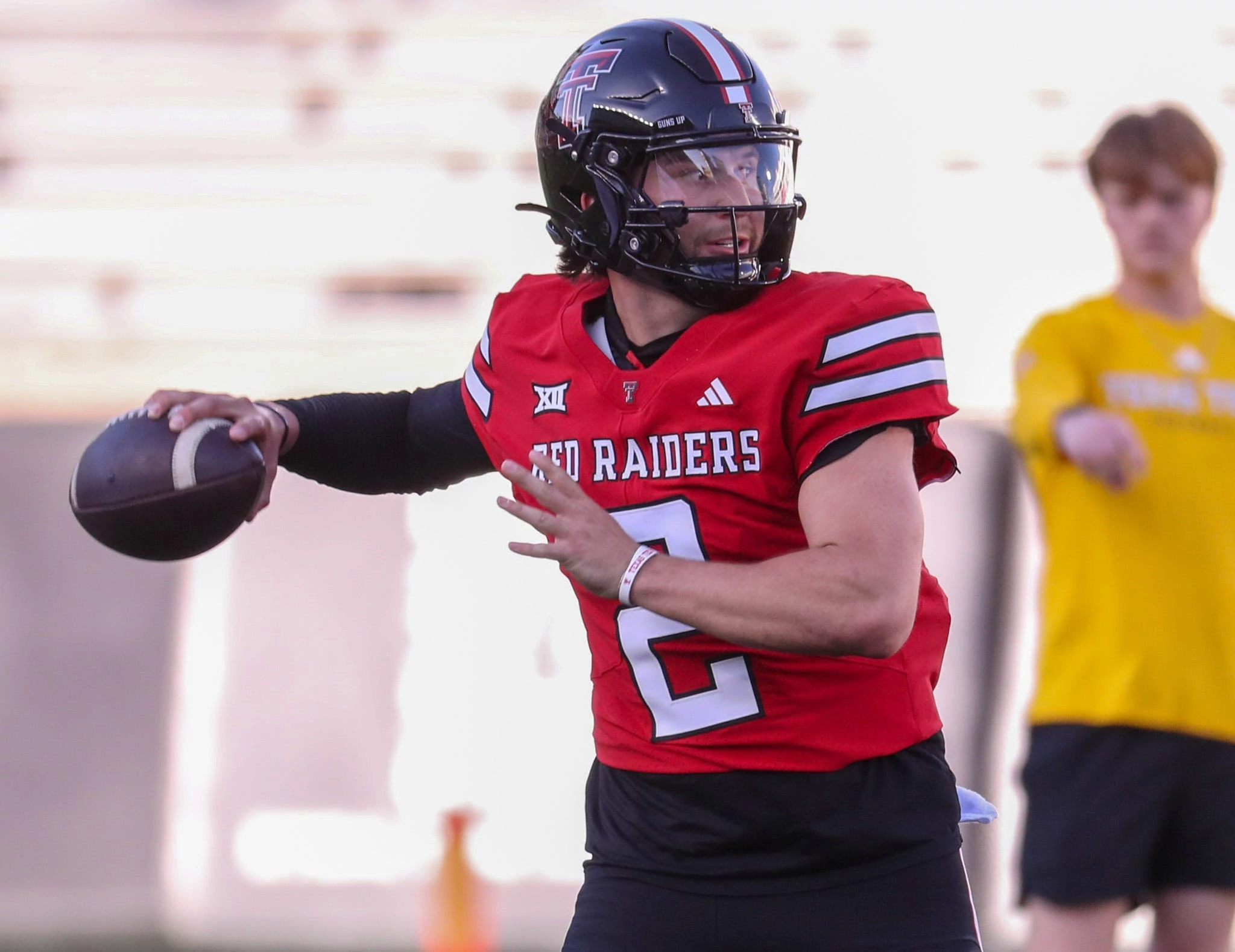
Brendan Sorsby looks to throw during the Texas Tech football team's spring game, Friday, April 17, 2026, at Jones AT&T Stadium.
There is no stranger story in college football right now than the one about a quarterback who won and lost everything in the same month. Brendan Sorsby admitted to betting on his own team, got banned from college sports for life, watched a judge hand his career back in a single afternoon, and then lost it all over again. Be that as it may, the wildest part is not the courtroom drama. It is what the rest of the sport did once the courtroom drama was over.
The one rule you cannot break
Let’s start with what Sorsby actually did, because the severity is the whole point. Over four years at Indiana, Cincinnati, and Texas Tech, he placed thousands of bets totaling more than $90,000, and at least 40 of them were on Indiana football while he was on the roster. He also funded betting accounts in other people’s names to hide the activity, and reports suggest he may have broken state law along the way. Betting on your own team is the one true cardinal sin in sports, the line every other rule exists to protect, and the penalty for it is simple and permanent. In May, the NCAA ruled him permanently ineligible. By every normal measure, his college career was over.
The day that changed everything
On June 8, things took an unexpected turn. Ken Curry, a judge in Lubbock,
granted Sorsby a temporary injunction
that lets him suit up for Texas Tech in 2026, ruling that he would suffer irreparable harm if he could not play while his case moved through the courts. His lawyers framed the gambling as a diagnosed addiction, a mental health condition the NCAA should treat rather than punish. More than likely, you can already see the problem this created. If one local judge can wipe out a lifetime gambling ban in an afternoon, the NCAA cannot enforce anything, not even the rule nobody thought was up for debate. The decision did not just save Sorsby. It threatened the idea that the rulebook means anything at all.
The sport closed the loophole itself
That is when college football took matters into its own hands. The backlash was immediate and brutal. Georgia and Nebraska refused to schedule Texas Tech, Michigan canceled a volleyball match, the Texas attorney general got involved, and the Big 12 took the fight to federal court to keep Sorsby off the field. Trapped on all sides, he withdrew his lawsuit and rolled the dice on the NFL. It did not work. On June 23, the league announced it would not hold a supplemental draft at all, and that slammed the door. In its letter, the NFL said the case was “too closely tied to the League’s core integrity interests” and faulted Sorsby for dodging accountability rather than owning what he did. His attorney, Jeffery Kessler, called it “a violation of the CBA and the law” and promised to fight.
So here is where one of the most talented quarterbacks in the country actually stands. He has no college team because the NCAA still says he is ineligible. He has no NFL, because the league would not open the door for him. His earliest shot at a pro career is now the 2027 draft, a full year off with a scarlet letter on his file. Either way, the lesson runs bigger than one player. A judge proved the NCAA cannot enforce its own rules anymore. The sport answered by proving it does not need the NCAA to. When the rulebook failed, the schools, the conference, and the league enforced the punishment themselves, and Brendan Sorsby learned the hard way that accountability is sometimes dependent on who is dishing it out.
Up To $1500 in Bonus Bets Paid Back if your First Bet Does Not Win
T&Cs apply
4.5/5
Gambling problem? Call 1-800-GAMBLER or 1-800-MY-RESET (Available in the US) 877-8-HOPENY or text HOPENY (467369) (NY) 1-800-327-5050 (MA), 1-800-BETS-OFF (IA), 1-800-981-0023 (PR). 21+ only. Please Gamble Responsibly. See BetMGM.com for Terms. First Bet Offer for new customers only (if applicable). Subject to eligibility requirements. Bonus bets are non-withdrawable. In partnership with Kansas Crossing Casino and Hotel. Promotional offers not available in Mississippi, Massachusetts, New York, Ontario, or Puerto Rico.
New DraftKings Customers: Spend $5+ Get $150 in Bonuses
T&Cs apply
4.5/5
GAMBLING PROBLEM? CALL 1-800-GAMBLER or 1-800-MY-RESET, (800) 327-5050 or visit gamblinghelplinema.org (MA). Please Gamble Responsibly. 888-789-7777/visit ccpg.org (CT), or visit www.mdgamblinghelp.org (MD), 1-800-981-0023 (PR). 21+ and present in most states. (18+ DC/NH/PR/WY). Void in CAN. Eligibility restrictions apply. On behalf of Boot Hill Casino (KS). Pass-thru of per wager tax may apply in IL. 1 per new DraftKings customer. $5+ first-time bet req. Max. $150 issued as non-withdrawable Bonus Bets. Stake removed from payout. Reward issued as $50 in Bonus Bets every 7 days via click-to-claim for 14 days. Bonus Bets and click-to-claims expire 7 days (168hrs) after issuance. Terms: sportsbook.draftkings.com/promos. Ends 10/11/26 at 11:59 PM ET. Sponsored by DK.
Must be 21+. GAMBLING PROBLEM? CALL 1-800-GAMBLER OR CALL 1-800-MY-RESET, www.mdgamblinghelp.org (MD), (800)-327-5050 or gamblinghelplinema.org (MA), Call (877)8-HOPENY or text HOPENY (467369) (NY), (888) 789-7777 or ccpg.org (CT), morethanagame.nc.gov (NC), 1800gambler.net (WV)
Bet $1 and get double the winnings up to $25 for your next 10 bets
T&Cs apply
4.4/5
21+ New users only. Must register using eligible promo code. First bet after registration must qualify. Max. Bonus Bet: $1,000. Bonus Bet expires 14 days after receipt. Void where prohibited. See Caesars.com/promos for full terms. Gambling Problem? 1-800-GAMBLER (1-800-426-2537)
21+ and present in OH. Gambling Problem? Call 1-800-GAMBLER.
This site is using
Cloudflare
and adheres to the
Google Safe Browsing Program. We adapted
Google's Privacy Guidelines
to keep your data safe at all times.
Close
Ready to Win Big? Join the Elite with Our Sports Betting Deals!
FanDuel Promo
New Users – Get $250 in Bonus Bets when you wager $5 for 5 days
Up To $1500 in Bonus Bets Paid Back if your First Bet Does Not Win
Best Slots
T&Cs and 21+ apply
Gambling problem? Call 1-800-GAMBLER or 1-800-MY-RESET (Available in the US) 877-8-HOPENY or text HOPENY (467369) (NY) 1-800-327-5050 (MA), 1-800-BETS-OFF (IA), 1-800-981-0023 (PR). 21+ only. Please Gamble Responsibly. See BetMGM.com for Terms. First Bet Offer for new customers only (if applicable). Subject to eligibility requirements. Bonus bets are non-withdrawable. In partnership with Kansas Crossing Casino and Hotel. Promotional offers not available in Mississippi, Massachusetts, New York, Ontario, or Puerto Rico.
Code:
Open BetMGM
Get Bonus
DraftKings Promo
New DraftKings Customers: Spend $5+ Get $150 in Bonuses
Newcomer
T&Cs and 21+ apply
GAMBLING PROBLEM? CALL 1-800-GAMBLER or 1-800-MY-RESET, (800) 327-5050 or visit gamblinghelplinema.org (MA). Please Gamble Responsibly. 888-789-7777/visit ccpg.org (CT), or visit www.mdgamblinghelp.org (MD), 1-800-981-0023 (PR). 21+ and present in most states. (18+ DC/NH/PR/WY). Void in CAN. Eligibility restrictions apply. On behalf of Boot Hill Casino (KS). Pass-thru of per wager tax may apply in IL. 1 per new DraftKings customer. $5+ first-time bet req. Max. $150 issued as non-withdrawable Bonus Bets. Stake removed from payout. Reward issued as $50 in Bonus Bets every 7 days via click-to-claim for 14 days. Bonus Bets and click-to-claims expire 7 days (168hrs) after issuance. Terms: sportsbook.draftkings.com/promos. Ends 10/11/26 at 11:59 PM ET. Sponsored by DK.
Code:
Open DraftKings
Get Bonus
Find out what the legends have to say about sports this week....