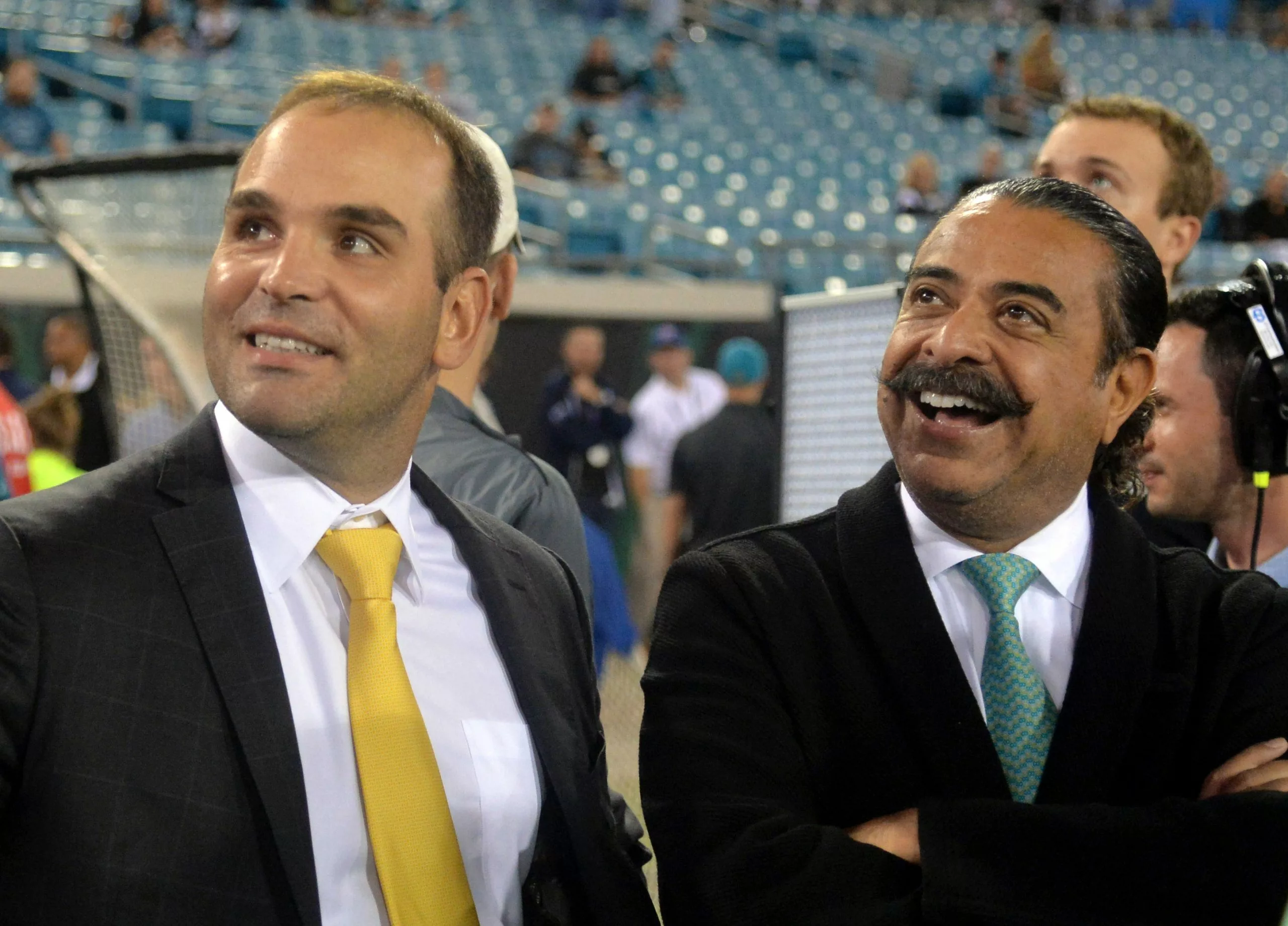
Nov 19, 2015; Jacksonville, FL, USA; Jacksonville Jaguars owner Shahid Khan (right) and general manager David Caldwell before an NFL football game against the Tennessee Titans at EverBank Field. Mandatory Credit: Kirby Lee-USA TODAY Sports
Florida ran two searches last winter. One produced Jon Sumrall. The other produced Dave Caldwell, a former Jacksonville Jaguars general manager and Philadelphia Eagles personnel executive, who was handed roster and contract management, recruiting, the personnel department, and football operations. “We felt like we had an opportunity to do something different in college football that would give us an advantage,” athletic director Scott Stricklin said. What Florida had been doing before, with the head coach acting as chief executive of everything, produced four losing seasons in five. The college football general manager exists to take half that job away.
What the College Football General Manager Actually Runs
The job exists because the sport built a front office’s worth of work and gave nobody the title. Programs now carry a revenue-sharing cap of $21.3 million per school, third-party money that sits outside that cap, contracts requiring approval above $600, and a portal that turns over a third of the roster every winter. None of that work resembles coaching, and nearly all of it decides whether a coach survives.
Caldwell has scouted or run personnel departments since 1996, with the Panthers, Colts and Falcons before Jacksonville and five seasons in Philadelphia under Howie Roseman, a Florida graduate, ending with a Super Bowl LIX ring. LSU had one of the first arrangements like this years ago, when Austin Thomas ran personnel under Ed Orgeron, but almost nobody copied it until the money arrived.
Caldwell went to work before Florida announced him. He and Sumrall kept five players who had considered leaving at a combined cost of $5.2 million, then brought in more than two dozen transfers. “I feel like this is the way college athletics has been going for a long time,” Caldwell said.
He is not an outlier hire. Alabama brought Courtney Morgan from Washington with Kalen DeBoer. USC paid Chad Bowden roughly $1 million to leave Notre Dame, where he had been making about $300,000, and Bowden immediately reshaped a recruiting operation that had
never prioritized its own backyard. Michigan had tried to hire him a year earlier and lost. General managers now get poached the way coordinators do, with raises to match.
Why the Coach Still Holds the Leverage
The pay tells a different story than the job description. USA Today compiled 49 college general manager salaries, and only 13 of those people clear $500,000. The highest figure sits above $1.5 million, with a buyout north of $3 million. Ohio State’s Mark Pantoni ranks second at $900,000. Head coaches at the same schools make eight and ten times that.
Structure tells a similar story. The college football general manager usually owes his job to the coach he supposedly checks. Lincoln Riley announced Bowden’s hire himself. Morgan arrived at Alabama because DeBoer wanted him there. In most buildings, the coach still selects the general manager, which is the opposite of how an NFL front office works and the reason the comparison keeps breaking down.
The NFL took decades to get where college football is pretending to already be. Howie Roseman now enjoys more job security and collects more credit for Philadelphia’s Super Bowl runs than Nick Sirianni does, and that arrangement arrived only after years of owners deciding the roster mattered more than the sideline.
Florida is the cleanest test of whether the sport gets there faster. Caldwell’s Jaguars won 37 games and lost 86, and Jacksonville fired him during a 1-10 season. Gainesville hired him anyway, which says a great deal about how much the roster now matters and remarkably little about how well anyone can prove they build one.
Up To $1500 in Bonus Bets Paid Back if your First Bet Does Not Win
T&Cs apply
4.5/5
Gambling problem? Call 1-800-GAMBLER or 1-800-MY-RESET (Available in the US) 877-8-HOPENY or text HOPENY (467369) (NY) 1-800-327-5050 (MA), 1-800-BETS-OFF (IA), 1-800-981-0023 (PR). 21+ only. Please Gamble Responsibly. See BetMGM.com for Terms. First Bet Offer for new customers only (if applicable). Subject to eligibility requirements. Bonus bets are non-withdrawable. In partnership with Kansas Crossing Casino and Hotel. Promotional offers not available in Mississippi, Massachusetts, New York, Ontario, or Puerto Rico.
New DraftKings Customers: Spend $5+ Get $150 in Bonuses
T&Cs apply
4.5/5
GAMBLING PROBLEM? CALL 1-800-GAMBLER or 1-800-MY-RESET, (800) 327-5050 or visit gamblinghelplinema.org (MA). Please Gamble Responsibly. 888-789-7777/visit ccpg.org (CT), or visit www.mdgamblinghelp.org (MD), 1-800-981-0023 (PR). 21+ and present in most states. (18+ DC/NH/PR/WY). Void in CAN. Eligibility restrictions apply. On behalf of Boot Hill Casino (KS). Pass-thru of per wager tax may apply in IL. 1 per new DraftKings customer. $5+ first-time bet req. Max. $150 issued as non-withdrawable Bonus Bets. Stake removed from payout. Reward issued as $50 in Bonus Bets every 7 days via click-to-claim for 14 days. Bonus Bets and click-to-claims expire 7 days (168hrs) after issuance. Terms: sportsbook.draftkings.com/promos. Ends 10/11/26 at 11:59 PM ET. Sponsored by DK.
Must be 21+. GAMBLING PROBLEM? CALL 1-800-GAMBLER OR CALL 1-800-MY-RESET, www.mdgamblinghelp.org (MD), (800)-327-5050 or gamblinghelplinema.org (MA), Call (877)8-HOPENY or text HOPENY (467369) (NY), (888) 789-7777 or ccpg.org (CT), morethanagame.nc.gov (NC), 1800gambler.net (WV)
Bet $1 and get double the winnings up to $25 for your next 10 bets
T&Cs apply
4.4/5
21+ New users only. Must register using eligible promo code. First bet after registration must qualify. Max. Bonus Bet: $1,000. Bonus Bet expires 14 days after receipt. Void where prohibited. See Caesars.com/promos for full terms. Gambling Problem? 1-800-GAMBLER (1-800-426-2537)
21+ and present in OH. Gambling Problem? Call 1-800-GAMBLER.
This site is using
Cloudflare
and adheres to the
Google Safe Browsing Program. We adapted
Google's Privacy Guidelines
to keep your data safe at all times.
Close
Ready to Win Big? Join the Elite with Our Sports Betting Deals!
FanDuel Promo
New Users – Get $250 in Bonus Bets when you wager $5 for 5 days
Up To $1500 in Bonus Bets Paid Back if your First Bet Does Not Win
Best Slots
T&Cs and 21+ apply
Gambling problem? Call 1-800-GAMBLER or 1-800-MY-RESET (Available in the US) 877-8-HOPENY or text HOPENY (467369) (NY) 1-800-327-5050 (MA), 1-800-BETS-OFF (IA), 1-800-981-0023 (PR). 21+ only. Please Gamble Responsibly. See BetMGM.com for Terms. First Bet Offer for new customers only (if applicable). Subject to eligibility requirements. Bonus bets are non-withdrawable. In partnership with Kansas Crossing Casino and Hotel. Promotional offers not available in Mississippi, Massachusetts, New York, Ontario, or Puerto Rico.
Code:
Open BetMGM
Get Bonus
DraftKings Promo
New DraftKings Customers: Spend $5+ Get $150 in Bonuses
Newcomer
T&Cs and 21+ apply
GAMBLING PROBLEM? CALL 1-800-GAMBLER or 1-800-MY-RESET, (800) 327-5050 or visit gamblinghelplinema.org (MA). Please Gamble Responsibly. 888-789-7777/visit ccpg.org (CT), or visit www.mdgamblinghelp.org (MD), 1-800-981-0023 (PR). 21+ and present in most states. (18+ DC/NH/PR/WY). Void in CAN. Eligibility restrictions apply. On behalf of Boot Hill Casino (KS). Pass-thru of per wager tax may apply in IL. 1 per new DraftKings customer. $5+ first-time bet req. Max. $150 issued as non-withdrawable Bonus Bets. Stake removed from payout. Reward issued as $50 in Bonus Bets every 7 days via click-to-claim for 14 days. Bonus Bets and click-to-claims expire 7 days (168hrs) after issuance. Terms: sportsbook.draftkings.com/promos. Ends 10/11/26 at 11:59 PM ET. Sponsored by DK.
Code:
Open DraftKings
Get Bonus
Find out what the legends have to say about sports this week....