Texas Tech did not spend the offseason pretending it was content merely to compete for another Big 12 championship.
Texas Tech did not spend the offseason pretending it was content merely to compete for another Big 12 championship.
The Red Raiders spent like a program expecting to become a permanent member of college football’s new ruling class.
They attacked the transfer portal, retained important veterans and reportedly committed approximately $5 million to secure quarterback Brendan Sorsby, one of the most coveted players available. The investment reflected how much
Texas Tech’s expectations
changed following a record-setting 12-win season, a Big 12 championship and a College Football Playoff appearance.
Texas Tech is no longer attempting to surprise anyone.
The Red Raiders are attempting to prove that their 2025 breakthrough represented the beginning of something sustainable.
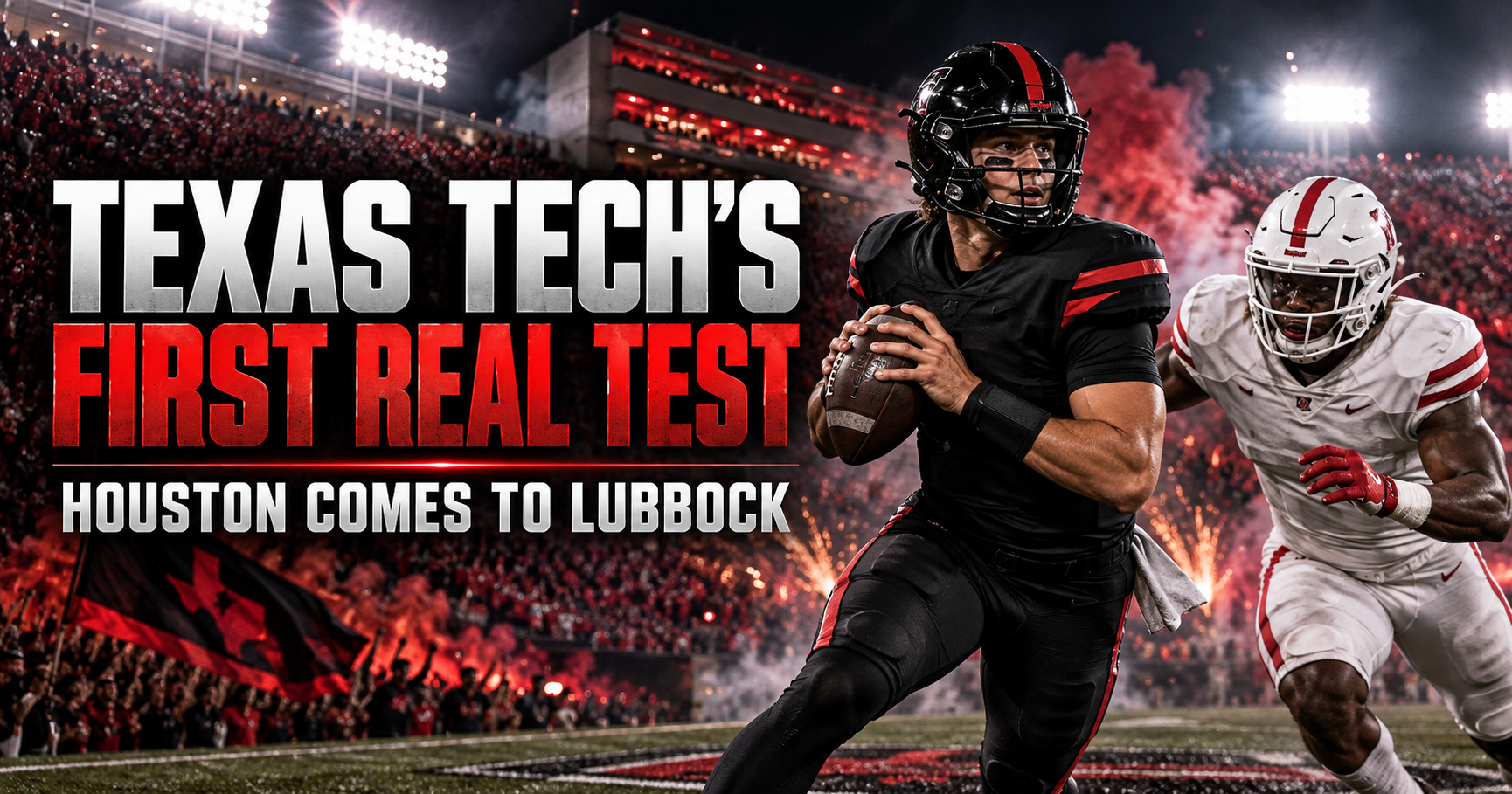
That is what makes Friday night’s Big 12 opener against No. 22 Houston so important. No. 13 Texas Tech enters the game at 2–0, but the Cougars represent its first legitimate test of the season.
Houston is experienced, physical and led by a veteran quarterback capable of punishing a defense that makes mistakes. The Cougars remember last season’s 35–11 loss to Texas Tech, and they spent the offseason improving the offensive line that failed to protect them adequately in that matchup.
Texas Tech purchased one of the most talented rosters in the Big 12. Now Houston will help determine whether it was worth the price.
Texas Tech Changed the Expectations in Lubbock
The 2025 season transformed the way Texas Tech is viewed nationally.
The Red Raiders won 12 games, captured the Big 12 and reached the College Football Playoff. An eventual shutout loss to Oregon exposed the gap that remained between Texas Tech and the sport’s absolute elite, but merely reaching that stage changed the program’s standards.
The Red Raiders could no longer approach the offseason like an underdog hoping to catch the conference by surprise.
They had become the target.
Texas Tech responded by leaning even harder into the modern roster-building model. The Red Raiders used their financial resources, booster support and transfer-portal operation to replace departing stars with established college players.
The most visible move was the addition of Sorsby.
The former Indiana and Cincinnati quarterback passed for 2,800 yards and 27 touchdowns while throwing only five interceptions during the 2025 season. He also rushed for nine scores, giving Texas Tech a powerful dual-threat quarterback with three years of starting experience.
Sorsby reportedly turned down LSU and considered entering the NFL Draft before choosing the Red Raiders. His decision was celebrated with a Times Square billboard—a public declaration that Texas Tech was operating like a national brand.
That kind of attention comes with pressure.
Sorsby was not brought to Lubbock simply to keep Texas Tech competitive. He was brought in to defend the Big 12 championship and lead another playoff run.
The Defense Had to Be Rebuilt, Not Replaced
Texas Tech’s 2025 success was built largely upon an elite defense that produced six NFL draft selections.
That level of attrition could destroy most conference champions. Defensive stars are more difficult to replace than offensive skill players because success often depends upon experience, communication and established chemistry.
Texas Tech believes it has found another way.
The Red Raiders retained veterans such as A.J. Holmes, Brice Pollock and Ben Roberts while supplementing the defense with experienced transfers. Players including Mateen Ibirogba were not brought in as developmental projects. They were added because Texas Tech expects them to contribute immediately.
The early results have been encouraging, particularly against the run. Texas Tech entered the Houston game ranked among the country’s better rushing defenses.
Questions remain in the secondary, however.
The Red Raiders surrendered enough passing production during their 35–24 victory at Oregon State to create concern heading into conference play. Texas Tech’s pass defense is still developing after losing so much NFL-caliber talent.
Houston is precisely the kind of opponent capable of finding out whether those concerns are legitimate.
Conner Weigman Gives Houston a Chance
Houston is not entering Lubbock with an inexperienced quarterback hoping to survive.
Conner Weigman has played enough high-level football to understand what the environment will demand.
After transferring from Texas A&M, Weigman produced the best season of his career in 2025. He passed for 2,705 yards and 25 touchdowns while adding 700 rushing yards and 11 scores. Houston improved to 10–3 and completed its turnaround with a Texas Bowl victory over LSU.
Weigman entered 2026 as the unquestioned starter and one of the most experienced quarterbacks in the conference. Through two games, he has passed for 425 yards with four touchdowns and one interception.
His mobility will be especially important against Texas Tech.
The Red Raiders want to create pressure without sacrificing their coverage structure. Weigman’s ability to escape the pocket, extend plays and convert third downs can force Texas Tech to become less aggressive.
Houston does not want him running 15 or 20 times. The Cougars depended too heavily upon Weigman’s legs last season, when he recorded 171 rushing attempts.
The goal is to use him selectively while allowing Houston’s improved backfield and offensive line to carry more of the physical burden.
Houston Rebuilt Its Offensive Line for Games Like This
Willie Fritz understood that Houston could not become a genuine Big 12 contender without improving its offensive front.
The Cougars upgraded the line through the transfer portal, adding Shadre Hurst and Anthony Boswell. Hurst entered the season with preseason All-Big 12 recognition, while Boswell was expected to provide stability in the middle of the formation.
Houston’s projected line became more athletic and functionally stronger than the 2025 unit.
That improvement will receive its first serious examination in Lubbock.
Texas Tech’s defensive line overwhelmed Houston during last season’s 35–11 victory. Weigman was injured in the game, and the Cougars were never able to establish enough offensive consistency to threaten the Red Raiders.
If the rebuilt line cannot protect Weigman on Friday, Houston will suffer a similar result.
The Cougars must avoid obvious passing situations, particularly on the road.
Texas Tech’s crowd
will become a factor if Houston repeatedly faces third-and-long, allowing the Red Raiders to disguise their pressures and attack a stationary target.
Houston needs Makhi Hughes to make a difference.
Hughes rushed for more than 1,300 yards in consecutive seasons at Tulane before transferring to Oregon and disappearing from the Ducks’ rotation. His reunion with Houston offensive coordinator Slade Nagle gives the Cougars a powerful runner capable of absorbing a significant workload.
A productive running game would slow Texas Tech’s pass rush, protect Weigman and keep Sorsby on the sideline.
Texas Tech Must Prove It Can Handle Being the Favorite
Texas Tech spent years chasing programs with more resources, deeper rosters and greater national recognition.
Now the Red Raiders have become one of those programs.
That transition creates a different kind of pressure.
Opponents are no longer overlooking Texas Tech. Houston has spent months preparing for this game because beating the defending conference champion would announce that the Cougars are ready to join the Big 12’s upper tier.
The Red Raiders will receive every opponent’s best effort. Their financial investment will be discussed after every mistake, loss or disappointing performance.
That may be unfair, but it is the reality Texas Tech willingly accepted.
When a program reportedly commits millions to acquiring a quarterback and spends aggressively throughout the roster, close losses are no longer celebrated as evidence of progress. The standard becomes championships.
Houston will test whether Texas Tech is comfortable carrying that burden.
Houston’s Continuity Cannot Be Purchased Overnight
Texas Tech possesses a talented roster, but Houston may have the advantage in continuity.
The Cougars are one of the few Power Four programs returning their head coach, all three coordinators and starting quarterback. They also brought back a substantial portion of a defense that ranked sixth in the Big 12 in points allowed.
Eight defensive starters returned, including cornerback Will James and safeties Kentrell Webb and Jordan Allen. Houston supplemented that experience with transfers rather than attempting to reconstruct the entire unit.
That familiarity matters early in the season.
Texas Tech is still integrating new players into critical roles. Houston’s defenders already understand Austin Armstrong’s system, terminology and expectations. They should be capable of making adjustments without requiring the extensive sideline communication that less experienced units need.
Sorsby will test them in ways Houston’s first two opponents could not.
He can attack vertically, make throws outside the pocket and punish defenses with with designed quarterback runs. Houston must force him to complete difficult passes rather than allowing his mobility to turn broken plays into explosive gains.
If the Cougars can keep Sorsby inside the pocket and create pressure without losing coverage integrity, Texas Tech may finally experience some offensive discomfort.
The Big 12 Race Begins Friday Night
This is only the conference opener for both programs. Neither team’s season will be over with a loss.
The result will still reshape how each is viewed.
A convincing Texas Tech victory would reinforce the idea that the Red Raiders remain the team to beat in the Big 12. It would validate their aggressive offseason spending and show that the defense can withstand the loss of six NFL draft selections.
A Houston victory would disrupt the conference hierarchy immediately.
The Cougars would move to 3–0 with a road victory over the defending Big 12 champion. Weigman would enter the conference’s quarterback spotlight, and Fritz would have proof that his methodical rebuilding project had reached championship contention.
Houston improved from 4–8 in 2024 to 10–3 in 2025. The next step is not merely winning more games. It is defeating the programs standing between the Cougars and the conference championship game.
Texas Tech is the first—and perhaps most important—of those programs.
The Red Raiders Must Justify the Investment
There is nothing wrong with Texas Tech using every available resource to build its roster.
College football’s traditional powers have benefited from financial advantages, enormous recruiting departments and national exposure for decades. Texas Tech has decided to compete with them under the sport’s new economic rules.
The Red Raiders should not apologize for that.
But spending creates expectations, and expectations eventually demand results.
Beating lesser opponents and climbing the rankings is not enough anymore. Texas Tech built this roster to win conference games against experienced teams like Houston. It acquired Sorsby to deliver when the opponent can pressure him. It reloaded the defense to prove that the program—not one exceptional collection of players—was responsible for last season’s success.
Houston is talented enough to expose weaknesses, experienced enough to remain composed and motivated enough to make the defending champion uncomfortable.
Up To $1500 in Bonus Bets Paid Back if your First Bet Does Not Win
T&Cs apply
4.5/5
Gambling problem? Call 1-800-GAMBLER or 1-800-MY-RESET (Available in the US) 877-8-HOPENY or text HOPENY (467369) (NY) 1-800-327-5050 (MA), 1-800-BETS-OFF (IA), 1-800-981-0023 (PR). 21+ only. Please Gamble Responsibly. See BetMGM.com for Terms. First Bet Offer for new customers only (if applicable). Subject to eligibility requirements. Bonus bets are non-withdrawable. In partnership with Kansas Crossing Casino and Hotel. Promotional offers not available in Mississippi, Massachusetts, New York, Ontario, or Puerto Rico.
New DraftKings Customers: Spend $5+ Get $150 in Bonuses
T&Cs apply
4.5/5
GAMBLING PROBLEM? CALL 1-800-GAMBLER or 1-800-MY-RESET, (800) 327-5050 or visit gamblinghelplinema.org (MA). Please Gamble Responsibly. 888-789-7777/visit ccpg.org (CT), or visit www.mdgamblinghelp.org (MD), 1-800-981-0023 (PR). 21+ and present in most states. (18+ DC/NH/PR/WY). Void in CAN. Eligibility restrictions apply. On behalf of Boot Hill Casino (KS). Pass-thru of per wager tax may apply in IL. 1 per new DraftKings customer. $5+ first-time bet req. Max. $150 issued as non-withdrawable Bonus Bets. Stake removed from payout. Reward issued as $50 in Bonus Bets every 7 days via click-to-claim for 14 days. Bonus Bets and click-to-claims expire 7 days (168hrs) after issuance. Terms: sportsbook.draftkings.com/promos. Ends 10/11/26 at 11:59 PM ET. Sponsored by DK.
Must be 21+. GAMBLING PROBLEM? CALL 1-800-GAMBLER OR CALL 1-800-MY-RESET, www.mdgamblinghelp.org (MD), (800)-327-5050 or gamblinghelplinema.org (MA), Call (877)8-HOPENY or text HOPENY (467369) (NY), (888) 789-7777 or ccpg.org (CT), morethanagame.nc.gov (NC), 1800gambler.net (WV)
Bet $1 and get double the winnings up to $25 for your next 10 bets
T&Cs apply
4.4/5
21+ New users only. Must register using eligible promo code. First bet after registration must qualify. Max. Bonus Bet: $1,000. Bonus Bet expires 14 days after receipt. Void where prohibited. See Caesars.com/promos for full terms. Gambling Problem? 1-800-GAMBLER (1-800-426-2537)
21+ and present in OH. Gambling Problem? Call 1-800-GAMBLER.
This site is using
Cloudflare
and adheres to the
Google Safe Browsing Program. We adapted
Google's Privacy Guidelines
to keep your data safe at all times.
Close
Ready to Win Big? Join the Elite with Our Sports Betting Deals!
FanDuel Promo
New Users – Get $250 in Bonus Bets when you wager $5 for 5 days
Up To $1500 in Bonus Bets Paid Back if your First Bet Does Not Win
Best Slots
T&Cs and 21+ apply
Gambling problem? Call 1-800-GAMBLER or 1-800-MY-RESET (Available in the US) 877-8-HOPENY or text HOPENY (467369) (NY) 1-800-327-5050 (MA), 1-800-BETS-OFF (IA), 1-800-981-0023 (PR). 21+ only. Please Gamble Responsibly. See BetMGM.com for Terms. First Bet Offer for new customers only (if applicable). Subject to eligibility requirements. Bonus bets are non-withdrawable. In partnership with Kansas Crossing Casino and Hotel. Promotional offers not available in Mississippi, Massachusetts, New York, Ontario, or Puerto Rico.
Code:
Open BetMGM
Get Bonus
DraftKings Promo
New DraftKings Customers: Spend $5+ Get $150 in Bonuses
Newcomer
T&Cs and 21+ apply
GAMBLING PROBLEM? CALL 1-800-GAMBLER or 1-800-MY-RESET, (800) 327-5050 or visit gamblinghelplinema.org (MA). Please Gamble Responsibly. 888-789-7777/visit ccpg.org (CT), or visit www.mdgamblinghelp.org (MD), 1-800-981-0023 (PR). 21+ and present in most states. (18+ DC/NH/PR/WY). Void in CAN. Eligibility restrictions apply. On behalf of Boot Hill Casino (KS). Pass-thru of per wager tax may apply in IL. 1 per new DraftKings customer. $5+ first-time bet req. Max. $150 issued as non-withdrawable Bonus Bets. Stake removed from payout. Reward issued as $50 in Bonus Bets every 7 days via click-to-claim for 14 days. Bonus Bets and click-to-claims expire 7 days (168hrs) after issuance. Terms: sportsbook.draftkings.com/promos. Ends 10/11/26 at 11:59 PM ET. Sponsored by DK.
Code:
Open DraftKings
Get Bonus
Find out what the legends have to say about sports this week....