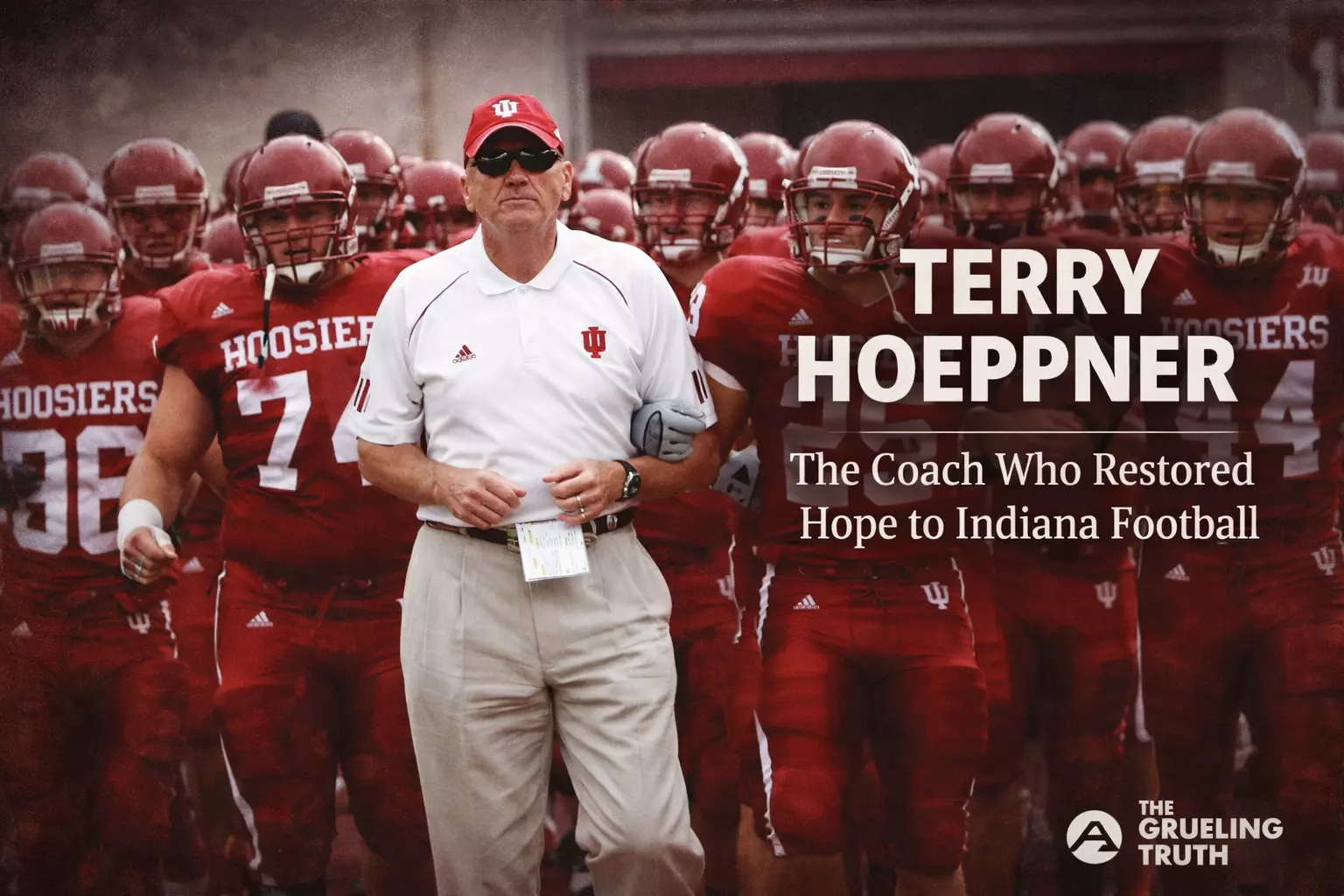
Indiana football has had better seasons than the two Terry Hoeppner coached in Bloomington. It has had bigger individual moments.
But no modern Indiana football figure left a deeper emotional fingerprint on the program than
Terry Hoeppner—because what he gave IU wasn’t just a playbook. He gave it
belief, a vocabulary for hope, and traditions that still define a Saturday in Bloomington. Those traditions and Indiana Football are now just one win away from winning a National Championship and the legacy of Terry Hoeppner is still felt twenty years later during this improbable run.
Hoeppner died on
June 19, 2007, at age 59, after battling brain cancer, only days after IU announced he would take a medical leave of absence for the 2007 season. And yet, nearly two decades later, his presence still feels baked into the program’s bones—because the things he built were never just “marketing.” They were
identity.
Sure, people will say that Indiana has no history, but I say, “not so fast.” The tradition may not be deep, no, we aren’t Ohio State or Alabama, but men like Bill Mallory and Terry Hoeppner, when they were at Indiana, made Indiana Football special. This surreal run to a National Championship game has been more than any Hoosier could have ever imagined. I just ask that on that night when the Hoosiers line up to play for the National Championship, all Hoosier fans remember
Coach Mallory
and Coach Hoeppner, because you know that they will be smiling down from above.
A Hoosier coach who
understood
Indiana
Hoeppner wasn’t a hired gun. He was Indiana through and through—an Indiana native who took a long, winding coaching path that included high school stops, assistant roles, and eventually a rise through the famed “Cradle of Coaches” at
Miami (OH).
That background mattered, because Hoeppner didn’t arrive in Bloomington pretending IU was something it wasn’t. He knew exactly what Indiana football had become in the public imagination: a program people joked about, a place opponents circled as a “get-right game,” a stadium that too often felt quiet by halftime.
Hoeppner’s first real act as IU coach wasn’t schematic. It was psychological:
he treated Indiana like it deserved to matter—and he demanded everyone around the program do the same.
The Miami (OH) proof: he wasn’t selling empty optimism
When Indiana hired Hoeppner in late 2004, the reason fans allowed themselves to hope wasn’t just because he was likable. It was because he’d already built something real.
As a head coach at Miami (OH) (1999–2004), Hoeppner went
48–25, won the
MAC in 2003, and took Miami to bowls. He also built a reputation for quarterback development and program culture—helping Miami remain relevant even as coaches came and went.
Indiana didn’t hire him as a “motivational speaker.” They hired him because he had a track record of taking a place with constraints and creating a machine that could win anyway.
And when he got to Bloomington, he immediately treated the job like a turnaround operation—equal parts football, psychology, and community-building.
“The Walk,” “The Rock,” and the decision to build a
program
before a record
Hoeppner inherited a brutal truth: Indiana football didn’t just need wins. It needed a reason for people to
care
again.
So, he went to work building traditions that would make Memorial Stadium feel like a place with ritual, meaning, and pride.
The Walk
IU athletics credits Hoeppner with establishing
“The Walk,”
a pregame procession where the team moves through fans on the way to the stadium, turning the arrival into a shared moment instead of a private tunnel routine.
It sounds simple, but it was strategic: a program doesn’t grow without
connection, and Hoeppner understood that Indiana football had to rebuild its relationship with its own people.
“The Rock” / “Defend the Rock”
Hoeppner also branded Memorial Stadium as
“The Rock”—a nod to the stadium’s limestone and a rallying cry:
“Defend the Rock.”
And crucially, it became physical. As later Indiana coverage explained, Hoeppner identified a massive limestone piece tied to Memorial Stadium’s construction, installed it, and turned touching it into a ritual.
This wasn’t gimmicky. It was deliberate symbolism:
take pride in home, protect it, turn Bloomington into a place opponents hate visiting.
“Play 13”
Then came the phrase that became his signature:
“Play 13.”
The meaning was straightforward: don’t talk about a 12-game season as if that’s the limit—Indiana’s goal was to earn a 13th game, a bowl.
For most programs, “bowl game” is baseline. For Indiana, it was a mountain. Hoeppner didn’t hide that. He attacked it.
The Iowa moment: when belief turned into a real Saturday
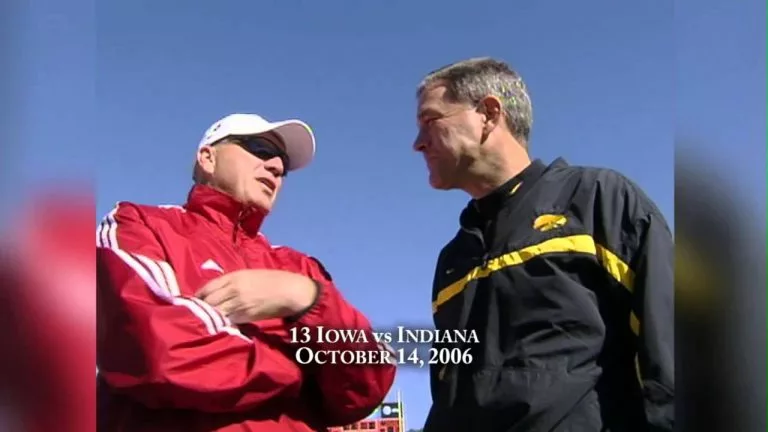
Every culture shift needs a game that feels like proof. Hoeppner’s IU tenure produced one that still lives in program lore: Indiana’s
31–28 win over No. 13 Iowa
in 2006.
After that win, IU’s own site described it as Indiana’s biggest victory in 20 years and explicitly tied it to Hoeppner’s mission— “Play 13”
and the ongoing call to
“Defend The Rock.”
And Hoeppner pushed the fanbase harder. He challenged people to show up, to turn Memorial Stadium into something loud, to make Bloomington feel like a real home-field edge. The win wasn’t just about the scoreboard—it was about the idea that Indiana could stop treating football as an obligation and start treating it as
a living thing
again.
That’s a key part of the Hoeppner legacy: he made Indiana football feel
alive—even before the record looked like it.
Greatest Season: 2006 Football – Indiana Beats Iowa
The illness, the leave, and the gut punch IU never got to process in time
Hoeppner’s death hit so hard because it arrived right as the program felt like it was finally turning a corner emotionally.
The official IU announcement of his passing notes he’d battled a lengthy illness and credits him not only for coaching but for establishing the traditions—specifically naming
The Walk
and calling Memorial Stadium
“The Rock.”
The National Football Foundation reported Hoeppner had undergone two brain surgeries over the prior 18 months and died of complications from a brain tumor.
This is what made it tragic in the deepest way: Hoeppner was selling a vision that required time—time he didn’t get.
The most haunting part: “Play 13” came true… without him
The reason Hoeppner’s story is so emotional at Indiana is that his central promise—Play 13—became a reality almost immediately after he was gone.
A 2007 Sports Illustrated piece captured the moment Indiana became bowl eligible that season and framed it through Hoeppner’s rallying cry, quoting his widow on the “bittersweet” feeling of that vision being realized without him there to enjoy it.
This is the essence of why he left such a mark: the program didn’t just remember him. It
carried him
into what came next.
Coach Hep/Jane Hoeppner Video
Why Terry Hoeppner mattered more than his record
Hoeppner went
4–7
in 2005 and
5–7
in 2006 at Indiana. If you only evaluate coaches by wins and losses, you miss the point entirely.
Terry Hoeppner’s legacy at Indiana is that he changed the conversation from:
“We’ll never be good” to
“Why not us?”
And he didn’t do it with delusion. He did it with rituals, language, and standards that made people believe Indiana football deserved to be taken seriously—by opponents, by recruits, and most importantly, by its own fans.
Even today, “Defend the Rock” remains enshrined as a recognized Indiana game-day tradition tied directly to Hoeppner’s influence.
That’s not nostalgia. That’s infrastructure.
The special truth about “Coach Hep”
Some coaches win big and become legends because banners force you to remember them.
Hoeppner became something rarer: a legend because he made people feel something they hadn’t felt in a long time—hope that wasn’t embarrassing.
He made fans show up with pride. He made players talk about bowls like a mission, not a fantasy. He made Indiana football stop apologizing for existing.
And in a program where gravity has historically pulled everything toward cynicism, that might be the hardest win of all.
Up To $1500 in Bonus Bets Paid Back if your First Bet Does Not Win
T&Cs apply
4.5/5
Gambling problem? Call 1-800-GAMBLER or 1-800-MY-RESET (Available in the US) 877-8-HOPENY or text HOPENY (467369) (NY) 1-800-327-5050 (MA), 1-800-BETS-OFF (IA), 1-800-981-0023 (PR). 21+ only. Please Gamble Responsibly. See BetMGM.com for Terms. First Bet Offer for new customers only (if applicable). Subject to eligibility requirements. Bonus bets are non-withdrawable. In partnership with Kansas Crossing Casino and Hotel. Promotional offers not available in Mississippi, Massachusetts, New York, Ontario, or Puerto Rico.
New DraftKings Customers: Spend $5+ Get $150 in Bonuses
T&Cs apply
4.5/5
GAMBLING PROBLEM? CALL 1-800-GAMBLER or 1-800-MY-RESET, (800) 327-5050 or visit gamblinghelplinema.org (MA). Please Gamble Responsibly. 888-789-7777/visit ccpg.org (CT), or visit www.mdgamblinghelp.org (MD), 1-800-981-0023 (PR). 21+ and present in most states. (18+ DC/NH/PR/WY). Void in CAN. Eligibility restrictions apply. On behalf of Boot Hill Casino (KS). Pass-thru of per wager tax may apply in IL. 1 per new DraftKings customer. $5+ first-time bet req. Max. $150 issued as non-withdrawable Bonus Bets. Stake removed from payout. Reward issued as $50 in Bonus Bets every 7 days via click-to-claim for 14 days. Bonus Bets and click-to-claims expire 7 days (168hrs) after issuance. Terms: sportsbook.draftkings.com/promos. Ends 10/11/26 at 11:59 PM ET. Sponsored by DK.
Must be 21+. GAMBLING PROBLEM? CALL 1-800-GAMBLER OR CALL 1-800-MY-RESET, www.mdgamblinghelp.org (MD), (800)-327-5050 or gamblinghelplinema.org (MA), Call (877)8-HOPENY or text HOPENY (467369) (NY), (888) 789-7777 or ccpg.org (CT), morethanagame.nc.gov (NC), 1800gambler.net (WV)
Bet $1 and get double the winnings up to $25 for your next 10 bets
T&Cs apply
4.4/5
21+ New users only. Must register using eligible promo code. First bet after registration must qualify. Max. Bonus Bet: $1,000. Bonus Bet expires 14 days after receipt. Void where prohibited. See Caesars.com/promos for full terms. Gambling Problem? 1-800-GAMBLER (1-800-426-2537)
21+ and present in OH. Gambling Problem? Call 1-800-GAMBLER.
This site is using
Cloudflare
and adheres to the
Google Safe Browsing Program. We adapted
Google's Privacy Guidelines
to keep your data safe at all times.
Close
Ready to Win Big? Join the Elite with Our Sports Betting Deals!
FanDuel Promo
New Users – Get $250 in Bonus Bets when you wager $5 for 5 days
Up To $1500 in Bonus Bets Paid Back if your First Bet Does Not Win
Best Slots
T&Cs and 21+ apply
Gambling problem? Call 1-800-GAMBLER or 1-800-MY-RESET (Available in the US) 877-8-HOPENY or text HOPENY (467369) (NY) 1-800-327-5050 (MA), 1-800-BETS-OFF (IA), 1-800-981-0023 (PR). 21+ only. Please Gamble Responsibly. See BetMGM.com for Terms. First Bet Offer for new customers only (if applicable). Subject to eligibility requirements. Bonus bets are non-withdrawable. In partnership with Kansas Crossing Casino and Hotel. Promotional offers not available in Mississippi, Massachusetts, New York, Ontario, or Puerto Rico.
Code:
Open BetMGM
Get Bonus
DraftKings Promo
New DraftKings Customers: Spend $5+ Get $150 in Bonuses
Newcomer
T&Cs and 21+ apply
GAMBLING PROBLEM? CALL 1-800-GAMBLER or 1-800-MY-RESET, (800) 327-5050 or visit gamblinghelplinema.org (MA). Please Gamble Responsibly. 888-789-7777/visit ccpg.org (CT), or visit www.mdgamblinghelp.org (MD), 1-800-981-0023 (PR). 21+ and present in most states. (18+ DC/NH/PR/WY). Void in CAN. Eligibility restrictions apply. On behalf of Boot Hill Casino (KS). Pass-thru of per wager tax may apply in IL. 1 per new DraftKings customer. $5+ first-time bet req. Max. $150 issued as non-withdrawable Bonus Bets. Stake removed from payout. Reward issued as $50 in Bonus Bets every 7 days via click-to-claim for 14 days. Bonus Bets and click-to-claims expire 7 days (168hrs) after issuance. Terms: sportsbook.draftkings.com/promos. Ends 10/11/26 at 11:59 PM ET. Sponsored by DK.
Code:
Open DraftKings
Get Bonus
Find out what the legends have to say about sports this week....