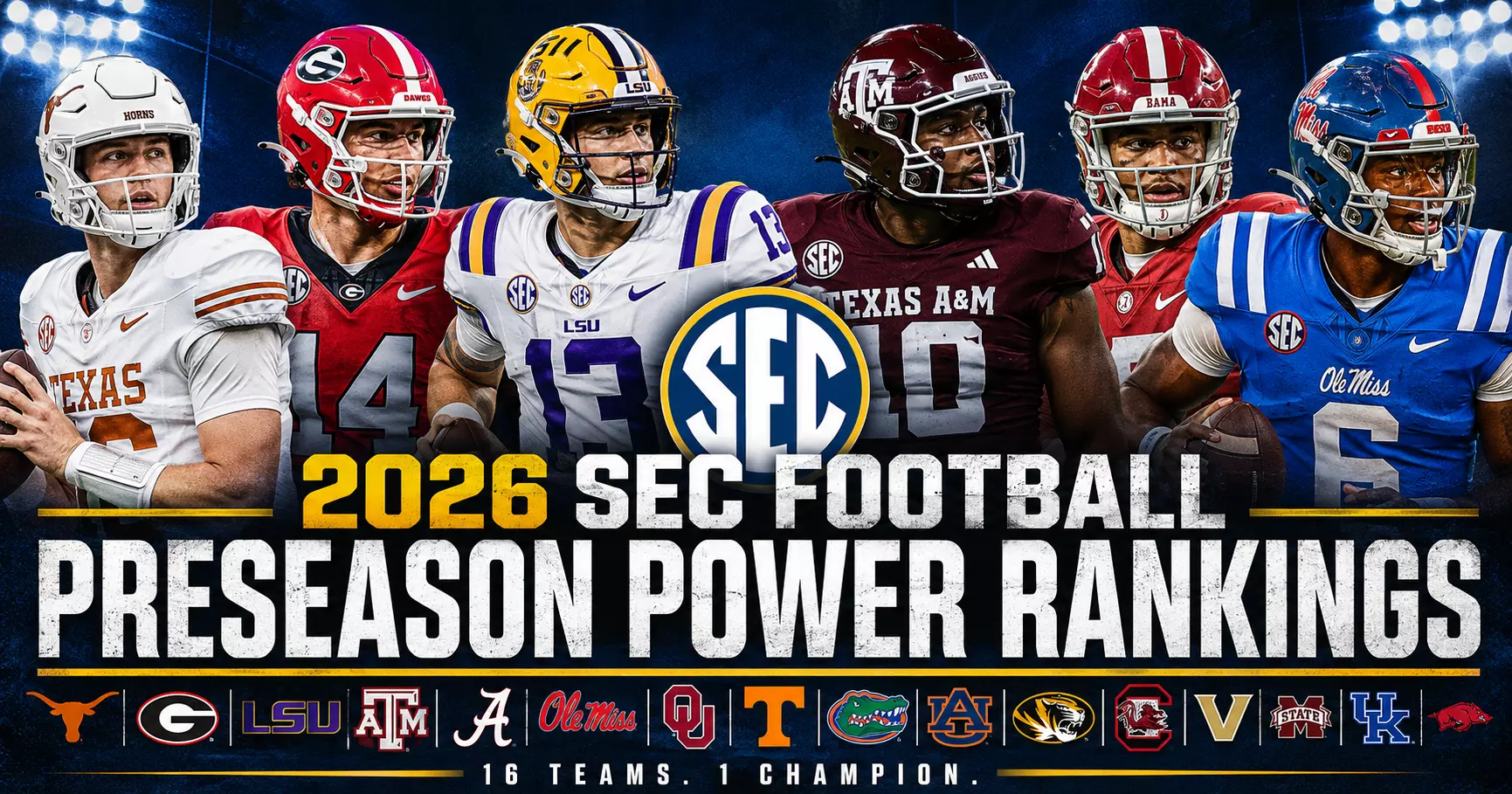
The SEC enters the 2026 season with championship contenders at the top, dangerous challengers throughout the middle.
The SEC enters the 2026 season with championship contenders at the top, dangerous challengers throughout the middle and six programs beginning their first full seasons under new head coaches. Lane Kiffin is now at LSU, Pete Golding leads Ole Miss, Jon Sumrall takes over Florida, Alex Golesh begins rebuilding Auburn, Ryan Silverfield inherits Arkansas and Will Stein returns to his home state to coach Kentucky.
These rankings measure how strong each team appears entering preseason camp. Roster talent, quarterback play, coaching, returning production, transfer additions and line-of-scrimmage strength were all considered. An unsettled quarterback competition is identified as such rather than treated as a completed decision.
16. Mississippi State Bulldogs
Head coach:
Jeff Lebby
Projected quarterback:
Kamario Taylor
Mississippi State enters Jeff Lebby’s third season needing visible progress. The Bulldogs improved slightly in 2025, but improvement without
bowl eligibility
will not satisfy a fan base tired of occupying the bottom tier of the SEC. Sophomore Kamario Taylor gives Lebby an exciting building block. Taylor completed 55.8 percent of his passes for 629 yards and five touchdowns last season, but his greatest value came as a runner. He carried 20 times for 173 yards and two touchdowns in the Egg Bowl, demonstrating the physical dual-threat ability around which Mississippi State can construct its offense.
Taylor must become a more consistent passer, especially when defenses force him to win from the pocket. The Bulldogs also need considerable defensive improvement after repeatedly struggling to control the line of scrimmage and prevent explosive plays. Lebby’s offensive background gives Mississippi State a chance to become difficult to prepare for, but this roster still lacks the depth and proven defensive difference-makers necessary to survive the conference schedule. Taylor raises the ceiling, yet the overall rebuild remains incomplete.
15. Arkansas Razorbacks
Head coach:
Ryan Silverfield
Projected quarterback:
KJ Jackson or AJ Hill
Arkansas starts over under Ryan Silverfield after the program’s decline during the final years of Sam Pittman’s tenure. Silverfield produced consistent results at Memphis, but rebuilding the Razorbacks will require more than installing a new offense. Arkansas needs greater depth, better line play and dependable quarterback production before it can climb the SEC standings. KJ Jackson is a strong dual-threat candidate who threw for 441 yards in limited 2025 action, while AJ Hill followed Silverfield from Memphis and already understands the new system. That makes this a genuine competition rather than a settled depth chart.
Silverfield should improve organization and offensive structure, but the Razorbacks lack the proven high-end personnel found throughout the conference. Even the teams immediately above Arkansas possess either a more established quarterback, stronger defense or greater roster continuity. The Hogs can become more competitive and steal a conference game or two, but expecting an immediate bowl run would be aggressive. This appears to be the first stage of a multiyear reconstruction.
14. Kentucky Wildcats
Head coach:
Will Stein
Projected quarterback:
Kenny Minchey
Kentucky made an intriguing long-term hire by bringing Will Stein home after his successful run coordinating Oregon’s offense. Stein understands the program and should give the Wildcats a faster, more creative offensive identity than they possessed during the final phase of the Mark Stoops era. Notre Dame transfer Kenny Minchey enters preseason camp as the clear favorite to start. Minchey threw only 26 passes in 2025, but he pushed CJ Carr during Notre Dame’s quarterback competition and now gets to work with a coach who helped develop Bo Nix, Dillon Gabriel and Dante Moore.
The concern is that Kentucky must change its identity while also rebuilding significant portions of the roster. Stein needs to establish an offensive line, create dependable perimeter production and find enough defensive depth to survive nine SEC games. Kentucky’s ceiling is higher than this ranking suggests because Stein’s system could unlock Minchey quickly. Entering the season, however, the Wildcats have too many unproven pieces to rank above teams with established quarterbacks or returning defensive cores.
13. Vanderbilt Commodores
Head coach:
Clark Lea
Projected quarterback:
Jared Curtis or Blaze Berlowitz
Clark Lea has changed Vanderbilt’s culture and demonstrated that the Commodores no longer must accept permanent residence at the bottom of the conference. The challenge in 2026 is replacing Diego Pavia, whose competitiveness, improvisation and leadership transformed the program. Five-star freshman Jared Curtis has the highest ceiling in the quarterback room, while Blaze Berlowitz offers greater familiarity with offensive coordinator Tim Beck’s system. Curtis is the more exciting long-term option, but Vanderbilt may prefer Berlowitz’s experience if the freshman does not separate himself during camp.
Vanderbilt should remain disciplined and difficult to overwhelm because Lea has established a legitimate defensive identity. However, the offense is replacing more than a quarterback. Pavia frequently turned broken plays and difficult third downs into positive outcomes, masking flaws that could become more visible without him. The Commodores rank above the three teams below them because their culture is more stable and their defense should remain competitive. Their ultimate ceiling depends on whether Curtis or Berlowitz can provide enough offense to replace Pavia’s enormous influence.
12. South Carolina Gamecocks
Head coach:
Shane Beamer
Quarterback:
LaNorris Sellers
South Carolina retains one of the SEC’s most physically gifted quarterbacks in LaNorris Sellers, but keeping him upright must become the program’s first priority. Sellers threw for 2,437 yards and 13 touchdowns in 2025 while operating behind a line that allowed more sacks per game than any other Power Four program. Forty-two of those sacks were charged while Sellers was on the field. His size, mobility and arm strength can make him extremely difficult to defend, but even an elite athlete cannot consistently overcome immediate pressure and the absence of a dependable running game.
New offensive coordinator Kendal Briles should use Sellers’ movement skills more effectively and create easier throws through tempo and designed quarterback runs. The Gamecocks still need better line play and greater offensive consistency, however. Shane Beamer’s special teams traditionally provide an advantage, and South Carolina has enough athleticism to upset ranked opponents. After a disappointing four-win 2025 season, the pressure is rising. Sellers gives the Gamecocks a real bounce-back opportunity, but the supporting cast must finally meet his talent level.
11. Auburn Tigers
Head coach:
Alex Golesh
Quarterback:
Byrum Brown
No first-year SEC coach brought a more natural offensive fit with him than Alex Golesh. Quarterback Byrum Brown followed Golesh from South Florida after completing 66.3 percent of his passes for 3,158 yards, 28 touchdowns and only seven interceptions in 2025. Brown also rushed for 1,008 yards and 14 scores, giving Auburn an experienced quarterback who already understands the terminology, tempo and expectations of the new system.
That continuity should allow Auburn to play quickly from the opening week instead of spending half the season learning a new identity. The Tigers’ problem is everything surrounding the quarterback. Golesh undertook a massive roster overhaul, Cam Coleman departed, and a pass defense that struggled badly in 2025 must be repaired. ESPN’s preseason FPI nevertheless places Auburn inside the national top 25 and projects approximately 6.6 victories, reflecting the roster’s underlying talent. Brown gives Auburn a higher floor than several rebuilding programs, but the Tigers need immediate defensive improvement to challenge the SEC’s upper half.
10. Florida Gators
Head coach:
Jon Sumrall
Projected quarterback:
Aaron Philo or Tramell Jones Jr.
Florida hired Jon Sumrall
to restore physicality, discipline and confidence to a program that has repeatedly underachieved relative to its recruiting base. The Gators possess enough talent to finish considerably higher than tenth, but their quarterback competition remains unresolved. Georgia Tech transfer Aaron Philo entered the offseason with an advantage because of his relationship with offensive coordinator Buster Faulkner. Tramell Jones Jr., however, performed well enough during the spring to keep the competition alive. Philo’s spring game included two early interceptions followed by a sharp 9-for-10 finish with 109 yards and two touchdowns.
Sumrall inherited a talented roster at several positions, particularly at receiver, and ESPN’s preseason model places Florida 18th nationally with a projected 6.7 victories. The Gators’ ceiling depends on stable quarterback play and better execution in close games. Sumrall has succeeded everywhere he has coached, but the SEC provides little patience. Florida should be more organized immediately, yet ranking the Gators higher before their quarterback situation is settled would require too much projection.
9. Missouri Tigers
Head coach:
Eli Drinkwitz
Projected quarterback:
Austin Simmons
Missouri is one of the conference’s most difficult teams to rank. Eli Drinkwitz has created stability and elevated expectations, but the Tigers must replace every 2025 defensive starter and enter the season with uncertainty surrounding their most productive offensive player. Running back Ahmad Hardy led the SEC in rushing last season but suffered a gunshot wound to his leg during the offseason, making his availability and recovery important football questions secondary to his health.
At quarterback, Ole Miss transfer Austin Simmons is the preseason favorite over Matt Zollers. Simmons threw for 744 yards in limited action last year but also produced five interceptions on 75 attempts. His arm talent is obvious, though his decision-making must improve. Zollers gained valuable experience when injuries forced him into Missouri’s lineup and remains capable of winning the position. Drinkwitz gives Missouri a dependable offensive structure, but replacing an entire starting defense is an enormous undertaking. The Tigers have bowl-level talent, yet their defensive turnover and quarterback uncertainty keep them outside the top eight.
8. Tennessee Volunteers
Head coach:
Josh Heupel
Projected quarterback:
Faizon Brandon or George MacIntyre
The Volunteers remain dangerous because Josh Heupel’s offense creates space, tempo and explosive-play opportunities, but the quarterback position is almost entirely unproven. True freshman Faizon Brandon and redshirt freshman George MacIntyre are battling to replace Joey Aguilar. MacIntyre has slightly more college experience, though that experience amounts to only nine more pass attempts. Brandon was one of the highest-rated quarterbacks in the 2026 recruiting class and may possess the greater long-term ceiling.
The defense could improve significantly under Jim Knowles, who coordinated Ohio State’s national championship defense in 2024. ESPN’s FPI places Tennessee 16th nationally and projects approximately 7.3 victories, which reflects both the roster’s talent and the uncertainty at quarterback. Tennessee can reach the playoff if one quarterback develops rapidly, but beginning the year with such little experience at the sport’s most important position prevents the Volunteers from ranking with the conference’s established contenders.
7. Oklahoma Sooners
Head coach:
Brent Venables
Quarterback:
John Mateer
Oklahoma should again field one of the SEC’s strongest defenses under Brent Venables. The Sooners’ ceiling will be determined by whether John Mateer and the offensive line can become more consistent. Mateer completed 62.2 percent of his passes for 2,885 yards and 14 touchdowns last season, but his 11 interceptions and struggles under heavy pressure limited the offense. Oklahoma surrendered 13 combined sacks during its three losses, and Mateer threw three interceptions against Texas.
Mateer remains a dangerous runner and improvisational quarterback capable of rescuing broken plays. He does not need to become the SEC’s best passer if the defense continues creating short fields and controlling games. ESPN’s preseason FPI ranks Oklahoma 12th nationally with a projected 7.5 victories, illustrating the respect surrounding the defense despite concerns about the offense. The Sooners have a playoff-level defense, but the offensive line and running game must make significant progress. Cleaner quarterback play would place Oklahoma firmly in the SEC championship race.
6. Ole Miss Rebels
Head coach:
Pete Golding
Quarterback:
Trinidad Chambliss
Ole Miss enters its first full season after Lane Kiffin with one of the best quarterbacks in college football. Trinidad Chambliss completed 66.1 percent of his passes for 3,937 yards, 22 touchdowns and only three interceptions in 2025. He elevated his game during the playoff, displaying the arm strength, mobility and composure necessary to beat elite opponents. His return gives first-year head coach Pete Golding an invaluable foundation.
Running back Kewan Lacy also returns, preserving two major pieces of an offense that should remain dangerous even without Kiffin calling the plays. The greater uncertainty is on defense, where Golding must replace important contributors while adjusting to the responsibilities of being a full-time head coach. ESPN places Ole Miss 14th nationally but projects only 7.3 victories, reflecting a difficult schedule and the concerns surrounding defensive turnover. Chambliss gives the Rebels a chance against anyone, but matching last season’s playoff run will require Golding to maintain offensive creativity while rebuilding his own side of the football.
5. Alabama Crimson Tide
Head coach:
Kalen DeBoerProjected quarterback:
Keelon Russell or Austin Mack
Alabama has won 20 games during Kalen DeBoer’s first two seasons, but expectations in Tuscaloosa are measured in championships rather than respectable records. The Crimson Tide must replace their starting quarterback and repair a running game that ranked 125th nationally in 2025. Redshirt freshman Keelon Russell appears to hold a slight advantage over Austin Mack after throwing for 240 yards and four touchdowns during Alabama’s spring scrimmage. Mack has more experience in DeBoer’s system, however, making this a legitimate preseason battle.
The supporting roster remains loaded with elite recruiting talent, which is why ESPN ranks Alabama eighth nationally despite the uncertainty at quarterback. DeBoer’s offense should create opportunities for whichever quarterback wins the job, but Alabama must become more physical and dependable in the running game. The Tide are ranked fourth because their talent level remains championship caliber. Until Russell or Mack proves capable of leading the offense through an SEC schedule, Alabama belongs just behind the league’s three most complete preseason teams.
4. Texas A&M Aggies
Head coach:
Mike ElkoQuarterback:
Marcel Reed
Texas A&M begins 2026 with one of the conference’s highest floors because Mike Elko has established a tough defensive identity and Marcel Reed returns with extensive starting experience. Reed completed 62.1 percent of his passes for 3,169 yards and 25 touchdowns in 2025 while adding a dangerous rushing element. The major concern is ball security: six of his 12 interceptions occurred during three of the Aggies’ final four games, two of which ended in losses.
Elko won 11 consecutive games before Texas A&M stumbled late, proving that the program is capable of sustaining contention. The Aggies must replace important personnel along both lines, and the schedule becomes more difficult. ESPN nevertheless ranks A&M 11th nationally and projects 8.4 victories. Reed does not need to become a different quarterback; he needs to eliminate the reckless mistakes that undermined otherwise strong performances. If the rebuilt lines hold up and Reed protects the football, Texas A&M can reach Atlanta and the College Football Playoff.
3. LSU Tigers
Head coach:
Lane Kiffin
Quarterback:
Sam Leavitt
LSU created the SEC’s most fascinating new partnership by hiring Lane Kiffin and pairing him with Arizona State transfer Sam Leavitt. Leavitt emerged nationally during Arizona State’s 2024 playoff run, though injuries limited him to 1,628 passing yards in 2025. He still threw 10 touchdowns against only three interceptions and produced a five-game stretch with 13 total touchdowns and no picks.
Kiffin also inherited the nation’s top-ranked transfer class, an elite receiving group and linebacker Whit Weeks as the centerpiece of Blake Baker’s defense. ESPN ranks LSU ninth nationally and projects 8.4 victories, but the Tigers’ ceiling is considerably higher than that projection. The concern is how quickly a heavily rebuilt roster can develop chemistry under an entirely new staff. Kiffin has never possessed this combination of quarterback talent, recruiting resources and defensive potential. LSU may experience early growing pains, but by November the Tigers could be the SEC’s most dangerous team and a legitimate national championship contender.
2. Texas Longhorns
Head coach:
Steve Sarkisian
Quarterback:
Arch Manning
Texas enters 2026 as the SEC’s most complete preseason team.
Arch Manning
endured an uneven opening to 2025 but improved dramatically after the Red River Rivalry. He finished with 3,163 passing yards, 26 touchdowns and seven interceptions, including a closing stretch in which he threw 14 touchdowns against only two picks. His mobility also became a greater part of the offense against elite opponents.
Steve Sarkisian again surrounds Manning with premium skill talent, and the Longhorns return approximately 68 percent of their overall production. Defensively, Will Muschamp takes control of a unit still stocked with blue-chip athletes. Texas must run the football more consistently after an uneven 2025 ground game, but few teams possess a better combination of quarterback experience, roster talent and coaching. ESPN ranks Texas second nationally and projects 9.8 victories, the highest placement of any SEC program. Georgia may be the conference’s safest choice, but Manning’s development gives Texas the highest offensive ceiling and makes the Longhorns very dangerous.
1. Georgia Bulldogs
Head coach:
Kirby Smart
Quarterback:
Gunner Stockton
Georgia remains the safest SEC championship selection because Kirby Smart has built the conference’s most dependable program. The Bulldogs are the reigning back-to-back SEC champions and return quarterback Gunner Stockton, who completed 69.7 percent of his passes for 2,894 yards, 24 touchdowns and only five interceptions in 2025. Stockton also showed his best form in the SEC Championship Game, completing 20 of 26 passes with three touchdowns and no interceptions against Alabama.
Running back Nate Frazier returns, while Georgia brings back 14 starters and approximately 68 percent of its production—among the best retention figures of the leading national contenders. The secondary has new faces, and road games against Alabama and Ole Miss make the schedule demanding. ESPN still ranks the Bulldogs fifth nationally and projects 9.9 victories. Georgia may not possess the SEC’s flashiest offense, but no program is better equipped to survive injuries, win close games and dominate the line of scrimmage.
Final 2026 SEC Preseason Power Rankings
Texas
Georgia
LSU
Alabama
Texas A&M
Ole Miss
Oklahoma
Tennessee
Missouri
Florida
Auburn
South Carolina
Vanderbilt
Mississippi State
Kentucky
Arkansas
Final Thoughts
The SEC championship race begins with Texas and Georgia, but neither program has separated itself enough to feel secure. LSU may possess the conference’s highest upside if Lane Kiffin and Sam Leavitt make an immediate connection. Alabama remains too talented to dismiss, while Texas A&M, Ole Miss and Oklahoma have the quarterbacks and defensive personnel necessary to reach the playoff.
The middle of the conference should be unpredictable. Tennessee, Florida and Auburn could outperform these rankings if their new quarterbacks or coaching staffs deliver immediate results. Missouri and South Carolina also possess enough offensive talent to become dangerous.
The defining feature of the 2026 SEC is uncertainty. Six teams have new head coaches, several programs enter camp with unsettled quarterback competitions and almost every contender faces a difficult conference schedule. Texas begins at No. 1, but surviving the SEC without multiple close calls will be nearly impossible.
Up To $1500 in Bonus Bets Paid Back if your First Bet Does Not Win
T&Cs apply
4.5/5
Gambling problem? Call 1-800-GAMBLER or 1-800-MY-RESET (Available in the US) 877-8-HOPENY or text HOPENY (467369) (NY) 1-800-327-5050 (MA), 1-800-BETS-OFF (IA), 1-800-981-0023 (PR). 21+ only. Please Gamble Responsibly. See BetMGM.com for Terms. First Bet Offer for new customers only (if applicable). Subject to eligibility requirements. Bonus bets are non-withdrawable. In partnership with Kansas Crossing Casino and Hotel. Promotional offers not available in Mississippi, Massachusetts, New York, Ontario, or Puerto Rico.
New DraftKings Customers: Spend $5+ Get $150 in Bonuses
T&Cs apply
4.5/5
GAMBLING PROBLEM? CALL 1-800-GAMBLER or 1-800-MY-RESET, (800) 327-5050 or visit gamblinghelplinema.org (MA). Please Gamble Responsibly. 888-789-7777/visit ccpg.org (CT), or visit www.mdgamblinghelp.org (MD), 1-800-981-0023 (PR). 21+ and present in most states. (18+ DC/NH/PR/WY). Void in CAN. Eligibility restrictions apply. On behalf of Boot Hill Casino (KS). Pass-thru of per wager tax may apply in IL. 1 per new DraftKings customer. $5+ first-time bet req. Max. $150 issued as non-withdrawable Bonus Bets. Stake removed from payout. Reward issued as $50 in Bonus Bets every 7 days via click-to-claim for 14 days. Bonus Bets and click-to-claims expire 7 days (168hrs) after issuance. Terms: sportsbook.draftkings.com/promos. Ends 10/11/26 at 11:59 PM ET. Sponsored by DK.
Must be 21+. GAMBLING PROBLEM? CALL 1-800-GAMBLER OR CALL 1-800-MY-RESET, www.mdgamblinghelp.org (MD), (800)-327-5050 or gamblinghelplinema.org (MA), Call (877)8-HOPENY or text HOPENY (467369) (NY), (888) 789-7777 or ccpg.org (CT), morethanagame.nc.gov (NC), 1800gambler.net (WV)
Bet $1 and get double the winnings up to $25 for your next 10 bets
T&Cs apply
4.4/5
21+ New users only. Must register using eligible promo code. First bet after registration must qualify. Max. Bonus Bet: $1,000. Bonus Bet expires 14 days after receipt. Void where prohibited. See Caesars.com/promos for full terms. Gambling Problem? 1-800-GAMBLER (1-800-426-2537)
21+ and present in OH. Gambling Problem? Call 1-800-GAMBLER.
This site is using
Cloudflare
and adheres to the
Google Safe Browsing Program. We adapted
Google's Privacy Guidelines
to keep your data safe at all times.
Close
Ready to Win Big? Join the Elite with Our Sports Betting Deals!
FanDuel Promo
New Users – Get $250 in Bonus Bets when you wager $5 for 5 days
Up To $1500 in Bonus Bets Paid Back if your First Bet Does Not Win
Best Slots
T&Cs and 21+ apply
Gambling problem? Call 1-800-GAMBLER or 1-800-MY-RESET (Available in the US) 877-8-HOPENY or text HOPENY (467369) (NY) 1-800-327-5050 (MA), 1-800-BETS-OFF (IA), 1-800-981-0023 (PR). 21+ only. Please Gamble Responsibly. See BetMGM.com for Terms. First Bet Offer for new customers only (if applicable). Subject to eligibility requirements. Bonus bets are non-withdrawable. In partnership with Kansas Crossing Casino and Hotel. Promotional offers not available in Mississippi, Massachusetts, New York, Ontario, or Puerto Rico.
Code:
Open BetMGM
Get Bonus
DraftKings Promo
New DraftKings Customers: Spend $5+ Get $150 in Bonuses
Newcomer
T&Cs and 21+ apply
GAMBLING PROBLEM? CALL 1-800-GAMBLER or 1-800-MY-RESET, (800) 327-5050 or visit gamblinghelplinema.org (MA). Please Gamble Responsibly. 888-789-7777/visit ccpg.org (CT), or visit www.mdgamblinghelp.org (MD), 1-800-981-0023 (PR). 21+ and present in most states. (18+ DC/NH/PR/WY). Void in CAN. Eligibility restrictions apply. On behalf of Boot Hill Casino (KS). Pass-thru of per wager tax may apply in IL. 1 per new DraftKings customer. $5+ first-time bet req. Max. $150 issued as non-withdrawable Bonus Bets. Stake removed from payout. Reward issued as $50 in Bonus Bets every 7 days via click-to-claim for 14 days. Bonus Bets and click-to-claims expire 7 days (168hrs) after issuance. Terms: sportsbook.draftkings.com/promos. Ends 10/11/26 at 11:59 PM ET. Sponsored by DK.
Code:
Open DraftKings
Get Bonus
Find out what the legends have to say about sports this week....