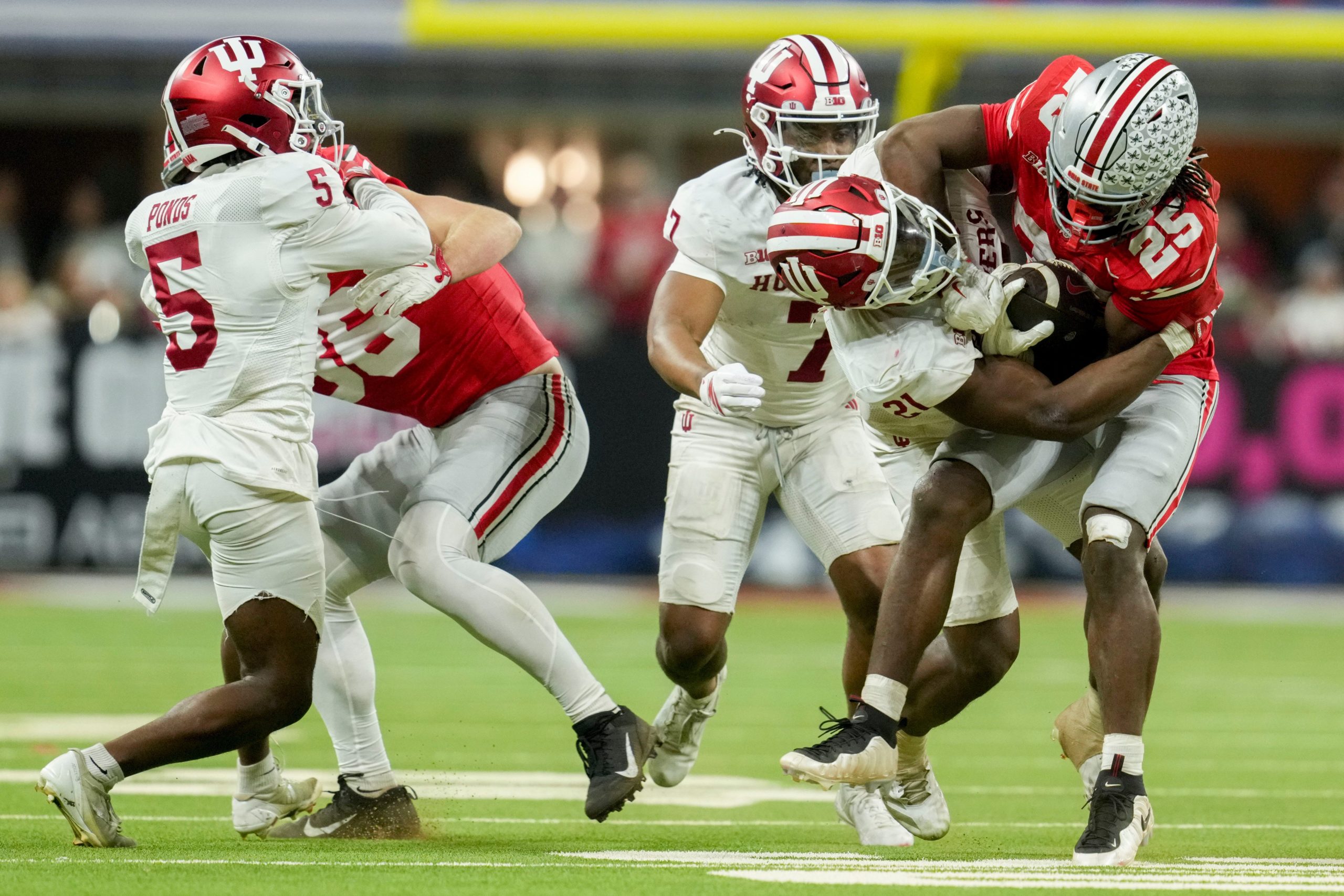
Indiana Hoosiers linebacker Rolijah Hardy (21) attempts to stop Ohio State Buckeyes running back Bo Jackson (25) on Saturday, Dec. 6, 2025, during the Big Ten football championship at Lucas Oil Stadium in Indianapolis.
Alabama general manager Courtney Morgan told Front Office Sports that a championship roster now costs “probably more than $40 million.” Then he added the line that undermines every figure in this story, his own included. “You never really know what other schools are spending,” Morgan said. The man running personnel at one of the sport’s wealthiest programs cannot see anybody else’s books, because college football roster spending carries no disclosure requirement at all. Here’s something you should know: every number in circulation is an estimate, a leak or a guess.
What College Football Roster Spending Actually Looks Like
Rusty Mansell of On3 put a name and a number together in December. “Texas will have the first 40 million dollar roster, no doubt in my mind they are close to that in real salary,” Mansell wrote. Steve Sarkisian called that reporting irresponsible and denied Texas had done any such thing.
Mike Gundy put Oregon close to $40 million. Dan Lanning waved it off and said his program spends to win. A.J. McCarron told a podcast that some teams sit between $40 million and $50 million while Alabama stays under $20 million.
Pete Nakos, who covers this beat for On3, disagrees with most of them. He reported that no roster in the sport has reached $40 million, and his survey of 17 coaches, administrators, collective operators and agents put Texas, Texas Tech and Ohio State on top, with Ohio State north of $35 million.
Blake Lawrence, whose company Opendorse processes deals for more than 100 Division I programs, went further. “There are few collectives that actually had 20 million dollars to spend a year,” Lawrence told CBS Sports, estimating fewer than five football programs cleared that number in 2024.
The floor is easier to confirm than the ceiling. Bret Bielema has said Illinois went 10-3 in 2024 on roughly $5 million. Group of Six programs operate on $2 to $3 million, nearly all of it revenue-sharing money with no donor layer beneath it.
What the Money Bought Last Winter
The portal shows what college football roster spending buys, even where the ledgers stay shut. Just under 3,300 FBS scholarship players entered during the 2026 cycle. CBS Sports’ Chris Hummer found that the SEC and Big Ten lost exactly one of their top players, Missouri edge rusher Damon Wilson II, who went to Miami. The ACC and Big 12 kept barely half of theirs, and 10 of the 16 who left moved up to the Big Ten or SEC.
Further down, it turns brutal. Of 114 Group of Six players who made their first or second team all-conference and returned for 2026, only 29.5 percent stayed at their school, and 73 of the 81 who left landed in the Power Four. Among Power Four all-conference players, 74.6 percent stayed put.
Texas Tech carries both halves of the argument. Boosters funded a roster above $28 million, including $7 million on the defensive line, and the Red Raiders won the Big 12 and made the College Football Playoff for the first time. Oregon shut them out 23-0 in the Orange Bowl quarterfinal, making Texas Tech the third team ever held scoreless in a playoff game. Money buys a bracket and nothing beyond it.
Money Can Buy Talent, but It Can’t Guarantee a Title
The rules permit all of it. The House settlement opened at $20.5 million per school and sits at $21.3 million this fiscal year, heading toward roughly $33 million by the mid-2030s. Texas Tech routed 74 percent of its share to football. Collective and booster money falls outside the cap, helping the two leagues that now
wield the most power and control
most of the sport’s revenue keep pulling away.
Indiana was the counterargument for one winter. The Hoosiers went 16-0, won the title, then cut their portal intake from 31 transfers two cycles earlier to 17 and bought at the top instead. They took Michigan State receiver Nick Marsh, Kansas State edge rusher Tobi Osunsanmi, Boston College back Turbo Richard, Wisconsin lineman Joe Brunner and TCU quarterback Josh Hoover, the leading returning passer in the country at 9,629 career yards. The program that broke the hierarchy needed one offseason to join it.
Up To $1500 in Bonus Bets Paid Back if your First Bet Does Not Win
T&Cs apply
4.5/5
Gambling problem? Call 1-800-GAMBLER or 1-800-MY-RESET (Available in the US) 877-8-HOPENY or text HOPENY (467369) (NY) 1-800-327-5050 (MA), 1-800-BETS-OFF (IA), 1-800-981-0023 (PR). 21+ only. Please Gamble Responsibly. See BetMGM.com for Terms. First Bet Offer for new customers only (if applicable). Subject to eligibility requirements. Bonus bets are non-withdrawable. In partnership with Kansas Crossing Casino and Hotel. Promotional offers not available in Mississippi, Massachusetts, New York, Ontario, or Puerto Rico.
New DraftKings Customers: Spend $5+ Get $150 in Bonuses
T&Cs apply
4.5/5
GAMBLING PROBLEM? CALL 1-800-GAMBLER or 1-800-MY-RESET, (800) 327-5050 or visit gamblinghelplinema.org (MA). Please Gamble Responsibly. 888-789-7777/visit ccpg.org (CT), or visit www.mdgamblinghelp.org (MD), 1-800-981-0023 (PR). 21+ and present in most states. (18+ DC/NH/PR/WY). Void in CAN. Eligibility restrictions apply. On behalf of Boot Hill Casino (KS). Pass-thru of per wager tax may apply in IL. 1 per new DraftKings customer. $5+ first-time bet req. Max. $150 issued as non-withdrawable Bonus Bets. Stake removed from payout. Reward issued as $50 in Bonus Bets every 7 days via click-to-claim for 14 days. Bonus Bets and click-to-claims expire 7 days (168hrs) after issuance. Terms: sportsbook.draftkings.com/promos. Ends 10/11/26 at 11:59 PM ET. Sponsored by DK.
Must be 21+. GAMBLING PROBLEM? CALL 1-800-GAMBLER OR CALL 1-800-MY-RESET, www.mdgamblinghelp.org (MD), (800)-327-5050 or gamblinghelplinema.org (MA), Call (877)8-HOPENY or text HOPENY (467369) (NY), (888) 789-7777 or ccpg.org (CT), morethanagame.nc.gov (NC), 1800gambler.net (WV)
Bet $1 and get double the winnings up to $25 for your next 10 bets
T&Cs apply
4.4/5
21+ New users only. Must register using eligible promo code. First bet after registration must qualify. Max. Bonus Bet: $1,000. Bonus Bet expires 14 days after receipt. Void where prohibited. See Caesars.com/promos for full terms. Gambling Problem? 1-800-GAMBLER (1-800-426-2537)
21+ and present in OH. Gambling Problem? Call 1-800-GAMBLER.
This site is using
Cloudflare
and adheres to the
Google Safe Browsing Program. We adapted
Google's Privacy Guidelines
to keep your data safe at all times.
Close
Ready to Win Big? Join the Elite with Our Sports Betting Deals!
FanDuel Promo
New Users – Get $250 in Bonus Bets when you wager $5 for 5 days
Up To $1500 in Bonus Bets Paid Back if your First Bet Does Not Win
Best Slots
T&Cs and 21+ apply
Gambling problem? Call 1-800-GAMBLER or 1-800-MY-RESET (Available in the US) 877-8-HOPENY or text HOPENY (467369) (NY) 1-800-327-5050 (MA), 1-800-BETS-OFF (IA), 1-800-981-0023 (PR). 21+ only. Please Gamble Responsibly. See BetMGM.com for Terms. First Bet Offer for new customers only (if applicable). Subject to eligibility requirements. Bonus bets are non-withdrawable. In partnership with Kansas Crossing Casino and Hotel. Promotional offers not available in Mississippi, Massachusetts, New York, Ontario, or Puerto Rico.
Code:
Open BetMGM
Get Bonus
DraftKings Promo
New DraftKings Customers: Spend $5+ Get $150 in Bonuses
Newcomer
T&Cs and 21+ apply
GAMBLING PROBLEM? CALL 1-800-GAMBLER or 1-800-MY-RESET, (800) 327-5050 or visit gamblinghelplinema.org (MA). Please Gamble Responsibly. 888-789-7777/visit ccpg.org (CT), or visit www.mdgamblinghelp.org (MD), 1-800-981-0023 (PR). 21+ and present in most states. (18+ DC/NH/PR/WY). Void in CAN. Eligibility restrictions apply. On behalf of Boot Hill Casino (KS). Pass-thru of per wager tax may apply in IL. 1 per new DraftKings customer. $5+ first-time bet req. Max. $150 issued as non-withdrawable Bonus Bets. Stake removed from payout. Reward issued as $50 in Bonus Bets every 7 days via click-to-claim for 14 days. Bonus Bets and click-to-claims expire 7 days (168hrs) after issuance. Terms: sportsbook.draftkings.com/promos. Ends 10/11/26 at 11:59 PM ET. Sponsored by DK.
Code:
Open DraftKings
Get Bonus
Find out what the legends have to say about sports this week....